Knowledge ManagementKnowledge Management
BY
SoumyaSoumya
Msc ME.dMsc ME.d
SNDP Training College AdimalySNDP Training College Adimaly
Knowledge Management
Knowledge management is the process
of discovery, acquisition, creation,
dissemination and utilization of
knowledge for the organization.
Definition
Knowledge Management
Knowledge has been recognized as an
important productivity factor for the
organization
Knowledge Management is a discipline
that seeks to improve the performance
of individuals and organisations by
maintaining and leveraging the present
and future value of knowledge assets.
Knowledge Management
 Knowledge Management is a discipline
 Knowledge is shareable in the organisation
 Cultural change is not automatic
 Create a change management plan
 Stay strategic
 Pick a topic, go in-depth, keep it current
 Don’t get hung up on the limitations
 Set expectations or risk extinction
 Integrate KM into existing systems
 Educate your self-service users
Principles of Knowledge Management
The more your share, the more you gain.
The knowledge acquisition process should be
part of the work process.
Integration of knowledge from multiple
disciplines has the highest probability of
creating new knowledge and value-added.
Knowledge valuation should be conducted
from customers’ perspective.
KM focus should be on core knowledge
critical to sustaining company’s competitive
edge.
Knowledge Management
Significance of Knowledge Management
Track, measure, share and make use of
intangible assets in an Organisation
Paying attention to ensure that they are
capturing, sharing and using productive
knowledge within their organisations to
enhance learning and improve performance.
Knowledge Management
Critical success factors can be categorized as
follows
 Leadership
 Culture
 Structure, roles, and responsibilities
 Information technology infrastructure
 Measurement.
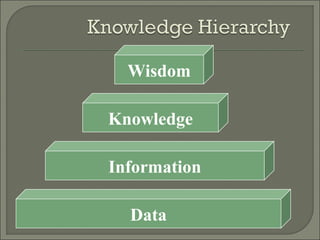
Wisdom
Knowledge
Information
Data
 Data – raw facts; numbers
 Information – data in context; readily
captured in documents and databases
 Knowledge – information plus
experience to act upon
 Wisdom - experience & knowledge
make sensible decision.
Knowledge Management
Organisation knowledge is frequently categorised into
•Tacit knowledge – personal; wisdom and experience;
context-specific; more difficult to extract and codify Can be
transmitted through social interactions and socialization
•Explicit knowledge – what is recorded; easily
identified , articulated and shared
•Cultural knowledge – Cultural Ethos specific to a line of
business or région or language or religion or nation.
Tacit Knowledge Explicit Knowledge
(Subjective) (Objective)
Knowledge of experience Knowledge of
rationality
(body) (mind)
Simultaneous knowledge Sequential knowledge
(here and now) (there and then)
Analog knowledge Digital knowledge
(practice) (theory)
Knowledge Management
Key Problems knowledge enterprises face today
are :
 Poor utilization of knowledge
 Information and knowledge islands
 Knowledge loss
 High cost of sharing knowledge
 Reinvention / Repetitions
 Lack of responsiveness
Knowledge Management
Characteristics of KM Implementation Trends
Approaches Adopted :
•Society Centric Approach – Treats knowledge
management as a social communication process
•Process Centric Approach – Focuses on
knowledge mapping in business process
•Technology Centric Approach - Focuses on
knowledge artifacts their creation storage and reuse
in IT systems.
Knowledge Management
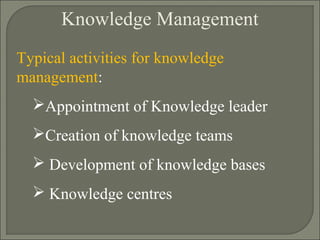
Typical activities for knowledge
management:
Appointment of Knowledge leader
Creation of knowledge teams
 Development of knowledge bases
 Knowledge centres
Knowledge sharing
Intellectual asset management
Provide motivation for employees
Identify & improve practises
Reduce substitutes
•  Knowledge is created through practice,
collaboration, interaction, and
education, as the different knowledge
types are shared and converted.
• Knowledge creation is also supported
by relevant information and data which
can improve decisions and serve as
building blocks in the creation of new
knowledge.
• It is important to support unstructured
work environments in areas where
creativity and innovation are important.
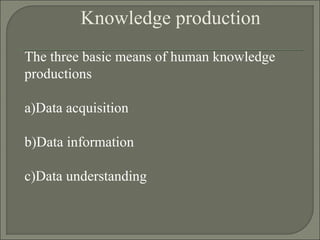
Knowledge production
The three basic means of human knowledge
productions
a)Data acquisition
b)Data information
c)Data understanding
 Willingness to collaborate with
knowledge culture.
 Respect & support for integrity of
knowledge.
 Seeking,capture & utilization of
knowledge
 Transparency,honest,trust.
 Enthusiasm for the role of IT technology.
 Wiig km model
 completeness,connectedness,congruency
 Boisot-I space km model
 codified-uncodified
 Abstract-concrete
 diffused-undiffused
 Ikujiro Nonaka and Takeuchi introduced
the SECI model (Nonaka & Takeuchi
1996) which has become the cornerstone
of knowledge creation and transfer
theory.
 They proposed four ways that knowledge
types can be combined and converted,
showing how knowledge is shared and
created in the organization.
 The model is based on the two types of
knowledge: tacit , explicit
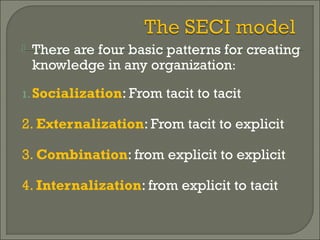
 There are four basic patterns for creating
knowledge in any organization:
1.Socialization: From tacit to tacit
2. Externalization: From tacit to explicit
3. Combination: from explicit to explicit
4. Internalization: from explicit to tacit
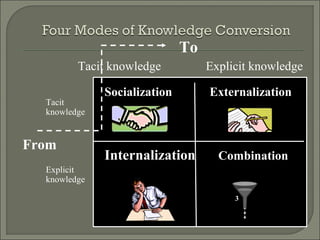
Socialization Externalization
Internalization Combination
Tacit
knowledge
Explicit
knowledge
Tacit knowledge Explicit knowledge
To
From
3
 Socialization:Tacit to tacit
Knowledge is passed on through
practice, guidance, imitation, and
observation.
 Externalization:Tacit to explicit
Tacit knowledge is codified into
documents, manuals, etc. so that it can
spread more easily through the
organization.
The use of metaphor is cited as an
important externalization mechanism.
Combination: Explicit to explicit
This is the simplest form. Codified
knowledge sources (e.g. documents) are
combined to create new knowledge. –it
does not extend the company’s
knowledge base
Internalization: Explicit to tacit
As explicit sources are used and learned,
the knowledge is internalized, modifying
the user's existing tacit knowledge.
 Nonoaka, Ikujiro, (1991)“The Knowledge Creating
Company”. Harvard Business Review
 Nonaka, I. & Takeuchi, H. (1995).The knowledge-creating
company: How Japanese Companies Create the
Dynamics of Innovation. New York: Oxford University Press
 http://mcleanglobal.com/public/MGC/publications/Nonaka%20
 Cook, S.D., & Brown, J.S. (1999), Bridging Epistemologies: the
Generative Dance between Organizational Knowledge and
Organizational Knowing. Organization Science, vol. 10, no. 4
 Polanyi, M. (1966). The Tacit Dimension. London, Routledge &
Kegan Paul, 1966
Knowledge management

Knowledge management

  • 1.
    Knowledge ManagementKnowledge Management BY SoumyaSoumya MscME.dMsc ME.d SNDP Training College AdimalySNDP Training College Adimaly
  • 2.
    Knowledge Management Knowledge managementis the process of discovery, acquisition, creation, dissemination and utilization of knowledge for the organization. Definition
  • 3.
    Knowledge Management Knowledge hasbeen recognized as an important productivity factor for the organization
  • 4.
    Knowledge Management isa discipline that seeks to improve the performance of individuals and organisations by maintaining and leveraging the present and future value of knowledge assets. Knowledge Management
  • 5.
    Knowledge Management  KnowledgeManagement is a discipline  Knowledge is shareable in the organisation  Cultural change is not automatic  Create a change management plan  Stay strategic  Pick a topic, go in-depth, keep it current  Don’t get hung up on the limitations  Set expectations or risk extinction  Integrate KM into existing systems  Educate your self-service users Principles of Knowledge Management
  • 6.
    The more yourshare, the more you gain. The knowledge acquisition process should be part of the work process. Integration of knowledge from multiple disciplines has the highest probability of creating new knowledge and value-added. Knowledge valuation should be conducted from customers’ perspective. KM focus should be on core knowledge critical to sustaining company’s competitive edge.
  • 7.
    Knowledge Management Significance ofKnowledge Management Track, measure, share and make use of intangible assets in an Organisation Paying attention to ensure that they are capturing, sharing and using productive knowledge within their organisations to enhance learning and improve performance.
  • 8.
    Knowledge Management Critical successfactors can be categorized as follows  Leadership  Culture  Structure, roles, and responsibilities  Information technology infrastructure  Measurement.
  • 9.
  • 10.
     Data –raw facts; numbers  Information – data in context; readily captured in documents and databases  Knowledge – information plus experience to act upon  Wisdom - experience & knowledge make sensible decision. Knowledge Management
  • 11.
    Knowledge Management Organisation knowledgeis frequently categorised into •Tacit knowledge – personal; wisdom and experience; context-specific; more difficult to extract and codify Can be transmitted through social interactions and socialization •Explicit knowledge – what is recorded; easily identified , articulated and shared •Cultural knowledge – Cultural Ethos specific to a line of business or région or language or religion or nation.
  • 12.
    Tacit Knowledge ExplicitKnowledge (Subjective) (Objective) Knowledge of experience Knowledge of rationality (body) (mind) Simultaneous knowledge Sequential knowledge (here and now) (there and then) Analog knowledge Digital knowledge (practice) (theory)
  • 13.
    Knowledge Management Key Problemsknowledge enterprises face today are :  Poor utilization of knowledge  Information and knowledge islands  Knowledge loss  High cost of sharing knowledge  Reinvention / Repetitions  Lack of responsiveness
  • 14.
    Knowledge Management Characteristics ofKM Implementation Trends Approaches Adopted : •Society Centric Approach – Treats knowledge management as a social communication process •Process Centric Approach – Focuses on knowledge mapping in business process •Technology Centric Approach - Focuses on knowledge artifacts their creation storage and reuse in IT systems.
  • 15.
    Knowledge Management Typical activitiesfor knowledge management: Appointment of Knowledge leader Creation of knowledge teams  Development of knowledge bases  Knowledge centres
  • 16.
    Knowledge sharing Intellectual assetmanagement Provide motivation for employees Identify & improve practises Reduce substitutes
  • 17.
    •  Knowledge iscreated through practice, collaboration, interaction, and education, as the different knowledge types are shared and converted. • Knowledge creation is also supported by relevant information and data which can improve decisions and serve as building blocks in the creation of new knowledge. • It is important to support unstructured work environments in areas where creativity and innovation are important.
  • 18.
    Knowledge production The threebasic means of human knowledge productions a)Data acquisition b)Data information c)Data understanding
  • 19.
     Willingness tocollaborate with knowledge culture.  Respect & support for integrity of knowledge.  Seeking,capture & utilization of knowledge  Transparency,honest,trust.  Enthusiasm for the role of IT technology.
  • 20.
     Wiig kmmodel  completeness,connectedness,congruency  Boisot-I space km model  codified-uncodified  Abstract-concrete  diffused-undiffused
  • 21.
     Ikujiro Nonakaand Takeuchi introduced the SECI model (Nonaka & Takeuchi 1996) which has become the cornerstone of knowledge creation and transfer theory.  They proposed four ways that knowledge types can be combined and converted, showing how knowledge is shared and created in the organization.  The model is based on the two types of knowledge: tacit , explicit
  • 22.
     There arefour basic patterns for creating knowledge in any organization: 1.Socialization: From tacit to tacit 2. Externalization: From tacit to explicit 3. Combination: from explicit to explicit 4. Internalization: from explicit to tacit
  • 23.
  • 25.
     Socialization:Tacit totacit Knowledge is passed on through practice, guidance, imitation, and observation.  Externalization:Tacit to explicit Tacit knowledge is codified into documents, manuals, etc. so that it can spread more easily through the organization. The use of metaphor is cited as an important externalization mechanism.
  • 26.
    Combination: Explicit toexplicit This is the simplest form. Codified knowledge sources (e.g. documents) are combined to create new knowledge. –it does not extend the company’s knowledge base Internalization: Explicit to tacit As explicit sources are used and learned, the knowledge is internalized, modifying the user's existing tacit knowledge.
  • 27.
     Nonoaka, Ikujiro,(1991)“The Knowledge Creating Company”. Harvard Business Review  Nonaka, I. & Takeuchi, H. (1995).The knowledge-creating company: How Japanese Companies Create the Dynamics of Innovation. New York: Oxford University Press  http://mcleanglobal.com/public/MGC/publications/Nonaka%20  Cook, S.D., & Brown, J.S. (1999), Bridging Epistemologies: the Generative Dance between Organizational Knowledge and Organizational Knowing. Organization Science, vol. 10, no. 4  Polanyi, M. (1966). The Tacit Dimension. London, Routledge & Kegan Paul, 1966

Editor's Notes

  • #5 Definitions are many and varied. Four main elements - explicit: knowledge is explicitly recognised (language, documents etc.) - systematic: it is too important to be left to chance - selective: there’s lots of knowledge; focus on that which is important - content and process perspective (nouns and verbs) By adopting a systematic vs. an ad-hoc approach, management consultancies believe they can offer better global solutions, and reduced competitive price pressures (e.g. see Booz Hamilton Allen)
  • #19 Definitions are many and varied. Four main elements - explicit: knowledge is explicitly recognised (language, documents etc.) - systematic: it is too important to be left to chance - selective: there’s lots of knowledge; focus on that which is important - content and process perspective (nouns and verbs) By adopting a systematic vs. an ad-hoc approach, management consultancies believe they can offer better global solutions, and reduced competitive price pressures (e.g. see Booz Hamilton Allen)
  • #26 This is deemed as a particularly difficult and often particularly important conversion mechanism. Since tacit knowledge can be virtually impossible to codify, the extent of this knowledge conversion mechanism is debatable.