Knowledge Management
And knowledge management is
a means, not an end - “Bill
gates”
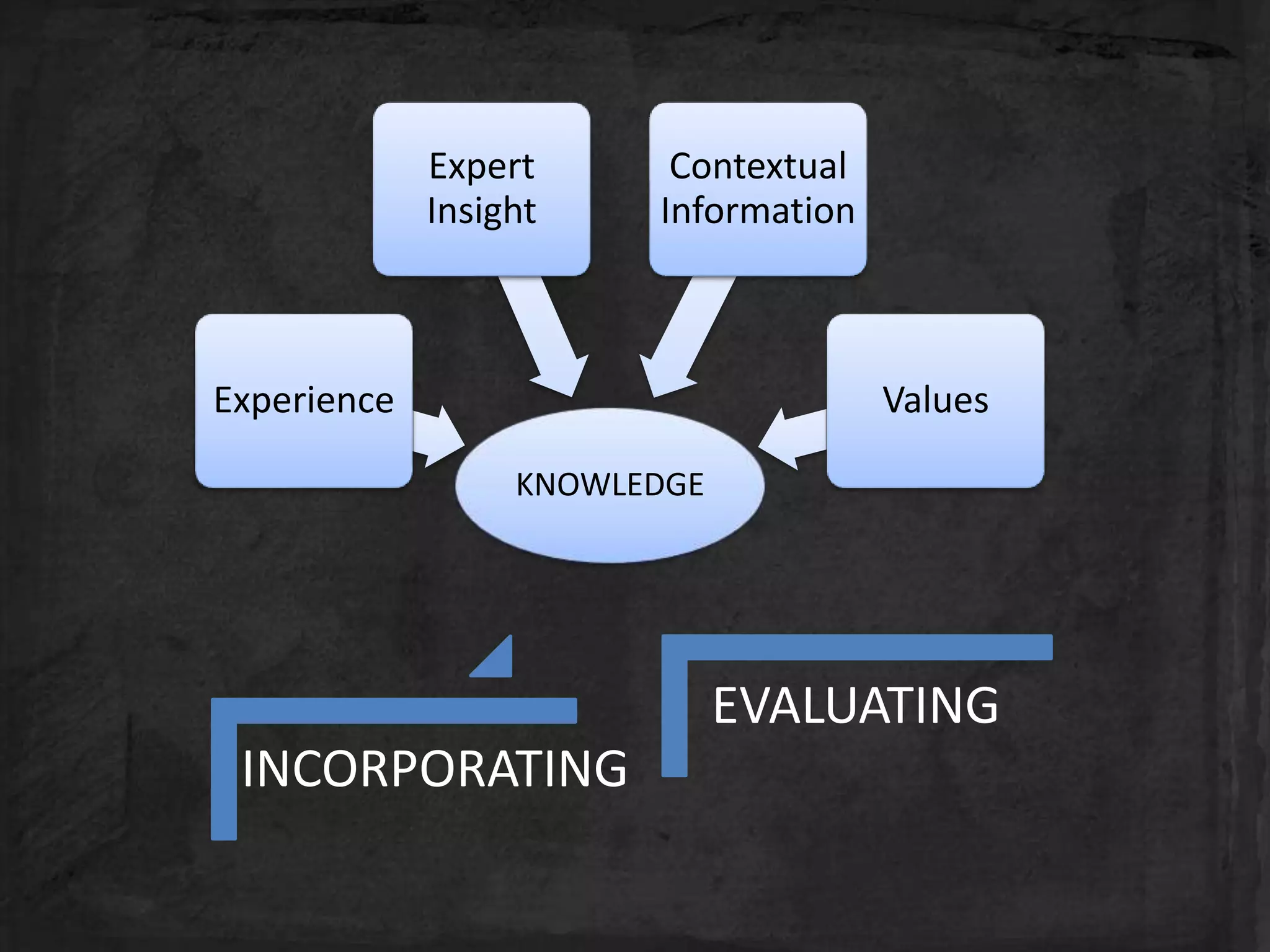
KNOWLEDGE
Experience
Expert
Insight
Contextual
Information
Values
INCORPORATING
EVALUATING
KSE DIFFERENCE
• KNOWLEDGE – Facts, skills, information
acquired by a person through experience or
education. It is Informal in nature.
• Skills – Ability to expertise in a particular
field practically.
• EDUCATION – Is a process of gaining
knowledge for some useful application. It is
formal in nature.
TYPES OF KNOWLEDGE
“The coordination and exploitation
of organizational knowledge resources, in
order to create benefit and competitive
advantage" - (Drucker 1999)
Definition – Knowledge Management
© ManagementStudyGuide.com. All rights
reserved.
“Is managing the corporation's knowledge through
a systematically and organizationally specified
process for acquiring, organizing, sustaining,
applying, sharing and renewing both
the tacit and explicit knowledge of employees to
enhance organizational performance and create
value.“
- Davenport & Prusak (2000)
Definition – Knowledge Management
© ManagementStudyGuide.com. All rights
reserved.
COMPONENTS OF KNOWLEDGE MANAGEMENT
Source : KEVIN C.DESOUZA, SCOTT PAQUETTE WWW.NEWAGEINTERNATIONALPUBLISERS.COM
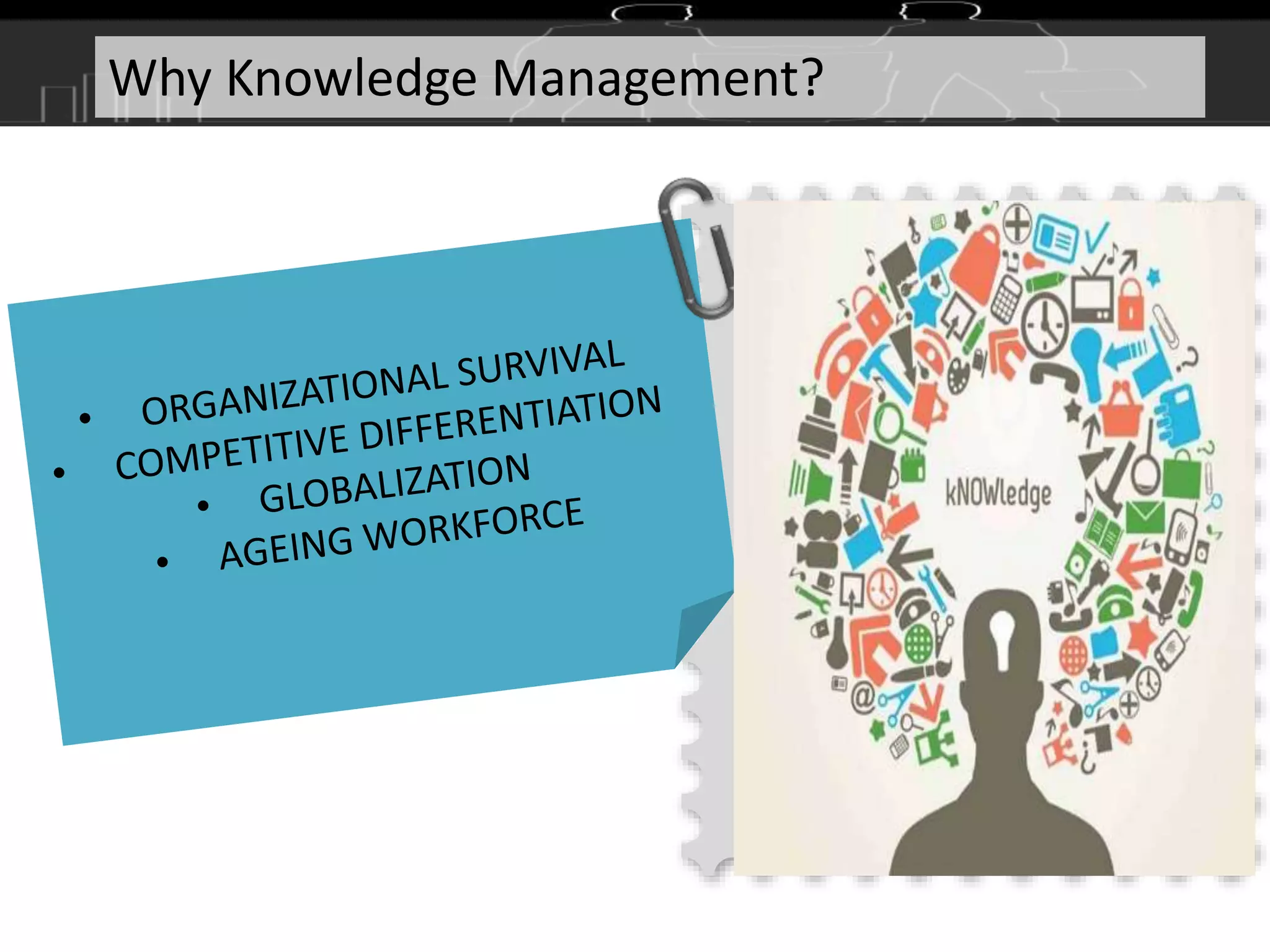
Why Knowledge Management?
KM as a interdisciplinary pursuit
The following are some of the benefits of negotiations:
Economics
Friedrich August
Von Hayek (1899-
1912)
Management
Sciences
Grant, Nelson and
Chandler
Library and
Informational
Sciences
Library of
Alxandria 200 BC
Medical
Sciences
Diagnosis,
reports
STAGES OF KNOWLEDGE MANAGEMENT
1
2
3
4
5
The following are the stages of any negotiation process:
Let us look at each in detail.
STAGE 1 – CLUSTERING OF KNOWLEDGE
Stage 5: Transfer of
Knowledge
Stage 4:
Selection and Analysis
Stage 3:
Classification
Stage 2:
Inquiry
Stage 1:
Clustering
Stage 2:
Storage
Stage 3:
Classification
Stage 4:
Selection and Analysis
Stage 5: Transfer of
Knowledge
Stage 1: Meeting
• May be formal or informal.
• When there are two or more
parties meet, interact and find
out the valuable information.
• Perform Gap Analysis
Stage 5: Transfer of
Knowledge
Stage 4:
Selection and Analysis
Stage 3:
Classification
Stage 2: Storing of
Knowledge
Stage 1:
Clustering
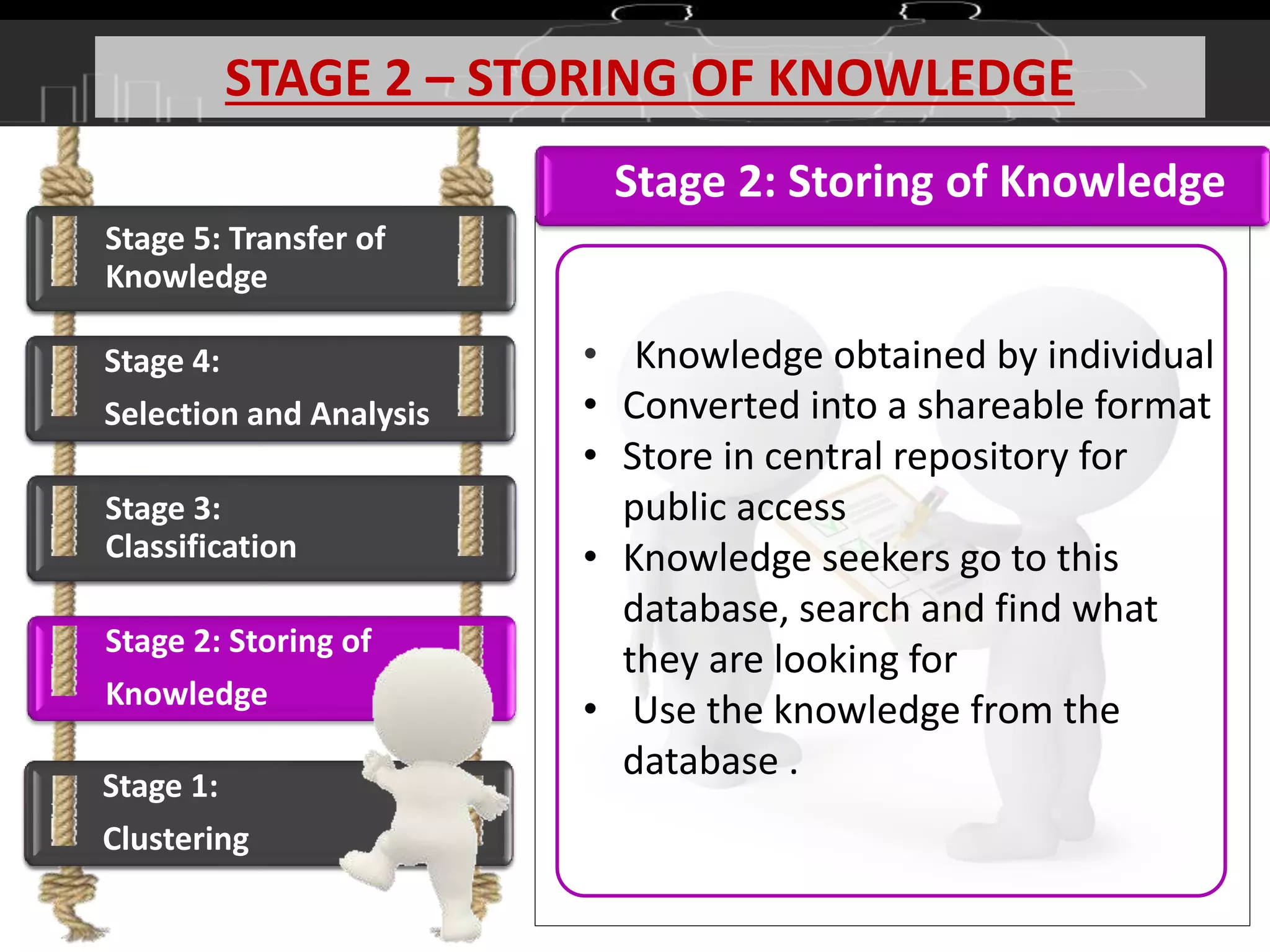
STAGE 2 – STORING OF KNOWLEDGE
Stage 1:
Clustering
Stage 3:
Classification
Stage 4:
Selection and Analysis
Stage 5: Transfer of
Knowledge
Stage 2: Storing of Knowledge
• Knowledge obtained by individual
• Converted into a shareable format
• Store in central repository for
public access
• Knowledge seekers go to this
database, search and find what
they are looking for
• Use the knowledge from the
database .
Stage 5: Transfer of
Knowledge
Stage 4:
Selection and Analysis
Stage 3:
Classification
Stage 2:
Inquiry
Stage 1:
Clustering
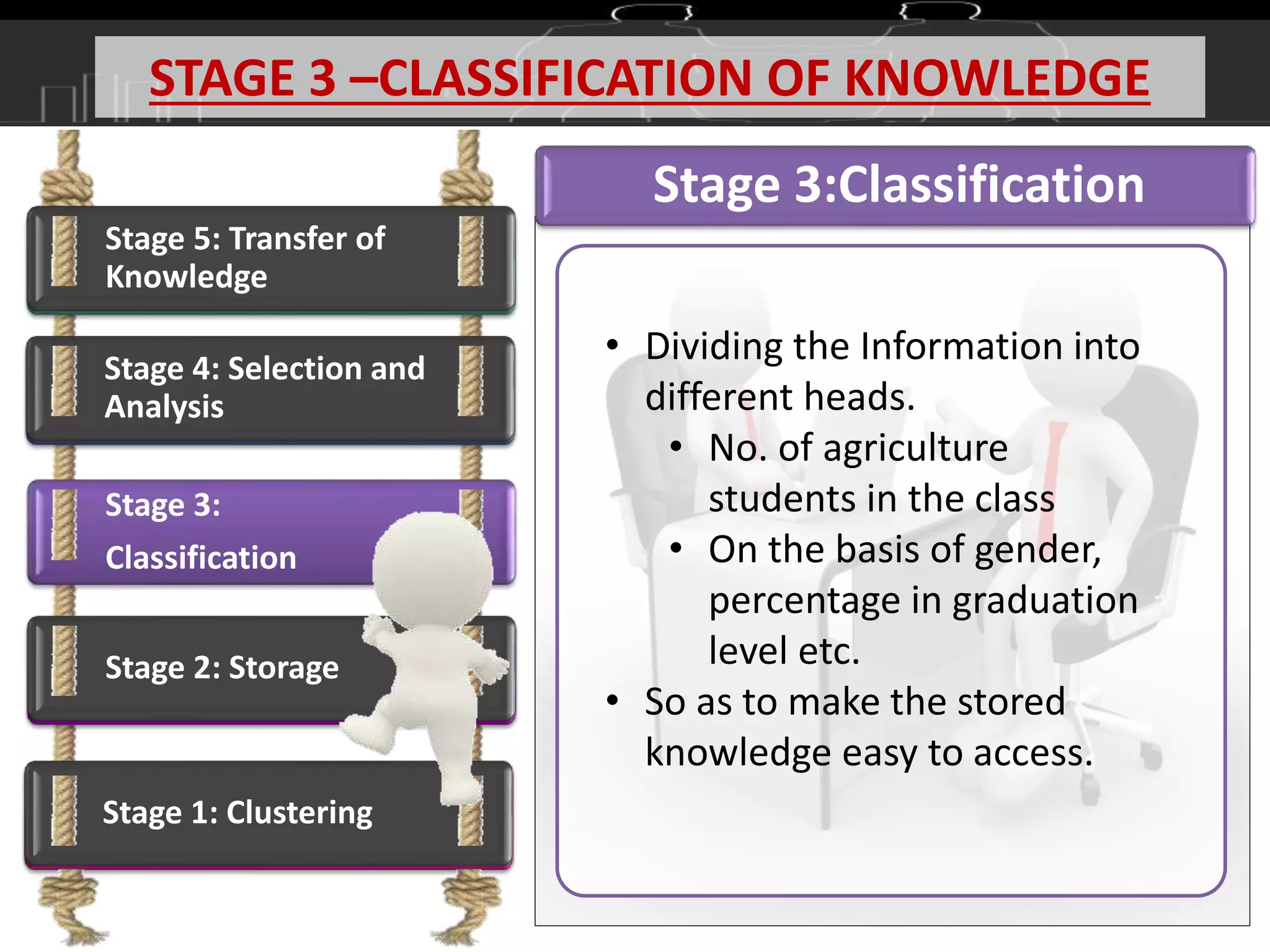
STAGE 3 –CLASSIFICATION OF KNOWLEDGE
Stage 1: Clustering
Stage 2: Storage
Stage 4: Selection and
Analysis
Stage 5: Transfer of
Knowledge
Stage 3:Classification
• Dividing the Information into
different heads.
• No. of agriculture
students in the class
• On the basis of gender,
percentage in graduation
level etc.
• So as to make the stored
knowledge easy to access.
Stage 5: Transfer of
Knowledge
Stage 4:
Selection and Analysis
Stage 3:
Classification
Stage 2:
Inquiry
Stage 1:
Clustering
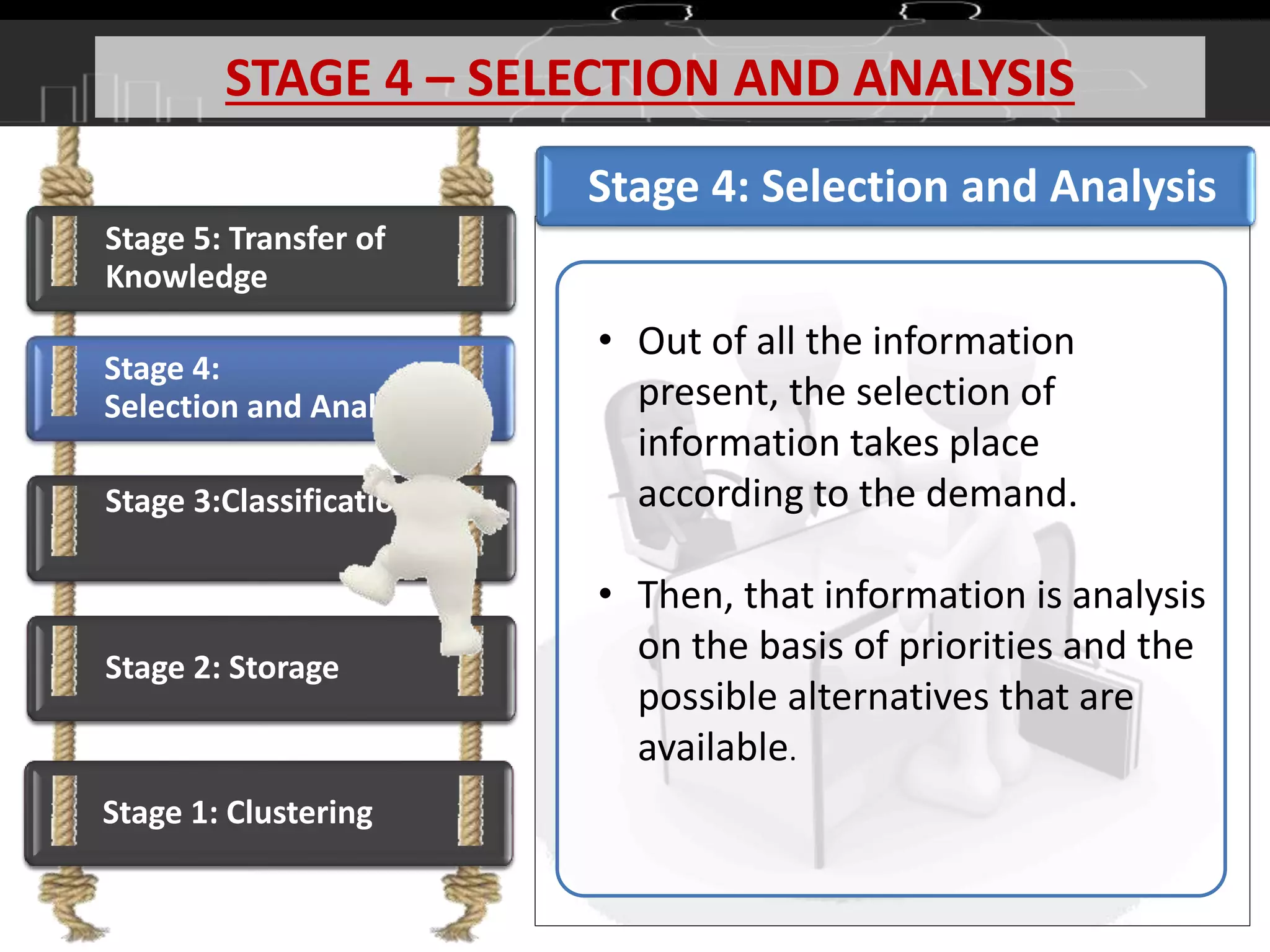
STAGE 4 – SELECTION AND ANALYSIS
Stage 1: Clustering
Stage 2: Storage
Stage 3:Classification
Stage 5: Transfer of
Knowledge
Stage 4: Selection and Analysis
• Out of all the information
present, the selection of
information takes place
according to the demand.
• Then, that information is analysis
on the basis of priorities and the
possible alternatives that are
available.
Stage 5: Transfer of
Knowledge
Stage 4:
Selection and Analysis
Stage 3:
Classification
Stage 2:
Inquiry
Stage 1:
Clustering
STAGE 5 – TRANSFER OF KNOWLEDGE
Stage 1: Clustering
Stage 2: Storage
Stage 3:Classification
Stage 4: Selection and
Analysis
Stage 5: Transfer of Knowledge
• Argote & Ingram (2000) define
knowledge transfer as "the
process through which one unit
(e.g., group, department, or
division) is affected by the
experience of another.
“Successful knowledge transfer
involves neither computers nor
documents but rather interactions
between people.”
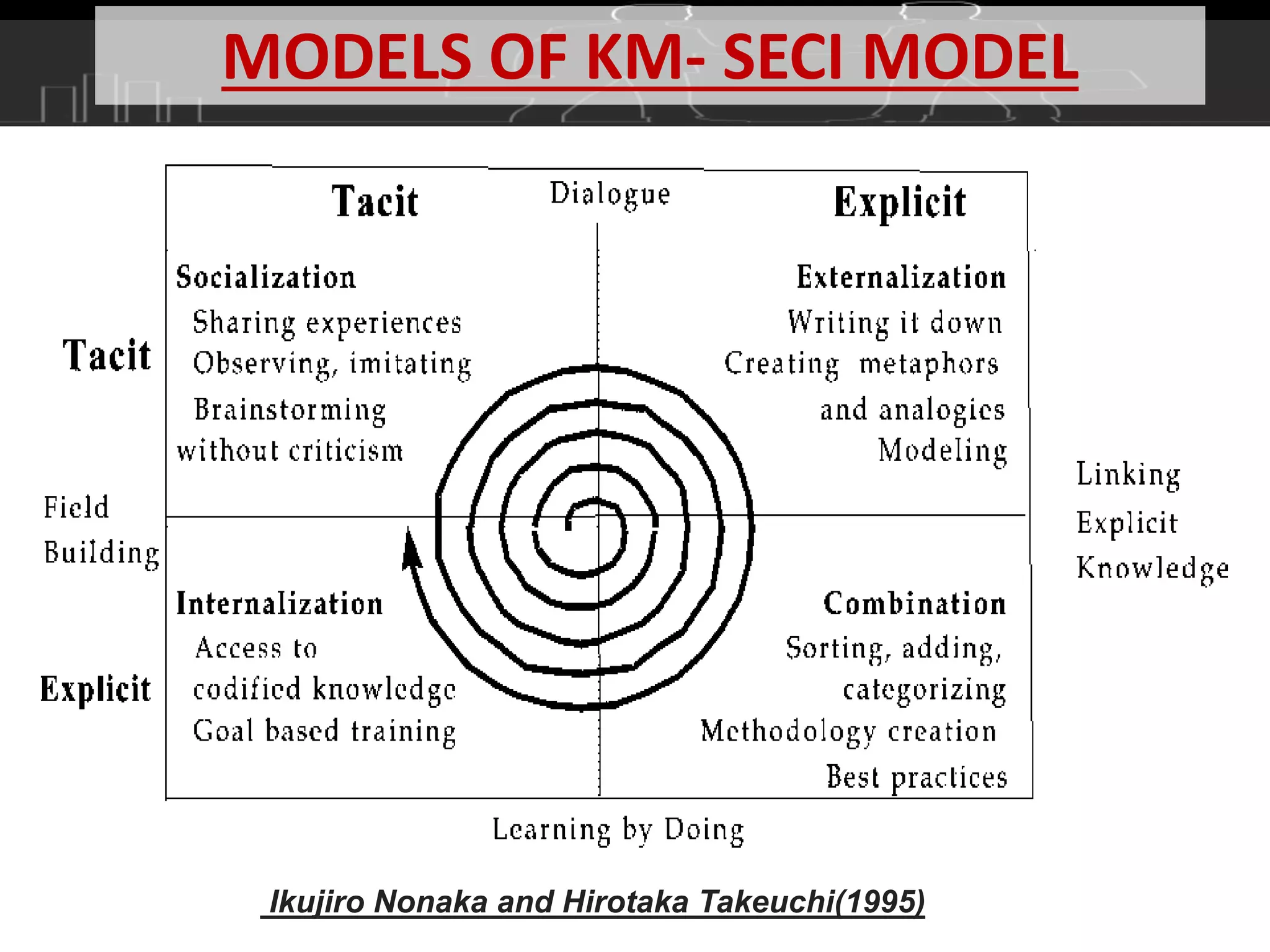
MODELS OF KM- SECI MODEL
Ikujiro Nonaka and Hirotaka Takeuchi(1995)
MODELS OF KM- SECI MODEL
Choo’s Model (1998)
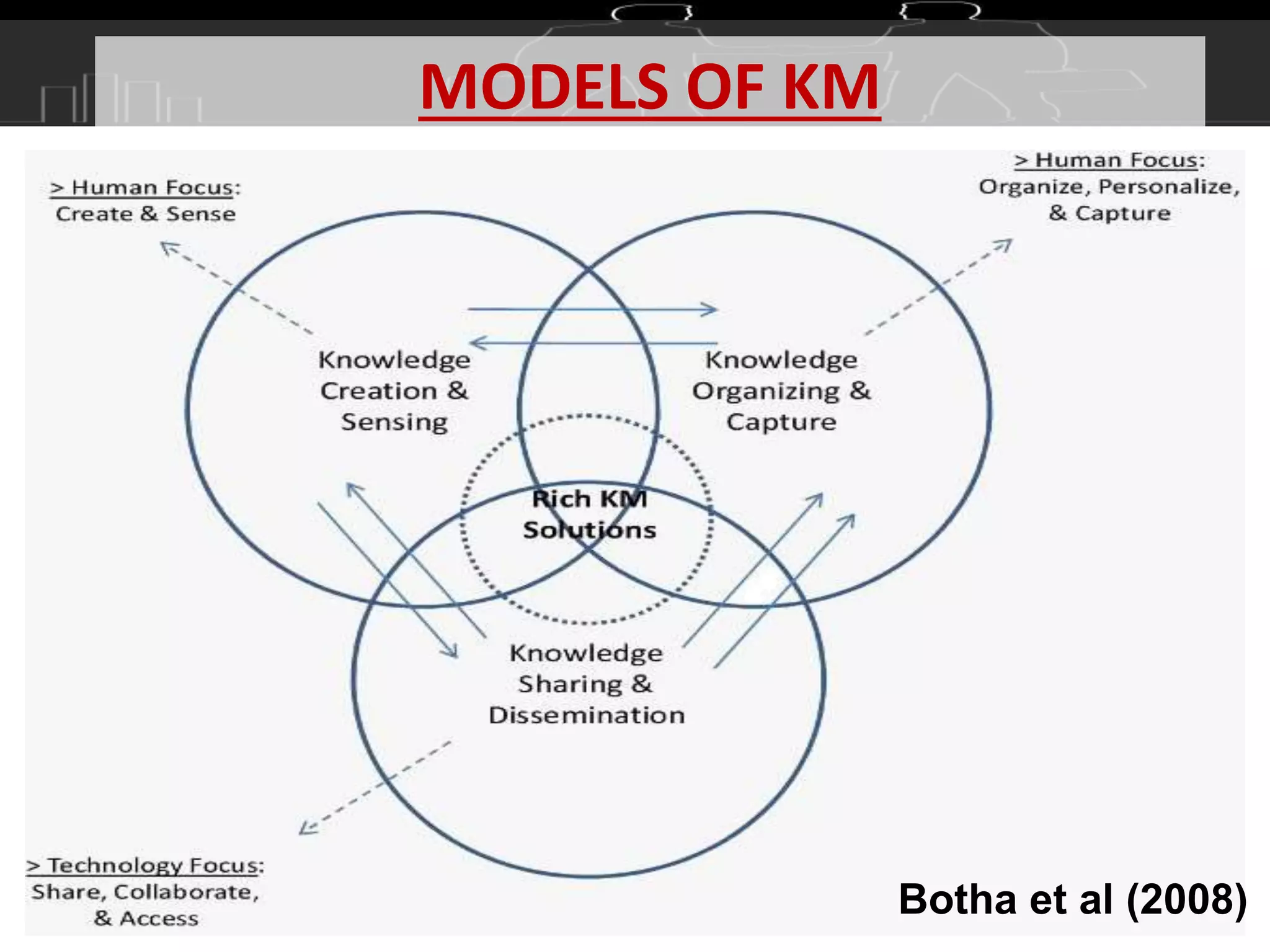
MODELS OF KM
Botha et al (2008)
THANK YOU

Knowledge management

  • 1.
    Knowledge Management And knowledgemanagement is a means, not an end - “Bill gates”
  • 2.
  • 3.
    KSE DIFFERENCE • KNOWLEDGE– Facts, skills, information acquired by a person through experience or education. It is Informal in nature. • Skills – Ability to expertise in a particular field practically. • EDUCATION – Is a process of gaining knowledge for some useful application. It is formal in nature.
  • 4.
  • 6.
    “The coordination andexploitation of organizational knowledge resources, in order to create benefit and competitive advantage" - (Drucker 1999) Definition – Knowledge Management © ManagementStudyGuide.com. All rights reserved.
  • 7.
    “Is managing thecorporation's knowledge through a systematically and organizationally specified process for acquiring, organizing, sustaining, applying, sharing and renewing both the tacit and explicit knowledge of employees to enhance organizational performance and create value.“ - Davenport & Prusak (2000) Definition – Knowledge Management © ManagementStudyGuide.com. All rights reserved.
  • 8.
    COMPONENTS OF KNOWLEDGEMANAGEMENT Source : KEVIN C.DESOUZA, SCOTT PAQUETTE WWW.NEWAGEINTERNATIONALPUBLISERS.COM
  • 9.
  • 10.
  • 11.
    KM as ainterdisciplinary pursuit The following are some of the benefits of negotiations: Economics Friedrich August Von Hayek (1899- 1912) Management Sciences Grant, Nelson and Chandler Library and Informational Sciences Library of Alxandria 200 BC Medical Sciences Diagnosis, reports
  • 12.
    STAGES OF KNOWLEDGEMANAGEMENT 1 2 3 4 5 The following are the stages of any negotiation process: Let us look at each in detail.
  • 13.
    STAGE 1 –CLUSTERING OF KNOWLEDGE Stage 5: Transfer of Knowledge Stage 4: Selection and Analysis Stage 3: Classification Stage 2: Inquiry Stage 1: Clustering Stage 2: Storage Stage 3: Classification Stage 4: Selection and Analysis Stage 5: Transfer of Knowledge Stage 1: Meeting • May be formal or informal. • When there are two or more parties meet, interact and find out the valuable information. • Perform Gap Analysis
  • 14.
    Stage 5: Transferof Knowledge Stage 4: Selection and Analysis Stage 3: Classification Stage 2: Storing of Knowledge Stage 1: Clustering STAGE 2 – STORING OF KNOWLEDGE Stage 1: Clustering Stage 3: Classification Stage 4: Selection and Analysis Stage 5: Transfer of Knowledge Stage 2: Storing of Knowledge • Knowledge obtained by individual • Converted into a shareable format • Store in central repository for public access • Knowledge seekers go to this database, search and find what they are looking for • Use the knowledge from the database .
  • 15.
    Stage 5: Transferof Knowledge Stage 4: Selection and Analysis Stage 3: Classification Stage 2: Inquiry Stage 1: Clustering STAGE 3 –CLASSIFICATION OF KNOWLEDGE Stage 1: Clustering Stage 2: Storage Stage 4: Selection and Analysis Stage 5: Transfer of Knowledge Stage 3:Classification • Dividing the Information into different heads. • No. of agriculture students in the class • On the basis of gender, percentage in graduation level etc. • So as to make the stored knowledge easy to access.
  • 16.
    Stage 5: Transferof Knowledge Stage 4: Selection and Analysis Stage 3: Classification Stage 2: Inquiry Stage 1: Clustering STAGE 4 – SELECTION AND ANALYSIS Stage 1: Clustering Stage 2: Storage Stage 3:Classification Stage 5: Transfer of Knowledge Stage 4: Selection and Analysis • Out of all the information present, the selection of information takes place according to the demand. • Then, that information is analysis on the basis of priorities and the possible alternatives that are available.
  • 17.
    Stage 5: Transferof Knowledge Stage 4: Selection and Analysis Stage 3: Classification Stage 2: Inquiry Stage 1: Clustering STAGE 5 – TRANSFER OF KNOWLEDGE Stage 1: Clustering Stage 2: Storage Stage 3:Classification Stage 4: Selection and Analysis Stage 5: Transfer of Knowledge • Argote & Ingram (2000) define knowledge transfer as "the process through which one unit (e.g., group, department, or division) is affected by the experience of another. “Successful knowledge transfer involves neither computers nor documents but rather interactions between people.”
  • 18.
    MODELS OF KM-SECI MODEL Ikujiro Nonaka and Hirotaka Takeuchi(1995)
  • 19.
    MODELS OF KM-SECI MODEL Choo’s Model (1998)
  • 20.
    MODELS OF KM Bothaet al (2008)
  • 21.