EMPHASIS
Knowledge Management
EMPHASIS Environment
 It is complex: CARE, NGOs, Partners
 Regional, Maybe Starfish-structure
 Matrix supervision,
 Performance-oriented
 Process innovation approach
 Quality content
 Emphasis on creativity, talent, knowledge,
  sharing, communication, learning,
  adapting,
Community of Practice (CoP)
An affinity group. An informal network or forum
  where tips are exchanged and ideas generated
  [Thomas A. Stewart].

A group of professionals, informally bound to one
  another through exposure to a common class of
  problems, common pursuit of solutions, and
  thereby themselves embodying a store of
  knowledge [McKinsey & Co.].
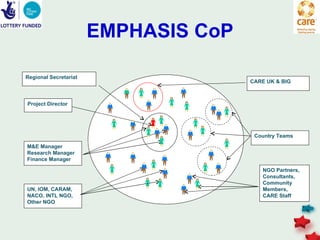
EMPHASIS CoP

Regional Secretariat
                                      CARE UK & BIG


Project Director


                                       Country Teams
M&E Manager
Research Manager
Finance Manager

                                          NGO Partners,
                                          Consultants,
                                          Community
UN, IOM, CARAM,                           Members,
NACO, INTL NGO,                           CARE Staff
Other NGO
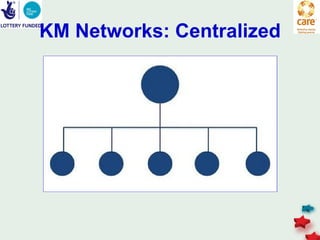
KM Networks: Centralized
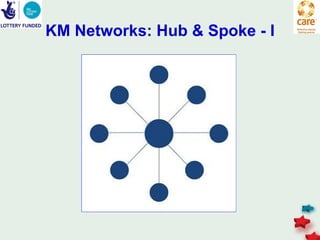
KM Networks: Hub & Spoke - I
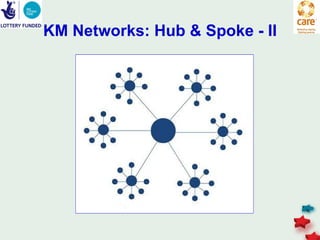
KM Networks: Hub & Spoke - II
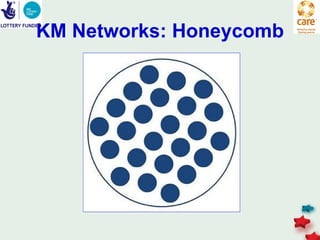
KM Networks: Honeycomb
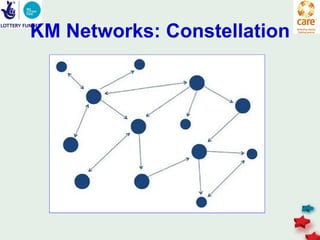
KM Networks: Constellation
The pressures
 Pressure to reduce costs, increase quality of service and
  return on investment
 Time lost in gestation; so need to accelerate pace to
  achieve work plan; so project changes
 Retention of team, effective platforms and self-serve
  options like Ning
 Project emphasizes sharing Data, Info, & Knowledge,
 KM process which suits partners, donors and listeners
 New approaches and tools to replace command and
  control structures like cross functional teams
 EMPHASIS to be a Regional collaborative team
Sustaining Change
“ The Basic Economic Resources – the means of
   production – is no longer Capital, nor natural resources,
   nor labour. It is and will be knowledge ” – Peter Drucker

 Shift from Physical asset oriented to Intellectual asset
  oriented economy. Values derived from intellectual
  capital
 Continuous learning becoming an integral part of
  CARE.
 Knowledge & Expertise of CARE and its Individuals
  should be seen as Critical Resources.
Why knowledge?
 CARE is Resources + Capabilities; the capabilities
  tapped in EMPHASIS & individuals are essential for
  sustaining competitive advantages.
 The raise of ‘Organisational learning” – the question of
  survival, success and sustainability
 Knowledge is the only indispensible resource
 The sustained competitive advantage comes only from
  what you know and how fast you can put into action.
 Knowledge is the most advantageous tool to deal with
  Change and documenting EMPHASIS Project memory
What is knowledge?
 Knowledge is information combined with experience,
  context, interpretation and reflection. It is high value form
  of information that is ready to apply to decisions and
  actions

 Knowledge is ‘Justified true belief’

 “Knowledge is experience. Every thing else is just
  information” – Albert Einstein

 “The wise see Knowledge and action as one” – The
  Bhagavad Gita
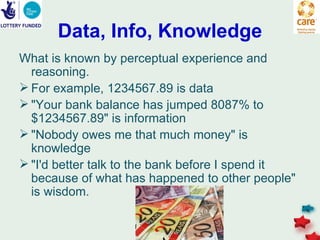
Data, Info, Knowledge
What is known by perceptual experience and
  reasoning.
 For example, 1234567.89 is data
 "Your bank balance has jumped 8087% to
  $1234567.89" is information
 "Nobody owes me that much money" is
  knowledge
 "I'd better talk to the bank before I spend it
  because of what has happened to other people"
  is wisdom.
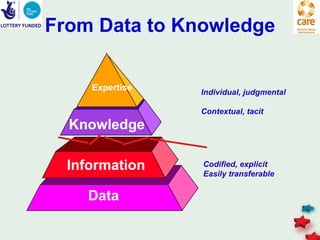
From Data to Knowledge

     Expertise   Individual, judgmental

                 Contextual, tacit
  Knowledge

  Information    Codified, explicit
                 Easily transferable

    Data
Explicit or Enterprise Knowledge
 Formal and systematic
 Easily communicated and shared
 Recordable, articulate, transmittable
 Examples: product Specification, Computer
  Programme, Process sheets, methods of
  working, or Engineering Drawing.
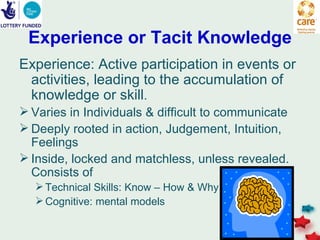
Experience or Tacit Knowledge
Experience: Active participation in events or
 activities, leading to the accumulation of
 knowledge or skill.
 Varies in Individuals & difficult to communicate
 Deeply rooted in action, Judgement, Intuition,
  Feelings
 Inside, locked and matchless, unless revealed.
  Consists of
   Technical Skills: Know – How & Why
   Cognitive: mental models
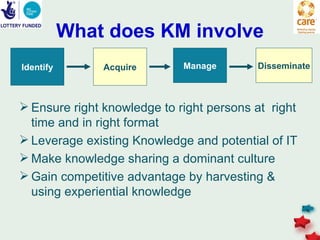
What does KM involve
Identify       Acquire       Manage       Disseminate


 Ensure right knowledge to right persons at right
  time and in right format
 Leverage existing Knowledge and potential of IT
 Make knowledge sharing a dominant culture
 Gain competitive advantage by harvesting &
  using experiential knowledge
KM Definitions - Callioni
Managing mindfully a process that links data
  through information, and knowledge, to
 action, learning and transfer.

The output is action while the outcome is
 learning and transfer.
KM Definitions
Knowledge Management is the art of
 creating value from the intangible assets
 of an organization. (Sveiby)

Knowledge Management consists in the
 identification, optimization and dynamic
 management of the intellectual assets
 possessed in explicit or implicit form by
 persons or communities (Snowden).
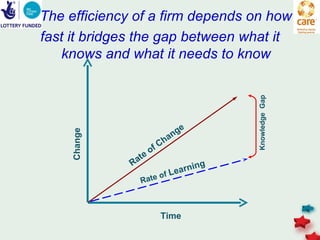
The efficiency of a firm depends on how
fast it bridges the gap between what it
   knows and what it needs to know


                                           Knowledge Gap
                                  ge
    Change


                                n
                              ha
                       o fC
                   e
              R at
                                       g
                              earnin
                         of L
                 Rate


                          Time
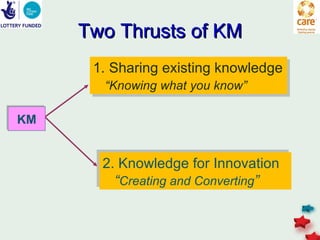
Two Thrusts of KM
      1. Sharing existing knowledge
       “Knowing what you know”

KM


       2. Knowledge for Innovation
         “Creating and Converting”
Why KM?
 Not to reinvent the wheel : solution exists, or is
  known somewhere in the organization
 Learn from past mistakes – ours or others
 Knowledge resource depletion, Reduction,
  migration & brain-drain
 Innovate & lead change in the business

              Wise Men Learn from their Mistakes
           The Wiser Learn from Others mistakes also
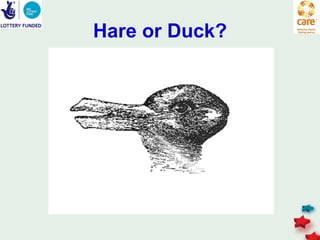
Lens and Frames
 What you see depends on where you sit
 What you do depends on where you stand
 What you hear depends on where your
  mind is
 What you feel depends on what you know
Hare or Duck?
First Position

Seeing, hearing and feeling the situation
 through your own eyes, ears and feelings.

You think in terms of what is important to
 you, and what you want to achieve,
Second Position
Stepping into the shoes of the other person
  and experiencing (seeing, hearing and
  feeling) the situation as if you were him,
  her, or them.

You think in terms of how this situation
 would be interpreted by other person.
 “Before criticizing someone, walk a mile in
 their shoes!”
Third Position
Standing back from a situation and experiencing it
  as if you were a detached observer. In your mind
  you are able to see and hear the other person as
  if you were a Third person.

You think in terms of what opinion, observations or
  advice would some one who is not involved
  offer. You need to be in a strong resourceful
  state and take a objective view of your own
  behaviour and look for opportunities to respond
  differently, in order to achieve a different and
  more positive outcome.
Which Position?
 We stand for Evidence, Truth…
 We stand for Peace…
 So, the Third position


             ‘Facilitate Sharing’ in our CoP
                       The EMPHASIS CoP
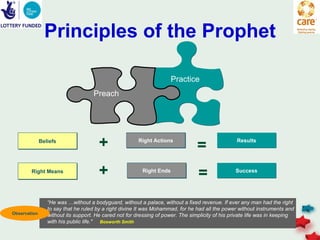
Principles of the Prophet

                                                                      Practice
                                    Preach


              Beliefs
                                       +                Right Actions
                                                                                 =                Results


        Right Means                    +                 Right Ends
                                                                                 =               Success


                 “He was …without a bodyguard, without a palace, without a fixed revenue. If ever any man had the right
                 to say that he ruled by a right divine It was Mohammad, for he had all the power without instruments and
Observation      without its support. He cared not for dressing of power. The simplicity of his private life was in keeping
                 with his public life." Bosworth Smith
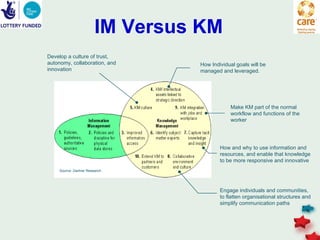
IM Versus KM
Develop a culture of trust,
autonomy, collaboration, and     How Individual goals will be
innovation                       managed and leveraged.


                                             Make KM part of the normal
                                             workflow and functions of the
                                             worker


                                         How and why to use information and
                                         resources, and enable that knowledge
                                         to be more responsive and innovative
    Source: Gartner Research


                                         Engage individuals and communities,
                                         to flatten organisational structures and
                                         simplify communication paths
Our KM Strategy
 We conducted knowledge audit
 Developed a knowledge strategy for attaining the goals
  of EMPHASIS
 Ensuring that appropriate KM activities are officially
  sanctioned
 Consider the CARE culture
 Consider the stages of the knowledge process: create,
  capture, share, revise
 Identify and consider ways to manage knowledge risks,
  & threats
 Review link between implementation & EMPHASIS
  objectives
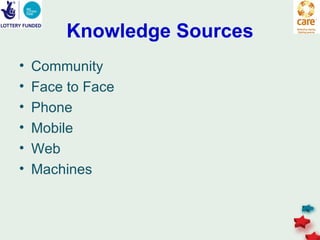
Knowledge Sources
•   Community
•   Face to Face
•   Phone
•   Mobile
•   Web
•   Machines
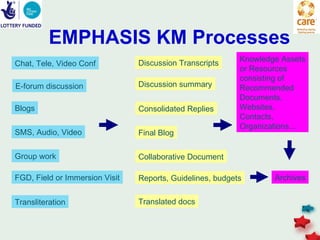
EMPHASIS KM Processes
                                Discussion Transcripts     Knowledge Assets
Chat, Tele, Video Conf
                                                           or Resources
                                                           consisting of
E-forum discussion              Discussion summary         Recommended
                                                           Documents,
Blogs                           Consolidated Replies       Websites,
                                                           Contacts,
                                                           Organizations…
SMS, Audio, Video               Final Blog

Group work                      Collaborative Document

FGD, Field or Immersion Visit   Reports, Guidelines, budgets       Archives


Transliteration                 Translated docs
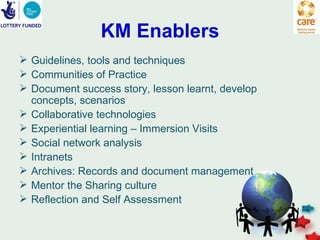
KM Enablers
 Guidelines, tools and techniques
 Communities of Practice
 Document success story, lesson learnt, develop
  concepts, scenarios
 Collaborative technologies
 Experiential learning – Immersion Visits
 Social network analysis
 Intranets
 Archives: Records and document management
 Mentor the Sharing culture
 Reflection and Self Assessment
Ring up Ning, and sing,

   Ring up Ning, and sing,
      Your story on Ning;
   If your story is stronger,
  Our program will be longer
   Ring up Ning, and sing!
http://emphasis.ning.com
    No thanks for your patience
   Thanks only for sharing in CoP
So, join the EMPHASIS CoP
 Your qualification is your knowledge

Emphasis introduction to km

  • 1.
  • 2.
    EMPHASIS Environment  Itis complex: CARE, NGOs, Partners  Regional, Maybe Starfish-structure  Matrix supervision,  Performance-oriented  Process innovation approach  Quality content  Emphasis on creativity, talent, knowledge, sharing, communication, learning, adapting,
  • 3.
    Community of Practice(CoP) An affinity group. An informal network or forum where tips are exchanged and ideas generated [Thomas A. Stewart]. A group of professionals, informally bound to one another through exposure to a common class of problems, common pursuit of solutions, and thereby themselves embodying a store of knowledge [McKinsey & Co.].
  • 4.
    EMPHASIS CoP Regional Secretariat CARE UK & BIG Project Director Country Teams M&E Manager Research Manager Finance Manager NGO Partners, Consultants, Community UN, IOM, CARAM, Members, NACO, INTL NGO, CARE Staff Other NGO
  • 5.
  • 6.
    KM Networks: Hub& Spoke - I
  • 7.
    KM Networks: Hub& Spoke - II
  • 8.
  • 9.
  • 10.
    The pressures  Pressureto reduce costs, increase quality of service and return on investment  Time lost in gestation; so need to accelerate pace to achieve work plan; so project changes  Retention of team, effective platforms and self-serve options like Ning  Project emphasizes sharing Data, Info, & Knowledge,  KM process which suits partners, donors and listeners  New approaches and tools to replace command and control structures like cross functional teams  EMPHASIS to be a Regional collaborative team
  • 11.
    Sustaining Change “ TheBasic Economic Resources – the means of production – is no longer Capital, nor natural resources, nor labour. It is and will be knowledge ” – Peter Drucker  Shift from Physical asset oriented to Intellectual asset oriented economy. Values derived from intellectual capital  Continuous learning becoming an integral part of CARE.  Knowledge & Expertise of CARE and its Individuals should be seen as Critical Resources.
  • 12.
    Why knowledge?  CAREis Resources + Capabilities; the capabilities tapped in EMPHASIS & individuals are essential for sustaining competitive advantages.  The raise of ‘Organisational learning” – the question of survival, success and sustainability  Knowledge is the only indispensible resource  The sustained competitive advantage comes only from what you know and how fast you can put into action.  Knowledge is the most advantageous tool to deal with Change and documenting EMPHASIS Project memory
  • 13.
    What is knowledge? Knowledge is information combined with experience, context, interpretation and reflection. It is high value form of information that is ready to apply to decisions and actions  Knowledge is ‘Justified true belief’  “Knowledge is experience. Every thing else is just information” – Albert Einstein  “The wise see Knowledge and action as one” – The Bhagavad Gita
  • 14.
    Data, Info, Knowledge Whatis known by perceptual experience and reasoning.  For example, 1234567.89 is data  "Your bank balance has jumped 8087% to $1234567.89" is information  "Nobody owes me that much money" is knowledge  "I'd better talk to the bank before I spend it because of what has happened to other people" is wisdom.
  • 15.
    From Data toKnowledge Expertise Individual, judgmental Contextual, tacit Knowledge Information Codified, explicit Easily transferable Data
  • 16.
    Explicit or EnterpriseKnowledge  Formal and systematic  Easily communicated and shared  Recordable, articulate, transmittable  Examples: product Specification, Computer Programme, Process sheets, methods of working, or Engineering Drawing.
  • 17.
    Experience or TacitKnowledge Experience: Active participation in events or activities, leading to the accumulation of knowledge or skill.  Varies in Individuals & difficult to communicate  Deeply rooted in action, Judgement, Intuition, Feelings  Inside, locked and matchless, unless revealed. Consists of  Technical Skills: Know – How & Why  Cognitive: mental models
  • 18.
    What does KMinvolve Identify Acquire Manage Disseminate  Ensure right knowledge to right persons at right time and in right format  Leverage existing Knowledge and potential of IT  Make knowledge sharing a dominant culture  Gain competitive advantage by harvesting & using experiential knowledge
  • 19.
    KM Definitions -Callioni Managing mindfully a process that links data through information, and knowledge, to action, learning and transfer. The output is action while the outcome is learning and transfer.
  • 20.
    KM Definitions Knowledge Managementis the art of creating value from the intangible assets of an organization. (Sveiby) Knowledge Management consists in the identification, optimization and dynamic management of the intellectual assets possessed in explicit or implicit form by persons or communities (Snowden).
  • 21.
    The efficiency ofa firm depends on how fast it bridges the gap between what it knows and what it needs to know Knowledge Gap ge Change n ha o fC e R at g earnin of L Rate Time
  • 22.
    Two Thrusts ofKM 1. Sharing existing knowledge “Knowing what you know” KM 2. Knowledge for Innovation “Creating and Converting”
  • 23.
    Why KM?  Notto reinvent the wheel : solution exists, or is known somewhere in the organization  Learn from past mistakes – ours or others  Knowledge resource depletion, Reduction, migration & brain-drain  Innovate & lead change in the business Wise Men Learn from their Mistakes The Wiser Learn from Others mistakes also
  • 24.
    Lens and Frames What you see depends on where you sit  What you do depends on where you stand  What you hear depends on where your mind is  What you feel depends on what you know
  • 25.
  • 26.
    First Position Seeing, hearingand feeling the situation through your own eyes, ears and feelings. You think in terms of what is important to you, and what you want to achieve,
  • 27.
    Second Position Stepping intothe shoes of the other person and experiencing (seeing, hearing and feeling) the situation as if you were him, her, or them. You think in terms of how this situation would be interpreted by other person. “Before criticizing someone, walk a mile in their shoes!”
  • 28.
    Third Position Standing backfrom a situation and experiencing it as if you were a detached observer. In your mind you are able to see and hear the other person as if you were a Third person. You think in terms of what opinion, observations or advice would some one who is not involved offer. You need to be in a strong resourceful state and take a objective view of your own behaviour and look for opportunities to respond differently, in order to achieve a different and more positive outcome.
  • 29.
    Which Position?  Westand for Evidence, Truth…  We stand for Peace…  So, the Third position  ‘Facilitate Sharing’ in our CoP  The EMPHASIS CoP
  • 30.
    Principles of theProphet Practice Preach Beliefs + Right Actions = Results Right Means + Right Ends = Success “He was …without a bodyguard, without a palace, without a fixed revenue. If ever any man had the right to say that he ruled by a right divine It was Mohammad, for he had all the power without instruments and Observation without its support. He cared not for dressing of power. The simplicity of his private life was in keeping with his public life." Bosworth Smith
  • 31.
    IM Versus KM Developa culture of trust, autonomy, collaboration, and How Individual goals will be innovation managed and leveraged. Make KM part of the normal workflow and functions of the worker How and why to use information and resources, and enable that knowledge to be more responsive and innovative Source: Gartner Research Engage individuals and communities, to flatten organisational structures and simplify communication paths
  • 32.
    Our KM Strategy We conducted knowledge audit  Developed a knowledge strategy for attaining the goals of EMPHASIS  Ensuring that appropriate KM activities are officially sanctioned  Consider the CARE culture  Consider the stages of the knowledge process: create, capture, share, revise  Identify and consider ways to manage knowledge risks, & threats  Review link between implementation & EMPHASIS objectives
  • 33.
    Knowledge Sources • Community • Face to Face • Phone • Mobile • Web • Machines
  • 34.
    EMPHASIS KM Processes Discussion Transcripts Knowledge Assets Chat, Tele, Video Conf or Resources consisting of E-forum discussion Discussion summary Recommended Documents, Blogs Consolidated Replies Websites, Contacts, Organizations… SMS, Audio, Video Final Blog Group work Collaborative Document FGD, Field or Immersion Visit Reports, Guidelines, budgets Archives Transliteration Translated docs
  • 35.
    KM Enablers  Guidelines,tools and techniques  Communities of Practice  Document success story, lesson learnt, develop concepts, scenarios  Collaborative technologies  Experiential learning – Immersion Visits  Social network analysis  Intranets  Archives: Records and document management  Mentor the Sharing culture  Reflection and Self Assessment
  • 36.
    Ring up Ning,and sing, Ring up Ning, and sing, Your story on Ning; If your story is stronger, Our program will be longer Ring up Ning, and sing!
  • 37.
    http://emphasis.ning.com No thanks for your patience Thanks only for sharing in CoP So, join the EMPHASIS CoP Your qualification is your knowledge