Knowledge Management and
   Learning Organization
         Tola KN
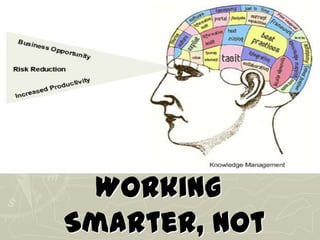
Working
Smarter, Not
Outline of the Presentation

โ–บ What   is Knowledge ?

โ–บ Knowledge    Management

โ–บ Learning   Organization
What is Knowledge ?


โ€œTo represent reality in thought or experience
  the way it really is on the basis of adequate
                     grounds.โ€
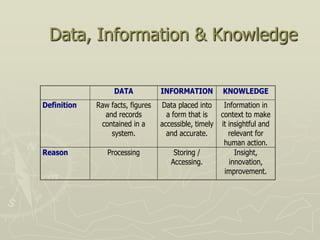
Data, Information & Knowledge


                  DATA            INFORMATION         KNOWLEDGE
Definition   Raw facts, figures   Data placed into    Information in
               and records          a form that is   context to make
              contained in a      accessible, timely it insightful and
                 system.            and accurate.       relevant for
                                                      human action.
Reason          Processing             Storing /          Insight,
                                      Accessing.        innovation,
                                                      improvement.
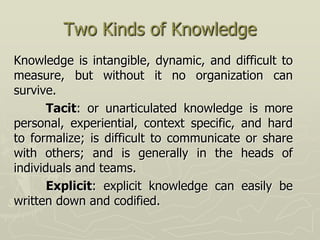
Two Kinds of Knowledge
Knowledge is intangible, dynamic, and difficult to
measure, but without it no organization can
survive.
       Tacit: or unarticulated knowledge is more
personal, experiential, context specific, and hard
to formalize; is difficult to communicate or share
with others; and is generally in the heads of
individuals and teams.
       Explicit: explicit knowledge can easily be
written down and codified.
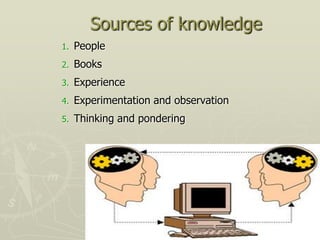
Sources of knowledge
1.   People
2.   Books
3.   Experience
4.   Experimentation and observation
5.   Thinking and pondering
Contโ€ฆ
Common sense: Every one knows that it is so
Intuition: I just know it
Beliefs: it is based on personal conviction
Tenacity: verification over the years
Tradition: practice through generations
Personal Experience: personal testing and experience

Authority: the word of experts
Divine and supernatural powers: the revelations of God and of other powers
Reason and logic: the intellect can capture truth and knowledge directly
Scientific methods: knowledge is derived through empirical procedures
Documentation

โ–บ   Documentation is a general term for a multiplicity of documents in a
    chosen mix of media and with a certain collection. Purpose of
    documentation is the use to support a tool or a process.


โ–บ   Classical documentation is a set of documents printed on paper.
    Documentation (to document) also refers to the process of providing
    evidence.
Documentation composure

Documentation may include:
โ–บ written information for any read, projection or
  technical performing,
โ–บ data media of any format and for any reproduction,
โ–บ other content.
โ–บ Common types of documentation include user guides,
  white papers, on-line help, quick-reference guides. It is
  less common to see hard-copy (paper) documentation.
  Documentation is distributed via websites, software
  products, and other on-line applications
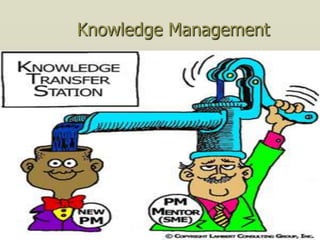
Knowledge Management
โ–บ   Defined in a variety of ways.
โ–บ   KM in education: a strategy to enable people to develop a
    set of practices to create, capture, share & use knowledge
    to advance.
โ–บ   KM focuses on:
     ๏‚ง people who create and use knowledge.
     ๏‚ง processes and technologies by which knowledge is
       created, maintained and accessed.
     ๏‚ง artifacts in which knowledge is stored (manuals,
       databases, intranets, books, heads).
Definition
      โ€œknowledge management is the art of creating value from an
             organizationโ€Ÿs intangible assets.โ€ ( Saviby 2000)

โ€œKM is a newly emerging , interdisciplinary business model dealing with all
        aspects of knowledge within the context of the firm, including
     knowledge creation , codification, sharing and how these activities
             promote learning and innovation.โ€ (Berkeley 2001)

    โ€œThe systematic process of creating, maintaining and nurturing an
     organization to make the best use of knowledge to create business
     value and generate competitive advantageโ€ (Nancy C. Shaw 2004)

  โ€œKM is the process of capturing and making use of a firmโ€Ÿs collective
     expertise anywhere in the business โ€“ on paper, in documents, in
  database (called Explicit knowledge), or in peopleโ€Ÿs heads ( called tacit
                                knowledge)โ€
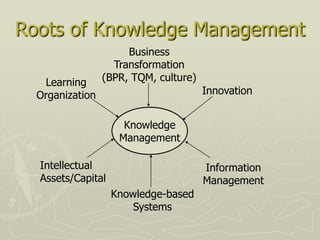
Roots of Knowledge Management
                      Business
                   Transformation
   Learning      (BPR, TQM, culture)
  Organization                         Innovation


                     Knowledge
                    Management

  Intellectual                         Information
  Assets/Capital                       Management
                   Knowledge-based
                       Systems
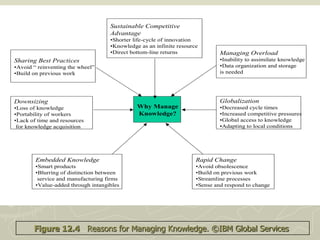
Sustainable Competitive
                                    Advantage
                                    โ€ขShorter life-cycle of innovation
                                    โ€ขKnowledge as an infinite resource
                                    โ€ขDirect bottom-line returns               Managing Overload
Sharing Best Practices                                                        โ€ขInability to assimilate knowledge
โ€ขAvoid โ€œ reinventing the wheelโ€                                               โ€ขData organization and storage
โ€ขBuild on previous work                                                       is needed


Downsizing                                                                    Globalization
โ€ขLoss of knowledge                            Why Manage                      โ€ขDecreased cycle times
โ€ขPortability of workers                       Knowledge?                      โ€ขIncreased competitive pressures
โ€ขLack of time and resources                                                   โ€ขGlobal access to knowledge
 for knowledge acquisition                                                    โ€ขAdapting to local conditions


        Embedded Knowledge                                           Rapid Change
        โ€ขSmart products                                              โ€ขAvoid obsolescence
        โ€ขBlurring of distinction between                             โ€ขBuild on previous work
         service and manufacturing firms                             โ€ขStreamline processes
        โ€ขValue-added through intangibles                             โ€ขSense and respond to change


       Figure 12.4 Reasons for Managing Knowledge. ยฉIBM Global Services
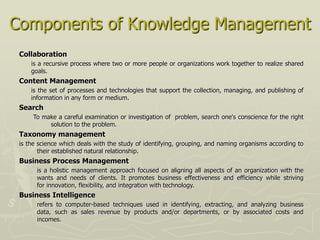
Components of Knowledge Management
 Collaboration
     is a recursive process where two or more people or organizations work together to realize shared
     goals.
 Content Management
     is the set of processes and technologies that support the collection, managing, and publishing of
     information in any form or medium.
 Search
     To make a careful examination or investigation of problem, search one's conscience for the right
          solution to the problem.
 Taxonomy management
 is the science which deals with the study of identifying, grouping, and naming organisms according to
        their established natural relationship.
 Business Process Management
       is a holistic management approach focused on aligning all aspects of an organization with the
       wants and needs of clients. It promotes business effectiveness and efficiency while striving
       for innovation, flexibility, and integration with technology.
 Business Intelligence
       refers to computer-based techniques used in identifying, extracting, and analyzing business
       data, such as sales revenue by products and/or departments, or by associated costs and
       incomes.
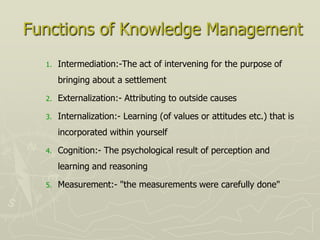
Functions of Knowledge Management
  1.   Intermediation:-The act of intervening for the purpose of
       bringing about a settlement

  2.   Externalization:- Attributing to outside causes

  3.   Internalization:- Learning (of values or attitudes etc.) that is
       incorporated within yourself

  4.   Cognition:- The psychological result of perception and
       learning and reasoning

  5.   Measurement:- "the measurements were carefully done"
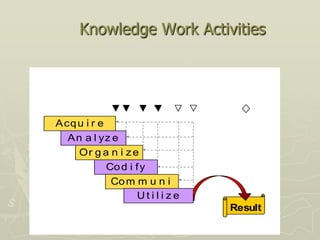
Knowledge Work Activities


A cq u i r e
   A n a l yz e
      Or g a n i z e
             Co d i f y
              Co m m u n i
                 ca tte l i z e
                     U i
                                  Result
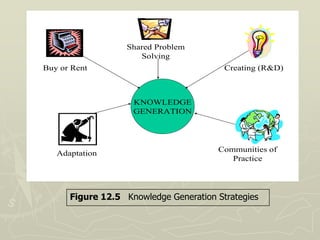
Shared Problem
                     Solving
Buy or Rent                              Creating (R&D)


                    KNOWLEDGE
                    GENERATION


                                       Communities of
   Adaptation
                                          Practice


      Figure 12.5 Knowledge Generation Strategies
KM strategies in Organization


โ–บ   Rewards (as a means of motivating for knowledge sharing)
โ–บ   Storytelling (as a means of transferring tacit knowledge)
โ–บ   Cross-project learning
โ–บ   After action reviews
โ–บ   Knowledge mapping (a map of knowledge repositories
    within a company accessible by all)
โ–บ   Expert directories (to enable knowledge seeker to reach to
    the experts)
โ–บ   specific subject
In Successful KM Programs
โ–บ Information   is widely disseminated throughout
  the organization. Wherever it is needed, it is
  accessible.
โ–บ Accessible at a fast rate of speed.
โ–บ Virtual communities of practice share what is
  known in a global fashion, independent of time
  zones and other geographic limitations.
โ–บ Business boundaries are broad, and often
  virtual in nature.
โ–บ Collaboration to support continuous innovation
  and new knowledge creation.
Symptoms of KM Diffusion
             Challenges
โ–บ No  internal learning communities
โ–บ Lack of psychological safety
โ–บ Lack of workplace trust
โ–บ Arrogance of people who believe they
  know everything, so why try?
โ–บ Lack of communication within an
  organization made evident by continually
  reinventing the same wheel
โ–บ Negativity and unrealistic expectations
Learning Organization


โ€œOver the long run, superior performance
     depends on superior learning.โ€
  -- Peter Senge, leader of the learning organization movement
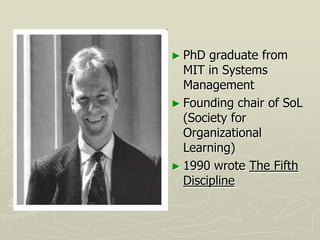
โ–บ PhD  graduate from
  MIT in Systems
  Management
โ–บ Founding chair of SoL
  (Society for
  Organizational
  Learning)
โ–บ 1990 wrote The Fifth
  Discipline
What is a Learning Organisation?

โ–บ   "The essence of organisational learning is the
    organisation's ability to use the amazing mental
    capacity of all its members to create the kind of
    processes that will improve its own" Nancy Dixon, 1994

โ–บ   "Organisations where people continually expand their
    capacity to create the results they truly desire, where
    new and expansive patterns of thinking are nurtured,
    where collective aspiration is set free, and where
    people are continually learning to learn togetherโ€œ
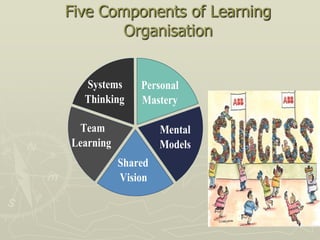
Five Components of Learning
        Organisation


  Systems      Personal
  Thinking     Mastery

 Team               Mental
Learning            Models
           Shared
           Vision
Systems Thinking
๏ƒ˜   interdependency and change
๏ƒ˜   focus on whole not individual parts
๏ƒ˜   long-term goals vs. short-term benefits
๏ƒ˜   better appreciation of systems leads to
    more appropriate action
๏ƒ˜   mind shift & understanding change
    processes.
๏ƒ˜   โ€žfeedbackโ€Ÿ to reinforce/counteract action.
๏ƒ˜   recognize recurring structures
๏ƒ˜   remove root causes/problems
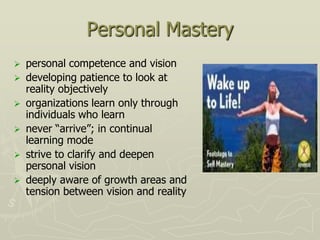
Personal Mastery
๏ƒ˜   personal competence and vision
๏ƒ˜   developing patience to look at
    reality objectively
๏ƒ˜   organizations learn only through
    individuals who learn
๏ƒ˜   never โ€œarriveโ€; in continual
    learning mode
๏ƒ˜   strive to clarify and deepen
    personal vision
๏ƒ˜   deeply aware of growth areas and
    tension between vision and reality
Mental Models

๏ƒ˜ changing ingrained assumptions
  about influencing factors.
๏ƒ˜ deeply ingrained assumptions and
  generalizations
๏ƒ˜ honest and critical analysis of deep-
  rooted mental models
๏ƒ˜ transcend mental models in order
  for change to take place
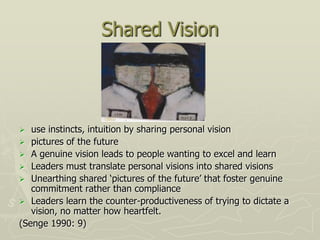
Shared Vision


๏ƒ˜  use instincts, intuition by sharing personal vision
๏ƒ˜ pictures of the future
๏ƒ˜ A genuine vision leads to people wanting to excel and learn
๏ƒ˜ Leaders must translate personal visions into shared visions
๏ƒ˜ Unearthing shared โ€žpictures of the futureโ€Ÿ that foster genuine
   commitment rather than compliance
๏ƒ˜ Leaders learn the counter-productiveness of trying to dictate a
   vision, no matter how heartfelt.
(Senge 1990: 9)
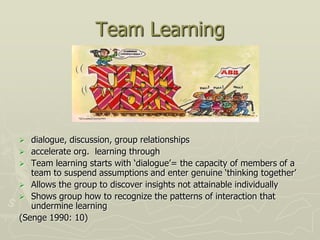
Team Learning


๏ƒ˜  dialogue, discussion, group relationships
๏ƒ˜ accelerate org. learning through
๏ƒ˜ Team learning starts with โ€ždialogueโ€Ÿ= the capacity of members of a
   team to suspend assumptions and enter genuine โ€žthinking togetherโ€Ÿ
๏ƒ˜ Allows the group to discover insights not attainable individually
๏ƒ˜ Shows group how to recognize the patterns of interaction that
   undermine learning
(Senge 1990: 10)
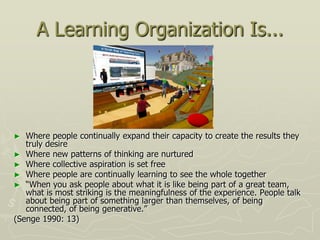
A Learning Organization Is...


โ–บ  Where people continually expand their capacity to create the results they
   truly desire
โ–บ Where new patterns of thinking are nurtured
โ–บ Where collective aspiration is set free
โ–บ Where people are continually learning to see the whole together
โ–บ โ€œWhen you ask people about what it is like being part of a great team,
   what is most striking is the meaningfulness of the experience. People talk
   about being part of something larger than themselves, of being
   connected, of being generative.โ€
(Senge 1990: 13)
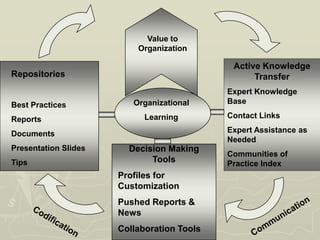
Value to
                          Organization

                                             Active Knowledge
Repositories                                      Transfer
                                            Expert Knowledge
Best Practices           Organizational     Base

Reports                     Learning        Contact Links

Documents                                   Expert Assistance as
                                            Needed
Presentation Slides     Decision Making
                                            Communities of
Tips                         Tools          Practice Index
                      Profiles for
                      Customization
                      Pushed Reports &
                      News
                      Collaboration Tools
Thank You
     &
   Happy
Labour Day

Knowledge management and learning organization

  • 1.
    Knowledge Management and Learning Organization Tola KN
  • 2.
  • 3.
    Outline of thePresentation โ–บ What is Knowledge ? โ–บ Knowledge Management โ–บ Learning Organization
  • 4.
    What is Knowledge? โ€œTo represent reality in thought or experience the way it really is on the basis of adequate grounds.โ€
  • 5.
    Data, Information &Knowledge DATA INFORMATION KNOWLEDGE Definition Raw facts, figures Data placed into Information in and records a form that is context to make contained in a accessible, timely it insightful and system. and accurate. relevant for human action. Reason Processing Storing / Insight, Accessing. innovation, improvement.
  • 6.
    Two Kinds ofKnowledge Knowledge is intangible, dynamic, and difficult to measure, but without it no organization can survive. Tacit: or unarticulated knowledge is more personal, experiential, context specific, and hard to formalize; is difficult to communicate or share with others; and is generally in the heads of individuals and teams. Explicit: explicit knowledge can easily be written down and codified.
  • 7.
    Sources of knowledge 1. People 2. Books 3. Experience 4. Experimentation and observation 5. Thinking and pondering
  • 8.
    Contโ€ฆ Common sense: Everyone knows that it is so Intuition: I just know it Beliefs: it is based on personal conviction Tenacity: verification over the years Tradition: practice through generations Personal Experience: personal testing and experience Authority: the word of experts Divine and supernatural powers: the revelations of God and of other powers Reason and logic: the intellect can capture truth and knowledge directly Scientific methods: knowledge is derived through empirical procedures
  • 9.
    Documentation โ–บ Documentation is a general term for a multiplicity of documents in a chosen mix of media and with a certain collection. Purpose of documentation is the use to support a tool or a process. โ–บ Classical documentation is a set of documents printed on paper. Documentation (to document) also refers to the process of providing evidence.
  • 10.
    Documentation composure Documentation mayinclude: โ–บ written information for any read, projection or technical performing, โ–บ data media of any format and for any reproduction, โ–บ other content. โ–บ Common types of documentation include user guides, white papers, on-line help, quick-reference guides. It is less common to see hard-copy (paper) documentation. Documentation is distributed via websites, software products, and other on-line applications
  • 11.
  • 12.
    Knowledge Management โ–บ Defined in a variety of ways. โ–บ KM in education: a strategy to enable people to develop a set of practices to create, capture, share & use knowledge to advance. โ–บ KM focuses on: ๏‚ง people who create and use knowledge. ๏‚ง processes and technologies by which knowledge is created, maintained and accessed. ๏‚ง artifacts in which knowledge is stored (manuals, databases, intranets, books, heads).
  • 13.
    Definition โ€œknowledge management is the art of creating value from an organizationโ€Ÿs intangible assets.โ€ ( Saviby 2000) โ€œKM is a newly emerging , interdisciplinary business model dealing with all aspects of knowledge within the context of the firm, including knowledge creation , codification, sharing and how these activities promote learning and innovation.โ€ (Berkeley 2001) โ€œThe systematic process of creating, maintaining and nurturing an organization to make the best use of knowledge to create business value and generate competitive advantageโ€ (Nancy C. Shaw 2004) โ€œKM is the process of capturing and making use of a firmโ€Ÿs collective expertise anywhere in the business โ€“ on paper, in documents, in database (called Explicit knowledge), or in peopleโ€Ÿs heads ( called tacit knowledge)โ€
  • 14.
    Roots of KnowledgeManagement Business Transformation Learning (BPR, TQM, culture) Organization Innovation Knowledge Management Intellectual Information Assets/Capital Management Knowledge-based Systems
  • 15.
    Sustainable Competitive Advantage โ€ขShorter life-cycle of innovation โ€ขKnowledge as an infinite resource โ€ขDirect bottom-line returns Managing Overload Sharing Best Practices โ€ขInability to assimilate knowledge โ€ขAvoid โ€œ reinventing the wheelโ€ โ€ขData organization and storage โ€ขBuild on previous work is needed Downsizing Globalization โ€ขLoss of knowledge Why Manage โ€ขDecreased cycle times โ€ขPortability of workers Knowledge? โ€ขIncreased competitive pressures โ€ขLack of time and resources โ€ขGlobal access to knowledge for knowledge acquisition โ€ขAdapting to local conditions Embedded Knowledge Rapid Change โ€ขSmart products โ€ขAvoid obsolescence โ€ขBlurring of distinction between โ€ขBuild on previous work service and manufacturing firms โ€ขStreamline processes โ€ขValue-added through intangibles โ€ขSense and respond to change Figure 12.4 Reasons for Managing Knowledge. ยฉIBM Global Services
  • 16.
    Components of KnowledgeManagement Collaboration is a recursive process where two or more people or organizations work together to realize shared goals. Content Management is the set of processes and technologies that support the collection, managing, and publishing of information in any form or medium. Search To make a careful examination or investigation of problem, search one's conscience for the right solution to the problem. Taxonomy management is the science which deals with the study of identifying, grouping, and naming organisms according to their established natural relationship. Business Process Management is a holistic management approach focused on aligning all aspects of an organization with the wants and needs of clients. It promotes business effectiveness and efficiency while striving for innovation, flexibility, and integration with technology. Business Intelligence refers to computer-based techniques used in identifying, extracting, and analyzing business data, such as sales revenue by products and/or departments, or by associated costs and incomes.
  • 17.
    Functions of KnowledgeManagement 1. Intermediation:-The act of intervening for the purpose of bringing about a settlement 2. Externalization:- Attributing to outside causes 3. Internalization:- Learning (of values or attitudes etc.) that is incorporated within yourself 4. Cognition:- The psychological result of perception and learning and reasoning 5. Measurement:- "the measurements were carefully done"
  • 18.
    Knowledge Work Activities Acq u i r e A n a l yz e Or g a n i z e Co d i f y Co m m u n i ca tte l i z e U i Result
  • 19.
    Shared Problem Solving Buy or Rent Creating (R&D) KNOWLEDGE GENERATION Communities of Adaptation Practice Figure 12.5 Knowledge Generation Strategies
  • 20.
    KM strategies inOrganization โ–บ Rewards (as a means of motivating for knowledge sharing) โ–บ Storytelling (as a means of transferring tacit knowledge) โ–บ Cross-project learning โ–บ After action reviews โ–บ Knowledge mapping (a map of knowledge repositories within a company accessible by all) โ–บ Expert directories (to enable knowledge seeker to reach to the experts) โ–บ specific subject
  • 21.
    In Successful KMPrograms โ–บ Information is widely disseminated throughout the organization. Wherever it is needed, it is accessible. โ–บ Accessible at a fast rate of speed. โ–บ Virtual communities of practice share what is known in a global fashion, independent of time zones and other geographic limitations. โ–บ Business boundaries are broad, and often virtual in nature. โ–บ Collaboration to support continuous innovation and new knowledge creation.
  • 22.
    Symptoms of KMDiffusion Challenges โ–บ No internal learning communities โ–บ Lack of psychological safety โ–บ Lack of workplace trust โ–บ Arrogance of people who believe they know everything, so why try? โ–บ Lack of communication within an organization made evident by continually reinventing the same wheel โ–บ Negativity and unrealistic expectations
  • 23.
    Learning Organization โ€œOver thelong run, superior performance depends on superior learning.โ€ -- Peter Senge, leader of the learning organization movement
  • 24.
    โ–บ PhD graduate from MIT in Systems Management โ–บ Founding chair of SoL (Society for Organizational Learning) โ–บ 1990 wrote The Fifth Discipline
  • 25.
    What is aLearning Organisation? โ–บ "The essence of organisational learning is the organisation's ability to use the amazing mental capacity of all its members to create the kind of processes that will improve its own" Nancy Dixon, 1994 โ–บ "Organisations where people continually expand their capacity to create the results they truly desire, where new and expansive patterns of thinking are nurtured, where collective aspiration is set free, and where people are continually learning to learn togetherโ€œ
  • 26.
    Five Components ofLearning Organisation Systems Personal Thinking Mastery Team Mental Learning Models Shared Vision
  • 27.
    Systems Thinking ๏ƒ˜ interdependency and change ๏ƒ˜ focus on whole not individual parts ๏ƒ˜ long-term goals vs. short-term benefits ๏ƒ˜ better appreciation of systems leads to more appropriate action ๏ƒ˜ mind shift & understanding change processes. ๏ƒ˜ โ€žfeedbackโ€Ÿ to reinforce/counteract action. ๏ƒ˜ recognize recurring structures ๏ƒ˜ remove root causes/problems
  • 28.
    Personal Mastery ๏ƒ˜ personal competence and vision ๏ƒ˜ developing patience to look at reality objectively ๏ƒ˜ organizations learn only through individuals who learn ๏ƒ˜ never โ€œarriveโ€; in continual learning mode ๏ƒ˜ strive to clarify and deepen personal vision ๏ƒ˜ deeply aware of growth areas and tension between vision and reality
  • 29.
    Mental Models ๏ƒ˜ changingingrained assumptions about influencing factors. ๏ƒ˜ deeply ingrained assumptions and generalizations ๏ƒ˜ honest and critical analysis of deep- rooted mental models ๏ƒ˜ transcend mental models in order for change to take place
  • 30.
    Shared Vision ๏ƒ˜ use instincts, intuition by sharing personal vision ๏ƒ˜ pictures of the future ๏ƒ˜ A genuine vision leads to people wanting to excel and learn ๏ƒ˜ Leaders must translate personal visions into shared visions ๏ƒ˜ Unearthing shared โ€žpictures of the futureโ€Ÿ that foster genuine commitment rather than compliance ๏ƒ˜ Leaders learn the counter-productiveness of trying to dictate a vision, no matter how heartfelt. (Senge 1990: 9)
  • 31.
    Team Learning ๏ƒ˜ dialogue, discussion, group relationships ๏ƒ˜ accelerate org. learning through ๏ƒ˜ Team learning starts with โ€ždialogueโ€Ÿ= the capacity of members of a team to suspend assumptions and enter genuine โ€žthinking togetherโ€Ÿ ๏ƒ˜ Allows the group to discover insights not attainable individually ๏ƒ˜ Shows group how to recognize the patterns of interaction that undermine learning (Senge 1990: 10)
  • 32.
    A Learning OrganizationIs... โ–บ Where people continually expand their capacity to create the results they truly desire โ–บ Where new patterns of thinking are nurtured โ–บ Where collective aspiration is set free โ–บ Where people are continually learning to see the whole together โ–บ โ€œWhen you ask people about what it is like being part of a great team, what is most striking is the meaningfulness of the experience. People talk about being part of something larger than themselves, of being connected, of being generative.โ€ (Senge 1990: 13)
  • 33.
    Value to Organization Active Knowledge Repositories Transfer Expert Knowledge Best Practices Organizational Base Reports Learning Contact Links Documents Expert Assistance as Needed Presentation Slides Decision Making Communities of Tips Tools Practice Index Profiles for Customization Pushed Reports & News Collaboration Tools
  • 34.
    Thank You & Happy Labour Day