


Knowledge Leadership:
Innovating our Future
Prof.Dr.Aung Tun Thet
Knowledge
• Hot topic
• Intellectual capital
• ‘Hidden assets'
• Value creation
New Economic World Order
• Intellectual not financial capital
• Profound changes in managing most precious
resource - human talent
Management Concepts
• Evolving
• From Leading (and being led)
• To Navigation and networking
• Not traditional command-and-control
Modern Management
• Beyond information technology
• Not fear speed of change
• Embrace learning
Effective Management
• Not having most knowledge
• Knowing how to use it
Leadership
• More art than science
• Return-on-leadership (ROL)
• Innovation competence
• Measure performance
Knowledge Economy
• Focus upon and manage knowledge - individual and
collective
• Multiplier effect
• More shared more grow
• New style of leadership behaviour
Knowledge Economy
• Agricultural, industrial and information age: linear,
competitive, market-share oriented management
• Intangible variables: intellectual capital,
alliances/partnering, and global communications -
both human and technical
Leadership Differ in
Knowledge Economy
Today
• Connections made between isolated elements
• Innovation fostered by information gathered from
new connections
Today
• Insights gained from other disciplines or places
• Active, collegial networks
• Fluid, open boundaries
• Innovation from circles of exchange
• Information not accumulated or stored but created
21st Century Leadership
• More vision and visibility
• Not learned behaviours
• Behaviours demonstrate impact
21st Century
• Knowledge obsolesce accelerate
• ‘Digital Divide’ - gap between “haves” and “have
nots”
• Human (vs. information or technology) agenda place
emphasis on all people and all cultures
21st Century
• Real-time learning critical
• Yesterday’s leaders focus on ‘leading’
• Tomorrow’s leaders local, national, regional and
international statesmen (and women)
• Effectively balance economics, education and
environment
Seven Cs of
Knowledge Leadership
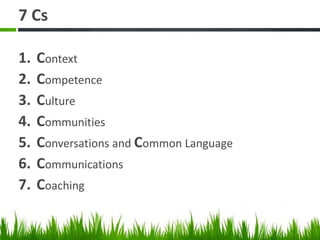
7 Cs
1. Context
2. Competence
3. Culture
4. Communities
5. Conversations and Common Language
6. Communications
7. Coaching
1. Context
• New Human Capital orientation
• Performance metrics dynamic
• Measure intangibles
• Organizational structures networked
• Self-managing knowledge workers
1. Context
• Processes transcend organization boundaries
• Link all stakeholders into strategic innovation
system
• Information technology for knowledge processing
1. Context
• Vision
• “Although the urgent business of everyday life is
important,
• it is not as important as the future.”
1. Context
• Leaders inspire passion
• Ensure teams stability
• Maintain focus and balance
• Lead by example, walk-the-talk, and understand
‘whole’
• Leverage talents
2. Competence
• 35 organized into following categories:
• Direction Setting
• Change Leadership
• Critical Thinking
• Organizational Development and Diversity
• Work-Life (Personal/Organization) Balance
• Quality, Knowledge and Innovation
Leadership
• Impossible to teach
• Learn, experience and supported
Five-step learning process
• Step One - Competency Profile
• Step Two - Learning Plan
• Step Three - Learning Process
• Step Four - Re-entry Planning
• Step Five - Measurement of Impact
3. Culture
• Values - explicit and implicit
• Trust - accountability, integrity, honesty and ethics
• Communications - human and technical
• Vision - sense of direction, uniqueness, or
aspirations
3. Culture
• Knowledge valued
• Engender change, innovation, openness and trust
• People recognized and rewarded for knowledge
contribution
3. Culture
• Effective knowledge creation
• Flexible, networked organizational structures
• Multiple teams
• Intensive and purposeful networking
• Knowledge-sharing - job rotation, learning events,
effective teaming and comprehensive technology
infrastructure
4. Communities
• Convergence of functional perspectives
• Common agenda
4. Communities
• HR professionals develop relevant performance
measures and use information technology
• Chief Information Officers understand organization
structure, motivations of people and cross-boundary
processes
4. Communities
• Quality experts building training infrastructures for
transfer of knowledge and best practices
• R&D managers involved in business development
and reducing cycle time with increased customer
interaction
• Finance professionals expand audit capabilities to
influence business strategy
4. Communities
• Respect for alternative paradigms
• Value created in organization interfaces – “white
space”
• Connections between individuals, organizations,
companies
4. Communities
• Communities of Practice - quality circles and
networked organizations
• Harness creativity
• Promote cross-fertilization for prosperous
innovation
4. Communities
• Peers
• Common sense of purpose
• Natural connections
• Ideas originate exchanged
• Result in marketable products and services
4. Communities
• Innovation bond diverse constituencies
• Knowledge and intellectual capital mechanisms build
synergy
• Essence of sustainable organizations
• Economies of future
4. Communities
• Leaders collaborate and contribute to success of one
another
• Not zero-sum game!
5. Conversations and Common Language
• Innovation language
• Heritage, purpose, mission and strategy
• Connections made among internal and external
constituencies
• Purposeful conversations
• Art of structured conversation and dialogue
5. Conversations and Common Language
• Learning and improvement two sides of same coin
• Quest for effective learning
• Understand and leverage diversity of knowledge,
skills, experiences
• ‘Network of conversations’
6. Communications
• Leverage technology
• Not always technical
• “You do not get a second chance,
• to make a first impression”
• Simple but not simplistic
6. Communications
• Integrated to leverage human capital
• External messages consistent with internal culture,
values and vision
• Branding, ethics, direction, success stories, etc. -
conveyed skilfully and on regular basis
6. Communications
• Knowledge-type advertising campaigns:
• “Knowledge is powerful medicine”
• “Understanding comes with Time”
• “Old tradition, new thinking”
6. Communications
• Marketing products and services
• Present timely image to external stakeholders
• Motivational tool for employees
6. Communications
• Federal Express “The World on Time”
• Simple, memorable, substantive and visceral
• Right words in right context
6. Communications
• Learning process
• Dissemination tool
• Tapping into customer knowledge
• Distributed learning network of expertise
• Intelligence service
• Business development
• Listening
7. Coaching
• Guided relationship process
• Both responsible
• Process forward looking, change-oriented and
developmental
• Enable success, productivity, revenue growth and
stakeholder value
7. Coaching
• ‘Being’ than ‘Doing’
• Trust, support and shared values
• Ability to see contexts not supplying content
• Affirms person
• Clarify choices
• Catalyst for achieving both individual and
organizational purposes
7. Coaching
• Connects inner person (confidence, values, purpose)
• With external leadership (articulating vision,
reaching targets, and achieving goals)
• Opposite of judging and need for control
7. Coaching
• Effective leaders do not have all the answers
• Healthy curiosity
• Sense of direction
• Standards of excellence
• Genuinely value others
• ‘Know what the others know’
7. Coaching
• Constantly learning (Kaizen)
• Experiment with new ideas
• Not afraid to make mistakes
• Facilitating process
• Navigate through uncharted territory
7. Coaching
• On-the-job learning
• Guide own innovation process
Conclusion
New Millennium
• Leadership carry forward not resemble past
• Future leadership novel skill-set
Knowledge Leaders
• Understand nature of complex context
• Competencies based in experience
• Know relationship between:
• Motivation (Psychology) of individual
• Culture (Sociology) of organization
• Value heritage (Anthropology)
7 Cs
1. Context
2. Competence
3. Culture
4. Communities
5. Conversations and Common Language
6. Communications
7. Coaching
Thank You!

BFBM(14-2016) Knowledge leadership bfbm14

  • 1.
    Knowledge Leadership: Innovating ourFuture Prof.Dr.Aung Tun Thet
  • 5.
    Knowledge • Hot topic •Intellectual capital • ‘Hidden assets' • Value creation
  • 6.
    New Economic WorldOrder • Intellectual not financial capital • Profound changes in managing most precious resource - human talent
  • 7.
    Management Concepts • Evolving •From Leading (and being led) • To Navigation and networking • Not traditional command-and-control
  • 8.
    Modern Management • Beyondinformation technology • Not fear speed of change • Embrace learning
  • 9.
    Effective Management • Nothaving most knowledge • Knowing how to use it
  • 10.
    Leadership • More artthan science • Return-on-leadership (ROL) • Innovation competence • Measure performance
  • 11.
    Knowledge Economy • Focusupon and manage knowledge - individual and collective • Multiplier effect • More shared more grow • New style of leadership behaviour
  • 12.
    Knowledge Economy • Agricultural,industrial and information age: linear, competitive, market-share oriented management • Intangible variables: intellectual capital, alliances/partnering, and global communications - both human and technical
  • 13.
  • 15.
    Today • Connections madebetween isolated elements • Innovation fostered by information gathered from new connections
  • 16.
    Today • Insights gainedfrom other disciplines or places • Active, collegial networks • Fluid, open boundaries • Innovation from circles of exchange • Information not accumulated or stored but created
  • 17.
    21st Century Leadership •More vision and visibility • Not learned behaviours • Behaviours demonstrate impact
  • 18.
    21st Century • Knowledgeobsolesce accelerate • ‘Digital Divide’ - gap between “haves” and “have nots” • Human (vs. information or technology) agenda place emphasis on all people and all cultures
  • 19.
    21st Century • Real-timelearning critical • Yesterday’s leaders focus on ‘leading’ • Tomorrow’s leaders local, national, regional and international statesmen (and women) • Effectively balance economics, education and environment
  • 20.
  • 22.
    7 Cs 1. Context 2.Competence 3. Culture 4. Communities 5. Conversations and Common Language 6. Communications 7. Coaching
  • 23.
    1. Context • NewHuman Capital orientation • Performance metrics dynamic • Measure intangibles • Organizational structures networked • Self-managing knowledge workers
  • 24.
    1. Context • Processestranscend organization boundaries • Link all stakeholders into strategic innovation system • Information technology for knowledge processing
  • 25.
    1. Context • Vision •“Although the urgent business of everyday life is important, • it is not as important as the future.”
  • 26.
    1. Context • Leadersinspire passion • Ensure teams stability • Maintain focus and balance • Lead by example, walk-the-talk, and understand ‘whole’ • Leverage talents
  • 27.
    2. Competence • 35organized into following categories: • Direction Setting • Change Leadership • Critical Thinking • Organizational Development and Diversity • Work-Life (Personal/Organization) Balance • Quality, Knowledge and Innovation
  • 28.
    Leadership • Impossible toteach • Learn, experience and supported
  • 29.
    Five-step learning process •Step One - Competency Profile • Step Two - Learning Plan • Step Three - Learning Process • Step Four - Re-entry Planning • Step Five - Measurement of Impact
  • 30.
    3. Culture • Values- explicit and implicit • Trust - accountability, integrity, honesty and ethics • Communications - human and technical • Vision - sense of direction, uniqueness, or aspirations
  • 31.
    3. Culture • Knowledgevalued • Engender change, innovation, openness and trust • People recognized and rewarded for knowledge contribution
  • 32.
    3. Culture • Effectiveknowledge creation • Flexible, networked organizational structures • Multiple teams • Intensive and purposeful networking • Knowledge-sharing - job rotation, learning events, effective teaming and comprehensive technology infrastructure
  • 33.
    4. Communities • Convergenceof functional perspectives • Common agenda
  • 34.
    4. Communities • HRprofessionals develop relevant performance measures and use information technology • Chief Information Officers understand organization structure, motivations of people and cross-boundary processes
  • 35.
    4. Communities • Qualityexperts building training infrastructures for transfer of knowledge and best practices • R&D managers involved in business development and reducing cycle time with increased customer interaction • Finance professionals expand audit capabilities to influence business strategy
  • 36.
    4. Communities • Respectfor alternative paradigms • Value created in organization interfaces – “white space” • Connections between individuals, organizations, companies
  • 37.
    4. Communities • Communitiesof Practice - quality circles and networked organizations • Harness creativity • Promote cross-fertilization for prosperous innovation
  • 38.
    4. Communities • Peers •Common sense of purpose • Natural connections • Ideas originate exchanged • Result in marketable products and services
  • 39.
    4. Communities • Innovationbond diverse constituencies • Knowledge and intellectual capital mechanisms build synergy • Essence of sustainable organizations • Economies of future
  • 40.
    4. Communities • Leaderscollaborate and contribute to success of one another • Not zero-sum game!
  • 41.
    5. Conversations andCommon Language • Innovation language • Heritage, purpose, mission and strategy • Connections made among internal and external constituencies • Purposeful conversations • Art of structured conversation and dialogue
  • 42.
    5. Conversations andCommon Language • Learning and improvement two sides of same coin • Quest for effective learning • Understand and leverage diversity of knowledge, skills, experiences • ‘Network of conversations’
  • 43.
    6. Communications • Leveragetechnology • Not always technical • “You do not get a second chance, • to make a first impression” • Simple but not simplistic
  • 44.
    6. Communications • Integratedto leverage human capital • External messages consistent with internal culture, values and vision • Branding, ethics, direction, success stories, etc. - conveyed skilfully and on regular basis
  • 45.
    6. Communications • Knowledge-typeadvertising campaigns: • “Knowledge is powerful medicine” • “Understanding comes with Time” • “Old tradition, new thinking”
  • 46.
    6. Communications • Marketingproducts and services • Present timely image to external stakeholders • Motivational tool for employees
  • 47.
    6. Communications • FederalExpress “The World on Time” • Simple, memorable, substantive and visceral • Right words in right context
  • 48.
    6. Communications • Learningprocess • Dissemination tool • Tapping into customer knowledge • Distributed learning network of expertise • Intelligence service • Business development • Listening
  • 49.
    7. Coaching • Guidedrelationship process • Both responsible • Process forward looking, change-oriented and developmental • Enable success, productivity, revenue growth and stakeholder value
  • 50.
    7. Coaching • ‘Being’than ‘Doing’ • Trust, support and shared values • Ability to see contexts not supplying content • Affirms person • Clarify choices • Catalyst for achieving both individual and organizational purposes
  • 51.
    7. Coaching • Connectsinner person (confidence, values, purpose) • With external leadership (articulating vision, reaching targets, and achieving goals) • Opposite of judging and need for control
  • 52.
    7. Coaching • Effectiveleaders do not have all the answers • Healthy curiosity • Sense of direction • Standards of excellence • Genuinely value others • ‘Know what the others know’
  • 53.
    7. Coaching • Constantlylearning (Kaizen) • Experiment with new ideas • Not afraid to make mistakes • Facilitating process • Navigate through uncharted territory
  • 54.
    7. Coaching • On-the-joblearning • Guide own innovation process
  • 55.
  • 57.
    New Millennium • Leadershipcarry forward not resemble past • Future leadership novel skill-set
  • 58.
    Knowledge Leaders • Understandnature of complex context • Competencies based in experience • Know relationship between: • Motivation (Psychology) of individual • Culture (Sociology) of organization • Value heritage (Anthropology)
  • 59.
    7 Cs 1. Context 2.Competence 3. Culture 4. Communities 5. Conversations and Common Language 6. Communications 7. Coaching
  • 62.