Knowledge Management, Innovation & Productivity as an Integral Part of Good Governance Prof. K. Subramanian SM(IEEE, USA), SMACM(USA), FIETE, SMCSI,MAIMA,MAIS(USA),MCFE(USA) Director & Professor, Advanced Center for Informatics & Innovative Learning (ACIIL), IGNOU Honorary  IT Adviser to CAG of India Ex-DDG(NIC), Ministry of Comm. & IT Emeritus President, eInformation Systems, Security, Audit Association President, Cyber Society of India
Agenda Recent Developments Myths of KM KM & Society Innovation & Productivity Standards Governance & Assurance Maturity Model
Important Notable  Quotes “ Ever since men began to modify their lives by using technology they have found themselves in a series of technological traps.” Roger Revelle “ The law is the last interpretation of the law given by the last judge.”- Anon. “ Privacy is where technology and the law collide.”  -- Richard Smith   (who traced the ‘I Love You’ and ‘Melissa viruses’) "Technology makes it possible for people to gain control over everything, except over technology" John Tudor
Important Notable  Quotes Productivity and Innovation  are the strongest determinants of standard of living in the knowledge-based society, and provide the only direct route to recession-proofing the economy, and achieving broad economic and social benefits. Research performance  is a robust predictor of productivity and innovation Innovation is at the heart of productivity growth
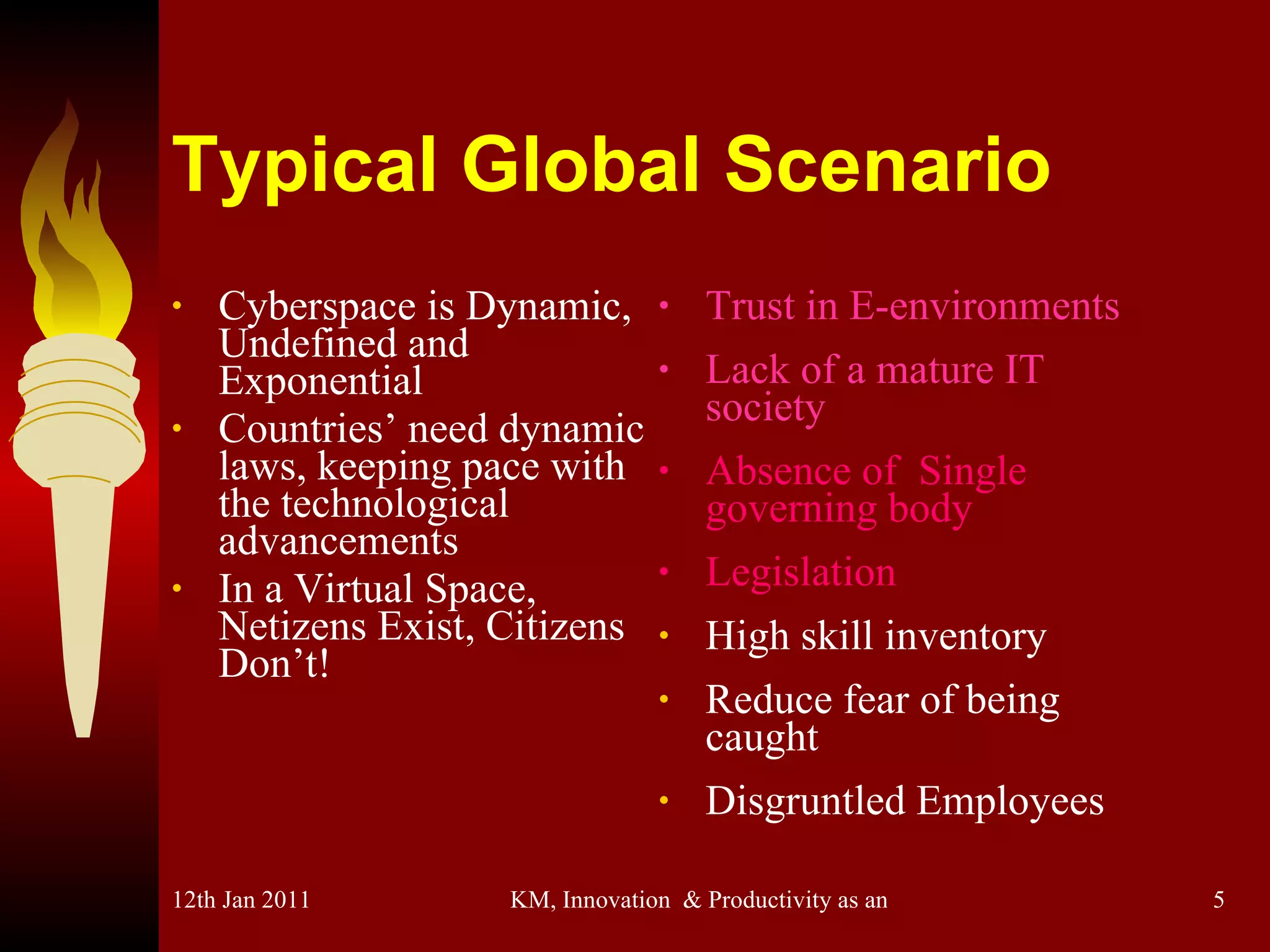
Typical Global Scenario Cyberspace is Dynamic, Undefined and Exponential Countries’ need dynamic laws, keeping pace with the technological advancements In a Virtual Space, Netizens Exist, Citizens Don’t! Trust in E-environments Lack of a mature IT society Absence of  Single governing body Legislation High skill inventory Reduce fear of being caught Disgruntled Employees
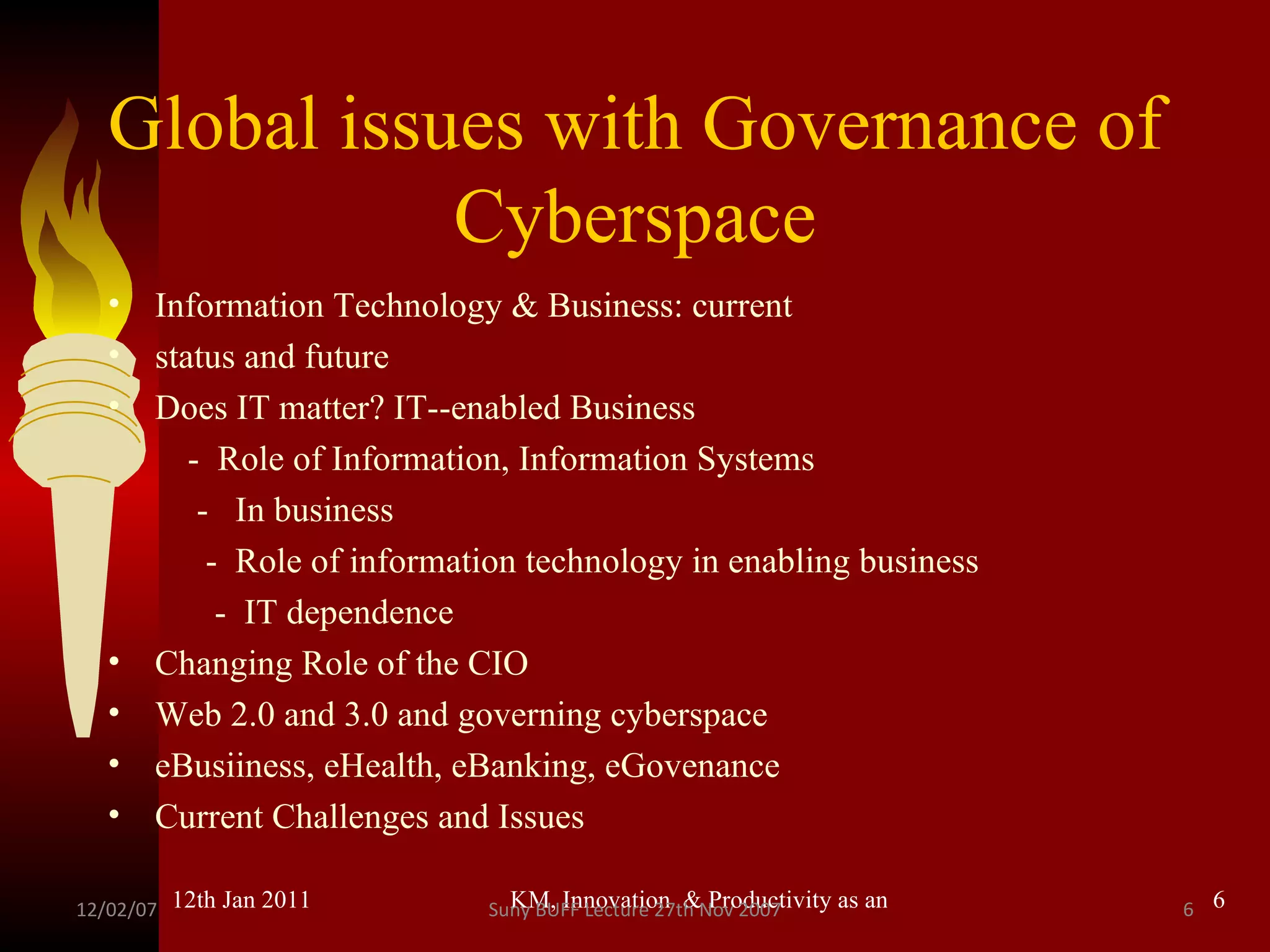
Global issues with Governance of Cyberspace Information Technology & Business: current status and future Does IT matter? IT--enabled Business -  Role of Information, Information Systems  -  In business -  Role of information technology in enabling business -  IT dependence Changing Role of the CIO Web 2.0 and 3.0 and governing cyberspace eBusiiness, eHealth, eBanking, eGovenance Current Challenges and Issues 12/02/07 Suny BUFF Lecture 27th Nov 2007
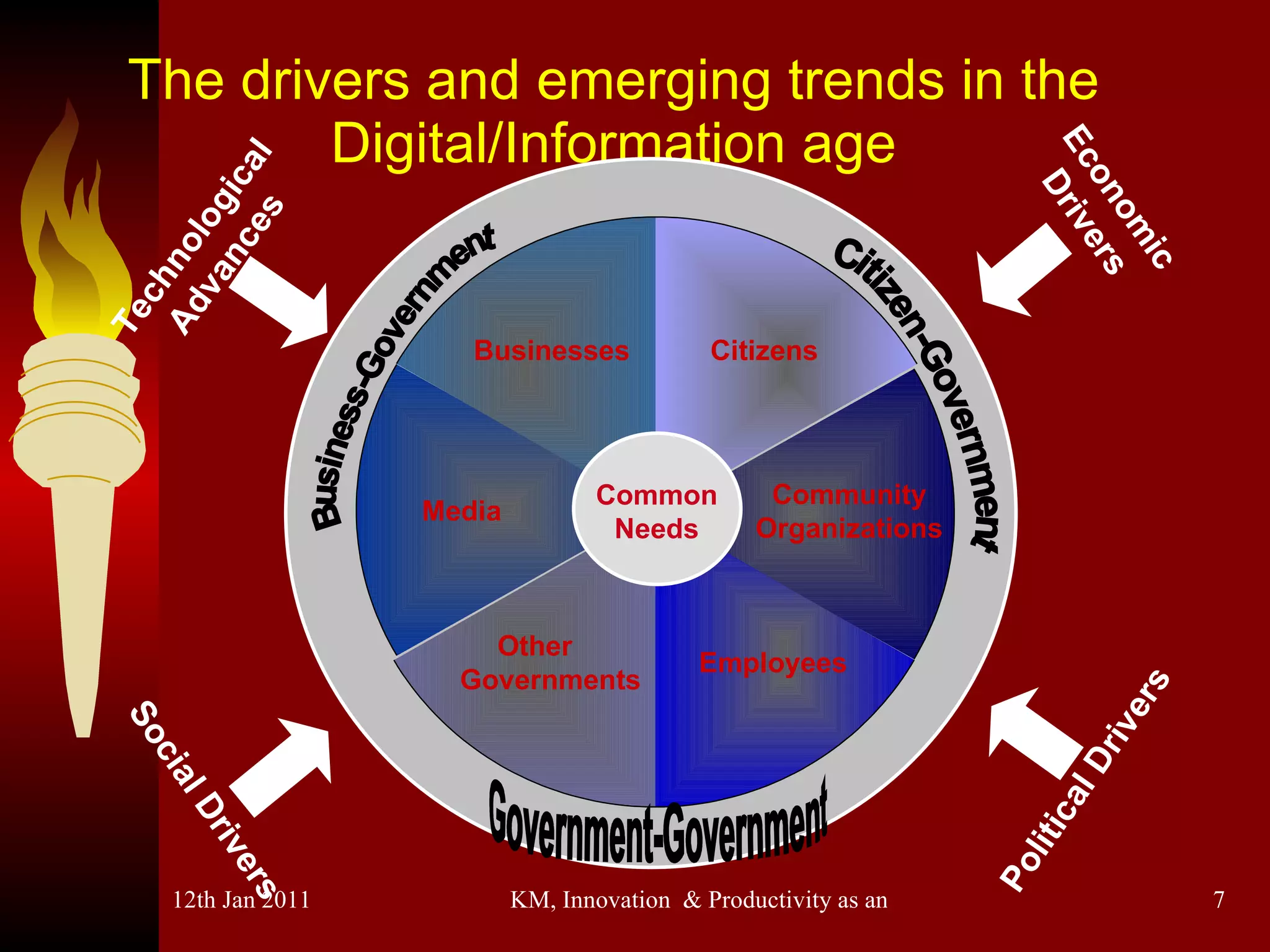
The drivers and emerging trends in the Digital/Information age Economic Drivers Technological Advances Political Drivers Social Drivers Citizens Community Organizations Other  Governments Media Businesses Employees Government-Government Business-Government Citizen-Government Common Needs
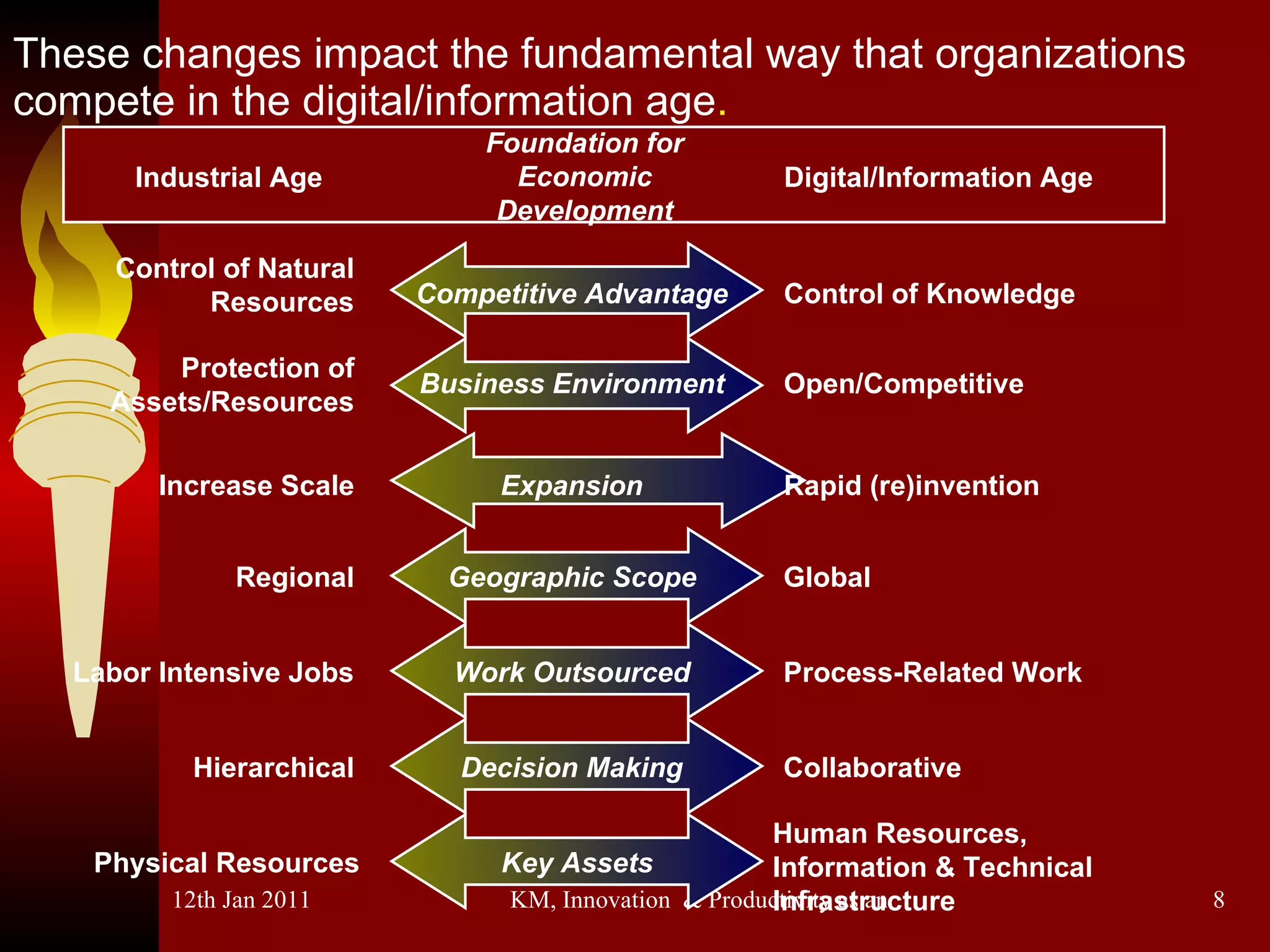
These changes impact the fundamental way that organizations compete in the digital/information age .   Industrial Age Foundation for Economic Development Digital/Information Age   Control of Natural Resources Control of Knowledge Competitive Advantage Protection of Assets/Resources Open/Competitive Rapid (re)invention Increase Scale Expansion Business Environment Labor Intensive Jobs Process-Related Work Work Outsourced Decision Making Hierarchical Collaborative Key Assets Human Resources, Information & Technical Infrastructure  Physical Resources Geographic Scope Global Regional
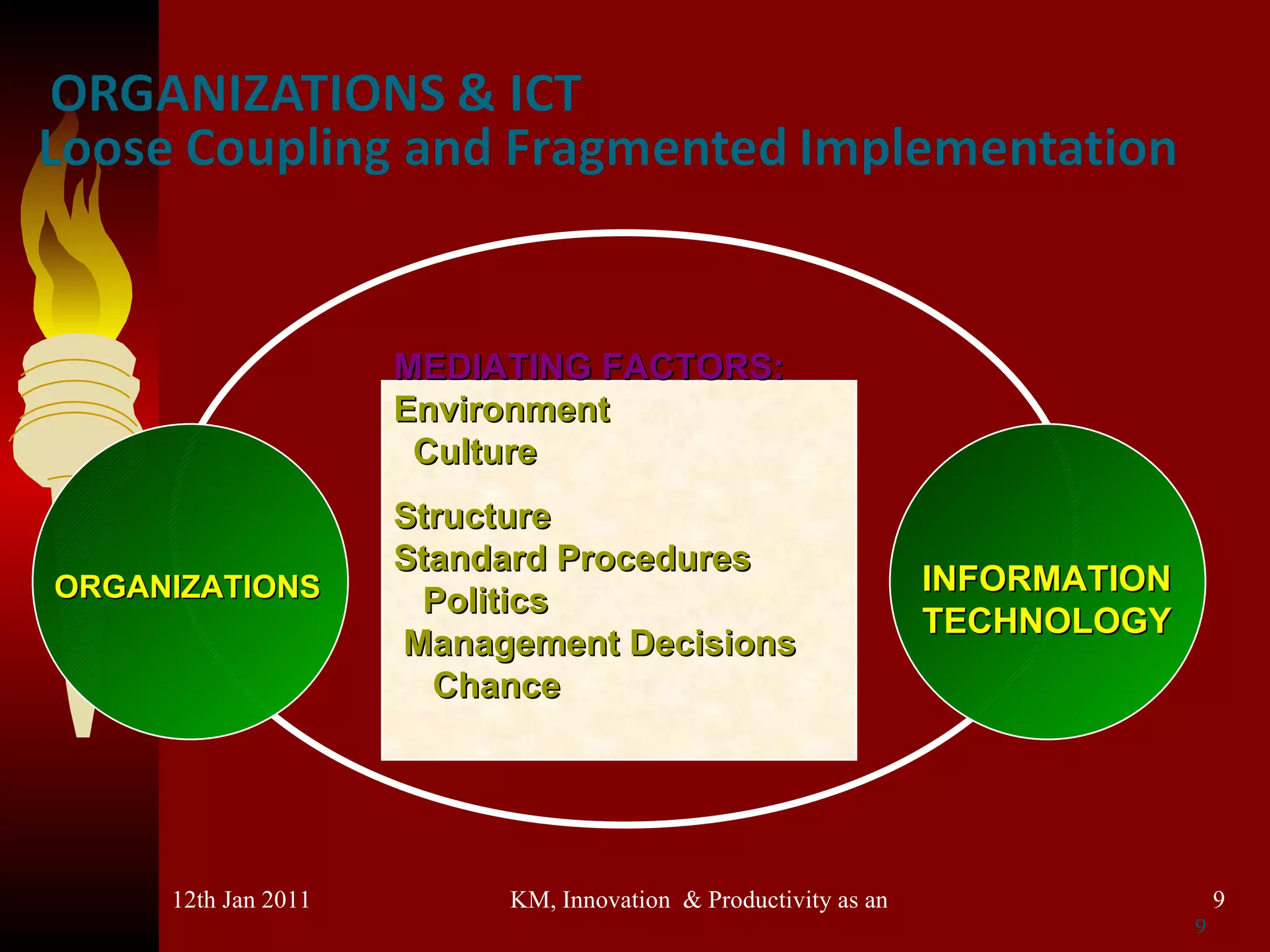
MEDIATING FACTORS:   Environment  Culture Structure  Standard Procedures  Politics  Management Decisions  Chance ORGANIZATIONS INFORMATION TECHNOLOGY
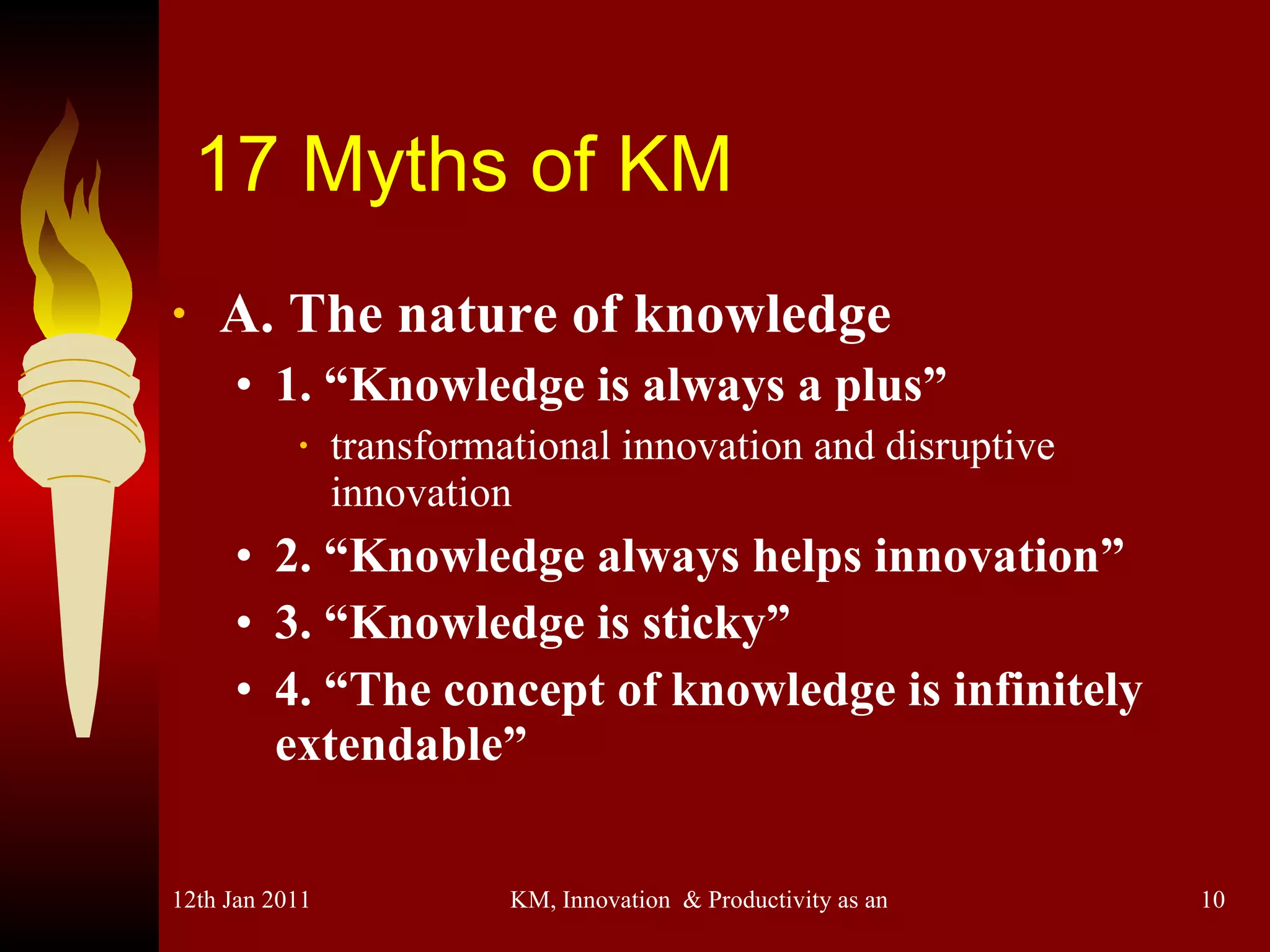
17 Myths of KM A. The nature of knowledge 1. “Knowledge is always a plus” transformational innovation and disruptive innovation 2. “Knowledge always helps innovation” 3. “Knowledge is sticky” 4. “The concept of knowledge is infinitely extendable”
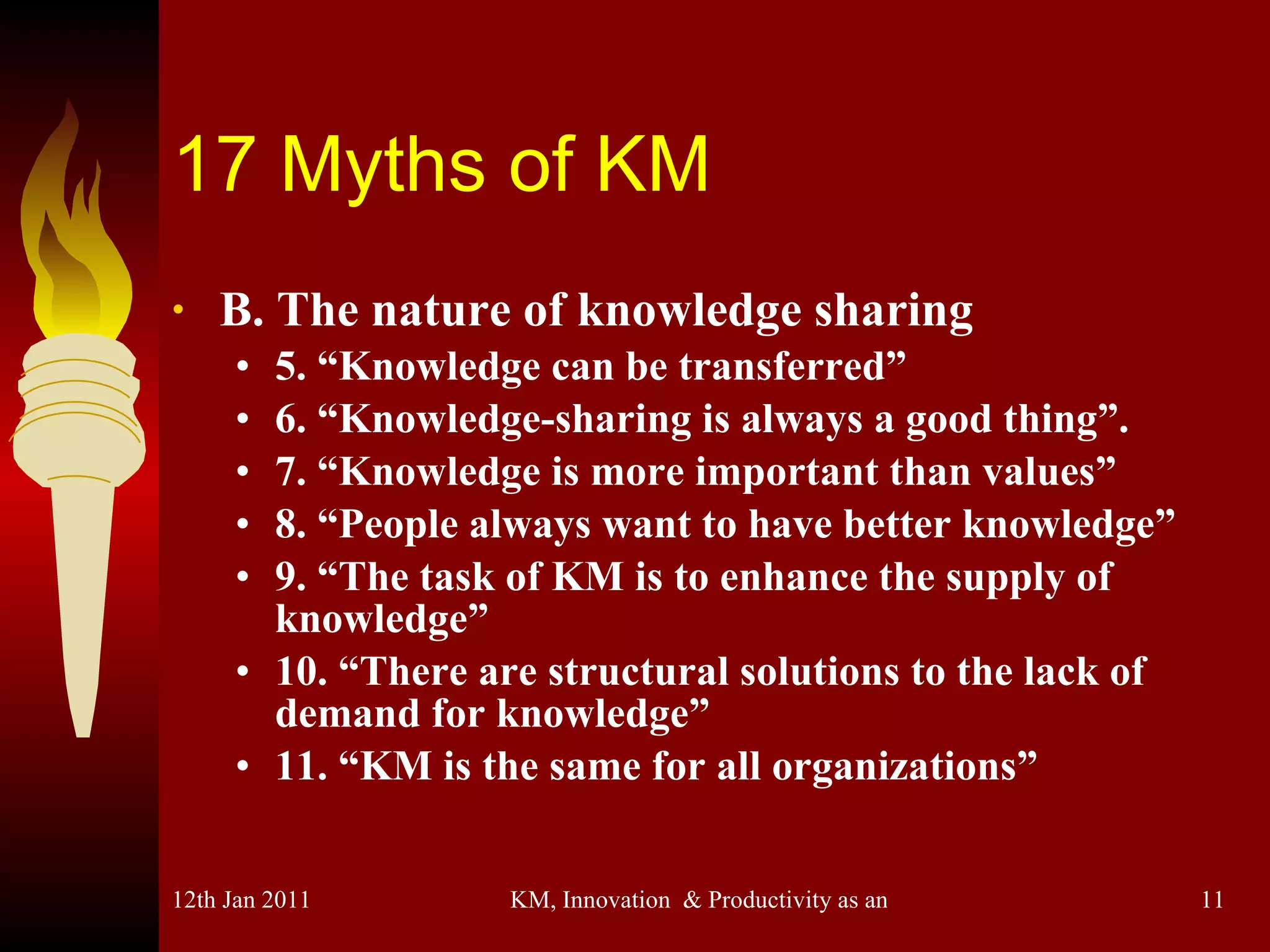
17 Myths of KM B. The nature of knowledge sharing 5. “Knowledge can be transferred” 6. “Knowledge-sharing is always a good thing”. 7. “Knowledge is more important than values” 8. “People always want to have better knowledge” 9. “The task of KM is to enhance the supply of knowledge” 10. “There are structural solutions to the lack of demand for knowledge” 11. “KM is the same for all organizations”
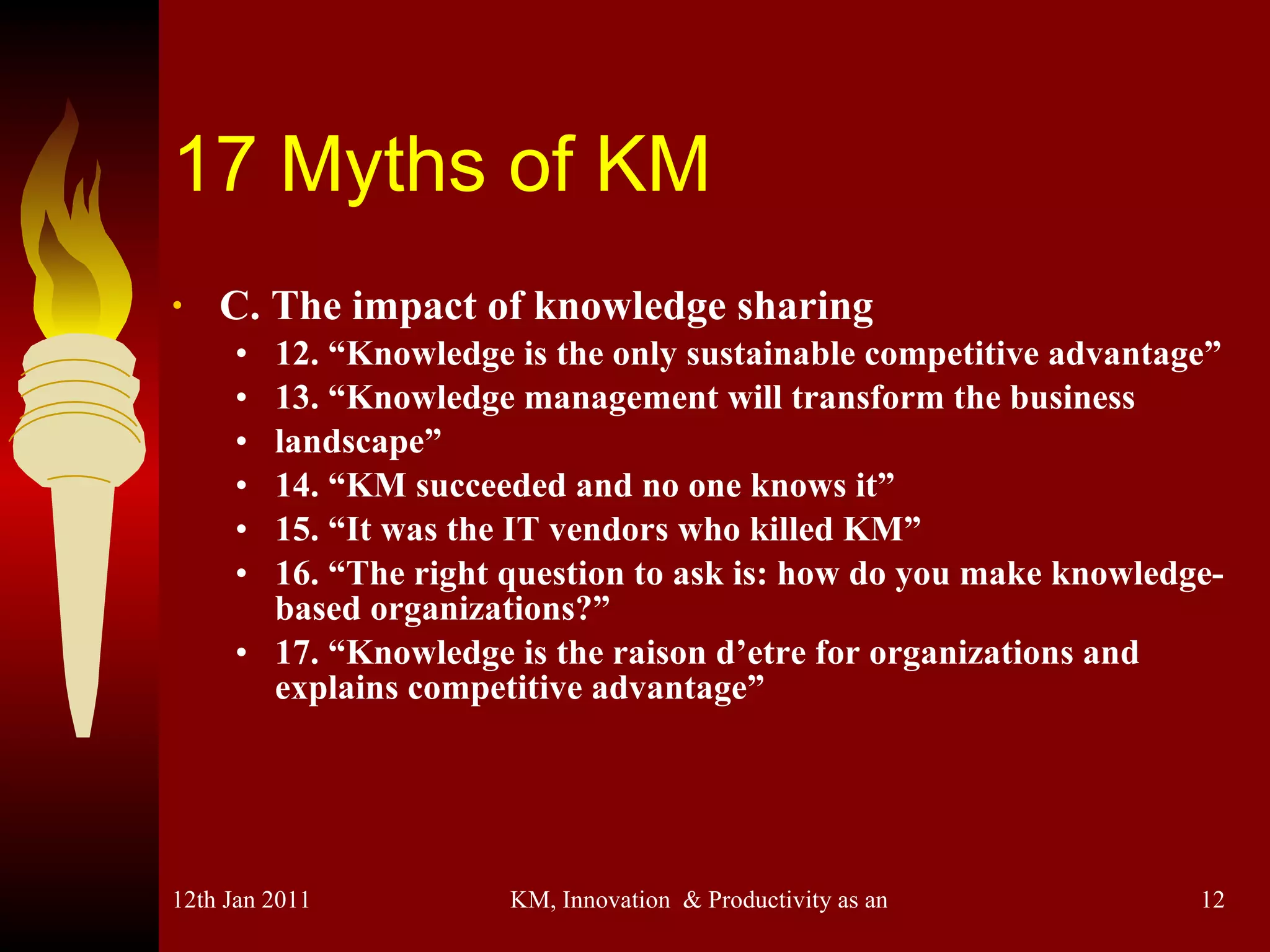
17 Myths of KM C. The impact of knowledge sharing 12. “Knowledge is the only sustainable competitive advantage” 13. “Knowledge management will transform the business landscape” 14. “KM succeeded and no one knows it” 15. “It was the IT vendors who killed KM” 16. “The right question to ask is: how do you make knowledge-based organizations?” 17. “Knowledge is the raison d’etre for organizations and explains competitive advantage”
Principles of  Good Governance Leadership Selflessness Integrity Objectivity Accountability Openness Honesty Humane Governance Should be Creative Uses Knowledge for National Wealth and Health creation Understands the economics of Knowledge High Morality
New Important Evolving Technologies 6T (IT, BT, NT, ET, CT and ST)  Digital Cocooning,  Insperience (Indoor + Experience), Web Identity (Avata, MiniHome,…),  Consumption Curator,  Ubitizen (Ubiquitous + Citizen), DMB (Digital Multimedia Broadcasting), TPS (Triple Play Service: Internet +Tel+ Broadcast) Grid Computing Ubiquitous Technology
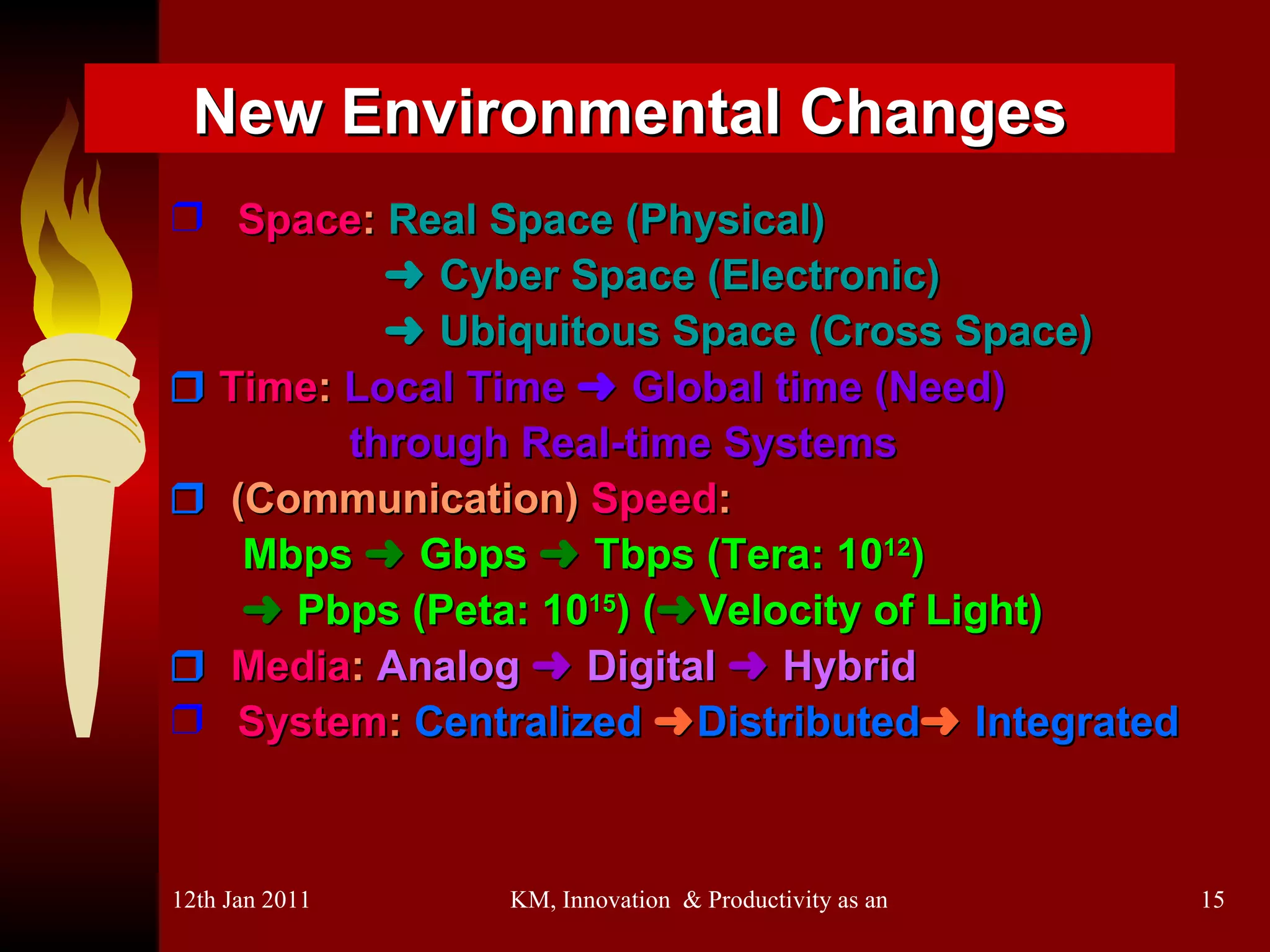
New Environmental Changes Space :   Real Space (Physical)     Cyber Space (Electronic)     Ubiquitous Space (Cross Space)    Time :   Local Time    Global time (Need) through Real-time Systems    (Communication)  Speed :   Mbps     Gbps    Tbps (Tera: 10 12 )    Pbps (Peta: 10 15 ) (  Velocity of Light)    Media :   Analog    Digital    Hybrid System :  Centralized   Distributed   Integrated
The Connectivity Paradigm The Physical Connectivity The Economic Connectivity The Electronic Connectivity The Knowledge Connectivity The Spiritual Connectivity
 
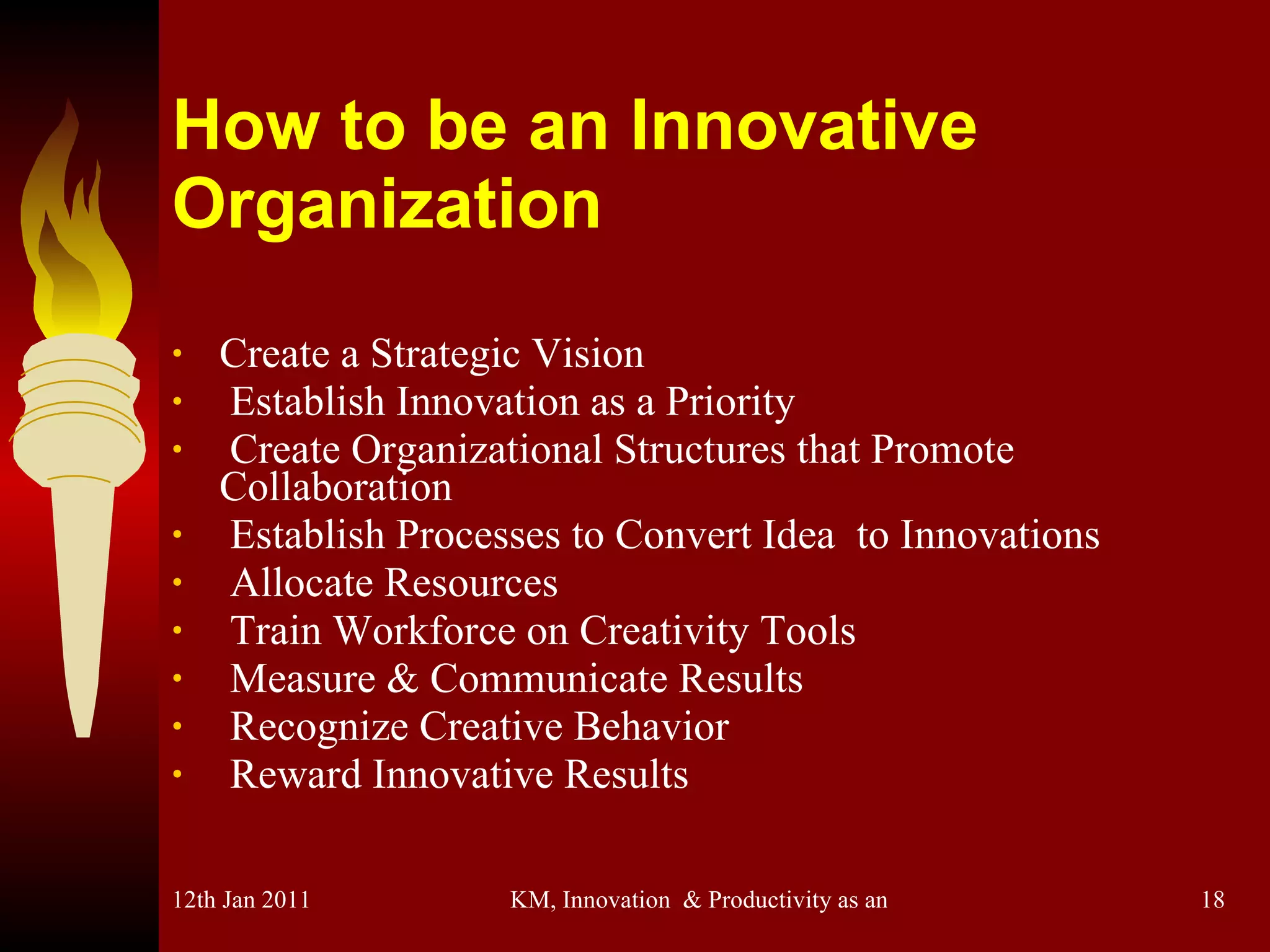
How to be an Innovative Organization Create a Strategic Vision Establish Innovation as a Priority Create Organizational Structures that Promote Collaboration Establish Processes to Convert Idea  to Innovations Allocate Resources Train Workforce on Creativity Tools Measure & Communicate Results Recognize Creative Behavior Reward Innovative Results
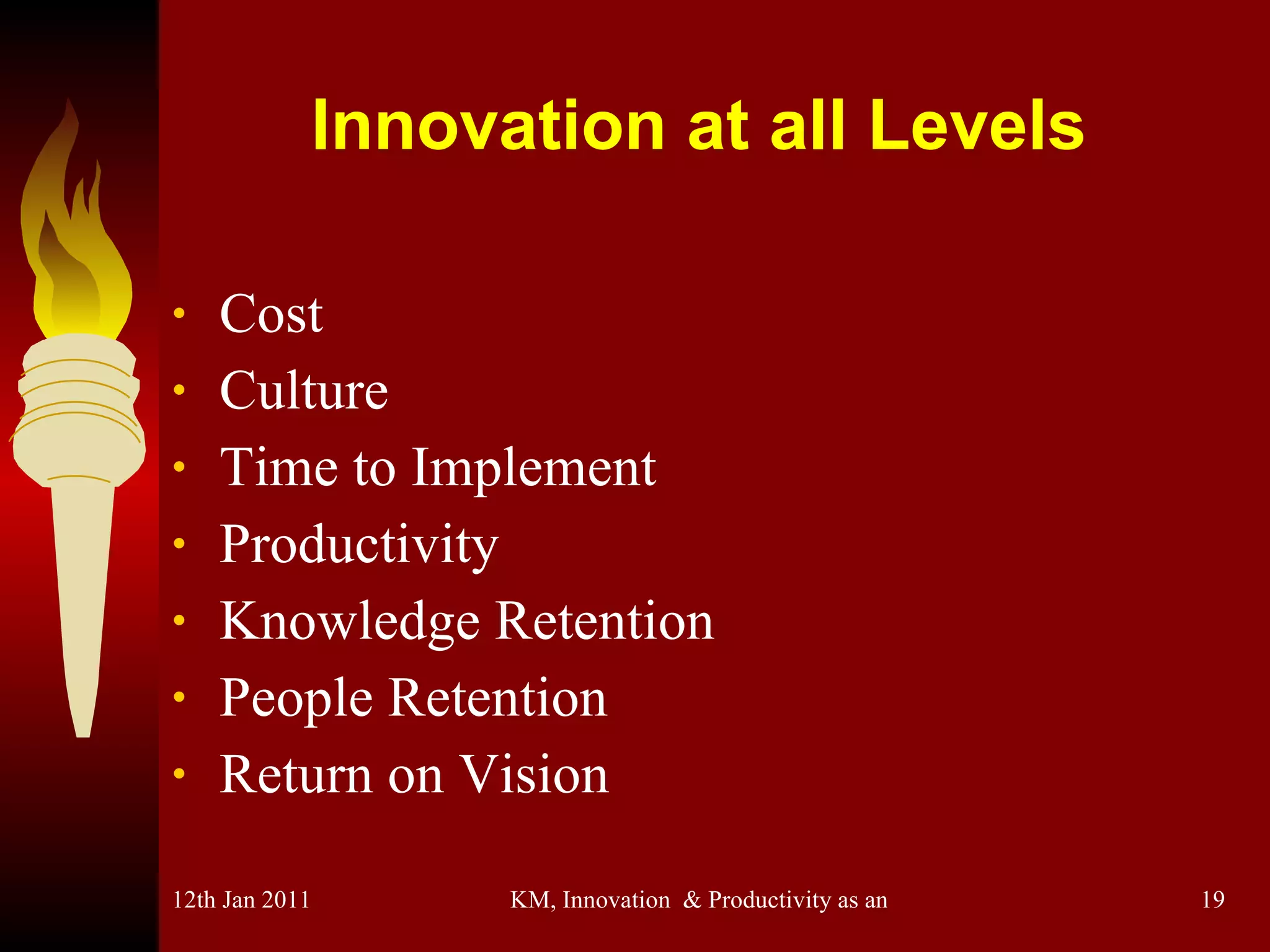
Innovation at all Levels Cost Culture Time to Implement Productivity Knowledge Retention People Retention Return on Vision
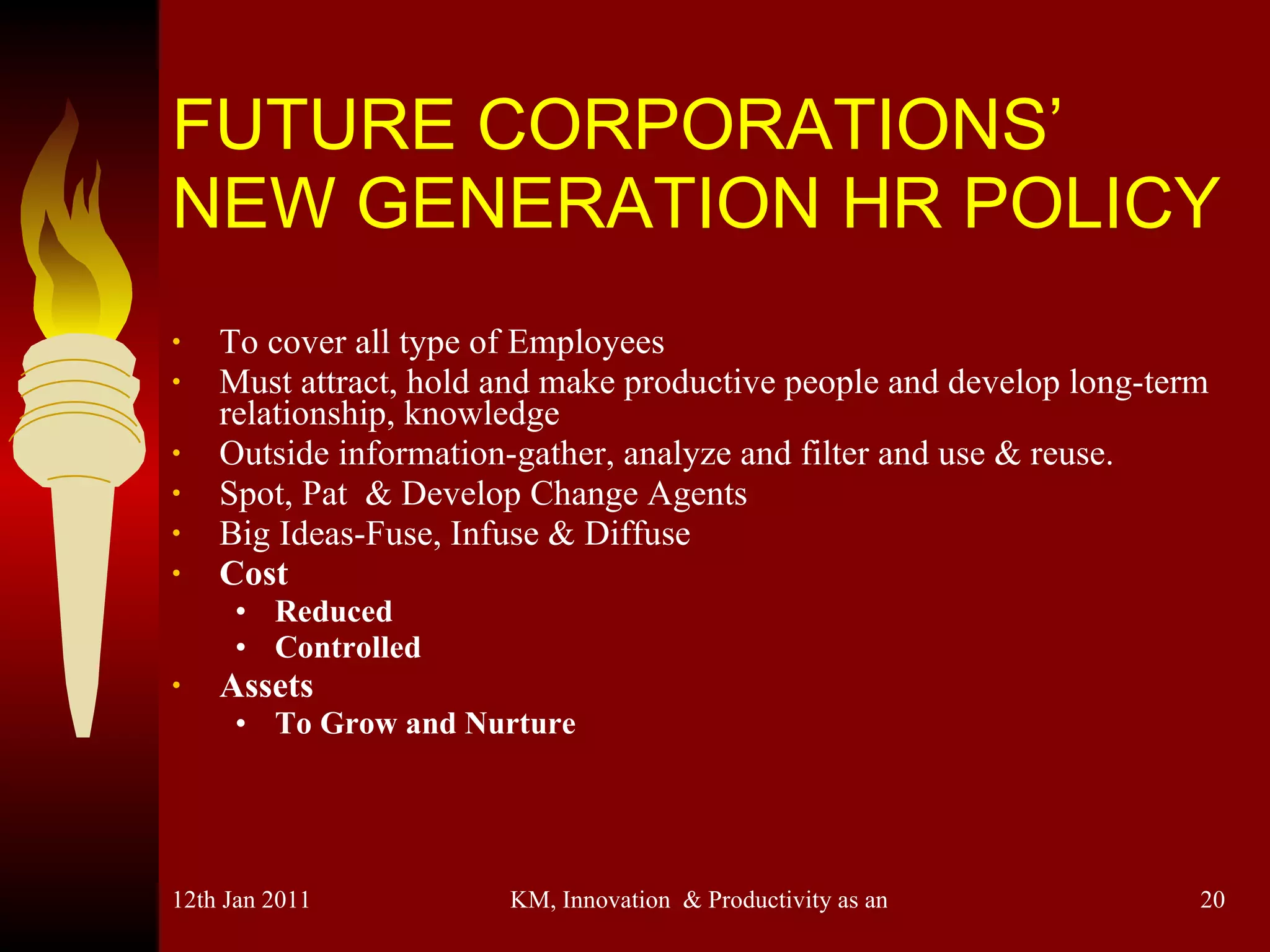
FUTURE CORPORATIONS’ NEW GENERATION HR POLICY To cover all type of Employees Must attract, hold and make productive people and develop long-term relationship, knowledge Outside information-gather, analyze and filter and use & reuse. Spot, Pat  & Develop Change Agents Big Ideas-Fuse, Infuse & Diffuse Cost Reduced Controlled Assets To Grow and Nurture
KM & Community Despite the rise of virtual technologies, the physical work environment is still a major factor in knowledge workers performance Creating a knowledge friendly culture and a productive work environment, fending off bureaucracy; helping to create and nurture such a community Looking at Intellectual Capital created in relation to the resources deployed Managers of knowledge workers often have to be knowledge workers themselves; they are “ player/coaches”. Getting the right balance of playing and coaching is critical, but is quite difficult The fate of advanced economies depends upon making knowledge workers more productive  Peter Drucker
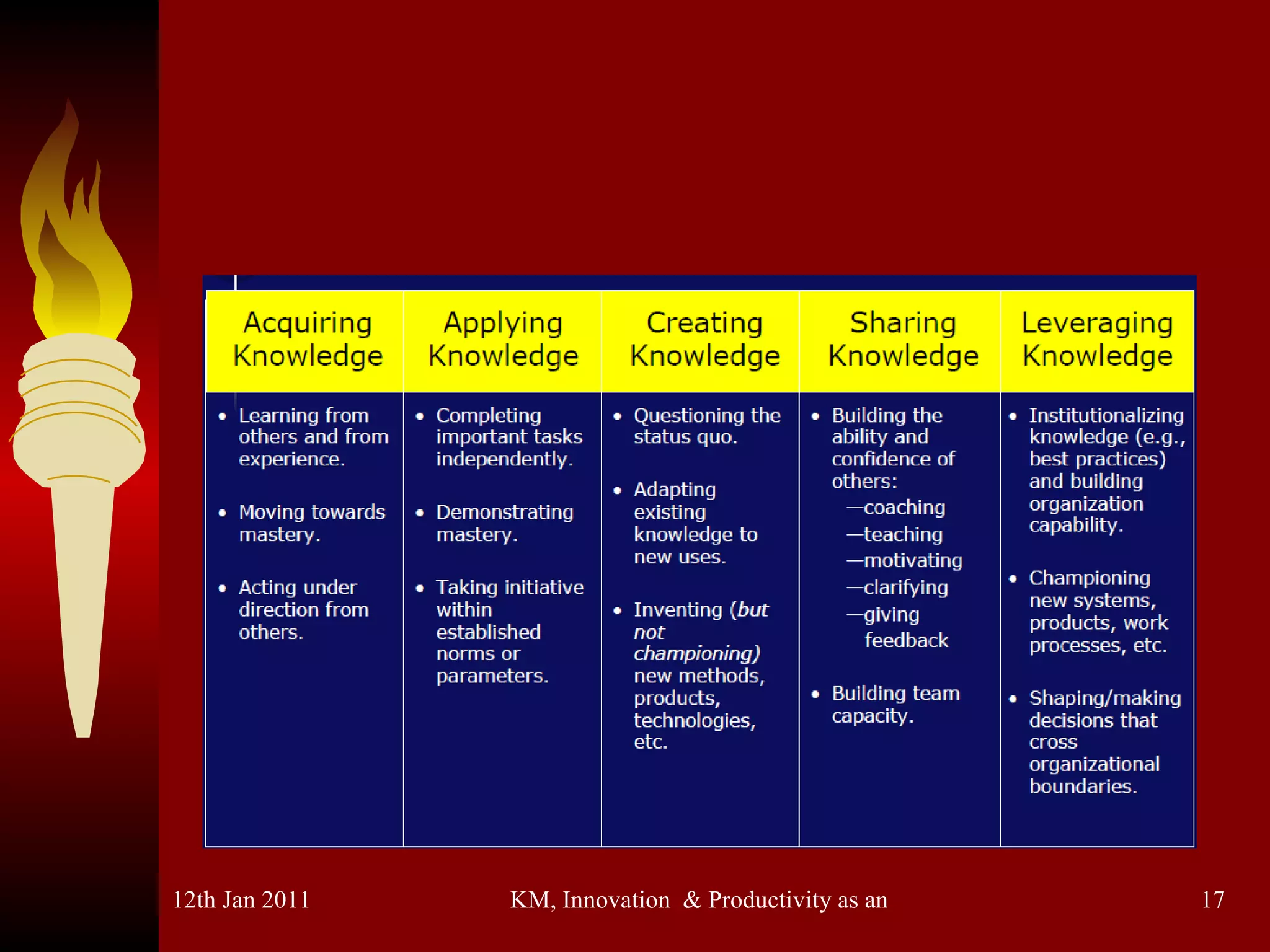
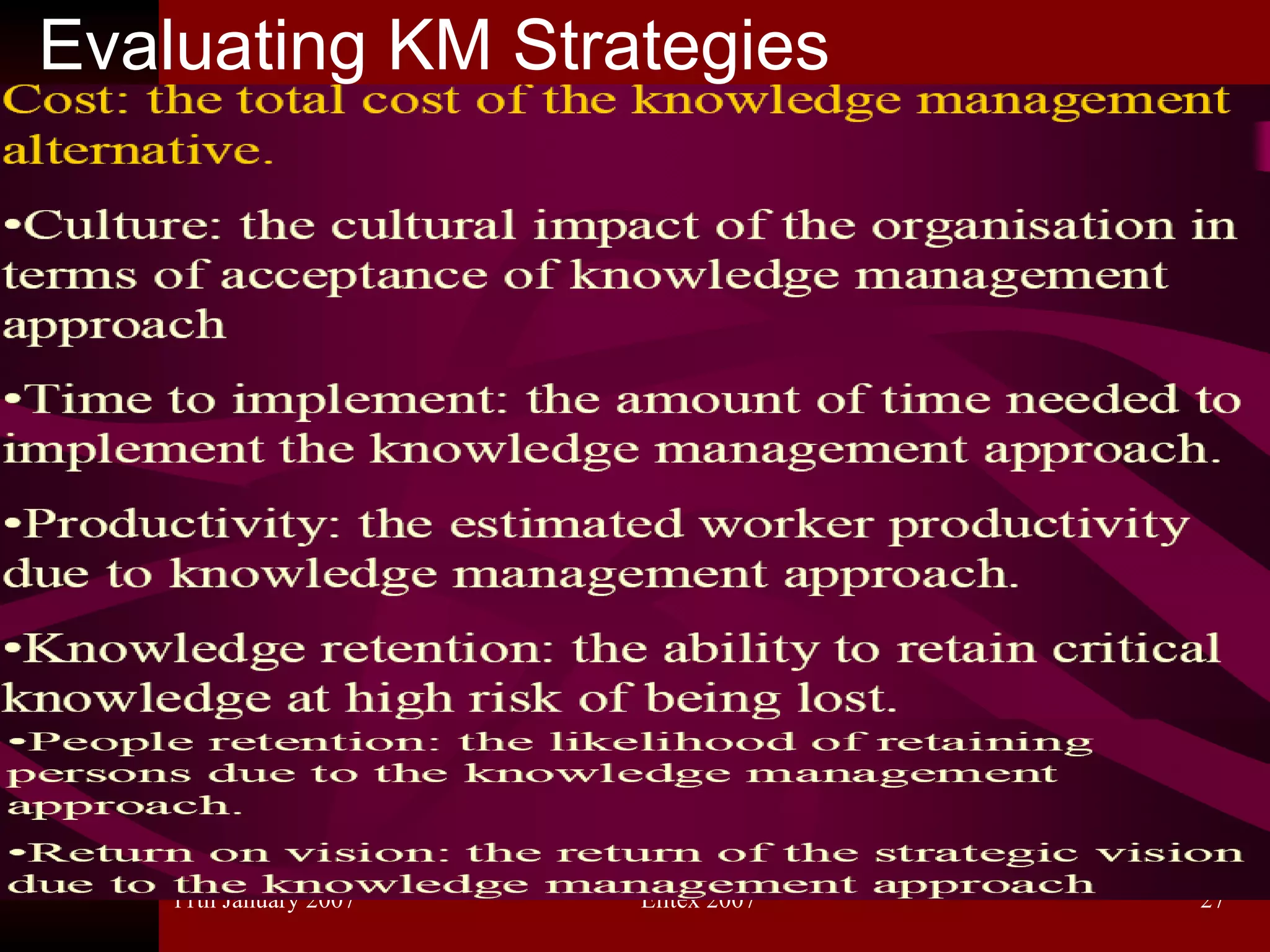
Evaluating KM Strategies: Cost Culture Time to Implement Productivity Knowledge Retention People Retention Return on Vision
A combination of technology, innovation, leadership and inspired workforce-Ingredients for India Development The economic strength is powered by competitiveness - The competitiveness is powered by knowledge power.  - The knowledge power is powered by Technology and Innovation.  - The Technology and Innovation is powered by Resource Investment.  - The Resource investment is powered by Revenue and Return on Investment.  - The Revenue is powered by Volume and repeat sales through Customer Loyalty.  - The customer loyalty is powered by Quality and value of products.  - Quality and value of products is powered by Employee Productivity and innovation.  - The Employee Productivity is powered by Employee Loyalty, employee satisfaction and working environment. - The Working Environment is powered by management stewardship.  - Management stewardship is powered by Invisible leadership
Knowledge Work: Should have Autonomy & Associated Responsibility Continuous Innovation should be built into the KW’s Job. Continuous Learning & Continuous Teaching should be part of the Job Judgments rather than Measures dominates KWs’ Productivity
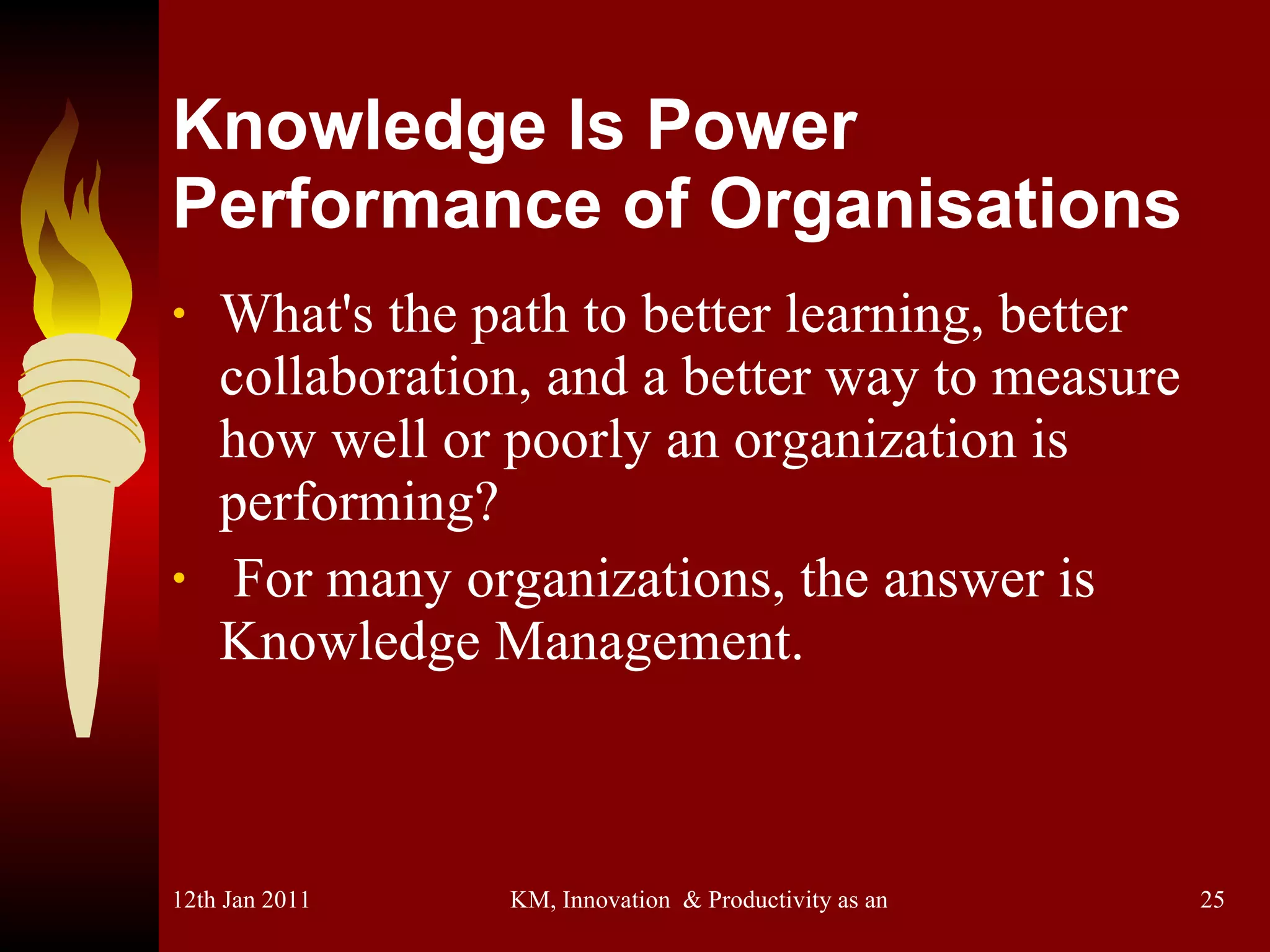
Knowledge Is Power Performance of Organisations What's the path to better learning, better collaboration, and a better way to measure how well or poorly an organization is performing? For many organizations, the answer is Knowledge Management.
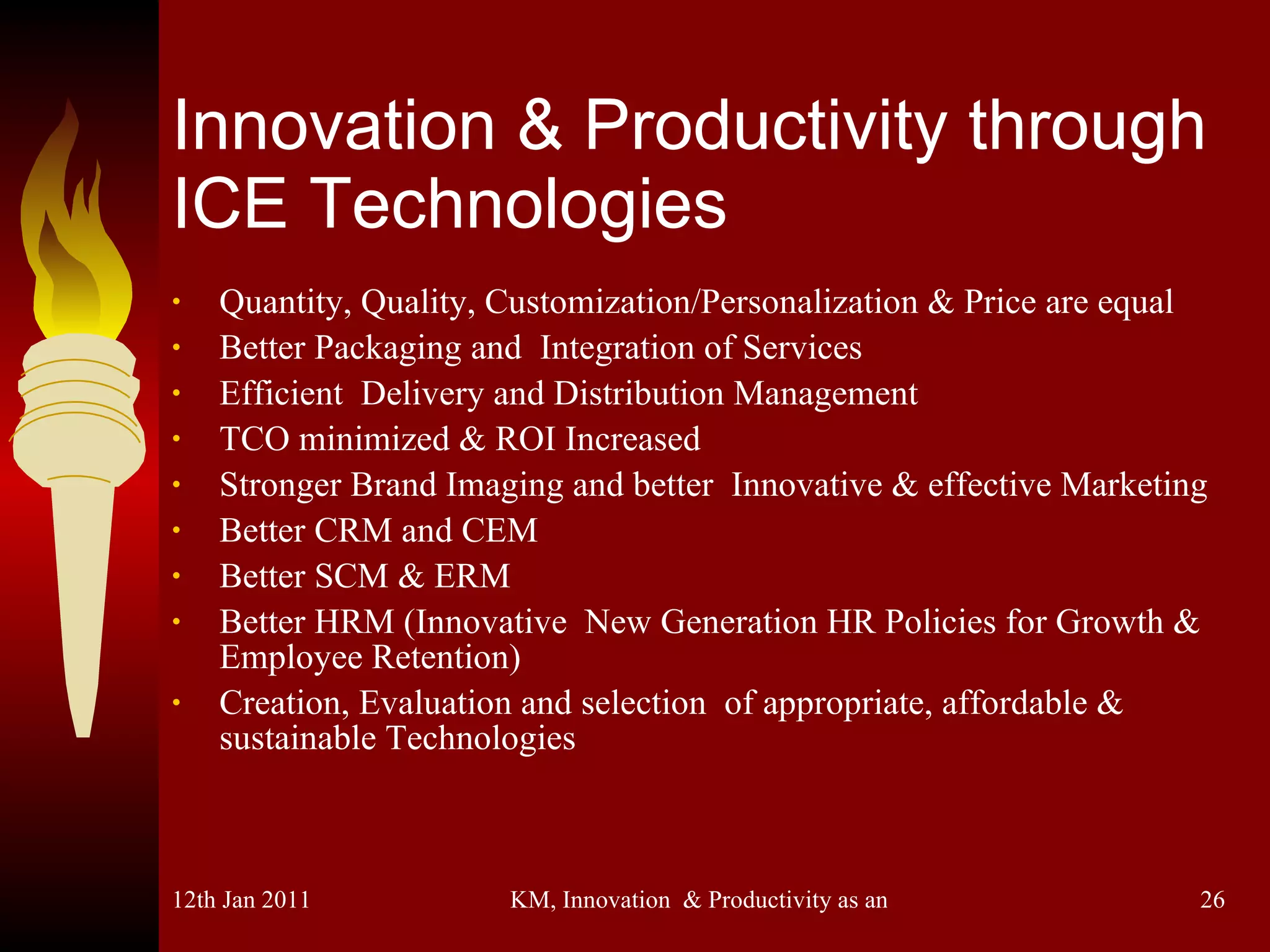
Innovation & Productivity through ICE Technologies Quantity, Quality, Customization/Personalization & Price are equal Better Packaging and  Integration of Services Efficient  Delivery and Distribution Management TCO minimized & ROI Increased Stronger Brand Imaging and better  Innovative & effective Marketing Better CRM and CEM Better SCM & ERM Better HRM (Innovative  New Generation HR Policies for Growth &  Employee Retention) Creation, Evaluation and selection  of appropriate, affordable & sustainable Technologies
Evaluating KM Strategies
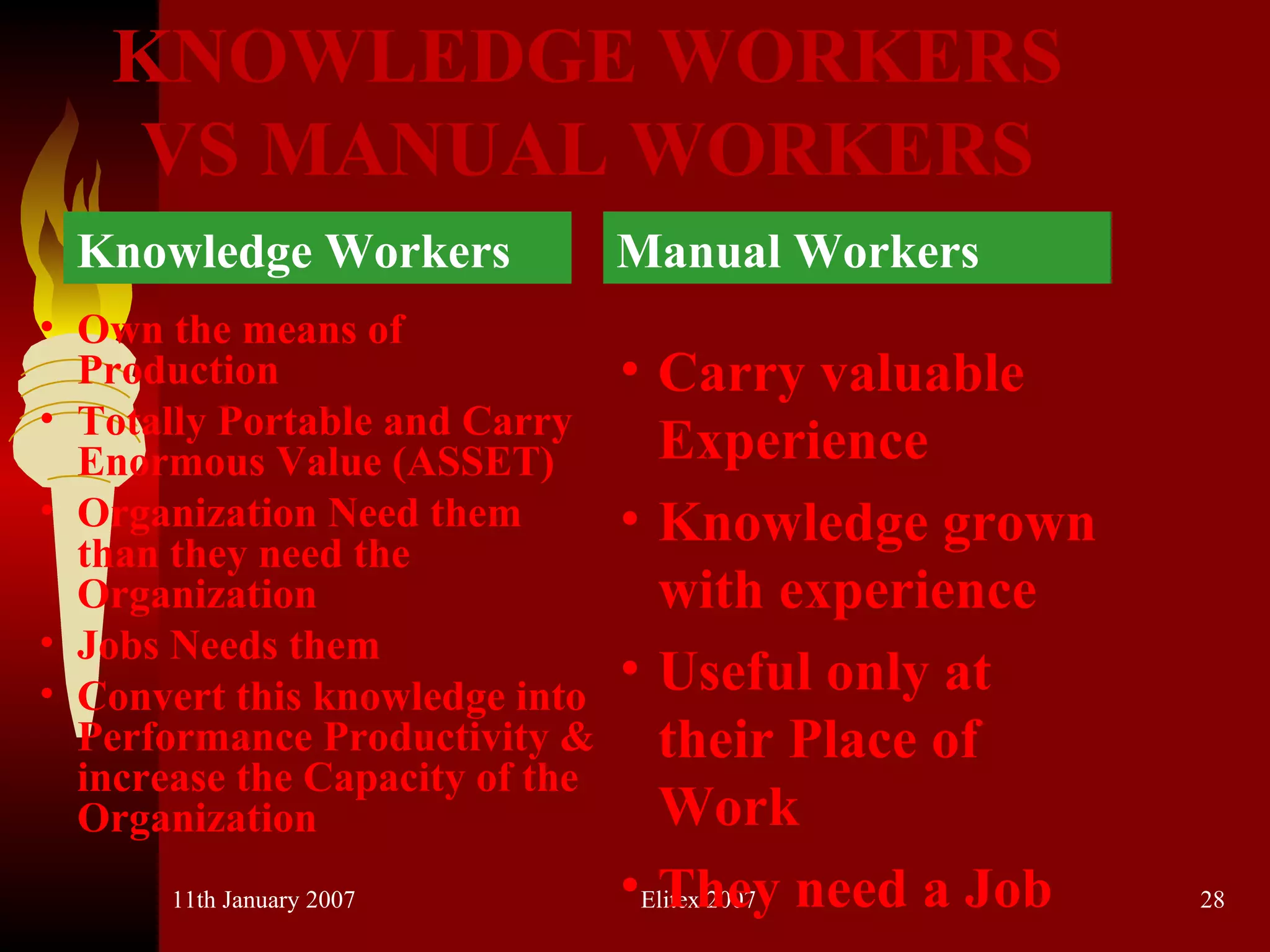
KNOWLEDGE WORKERS VS MANUAL WORKERS Own the means of Production Totally Portable and Carry Enormous Value (ASSET) Organization Need them than they need the Organization Jobs Needs them Convert this knowledge into Performance Productivity & increase the Capacity of the Organization Carry valuable Experience Knowledge grown with experience Useful only at their Place of Work They need a Job Knowledge Workers Manual Workers
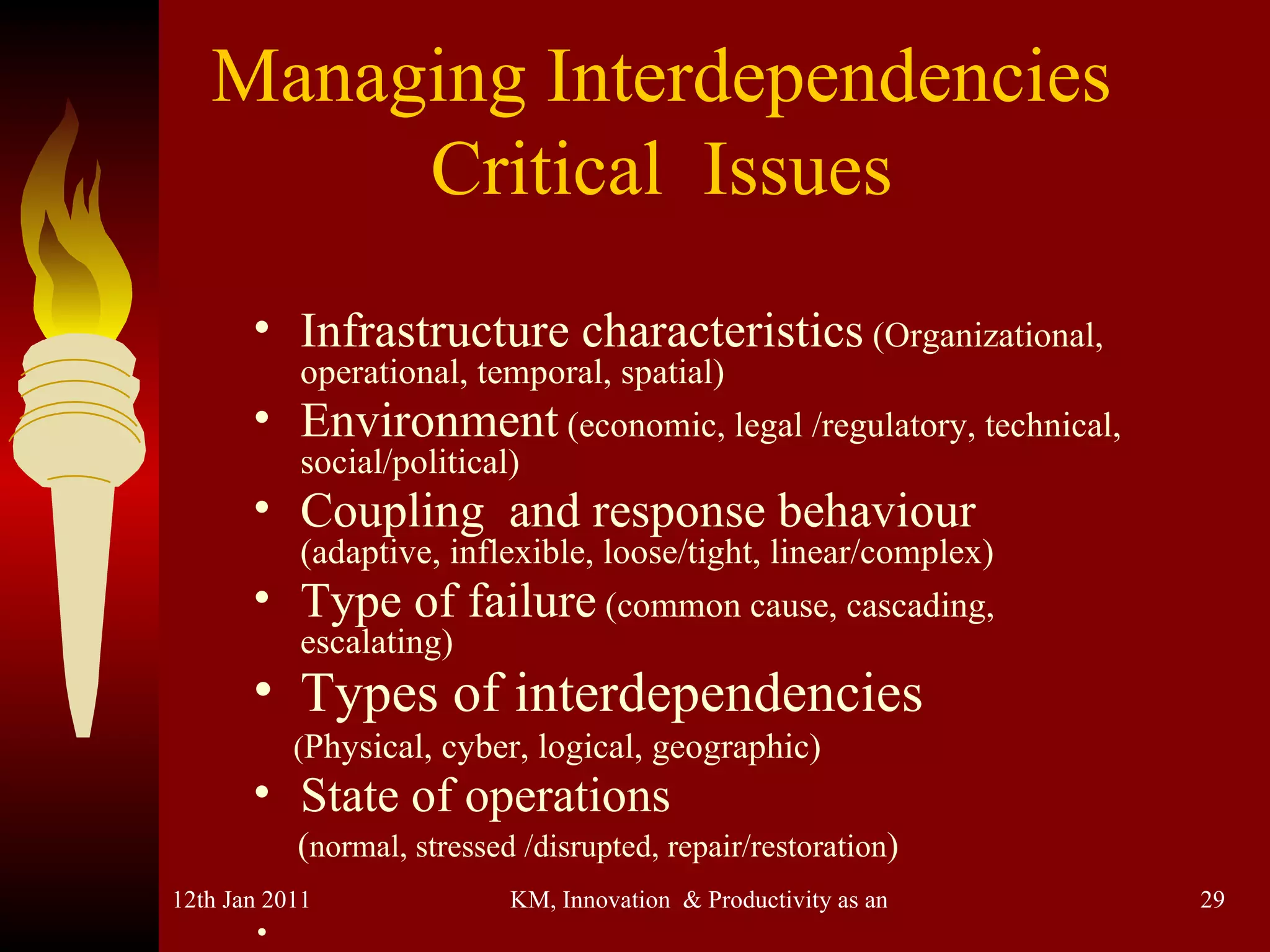
Managing Interdependencies Critical  Issues Infrastructure characteristics  (Organizational, operational, temporal, spatial)  Environment  (economic, legal /regulatory, technical, social/political) Coupling  and response behaviour   (adaptive, inflexible, loose/tight, linear/complex) Type of failure  (common cause, cascading, escalating) Types of interdependencies   ( Physical, cyber, logical, geographic) State of operations   ( normal, stressed /disrupted, repair/restoration ) .
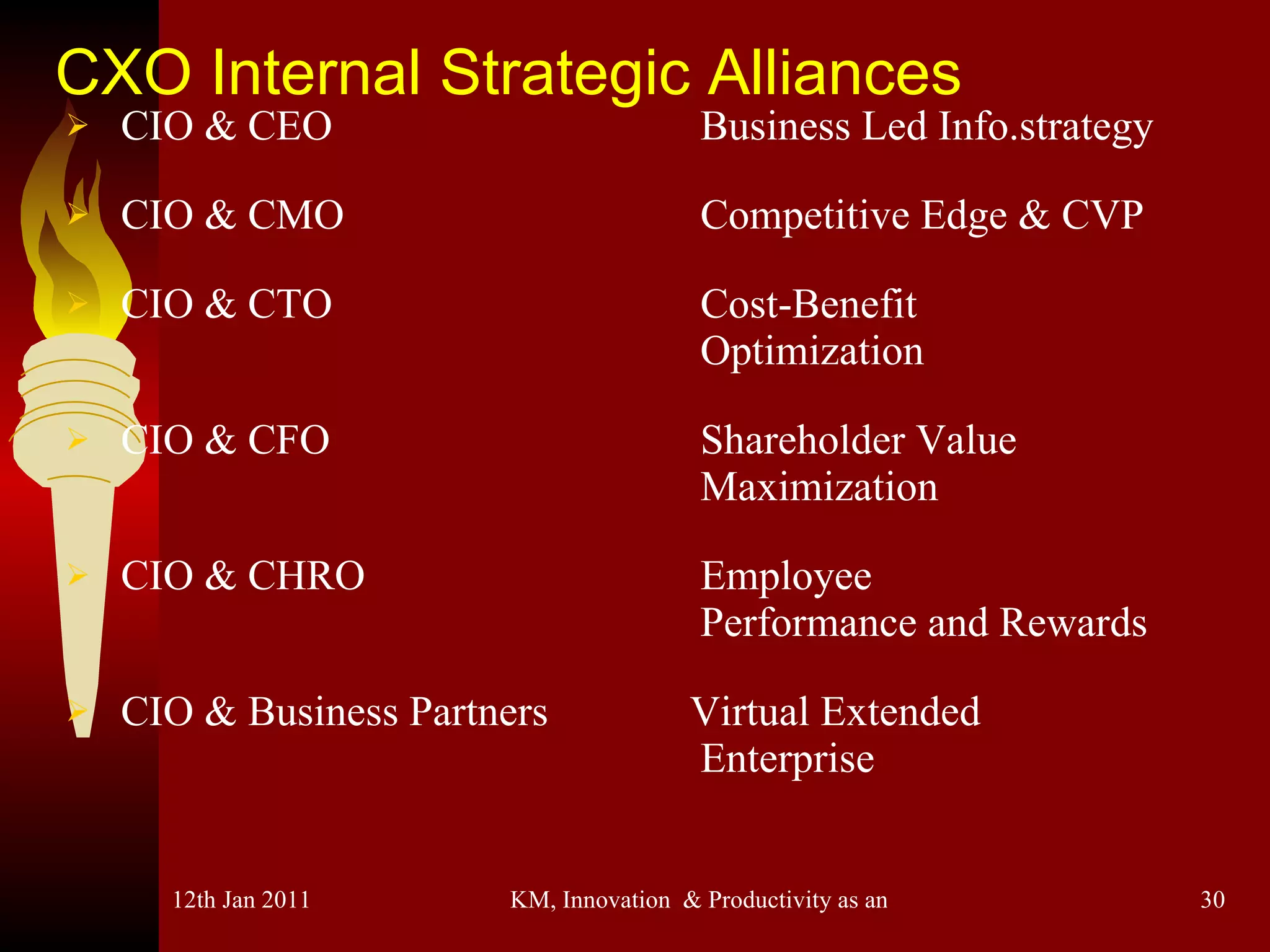
CIO & CEO Business Led Info.strategy CIO & CMO Competitive Edge & CVP CIO & CTO Cost-Benefit  Optimization CIO & CFO Shareholder Value  Maximization CIO & CHRO Employee  Performance and Rewards CIO & Business Partners   Virtual Extended  Enterprise CXO Internal Strategic Alliances
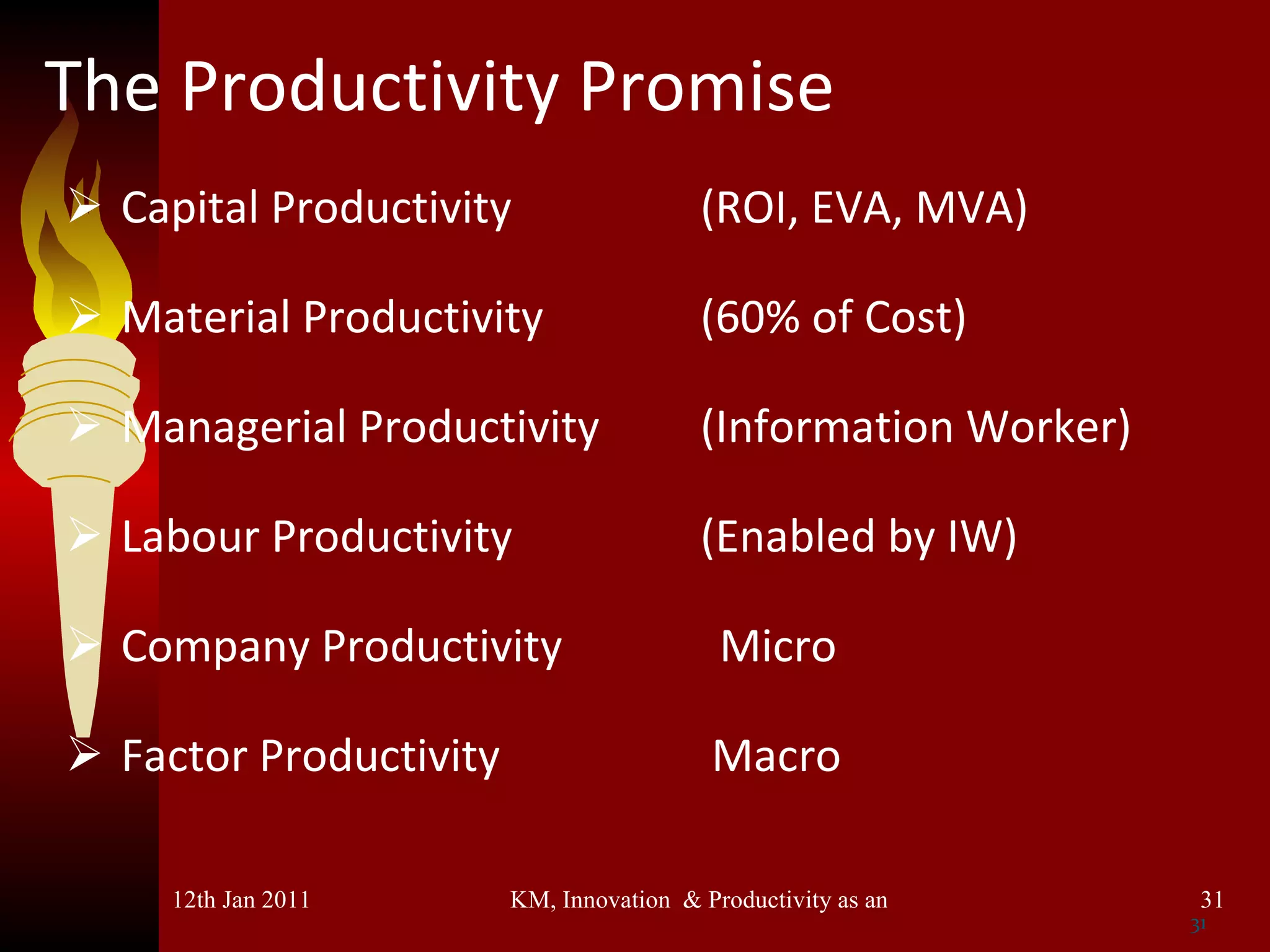
Capital Productivity (ROI, EVA, MVA) Material Productivity (60% of Cost) Managerial Productivity (Information Worker) Labour Productivity (Enabled by IW) Company Productivity   Micro Factor Productivity  Macro The Productivity Promise
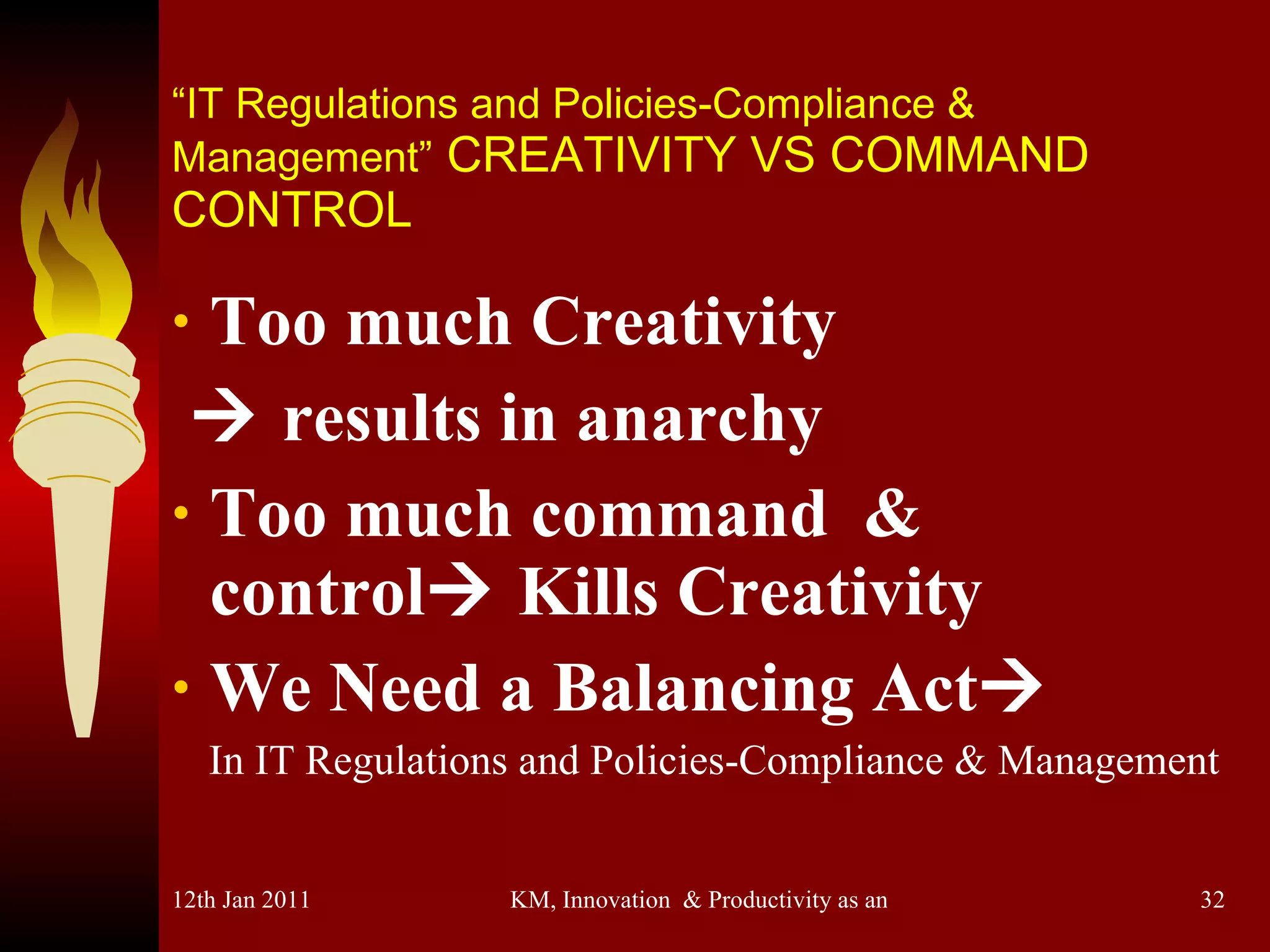
“ IT Regulations and Policies-Compliance & Management”  CREATIVITY VS COMMAND CONTROL Too much Creativity    results in anarchy Too much command  & control   Kills Creativity We Need a Balancing Act  In IT Regulations and Policies-Compliance & Management
Lately, management realizes that there is a need to extend governance to information technology as well, and provide the leadership, organizational structures and processes that ensure that the enterprise’s IT sustains and extends the enterprise’s strategies and objectives.
With the increasingly demanded accountably of the Board of Management, an organization’s information and other intangible assets account for more than 80 percent of its market value,( IT Governance Institute® (ITGI®)). impairments to the integrity of information can be devastating to a company and its senior executives, who are held increasingly accountable for their organization’s financial information.
 
Governance Components Project Governance IT Governance Legal Governance Security Governance Human & Humane Governance
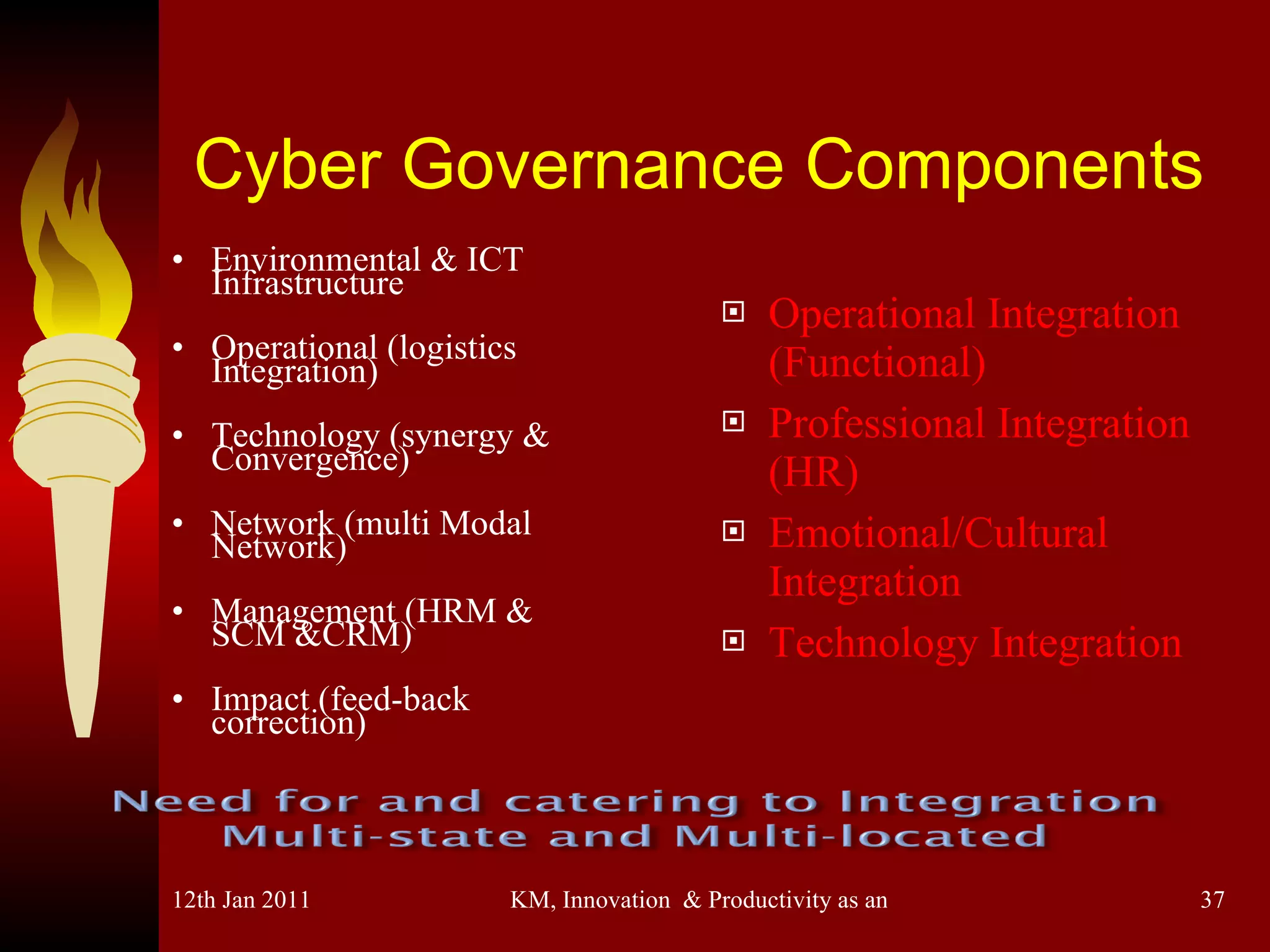
Cyber Governance Components Environmental & ICT Infrastructure Operational (logistics Integration) Technology (synergy & Convergence) Network (multi Modal Network) Management (HRM & SCM &CRM) Impact (feed-back correction) Operational Integration (Functional) Professional Integration (HR) Emotional/Cultural Integration Technology Integration
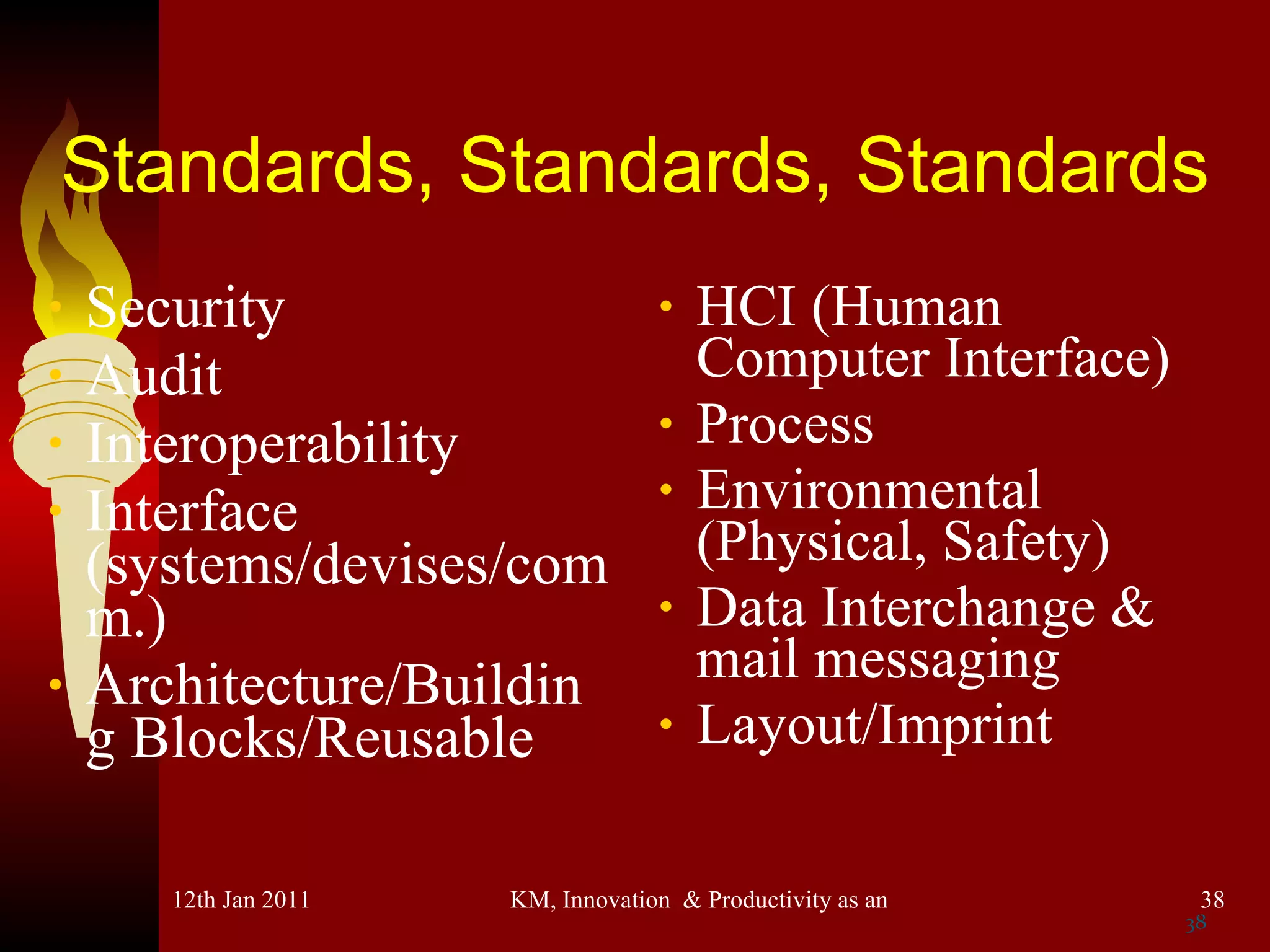
Standards, Standards, Standards Security Audit Interoperability Interface (systems/devises/comm.) Architecture/Building Blocks/Reusable HCI (Human Computer Interface) Process Environmental (Physical, Safety) Data Interchange & mail messaging Layout/Imprint
 
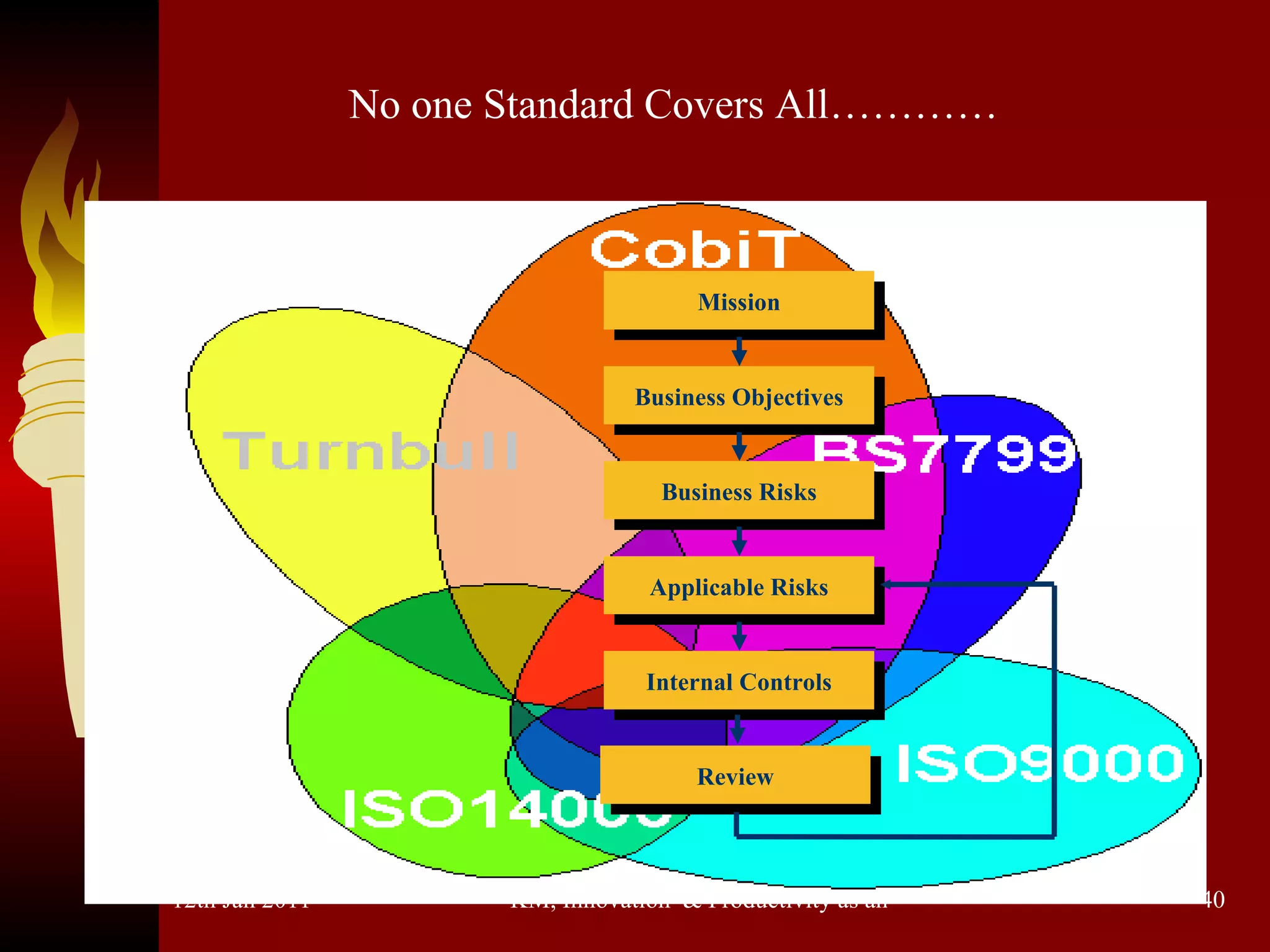
No one Standard Covers All………… Mission Business Objectives Business Risks Applicable Risks Internal Controls Review
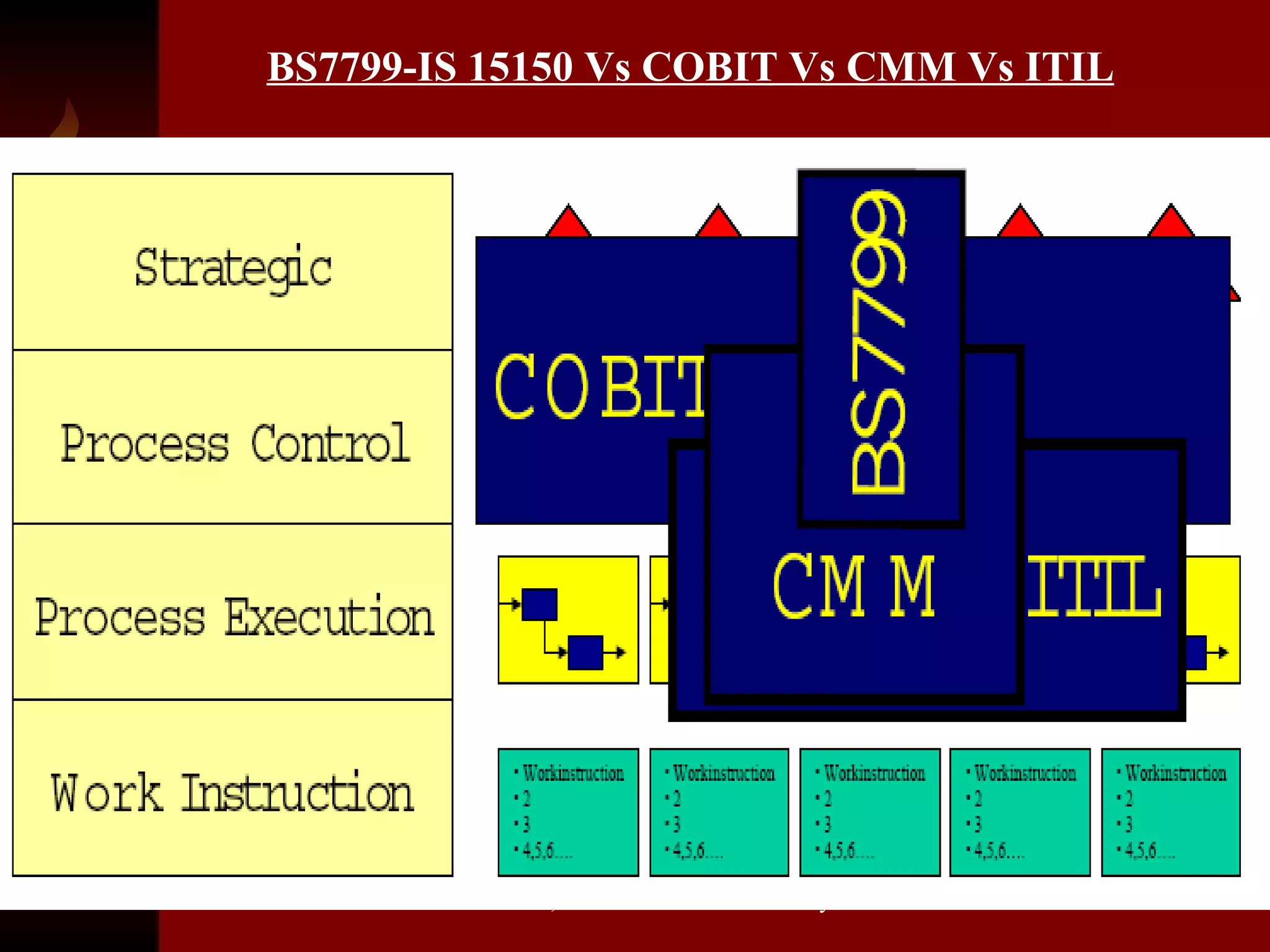
BS7799-IS 15150 Vs COBIT Vs CMM Vs ITIL
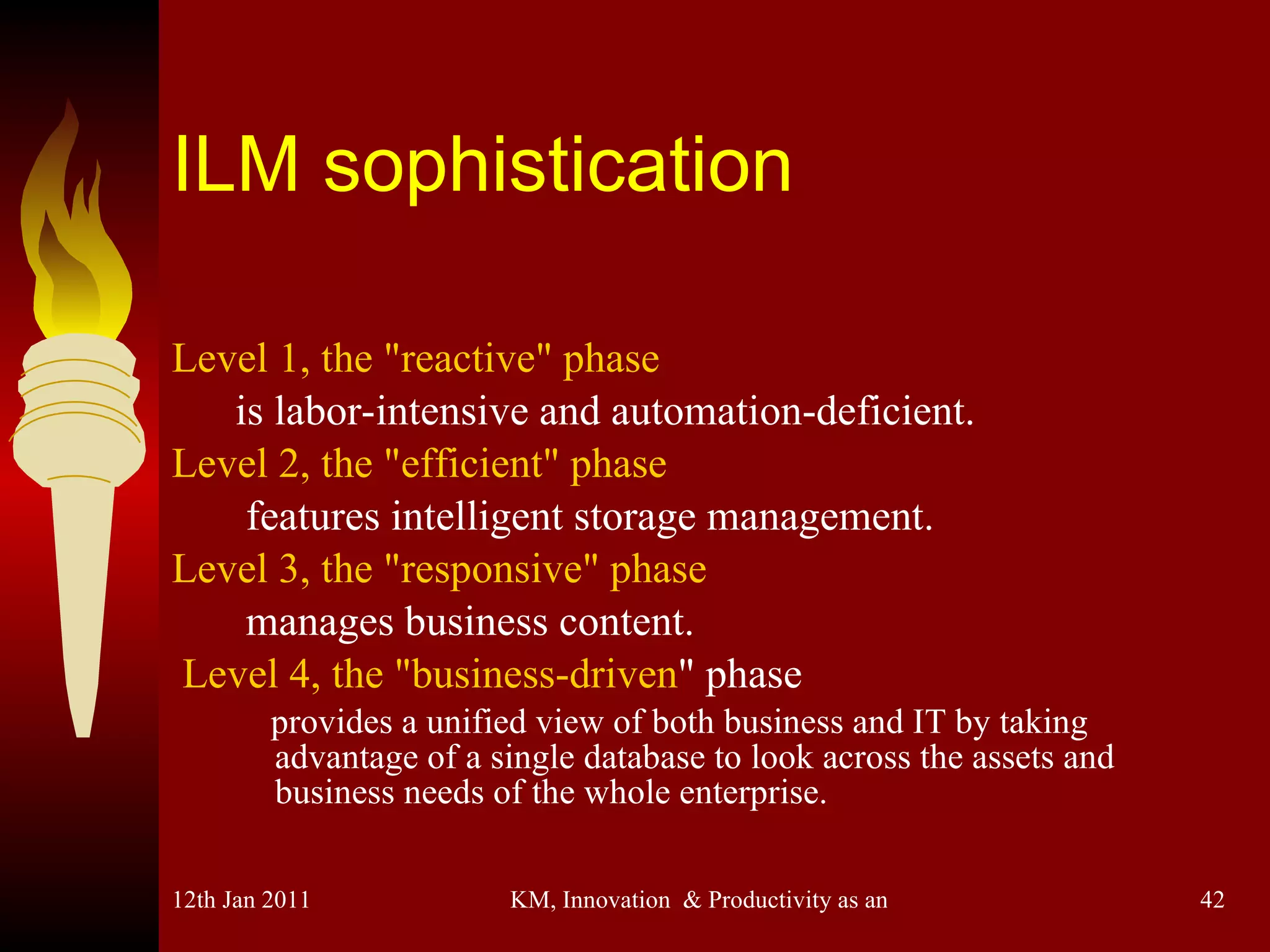
ILM sophistication Level 1, the "reactive" phase   is labor-intensive and automation-deficient.  Level 2, the "efficient" phase   features intelligent storage management.   Level 3, the "responsive" phase   manages business content.   Level 4, the "business-driven " phase  provides a unified view of both business and IT by taking  advantage of a single database to look across the assets and business needs of the whole enterprise.
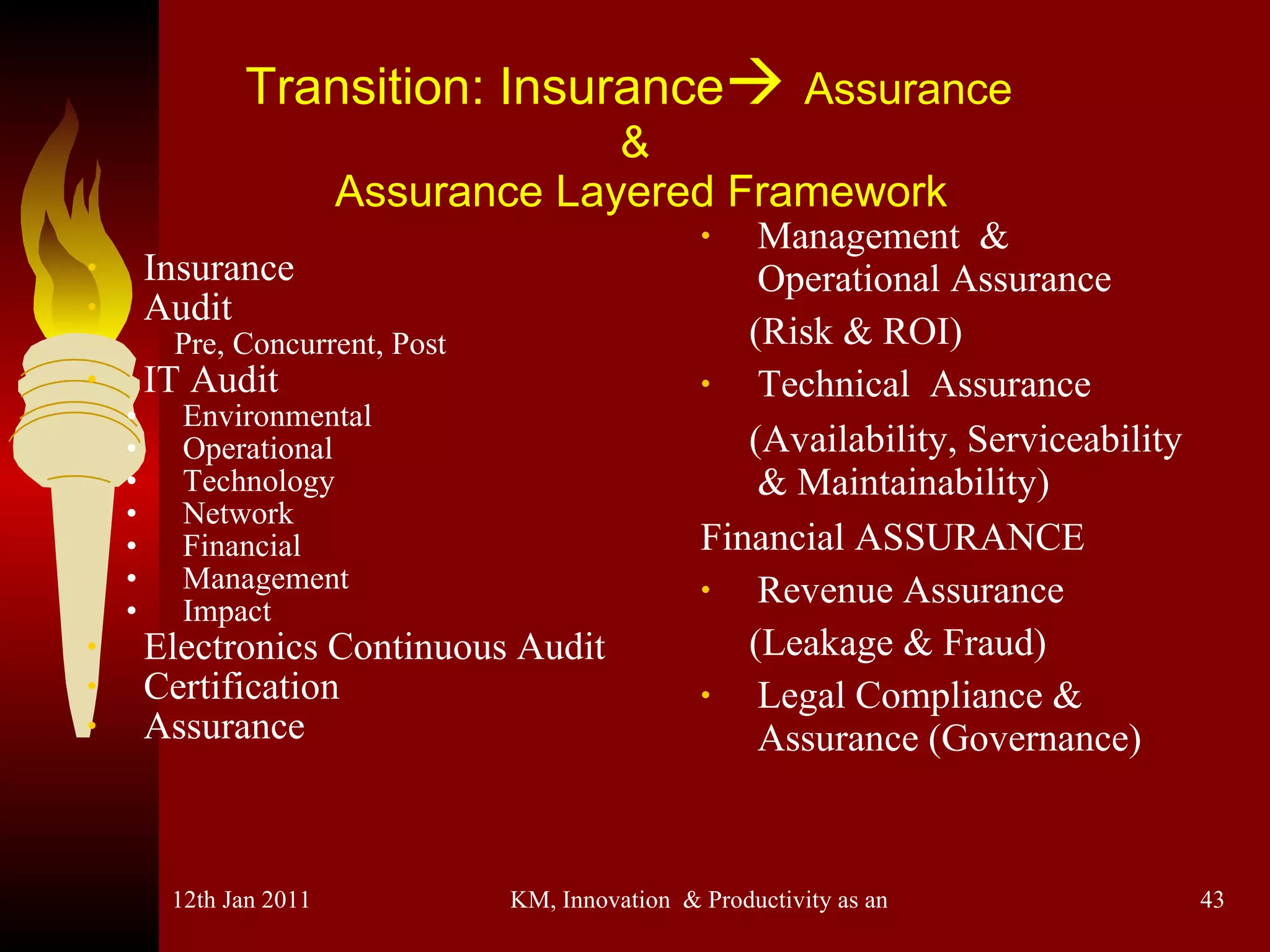
Transition: Insurance    Assurance  &  Assurance Layered Framework Insurance Audit Pre, Concurrent, Post IT Audit Environmental Operational Technology Network Financial Management Impact Electronics Continuous Audit Certification Assurance Management  & Operational Assurance  (Risk & ROI) Technical  Assurance (Availability, Serviceability & Maintainability) Financial ASSURANCE Revenue Assurance  (Leakage & Fraud) Legal Compliance & Assurance (Governance)
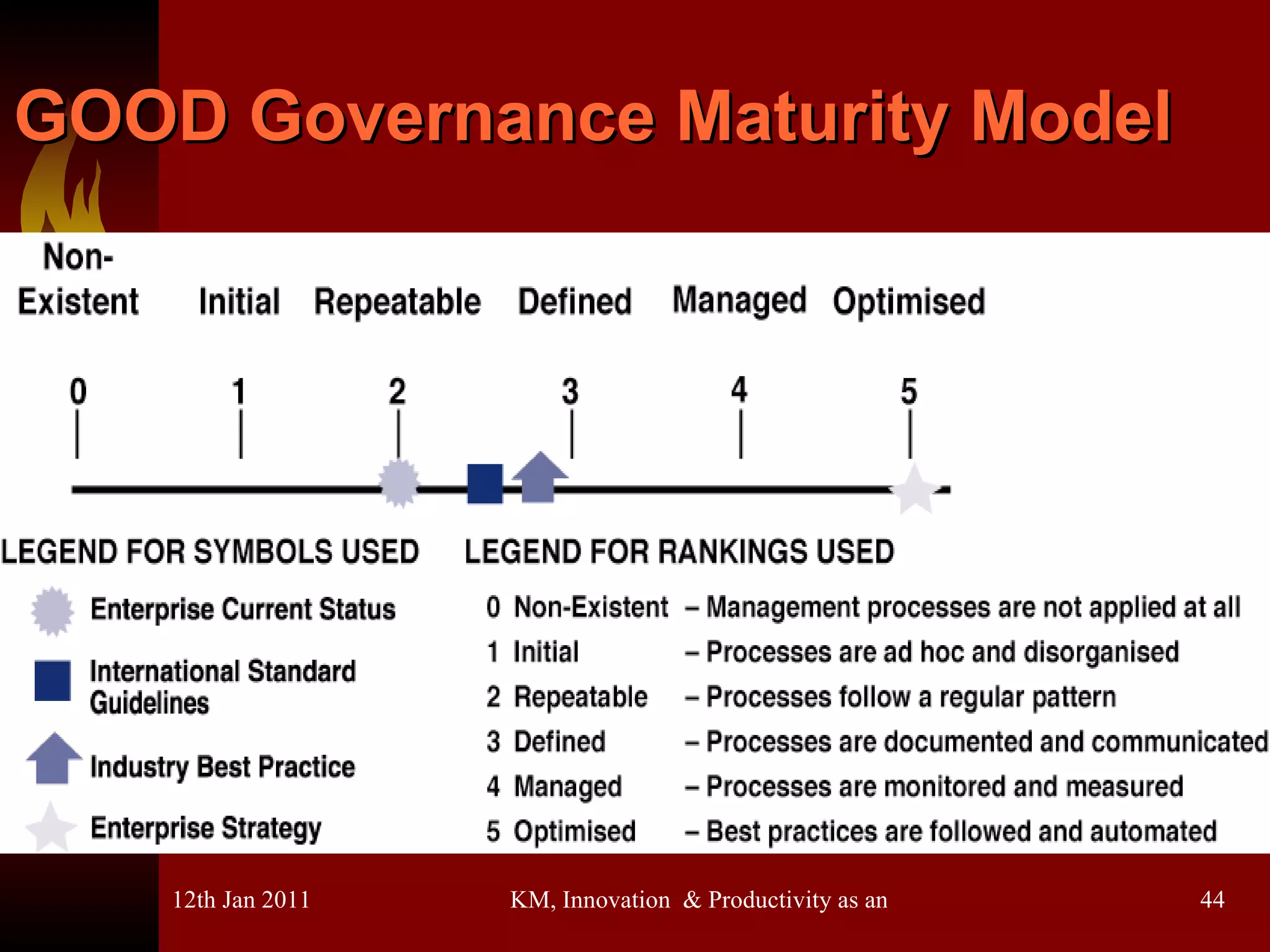
GOOD Governance Maturity Model
Lead IT governance—don't be led by it
“  Regulations and Policies-Compliance & Management” Pre-requisites  Physical Infrastructure and Mind-set PAST :  We have inherited a past, for which we cannot be held responsible ; PRESENT :  have fashioned the present on the basis of development models, which have undergone many mid-course corrections FUTURE : The path to the future -- a future in which India and Indians will play a dominant role in world affairs -- is replete with opportunities and challenges.  In a number of key areas,  it is necessary Break from the past in order to achieve our Vision.  We have within ourselves the capacity to succeed We have to embrace  Integrated Security & Cyber Assurance Framework
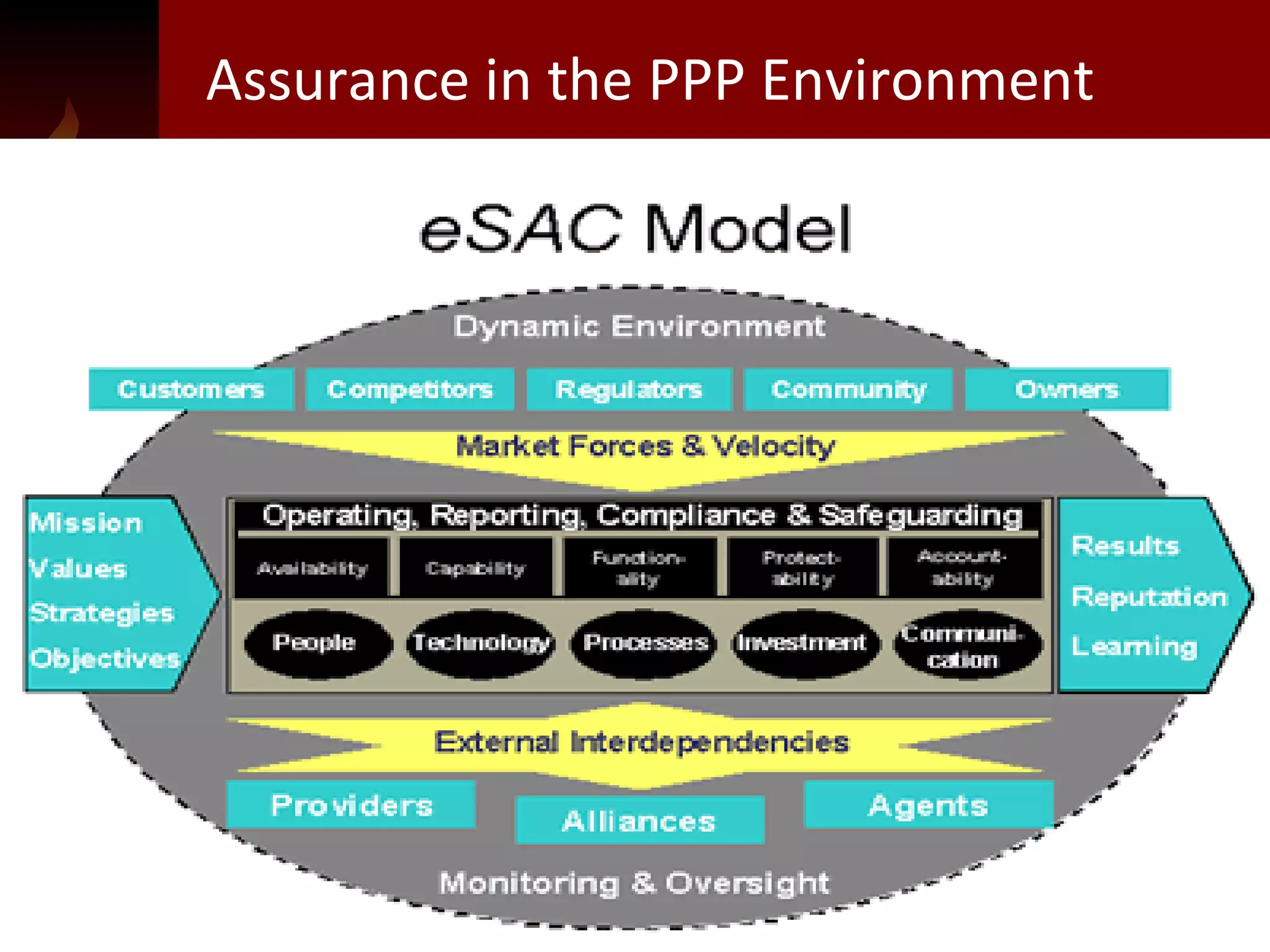
3/7/2009 IMT Ghaziabad Lecture Prof. KS@2009 March 2009 Assurance in the PPP Environment
Good Governance  - Final Message “ In Governance matters  Past  is no guarantee;  Present  is imperfect and  Future  is uncertain“ “ Failure is not when we fall down, but when we fail to get up”
THANK YOU For  Interaction: Prof. K. Subramanian [email_address] [email_address] [email_address] [email_address] Tele: 29533068

Iipa lecture km & good governance jan 12 2011

  • 1.
    Knowledge Management, Innovation& Productivity as an Integral Part of Good Governance Prof. K. Subramanian SM(IEEE, USA), SMACM(USA), FIETE, SMCSI,MAIMA,MAIS(USA),MCFE(USA) Director & Professor, Advanced Center for Informatics & Innovative Learning (ACIIL), IGNOU Honorary IT Adviser to CAG of India Ex-DDG(NIC), Ministry of Comm. & IT Emeritus President, eInformation Systems, Security, Audit Association President, Cyber Society of India
  • 2.
    Agenda Recent DevelopmentsMyths of KM KM & Society Innovation & Productivity Standards Governance & Assurance Maturity Model
  • 3.
    Important Notable Quotes “ Ever since men began to modify their lives by using technology they have found themselves in a series of technological traps.” Roger Revelle “ The law is the last interpretation of the law given by the last judge.”- Anon. “ Privacy is where technology and the law collide.” -- Richard Smith (who traced the ‘I Love You’ and ‘Melissa viruses’) "Technology makes it possible for people to gain control over everything, except over technology" John Tudor
  • 4.
    Important Notable Quotes Productivity and Innovation are the strongest determinants of standard of living in the knowledge-based society, and provide the only direct route to recession-proofing the economy, and achieving broad economic and social benefits. Research performance is a robust predictor of productivity and innovation Innovation is at the heart of productivity growth
  • 5.
    Typical Global ScenarioCyberspace is Dynamic, Undefined and Exponential Countries’ need dynamic laws, keeping pace with the technological advancements In a Virtual Space, Netizens Exist, Citizens Don’t! Trust in E-environments Lack of a mature IT society Absence of Single governing body Legislation High skill inventory Reduce fear of being caught Disgruntled Employees
  • 6.
    Global issues withGovernance of Cyberspace Information Technology & Business: current status and future Does IT matter? IT--enabled Business - Role of Information, Information Systems - In business - Role of information technology in enabling business - IT dependence Changing Role of the CIO Web 2.0 and 3.0 and governing cyberspace eBusiiness, eHealth, eBanking, eGovenance Current Challenges and Issues 12/02/07 Suny BUFF Lecture 27th Nov 2007
  • 7.
    The drivers andemerging trends in the Digital/Information age Economic Drivers Technological Advances Political Drivers Social Drivers Citizens Community Organizations Other Governments Media Businesses Employees Government-Government Business-Government Citizen-Government Common Needs
  • 8.
    These changes impactthe fundamental way that organizations compete in the digital/information age . Industrial Age Foundation for Economic Development Digital/Information Age Control of Natural Resources Control of Knowledge Competitive Advantage Protection of Assets/Resources Open/Competitive Rapid (re)invention Increase Scale Expansion Business Environment Labor Intensive Jobs Process-Related Work Work Outsourced Decision Making Hierarchical Collaborative Key Assets Human Resources, Information & Technical Infrastructure Physical Resources Geographic Scope Global Regional
  • 9.
    MEDIATING FACTORS: Environment Culture Structure Standard Procedures Politics Management Decisions Chance ORGANIZATIONS INFORMATION TECHNOLOGY
  • 10.
    17 Myths ofKM A. The nature of knowledge 1. “Knowledge is always a plus” transformational innovation and disruptive innovation 2. “Knowledge always helps innovation” 3. “Knowledge is sticky” 4. “The concept of knowledge is infinitely extendable”
  • 11.
    17 Myths ofKM B. The nature of knowledge sharing 5. “Knowledge can be transferred” 6. “Knowledge-sharing is always a good thing”. 7. “Knowledge is more important than values” 8. “People always want to have better knowledge” 9. “The task of KM is to enhance the supply of knowledge” 10. “There are structural solutions to the lack of demand for knowledge” 11. “KM is the same for all organizations”
  • 12.
    17 Myths ofKM C. The impact of knowledge sharing 12. “Knowledge is the only sustainable competitive advantage” 13. “Knowledge management will transform the business landscape” 14. “KM succeeded and no one knows it” 15. “It was the IT vendors who killed KM” 16. “The right question to ask is: how do you make knowledge-based organizations?” 17. “Knowledge is the raison d’etre for organizations and explains competitive advantage”
  • 13.
    Principles of Good Governance Leadership Selflessness Integrity Objectivity Accountability Openness Honesty Humane Governance Should be Creative Uses Knowledge for National Wealth and Health creation Understands the economics of Knowledge High Morality
  • 14.
    New Important EvolvingTechnologies 6T (IT, BT, NT, ET, CT and ST) Digital Cocooning, Insperience (Indoor + Experience), Web Identity (Avata, MiniHome,…), Consumption Curator, Ubitizen (Ubiquitous + Citizen), DMB (Digital Multimedia Broadcasting), TPS (Triple Play Service: Internet +Tel+ Broadcast) Grid Computing Ubiquitous Technology
  • 15.
    New Environmental ChangesSpace : Real Space (Physical)  Cyber Space (Electronic)  Ubiquitous Space (Cross Space)  Time : Local Time  Global time (Need) through Real-time Systems  (Communication) Speed : Mbps  Gbps  Tbps (Tera: 10 12 )  Pbps (Peta: 10 15 ) (  Velocity of Light)  Media : Analog  Digital  Hybrid System : Centralized  Distributed  Integrated
  • 16.
    The Connectivity ParadigmThe Physical Connectivity The Economic Connectivity The Electronic Connectivity The Knowledge Connectivity The Spiritual Connectivity
  • 17.
  • 18.
    How to bean Innovative Organization Create a Strategic Vision Establish Innovation as a Priority Create Organizational Structures that Promote Collaboration Establish Processes to Convert Idea to Innovations Allocate Resources Train Workforce on Creativity Tools Measure & Communicate Results Recognize Creative Behavior Reward Innovative Results
  • 19.
    Innovation at allLevels Cost Culture Time to Implement Productivity Knowledge Retention People Retention Return on Vision
  • 20.
    FUTURE CORPORATIONS’ NEWGENERATION HR POLICY To cover all type of Employees Must attract, hold and make productive people and develop long-term relationship, knowledge Outside information-gather, analyze and filter and use & reuse. Spot, Pat & Develop Change Agents Big Ideas-Fuse, Infuse & Diffuse Cost Reduced Controlled Assets To Grow and Nurture
  • 21.
    KM & CommunityDespite the rise of virtual technologies, the physical work environment is still a major factor in knowledge workers performance Creating a knowledge friendly culture and a productive work environment, fending off bureaucracy; helping to create and nurture such a community Looking at Intellectual Capital created in relation to the resources deployed Managers of knowledge workers often have to be knowledge workers themselves; they are “ player/coaches”. Getting the right balance of playing and coaching is critical, but is quite difficult The fate of advanced economies depends upon making knowledge workers more productive Peter Drucker
  • 22.
    Evaluating KM Strategies:Cost Culture Time to Implement Productivity Knowledge Retention People Retention Return on Vision
  • 23.
    A combination oftechnology, innovation, leadership and inspired workforce-Ingredients for India Development The economic strength is powered by competitiveness - The competitiveness is powered by knowledge power. - The knowledge power is powered by Technology and Innovation. - The Technology and Innovation is powered by Resource Investment. - The Resource investment is powered by Revenue and Return on Investment. - The Revenue is powered by Volume and repeat sales through Customer Loyalty. - The customer loyalty is powered by Quality and value of products. - Quality and value of products is powered by Employee Productivity and innovation. - The Employee Productivity is powered by Employee Loyalty, employee satisfaction and working environment. - The Working Environment is powered by management stewardship. - Management stewardship is powered by Invisible leadership
  • 24.
    Knowledge Work: Shouldhave Autonomy & Associated Responsibility Continuous Innovation should be built into the KW’s Job. Continuous Learning & Continuous Teaching should be part of the Job Judgments rather than Measures dominates KWs’ Productivity
  • 25.
    Knowledge Is PowerPerformance of Organisations What's the path to better learning, better collaboration, and a better way to measure how well or poorly an organization is performing? For many organizations, the answer is Knowledge Management.
  • 26.
    Innovation & Productivitythrough ICE Technologies Quantity, Quality, Customization/Personalization & Price are equal Better Packaging and Integration of Services Efficient Delivery and Distribution Management TCO minimized & ROI Increased Stronger Brand Imaging and better Innovative & effective Marketing Better CRM and CEM Better SCM & ERM Better HRM (Innovative New Generation HR Policies for Growth & Employee Retention) Creation, Evaluation and selection of appropriate, affordable & sustainable Technologies
  • 27.
  • 28.
    KNOWLEDGE WORKERS VSMANUAL WORKERS Own the means of Production Totally Portable and Carry Enormous Value (ASSET) Organization Need them than they need the Organization Jobs Needs them Convert this knowledge into Performance Productivity & increase the Capacity of the Organization Carry valuable Experience Knowledge grown with experience Useful only at their Place of Work They need a Job Knowledge Workers Manual Workers
  • 29.
    Managing Interdependencies Critical Issues Infrastructure characteristics (Organizational, operational, temporal, spatial) Environment (economic, legal /regulatory, technical, social/political) Coupling and response behaviour (adaptive, inflexible, loose/tight, linear/complex) Type of failure (common cause, cascading, escalating) Types of interdependencies ( Physical, cyber, logical, geographic) State of operations ( normal, stressed /disrupted, repair/restoration ) .
  • 30.
    CIO & CEOBusiness Led Info.strategy CIO & CMO Competitive Edge & CVP CIO & CTO Cost-Benefit Optimization CIO & CFO Shareholder Value Maximization CIO & CHRO Employee Performance and Rewards CIO & Business Partners Virtual Extended Enterprise CXO Internal Strategic Alliances
  • 31.
    Capital Productivity (ROI,EVA, MVA) Material Productivity (60% of Cost) Managerial Productivity (Information Worker) Labour Productivity (Enabled by IW) Company Productivity Micro Factor Productivity Macro The Productivity Promise
  • 32.
    “ IT Regulationsand Policies-Compliance & Management” CREATIVITY VS COMMAND CONTROL Too much Creativity  results in anarchy Too much command & control  Kills Creativity We Need a Balancing Act  In IT Regulations and Policies-Compliance & Management
  • 33.
    Lately, management realizesthat there is a need to extend governance to information technology as well, and provide the leadership, organizational structures and processes that ensure that the enterprise’s IT sustains and extends the enterprise’s strategies and objectives.
  • 34.
    With the increasinglydemanded accountably of the Board of Management, an organization’s information and other intangible assets account for more than 80 percent of its market value,( IT Governance Institute® (ITGI®)). impairments to the integrity of information can be devastating to a company and its senior executives, who are held increasingly accountable for their organization’s financial information.
  • 35.
  • 36.
    Governance Components ProjectGovernance IT Governance Legal Governance Security Governance Human & Humane Governance
  • 37.
    Cyber Governance ComponentsEnvironmental & ICT Infrastructure Operational (logistics Integration) Technology (synergy & Convergence) Network (multi Modal Network) Management (HRM & SCM &CRM) Impact (feed-back correction) Operational Integration (Functional) Professional Integration (HR) Emotional/Cultural Integration Technology Integration
  • 38.
    Standards, Standards, StandardsSecurity Audit Interoperability Interface (systems/devises/comm.) Architecture/Building Blocks/Reusable HCI (Human Computer Interface) Process Environmental (Physical, Safety) Data Interchange & mail messaging Layout/Imprint
  • 39.
  • 40.
    No one StandardCovers All………… Mission Business Objectives Business Risks Applicable Risks Internal Controls Review
  • 41.
    BS7799-IS 15150 VsCOBIT Vs CMM Vs ITIL
  • 42.
    ILM sophistication Level1, the "reactive" phase is labor-intensive and automation-deficient. Level 2, the "efficient" phase features intelligent storage management.  Level 3, the "responsive" phase manages business content.  Level 4, the "business-driven " phase provides a unified view of both business and IT by taking advantage of a single database to look across the assets and business needs of the whole enterprise.
  • 43.
    Transition: Insurance  Assurance & Assurance Layered Framework Insurance Audit Pre, Concurrent, Post IT Audit Environmental Operational Technology Network Financial Management Impact Electronics Continuous Audit Certification Assurance Management & Operational Assurance (Risk & ROI) Technical Assurance (Availability, Serviceability & Maintainability) Financial ASSURANCE Revenue Assurance (Leakage & Fraud) Legal Compliance & Assurance (Governance)
  • 44.
  • 45.
  • 46.
    “ Regulationsand Policies-Compliance & Management” Pre-requisites Physical Infrastructure and Mind-set PAST : We have inherited a past, for which we cannot be held responsible ; PRESENT : have fashioned the present on the basis of development models, which have undergone many mid-course corrections FUTURE : The path to the future -- a future in which India and Indians will play a dominant role in world affairs -- is replete with opportunities and challenges. In a number of key areas, it is necessary Break from the past in order to achieve our Vision. We have within ourselves the capacity to succeed We have to embrace Integrated Security & Cyber Assurance Framework
  • 47.
    3/7/2009 IMT GhaziabadLecture Prof. KS@2009 March 2009 Assurance in the PPP Environment
  • 48.
    Good Governance - Final Message “ In Governance matters Past is no guarantee; Present is imperfect and Future is uncertain“ “ Failure is not when we fall down, but when we fail to get up”
  • 49.
    THANK YOU For Interaction: Prof. K. Subramanian [email_address] [email_address] [email_address] [email_address] Tele: 29533068

Editor's Notes

  • #8 Citizen Need: Citizens are demanding that governments offer necessary services and operate at the same level of service that they receive in the private sector Citizens’ expectations of government are changing due to technological advances as well as social, political, and cultural changes Increased expectations for: better and faster service Expectation of reduced burden of government interaction: Paper work, Response time, Costs Increased expectations from government: Better service, Faster service, Secure service, Convenience, Personalized service Citizens are increasingly demanding secure interactions with government Business Needs: Expectation of reduced burden of government interaction: Paper work, Response time, Costs Increased expectations from government: Streamlined reporting, Better service, Faster service, Secure service, Convenience, Personalized service Businesses are demanding supportive legislative and regulatory environment Businesses are pushing for real-time feedback from government Businesses are expecting government to facilitate transition to the digital economy Community Needs: Communities are increasingly forming around issues to demand that governments provide the necessary services Communities’ expectations are changing due to technological advances as well as social, political, and cultural changes Regionalization of communities is pushing for improved information sharing among communities Non-geographic communities of interests are growing across the globe Devolution of accountability & service delivery responsibility to local community Virtual communities are expecting 7x24 responsiveness from government Employee Needs: Employees need to have the information, training, skills and assets to do their jobs more efficiently Recruiting and retaining highly skilled employees is increasing becoming chanllenging Demand similar training and work environment to leading edge corporations Employees’ expectations are changing due to technological advances as well as political and cultural changes Create more challenging work environment Knowledge management required by employees to provide value added services Enhanced level of skills required to deliver services via the Internet Continuous skill-enhancement is needed to meet the challenges arising from rapid technological advancement As decisions are pushed down to the customer interaction point, employees need instantaneous and relevant information to make decisions Other Gov't Needs Increased electronic interactions between central, regional and foreign governments and international organizations requiring new organizations, processes, and infrastructures Traditional organizational walls are breaking down requiring inter and intra agency information sharing Increased coordination is needed among all levels of government Regional alliances are forming to address economic development issues Media Needs Media is expecting instantaneous access to information Media is expecting increased access to decision makers There is increased scrutiny of government operations Media’s involvement is increasing in the political process Media is becoming increasingly sensational requiring immediate and accurate government response Social & Economic Changes Higher per capita income & aging populations More educated users Heightened economic stability & competitiveness Increasing globalization of economy and interactions Need to provide access and relevant content to all users -- address the digital divide Political Changes: Devolution of accountability & service delivery responsibility to local government Citizens are demanding for decision making increasingly at local level Regional alliances are forming - political, economic, and military Increasing access to information and decision making - transparent government Increasing globalization of trade Economic development needs partnering with other governments Cultural Changes Increased focus on personal responsibility for making decisions and actions Expectations for quick and instantaneous response Increased comfort level with on-line interactions with government Familiarity with networked environment Highly mobile workforce and communities Highly diverse workforce and communities Virtual environment - place and time becoming irrelevant Technolgical Advances Cheaper and faster technology Rapid development of newer technology Increasing mobile computing environment Increasing pervasive computing Increasing availability of technology Technologies providing universal access
  • #10 eGOV Project Governance Panel 08/04/11 Prof. KS@ sept 2007 ICISA New delhi
  • #14 Government is by the people, for the people, and of the people
  • #30 Corporate Goverance & Assurance 29th November 2007 Prof. K. Subramanian @October 2007
  • #37 Cybr assurance-Tne need for Technologists & Business of 'morrow 27/11/2007 Prof. KS SUNY BUF Lecture 27th November 2007
  • #39 Cybr assurance-Tne need for Technologists & Business of 'morrow 27/11/2007 Prof. KS SUNY BUF Lecture 27th November 2007
  • #45 The development was guided by the Software Engineering Institute’s efforts in the late 80’s in building maturity models for software development. By using such a scale, an organization can determine where it is, define where it wants to go and, if it identifies a gap, it can do an analysis to translate the findings into projects. Reference points can be added to the scale. Comparisons can be performed with what others are doing, if that data is available, and the organization can determine where emerging international standards and industry best practices are pointing for the effective management of security and control.
  • #48 Cybr assurance-Tne need for Technologists & Business of 'morrow 27/11/2007 Prof. KS SUNY BUF Lecture 27th November 2007