Peptide Side Reactions
Yi Yang, Chemical Development
21st Apr. 2016, IPC
1
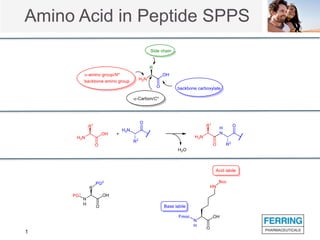
Amino Acid in Peptide SPPS
2
Solid Phase Peptide Synthesis (SPPS)
3
A. Peptide Fragmentation/Deletion Side
Reactions
A-1: N-Ac-N-alkyl peptide acidolysis
‣ Peptides with a motif of N-Ac-N-alkyl-Xaa sequence
at the N-terminus have the distinctively
high propensity to acidolysis
Dyn A(1-11) H-Tyr-Gly-Gly-Phe-Leu-Arg-Arg-Ile-Arg-Pro-Lys-NH2
Arodyn 1: Ac-Phe-Phe-Phe-Arg-Leu-Arg-Arg-D-Ala-Arg-Pro-Lys-NH2
Arodyn 2: Ac-N-Me-Phe-Phe-Trp-Arg-Leu-Arg-Arg-D-Ala-Arg-Pro-Lys-NH2
Arodyn 3: CH3OCO-N-Me-Phe-Phe-Trp-Arg-Leu-Arg-Arg-D-Ala-Arg-Pro-Lys-NH2
Arodyn 4: N-Me-Phe-Phe-Trp-Arg-Leu-Arg-Arg-D-Ala-Arg-Pro-Lys-NH2
4
A. Peptide Fragmentation/Deletion Side
Reactions
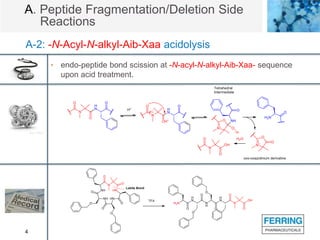
A-2: -N-Acyl-N-alkyl-Aib-Xaa acidolysis
‣ endo-peptide bond scission at -N-acyl-N-alkyl-Aib-Xaa- sequence
upon acid treatment.
5
A. Peptide Fragmentation/Deletion Side
Reactions
A-3: Acidolysis of -Asp-Pro- bond
‣ -Asp-Pro- peptide bond is labile under acidic conditions such as in TFA, HF,
formic acid and acetic acid, even at weak acidic milieu (pH 4)
protein E298D eNOS has been identified to suffer from acidolytic fission at
-Asp298-Pro299- sequence, giving rise to 100 kDa and 35 kDa fragments, while its native protein counterpart
eNOS (Glu298) is exempted from acidolysis under the same conditions.
Herpes simplex virion-originated peptide might suffer from -Asp-Pro- cleavage during FAB-MS
analysis; while –Asn-Pro- is exempted from such degradation.
6
A. Peptide Fragmentation/Deletion Side
Reactions
A-4: Auto-degradation of peptide N-terminal H-His-Pro-Xaa- moiety
‣ The amide bond between Pro and the amino acid on its C-terminal side in
peptide sequence could undergo fragmentation process catalyzed by the
imidazole group on N-terminal His.
7
A. Peptide Fragmentation/Deletion Side
Reactions
A-5: Acidolysis of the peptide C-terminal N-Me-Xaa
Peptides containing C-terminal N-Me-Xaa residues are less stable in
acidic condition, giving rise to deletion sequence.
8
A. Peptide Fragmentation/Deletion Side
Reactions
A-6: Deguanidination side reaction on Arg
If the guanidino moiety from Arg side chain is acylated by amino
acid derivatives, it could be decomposed into Orn side product
9
A. Peptide Fragmentation/Deletion Side
Reactions
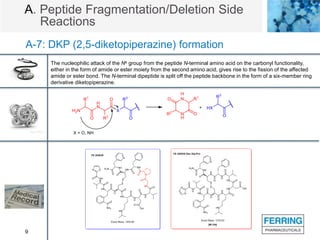
A-7: DKP (2,5-diketopiperazine) formation
The nucleophilic attack of the Nα group from the peptide N-terminal amino acid on the carbonyl functionality,
either in the form of amide or ester moiety from the second amino acid, gives rise to the fission of the affected
amide or ester bond. The N-terminal dipeptide is split off the peptide backbone in the form of a six-member ring
derivative diketopiperazine.
10
B. β-Elimination Side Reactions
• β-elimination is a group of common side reactions that
predominantly affect peptides bearing electron-withdrawing
substituent located on the side chain Cβ position, such as Cys and
phosphorylated Ser/Thr.
• These peptides could suffer from β-elimination mostly under base
treatment.
• The consequence of this side reaction is the elimination of
substituent on Cβ and the formation of dehydroalanine and/or
corresponding relevant adducts.
11
B. β-Elimination Side Reactions
B-1: β-Elimination of Cys sulfhydryl side chain
Hα on Cys residue in the parental peptide is vulnerable to the base treatment and the
protected sulfhydryl derivative suffers from the degradation by means of splitting off the β-
position on Cys side chain, giving rise to the formation of a dehydroalanine intermediate.
12
B. β-Elimination Side Reactions
B-2: β-Elimination of phosphorylated Ser, Thr
Utilization of Fmoc-Ser/Thr(PO3R2)-OH (R=methyl, ethyl,
tert-butyl, benzyl) building blocks for the preparation of
phosphopeptides could potentially cause β-elimination side
reaction resembling Cys β-elimination.
13
C. Peptide Rearrangement Side Reactions
• Undesirable peptide rearrangement represents a category of
common side reactions occurred in the process of peptide
manufacture as well as storage.
• pH is one of the most important factors that drive peptide
rearrangement process.
• One of challenges inherent to these types of side reactions is that
the derived side products are frequently isomer to the target
peptides and the development of analytical methods with respect
to the re-arranged peptide impurities poses a critical task.
• Only acyl O N migrations are discussed herein.
14
C. Peptide Rearrangement Side Reactions
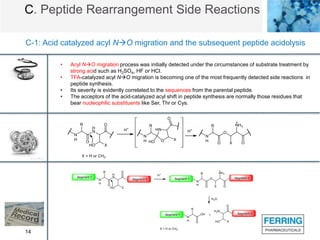
C-1: Acid catalyzed acyl NO migration and the subsequent peptide acidolysis
• Acyl NO migration process was initially detected under the circumstances of substrate treatment by
strong acid such as H2SO4, HF or HCl.
• TFA-catalyzed acyl NO migration is becoming one of the most frequently detected side reactions in
peptide synthesis.
• Its severity is evidently correlated to the sequences from the parental peptide.
• The acceptors of the acid-catalyzed acyl shift in peptide synthesis are normally those residues that
bear nucleophilic substituents like Ser, Thr or Cys.
15
C. Peptide Rearrangement Side Reactions
C-1: Acid catalyzed acyl NO migration and the subsequent peptide acidolysis
16
C. Peptide Rearrangement Side Reactions
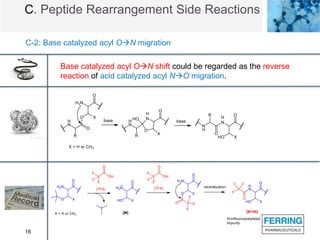
C-2: Base catalyzed acyl ON migration
Base catalyzed acyl ON shift could be regarded as the reverse
reaction of acid catalyzed acyl NO migration.
17
C. Peptide Rearrangement Side Reactions
C-2: Base catalyzed acyl ON migration
18
D. Intramolecular Cyclization Side Reactions
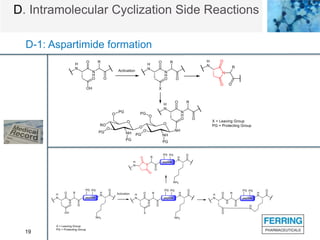
D-1: Aspartimide formation
• Asp converted to imide by repelling a H2O molecule [M-18].
• One of the most severe side reactions on peptides.
• Both acid and base-catalyzed.
• Occurred both in peptide synthesis, formulation, and storage.
• Sequence dependent -Asp-Xaa-
• Could also affect Glu, but to a much lesser extent (glutarimide).
19
D. Intramolecular Cyclization Side Reactions
D-1: Aspartimide formation
20
D. Intramolecular Cyclization Side Reactions
D-2: Asn/Gln deamidation
• Asn/Gln-containing peptides are frequently involved in deamidation side reactions
• Amide side chains are converted into the corresponding carboxylates [M+1].
• Diverse mechanism.
• Both acid- and base-catalyzed.
• Sequence dependent -Asn-Xaa-
21
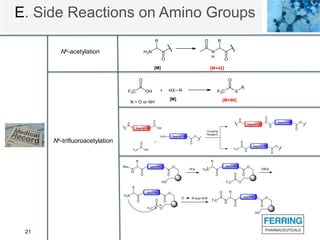
E. Side Reactions on Amino Groups
Nα-acetylation
Nα-trifluoroacetylation
22
E. Side Reactions on Amino Groups
Nα-formylation
Nα-alkylation
23
E. Side Reactions on Amino Groups
Nα-alkylation
24
E. Side Reactions on Amino Groups
N-alkylation on N-terminal His via acetone-mediated enamination
25
F. Peptide Oxidation Side Reactions
Cys Oxidation
26
F. Peptide Oxidation Side Reactions
Met Oxidation
Trp Oxidation
27
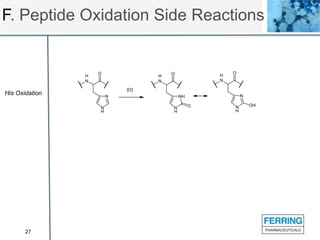
F. Peptide Oxidation Side Reactions
His Oxidation
28
G. Cys Disulfide-related Side Reactions
Disulfide
Scrambling
Thiol-Cystine disulfide exchange
Redox buffer induced disulfide bond scrambling
29
G. Cys Disulfide-related Side Reactions
Disulfide
Degradation
Homolytic
degradation
β-elimination
α-elimination
30
G. Cys Disulfide-related Side Reactions
Trisulfide
Formation
Lanthionine
Formation
31
G. Excipient-induced Side Reaction
Excipient Impurity Potential Side Reactions
Peroxide Oxidation on Cys, His, Trp, Met, etc.
Formic acid Fomylation on amino, hydroxy group
Formaldehyde
Imine formation on amino group, cross linking between
amino acid, N-alkylation, etc.
Aldehyde (Furfural, 5-
hydroxymethyl furfural)
Imine formation on amino group
glucose Maillard Reaction with amino group
Formic acid
acetic acid acetylation on amino and hydroxy group
Benzyl alcohol Benzaldehyde
Aldehyde
Peroxide
Starch Formaldehyde
Mannitol
Reducing sugar (mannose,
glucose)
Imine formation on amino group
arylmethylamine degardaion
Povidone, Polysorbate (Tween)
Lactose
PEG
32
33
Average
Δ Mass
Modification Proposed Side Reaction Scheme
-98 β-elimination of phosphopeptide
-80 Peptide dephosphorylation
-42 Conversion of Arg to Orn via deguanidination
-34 Cysteine β-elimination
-32 Disulfide desulfurization
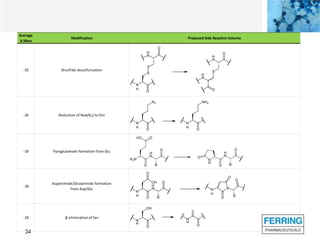
34
Average
Δ Mass
Modification Proposed Side Reaction Scheme
-32 Disulfide desulfurization
-26 Reduction of Nva(N3) to Orn
-18 Pyroglutamate formation from Glu
-18
Aspartimide/Glutarimide formation
from Asp/Glu
-18 β-elimination of Ser
35
Average
Δ Mass
Modification Proposed Side Reaction Scheme
-18 dehydration of Asn/Gln
-17 Pyroglutamate formation from Gln
-17
Aspartimide/Glutarimide formation
from Asn/Gln
-16 H-phosphonate formation
-14 Thioanisole-induced Tyr demethylation
-2 Cysteine oxidation to Cystine
36
Average
Δ Mass
Modification Proposed Side Reaction Scheme
+1 Asn/Gln hydrolysis
+1 Peptide amide hydrolysis
+2 Cystine reduction
+2 Trp reduction
+4 Oxidation of Trp to Kynurenine
+12 Imine formation on amino-containing peptide
+12 Imidazolin-4-one formation on peptide N-terminus
37
Average
Δ Mass
Modification Proposed Side Reaction Scheme
+12
Formaldehyde-induced crosslinking of peptide N-
terminal Cys, Trp, Lys(Nma)
+14 Methylation of amino group
+14 methylesterfication on carboxyl group
+16 Oxidation of Cys to Cysteine sulfenic acid
+16 Oxidation of Trp to Oia (Oxindolylalanine)
+16 Oxidation of Met to Met sulfoxide
+16 Oxidation of His to 2-oxo-His
38
Average
Δ Mass
Modification Proposed Side Reaction Scheme
+25 Cys cyanilation
+26
Schiff base formation from amino group and
acetaldehyde
+27 Cyanohydrin formation
+28 Peptide formylation at N α
, Lys-N ε
, Trp-N in
or His-N im
+28 Carboxylate ethylation
+28 N -dimethylation
+32 Trisulfide formation
+32 Oxidation of Met to Met sulfone
+32 Oxidation of Cys to Cysteine sulfinic acid
39
Average
Δ Mass
Modification Proposed Side Reaction Scheme
+32 Oxidation of Trp to N -formylkynureine
+34 Chlorination of Tyr
+40 Enamination of His imidazolyl side chain by acetone
+40
Acetone induced peptide N -terminal imidazolidinone
formation
+42 Acetylation on N α
, Lys-N e
, O-Ser/Thr
+44 Trp carbamate
40
Average
Δ Mass
Modification Proposed Side Reaction Scheme
+48 Oxidation of Cys to Cys sulfonic acid
+51 Cys beta-elimination and piperidide adduct formation
+56
tert-butylation on nucleophilic amino acid or
insufficient removal of tBu protecting group
+67 Asp-piperidide
+71 endo-β-alanine
41
Average
Δ Mass
Modification Proposed Side Reaction Scheme
+74 esterification of Asp/Glu by glycerol
+ 80 Sulfonation
+ 90 Benzylation
+96 trifluoroacetylation of amino or hydroxyl group
42
Further Reading

Peptide Side Reaction

  • 1.
    Peptide Side Reactions YiYang, Chemical Development 21st Apr. 2016, IPC
  • 2.
    1 Amino Acid inPeptide SPPS
  • 3.
    2 Solid Phase PeptideSynthesis (SPPS)
  • 4.
    3 A. Peptide Fragmentation/DeletionSide Reactions A-1: N-Ac-N-alkyl peptide acidolysis ‣ Peptides with a motif of N-Ac-N-alkyl-Xaa sequence at the N-terminus have the distinctively high propensity to acidolysis Dyn A(1-11) H-Tyr-Gly-Gly-Phe-Leu-Arg-Arg-Ile-Arg-Pro-Lys-NH2 Arodyn 1: Ac-Phe-Phe-Phe-Arg-Leu-Arg-Arg-D-Ala-Arg-Pro-Lys-NH2 Arodyn 2: Ac-N-Me-Phe-Phe-Trp-Arg-Leu-Arg-Arg-D-Ala-Arg-Pro-Lys-NH2 Arodyn 3: CH3OCO-N-Me-Phe-Phe-Trp-Arg-Leu-Arg-Arg-D-Ala-Arg-Pro-Lys-NH2 Arodyn 4: N-Me-Phe-Phe-Trp-Arg-Leu-Arg-Arg-D-Ala-Arg-Pro-Lys-NH2
  • 5.
    4 A. Peptide Fragmentation/DeletionSide Reactions A-2: -N-Acyl-N-alkyl-Aib-Xaa acidolysis ‣ endo-peptide bond scission at -N-acyl-N-alkyl-Aib-Xaa- sequence upon acid treatment.
  • 6.
    5 A. Peptide Fragmentation/DeletionSide Reactions A-3: Acidolysis of -Asp-Pro- bond ‣ -Asp-Pro- peptide bond is labile under acidic conditions such as in TFA, HF, formic acid and acetic acid, even at weak acidic milieu (pH 4) protein E298D eNOS has been identified to suffer from acidolytic fission at -Asp298-Pro299- sequence, giving rise to 100 kDa and 35 kDa fragments, while its native protein counterpart eNOS (Glu298) is exempted from acidolysis under the same conditions. Herpes simplex virion-originated peptide might suffer from -Asp-Pro- cleavage during FAB-MS analysis; while –Asn-Pro- is exempted from such degradation.
  • 7.
    6 A. Peptide Fragmentation/DeletionSide Reactions A-4: Auto-degradation of peptide N-terminal H-His-Pro-Xaa- moiety ‣ The amide bond between Pro and the amino acid on its C-terminal side in peptide sequence could undergo fragmentation process catalyzed by the imidazole group on N-terminal His.
  • 8.
    7 A. Peptide Fragmentation/DeletionSide Reactions A-5: Acidolysis of the peptide C-terminal N-Me-Xaa Peptides containing C-terminal N-Me-Xaa residues are less stable in acidic condition, giving rise to deletion sequence.
  • 9.
    8 A. Peptide Fragmentation/DeletionSide Reactions A-6: Deguanidination side reaction on Arg If the guanidino moiety from Arg side chain is acylated by amino acid derivatives, it could be decomposed into Orn side product
  • 10.
    9 A. Peptide Fragmentation/DeletionSide Reactions A-7: DKP (2,5-diketopiperazine) formation The nucleophilic attack of the Nα group from the peptide N-terminal amino acid on the carbonyl functionality, either in the form of amide or ester moiety from the second amino acid, gives rise to the fission of the affected amide or ester bond. The N-terminal dipeptide is split off the peptide backbone in the form of a six-member ring derivative diketopiperazine.
  • 11.
    10 B. β-Elimination SideReactions • β-elimination is a group of common side reactions that predominantly affect peptides bearing electron-withdrawing substituent located on the side chain Cβ position, such as Cys and phosphorylated Ser/Thr. • These peptides could suffer from β-elimination mostly under base treatment. • The consequence of this side reaction is the elimination of substituent on Cβ and the formation of dehydroalanine and/or corresponding relevant adducts.
  • 12.
    11 B. β-Elimination SideReactions B-1: β-Elimination of Cys sulfhydryl side chain Hα on Cys residue in the parental peptide is vulnerable to the base treatment and the protected sulfhydryl derivative suffers from the degradation by means of splitting off the β- position on Cys side chain, giving rise to the formation of a dehydroalanine intermediate.
  • 13.
    12 B. β-Elimination SideReactions B-2: β-Elimination of phosphorylated Ser, Thr Utilization of Fmoc-Ser/Thr(PO3R2)-OH (R=methyl, ethyl, tert-butyl, benzyl) building blocks for the preparation of phosphopeptides could potentially cause β-elimination side reaction resembling Cys β-elimination.
  • 14.
    13 C. Peptide RearrangementSide Reactions • Undesirable peptide rearrangement represents a category of common side reactions occurred in the process of peptide manufacture as well as storage. • pH is one of the most important factors that drive peptide rearrangement process. • One of challenges inherent to these types of side reactions is that the derived side products are frequently isomer to the target peptides and the development of analytical methods with respect to the re-arranged peptide impurities poses a critical task. • Only acyl O N migrations are discussed herein.
  • 15.
    14 C. Peptide RearrangementSide Reactions C-1: Acid catalyzed acyl NO migration and the subsequent peptide acidolysis • Acyl NO migration process was initially detected under the circumstances of substrate treatment by strong acid such as H2SO4, HF or HCl. • TFA-catalyzed acyl NO migration is becoming one of the most frequently detected side reactions in peptide synthesis. • Its severity is evidently correlated to the sequences from the parental peptide. • The acceptors of the acid-catalyzed acyl shift in peptide synthesis are normally those residues that bear nucleophilic substituents like Ser, Thr or Cys.
  • 16.
    15 C. Peptide RearrangementSide Reactions C-1: Acid catalyzed acyl NO migration and the subsequent peptide acidolysis
  • 17.
    16 C. Peptide RearrangementSide Reactions C-2: Base catalyzed acyl ON migration Base catalyzed acyl ON shift could be regarded as the reverse reaction of acid catalyzed acyl NO migration.
  • 18.
    17 C. Peptide RearrangementSide Reactions C-2: Base catalyzed acyl ON migration
  • 19.
    18 D. Intramolecular CyclizationSide Reactions D-1: Aspartimide formation • Asp converted to imide by repelling a H2O molecule [M-18]. • One of the most severe side reactions on peptides. • Both acid and base-catalyzed. • Occurred both in peptide synthesis, formulation, and storage. • Sequence dependent -Asp-Xaa- • Could also affect Glu, but to a much lesser extent (glutarimide).
  • 20.
    19 D. Intramolecular CyclizationSide Reactions D-1: Aspartimide formation
  • 21.
    20 D. Intramolecular CyclizationSide Reactions D-2: Asn/Gln deamidation • Asn/Gln-containing peptides are frequently involved in deamidation side reactions • Amide side chains are converted into the corresponding carboxylates [M+1]. • Diverse mechanism. • Both acid- and base-catalyzed. • Sequence dependent -Asn-Xaa-
  • 22.
    21 E. Side Reactionson Amino Groups Nα-acetylation Nα-trifluoroacetylation
  • 23.
    22 E. Side Reactionson Amino Groups Nα-formylation Nα-alkylation
  • 24.
    23 E. Side Reactionson Amino Groups Nα-alkylation
  • 25.
    24 E. Side Reactionson Amino Groups N-alkylation on N-terminal His via acetone-mediated enamination
  • 26.
    25 F. Peptide OxidationSide Reactions Cys Oxidation
  • 27.
    26 F. Peptide OxidationSide Reactions Met Oxidation Trp Oxidation
  • 28.
    27 F. Peptide OxidationSide Reactions His Oxidation
  • 29.
    28 G. Cys Disulfide-relatedSide Reactions Disulfide Scrambling Thiol-Cystine disulfide exchange Redox buffer induced disulfide bond scrambling
  • 30.
    29 G. Cys Disulfide-relatedSide Reactions Disulfide Degradation Homolytic degradation β-elimination α-elimination
  • 31.
    30 G. Cys Disulfide-relatedSide Reactions Trisulfide Formation Lanthionine Formation
  • 32.
    31 G. Excipient-induced SideReaction Excipient Impurity Potential Side Reactions Peroxide Oxidation on Cys, His, Trp, Met, etc. Formic acid Fomylation on amino, hydroxy group Formaldehyde Imine formation on amino group, cross linking between amino acid, N-alkylation, etc. Aldehyde (Furfural, 5- hydroxymethyl furfural) Imine formation on amino group glucose Maillard Reaction with amino group Formic acid acetic acid acetylation on amino and hydroxy group Benzyl alcohol Benzaldehyde Aldehyde Peroxide Starch Formaldehyde Mannitol Reducing sugar (mannose, glucose) Imine formation on amino group arylmethylamine degardaion Povidone, Polysorbate (Tween) Lactose PEG
  • 33.
  • 34.
    33 Average Δ Mass Modification ProposedSide Reaction Scheme -98 β-elimination of phosphopeptide -80 Peptide dephosphorylation -42 Conversion of Arg to Orn via deguanidination -34 Cysteine β-elimination -32 Disulfide desulfurization
  • 35.
    34 Average Δ Mass Modification ProposedSide Reaction Scheme -32 Disulfide desulfurization -26 Reduction of Nva(N3) to Orn -18 Pyroglutamate formation from Glu -18 Aspartimide/Glutarimide formation from Asp/Glu -18 β-elimination of Ser
  • 36.
    35 Average Δ Mass Modification ProposedSide Reaction Scheme -18 dehydration of Asn/Gln -17 Pyroglutamate formation from Gln -17 Aspartimide/Glutarimide formation from Asn/Gln -16 H-phosphonate formation -14 Thioanisole-induced Tyr demethylation -2 Cysteine oxidation to Cystine
  • 37.
    36 Average Δ Mass Modification ProposedSide Reaction Scheme +1 Asn/Gln hydrolysis +1 Peptide amide hydrolysis +2 Cystine reduction +2 Trp reduction +4 Oxidation of Trp to Kynurenine +12 Imine formation on amino-containing peptide +12 Imidazolin-4-one formation on peptide N-terminus
  • 38.
    37 Average Δ Mass Modification ProposedSide Reaction Scheme +12 Formaldehyde-induced crosslinking of peptide N- terminal Cys, Trp, Lys(Nma) +14 Methylation of amino group +14 methylesterfication on carboxyl group +16 Oxidation of Cys to Cysteine sulfenic acid +16 Oxidation of Trp to Oia (Oxindolylalanine) +16 Oxidation of Met to Met sulfoxide +16 Oxidation of His to 2-oxo-His
  • 39.
    38 Average Δ Mass Modification ProposedSide Reaction Scheme +25 Cys cyanilation +26 Schiff base formation from amino group and acetaldehyde +27 Cyanohydrin formation +28 Peptide formylation at N α , Lys-N ε , Trp-N in or His-N im +28 Carboxylate ethylation +28 N -dimethylation +32 Trisulfide formation +32 Oxidation of Met to Met sulfone +32 Oxidation of Cys to Cysteine sulfinic acid
  • 40.
    39 Average Δ Mass Modification ProposedSide Reaction Scheme +32 Oxidation of Trp to N -formylkynureine +34 Chlorination of Tyr +40 Enamination of His imidazolyl side chain by acetone +40 Acetone induced peptide N -terminal imidazolidinone formation +42 Acetylation on N α , Lys-N e , O-Ser/Thr +44 Trp carbamate
  • 41.
    40 Average Δ Mass Modification ProposedSide Reaction Scheme +48 Oxidation of Cys to Cys sulfonic acid +51 Cys beta-elimination and piperidide adduct formation +56 tert-butylation on nucleophilic amino acid or insufficient removal of tBu protecting group +67 Asp-piperidide +71 endo-β-alanine
  • 42.
    41 Average Δ Mass Modification ProposedSide Reaction Scheme +74 esterification of Asp/Glu by glycerol + 80 Sulfonation + 90 Benzylation +96 trifluoroacetylation of amino or hydroxyl group
  • 43.