SUBJECT: Computer Integrated Manufacturing
Topic: Group Technology
Department: Mechanical Engg.
Group Member
Prepared ByName Enrollment number
Javiya Viren 130943119004
Lad Mitesh 130943119005
Manjra Mohmmedarif 130943119006
Parmar Mayur 130943119007
Patel Hiten 130943119008
Guide By :- Mr.Amit.R.Patel
Introduction to Production System
Production system can be defined as the combination of human
resources , equipment, factory layout and procedures, organized
to accomplish the manufacturing operations of company.
It is consists of two parts
(1) Facilities
(2) Manufacturing Support system
Types Of Production Systems
The Production System can be categorized into four types:
(1) Continuous Flow Type Production System
(2) Mass Production System
(3) Batch Production System
(4)Job Production System
(1) Continuous Flow Type Production System
The example of continuous flow type production system are: chemical
plants ,oil refineries ,etc.
(2)Mass Production System
In mass production system ,the components are produced in large
quantity and minimal variety.
In mass production systems use product layout.
The example of mass production system: manufacturing of
nuts,bolts,spring etc.
.
(3) Batch Production System
In batch production system ,the components are produced in medium
quantities and medium variety.
The example of batch production system are: manufacturing of marine
engines , vehicles, clothes , etc.
The batch production system utilize flexible manufacturing system
(FMS).
(4) Job Production System
In job production system ,the components are produced in low
quantities, based on order.
The minimum lot size can be one unit.
The example of job production system are: manufacturing of jigs,
fixtures, dies, etc.
Concept ofAutomation
ompound belt drive
Automation can be defined as the technology use for the application of
integrated mechanical , electronics and computer based system in
operation and control of production system.
Some example of automatic of process in production system are as
follows:
(1)NC and CNC machines,
(2)Automatic assembly machines,
(3)Industrial robots,
(4)Automatic storage system,
(5)Computer aided production planning and control.
Need for automation
• To increase productivity.
• To reduce cost of production.
• To improve product quality.
• To reduced production time.
• To improve work safety.
• To have better control over manufacturing activites.
Advantages ofAutomation
• Increase in productivity.
• Reduction in labor cost an cost of production.
• Reduction in scrap and rework.
• Improve in product quality.
• Reduction in lead time.
• Improve in work safety.
• Better control over manufacturing activities.
• Increase in shop efficiency.
Limitations ofAutomation
• High initial cost.
• High maintenance cost.
• High operating skill labor are required.
Group Technology
Group technology is a manufacturing philosophy in which a similar
parts are identified and group together as a part family, in order to
taken the advantages of their similarities in design and
manufacturing.
In addition ,there increase trend achiving a higher level of integration
between the design and manufacturing activities of a company.
The above two objective can be achieved by using a manufacturing
philosophy known as group.
Part Family
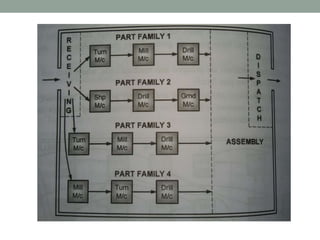
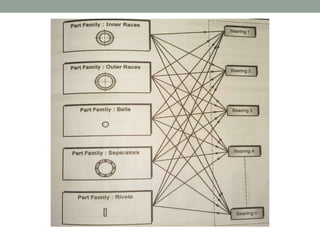
Part family is a collection of parts , which are similar because of
either: (1) their geometric shape and size (2) similar processing
steps are required in their manufacturing.
Each part family, which consists of number of parts, processes
similar design or/and manufacturing characteristics.
Either ball bearing example consider.
Method of Grouping Parts into Part Families
There are four general methods for grouping parts into families.
(1) Visual inspection
(2) Composite part method
(3) Production flow analysis
(4) Parts classification and coding
(1) Visual inspection
In visual inspection ,the grouping of parts into part family is done by
looking for similarities in shape. Size and methods of manufacture.
The visual inspection is least expensive and least accurate method.
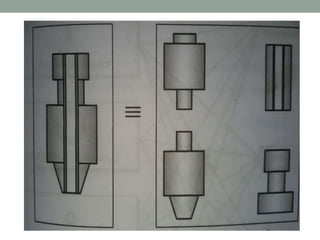
(2)Composite part Method
In this method ,the feature of all part family are combined into a
hypothetical composite part.
Production FlowAnalysis
The production flow analysis uses manufacturing data into identify part
families.
Production flow analysis involve following steps:
(1) Data collection
(2) Sorting of operations
(3) Preparation of PFA chart
(4)Data analysis
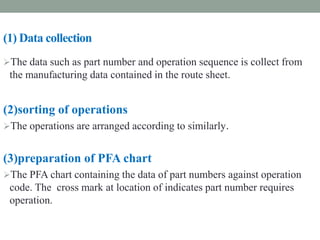
(1) Data collection
The data such as part number and operation sequence is collect from
the manufacturing data contained in the route sheet.
(2)sorting of operations
The operations are arranged according to similarly.
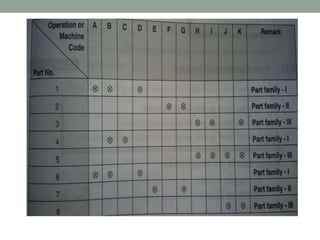
(3)preparation of PFA chart
The PFA chart containing the data of part numbers against operation
code. The cross mark at location of indicates part number requires
operation.
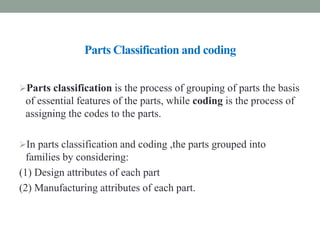
Parts Classification and coding
Parts classification is the process of grouping of parts the basis
of essential features of the parts, while coding is the process of
assigning the codes to the parts.
In parts classification and coding ,the parts grouped into
families by considering:
(1) Design attributes of each part
(2) Manufacturing attributes of each part.
Advantages of Group Technology
Reduced material handling.
Reduced tool set-up time.
Reduced work- in- process.
Promotes standardization of tooling, fixture and setups.
Simplified process planning and production scheduling.
Better work satisfaction.
Better product quality and productivity.
Limitation of Group Technology
Difficulty in grouping the parts into families.
Difficulty in rearranging machines into machine cells.
Inertia to change.
Cim ppt

Cim ppt

  • 1.
    SUBJECT: Computer IntegratedManufacturing Topic: Group Technology Department: Mechanical Engg.
  • 2.
    Group Member Prepared ByNameEnrollment number Javiya Viren 130943119004 Lad Mitesh 130943119005 Manjra Mohmmedarif 130943119006 Parmar Mayur 130943119007 Patel Hiten 130943119008 Guide By :- Mr.Amit.R.Patel
  • 3.
    Introduction to ProductionSystem Production system can be defined as the combination of human resources , equipment, factory layout and procedures, organized to accomplish the manufacturing operations of company. It is consists of two parts (1) Facilities (2) Manufacturing Support system
  • 4.
    Types Of ProductionSystems The Production System can be categorized into four types: (1) Continuous Flow Type Production System (2) Mass Production System (3) Batch Production System (4)Job Production System
  • 5.
    (1) Continuous FlowType Production System The example of continuous flow type production system are: chemical plants ,oil refineries ,etc. (2)Mass Production System In mass production system ,the components are produced in large quantity and minimal variety. In mass production systems use product layout. The example of mass production system: manufacturing of nuts,bolts,spring etc. .
  • 6.
    (3) Batch ProductionSystem In batch production system ,the components are produced in medium quantities and medium variety. The example of batch production system are: manufacturing of marine engines , vehicles, clothes , etc. The batch production system utilize flexible manufacturing system (FMS). (4) Job Production System In job production system ,the components are produced in low quantities, based on order. The minimum lot size can be one unit. The example of job production system are: manufacturing of jigs, fixtures, dies, etc.
  • 7.
    Concept ofAutomation ompound beltdrive Automation can be defined as the technology use for the application of integrated mechanical , electronics and computer based system in operation and control of production system. Some example of automatic of process in production system are as follows: (1)NC and CNC machines, (2)Automatic assembly machines, (3)Industrial robots, (4)Automatic storage system, (5)Computer aided production planning and control.
  • 8.
    Need for automation •To increase productivity. • To reduce cost of production. • To improve product quality. • To reduced production time. • To improve work safety. • To have better control over manufacturing activites.
  • 9.
    Advantages ofAutomation • Increasein productivity. • Reduction in labor cost an cost of production. • Reduction in scrap and rework. • Improve in product quality. • Reduction in lead time. • Improve in work safety. • Better control over manufacturing activities. • Increase in shop efficiency.
  • 10.
    Limitations ofAutomation • Highinitial cost. • High maintenance cost. • High operating skill labor are required.
  • 11.
    Group Technology Group technologyis a manufacturing philosophy in which a similar parts are identified and group together as a part family, in order to taken the advantages of their similarities in design and manufacturing. In addition ,there increase trend achiving a higher level of integration between the design and manufacturing activities of a company. The above two objective can be achieved by using a manufacturing philosophy known as group.
  • 13.
    Part Family Part familyis a collection of parts , which are similar because of either: (1) their geometric shape and size (2) similar processing steps are required in their manufacturing. Each part family, which consists of number of parts, processes similar design or/and manufacturing characteristics. Either ball bearing example consider.
  • 15.
    Method of GroupingParts into Part Families There are four general methods for grouping parts into families. (1) Visual inspection (2) Composite part method (3) Production flow analysis (4) Parts classification and coding
  • 16.
    (1) Visual inspection Invisual inspection ,the grouping of parts into part family is done by looking for similarities in shape. Size and methods of manufacture. The visual inspection is least expensive and least accurate method. (2)Composite part Method In this method ,the feature of all part family are combined into a hypothetical composite part.
  • 18.
    Production FlowAnalysis The productionflow analysis uses manufacturing data into identify part families. Production flow analysis involve following steps: (1) Data collection (2) Sorting of operations (3) Preparation of PFA chart (4)Data analysis
  • 19.
    (1) Data collection Thedata such as part number and operation sequence is collect from the manufacturing data contained in the route sheet. (2)sorting of operations The operations are arranged according to similarly. (3)preparation of PFA chart The PFA chart containing the data of part numbers against operation code. The cross mark at location of indicates part number requires operation.
  • 21.
    Parts Classification andcoding Parts classification is the process of grouping of parts the basis of essential features of the parts, while coding is the process of assigning the codes to the parts. In parts classification and coding ,the parts grouped into families by considering: (1) Design attributes of each part (2) Manufacturing attributes of each part.
  • 22.
    Advantages of GroupTechnology Reduced material handling. Reduced tool set-up time. Reduced work- in- process. Promotes standardization of tooling, fixture and setups. Simplified process planning and production scheduling. Better work satisfaction. Better product quality and productivity.
  • 23.
    Limitation of GroupTechnology Difficulty in grouping the parts into families. Difficulty in rearranging machines into machine cells. Inertia to change.