Vehicle Safety System
Prof. S.S. Petkar (M.E. Mech Prod)
Introduction
• Safety of an automobile can be ensured by
two main consideration.
• Design should be such that chances of
accident happening are minimum
• Accident does take place, the injury to the
occupants should be minimum
Prof. S.S. Petkar (M.E. Mech Prod)
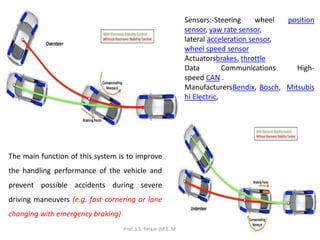
Electronic stability program (ESP) system operation
• It integrated ABS & Traction control system (TCS)
• It is a function that prevents from skidding
• If the vehicle moves in different direction under
steering & over steering :- ESC detects the
situation & reacts accordingly.
This system calculates the
actual path of the vehicle
Prof. S.S. Petkar (M.E. Mech Prod)
Yaw Sensor &
Acceleration sensor
Prof. S.S. Petkar (M.E. Mech Prod)
The main function of this system is to improve
the handling performance of the vehicle and
prevent possible accidents during severe
driving maneuvers (e.g. fast cornering or lane
changing with emergency braking)
Sensors:-Steering wheel position
sensor, yaw rate sensor,
lateral acceleration sensor,
wheel speed sensor
Actuatorsbrakes, throttle
Data Communications High-
speed CAN .
ManufacturersBendix, Bosch, Mitsubis
hi Electric,
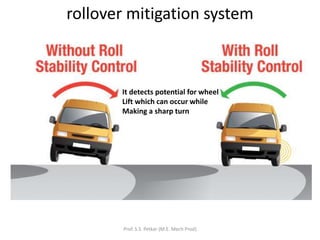
rollover mitigation system
Prof. S.S. Petkar (M.E. Mech Prod)
It detects potential for wheel
Lift which can occur while
Making a sharp turn
• Automatically reduces the engine power &
Applies the brakes as needed.
• Applies brakes to one or more wheel as per
requirement
Prof. S.S. Petkar (M.E. Mech Prod)
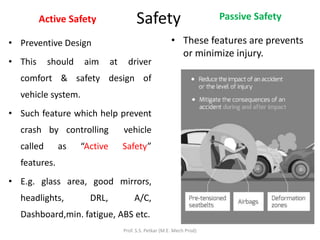
Safety
Active Safety
• Preventive Design
• This should aim at driver
comfort & safety design of
vehicle system.
• Such feature which help prevent
crash by controlling vehicle
called as “Active Safety”
features.
• E.g. glass area, good mirrors,
headlights, DRL, A/C,
Dashboard,min. fatigue, ABS etc.
Passive Safety
• These features are prevents
or minimize injury.
Prof. S.S. Petkar (M.E. Mech Prod)
latest trends in traffic system for improved
road safety
• Monitoring real-time on-road performance
• Auditing operations or monitoring off-road
performance
• Compute the results
Prof. S.S. Petkar (M.E. Mech Prod)
head restraints
Prof. S.S. Petkar (M.E. Mech Prod)
• Head restraints (also called headrests) are an
automotive safety feature, attached or
integrated into the top of each seat to limit
the rearward movement of the adult
occupant's head.
• Effective head restraints are designed
to reduce the rearward motion of the head in
a rear end crash and decrease the chances of
occupants sustaining whiplash neck injuries.
Head restraints are commonly referred to as
head rests.
Prof. S.S. Petkar (M.E. Mech Prod)
How should head restraints be adjusted in a car?
• Adjusting head restraints
• Make sure the top of the head restraint is at
least level with the top of your head.
• Position the head restraint so it's as close to
the back of your head as possible. You may
need to adjust the back of the seat.
Prof. S.S. Petkar (M.E. Mech Prod)
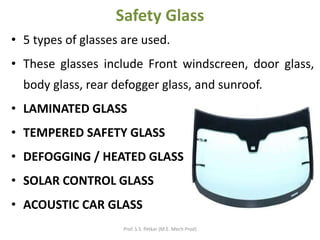
Safety Glass
• 5 types of glasses are used.
• These glasses include Front windscreen, door glass,
body glass, rear defogger glass, and sunroof.
• LAMINATED GLASS
• TEMPERED SAFETY GLASS
• DEFOGGING / HEATED GLASS
• SOLAR CONTROL GLASS
• ACOUSTIC CAR GLASS
Prof. S.S. Petkar (M.E. Mech Prod)
Laminated Glass
• Laminated glass is the most common type of safety car glass used in
windshields and sunroofs.
• It displays high resistance to shattering.
• The laminated layer improves the penetration resistance ability of
the car windshield without compromising its visibility.
• Laminated glass is mainly made by putting a PVB layer in between 2
glass layers and some chemicals for strengthening or other
properties like color, transparency, acoustic properties, etc.
• Laminated glass is used as a windshield in cars as it doesn’t shatter.
PVB layer binds the glass together in case of damage and saves
passengers.
• Even in case of a severe accident, a laminated car windshield acts as
a cushion and protects the passengers. A laminated car windshield
also keeps passengers safe by supporting airbag deployment.
Prof. S.S. Petkar (M.E. Mech Prod)
TEMPERED SAFETY GLASS
• Tempered glass is used in rear windows, fixed body
glass, doors, and the sunroof of your car.
• Tempered glass is stronger than laminated glass but it
gets scattered on hitting hard or at the edges. For this
reason, most countries do not permit its use as a
windshield in cars.
• Tempered glass is made by the heating glass at high
temperatures and suddenly cooling it. Like laminated
glass, specific chemicals are used to add properties to
make special types of car glass-like solar control glass,
acoustic glass, and colored glass.
• Additionally, tempered glass in cars no longer harms
you even after scattering.
Prof. S.S. Petkar (M.E. Mech Prod)
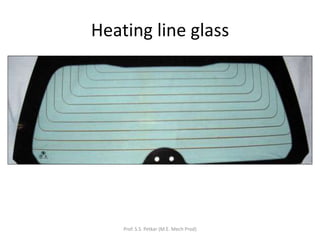
DEFOGGING / HEATED GLASS
• The third type of
safety car glass is
based on its use.
• A Defogging or
Heated glass is
used for defrosting
the car glasses in
the winter season.
Prof. S.S. Petkar (M.E. Mech Prod)
Heating line glass
Prof. S.S. Petkar (M.E. Mech Prod)
SOLAR CONTROL GLASS
• Solar heating is a prominent issue in most
Asian, African, and American markets. It
affects car cabins condition and causes
discomfort to occupants.
• It also reduces car AC performance. Both solar
UV and IR rays affect human health. So, car
manufacturers like Mercedes, BMW, KIA offer
a different type of safety car glass i.e. Solar
coated car windshield.
Prof. S.S. Petkar (M.E. Mech Prod)
Optimized Solar control glass improves fuel
efficiency
Prof. S.S. Petkar (M.E. Mech Prod)
In cars, the rear-view mirror is usually affixed to the top of the windshield on a
double-swivel mount allowing it to be adjusted to suit the height and viewing
angle of any driver and to swing harmlessly out of the way if impacted by a vehicle
occupant in a collision
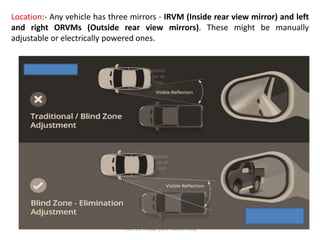
Location:- Any vehicle has three mirrors - IRVM (Inside rear view mirror) and left
and right ORVMs (Outside rear view mirrors). These might be manually
adjustable or electrically powered ones.
Prof. S.S. Petkar (M.E. Mech Prod)
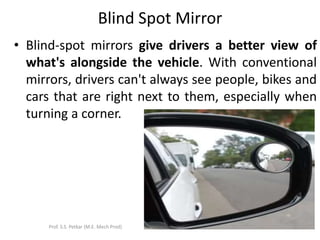
Blind Spot Mirror
• Blind-spot mirrors give drivers a better view of
what's alongside the vehicle. With conventional
mirrors, drivers can't always see people, bikes and
cars that are right next to them, especially when
turning a corner.
Prof. S.S. Petkar (M.E. Mech Prod)

Vehicle safety system.pptx

  • 1.
    Vehicle Safety System Prof.S.S. Petkar (M.E. Mech Prod)
  • 2.
    Introduction • Safety ofan automobile can be ensured by two main consideration. • Design should be such that chances of accident happening are minimum • Accident does take place, the injury to the occupants should be minimum Prof. S.S. Petkar (M.E. Mech Prod)
  • 3.
    Electronic stability program(ESP) system operation • It integrated ABS & Traction control system (TCS) • It is a function that prevents from skidding • If the vehicle moves in different direction under steering & over steering :- ESC detects the situation & reacts accordingly. This system calculates the actual path of the vehicle Prof. S.S. Petkar (M.E. Mech Prod) Yaw Sensor & Acceleration sensor
  • 4.
    Prof. S.S. Petkar(M.E. Mech Prod) The main function of this system is to improve the handling performance of the vehicle and prevent possible accidents during severe driving maneuvers (e.g. fast cornering or lane changing with emergency braking) Sensors:-Steering wheel position sensor, yaw rate sensor, lateral acceleration sensor, wheel speed sensor Actuatorsbrakes, throttle Data Communications High- speed CAN . ManufacturersBendix, Bosch, Mitsubis hi Electric,
  • 5.
    rollover mitigation system Prof.S.S. Petkar (M.E. Mech Prod) It detects potential for wheel Lift which can occur while Making a sharp turn
  • 6.
    • Automatically reducesthe engine power & Applies the brakes as needed. • Applies brakes to one or more wheel as per requirement Prof. S.S. Petkar (M.E. Mech Prod)
  • 7.
    Safety Active Safety • PreventiveDesign • This should aim at driver comfort & safety design of vehicle system. • Such feature which help prevent crash by controlling vehicle called as “Active Safety” features. • E.g. glass area, good mirrors, headlights, DRL, A/C, Dashboard,min. fatigue, ABS etc. Passive Safety • These features are prevents or minimize injury. Prof. S.S. Petkar (M.E. Mech Prod)
  • 8.
    latest trends intraffic system for improved road safety • Monitoring real-time on-road performance • Auditing operations or monitoring off-road performance • Compute the results Prof. S.S. Petkar (M.E. Mech Prod)
  • 9.
    Prof. S.S. Petkar(M.E. Mech Prod)
  • 10.
    Prof. S.S. Petkar(M.E. Mech Prod)
  • 11.
    head restraints Prof. S.S.Petkar (M.E. Mech Prod)
  • 12.
    • Head restraints(also called headrests) are an automotive safety feature, attached or integrated into the top of each seat to limit the rearward movement of the adult occupant's head. • Effective head restraints are designed to reduce the rearward motion of the head in a rear end crash and decrease the chances of occupants sustaining whiplash neck injuries. Head restraints are commonly referred to as head rests. Prof. S.S. Petkar (M.E. Mech Prod)
  • 13.
    How should headrestraints be adjusted in a car? • Adjusting head restraints • Make sure the top of the head restraint is at least level with the top of your head. • Position the head restraint so it's as close to the back of your head as possible. You may need to adjust the back of the seat. Prof. S.S. Petkar (M.E. Mech Prod)
  • 14.
    Safety Glass • 5types of glasses are used. • These glasses include Front windscreen, door glass, body glass, rear defogger glass, and sunroof. • LAMINATED GLASS • TEMPERED SAFETY GLASS • DEFOGGING / HEATED GLASS • SOLAR CONTROL GLASS • ACOUSTIC CAR GLASS Prof. S.S. Petkar (M.E. Mech Prod)
  • 15.
    Laminated Glass • Laminatedglass is the most common type of safety car glass used in windshields and sunroofs. • It displays high resistance to shattering. • The laminated layer improves the penetration resistance ability of the car windshield without compromising its visibility. • Laminated glass is mainly made by putting a PVB layer in between 2 glass layers and some chemicals for strengthening or other properties like color, transparency, acoustic properties, etc. • Laminated glass is used as a windshield in cars as it doesn’t shatter. PVB layer binds the glass together in case of damage and saves passengers. • Even in case of a severe accident, a laminated car windshield acts as a cushion and protects the passengers. A laminated car windshield also keeps passengers safe by supporting airbag deployment. Prof. S.S. Petkar (M.E. Mech Prod)
  • 16.
    TEMPERED SAFETY GLASS •Tempered glass is used in rear windows, fixed body glass, doors, and the sunroof of your car. • Tempered glass is stronger than laminated glass but it gets scattered on hitting hard or at the edges. For this reason, most countries do not permit its use as a windshield in cars. • Tempered glass is made by the heating glass at high temperatures and suddenly cooling it. Like laminated glass, specific chemicals are used to add properties to make special types of car glass-like solar control glass, acoustic glass, and colored glass. • Additionally, tempered glass in cars no longer harms you even after scattering. Prof. S.S. Petkar (M.E. Mech Prod)
  • 17.
    DEFOGGING / HEATEDGLASS • The third type of safety car glass is based on its use. • A Defogging or Heated glass is used for defrosting the car glasses in the winter season. Prof. S.S. Petkar (M.E. Mech Prod)
  • 18.
    Heating line glass Prof.S.S. Petkar (M.E. Mech Prod)
  • 19.
    SOLAR CONTROL GLASS •Solar heating is a prominent issue in most Asian, African, and American markets. It affects car cabins condition and causes discomfort to occupants. • It also reduces car AC performance. Both solar UV and IR rays affect human health. So, car manufacturers like Mercedes, BMW, KIA offer a different type of safety car glass i.e. Solar coated car windshield. Prof. S.S. Petkar (M.E. Mech Prod)
  • 20.
    Optimized Solar controlglass improves fuel efficiency Prof. S.S. Petkar (M.E. Mech Prod)
  • 21.
    Prof. S.S. Petkar(M.E. Mech Prod)
  • 22.
    Prof. S.S. Petkar(M.E. Mech Prod)
  • 23.
    Prof. S.S. Petkar(M.E. Mech Prod) In cars, the rear-view mirror is usually affixed to the top of the windshield on a double-swivel mount allowing it to be adjusted to suit the height and viewing angle of any driver and to swing harmlessly out of the way if impacted by a vehicle occupant in a collision
  • 24.
    Location:- Any vehiclehas three mirrors - IRVM (Inside rear view mirror) and left and right ORVMs (Outside rear view mirrors). These might be manually adjustable or electrically powered ones. Prof. S.S. Petkar (M.E. Mech Prod)
  • 25.
    Blind Spot Mirror •Blind-spot mirrors give drivers a better view of what's alongside the vehicle. With conventional mirrors, drivers can't always see people, bikes and cars that are right next to them, especially when turning a corner. Prof. S.S. Petkar (M.E. Mech Prod)