Mechanical
Measurement
Presentation by Prof. S.S. Petkar
Reference: Industrial instrumentation and control by Nakra Choudhari
Need Of Mechanical Measurement
 It is fundamental element of any control system
 It is a helpful in carrying out successful operation of any system
 Measurement is fundamental basis of all research , design and
development
 To maintain customer relations.
 To take decision on defective parts.
 To establish the validity of design and finding new data, new designs
 To determine a true dimension of a part.
Basic definitions (Static Performance characteristics)
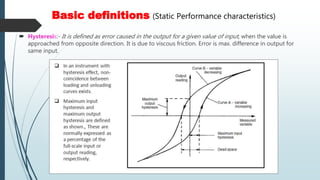
 Hysteresis:- It is defined as error caused in the output for a given value of input, when the value is
approached from opposite direction. It is due to viscous friction. Error is max. difference in output for
same input.
Linearity
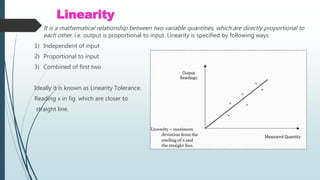
 It is a mathematical relationship between two variable quantities, which are directly proportional to
each other. i.e. output is proportional to input. Linearity is specified by following ways
1) Independent of input
2) Proportional to input
3) Combined of first two
Ideally it is known as Linearity Tolerance.
Reading x in fig. which are closer to
straight line.
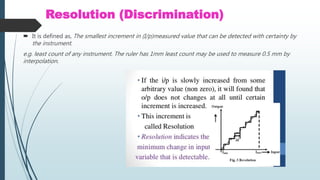
Resolution (Discrimination)
 It is defined as, The smallest increment in (I/p)measured value that can be detected with certainty by
the instrument.
e.g. least count of any instrument. The ruler has 1mm least count may be used to measure 0.5 mm by
interpolation.
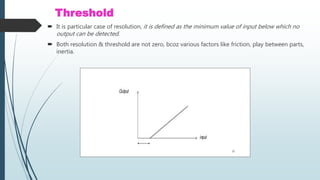
Threshold
 It is particular case of resolution, it is defined as the minimum value of input below which no
output can be detected.
 Both resolution & threshold are not zero, bcoz various factors like friction, play between parts,
inertia.
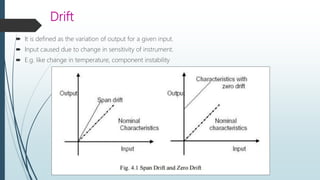
Drift
 It is defined as the variation of output for a given input.
 Input caused due to change in sensitivity of instrument.
 E.g. like change in temperature, component instability
Zero stability
 The ability of instrument to return to zero after the measured
has returned to zero.
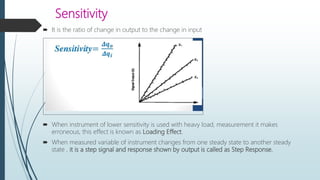
Sensitivity
 It is the ratio of change in output to the change in input
 When instrument of lower sensitivity is used with heavy load, measurement it makes
erroneous, this effect is known as Loading Effect.
 When measured variable of instrument changes from one steady state to another steady
state , it is a step signal and response shown by output is called as Step Response.
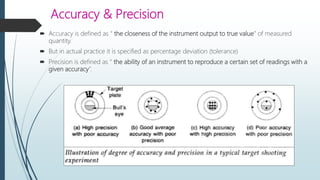
Accuracy & Precision
 Accuracy is defined as “ the closeness of the instrument output to true value” of measured
quantity.
 But in actual practice it is specified as percentage deviation (tolerance)
 Precision is defined as “ the ability of an instrument to reproduce a certain set of readings with a
given accuracy”.
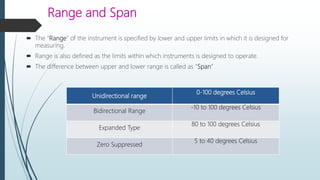
Range and Span
 The “Range” of the instrument is specified by lower and upper limits in which it is designed for
measuring.
 Range is also defined as the limits within which instruments is designed to operate.
 The difference between upper and lower range is called as “Span”
Unidirectional range
0-100 degrees Celsius
Bidirectional Range
-10 to 100 degrees Celsius
Expanded Type
80 to 100 degrees Celsius
Zero Suppressed
5 to 40 degrees Celsius
Dead Band
 It is defined as the largest change in the measurand to which instrument does
not respond.
 It is largest change of input quantity for which there is no output
 Example:- input applied may not be sufficient to overcome friction.
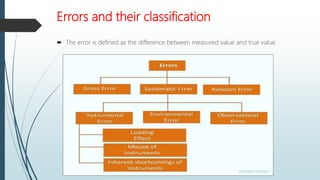
Errors and their classification
 The error is defined as the difference between measured value and true value.
Systematic and Cumulative error
 Such errors tend to have same magnitude and signs for given set
of conditions, because the algebraic sign is same, they tend to
accumulate and known as “cumulative errors”
 Causes:-
1) instrument errors
2) environmental errors
3) loading errors
Accidental errors & Random Errors
 These errors are caused due to random variation in parameters or the system of instruments
 Such errors vary in magnitude and may either positive or negative
 They are also called compensating errors
 Factors affecting:-
1) Inconsistency associated with accurate measurement of small quantities
2) Some system defects
3) Effect of unrestrained and randomly varying parameters
Miscellaneous or Gross Errors
These are certain errors that cannot be strictly classified as other
errors. Therefore they called as “miscellaneous errors”.
Causes:
1) Personal and human errors
2)Errors due to faulty adjustments
3)Improper application of instrument.
Measurement Methods
 It involves two parameters, the magnitude of value and unit of
measurement
 Two types of measurement methods:
1) Direct measurement (compare with standards)
2) Indirect measurement
Direct Measurement
 Here the quantity directly compare with primary or secondary standards
 Example: to measure a length of bar with tape or scale and compare with primary std.
Here tape and scale acts as a secondary standards.
 Primary standards are devices maintained by standards companies, national labs in different
parts of the world
 this method is not always accurate
 Errors can be occurred due to human limitations
Indirect Measurement
 In this we cannot measure quantity directly
 In this methods transducer, sensors are used for measuring system, where input is
converted to other measurable quantity (o/p)
 The majority of transducers convert mechanical input to electrical output, also
mechanical input to mechanical output.
 E.g. Recording temperature,
 Pressure in deep depths of ground or in some remote places.
Generalised Measurement System
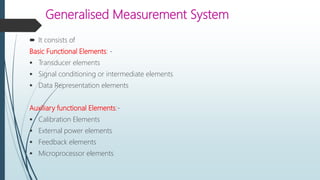
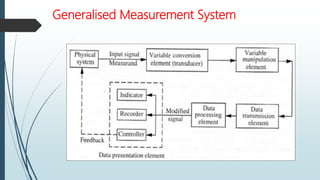
 It consists of
Basic Functional Elements: -
 Transducer elements
 Signal conditioning or intermediate elements
 Data Representation elements
Auxiliary functional Elements:-
 Calibration Elements
 External power elements
 Feedback elements
 Microprocessor elements
Generalised Measurement System

Mechanical measurement 1

  • 1.
    Mechanical Measurement Presentation by Prof.S.S. Petkar Reference: Industrial instrumentation and control by Nakra Choudhari
  • 2.
    Need Of MechanicalMeasurement  It is fundamental element of any control system  It is a helpful in carrying out successful operation of any system  Measurement is fundamental basis of all research , design and development  To maintain customer relations.  To take decision on defective parts.  To establish the validity of design and finding new data, new designs  To determine a true dimension of a part.
  • 3.
    Basic definitions (StaticPerformance characteristics)  Hysteresis:- It is defined as error caused in the output for a given value of input, when the value is approached from opposite direction. It is due to viscous friction. Error is max. difference in output for same input.
  • 4.
    Linearity  It isa mathematical relationship between two variable quantities, which are directly proportional to each other. i.e. output is proportional to input. Linearity is specified by following ways 1) Independent of input 2) Proportional to input 3) Combined of first two Ideally it is known as Linearity Tolerance. Reading x in fig. which are closer to straight line.
  • 5.
    Resolution (Discrimination)  Itis defined as, The smallest increment in (I/p)measured value that can be detected with certainty by the instrument. e.g. least count of any instrument. The ruler has 1mm least count may be used to measure 0.5 mm by interpolation.
  • 6.
    Threshold  It isparticular case of resolution, it is defined as the minimum value of input below which no output can be detected.  Both resolution & threshold are not zero, bcoz various factors like friction, play between parts, inertia.
  • 7.
    Drift  It isdefined as the variation of output for a given input.  Input caused due to change in sensitivity of instrument.  E.g. like change in temperature, component instability
  • 8.
    Zero stability  Theability of instrument to return to zero after the measured has returned to zero.
  • 9.
    Sensitivity  It isthe ratio of change in output to the change in input  When instrument of lower sensitivity is used with heavy load, measurement it makes erroneous, this effect is known as Loading Effect.  When measured variable of instrument changes from one steady state to another steady state , it is a step signal and response shown by output is called as Step Response.
  • 10.
    Accuracy & Precision Accuracy is defined as “ the closeness of the instrument output to true value” of measured quantity.  But in actual practice it is specified as percentage deviation (tolerance)  Precision is defined as “ the ability of an instrument to reproduce a certain set of readings with a given accuracy”.
  • 11.
    Range and Span The “Range” of the instrument is specified by lower and upper limits in which it is designed for measuring.  Range is also defined as the limits within which instruments is designed to operate.  The difference between upper and lower range is called as “Span” Unidirectional range 0-100 degrees Celsius Bidirectional Range -10 to 100 degrees Celsius Expanded Type 80 to 100 degrees Celsius Zero Suppressed 5 to 40 degrees Celsius
  • 12.
    Dead Band  Itis defined as the largest change in the measurand to which instrument does not respond.  It is largest change of input quantity for which there is no output  Example:- input applied may not be sufficient to overcome friction.
  • 13.
    Errors and theirclassification  The error is defined as the difference between measured value and true value.
  • 14.
    Systematic and Cumulativeerror  Such errors tend to have same magnitude and signs for given set of conditions, because the algebraic sign is same, they tend to accumulate and known as “cumulative errors”  Causes:- 1) instrument errors 2) environmental errors 3) loading errors
  • 15.
    Accidental errors &Random Errors  These errors are caused due to random variation in parameters or the system of instruments  Such errors vary in magnitude and may either positive or negative  They are also called compensating errors  Factors affecting:- 1) Inconsistency associated with accurate measurement of small quantities 2) Some system defects 3) Effect of unrestrained and randomly varying parameters
  • 16.
    Miscellaneous or GrossErrors These are certain errors that cannot be strictly classified as other errors. Therefore they called as “miscellaneous errors”. Causes: 1) Personal and human errors 2)Errors due to faulty adjustments 3)Improper application of instrument.
  • 17.
    Measurement Methods  Itinvolves two parameters, the magnitude of value and unit of measurement  Two types of measurement methods: 1) Direct measurement (compare with standards) 2) Indirect measurement
  • 18.
    Direct Measurement  Herethe quantity directly compare with primary or secondary standards  Example: to measure a length of bar with tape or scale and compare with primary std. Here tape and scale acts as a secondary standards.  Primary standards are devices maintained by standards companies, national labs in different parts of the world  this method is not always accurate  Errors can be occurred due to human limitations
  • 19.
    Indirect Measurement  Inthis we cannot measure quantity directly  In this methods transducer, sensors are used for measuring system, where input is converted to other measurable quantity (o/p)  The majority of transducers convert mechanical input to electrical output, also mechanical input to mechanical output.  E.g. Recording temperature,  Pressure in deep depths of ground or in some remote places.
  • 20.
    Generalised Measurement System It consists of Basic Functional Elements: -  Transducer elements  Signal conditioning or intermediate elements  Data Representation elements Auxiliary functional Elements:-  Calibration Elements  External power elements  Feedback elements  Microprocessor elements
  • 21.