ROOT-A COMPREHENSIVE
STUDY
Presented by
Dr. N. Sannigrahi,
Associate Professor,
Department of Botany,
Nistarini College, Purulia,
D.B. Road, Purulia (W.B),
India-723101
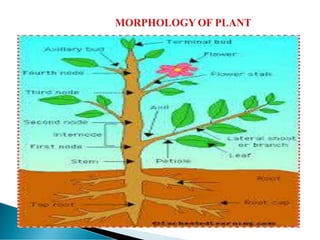
 Root as descending part is the extension and modification of the radical of
the germinating seeds of the higher plants.
 Roots have no nodes or internodes pattern of construction,
 No leaves, no branching from regular spots, no vegetative bud mostly,
 Grows downward and holds the plants tightly to absorb water, minerals
along with storage and other secondary functions,
 Mostly cylindrical in structure,
 Positively geotropic and hydrotropic but negatively phototropic,
 Mostly colorless, white without chlorophyll,
 Root cap present over the apex of the root,
 Six types of roots- tap roots, fibrous root, lateral roots, adventitious root,
storage roots and aerial; roots,
 A lot of specialties according to need by modifications,
 Plants without root: Wolfia arrhiza, Utricularia stellaris
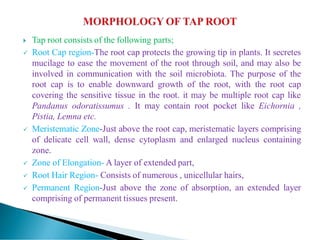
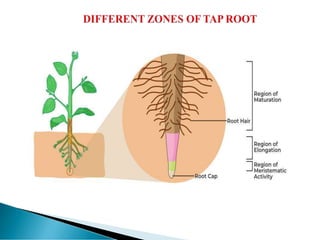
 Tap root consists of the following parts;
 Root Cap region-The root cap protects the growing tip in plants. It secretes
mucilage to ease the movement of the root through soil, and may also be
involved in communication with the soil microbiota. The purpose of the
root cap is to enable downward growth of the root, with the root cap
covering the sensitive tissue in the root. it may be multiple root cap like
Pandanus odoratissumus . It may contain root pocket like Eichornia ,
Pistia, Lemna etc.
 Meristematic Zone-Just above the root cap, meristematic layers comprising
of delicate cell wall, dense cytoplasm and enlarged nucleus containing
zone.
 Zone of Elongation- A layer of extended part,
 Root Hair Region- Consists of numerous , unicellular hairs,
 Permanent Region-Just above the zone of absorption, an extended layer
comprising of permanent tissues present.
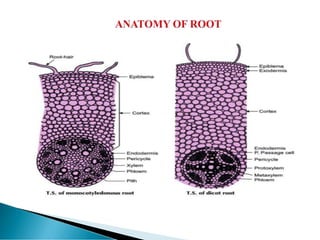
 Higher Plants mainly angiosperm broadly divides into two categories-
monocot and dicot and they differ to each other on the basis of internal
structures in general and the number of vascular bundles in particular.
 The common features are as follows:
 No cuticle in the epidermis,
 Epidermis - outer single layered parenchyma cells with unicellular hairs,
 General Cortex- Mostly a series of parenchymatous tissues with no
intercellular spaces to store starch and organic matter as reserve food
matters,
 Endodermis – the innermost layer, a compact area of cells encircled by
fatty band inside each cell to establish vascular connection,
 Pericycle- a layer of cells encircles the vascular cylinder,
 The vascular bundles- made up of xylem and phloem in radial fashion , up
to 4-6 in dicot root and more than 6 in monocot root, exarch xylem,
 No pith present,
 Some modifications like passage cells present in the endodermis.
 Beside the normal function of root like mechanical function, physiological
function and some special function, it undergoes a series of change to
respond stress as a part to resume normal function. The following type of
modifications are found :
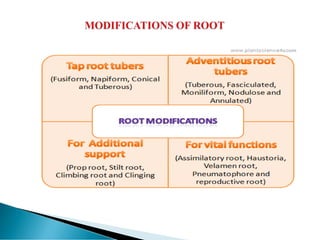
 MODIFICATION OF TAP ROOT
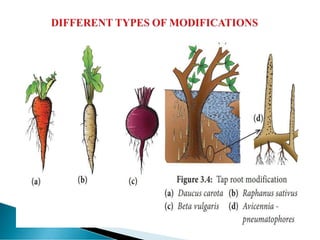
 Storage root- To store food, some roots undergo swollen and enlarged , the
root branches become fibrillar in nature.
 A. Fusiform - Middle part swells and the two ends taper as found in radish,
Raphanus sativus ( Brassicaceae).
 B. Conical- The upper part swells and gradually narrower in the lower part
giving conical shape as found in carrot, Daucas carota (Brassicaceae),
 C. Napiform - The upper part swells but the lower portion immediately
narrower like tail like structure as found in Brassica napus ( Brassicaceae).
 D. Tuberous- The tap root swells but do not undergo any special shape as
found in four o’ clock plant, Mirabilis jalapa (Nyctaginaceae)
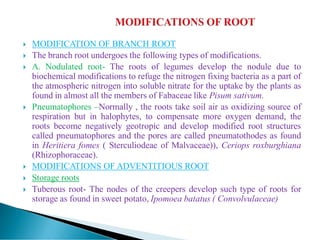
 MODIFICATION OF BRANCH ROOT
 The branch root undergoes the following types of modifications.
 A. Nodulated root- The roots of legumes develop the nodule due to
biochemical modifications to refuge the nitrogen fixing bacteria as a part of
the atmospheric nitrogen into soluble nitrate for the uptake by the plants as
found in almost all the members of Fabaceae like Pisum sativum.
 Pneumatophores –Normally , the roots take soil air as oxidizing source of
respiration but in halophytes, to compensate more oxygen demand, the
roots become negatively geotropic and develop modified root structures
called pneumatophores and the pores are called pneumatothodes as found
in Heritiera fomes ( Sterculiodeae of Malvaceae)), Ceriops roxburghiana
(Rhizophoraceae).
 MODIFICATIONS OF ADVENTITIOUS ROOT
 Storage roots
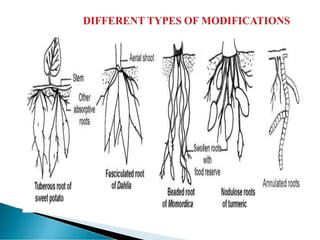
 Tuberous root- The nodes of the creepers develop such type of roots for
storage as found in sweet potato, Ipomoea batatus ( Convolvulaceae)
 Fasiculated root –From the lowermost node of the stem, the fibrous roots
appear and undergo swelling due to food storage as found in Asparagus
racemosus (Asparagaceae) and Dahlia hybrida ( Asteraceae).
 Nodulated root-The terminal portion of the adventitious root swells due to
food storage as found in Curcuma amada (Zingiberaceae) and Canna indica
( Cannaceae).
 Moniliform or Beaded root-The adventitious roots undergoes swelling and
normal at a regular intervals and appear as beads as found in Mormordica
cochinchinensis (Cucurbitaceae) and Mormordica charantia (
Cucurbitaceae).
 Annulated root-The adventitious roots gradually appear as ball or annular
growths as found in Ipecac , Psychotria ipecacuanha ( Rubiaceae).
 ADVENTITIOUS ROOTS MODIFICATIONS FOR PHYSIOLOGICAL
MODIFICATIONS:
 Epiphytic root- These are roots of some parasites that floats on air; have
velamen like sponge tissues to absorb atmospheric water as Vanda
roxburghii ( Orchidaceae)
 Assimilatory Root- Some roots derive from the internodes of stem ,
conduct photosynthesis due to chlorophyll as found in Tinospora cordifolia
( Menispermaceae) and Trapa bispinosa ( Lathraceae).
 Parasitic Root or Haustoria – Some roots derived from the nodes of some
parasites, invade the phloem of the host plant for nutrition as found in
Cuscuta reflexa ( Convolvulaceae).
 Floating Root –In aquatic plants, the adventitious root develop from nodes
that enables to float and undergo respiration as found in Jussiaea repens (
Onagraceae) now known as Ludwigia adscendens.
 Reproductive Root- Very often the adventitious root develop the
reproductive bud to form new individual as found in Trichosanthes dioica (
Cucurbitaceae) , Ipoea batatus (Convolvulaceae).
 Thus, these are type of modifications for different physiological functions
as extended by plants of diverse groups.
 Prop Root- The adventitious roots develop from the expanded portion of
the stem, hang on the lower side with root cap on the tip and appear as prop
to withstand the pressure exerted from the trunk. Very often, it extend the
function in absence of tap root as found in Ficus benghalensis ( Moraceae).
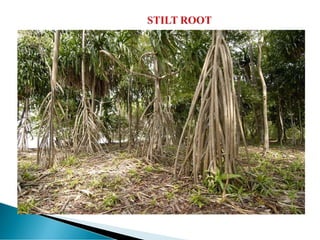
 Stilt Root- From the lower part of the stem, some nodes develop
adventitious root and vertically pushed into the soil known as stilt root to
stand erect and extend physiological functions found in Pandanus
fascicularis ( Pandanaceae) , Zea mays ( Poaceae) etc.
 Root Buttress – These are the aerial extensions of the lateral surface roots
having the internal organization of the admixture of root and stem as found
in Bombyx ceiba ( Bombaceae). It helps to withstand pressure exerted by
the heavy crown of the standing plant.
 Climbing Root - Climbing roots are the adventitious roots that arise from
the nodes or internodes in plants having weak stems. These roots help the
plants in climbing by penetrating the cracks of the support, as in Pothos
(money plant) or they may stick firmly to a support by secreting a
cementing gummy substance, as in Ficus pumila (Moraceae)
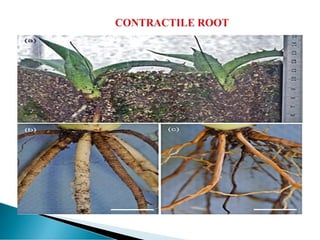
 Contractile Root- Contractile roots are responsible for movement of the
underground shoot part of the plant, e.g., a corm, a bulb, or a. rhizome.
Movement of such organs must overcome soil resistance, and thus it
depends on several soil parameters, e.g., soil. type, moisture, and
mechanical stability. The expansion and contraction of the contractile root
enables the plant to resume its normal position as found in Canna indica
(Cannaceae) , Alium cepa ( Liliaceae) etc.
 Thorn Root-Root thorns are strongly sclerenchymatized roots arising on
the stem above the ground. It saves the plant against herbivores. The sharp
thorns may also save properties when grown as a hedge. These roots
mainly confer protection to the plants from the different adverse situations
as found in the members of Arecaceae like Borassus flebllifer.
 Haptera- In addition to these, some plants of hilly regions develop some
special roots get attached to the rock surface called Haptera as found in
Podostemum sp.
 The classical taxonomy of plant needs the morphology of the root for the
identification of the plant in order to get an holistic idea of the study
material. Here are some of the information that can be used in this regard.
 The identification of taxa by their root would allow species specific
question to address,
 Tap root and fibrous roots can help to make difference between monocot
and dicot plants,
 The different type of underground modifications enable to identify species
in the hierarchical level,
 Preparation of key can be done on the basis of root characters,
 Although root is the underground part, it develops the challenges as far as
the identification of plants on the basis of this character.
 References:
 Google for different images incorporated into this PPT,
 Different WebPages for reference and content,
 Disclaimer:
 This presentation has been made and designed as the free open source of
study materials intended for the academic fraternity. The presenter does not
claim any kind of financial interest for this work. It is completely free for
use.

Vegetative Morphology of Plant's Root- A Comprehensive Study.

  • 1.
    ROOT-A COMPREHENSIVE STUDY Presented by Dr.N. Sannigrahi, Associate Professor, Department of Botany, Nistarini College, Purulia, D.B. Road, Purulia (W.B), India-723101
  • 2.
     Root asdescending part is the extension and modification of the radical of the germinating seeds of the higher plants.  Roots have no nodes or internodes pattern of construction,  No leaves, no branching from regular spots, no vegetative bud mostly,  Grows downward and holds the plants tightly to absorb water, minerals along with storage and other secondary functions,  Mostly cylindrical in structure,  Positively geotropic and hydrotropic but negatively phototropic,  Mostly colorless, white without chlorophyll,  Root cap present over the apex of the root,  Six types of roots- tap roots, fibrous root, lateral roots, adventitious root, storage roots and aerial; roots,  A lot of specialties according to need by modifications,  Plants without root: Wolfia arrhiza, Utricularia stellaris
  • 4.
     Tap rootconsists of the following parts;  Root Cap region-The root cap protects the growing tip in plants. It secretes mucilage to ease the movement of the root through soil, and may also be involved in communication with the soil microbiota. The purpose of the root cap is to enable downward growth of the root, with the root cap covering the sensitive tissue in the root. it may be multiple root cap like Pandanus odoratissumus . It may contain root pocket like Eichornia , Pistia, Lemna etc.  Meristematic Zone-Just above the root cap, meristematic layers comprising of delicate cell wall, dense cytoplasm and enlarged nucleus containing zone.  Zone of Elongation- A layer of extended part,  Root Hair Region- Consists of numerous , unicellular hairs,  Permanent Region-Just above the zone of absorption, an extended layer comprising of permanent tissues present.
  • 6.
     Higher Plantsmainly angiosperm broadly divides into two categories- monocot and dicot and they differ to each other on the basis of internal structures in general and the number of vascular bundles in particular.  The common features are as follows:  No cuticle in the epidermis,  Epidermis - outer single layered parenchyma cells with unicellular hairs,  General Cortex- Mostly a series of parenchymatous tissues with no intercellular spaces to store starch and organic matter as reserve food matters,  Endodermis – the innermost layer, a compact area of cells encircled by fatty band inside each cell to establish vascular connection,  Pericycle- a layer of cells encircles the vascular cylinder,  The vascular bundles- made up of xylem and phloem in radial fashion , up to 4-6 in dicot root and more than 6 in monocot root, exarch xylem,  No pith present,  Some modifications like passage cells present in the endodermis.
  • 8.
     Beside thenormal function of root like mechanical function, physiological function and some special function, it undergoes a series of change to respond stress as a part to resume normal function. The following type of modifications are found :  MODIFICATION OF TAP ROOT  Storage root- To store food, some roots undergo swollen and enlarged , the root branches become fibrillar in nature.  A. Fusiform - Middle part swells and the two ends taper as found in radish, Raphanus sativus ( Brassicaceae).  B. Conical- The upper part swells and gradually narrower in the lower part giving conical shape as found in carrot, Daucas carota (Brassicaceae),  C. Napiform - The upper part swells but the lower portion immediately narrower like tail like structure as found in Brassica napus ( Brassicaceae).  D. Tuberous- The tap root swells but do not undergo any special shape as found in four o’ clock plant, Mirabilis jalapa (Nyctaginaceae)
  • 10.
     MODIFICATION OFBRANCH ROOT  The branch root undergoes the following types of modifications.  A. Nodulated root- The roots of legumes develop the nodule due to biochemical modifications to refuge the nitrogen fixing bacteria as a part of the atmospheric nitrogen into soluble nitrate for the uptake by the plants as found in almost all the members of Fabaceae like Pisum sativum.  Pneumatophores –Normally , the roots take soil air as oxidizing source of respiration but in halophytes, to compensate more oxygen demand, the roots become negatively geotropic and develop modified root structures called pneumatophores and the pores are called pneumatothodes as found in Heritiera fomes ( Sterculiodeae of Malvaceae)), Ceriops roxburghiana (Rhizophoraceae).  MODIFICATIONS OF ADVENTITIOUS ROOT  Storage roots  Tuberous root- The nodes of the creepers develop such type of roots for storage as found in sweet potato, Ipomoea batatus ( Convolvulaceae)
  • 12.
     Fasiculated root–From the lowermost node of the stem, the fibrous roots appear and undergo swelling due to food storage as found in Asparagus racemosus (Asparagaceae) and Dahlia hybrida ( Asteraceae).  Nodulated root-The terminal portion of the adventitious root swells due to food storage as found in Curcuma amada (Zingiberaceae) and Canna indica ( Cannaceae).  Moniliform or Beaded root-The adventitious roots undergoes swelling and normal at a regular intervals and appear as beads as found in Mormordica cochinchinensis (Cucurbitaceae) and Mormordica charantia ( Cucurbitaceae).  Annulated root-The adventitious roots gradually appear as ball or annular growths as found in Ipecac , Psychotria ipecacuanha ( Rubiaceae).  ADVENTITIOUS ROOTS MODIFICATIONS FOR PHYSIOLOGICAL MODIFICATIONS:  Epiphytic root- These are roots of some parasites that floats on air; have velamen like sponge tissues to absorb atmospheric water as Vanda roxburghii ( Orchidaceae)
  • 14.
     Assimilatory Root-Some roots derive from the internodes of stem , conduct photosynthesis due to chlorophyll as found in Tinospora cordifolia ( Menispermaceae) and Trapa bispinosa ( Lathraceae).  Parasitic Root or Haustoria – Some roots derived from the nodes of some parasites, invade the phloem of the host plant for nutrition as found in Cuscuta reflexa ( Convolvulaceae).  Floating Root –In aquatic plants, the adventitious root develop from nodes that enables to float and undergo respiration as found in Jussiaea repens ( Onagraceae) now known as Ludwigia adscendens.  Reproductive Root- Very often the adventitious root develop the reproductive bud to form new individual as found in Trichosanthes dioica ( Cucurbitaceae) , Ipoea batatus (Convolvulaceae).  Thus, these are type of modifications for different physiological functions as extended by plants of diverse groups.
  • 16.
     Prop Root-The adventitious roots develop from the expanded portion of the stem, hang on the lower side with root cap on the tip and appear as prop to withstand the pressure exerted from the trunk. Very often, it extend the function in absence of tap root as found in Ficus benghalensis ( Moraceae).  Stilt Root- From the lower part of the stem, some nodes develop adventitious root and vertically pushed into the soil known as stilt root to stand erect and extend physiological functions found in Pandanus fascicularis ( Pandanaceae) , Zea mays ( Poaceae) etc.  Root Buttress – These are the aerial extensions of the lateral surface roots having the internal organization of the admixture of root and stem as found in Bombyx ceiba ( Bombaceae). It helps to withstand pressure exerted by the heavy crown of the standing plant.  Climbing Root - Climbing roots are the adventitious roots that arise from the nodes or internodes in plants having weak stems. These roots help the plants in climbing by penetrating the cracks of the support, as in Pothos (money plant) or they may stick firmly to a support by secreting a cementing gummy substance, as in Ficus pumila (Moraceae)
  • 18.
     Contractile Root-Contractile roots are responsible for movement of the underground shoot part of the plant, e.g., a corm, a bulb, or a. rhizome. Movement of such organs must overcome soil resistance, and thus it depends on several soil parameters, e.g., soil. type, moisture, and mechanical stability. The expansion and contraction of the contractile root enables the plant to resume its normal position as found in Canna indica (Cannaceae) , Alium cepa ( Liliaceae) etc.  Thorn Root-Root thorns are strongly sclerenchymatized roots arising on the stem above the ground. It saves the plant against herbivores. The sharp thorns may also save properties when grown as a hedge. These roots mainly confer protection to the plants from the different adverse situations as found in the members of Arecaceae like Borassus flebllifer.  Haptera- In addition to these, some plants of hilly regions develop some special roots get attached to the rock surface called Haptera as found in Podostemum sp.
  • 20.
     The classicaltaxonomy of plant needs the morphology of the root for the identification of the plant in order to get an holistic idea of the study material. Here are some of the information that can be used in this regard.  The identification of taxa by their root would allow species specific question to address,  Tap root and fibrous roots can help to make difference between monocot and dicot plants,  The different type of underground modifications enable to identify species in the hierarchical level,  Preparation of key can be done on the basis of root characters,  Although root is the underground part, it develops the challenges as far as the identification of plants on the basis of this character.
  • 21.
     References:  Googlefor different images incorporated into this PPT,  Different WebPages for reference and content,  Disclaimer:  This presentation has been made and designed as the free open source of study materials intended for the academic fraternity. The presenter does not claim any kind of financial interest for this work. It is completely free for use.