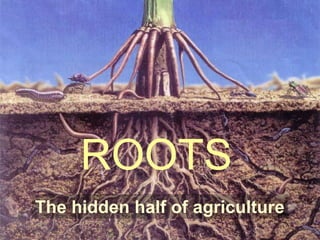
ROOTS
The hidden half of agriculture
How many of you regularly
   look at crop roots ?

                   John McGillicuddy
                   IA crop scout
Bill Darrington (Persia, IA)
One of several readings
     for this week
Read the attached article and submit answers using WO before the start of class
next Wednesday.

1)Describe several factors contributing to deep root growth on Bill Darrington's
farm.

2) The article refers to Ray Rawson as the guru of "vertical farming"... what is
"vertical farming" and what did Bill Darrington learn from Ray Rawson about soil
aeration?

3) Why does Bill Darrington dig so many soil pits and what does he look for?

4) What is Bill Darrington's perspective on anhydrous ammonia? Do you agree
with this perspective?

5) Have you ever looked at roots in a soil pit? If so, describe something you
observed. If not, when do you think you will have an opportunity to look at some
roots? What do you think you will see?
Ken Ferrie – Farm Journal
All you need to do to grow healthy roots
       is use rootworm resistant genetics… right??


When rootworm pressure is high, rootworm resistant
  genetics normally result in much healthier roots
Rootworm resistant genetics are not a silver bullet !
                                     Severe damage by corn
                                   rootworm larvae to roots of
                                    a biotech corn rootworm
                                             hybrid


          http://www.ipm.iastate.edu/ipm/icm/2006/11-13/btcorn.html
We have witnessed the historically low densities of
  European corn borers across Illinois and some nearby
states that are now believed to be linked to the widespread
     adoption of Bt corn hybrids. Will we see a similar
   phenomenon unfold with western corn rootworms? I
 suspect we might be headed down this road. Will western
corn rootworms adapt as they have repeatedly done so in
  the past? If we don't integrate management tactics, we
     could have the answer sooner than we would like.
U of I Corn Borer survey results
The seed roots stop growing shortly after the coleoptile
 emerges from the soil surface. The nodal root system
   becomes visible at ~ V1. The nodal root system
       becomes the dominant system by V6.
16 weeks
  8
  4


7 feet deep !!
1926
Sub-soil water
and nutrients


                 Brady and Weil (2002)
Sidewall compaction


        ?
Waiting for drier soil
is the most important strategy

Sidewall compaction


             ?
Tillage systems
   affect root
  architecture


            Adapted from Hunt et al. (1986)
Long term no-till
                                  (w/ healthy soil biology)
             Intensive tillage


                                    Network
                   Plow pan            of
                                    biopores


Ontario Ministry of Ag and Food
Which solution
would you use ?
WIU Allison Organic Research Farm – September 2007
January
February
Early May

Warmer and drier than soil
with other cover crops and
 almost no weed growth
Visual evidence of biodrilling
Canola root


Rapeseed root
The experiment was planted to
     corn on May 29 2008

     Corn following radish
established well, had the lowest
   in-row weed pressure and
   yielded about 10 bu more.
Chemical toxicities
can inhibit root growth


             Aluminum
              toxicity


                          Aluminum
                           toxicity
Galled root system of tomato infected with root-knot
 nematode, Meloidogyne sp., compared with non-
                infected root system


                  Root pathogens can
                   inhibit root growth
           http://www.agnr.umd.edu/users/nrsl/entm/nematology/images/eis143.jpg
Root knot juvenile penetrating a tomato root
You won’t know what is happening
underground unless you take a look…
All you need
          is a shop-vac
           and a hose!


Its just like going to the dentist!
Roots have many functions !
Absorptive network for limiting soil resources
of water and nutrients

Mechanical structures that support plants,
strengthen soil, construct channels, break
rocks, etc.

Hydraulic conduits that redistribute soil water
and nutrients

Habitats for mycorrhizal fungi, rhizosphere
and rhizoplane organisms
Carbon pumps that feed soil organisms and
      contribute to soil organic matter

             Storage organs

Chemical factories that may change soil pH,
    poison competitors, filter out toxins,
      concentrate rare elements, etc.

A sensor network that helps regulate plant
                 growth
Macro-
anatomy of roots
Micro-anatomy of roots


http://www.sparknotes.com/biology/plants/plantstructures/section2.rhtml
What is the function
 of the root cap?
The cell wall of the endodermis (pink inner strip of cells) is waterproofed by the
Casparian strip, which forces water to enter the symplast before it can enter the
root xylem

                                                           phloem
  root hair
                                                             xylem


epidermis
                                                                 endodermis

    cortex
Apoplast vs. symplast


The movement of fluids from the root hairs to the xylem
can occur through one of two conductive pathways–
the apoplast and the symplast.

The apoplast route consists of inter-cellular spaces
within the root cortex along which water and solutes
can diffuse.

The symplast route consists of channels through cells
along which water and solutes are actively transported.
http://www.mie.utoronto.ca/labs/lcdlab/biopic/fig/35.03.jpg
Water moves upward
through plants
whenever there is a
progressively more
negative gradient of
water potential along
the soil-plant-
atmosphere
continuum
H20


A continuous                 Solar energy
chain of water
                              drives the
 molecules is                  process
  pulled up
 through the                 Plants provide
    plant                     the conduit


                 H20
               H20
             H20
Understanding nutrient uptake


                                                      H20
              Root exudates
N, S, P   activate soil microbes                 Transpirational


                                   Root growth
                                                     stream
                                                      H 20
                                                     Diffusion
Nutrient uptake is an active and selective process
  outside cell


                                               inside cell
Rhizosphere

 Roots normally
 occupy < 1% of topsoil
 volume
The rhizophere is
normally < 10 % of soil
volume                    Zone of root
                           influence
Navigating the rhizosphere
                                                          End of the
                           Rhizoplane                     rhizosphere
                        Endo-
                     Rhizosphere    Ecto-Rhizosphere
Microbial activity


                                                                    > 90%
                                          < 10% of soil
                                             volume
                                                                    of soil
                                                                   volume


                                   A few millimeters

                                                                    (Lavelle and Spain, 2001)
Both strategies are important !
Feed the soil vs. Feed the crop???
 Unhealthy roots use nutrients inefficiently…
  Healthy roots need available nutrients !


                              Acute
                               root
                             disease


 Chronic root
 malfunction
How do you know if a crop has healthy roots?

                                     extend into the
   white color                         B horizon


proliferate in all                       minimal
   directions                          evidence of
                                       deformities
Healthy
cowpea
nodule
 with a
  pink
interior
Legume
  nodules
  come in
many shapes
 and sizes
Lots of complicated biochemistry – very intensively studied!!


Legume
  love
 affair


                                                   Sarrantonio
Examples of rhizobia innoculant
Inoculation groups for commonly grown legumes
   Alfalfa Group                        Alfalfa
       (Rhizobium meliloti)                 Black medic
                                            Bur clover
                                            Button clover
                                            White sweetclover
                                            Yellow sweetclover
   Clover Group                         Alsike clover
      (Rhizobium trifolii)                  Arrowleaf clover*
                                            Ball clover
                                            Berseem clover
                                            Crimson clover
                                            Hop clover
                                            Persian clover
                                            Red clover
                                            Rose clover*
                                            Subterranean clover*
                                            White clover
   Cowpea Group                         Alyceclover
Soybean has its own inoculation group!!
     (Bradyrhizobium japonicum spp.)       Cowpea
                                           Kudzu
                                           Peanut
Mycorrhizal associations
                      Ectomycorrhizae


                                         AM endomycorrhizae


Arbutoid
mycorrhizae


    Ericoid
    endomycorrhizae

                                  Orchid endomycorrhizae


                                           Lavelle and Spain (2001)
Ectomycorrhizal roots
Close up of ecto-mycorrhiza
Mycorrhizal Networks: Connecting
    plants intra- and interspecifically
                                 •Many plants are
                                 connected
                                 underground by
                                 mycorrhizal hyphal
                                 interconnections.

                                 •Mycorrhizal (AM)
                                 fungi are not host
                                 specific.

Illustration by Mark Brundrett
Increase nutrient (P) uptake          suppress pathogens


 Mediate plant competition           Improve soil structure


                               Glomalin
                               Superglue
                               of the soil ??

Roots

  • 1.
    ROOTS The hidden halfof agriculture
  • 2.
    How many ofyou regularly look at crop roots ? John McGillicuddy IA crop scout
  • 3.
    Bill Darrington (Persia,IA) One of several readings for this week
  • 4.
    Read the attachedarticle and submit answers using WO before the start of class next Wednesday. 1)Describe several factors contributing to deep root growth on Bill Darrington's farm. 2) The article refers to Ray Rawson as the guru of "vertical farming"... what is "vertical farming" and what did Bill Darrington learn from Ray Rawson about soil aeration? 3) Why does Bill Darrington dig so many soil pits and what does he look for? 4) What is Bill Darrington's perspective on anhydrous ammonia? Do you agree with this perspective? 5) Have you ever looked at roots in a soil pit? If so, describe something you observed. If not, when do you think you will have an opportunity to look at some roots? What do you think you will see?
  • 5.
    Ken Ferrie –Farm Journal
  • 6.
    All you needto do to grow healthy roots is use rootworm resistant genetics… right?? When rootworm pressure is high, rootworm resistant genetics normally result in much healthier roots
  • 7.
    Rootworm resistant geneticsare not a silver bullet ! Severe damage by corn rootworm larvae to roots of a biotech corn rootworm hybrid http://www.ipm.iastate.edu/ipm/icm/2006/11-13/btcorn.html
  • 8.
    We have witnessedthe historically low densities of European corn borers across Illinois and some nearby states that are now believed to be linked to the widespread adoption of Bt corn hybrids. Will we see a similar phenomenon unfold with western corn rootworms? I suspect we might be headed down this road. Will western corn rootworms adapt as they have repeatedly done so in the past? If we don't integrate management tactics, we could have the answer sooner than we would like.
  • 10.
    U of ICorn Borer survey results
  • 11.
    The seed rootsstop growing shortly after the coleoptile emerges from the soil surface. The nodal root system becomes visible at ~ V1. The nodal root system becomes the dominant system by V6.
  • 12.
    16 weeks 8 4 7 feet deep !!
  • 13.
  • 15.
    Sub-soil water and nutrients Brady and Weil (2002)
  • 16.
  • 17.
    Waiting for driersoil is the most important strategy Sidewall compaction ?
  • 18.
    Tillage systems affect root architecture Adapted from Hunt et al. (1986)
  • 19.
    Long term no-till (w/ healthy soil biology) Intensive tillage Network Plow pan of biopores Ontario Ministry of Ag and Food
  • 20.
  • 21.
    WIU Allison OrganicResearch Farm – September 2007
  • 23.
  • 24.
  • 25.
    Early May Warmer anddrier than soil with other cover crops and almost no weed growth
  • 26.
    Visual evidence ofbiodrilling Canola root Rapeseed root
  • 27.
    The experiment wasplanted to corn on May 29 2008 Corn following radish established well, had the lowest in-row weed pressure and yielded about 10 bu more.
  • 28.
    Chemical toxicities can inhibitroot growth Aluminum toxicity Aluminum toxicity
  • 29.
    Galled root systemof tomato infected with root-knot nematode, Meloidogyne sp., compared with non- infected root system Root pathogens can inhibit root growth http://www.agnr.umd.edu/users/nrsl/entm/nematology/images/eis143.jpg
  • 30.
    Root knot juvenilepenetrating a tomato root
  • 31.
    You won’t knowwhat is happening underground unless you take a look…
  • 32.
    All you need is a shop-vac and a hose! Its just like going to the dentist!
  • 33.
    Roots have manyfunctions !
  • 34.
    Absorptive network forlimiting soil resources of water and nutrients Mechanical structures that support plants, strengthen soil, construct channels, break rocks, etc. Hydraulic conduits that redistribute soil water and nutrients Habitats for mycorrhizal fungi, rhizosphere and rhizoplane organisms
  • 35.
    Carbon pumps thatfeed soil organisms and contribute to soil organic matter Storage organs Chemical factories that may change soil pH, poison competitors, filter out toxins, concentrate rare elements, etc. A sensor network that helps regulate plant growth
  • 36.
  • 37.
  • 38.
    What is thefunction of the root cap?
  • 39.
    The cell wallof the endodermis (pink inner strip of cells) is waterproofed by the Casparian strip, which forces water to enter the symplast before it can enter the root xylem phloem root hair xylem epidermis endodermis cortex
  • 40.
    Apoplast vs. symplast Themovement of fluids from the root hairs to the xylem can occur through one of two conductive pathways– the apoplast and the symplast. The apoplast route consists of inter-cellular spaces within the root cortex along which water and solutes can diffuse. The symplast route consists of channels through cells along which water and solutes are actively transported.
  • 41.
  • 42.
    Water moves upward throughplants whenever there is a progressively more negative gradient of water potential along the soil-plant- atmosphere continuum
  • 43.
    H20 A continuous Solar energy chain of water drives the molecules is process pulled up through the Plants provide plant the conduit H20 H20 H20
  • 44.
    Understanding nutrient uptake H20 Root exudates N, S, P activate soil microbes Transpirational Root growth stream H 20 Diffusion
  • 45.
    Nutrient uptake isan active and selective process outside cell inside cell
  • 46.
    Rhizosphere Roots normally occupy < 1% of topsoil volume The rhizophere is normally < 10 % of soil volume Zone of root influence
  • 47.
    Navigating the rhizosphere End of the Rhizoplane rhizosphere Endo- Rhizosphere Ecto-Rhizosphere Microbial activity > 90% < 10% of soil volume of soil volume A few millimeters (Lavelle and Spain, 2001)
  • 48.
    Both strategies areimportant ! Feed the soil vs. Feed the crop??? Unhealthy roots use nutrients inefficiently… Healthy roots need available nutrients ! Acute root disease Chronic root malfunction
  • 49.
    How do youknow if a crop has healthy roots? extend into the white color B horizon proliferate in all minimal directions evidence of deformities
  • 50.
  • 51.
    Legume nodules come in many shapes and sizes
  • 52.
    Lots of complicatedbiochemistry – very intensively studied!! Legume love affair Sarrantonio
  • 53.
  • 54.
    Inoculation groups forcommonly grown legumes Alfalfa Group Alfalfa (Rhizobium meliloti) Black medic Bur clover Button clover White sweetclover Yellow sweetclover Clover Group Alsike clover (Rhizobium trifolii) Arrowleaf clover* Ball clover Berseem clover Crimson clover Hop clover Persian clover Red clover Rose clover* Subterranean clover* White clover Cowpea Group Alyceclover Soybean has its own inoculation group!! (Bradyrhizobium japonicum spp.) Cowpea Kudzu Peanut
  • 55.
    Mycorrhizal associations Ectomycorrhizae AM endomycorrhizae Arbutoid mycorrhizae Ericoid endomycorrhizae Orchid endomycorrhizae Lavelle and Spain (2001)
  • 56.
  • 57.
    Close up ofecto-mycorrhiza
  • 58.
    Mycorrhizal Networks: Connecting plants intra- and interspecifically •Many plants are connected underground by mycorrhizal hyphal interconnections. •Mycorrhizal (AM) fungi are not host specific. Illustration by Mark Brundrett
  • 59.
    Increase nutrient (P)uptake suppress pathogens Mediate plant competition Improve soil structure Glomalin Superglue of the soil ??