Pentoxylales
Presented by :- Patel Rinku
M.Sc (botany)Sem :- 1
CBO :- 402
Department of life sciences ,
H.N.G.U. , Patan
Contents
• Discovery of Pentoxylales
• Distinguishing Features
• Stem Genera of Pentoxylales
• leaves of Pentoxylales
• Seed - Bearing Organ of Pentoxylales
Discovery of Pentoxylales
• This group has been discovered and named
as "Pentoxylales " by well - known Indian
palaeobotanist professor Birbal Sahni ( 1948
).
• This is a group of some fossil plants
described from Rajmahal Hills in Amrapara
District (Santhal parganas ) of Eastern Bihar
( India ) revealing their existence in Jurassic
period .
• Spome (1965) has treated this group as an
Order under the name " Pentoxylales " .
• Harris (1962) also discovered Some members (
Carnoconites Cranwelli ) of this group from
New Zealand . B.P. Srivastava (1946) and
Vishnu- Mittre (1953 ,1957) are some of the
major Indian Contributors On Pentoxylales
stems , leaves and male and female
reproductive Organs of this group have
been described under following names :
• Stems : pentoxylon and Nipanioxylon
• Leaves : Nipaniophyllum
• Pollen - bearing Organs : Sahnia
• Seed - bearing Organs : Carnoconites
Distinguishing Features
1. Extinct Mesozoic plants found in Jurassic
period.
2. Although the exact habit of these plants
is not clearly established, these were
probably shrubs or very small trees.
3. Long and short shoots were present On
these plants.
4. Short shoots had Spirally arranged leaves
and terminally located reproductive Organs.
5. Leaves were thick, simple, lanceolate, and had
diploxylic leaf trace.
6. Stomata were formerly thought to be
Syndetocheilic, but now they are Considered to be
haplocheilic.
7. Leaves possessed Open venation.
8. Stems were polystelic Basinger et al. (1974)
Opined that " it may be more appropriate to call
each stele as vascular Segment or Sympodium."
9. Wood of pentoxylon was pycnoxylic and
resembled Araucaria.
10. Ovules were Sessile.
11. Female reproductive Organs were like
Stalked mulberry , Consisting of about 20 Sessile
Seeds attached to central receptacle and
Surrounded by Stony layer and then fleshy
Outer layer of integument uniting them.
12. Male reproductive Organs or
microsporophyll's form whorl of branched
microsporangiophores.
13. The microsporangiophores were fused
basally into a disc - like Structure.
Stem Genera of Pentoxylales
( 1 ) Pentoxylon Sahnii:
• Pentoxylon Sahnii and Nipanioxylon guptai
are the stem genera of "pentoxyleae " .
• The stems of pentoxylon Sahnii attained a
diameter from 3 mm to 2 cm .
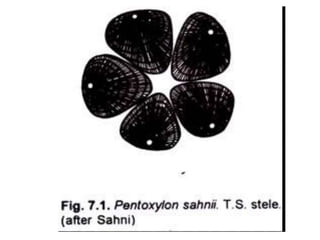
• Presence of five steles in a cross section of
the stem has been the main reason for giving
the name pentoxylon to the genus .
( 2 ) Nipanioxylon :
• This stem genus of pentoxyleae was discovered
from the village Nipania and hence named
Nipanioxylon .
• Nipanioxylon differed from pentoxylon in
possessing larger number of bundles (stele) and
less developed secondary growth in the stem.
Leaves of Pentoxylales
•Nipaniophyllum :
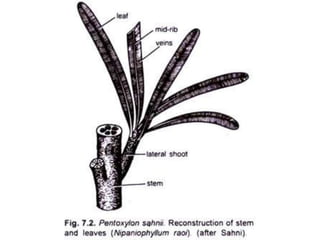
• The leaves have been described under the name
Nipaniophyllum raoi .
• They were present On the short lateral shoots .
• Each leaf was simple , petiolate , strap - shaped , and
possessed a well - developed mid rib with many
parallel lateral veins .
Seed - Bearing Organ of
Pentoxylales
( 1 )Carnoconites :
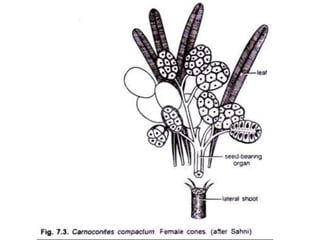
• The female cones or seed - bearing Organs have been
described under the name Carnoconites .
• Two Species ( C . compactum and C . laxum ) have been
described , Both these Species have , however , not
been reported in organic connection with the stem
genus pentoxylon but from the same rocks .
• Seed - bearing organs were forked and found attached
terminally on the lateral dwarf shoots .
• In spite of these facts Sahni (1948) used the word 'cone'
for these structures .
( 2 ) Sahnia Nipaniensis :
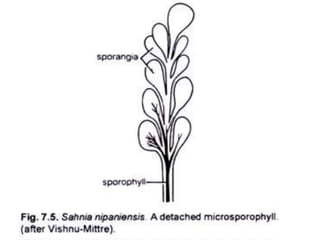
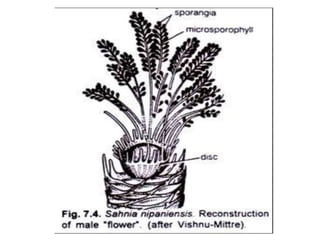
• The probable microsporangiate or male organs
of pentoxyleae were named as Sahnia
Nipaniensis by Vishnu - Mittre (1953) .
• They were present terminally on the shoot,
and fused basally in a shallow disc .
• Each microsporophyll possessed many pear -
shaped, unilocular sporangia .
• The sexine of the pollen wall is homogeneous
while its nexine is present in the form of thin
dark zone .
• In the region of aperuture, the sporoderm is
highly folded.
• Taylor & Taylor (1978) observed a few lamellae
in the region of aperture .
• Other details of the male flowers are not yet
fully known .
Reference :
• Botany for degree students Gymnosperms by
- P.C. VASISHTA
- A.K. SINHA
- ANIL KUMAR
 WWW.biologydiscussion.com
Thank you

Pentoxylales

  • 1.
    Pentoxylales Presented by :-Patel Rinku M.Sc (botany)Sem :- 1 CBO :- 402 Department of life sciences , H.N.G.U. , Patan
  • 2.
    Contents • Discovery ofPentoxylales • Distinguishing Features • Stem Genera of Pentoxylales • leaves of Pentoxylales • Seed - Bearing Organ of Pentoxylales
  • 3.
    Discovery of Pentoxylales •This group has been discovered and named as "Pentoxylales " by well - known Indian palaeobotanist professor Birbal Sahni ( 1948 ). • This is a group of some fossil plants described from Rajmahal Hills in Amrapara District (Santhal parganas ) of Eastern Bihar ( India ) revealing their existence in Jurassic period .
  • 4.
    • Spome (1965)has treated this group as an Order under the name " Pentoxylales " . • Harris (1962) also discovered Some members ( Carnoconites Cranwelli ) of this group from New Zealand . B.P. Srivastava (1946) and Vishnu- Mittre (1953 ,1957) are some of the major Indian Contributors On Pentoxylales stems , leaves and male and female reproductive Organs of this group have been described under following names :
  • 5.
    • Stems :pentoxylon and Nipanioxylon • Leaves : Nipaniophyllum • Pollen - bearing Organs : Sahnia • Seed - bearing Organs : Carnoconites
  • 6.
    Distinguishing Features 1. ExtinctMesozoic plants found in Jurassic period. 2. Although the exact habit of these plants is not clearly established, these were probably shrubs or very small trees. 3. Long and short shoots were present On these plants. 4. Short shoots had Spirally arranged leaves and terminally located reproductive Organs.
  • 7.
    5. Leaves werethick, simple, lanceolate, and had diploxylic leaf trace. 6. Stomata were formerly thought to be Syndetocheilic, but now they are Considered to be haplocheilic. 7. Leaves possessed Open venation. 8. Stems were polystelic Basinger et al. (1974) Opined that " it may be more appropriate to call each stele as vascular Segment or Sympodium." 9. Wood of pentoxylon was pycnoxylic and resembled Araucaria. 10. Ovules were Sessile.
  • 8.
    11. Female reproductiveOrgans were like Stalked mulberry , Consisting of about 20 Sessile Seeds attached to central receptacle and Surrounded by Stony layer and then fleshy Outer layer of integument uniting them. 12. Male reproductive Organs or microsporophyll's form whorl of branched microsporangiophores. 13. The microsporangiophores were fused basally into a disc - like Structure.
  • 9.
    Stem Genera ofPentoxylales ( 1 ) Pentoxylon Sahnii: • Pentoxylon Sahnii and Nipanioxylon guptai are the stem genera of "pentoxyleae " . • The stems of pentoxylon Sahnii attained a diameter from 3 mm to 2 cm . • Presence of five steles in a cross section of the stem has been the main reason for giving the name pentoxylon to the genus .
  • 11.
    ( 2 )Nipanioxylon : • This stem genus of pentoxyleae was discovered from the village Nipania and hence named Nipanioxylon . • Nipanioxylon differed from pentoxylon in possessing larger number of bundles (stele) and less developed secondary growth in the stem.
  • 12.
    Leaves of Pentoxylales •Nipaniophyllum: • The leaves have been described under the name Nipaniophyllum raoi . • They were present On the short lateral shoots . • Each leaf was simple , petiolate , strap - shaped , and possessed a well - developed mid rib with many parallel lateral veins .
  • 14.
    Seed - BearingOrgan of Pentoxylales ( 1 )Carnoconites : • The female cones or seed - bearing Organs have been described under the name Carnoconites . • Two Species ( C . compactum and C . laxum ) have been described , Both these Species have , however , not been reported in organic connection with the stem genus pentoxylon but from the same rocks . • Seed - bearing organs were forked and found attached terminally on the lateral dwarf shoots . • In spite of these facts Sahni (1948) used the word 'cone' for these structures .
  • 16.
    ( 2 )Sahnia Nipaniensis : • The probable microsporangiate or male organs of pentoxyleae were named as Sahnia Nipaniensis by Vishnu - Mittre (1953) . • They were present terminally on the shoot, and fused basally in a shallow disc . • Each microsporophyll possessed many pear - shaped, unilocular sporangia .
  • 18.
    • The sexineof the pollen wall is homogeneous while its nexine is present in the form of thin dark zone . • In the region of aperuture, the sporoderm is highly folded. • Taylor & Taylor (1978) observed a few lamellae in the region of aperture . • Other details of the male flowers are not yet fully known .
  • 20.
    Reference : • Botanyfor degree students Gymnosperms by - P.C. VASISHTA - A.K. SINHA - ANIL KUMAR  WWW.biologydiscussion.com
  • 21.