HYDRAULIC
STRUCTURES
A presentation on
1
Topics: We will discuss-
1. DAM
2. BRIDGES
3. CULVERTS
4. SLUICE GATES
5. AQUEDUCTS
6. SIPHONS
Presented By-
Nusrat Nasreen Khan, Syeda Khushnuma Wasim, M A Rafsan Mazumder,
Faisal Razy Anqur, A. S. M. Akram Samrat
2
DAM
3
What is Dam?
A dam is a barrier that impounds
water or underground steams.
Dams generally serve the primary
purpose of retaining water, while
other structures such
as floodgates or levees (also known
as dikes) are used to manage or
prevent water flow into specific land
regions. Hydropower and pumped-
storage hydroelectricity are often
used in conjunction with dams to
generate electricity. A dam can also
be used to collect water or for
storage of water which can be
evenly distributed between
locations.
4
Watertight
Sufficient
Strength
Releasing
Water
Flood Water
Flow
How Does
Dam Work?
A dam must be watertight so
that water does not leak out of
the dam and escape
downstream.
A dam wall must have
sufficient strength to stand permanently
under its own weight especially when at
least part of the dam wall is saturated
with water and to resist the water
pressure in the lake upstream of the
dam.
A dam must have some way of
releasing water in controlled
amounts as it is needed an outlet
valve of some type.
A dam must have some means
whereby these large volumes of
flood water can flow around the
dam without causing damage to the
dam itself. 5
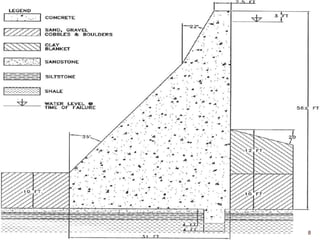
CROSS SECTION
6
7
8
Storage Capacity of
350×106 m3
producing up to 250,000
tons a day of tailings
Embankment ratio about
4:1
Syncrude Tailings Dam,
Canada
Holding 11,600,000
acre feet of water
Discharge capacity
of 18,406 cubic
meters/s
The main dam wall
stretching 2,743
meters
Tarbela Dam, Pakistan
SOME OF THE WORLD’S GREATEST DAMS
9
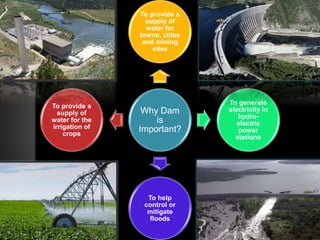
Why Dam
is
Important?
To provide a
supply of
water for
towns, cities
and mining
sites
To generate
electricity in
hydro-
electric
power
stations
To help
control or
mitigate
floods
To provide a
supply of
water for the
irrigation of
crops
10
BRIDGES
11
What is a BRIDGE?
A bridge is a structure built to span physical
obstacles such as a body of water, valley, or
road, for the purpose of providing passage
over the obstacle.
12
Fluid
Travelling
to Mid-
Span
Varying
Loads
Pinned
Connection
Horizontal
Sideway
Direction
As the hydraulic fluid is
pushed under pressure,
the fluid travels through
pipes eventually leading
to a vertical shaft
leading to the mid-span
of the bridge.
A bridge has the
ability to handle
varying loads
(wind/ice) and
possesses smooth
acceleration and
deceleration
In Arch based
bridges the main
forces are
directed in a
horizontal
sideways
direction.
In arch bridges
at the midpoint
of the arch there
is a pinned
connection,
essentially
making it a three
hinged arch
How Does a
Bridge Work?
13
14
15
CROSS SECTION
16
17
18
Pedestrian
Footbridge
Water
Transportat
ion
Vehicular
Transportat
ion
Light
Vehicles
The Uses of Hydraulic Bridges
19
Golden Gate
Bridge, San
Francisco
Sydney
Harbor
Bridge
World’s Famous Bridge
20
CULVERTS
21
A culvert is a
structure that allows
water to flow under
a road, railroad,
trail, or similar
obstruction.
Typically embedded
so as to be
surrounded by soil,
a culvert may be
made from a pipe,
reinforced concrete
or other material.
What is a
CULVERT?
22
TYPES OF CULVERTS
Box
culvert
Arch culvert
Pipe culvertBridge culvert
Pipe Single or Multiple
Pipe Arch Single or Multiple
Box Culvert Single or Multiple
Bridge Culvert
Arch Culvert
23
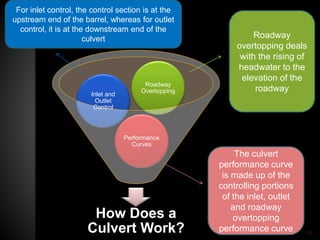
How Does a
Culvert Work?
Performance
Curves
Inlet and
Outlet
Control
Roadway
Overtopping
For inlet control, the control section is at the
upstream end of the barrel, whereas for outlet
control, it is at the downstream end of the
culvert Roadway
overtopping deals
with the rising of
headwater to the
elevation of the
roadway
The culvert
performance curve
is made up of the
controlling portions
of the inlet, outlet
and roadway
overtopping
performance curve 24
CROSS
SECTION
25
26
27
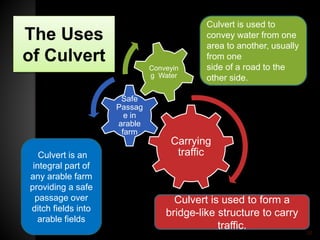
Carrying
traffic
Safe
Passag
e in
arable
farm
Conveyin
g Water
Culvert is used to form a
bridge-like structure to carry
traffic.
Culvert is used to
convey water from one
area to another, usually
from one
side of a road to the
other side.
Culvert is an
integral part of
any arable farm
providing a safe
passage over
ditch fields into
arable fields
The Uses
of Culvert
28
SLUICE GATE
29
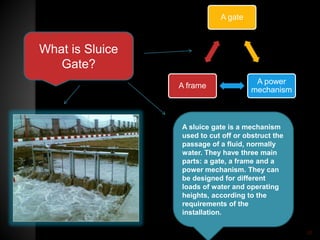
What is Sluice
Gate?
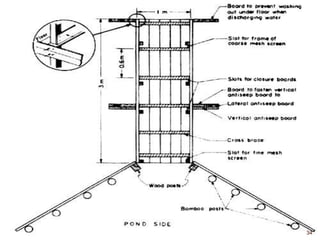
A sluice gate is a mechanism
used to cut off or obstruct the
passage of a fluid, normally
water. They have three main
parts: a gate, a frame and a
power mechanism. They can
be designed for different
loads of water and operating
heights, according to the
requirements of the
installation.
A gate
A power
mechanism
A frame
30
Threaded rod
system
Hydraulic System
Manual Raise and
Lowering
Electrically driven
hoisting system
How Does
Sluice Gate
Work?
Many sluice gates are moved by
means of a threaded rod system,
which needs to be regularly
cleaned and greased.
When gates are used in applications
with a large amount of water
pressure, they are raised and lowered
by hydraulic systems to control the
sluice gate flow.
Sometimes in smaller uses,
such as in cranberry bogs,
the gates are raised and
lowered manually.
At other times than manual, an
electrically-driven hoisting
system is used.
31
32
CROSS SECTION
33
34
35
Irrigation Channels
Sewage Treatment
Stations (WWTP)
Drinking Water Treatment
Stations (ETAP)
Sewers and
Reservoirs
What is the Use of
Sluice Gate?
36
AQUEDUCT
37
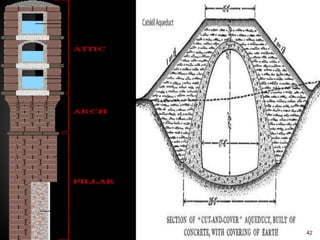
What is an AQUEDUCT?
An aqueduct is a watercourse constructed to
convey water. The term aqueduct is used for any
system of pipes, ditches, canals, tunnels, and other
structures used for this purpose. The simplest
aqueducts are small ditches cut into the earth.
Modern aqueducts may also use pipelines.
38
39
CROSS
SECTION
40
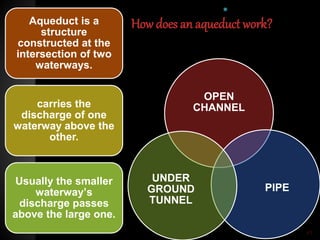
OPEN
CHANNEL
PIPE
UNDER
GROUND
TUNNEL
Usually the smaller
waterway’s
discharge passes
above the large one.
carries the
discharge of one
waterway above the
other.
Aqueduct is a
structure
constructed at the
intersection of two
waterways.
How does an aqueduct work?
41
42
Irrigation of
croplands
Supply
drinking
water
Help
drought
prone areas
with water
supplies
Control
flood
uses of aqueducts
43
SIPHON
44
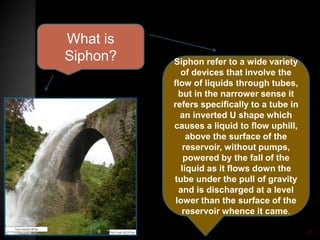
What is
Siphon? Siphon refer to a wide variety
of devices that involve the
flow of liquids through tubes,
but in the narrower sense it
refers specifically to a tube in
an inverted U shape which
causes a liquid to flow uphill,
above the surface of the
reservoir, without pumps,
powered by the fall of the
liquid as it flows down the
tube under the pull of gravity
and is discharged at a level
lower than the surface of the
reservoir whence it came.
45
Bernoulli’s
Principle
Unlike a
Manometer
Energy
Difference
A restatement of
conservation of energy
principle in that the sum
of all energy at any
given point in the siphon
flow is constant.
Operates as a
measurement of two
pressures in static balance
when the inlet and the
outlet are at the same
level.
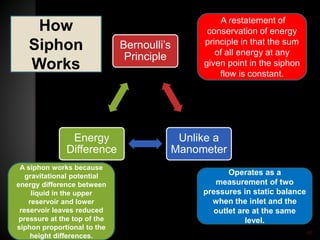
A siphon works because
gravitational potential
energy difference between
liquid in the upper
reservoir and lower
reservoir leaves reduced
pressure at the top of the
siphon proportional to the
height differences.
How
Siphon
Works
46
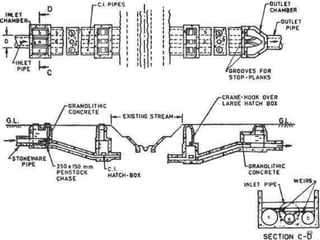
SIPHON
FUNCTION
PROCESS
47
CROSS
SECTION
48
49
50
Evacuating Water
Transferring Water
Waterworks and
Industry
Self-constructed
siphons, made of
pipes or tubes, can be
used to evacuate
water from cellars
after flooding.
Siphoning is common
in irrigated fields to
transfer a controlled
amount of water from
a ditch, over the ditch
wall, into furrows.
Large siphons are
used in municipal
waterworks and
industry. Their size
requires control via
valves at the intake
and outlet of the
How Siphon is
Important?
51
52
THANK YOU

Hydraulic structures

  • 1.
  • 2.
    Topics: We willdiscuss- 1. DAM 2. BRIDGES 3. CULVERTS 4. SLUICE GATES 5. AQUEDUCTS 6. SIPHONS Presented By- Nusrat Nasreen Khan, Syeda Khushnuma Wasim, M A Rafsan Mazumder, Faisal Razy Anqur, A. S. M. Akram Samrat 2
  • 3.
  • 4.
    What is Dam? Adam is a barrier that impounds water or underground steams. Dams generally serve the primary purpose of retaining water, while other structures such as floodgates or levees (also known as dikes) are used to manage or prevent water flow into specific land regions. Hydropower and pumped- storage hydroelectricity are often used in conjunction with dams to generate electricity. A dam can also be used to collect water or for storage of water which can be evenly distributed between locations. 4
  • 5.
    Watertight Sufficient Strength Releasing Water Flood Water Flow How Does DamWork? A dam must be watertight so that water does not leak out of the dam and escape downstream. A dam wall must have sufficient strength to stand permanently under its own weight especially when at least part of the dam wall is saturated with water and to resist the water pressure in the lake upstream of the dam. A dam must have some way of releasing water in controlled amounts as it is needed an outlet valve of some type. A dam must have some means whereby these large volumes of flood water can flow around the dam without causing damage to the dam itself. 5
  • 6.
  • 7.
  • 8.
  • 9.
    Storage Capacity of 350×106m3 producing up to 250,000 tons a day of tailings Embankment ratio about 4:1 Syncrude Tailings Dam, Canada Holding 11,600,000 acre feet of water Discharge capacity of 18,406 cubic meters/s The main dam wall stretching 2,743 meters Tarbela Dam, Pakistan SOME OF THE WORLD’S GREATEST DAMS 9
  • 10.
    Why Dam is Important? To providea supply of water for towns, cities and mining sites To generate electricity in hydro- electric power stations To help control or mitigate floods To provide a supply of water for the irrigation of crops 10
  • 11.
  • 12.
    What is aBRIDGE? A bridge is a structure built to span physical obstacles such as a body of water, valley, or road, for the purpose of providing passage over the obstacle. 12
  • 13.
    Fluid Travelling to Mid- Span Varying Loads Pinned Connection Horizontal Sideway Direction As thehydraulic fluid is pushed under pressure, the fluid travels through pipes eventually leading to a vertical shaft leading to the mid-span of the bridge. A bridge has the ability to handle varying loads (wind/ice) and possesses smooth acceleration and deceleration In Arch based bridges the main forces are directed in a horizontal sideways direction. In arch bridges at the midpoint of the arch there is a pinned connection, essentially making it a three hinged arch How Does a Bridge Work? 13
  • 14.
  • 15.
  • 16.
  • 17.
  • 18.
  • 19.
  • 20.
  • 21.
  • 22.
    A culvert isa structure that allows water to flow under a road, railroad, trail, or similar obstruction. Typically embedded so as to be surrounded by soil, a culvert may be made from a pipe, reinforced concrete or other material. What is a CULVERT? 22
  • 23.
    TYPES OF CULVERTS Box culvert Archculvert Pipe culvertBridge culvert Pipe Single or Multiple Pipe Arch Single or Multiple Box Culvert Single or Multiple Bridge Culvert Arch Culvert 23
  • 24.
    How Does a CulvertWork? Performance Curves Inlet and Outlet Control Roadway Overtopping For inlet control, the control section is at the upstream end of the barrel, whereas for outlet control, it is at the downstream end of the culvert Roadway overtopping deals with the rising of headwater to the elevation of the roadway The culvert performance curve is made up of the controlling portions of the inlet, outlet and roadway overtopping performance curve 24
  • 25.
  • 26.
  • 27.
  • 28.
    Carrying traffic Safe Passag e in arable farm Conveyin g Water Culvertis used to form a bridge-like structure to carry traffic. Culvert is used to convey water from one area to another, usually from one side of a road to the other side. Culvert is an integral part of any arable farm providing a safe passage over ditch fields into arable fields The Uses of Culvert 28
  • 29.
  • 30.
    What is Sluice Gate? Asluice gate is a mechanism used to cut off or obstruct the passage of a fluid, normally water. They have three main parts: a gate, a frame and a power mechanism. They can be designed for different loads of water and operating heights, according to the requirements of the installation. A gate A power mechanism A frame 30
  • 31.
    Threaded rod system Hydraulic System ManualRaise and Lowering Electrically driven hoisting system How Does Sluice Gate Work? Many sluice gates are moved by means of a threaded rod system, which needs to be regularly cleaned and greased. When gates are used in applications with a large amount of water pressure, they are raised and lowered by hydraulic systems to control the sluice gate flow. Sometimes in smaller uses, such as in cranberry bogs, the gates are raised and lowered manually. At other times than manual, an electrically-driven hoisting system is used. 31
  • 32.
  • 33.
  • 34.
  • 35.
  • 36.
    Irrigation Channels Sewage Treatment Stations(WWTP) Drinking Water Treatment Stations (ETAP) Sewers and Reservoirs What is the Use of Sluice Gate? 36
  • 37.
  • 38.
    What is anAQUEDUCT? An aqueduct is a watercourse constructed to convey water. The term aqueduct is used for any system of pipes, ditches, canals, tunnels, and other structures used for this purpose. The simplest aqueducts are small ditches cut into the earth. Modern aqueducts may also use pipelines. 38
  • 39.
  • 40.
  • 41.
    OPEN CHANNEL PIPE UNDER GROUND TUNNEL Usually the smaller waterway’s dischargepasses above the large one. carries the discharge of one waterway above the other. Aqueduct is a structure constructed at the intersection of two waterways. How does an aqueduct work? 41
  • 42.
  • 43.
    Irrigation of croplands Supply drinking water Help drought prone areas withwater supplies Control flood uses of aqueducts 43
  • 44.
  • 45.
    What is Siphon? Siphonrefer to a wide variety of devices that involve the flow of liquids through tubes, but in the narrower sense it refers specifically to a tube in an inverted U shape which causes a liquid to flow uphill, above the surface of the reservoir, without pumps, powered by the fall of the liquid as it flows down the tube under the pull of gravity and is discharged at a level lower than the surface of the reservoir whence it came. 45
  • 46.
    Bernoulli’s Principle Unlike a Manometer Energy Difference A restatementof conservation of energy principle in that the sum of all energy at any given point in the siphon flow is constant. Operates as a measurement of two pressures in static balance when the inlet and the outlet are at the same level. A siphon works because gravitational potential energy difference between liquid in the upper reservoir and lower reservoir leaves reduced pressure at the top of the siphon proportional to the height differences. How Siphon Works 46
  • 47.
  • 48.
  • 49.
  • 50.
  • 51.
    Evacuating Water Transferring Water Waterworksand Industry Self-constructed siphons, made of pipes or tubes, can be used to evacuate water from cellars after flooding. Siphoning is common in irrigated fields to transfer a controlled amount of water from a ditch, over the ditch wall, into furrows. Large siphons are used in municipal waterworks and industry. Their size requires control via valves at the intake and outlet of the How Siphon is Important? 51
  • 52.