DEPARTMENT OF CIVIL ENGINEERING
BY (BATCH-7)
ABHISHEK.K(11241A0132)
HEMANTH REDDY.Y(11241A0160)
CHERUKU SRIKANTH(11241A0169)
SUSHEEL CHOWDARY(10241A0182)
PREM KUMAR.G(11241A0117)
PROJECT GUIDE:
Mr. S.VENKATA CHARYULU
1
 ABSTRACT
 INTRODUCTION
 OBJECTIVES
 TYPES OF WATER TANKS
 INTZE TANK AND ITS CONSTRUCTION
 MATERIALS REQUIRED IN CONSTRUCTION
 STUDY FOR GRIET CAMPUS
 DESIGN THROUGH MANUAL PROCESS
 DESIGN THROUGH STAAD PRO
 CONCLUSIONS
 REFERENCES
2
 Due to enormous need by the public, water has to be stored
and supplied according to their needs. Water demand is not
constant throughout the day. It fluctuates hour to hour. In order
to supply constant amount of water, we need to store water. So
to meet the public water demand, water tank need to be
constructed.
 Storage reservoirs and overhead tanks are used to store water,
liquid petroleum, petroleum products and similar liquids. The
force analysis of the reservoirs or tanks is about the same
irrespective of the chemical nature of the product. All tanks
are designed as crack free structures to eliminate any leakage.
 This project gives a brief study of design and analysis of an
Intze water storage tank for GRIET campus using working
stress method and STAAD pro.
3
 A water tank is used to store water to tide over the daily
requirement. In the construction of concrete structure for the
storage of water and other liquids the imperviousness of
concrete is most essential.
 Design of liquid retaining structure has to be based on the
avoidance of cracking in the concrete having regard to its
tensile strength.
 Cracks can be prevented by avoiding the use of thick timber
shuttering which prevent the easy escape of heat of hydration
from the concrete mass the risk of cracking can also be
minimized by reducing the restraints on free expansion or
contraction of the structure.
4
1. To make a study about the existing supply of water and need
for water storage in GRIET campus.
2. To calculate the forces and stresses acting on Intze water
storage tank.
3. To make a study about the guidelines for the design of liquid
retaining Structure according to its code.
4. To Design and analyze water tank structure using manual
method and STAAD pro software.
5
1. CLASSIFICATION BASED ON POSITION:
 Tanks resting on ground
 Underground water tanks
 Elevated water tanks
2. CLASSIFICATION BASED ON SHAPE:
 Circular tanks
 Rectangular tanks
 Intze tanks
 Spherical tanks
 Conical bottom tanks
 PSC tanks
6
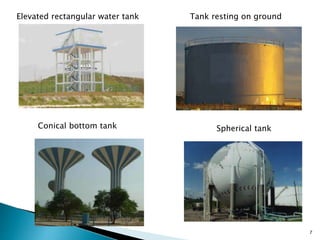
Elevated rectangular water tank Tank resting on ground
Spherical tankConical bottom tank
7
8
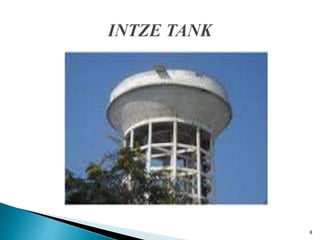
 The name “Intze” is given by a German hydraulic engineer
OTTO INTZE(1843-1904)
 Intze Principle for water towers: A water tower built in
accordance with the Intze Principle has a brick shaft on which
the water tank sits. The base of the tank is fixed with a ring
anchor made of iron or steel, so that only vertical, not
horizontal, forces are transmitted to the tower. Due to the lack
of horizontal forces the tower shaft does not need to be quite
as solidly built.
 This type of tank was first used in Germany between 1885 and
1905.
9
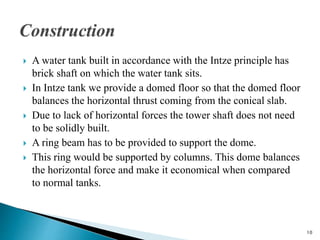
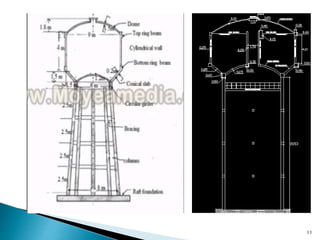
 A water tank built in accordance with the Intze principle has
brick shaft on which the water tank sits.
 In Intze tank we provide a domed floor so that the domed floor
balances the horizontal thrust coming from the conical slab.
 Due to lack of horizontal forces the tower shaft does not need
to be solidly built.
 A ring beam has to be provided to support the dome.
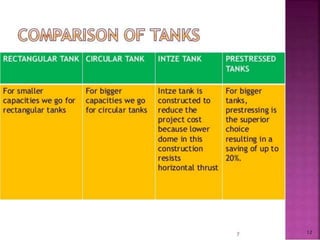
 This ring would be supported by columns. This dome balances
the horizontal force and make it economical when compared
to normal tanks.
10
11
12
 CONCRETE
 STEEL
 WATER PROOFING MATERIALS
 MINIMUM REINFORCEMENT
13
 M20 grade concrete is used for construction.
 High quality
 Leak proof
 Should not crack
14
 Permissible stresses should not exceed the limit
 Permissible stress in direct tension=1000kg/cm2
 Tensile stress in bending =1000 to 1200 kg/cm2
15
 0.3% of gross cross sectional area must be provided up to
100mm thickness
 0.2% of gross cross sectional area for 100-450mm thickness
 0.2% of gross cross sectional area should be provided for
>450mm thickness in each direction
 0.12% should be provided in foundations
16
 The objective of using them is to fill the pores of concrete and
to obtain a dense and less permeable concrete.
 Commonly used water proofing material is HYDRAULIC
LIME.
 Other agents like chalk, sodium silicate zinc sulphate, calcium
chloride etc.., are used.
17
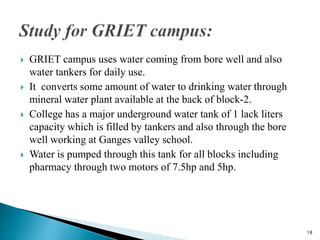
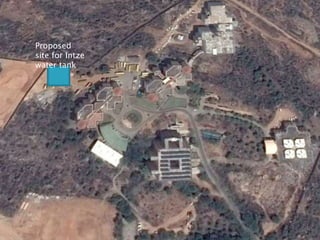
 GRIET campus uses water coming from bore well and also
water tankers for daily use.
 It converts some amount of water to drinking water through
mineral water plant available at the back of block-2.
 College has a major underground water tank of 1 lack liters
capacity which is filled by tankers and also through the bore
well working at Ganges valley school.
 Water is pumped through this tank for all blocks including
pharmacy through two motors of 7.5hp and 5hp.
18
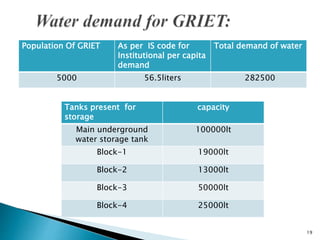
Population Of GRIET As per IS code for
Institutional per capita
demand
Total demand of water
5000 56.5liters 282500
Tanks present for
storage
capacity
Main underground
water storage tank
100000lt
Block-1 19000lt
Block-2 13000lt
Block-3 50000lt
Block-4 25000lt
19
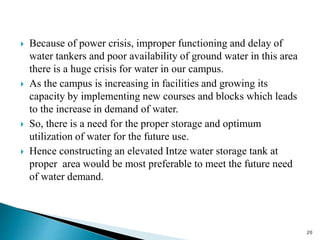
 Because of power crisis, improper functioning and delay of
water tankers and poor availability of ground water in this area
there is a huge crisis for water in our campus.
 As the campus is increasing in facilities and growing its
capacity by implementing new courses and blocks which leads
to the increase in demand of water.
 So, there is a need for the proper storage and optimum
utilization of water for the future use.
 Hence constructing an elevated Intze water storage tank at
proper area would be most preferable to meet the future need
of water demand.
20
Proposed
site for Intze
water tank
21
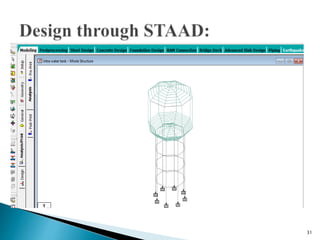
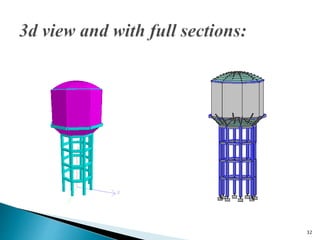
 STAAD PRO:
Structural Analysis And Design developed by Bentley is most
commonly used software for quick analysis and design of
water tank.
It uses Finite element analysis to analyze any structure which
is the best method to analyze easily and in less time.
22
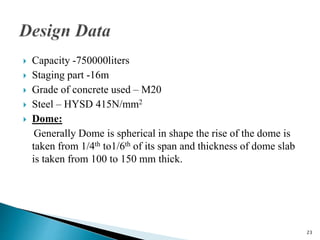
 Capacity -750000liters
 Staging part -16m
 Grade of concrete used – M20
 Steel – HYSD 415N/mm2
 Dome:
Generally Dome is spherical in shape the rise of the dome is
taken from 1/4th to1/6th of its span and thickness of dome slab
is taken from 100 to 150 mm thick.
23
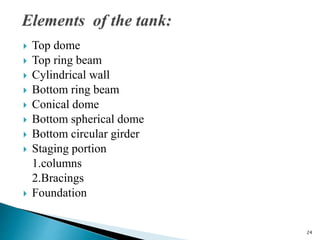
 Top dome
 Top ring beam
 Cylindrical wall
 Bottom ring beam
 Conical dome
 Bottom spherical dome
 Bottom circular girder
 Staging portion
1.columns
2.Bracings
 Foundation
24
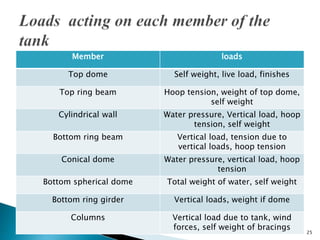
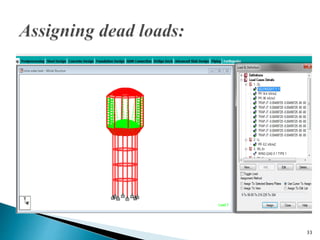
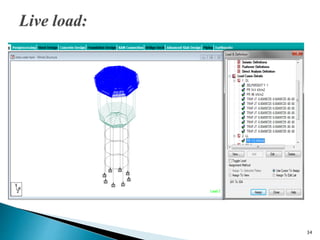
Member loads
Top dome Self weight, live load, finishes
Top ring beam Hoop tension, weight of top dome,
self weight
Cylindrical wall Water pressure, Vertical load, hoop
tension, self weight
Bottom ring beam Vertical load, tension due to
vertical loads, hoop tension
Conical dome Water pressure, vertical load, hoop
tension
Bottom spherical dome Total weight of water, self weight
Bottom ring girder Vertical loads, weight if dome
Columns Vertical load due to tank, wind
forces, self weight of bracings
25
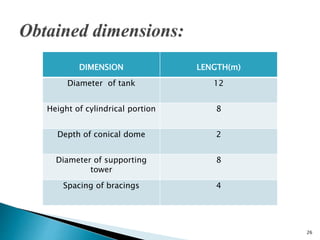
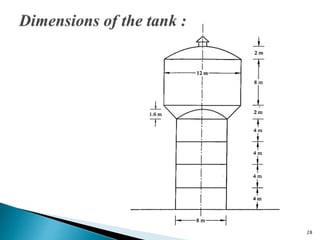
DIMENSION LENGTH(m)
Diameter of tank 12
Height of cylindrical portion 8
Depth of conical dome 2
Diameter of supporting
tower
8
Spacing of bracings 4
26
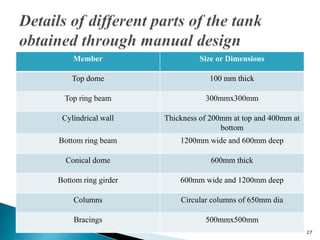
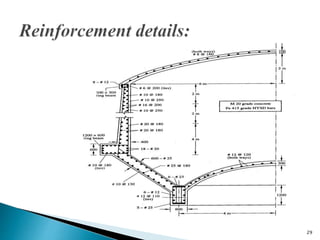
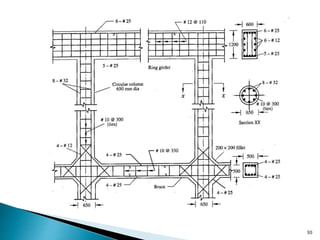
Member Size or Dimensions
Top dome 100 mm thick
Top ring beam 300mmx300mm
Cylindrical wall Thickness of 200mm at top and 400mm at
bottom
Bottom ring beam 1200mm wide and 600mm deep
Conical dome 600mm thick
Bottom ring girder 600mm wide and 1200mm deep
Columns Circular columns of 650mm dia
Bracings 500mmx500mm
27
28
29
30
31
32
33
34
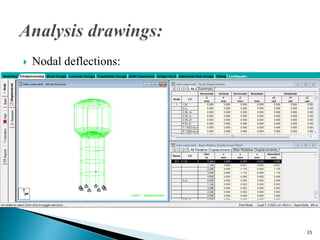
 Nodal deflections:
35
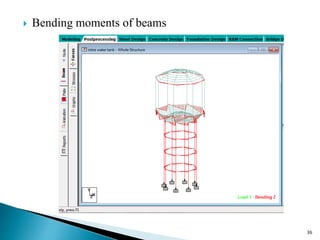
 Bending moments of beams
36
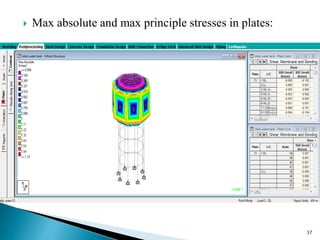
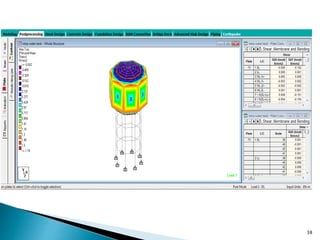
 Max absolute and max principle stresses in plates:
37
38
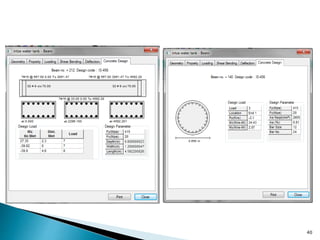
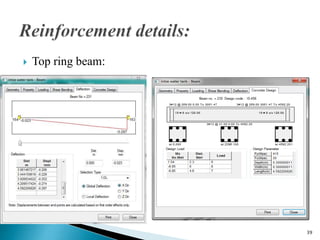
 Top ring beam:
39
40
 Both manual design and STAAD deigns are analyzed
for the same loading conditions.
 First manual calculations are calculated and then these
dimensions are taken in STAAD analysis.
 Results shown that no member fail and the design is
stable.
 The reinforcement details of STAAD doesn’t give
much economical design.
 So the manual design is adopted for the construction of
tank.
41
 A parametric study of an Intze type of tank paper given in
international conf of structural and civil engineering by M.K.
Sharma, Z. Ahmed, P. Bhardwaj and S.Choudhury.
 Design of Intze Tank in Perspective of Revision of IS: 3370
by Ranjit Singh Lodhi, Dr. Abhay Sharma, Dr. Vivek Garg
(International Journal of Scientific Engineering and
Technology Volume No.3 Issue No.9, pp : 1193-1197).
 Some aspects in analysis of Intze type water tank by I.
Rajendran.
 Structural design and drawing by N. Krishna raju.
 IS-456:2000 for design of concrete
 IS-3370- 1965 for design of water retaining concrete
structures
42
43

Intze tank design

  • 1.
    DEPARTMENT OF CIVILENGINEERING BY (BATCH-7) ABHISHEK.K(11241A0132) HEMANTH REDDY.Y(11241A0160) CHERUKU SRIKANTH(11241A0169) SUSHEEL CHOWDARY(10241A0182) PREM KUMAR.G(11241A0117) PROJECT GUIDE: Mr. S.VENKATA CHARYULU 1
  • 2.
     ABSTRACT  INTRODUCTION OBJECTIVES  TYPES OF WATER TANKS  INTZE TANK AND ITS CONSTRUCTION  MATERIALS REQUIRED IN CONSTRUCTION  STUDY FOR GRIET CAMPUS  DESIGN THROUGH MANUAL PROCESS  DESIGN THROUGH STAAD PRO  CONCLUSIONS  REFERENCES 2
  • 3.
     Due toenormous need by the public, water has to be stored and supplied according to their needs. Water demand is not constant throughout the day. It fluctuates hour to hour. In order to supply constant amount of water, we need to store water. So to meet the public water demand, water tank need to be constructed.  Storage reservoirs and overhead tanks are used to store water, liquid petroleum, petroleum products and similar liquids. The force analysis of the reservoirs or tanks is about the same irrespective of the chemical nature of the product. All tanks are designed as crack free structures to eliminate any leakage.  This project gives a brief study of design and analysis of an Intze water storage tank for GRIET campus using working stress method and STAAD pro. 3
  • 4.
     A watertank is used to store water to tide over the daily requirement. In the construction of concrete structure for the storage of water and other liquids the imperviousness of concrete is most essential.  Design of liquid retaining structure has to be based on the avoidance of cracking in the concrete having regard to its tensile strength.  Cracks can be prevented by avoiding the use of thick timber shuttering which prevent the easy escape of heat of hydration from the concrete mass the risk of cracking can also be minimized by reducing the restraints on free expansion or contraction of the structure. 4
  • 5.
    1. To makea study about the existing supply of water and need for water storage in GRIET campus. 2. To calculate the forces and stresses acting on Intze water storage tank. 3. To make a study about the guidelines for the design of liquid retaining Structure according to its code. 4. To Design and analyze water tank structure using manual method and STAAD pro software. 5
  • 6.
    1. CLASSIFICATION BASEDON POSITION:  Tanks resting on ground  Underground water tanks  Elevated water tanks 2. CLASSIFICATION BASED ON SHAPE:  Circular tanks  Rectangular tanks  Intze tanks  Spherical tanks  Conical bottom tanks  PSC tanks 6
  • 7.
    Elevated rectangular watertank Tank resting on ground Spherical tankConical bottom tank 7
  • 8.
  • 9.
     The name“Intze” is given by a German hydraulic engineer OTTO INTZE(1843-1904)  Intze Principle for water towers: A water tower built in accordance with the Intze Principle has a brick shaft on which the water tank sits. The base of the tank is fixed with a ring anchor made of iron or steel, so that only vertical, not horizontal, forces are transmitted to the tower. Due to the lack of horizontal forces the tower shaft does not need to be quite as solidly built.  This type of tank was first used in Germany between 1885 and 1905. 9
  • 10.
     A watertank built in accordance with the Intze principle has brick shaft on which the water tank sits.  In Intze tank we provide a domed floor so that the domed floor balances the horizontal thrust coming from the conical slab.  Due to lack of horizontal forces the tower shaft does not need to be solidly built.  A ring beam has to be provided to support the dome.  This ring would be supported by columns. This dome balances the horizontal force and make it economical when compared to normal tanks. 10
  • 11.
  • 12.
  • 13.
     CONCRETE  STEEL WATER PROOFING MATERIALS  MINIMUM REINFORCEMENT 13
  • 14.
     M20 gradeconcrete is used for construction.  High quality  Leak proof  Should not crack 14
  • 15.
     Permissible stressesshould not exceed the limit  Permissible stress in direct tension=1000kg/cm2  Tensile stress in bending =1000 to 1200 kg/cm2 15
  • 16.
     0.3% ofgross cross sectional area must be provided up to 100mm thickness  0.2% of gross cross sectional area for 100-450mm thickness  0.2% of gross cross sectional area should be provided for >450mm thickness in each direction  0.12% should be provided in foundations 16
  • 17.
     The objectiveof using them is to fill the pores of concrete and to obtain a dense and less permeable concrete.  Commonly used water proofing material is HYDRAULIC LIME.  Other agents like chalk, sodium silicate zinc sulphate, calcium chloride etc.., are used. 17
  • 18.
     GRIET campususes water coming from bore well and also water tankers for daily use.  It converts some amount of water to drinking water through mineral water plant available at the back of block-2.  College has a major underground water tank of 1 lack liters capacity which is filled by tankers and also through the bore well working at Ganges valley school.  Water is pumped through this tank for all blocks including pharmacy through two motors of 7.5hp and 5hp. 18
  • 19.
    Population Of GRIETAs per IS code for Institutional per capita demand Total demand of water 5000 56.5liters 282500 Tanks present for storage capacity Main underground water storage tank 100000lt Block-1 19000lt Block-2 13000lt Block-3 50000lt Block-4 25000lt 19
  • 20.
     Because ofpower crisis, improper functioning and delay of water tankers and poor availability of ground water in this area there is a huge crisis for water in our campus.  As the campus is increasing in facilities and growing its capacity by implementing new courses and blocks which leads to the increase in demand of water.  So, there is a need for the proper storage and optimum utilization of water for the future use.  Hence constructing an elevated Intze water storage tank at proper area would be most preferable to meet the future need of water demand. 20
  • 21.
  • 22.
     STAAD PRO: StructuralAnalysis And Design developed by Bentley is most commonly used software for quick analysis and design of water tank. It uses Finite element analysis to analyze any structure which is the best method to analyze easily and in less time. 22
  • 23.
     Capacity -750000liters Staging part -16m  Grade of concrete used – M20  Steel – HYSD 415N/mm2  Dome: Generally Dome is spherical in shape the rise of the dome is taken from 1/4th to1/6th of its span and thickness of dome slab is taken from 100 to 150 mm thick. 23
  • 24.
     Top dome Top ring beam  Cylindrical wall  Bottom ring beam  Conical dome  Bottom spherical dome  Bottom circular girder  Staging portion 1.columns 2.Bracings  Foundation 24
  • 25.
    Member loads Top domeSelf weight, live load, finishes Top ring beam Hoop tension, weight of top dome, self weight Cylindrical wall Water pressure, Vertical load, hoop tension, self weight Bottom ring beam Vertical load, tension due to vertical loads, hoop tension Conical dome Water pressure, vertical load, hoop tension Bottom spherical dome Total weight of water, self weight Bottom ring girder Vertical loads, weight if dome Columns Vertical load due to tank, wind forces, self weight of bracings 25
  • 26.
    DIMENSION LENGTH(m) Diameter oftank 12 Height of cylindrical portion 8 Depth of conical dome 2 Diameter of supporting tower 8 Spacing of bracings 4 26
  • 27.
    Member Size orDimensions Top dome 100 mm thick Top ring beam 300mmx300mm Cylindrical wall Thickness of 200mm at top and 400mm at bottom Bottom ring beam 1200mm wide and 600mm deep Conical dome 600mm thick Bottom ring girder 600mm wide and 1200mm deep Columns Circular columns of 650mm dia Bracings 500mmx500mm 27
  • 28.
  • 29.
  • 30.
  • 31.
  • 32.
  • 33.
  • 34.
  • 35.
  • 36.
  • 37.
     Max absoluteand max principle stresses in plates: 37
  • 38.
  • 39.
     Top ringbeam: 39
  • 40.
  • 41.
     Both manualdesign and STAAD deigns are analyzed for the same loading conditions.  First manual calculations are calculated and then these dimensions are taken in STAAD analysis.  Results shown that no member fail and the design is stable.  The reinforcement details of STAAD doesn’t give much economical design.  So the manual design is adopted for the construction of tank. 41
  • 42.
     A parametricstudy of an Intze type of tank paper given in international conf of structural and civil engineering by M.K. Sharma, Z. Ahmed, P. Bhardwaj and S.Choudhury.  Design of Intze Tank in Perspective of Revision of IS: 3370 by Ranjit Singh Lodhi, Dr. Abhay Sharma, Dr. Vivek Garg (International Journal of Scientific Engineering and Technology Volume No.3 Issue No.9, pp : 1193-1197).  Some aspects in analysis of Intze type water tank by I. Rajendran.  Structural design and drawing by N. Krishna raju.  IS-456:2000 for design of concrete  IS-3370- 1965 for design of water retaining concrete structures 42
  • 43.