SUBMITTED BY
VIKRAM KESHARWANI
CIVIL BRANCH 6th SEMESTER
CONTENTS:-
1- INTRODUCTION
2- BASIC DEFINITIONS
3- FORCES ACTING ON GRAVITY DAM
4- STABILITY ANALYSIS
5- DESIGN OF GRAVITY DAMS
 A gravity dam is a solid structure, made of concrete or masonry,
constructed across a river to create a reservoir on its upstream.
 The section of the gravity dam is approximately triangular in
shape, with its apex at its top and maximum width at bottom.
 The section is so proportioned that it resists the various forces
acting on it by its own weight.
 Where good foundations are available, gravity dams can be
built upto any height. It is the most permanent one, and
requires little maintenance.
 The most ancient gravity dam on record was built in Egypt more
than 400 years B.C. of uncemented masonry.
INTRODUCTION
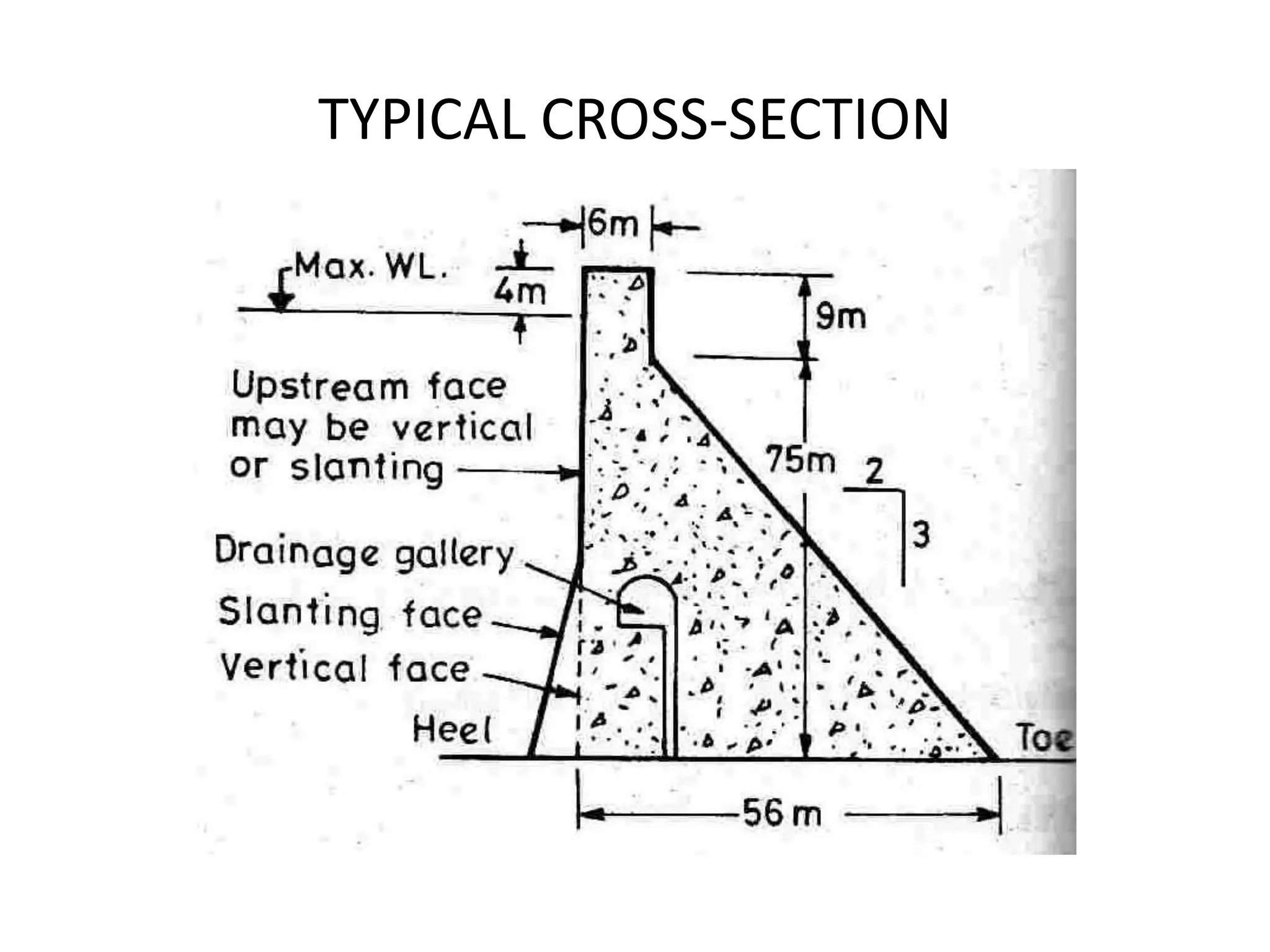
TYPICAL CROSS-SECTION
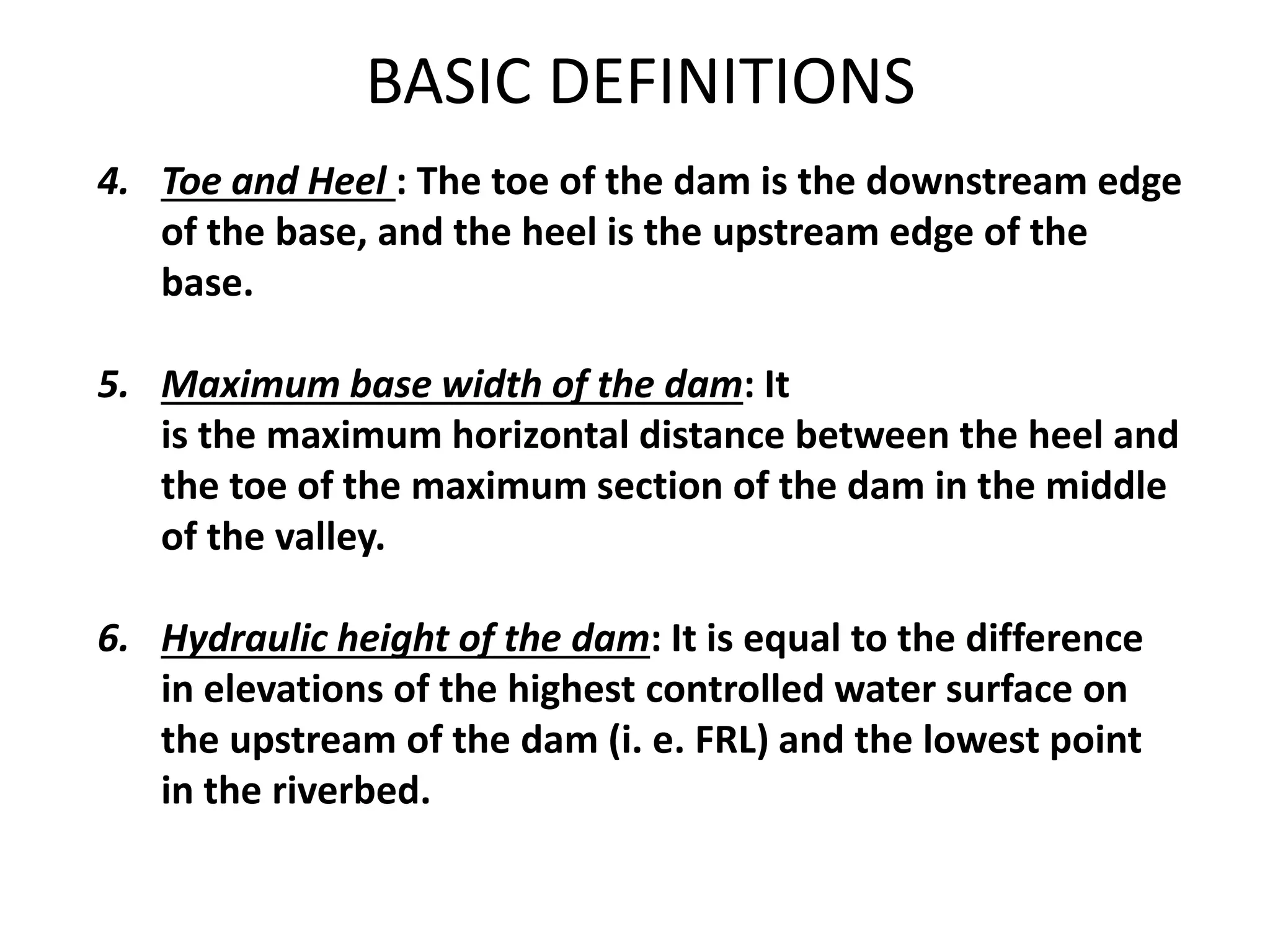
1. Axis of the dam: It is the line of the upstream edge of the top
(or crown) of the dam. The axis of the dam in plan is also
called the base line of the dam. The axis of the dam in plan is
usually straight.
2. Length of the dam: It is the distance from one abutment to
the other, measured along the axis of the dam at the level
of the top of the dam.
3. Structural height of the dam: It is the difference in elevations
of the top of the dam and the lowest point in the excavated
foundation. It, however, does not include the depth of special
geological features of foundations such as narrow fault zones
below the foundation. In general, the height of the dam
means its structural height.
BASIC DEFINITIONS
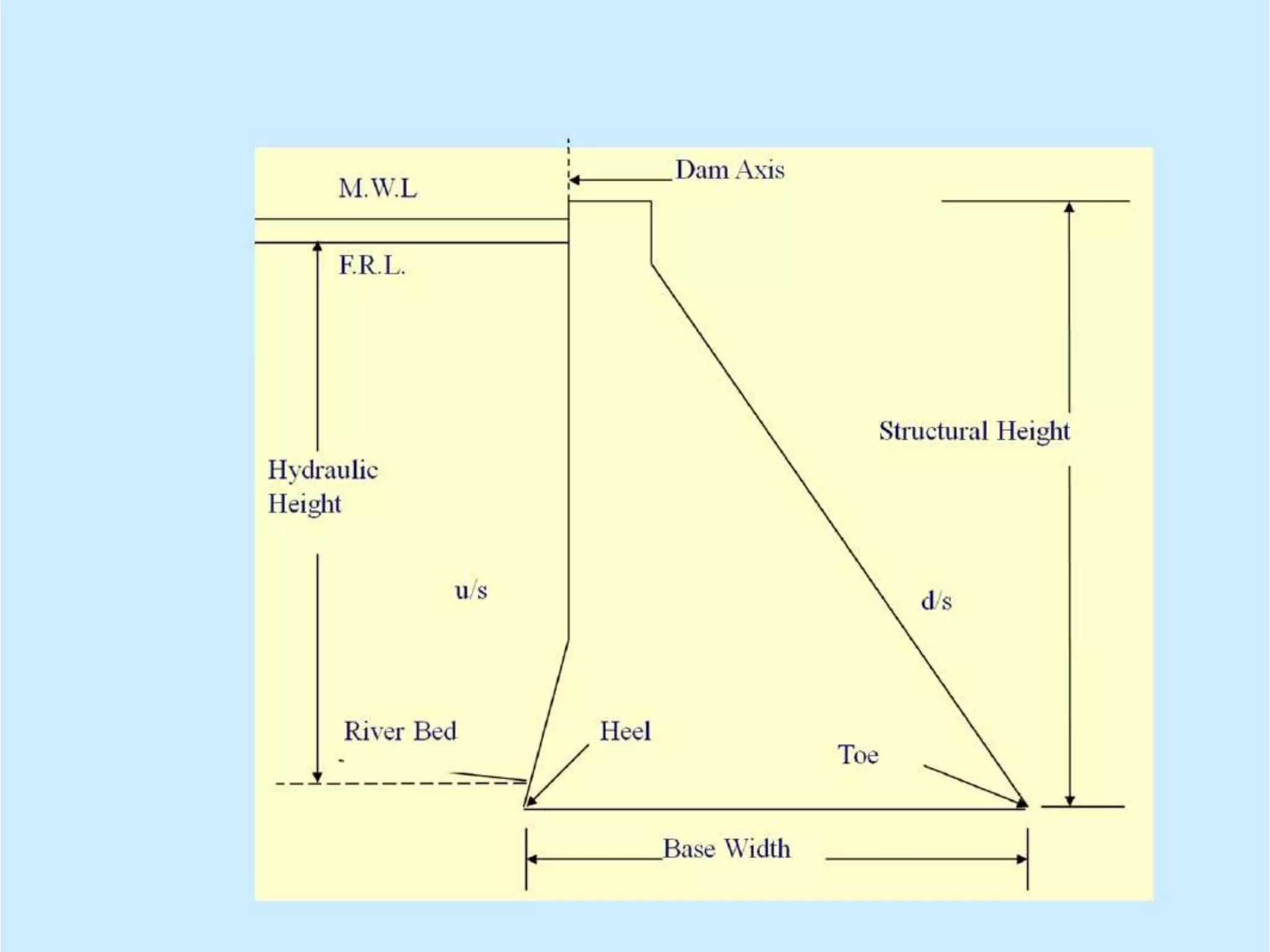
4. Toe and Heel : The toe of the dam is the downstream edge
of the base, and the heel is the upstream edge of the
base.
5. Maximum base width of the dam: It
is the maximum horizontal distance between the heel and
the toe of the maximum section of the dam in the middle
of the valley.
6. Hydraulic height of the dam: It is equal to the difference
in elevations of the highest controlled water surface on
the upstream of the dam (i. e. FRL) and the lowest point
in the riverbed.
BASIC DEFINITIONS
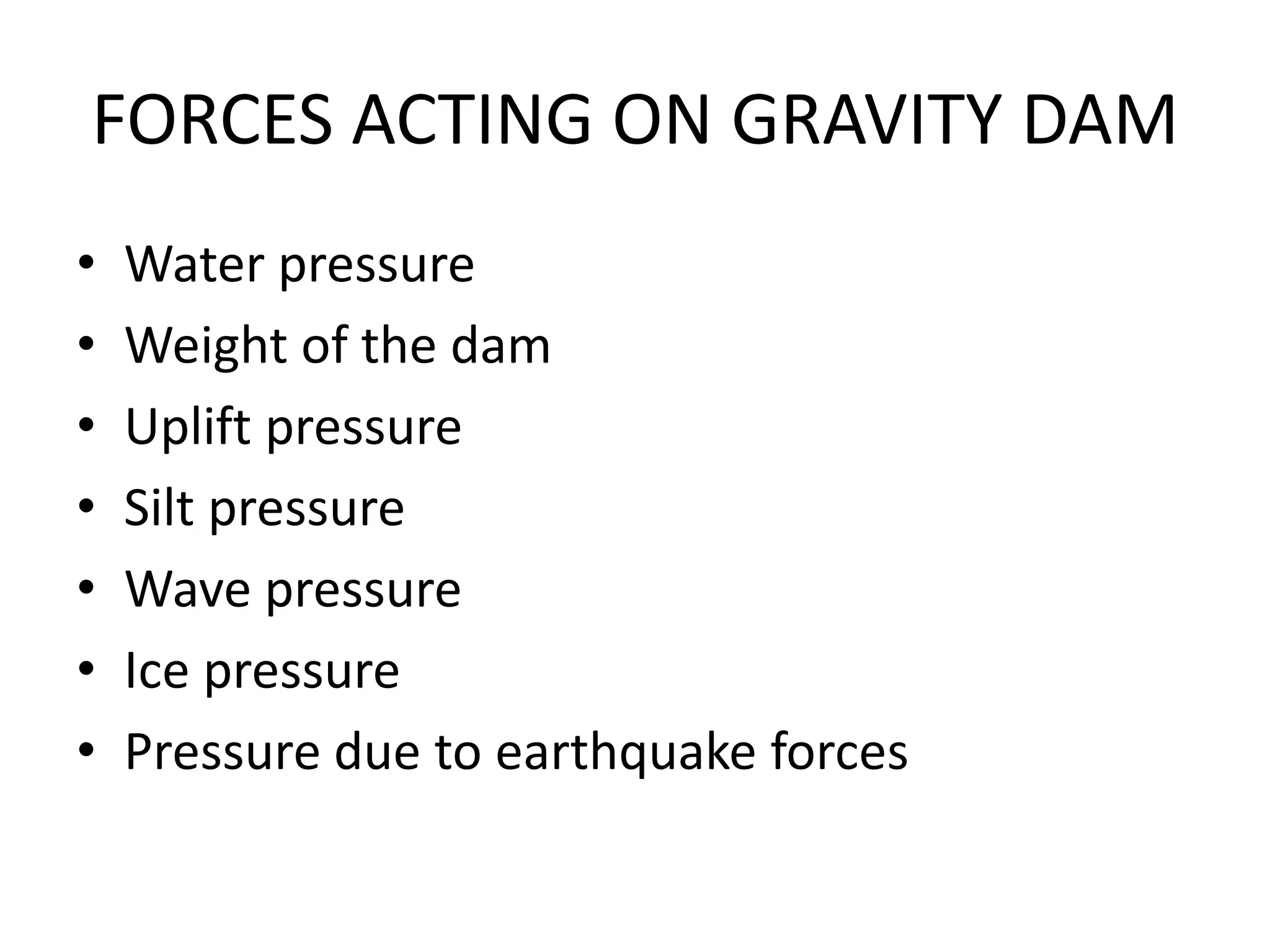
FORCES ACTING ON GRAVITY DAM
• Water pressure
• Weight of the dam
• Uplift pressure
• Silt pressure
• Wave pressure
• Ice pressure
• Pressure due to earthquake forces
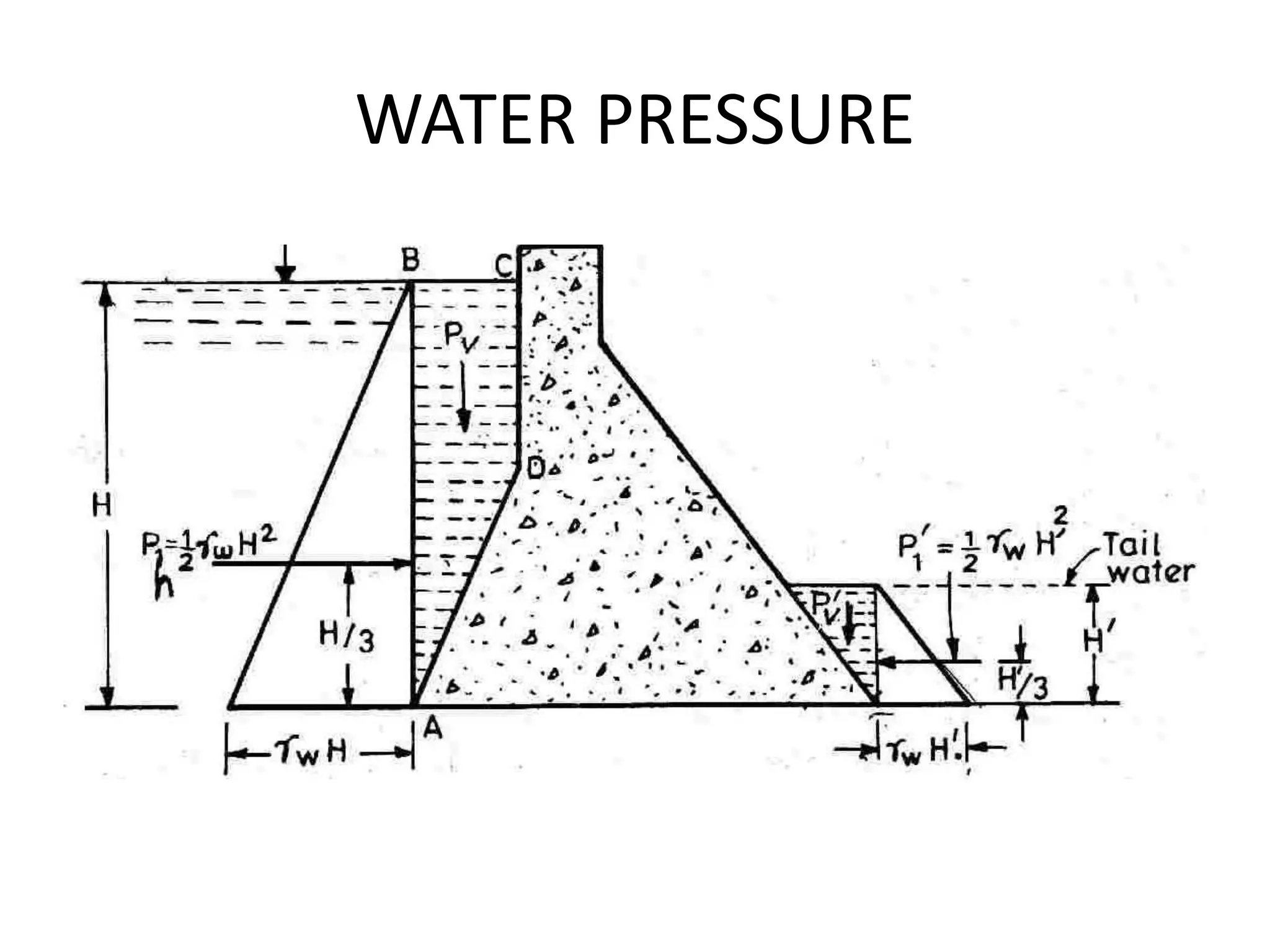
WATER PRESSURE
• It is the major external force acting on a dam.
• The intensity of the pressure varies
triangularly, with a zero intensity at the water
surface, to a value “wh” at depth h below the
water surface.
• Force due to water pressure
P = W H / 2
• This acts at a height of h/3 from base of the
dam.
2
WATER PRESSURE
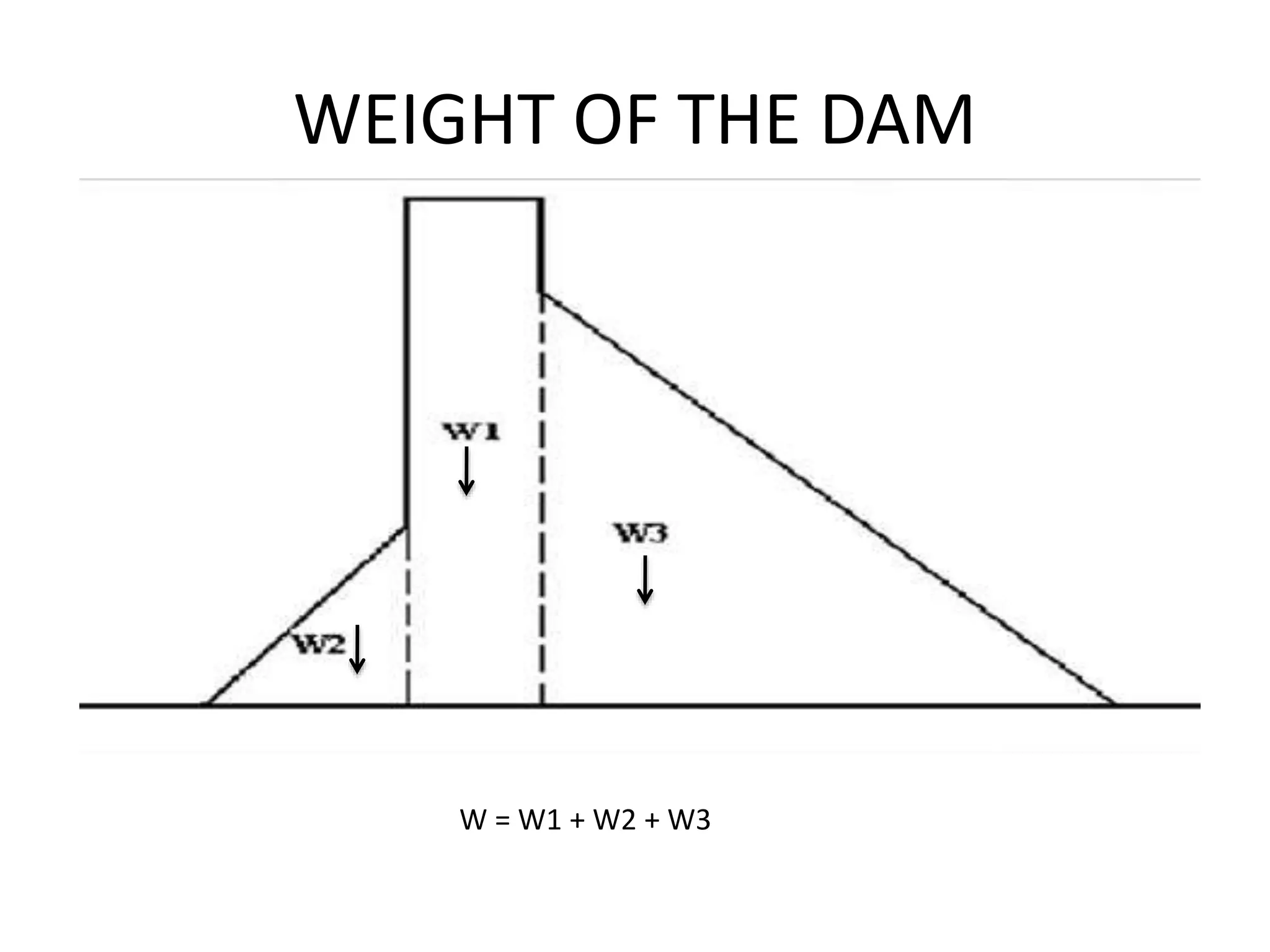
WEIGHT OF THE DAM
• Weight of the dam is the major resisting force.
• Unit length of the dam is consider.
• Total weight of the dam acts at the center of
gravity of this section.
WEIGHT OF THE DAM
W = W1 + W2 + W3
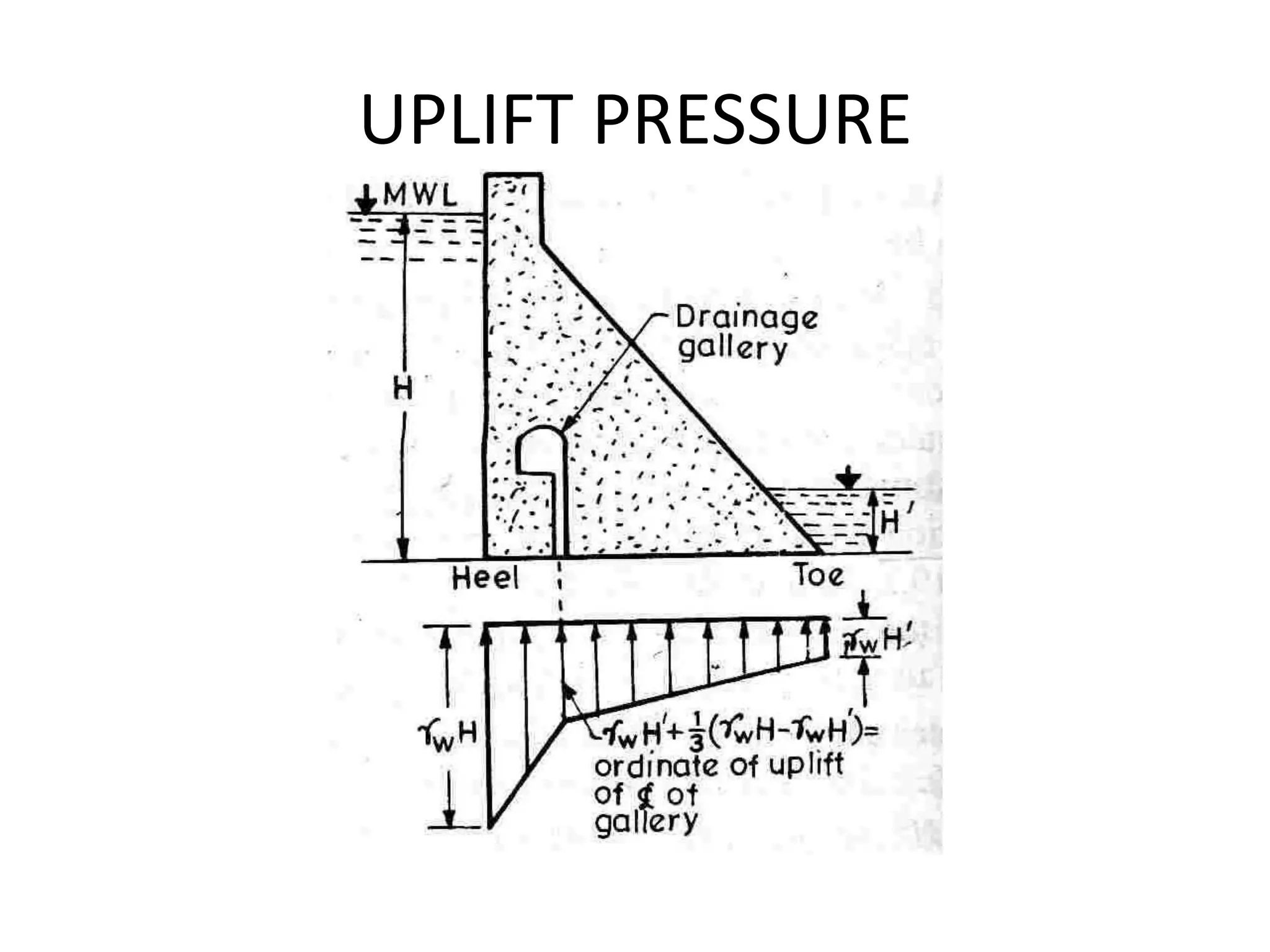
UPLIFT PRESSURE
• Uplift pressure is the upward pressure exerted
by water as it seeps through the body of the
dam or its foundation.
• Seeping water exerts pressure on the base of
the dam and it depends upon water head.
UPLIFT PRESSURE
SILT PRESSURE
• Silt gets deposited against the upstream face
of the dam.
• If h is the height of the silt deposited, then the
force exerted by this silt in addition to external
water pressure, can be
Psilt = γsub .h2 . Ka / 2
• It acts at h/3 from base.
WAVE PRESSURE
• Waves are generated on the surface of the
reservoir by the blowing winds, which cause
pressure towards the downstream side.
• Waves pressure depends upon the wave height.

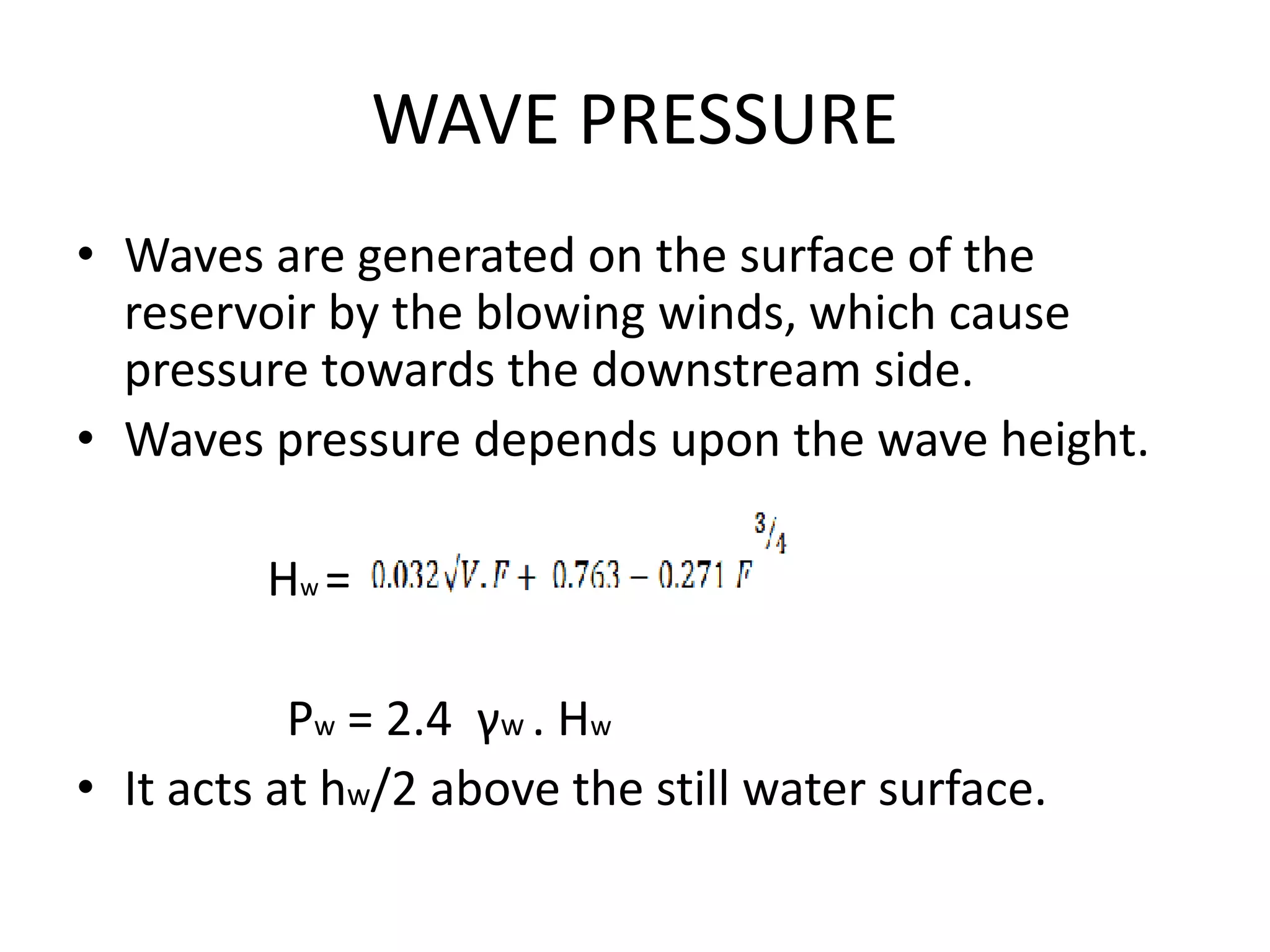
Hw =
Pw = 2.4 γw . Hw
• It acts at hw/2 above the still water surface.
ICE PRESSURE
• The ice may be formed on the water surface
of the reservoir in cold countries, may
sometimes melt and expand.
• The dam face has to resist the thrust exerted
by the expending ice.
• The magnitude of this force varies from 250 to
1500 kN/m depending upon the temperature
variations.
2
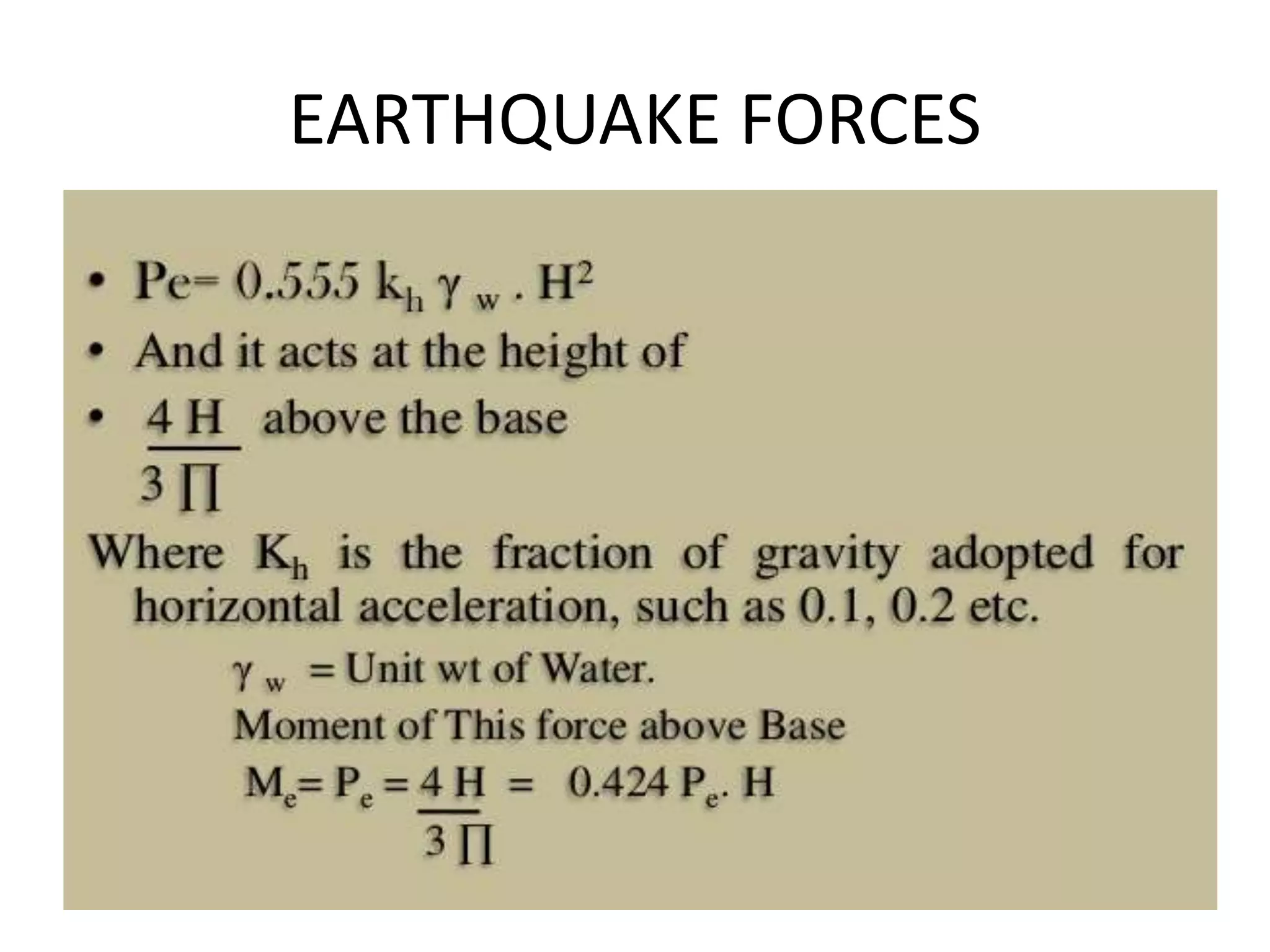
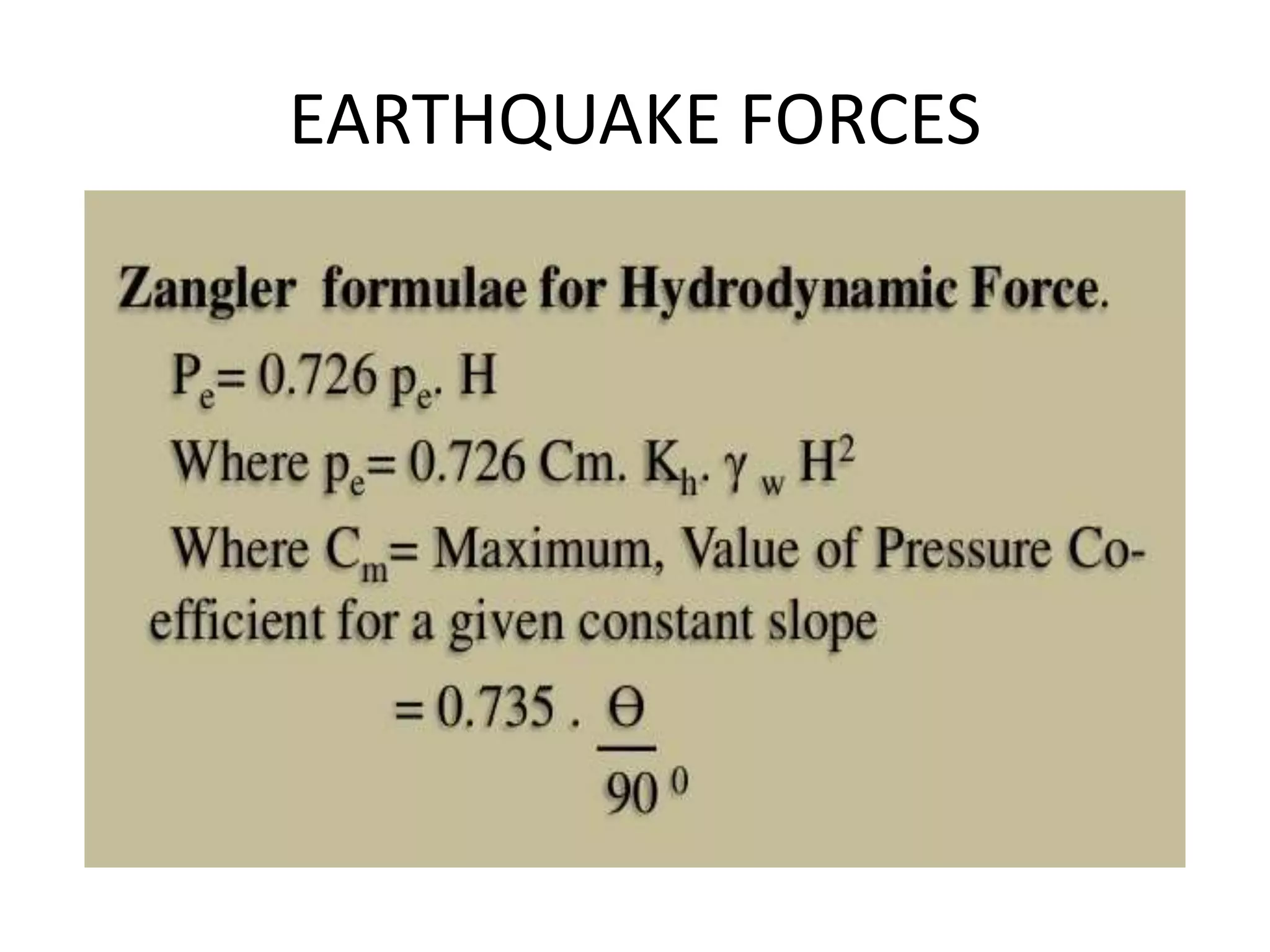
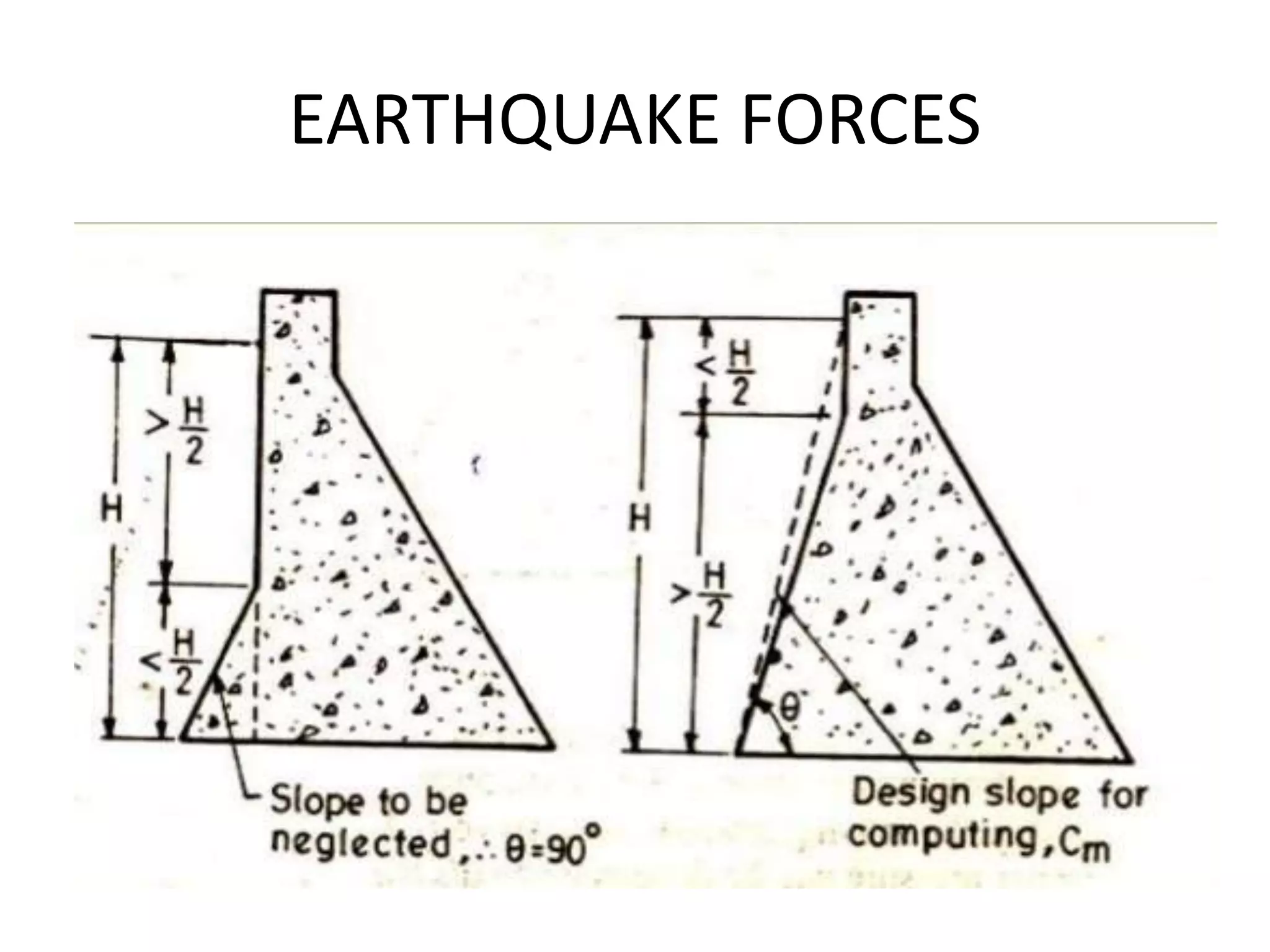
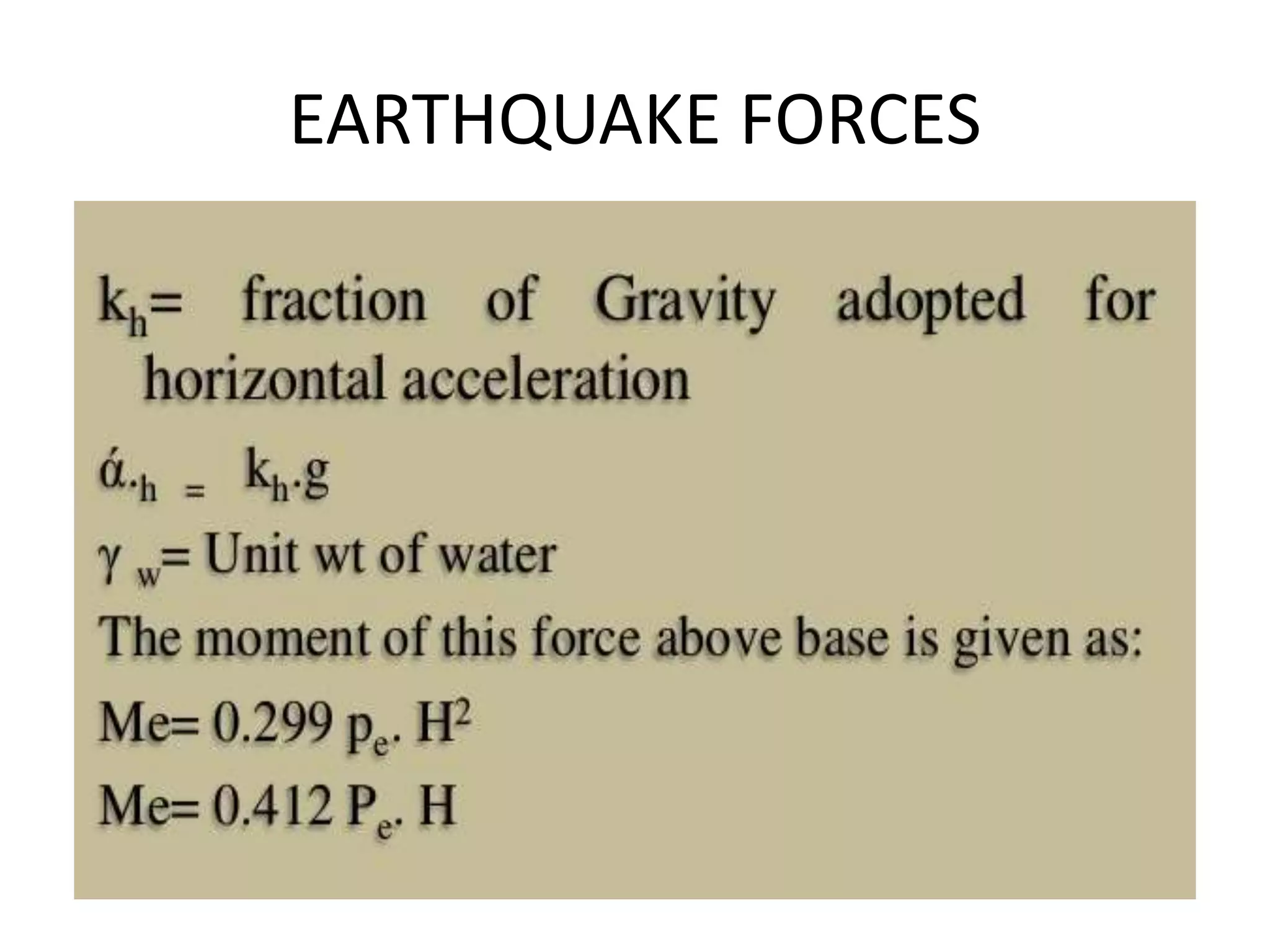
EARTHQUAKE FORCES
• If the dam is to be designed, is to be located in
a region which is susceptible to earthquakes,
allowance must be made for stresses
generated by the earthquakes.
• An earthquake produces waves which are
capable of shaking the earth upon which the
dam is resting , in every possible direction.
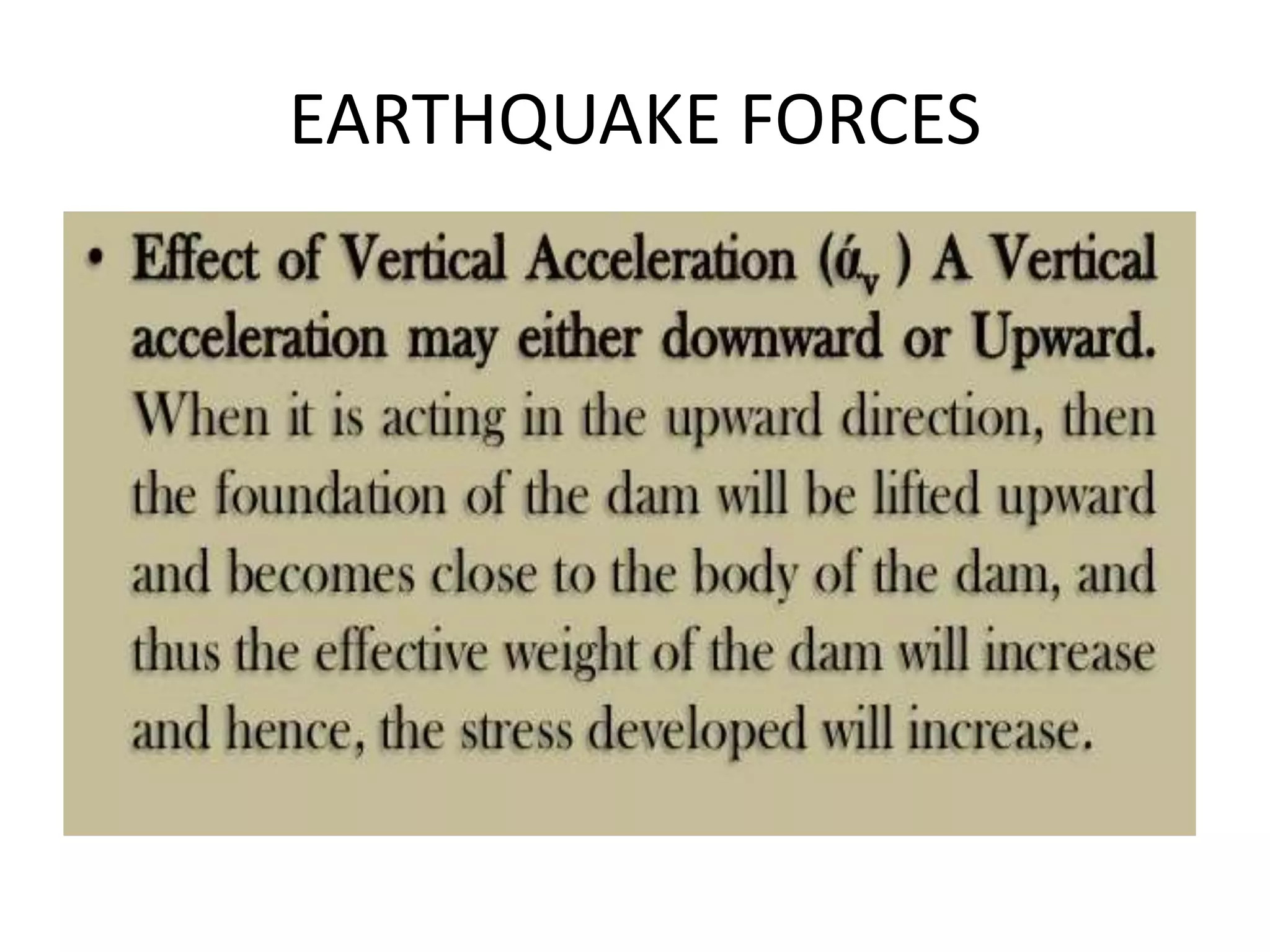
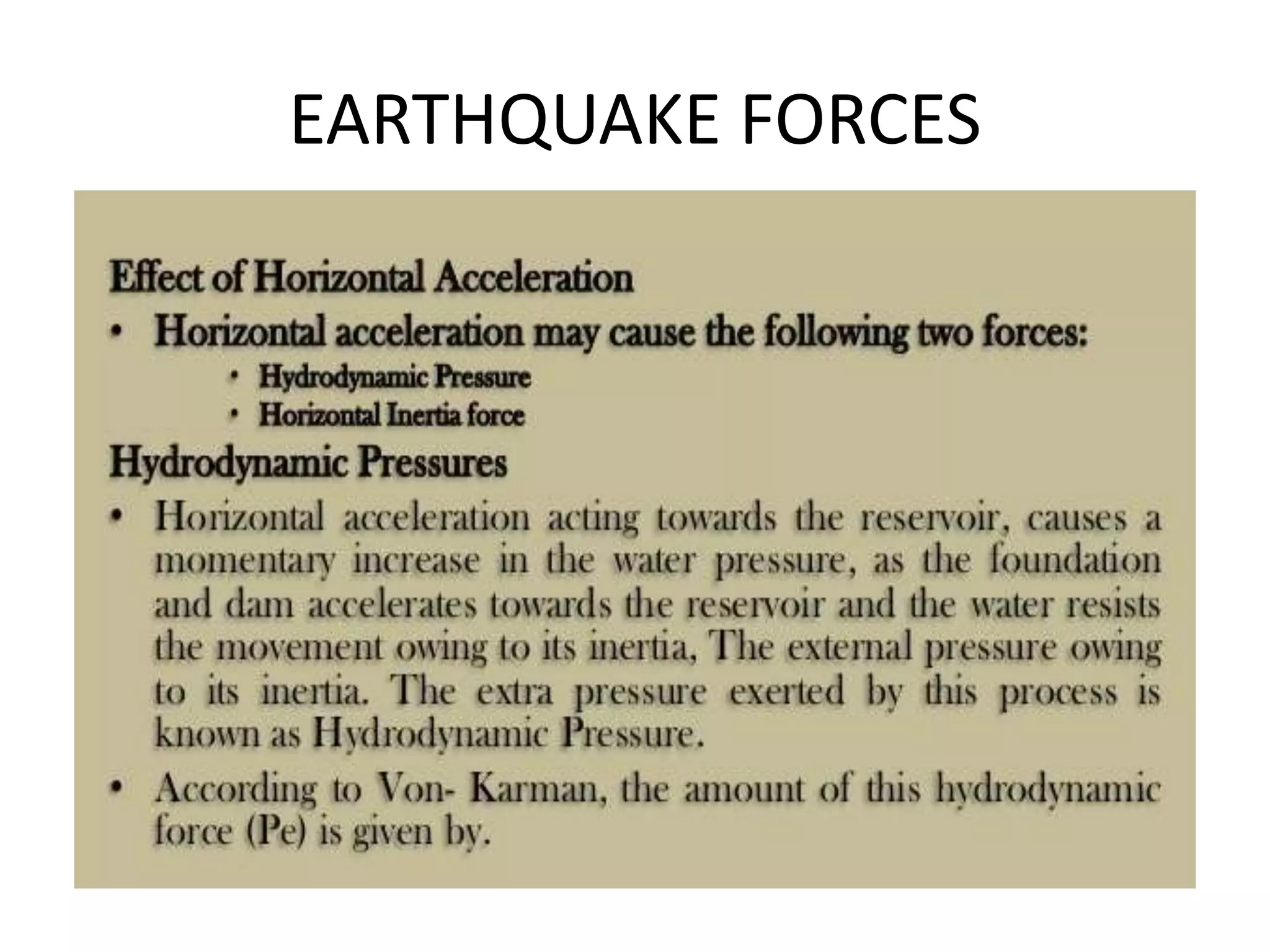
EARTHQUAKE FORCES
EARTHQUAKE FORCES
EARTHQUAKE FORCES
EARTHQUAKE FORCES
EARTHQUAKE FORCES
EARTHQUAKE FORCES
EARTHQUAKE FORCES
EARTHQUAKE FORCES
EARTHQUAKE FORCES
STABILITY ANALYSIS
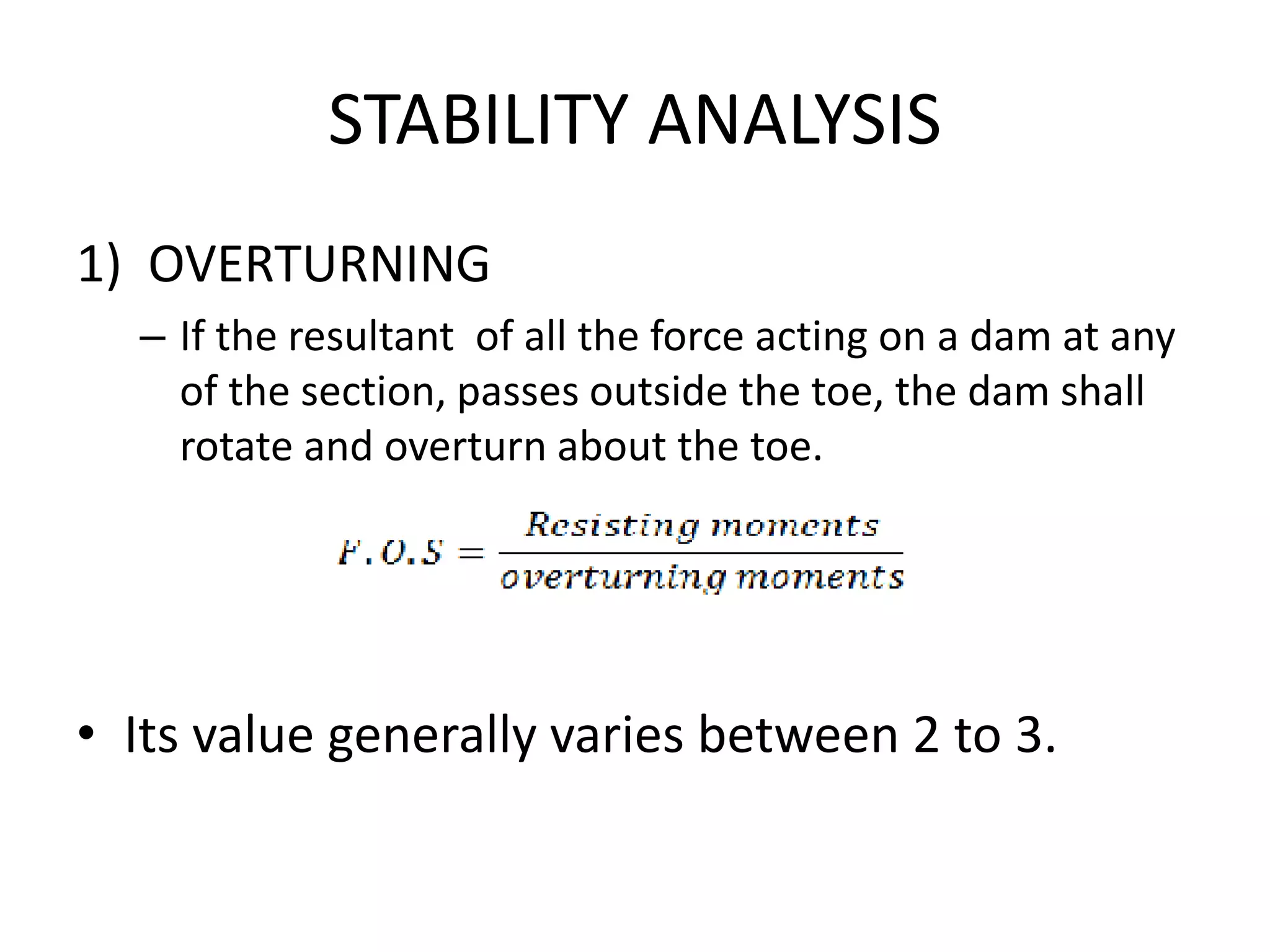
1) OVERTURNING
– If the resultant of all the force acting on a dam at any
of the section, passes outside the toe, the dam shall
rotate and overturn about the toe.
• Its value generally varies between 2 to 3.
STABILITY ANALYSIS
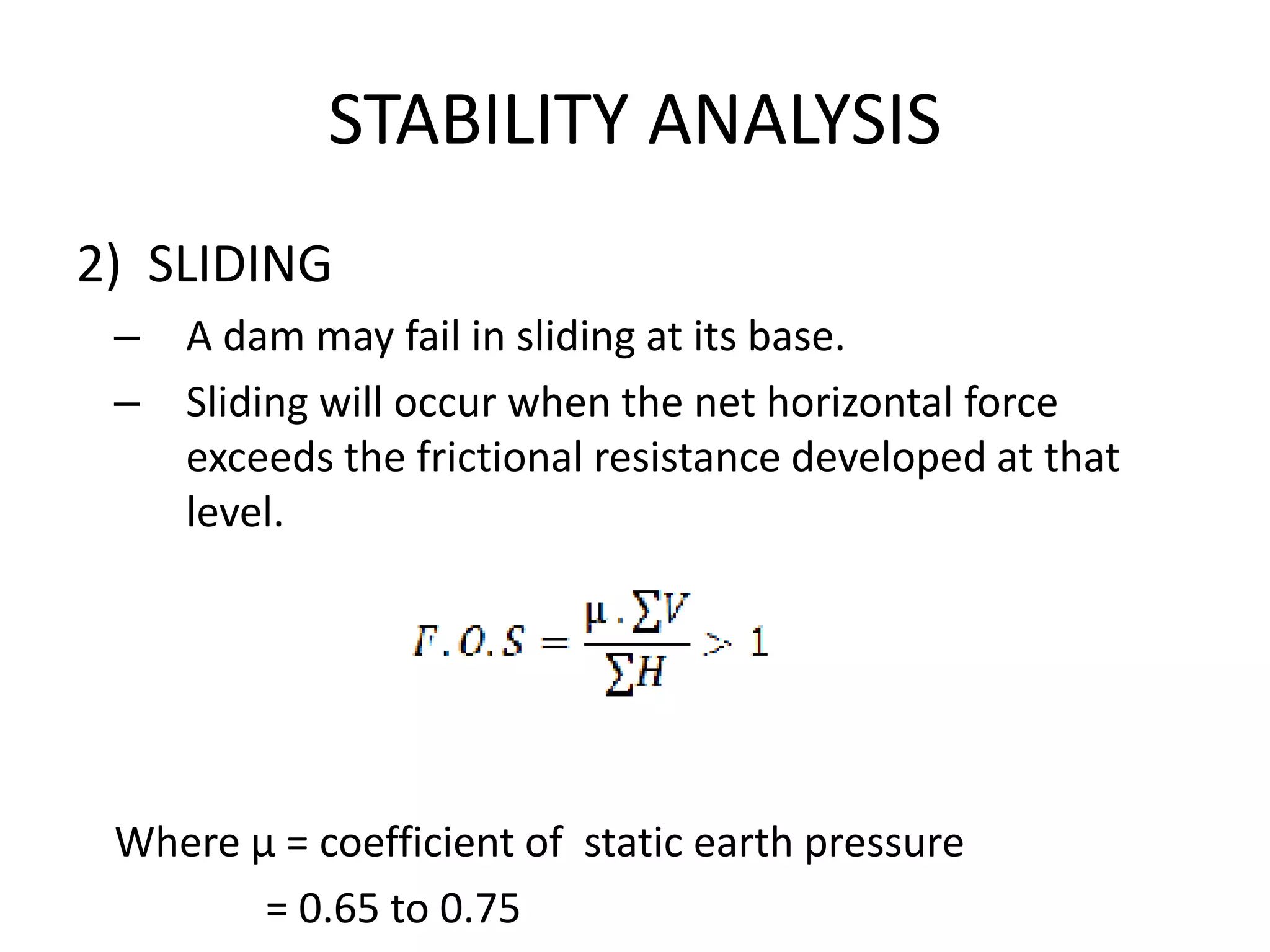
2) SLIDING
– A dam may fail in sliding at its base.
– Sliding will occur when the net horizontal force
exceeds the frictional resistance developed at that
level.
Where µ = coefficient of static earth pressure
= 0.65 to 0.75
STABILITY ANALYSIS
3) COMPRESSION OR CRUSHING
– A dam may fail by the failure of its materials.
– The compressive stress may exceed the allowable stress
and the dam material may get crushed.
4) TENSION
– Masonry and concrete gravity dam are usually designed in
such a way that no tension is developed anywhere,
because the materials can not withstand sustained tensile
stresses.
– If it subjected to such stresses, these materials may crack.
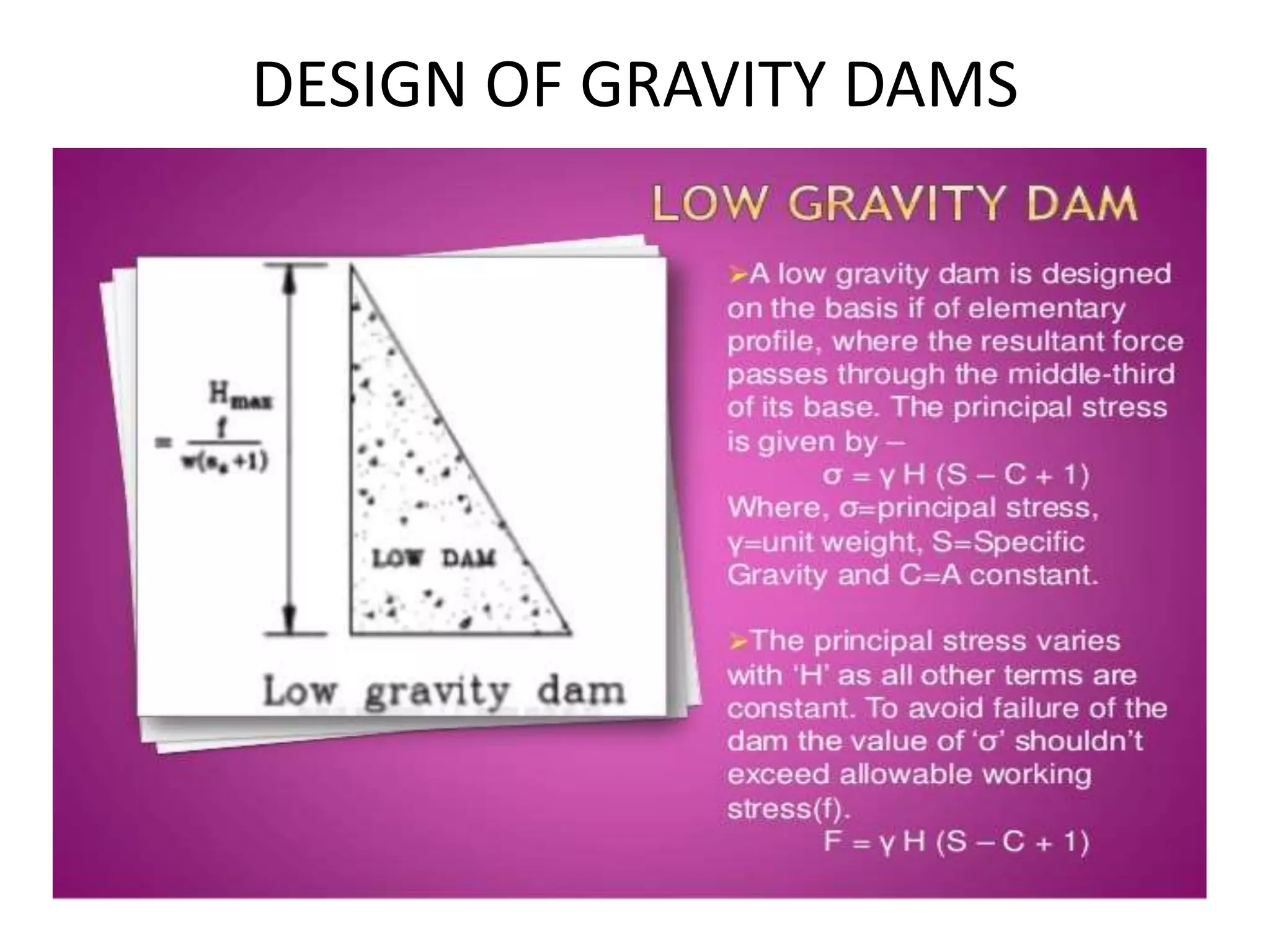
DESIGN OF GRAVITY DAMS
• The section of gravity dam should be chosen in such a way
that it is the most economical section and satisfies all the
conditions and requirements of stability. Hence, after the
section of dam has been arrived at, the stability analysis for
the dam must be carried out.
• TO DECIDE WHETHER THE DAM IS LOW OR HIGH- First of all,
the height of the dam to be constructed, should be checked
so as to ensure whether it is a low gravity dam or a high
gravity dam.
• If the ht. of the dam is less than that given by
𝑓
γw(𝑆𝑐+1)
(where 𝑓 is the permissible compressive stress of the dam
material and Sc is the Sp. Gravity of the dam material) then
the dam will be a low gravity dam otherwise vice versa.
DESIGN OF GRAVITY DAMS
Design of gravity dams

Design of gravity dams

  • 1.
  • 2.
    CONTENTS:- 1- INTRODUCTION 2- BASICDEFINITIONS 3- FORCES ACTING ON GRAVITY DAM 4- STABILITY ANALYSIS 5- DESIGN OF GRAVITY DAMS
  • 3.
     A gravitydam is a solid structure, made of concrete or masonry, constructed across a river to create a reservoir on its upstream.  The section of the gravity dam is approximately triangular in shape, with its apex at its top and maximum width at bottom.  The section is so proportioned that it resists the various forces acting on it by its own weight.  Where good foundations are available, gravity dams can be built upto any height. It is the most permanent one, and requires little maintenance.  The most ancient gravity dam on record was built in Egypt more than 400 years B.C. of uncemented masonry. INTRODUCTION
  • 4.
  • 5.
    1. Axis ofthe dam: It is the line of the upstream edge of the top (or crown) of the dam. The axis of the dam in plan is also called the base line of the dam. The axis of the dam in plan is usually straight. 2. Length of the dam: It is the distance from one abutment to the other, measured along the axis of the dam at the level of the top of the dam. 3. Structural height of the dam: It is the difference in elevations of the top of the dam and the lowest point in the excavated foundation. It, however, does not include the depth of special geological features of foundations such as narrow fault zones below the foundation. In general, the height of the dam means its structural height. BASIC DEFINITIONS
  • 6.
    4. Toe andHeel : The toe of the dam is the downstream edge of the base, and the heel is the upstream edge of the base. 5. Maximum base width of the dam: It is the maximum horizontal distance between the heel and the toe of the maximum section of the dam in the middle of the valley. 6. Hydraulic height of the dam: It is equal to the difference in elevations of the highest controlled water surface on the upstream of the dam (i. e. FRL) and the lowest point in the riverbed. BASIC DEFINITIONS
  • 8.
    FORCES ACTING ONGRAVITY DAM • Water pressure • Weight of the dam • Uplift pressure • Silt pressure • Wave pressure • Ice pressure • Pressure due to earthquake forces
  • 9.
    WATER PRESSURE • Itis the major external force acting on a dam. • The intensity of the pressure varies triangularly, with a zero intensity at the water surface, to a value “wh” at depth h below the water surface. • Force due to water pressure P = W H / 2 • This acts at a height of h/3 from base of the dam. 2
  • 10.
  • 11.
    WEIGHT OF THEDAM • Weight of the dam is the major resisting force. • Unit length of the dam is consider. • Total weight of the dam acts at the center of gravity of this section.
  • 12.
    WEIGHT OF THEDAM W = W1 + W2 + W3
  • 13.
    UPLIFT PRESSURE • Upliftpressure is the upward pressure exerted by water as it seeps through the body of the dam or its foundation. • Seeping water exerts pressure on the base of the dam and it depends upon water head.
  • 14.
  • 15.
    SILT PRESSURE • Siltgets deposited against the upstream face of the dam. • If h is the height of the silt deposited, then the force exerted by this silt in addition to external water pressure, can be Psilt = γsub .h2 . Ka / 2 • It acts at h/3 from base.
  • 16.
    WAVE PRESSURE • Wavesare generated on the surface of the reservoir by the blowing winds, which cause pressure towards the downstream side. • Waves pressure depends upon the wave height. Hw = Pw = 2.4 γw . Hw • It acts at hw/2 above the still water surface.
  • 17.
    ICE PRESSURE • Theice may be formed on the water surface of the reservoir in cold countries, may sometimes melt and expand. • The dam face has to resist the thrust exerted by the expending ice. • The magnitude of this force varies from 250 to 1500 kN/m depending upon the temperature variations. 2
  • 18.
    EARTHQUAKE FORCES • Ifthe dam is to be designed, is to be located in a region which is susceptible to earthquakes, allowance must be made for stresses generated by the earthquakes. • An earthquake produces waves which are capable of shaking the earth upon which the dam is resting , in every possible direction.
  • 19.
  • 20.
  • 21.
  • 22.
  • 23.
  • 24.
  • 25.
  • 26.
  • 27.
  • 28.
    STABILITY ANALYSIS 1) OVERTURNING –If the resultant of all the force acting on a dam at any of the section, passes outside the toe, the dam shall rotate and overturn about the toe. • Its value generally varies between 2 to 3.
  • 29.
    STABILITY ANALYSIS 2) SLIDING –A dam may fail in sliding at its base. – Sliding will occur when the net horizontal force exceeds the frictional resistance developed at that level. Where µ = coefficient of static earth pressure = 0.65 to 0.75
  • 30.
    STABILITY ANALYSIS 3) COMPRESSIONOR CRUSHING – A dam may fail by the failure of its materials. – The compressive stress may exceed the allowable stress and the dam material may get crushed. 4) TENSION – Masonry and concrete gravity dam are usually designed in such a way that no tension is developed anywhere, because the materials can not withstand sustained tensile stresses. – If it subjected to such stresses, these materials may crack.
  • 31.
    DESIGN OF GRAVITYDAMS • The section of gravity dam should be chosen in such a way that it is the most economical section and satisfies all the conditions and requirements of stability. Hence, after the section of dam has been arrived at, the stability analysis for the dam must be carried out. • TO DECIDE WHETHER THE DAM IS LOW OR HIGH- First of all, the height of the dam to be constructed, should be checked so as to ensure whether it is a low gravity dam or a high gravity dam. • If the ht. of the dam is less than that given by 𝑓 γw(𝑆𝑐+1) (where 𝑓 is the permissible compressive stress of the dam material and Sc is the Sp. Gravity of the dam material) then the dam will be a low gravity dam otherwise vice versa.
  • 32.
  • 33.