ENERGY DISSIPATORS
PRESENTED BY
KIRAN C JADHAV
GOVERNMENT COLLEGE OF ENGINEERING,
AURANGABAD
(An Autonomous Institute Of Government of Maharashtra)
DEPARTMENT OF CIVIL ENGINEERING
4/17/2017 1
CONTENT
• Introduction
• Types of Energy dissipators
• Stilling basins and bucket Energy dissipators
• hydraulic jump and importance
• Energy dissipation arrangement by studying
graph of discharge vs Tail Water Curve
• References
4/17/2017 2
DEFINITION OF ENERGY
DISSIPATORS
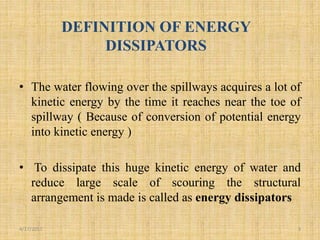
• The water flowing over the spillways acquires a lot of
kinetic energy by the time it reaches near the toe of
spillway ( Because of conversion of potential energy
into kinetic energy )
• To dissipate this huge kinetic energy of water and
reduce large scale of scouring the structural
arrangement is made is called as energy dissipators
4/17/2017 3
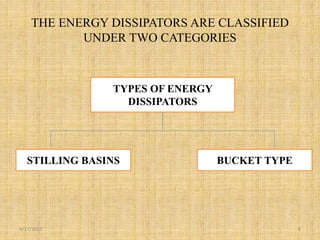
THE ENERGY DISSIPATORS ARE CLASSIFIED
UNDER TWO CATEGORIES
4/17/2017 4
TYPES OF ENERGY
DISSIPATORS
STILLING BASINS BUCKET TYPE
STILLING BASINS TYPE ENERGY
DISSIPATORS
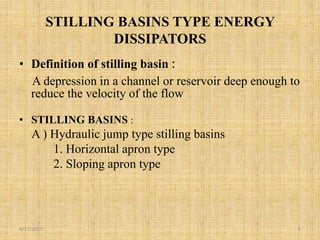
• Definition of stilling basin :
A depression in a channel or reservoir deep enough to
reduce the velocity of the flow
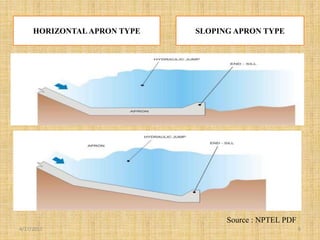
• STILLING BASINS :
A ) Hydraulic jump type stilling basins
1. Horizontal apron type
2. Sloping apron type
4/17/2017 5
4/17/2017 6
HORIZONTAL APRON TYPE SLOPING APRON TYPE
Source : NPTEL PDF
BUCKET TYPE ENERGY
DISSIPATORS
BUCKET TYPE :
1. Solid roller bucket
2. Slotted roller bucket
3. Ski jump (flip/trajectory) bucket
4/17/2017 7
4/17/2017 8
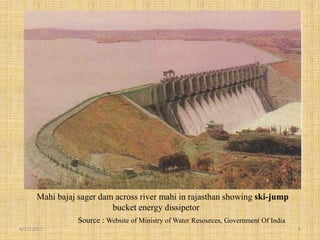
Mahi bajaj sager dam across river mahi in rajasthan showing ski-jump
bucket energy dissipetor
Source : Website of Ministry of Water Resources, Government Of India
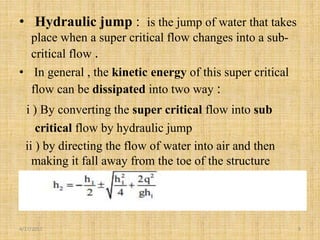
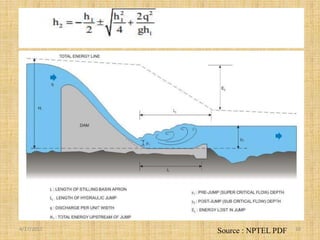
• Hydraulic jump : is the jump of water that takes
place when a super critical flow changes into a sub-
critical flow .
• In general , the kinetic energy of this super critical
flow can be dissipated into two way :
i ) By converting the super critical flow into sub
critical flow by hydraulic jump
ii ) by directing the flow of water into air and then
making it fall away from the toe of the structure
4/17/2017 9
4/17/2017 10Source : NPTEL PDF
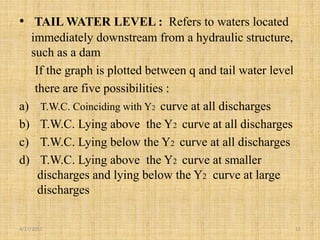
• TAIL WATER LEVEL : Refers to waters located
immediately downstream from a hydraulic structure,
such as a dam
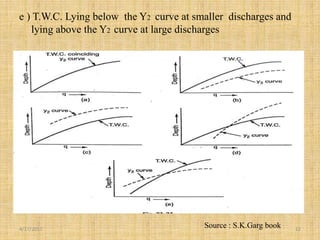
If the graph is plotted between q and tail water level
there are five possibilities :
a) T.W.C. Coinciding with Y2 curve at all discharges
b) T.W.C. Lying above the Y2 curve at all discharges
c) T.W.C. Lying below the Y2 curve at all discharges
d) T.W.C. Lying above the Y2 curve at smaller
discharges and lying below the Y2 curve at large
discharges
4/17/2017 11
e ) T.W.C. Lying below the Y2 curve at smaller discharges and
lying above the Y2 curve at large discharges
4/17/2017 12
Source : S.K.Garg book
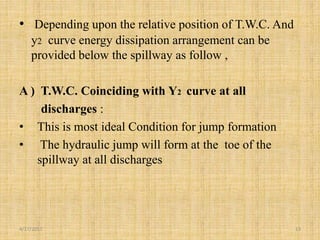
• Depending upon the relative position of T.W.C. And
y2 curve energy dissipation arrangement can be
provided below the spillway as follow ,
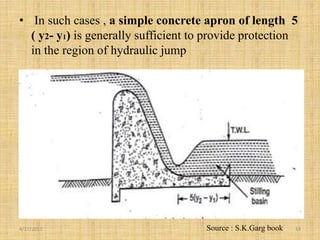
A ) T.W.C. Coinciding with Y2 curve at all
discharges :
• This is most ideal Condition for jump formation
• The hydraulic jump will form at the toe of the
spillway at all discharges
4/17/2017 13
• In such cases , a simple concrete apron of length 5
( y2- y1) is generally sufficient to provide protection
in the region of hydraulic jump
4/17/2017 14Source : S.K.Garg book
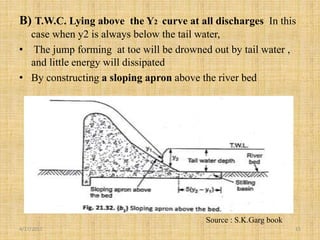
B) T.W.C. Lying above the Y2 curve at all discharges In this
case when y2 is always below the tail water,
• The jump forming at toe will be drowned out by tail water ,
and little energy will dissipated
• By constructing a sloping apron above the river bed
4/17/2017 15
Source : S.K.Garg book
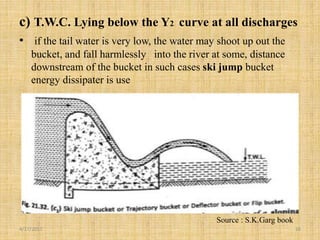
c) T.W.C. Lying below the Y2 curve at all discharges
• if the tail water is very low, the water may shoot up out the
bucket, and fall harmlessly into the river at some, distance
downstream of the bucket in such cases ski jump bucket
energy dissipater is use
4/17/2017 16
Source : S.K.Garg book
4/17/2017 17
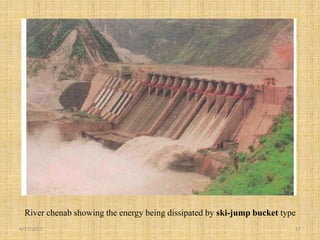
River chenab showing the energy being dissipated by ski-jump bucket type
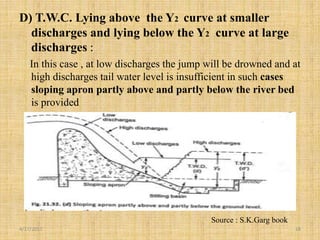
D) T.W.C. Lying above the Y2 curve at smaller
discharges and lying below the Y2 curve at large
discharges :
In this case , at low discharges the jump will be drowned and at
high discharges tail water level is insufficient in such cases
sloping apron partly above and partly below the river bed
is provided
4/17/2017 18
Source : S.K.Garg book
References
• Garg, S.K. "Irrigation Engineering and Hydraulic
Structures", Khanna Publishers, Delhi.
• IIT kharagpur Module of Hydraulic Structures for
Flow Diversion and Storage The National Programme
on Technology Enhanced Learning (NPTEL)
4/17/2017 19
Thank You
4/17/2017 20

energy dissipator in hydraulic structure

  • 1.
    ENERGY DISSIPATORS PRESENTED BY KIRANC JADHAV GOVERNMENT COLLEGE OF ENGINEERING, AURANGABAD (An Autonomous Institute Of Government of Maharashtra) DEPARTMENT OF CIVIL ENGINEERING 4/17/2017 1
  • 2.
    CONTENT • Introduction • Typesof Energy dissipators • Stilling basins and bucket Energy dissipators • hydraulic jump and importance • Energy dissipation arrangement by studying graph of discharge vs Tail Water Curve • References 4/17/2017 2
  • 3.
    DEFINITION OF ENERGY DISSIPATORS •The water flowing over the spillways acquires a lot of kinetic energy by the time it reaches near the toe of spillway ( Because of conversion of potential energy into kinetic energy ) • To dissipate this huge kinetic energy of water and reduce large scale of scouring the structural arrangement is made is called as energy dissipators 4/17/2017 3
  • 4.
    THE ENERGY DISSIPATORSARE CLASSIFIED UNDER TWO CATEGORIES 4/17/2017 4 TYPES OF ENERGY DISSIPATORS STILLING BASINS BUCKET TYPE
  • 5.
    STILLING BASINS TYPEENERGY DISSIPATORS • Definition of stilling basin : A depression in a channel or reservoir deep enough to reduce the velocity of the flow • STILLING BASINS : A ) Hydraulic jump type stilling basins 1. Horizontal apron type 2. Sloping apron type 4/17/2017 5
  • 6.
    4/17/2017 6 HORIZONTAL APRONTYPE SLOPING APRON TYPE Source : NPTEL PDF
  • 7.
    BUCKET TYPE ENERGY DISSIPATORS BUCKETTYPE : 1. Solid roller bucket 2. Slotted roller bucket 3. Ski jump (flip/trajectory) bucket 4/17/2017 7
  • 8.
    4/17/2017 8 Mahi bajajsager dam across river mahi in rajasthan showing ski-jump bucket energy dissipetor Source : Website of Ministry of Water Resources, Government Of India
  • 9.
    • Hydraulic jump: is the jump of water that takes place when a super critical flow changes into a sub- critical flow . • In general , the kinetic energy of this super critical flow can be dissipated into two way : i ) By converting the super critical flow into sub critical flow by hydraulic jump ii ) by directing the flow of water into air and then making it fall away from the toe of the structure 4/17/2017 9
  • 10.
  • 11.
    • TAIL WATERLEVEL : Refers to waters located immediately downstream from a hydraulic structure, such as a dam If the graph is plotted between q and tail water level there are five possibilities : a) T.W.C. Coinciding with Y2 curve at all discharges b) T.W.C. Lying above the Y2 curve at all discharges c) T.W.C. Lying below the Y2 curve at all discharges d) T.W.C. Lying above the Y2 curve at smaller discharges and lying below the Y2 curve at large discharges 4/17/2017 11
  • 12.
    e ) T.W.C.Lying below the Y2 curve at smaller discharges and lying above the Y2 curve at large discharges 4/17/2017 12 Source : S.K.Garg book
  • 13.
    • Depending uponthe relative position of T.W.C. And y2 curve energy dissipation arrangement can be provided below the spillway as follow , A ) T.W.C. Coinciding with Y2 curve at all discharges : • This is most ideal Condition for jump formation • The hydraulic jump will form at the toe of the spillway at all discharges 4/17/2017 13
  • 14.
    • In suchcases , a simple concrete apron of length 5 ( y2- y1) is generally sufficient to provide protection in the region of hydraulic jump 4/17/2017 14Source : S.K.Garg book
  • 15.
    B) T.W.C. Lyingabove the Y2 curve at all discharges In this case when y2 is always below the tail water, • The jump forming at toe will be drowned out by tail water , and little energy will dissipated • By constructing a sloping apron above the river bed 4/17/2017 15 Source : S.K.Garg book
  • 16.
    c) T.W.C. Lyingbelow the Y2 curve at all discharges • if the tail water is very low, the water may shoot up out the bucket, and fall harmlessly into the river at some, distance downstream of the bucket in such cases ski jump bucket energy dissipater is use 4/17/2017 16 Source : S.K.Garg book
  • 17.
    4/17/2017 17 River chenabshowing the energy being dissipated by ski-jump bucket type
  • 18.
    D) T.W.C. Lyingabove the Y2 curve at smaller discharges and lying below the Y2 curve at large discharges : In this case , at low discharges the jump will be drowned and at high discharges tail water level is insufficient in such cases sloping apron partly above and partly below the river bed is provided 4/17/2017 18 Source : S.K.Garg book
  • 19.
    References • Garg, S.K."Irrigation Engineering and Hydraulic Structures", Khanna Publishers, Delhi. • IIT kharagpur Module of Hydraulic Structures for Flow Diversion and Storage The National Programme on Technology Enhanced Learning (NPTEL) 4/17/2017 19
  • 20.