 Portland cement and other types
Introduction:-
“Portland cement is a hydraulic cement that
hardens when exposed to water, produced by
pulverizing a mixture of limestone, clay, sand, and
other minerals, and then firing the mixture at high
temperatures to form a cement clinker, which is
subsequently ground into a fine powder.”
 TOPIC:- PORTLAND CEMENT
 History:-
 1824: Joseph Aspdin patents Portland
cement.
 1820s-1840s: Aspdin refines the
manufacturing process.
 1850s-1900s: Industrialization
expands production and
transportation.
 1900s-present: Innovations drive
growth, new cement types emerge,
and sustainability becomes a focus
 Composition:-
Typical constituents of
Portland clinker + Gypsum
Typical constituents of
Portland Cement
01
• RAW MATERIAL EXTRACTION:-
• 1. Limestone, clay, sand, and other minerals are extracted from quarries or mine.
02
• CRUSHING & GRINDING:-
• 1. The raw materials are crushed and ground into a fine powder using crushers and
grinders. This process produces a uniform raw meal.
03
• MIXING & BLENDING:-
• 1. The raw meal is then mixed and blended with other ingredients, such as gypsum and
fly ash. This mixture is called the "kiln feed."
04
• PREHEATING & CALCINATION:-
• 1. Raw meal is heated to reduce moisture content. Preheated raw meal is heated to
900°C to produce calcined material.
05
• CLINKER FORMATION:-
• 1. Calcined material is heated to 1450°C in a rotary kiln. Kiln material is transformed
into clinker.
06
• Cooling & Grinding:-
• 1.Clinker is cooled to stop the chemical reaction. Clinker is ground into a fine powder
(cement).
07
• PACKING & DISTRIBUTION:-
• 1. Cement is packaged in bags or bulk containers. Cement is distributed to construction
sites, ready-mix concrete plants, and other customers.
PROCESS
 Hardening of Cement:-
When anhydrous cement mix is added to water, the silicates react,
forming hydrates and calcium hydroxide. Hardened Portland cement
contains about 70% cross-linked calcium silicate hydrate and 20%
crystalline calcium hydroxide.
 2Ca3SiO5 + 6H2O → Ca3SiO2O7.3H2O + 3Ca(OH)2
2Ca4Si2O4 + 4H2O → Ca3Si2O7.3H2O + Ca(OH)2
A typical cement paste contains about 60–75% water by volume and only
about 40–25% solids. The hardening occurs through at least two major
steps
Lightweight concrete
Lightweight coarse aggregates such as shale, clay, or slate, which give
it its characteristic low density.
oCharacteristic
 Less density & excellent thermal insulating properties.
 reduces the structural load on buildings.
 Air entrained container
Contains small air bubbles that are intentionally created during mixing
OTHER CEMENTS:-
Continue
oComposition
1.Cement (Portland or blended)
2.Water, Aggregates (sand, gravel, or crushed stone)
4.Air-entraining agents (AEA) (e.g., surfactants, soaps, or resins)
5.Optional: fly ash, silica fume, or other admixtures
oCharacteristics :
1.Density: (reduced due to air bubbles)
2.Porosity: Increased due to air bubbles
3.Absorption: Reduced due to improved durability
Continue…
Reinforced concrete
o Composition: cement concrete and steel bars.
o Strength: strong in both compression and tension,
o Durability: long service life. Resistance to torsion, bending,
compression traction. Excellent adhesive properties.
o Moldability: It can be molded and shaped.
Prestressed concrete
It is typically made by casting concrete about steel cables stretched By jacks.
After the concrete hardens, The tension is released, resulting in the entrapped Cables
compressing the concrete.
Continue…
o Characteristic
 More Durability ,more stiffness. deformation less, which improves its
serviceability
 Reduces steel corrosion.
Concrete Mansory
Composition: Portland cement and aggregates like sand and crushed stone.
o Characteristic
 More durability that can provide structural strength and fire resistant.
 It offers thermal mass for efficient heating and cooling. It provides sound
attenuation to a wall system
Non-Portland Cement
Calcium Aluminate:-
o Composition :It is made up of alumina , lime, and iron
and silica.
o Characteristic
 Gain strength quickly, developing strength in 24 hours
compared to Portland cement’s 28 days.
 Resistant to high temperatures and chemical attack.
Magnesia Cement:-
MgO is a white or yellow powder.
o Composition:-
Natural magnesite(MgCO3), serpentine,
dolomite, molten slag or seawater.
o Characteristics:-
 Hardness within 2-8 hours.
Gypsum cement
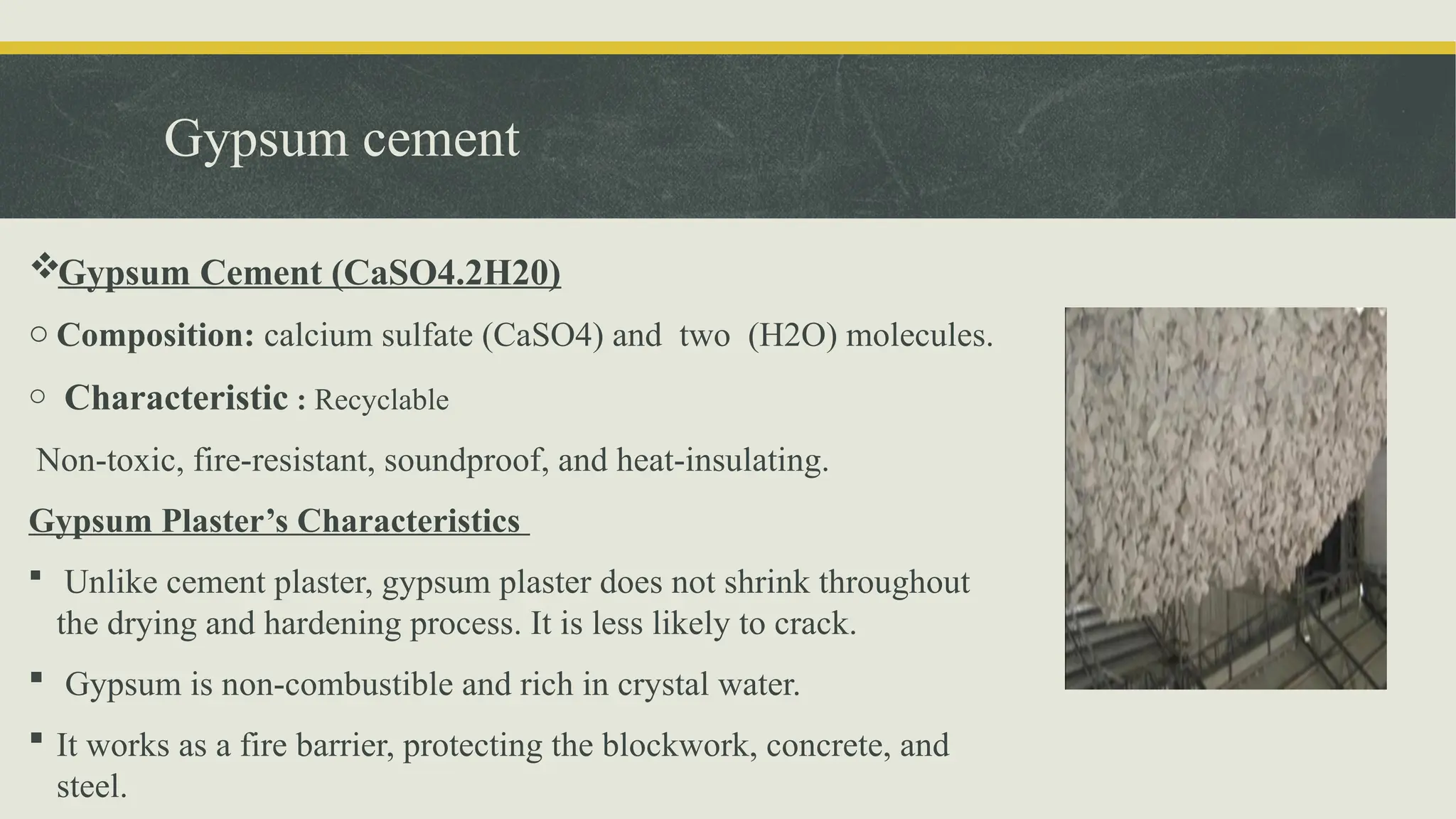
Gypsum Cement (CaSO4.2H20)
o Composition: calcium sulfate (CaSO4) and two (H2O) molecules.
o Characteristic : Recyclable
Non-toxic, fire-resistant, soundproof, and heat-insulating.
Gypsum Plaster’s Characteristics
 Unlike cement plaster, gypsum plaster does not shrink throughout
the drying and hardening process. It is less likely to crack.
 Gypsum is non-combustible and rich in crystal water.
 It works as a fire barrier, protecting the blockwork, concrete, and
steel.
Silicon dioxide:
Silica, is a combination of silicon and oxygen, two very abundant, naturally occurring
materials. There are many forms of silica. They all have the same makeup but may have a
different name, depending on how the particles arrange themselves.
(SiO2)AMORPHOUS:-
Amorphous or noncrystalline silica is silicon dioxide (SiO 2) that does not have a crystalline
structure.Silicon dioxide (SiO2) is the repeating general structural formula for the vast
majority of rock, sand, and dirt about us and for the material we refer to as glass.
 TOPIC:-Silicon Dioxide (Amorphous)
Occurrence:-
 SiO2, commonly found in nature as quartz. In many parts of the world, silica
is the major constituent of sand. Silica is one of the most complex and
abundant families of materials, existing as a compound of
several minerals and as a synthetic product. Examples include fused
quartz, fumed silica, opal, and aerogels.
 Silicon dioxide is a common fundamental constituent of Glass.
 Structural mostly found in α-quartz, but also found in almost all forms of
silicon dioxide.
 In the majority of silicon dioxides, the silicon atom shows tetrahedral
coordination, with four oxygen atoms surrounding a central Si atom (see 3-D
Unit Cell). Thus, SiO2 forms 3-dimensional network solids in which each
silicon atom is covalently bonded in a tetrahedral manner to 4 oxygen atoms.
Glass:
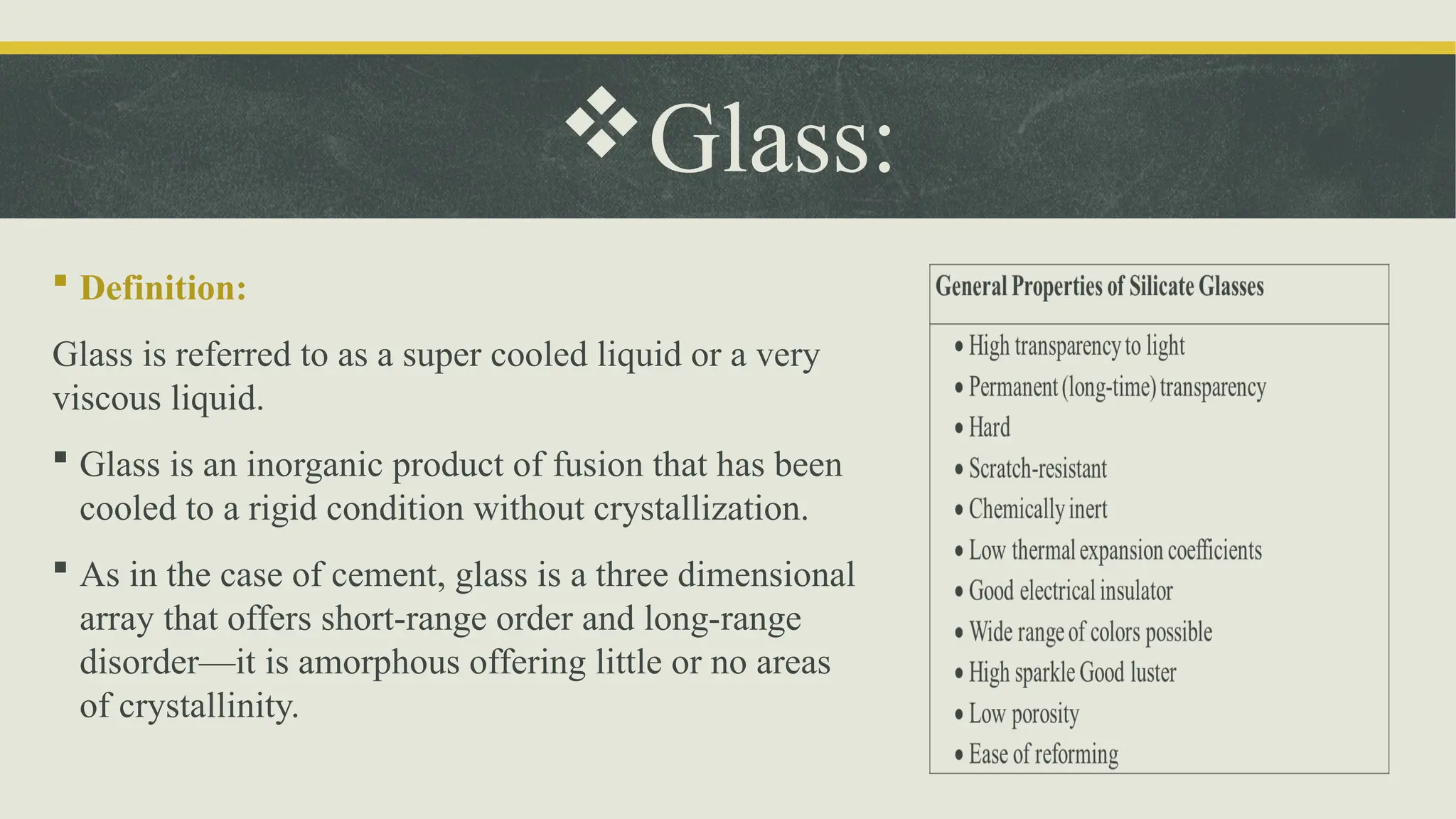
 Definition:
Glass is referred to as a super cooled liquid or a very
viscous liquid.
 Glass is an inorganic product of fusion that has been
cooled to a rigid condition without crystallization.
 As in the case of cement, glass is a three dimensional
array that offers short-range order and long-range
disorder—it is amorphous offering little or no areas
of crystallinity.
Synthesis:-
 A typical window glass will contain 95–99% silica sand with the remainder being soda ash
(Na2CO3), limestone (CaCO3), feldspar, and borax or boric acid along with the appropriate
coloring and decolorizing agents, oxidizing agents, etc. As noted previously, 5–40% by
weight of crushed cullet is also added. The soda ash, limestone, feldspar, and borax or boric
acid all form oxides as they are heated, which become integrated into the silicon structure:
Processing:
 Processing includes shaping and retreatments of glass. Since shaping may create undue sites of
amorphous structure, most glass objects are again heated to near their melting point. This process is called
annealing.
 Drawing is employed for shaping flat glass, glass tubing, and fiber glass. Most flat glass is shaped by
drawing a sheet of molten (heated so it can be shaped but not so it freely flows) glass onto a tank of molten
tin.
 Pressing is accomplished by simply dropping a portion of molten glass into a form and then applying
pressure to ensure that the glass takes the form of the mold. Lenses, glass blocks, baking dishes, and
ashtrays are examples
 The casting process involves filling molds with molten glass in much the same way that cement- and
plaster of Paris–molded objects are produced.
 Glass blowing is one of the oldest arts known to man. For art or tailor-made blown objects, the working
and blowing of the glass is done by a skilled worker who blows into a pipe intruded into the molten glass.
 Slow cooling will result in a glass containing larger areas of crystallinity resulting in stronger but more
brittle glass. Tempering is the name given when the glass is rapidly cooled, resulting in a glass that is more
amorphous as well as weaker but less brittle than more slowly cooled glass.

Portland Cement its history and its types .pptx

  • 1.
     Portland cementand other types
  • 2.
    Introduction:- “Portland cement isa hydraulic cement that hardens when exposed to water, produced by pulverizing a mixture of limestone, clay, sand, and other minerals, and then firing the mixture at high temperatures to form a cement clinker, which is subsequently ground into a fine powder.”  TOPIC:- PORTLAND CEMENT
  • 3.
     History:-  1824:Joseph Aspdin patents Portland cement.  1820s-1840s: Aspdin refines the manufacturing process.  1850s-1900s: Industrialization expands production and transportation.  1900s-present: Innovations drive growth, new cement types emerge, and sustainability becomes a focus
  • 4.
     Composition:- Typical constituentsof Portland clinker + Gypsum Typical constituents of Portland Cement
  • 5.
    01 • RAW MATERIALEXTRACTION:- • 1. Limestone, clay, sand, and other minerals are extracted from quarries or mine. 02 • CRUSHING & GRINDING:- • 1. The raw materials are crushed and ground into a fine powder using crushers and grinders. This process produces a uniform raw meal. 03 • MIXING & BLENDING:- • 1. The raw meal is then mixed and blended with other ingredients, such as gypsum and fly ash. This mixture is called the "kiln feed." 04 • PREHEATING & CALCINATION:- • 1. Raw meal is heated to reduce moisture content. Preheated raw meal is heated to 900°C to produce calcined material. 05 • CLINKER FORMATION:- • 1. Calcined material is heated to 1450°C in a rotary kiln. Kiln material is transformed into clinker. 06 • Cooling & Grinding:- • 1.Clinker is cooled to stop the chemical reaction. Clinker is ground into a fine powder (cement). 07 • PACKING & DISTRIBUTION:- • 1. Cement is packaged in bags or bulk containers. Cement is distributed to construction sites, ready-mix concrete plants, and other customers. PROCESS
  • 6.
     Hardening ofCement:- When anhydrous cement mix is added to water, the silicates react, forming hydrates and calcium hydroxide. Hardened Portland cement contains about 70% cross-linked calcium silicate hydrate and 20% crystalline calcium hydroxide.  2Ca3SiO5 + 6H2O → Ca3SiO2O7.3H2O + 3Ca(OH)2 2Ca4Si2O4 + 4H2O → Ca3Si2O7.3H2O + Ca(OH)2 A typical cement paste contains about 60–75% water by volume and only about 40–25% solids. The hardening occurs through at least two major steps
  • 7.
    Lightweight concrete Lightweight coarseaggregates such as shale, clay, or slate, which give it its characteristic low density. oCharacteristic  Less density & excellent thermal insulating properties.  reduces the structural load on buildings.  Air entrained container Contains small air bubbles that are intentionally created during mixing OTHER CEMENTS:-
  • 8.
    Continue oComposition 1.Cement (Portland orblended) 2.Water, Aggregates (sand, gravel, or crushed stone) 4.Air-entraining agents (AEA) (e.g., surfactants, soaps, or resins) 5.Optional: fly ash, silica fume, or other admixtures oCharacteristics : 1.Density: (reduced due to air bubbles) 2.Porosity: Increased due to air bubbles 3.Absorption: Reduced due to improved durability
  • 9.
    Continue… Reinforced concrete o Composition:cement concrete and steel bars. o Strength: strong in both compression and tension, o Durability: long service life. Resistance to torsion, bending, compression traction. Excellent adhesive properties. o Moldability: It can be molded and shaped. Prestressed concrete It is typically made by casting concrete about steel cables stretched By jacks. After the concrete hardens, The tension is released, resulting in the entrapped Cables compressing the concrete.
  • 10.
    Continue… o Characteristic  MoreDurability ,more stiffness. deformation less, which improves its serviceability  Reduces steel corrosion. Concrete Mansory Composition: Portland cement and aggregates like sand and crushed stone. o Characteristic  More durability that can provide structural strength and fire resistant.  It offers thermal mass for efficient heating and cooling. It provides sound attenuation to a wall system
  • 11.
    Non-Portland Cement Calcium Aluminate:- oComposition :It is made up of alumina , lime, and iron and silica. o Characteristic  Gain strength quickly, developing strength in 24 hours compared to Portland cement’s 28 days.  Resistant to high temperatures and chemical attack. Magnesia Cement:- MgO is a white or yellow powder. o Composition:- Natural magnesite(MgCO3), serpentine, dolomite, molten slag or seawater. o Characteristics:-  Hardness within 2-8 hours.
  • 12.
    Gypsum cement Gypsum Cement(CaSO4.2H20) o Composition: calcium sulfate (CaSO4) and two (H2O) molecules. o Characteristic : Recyclable Non-toxic, fire-resistant, soundproof, and heat-insulating. Gypsum Plaster’s Characteristics  Unlike cement plaster, gypsum plaster does not shrink throughout the drying and hardening process. It is less likely to crack.  Gypsum is non-combustible and rich in crystal water.  It works as a fire barrier, protecting the blockwork, concrete, and steel.
  • 13.
    Silicon dioxide: Silica, isa combination of silicon and oxygen, two very abundant, naturally occurring materials. There are many forms of silica. They all have the same makeup but may have a different name, depending on how the particles arrange themselves. (SiO2)AMORPHOUS:- Amorphous or noncrystalline silica is silicon dioxide (SiO 2) that does not have a crystalline structure.Silicon dioxide (SiO2) is the repeating general structural formula for the vast majority of rock, sand, and dirt about us and for the material we refer to as glass.  TOPIC:-Silicon Dioxide (Amorphous)
  • 14.
    Occurrence:-  SiO2, commonlyfound in nature as quartz. In many parts of the world, silica is the major constituent of sand. Silica is one of the most complex and abundant families of materials, existing as a compound of several minerals and as a synthetic product. Examples include fused quartz, fumed silica, opal, and aerogels.  Silicon dioxide is a common fundamental constituent of Glass.  Structural mostly found in α-quartz, but also found in almost all forms of silicon dioxide.  In the majority of silicon dioxides, the silicon atom shows tetrahedral coordination, with four oxygen atoms surrounding a central Si atom (see 3-D Unit Cell). Thus, SiO2 forms 3-dimensional network solids in which each silicon atom is covalently bonded in a tetrahedral manner to 4 oxygen atoms.
  • 15.
    Glass:  Definition: Glass isreferred to as a super cooled liquid or a very viscous liquid.  Glass is an inorganic product of fusion that has been cooled to a rigid condition without crystallization.  As in the case of cement, glass is a three dimensional array that offers short-range order and long-range disorder—it is amorphous offering little or no areas of crystallinity.
  • 16.
    Synthesis:-  A typicalwindow glass will contain 95–99% silica sand with the remainder being soda ash (Na2CO3), limestone (CaCO3), feldspar, and borax or boric acid along with the appropriate coloring and decolorizing agents, oxidizing agents, etc. As noted previously, 5–40% by weight of crushed cullet is also added. The soda ash, limestone, feldspar, and borax or boric acid all form oxides as they are heated, which become integrated into the silicon structure:
  • 17.
    Processing:  Processing includesshaping and retreatments of glass. Since shaping may create undue sites of amorphous structure, most glass objects are again heated to near their melting point. This process is called annealing.  Drawing is employed for shaping flat glass, glass tubing, and fiber glass. Most flat glass is shaped by drawing a sheet of molten (heated so it can be shaped but not so it freely flows) glass onto a tank of molten tin.  Pressing is accomplished by simply dropping a portion of molten glass into a form and then applying pressure to ensure that the glass takes the form of the mold. Lenses, glass blocks, baking dishes, and ashtrays are examples  The casting process involves filling molds with molten glass in much the same way that cement- and plaster of Paris–molded objects are produced.  Glass blowing is one of the oldest arts known to man. For art or tailor-made blown objects, the working and blowing of the glass is done by a skilled worker who blows into a pipe intruded into the molten glass.  Slow cooling will result in a glass containing larger areas of crystallinity resulting in stronger but more brittle glass. Tempering is the name given when the glass is rapidly cooled, resulting in a glass that is more amorphous as well as weaker but less brittle than more slowly cooled glass.