Marble
 NTRODUCTIONI
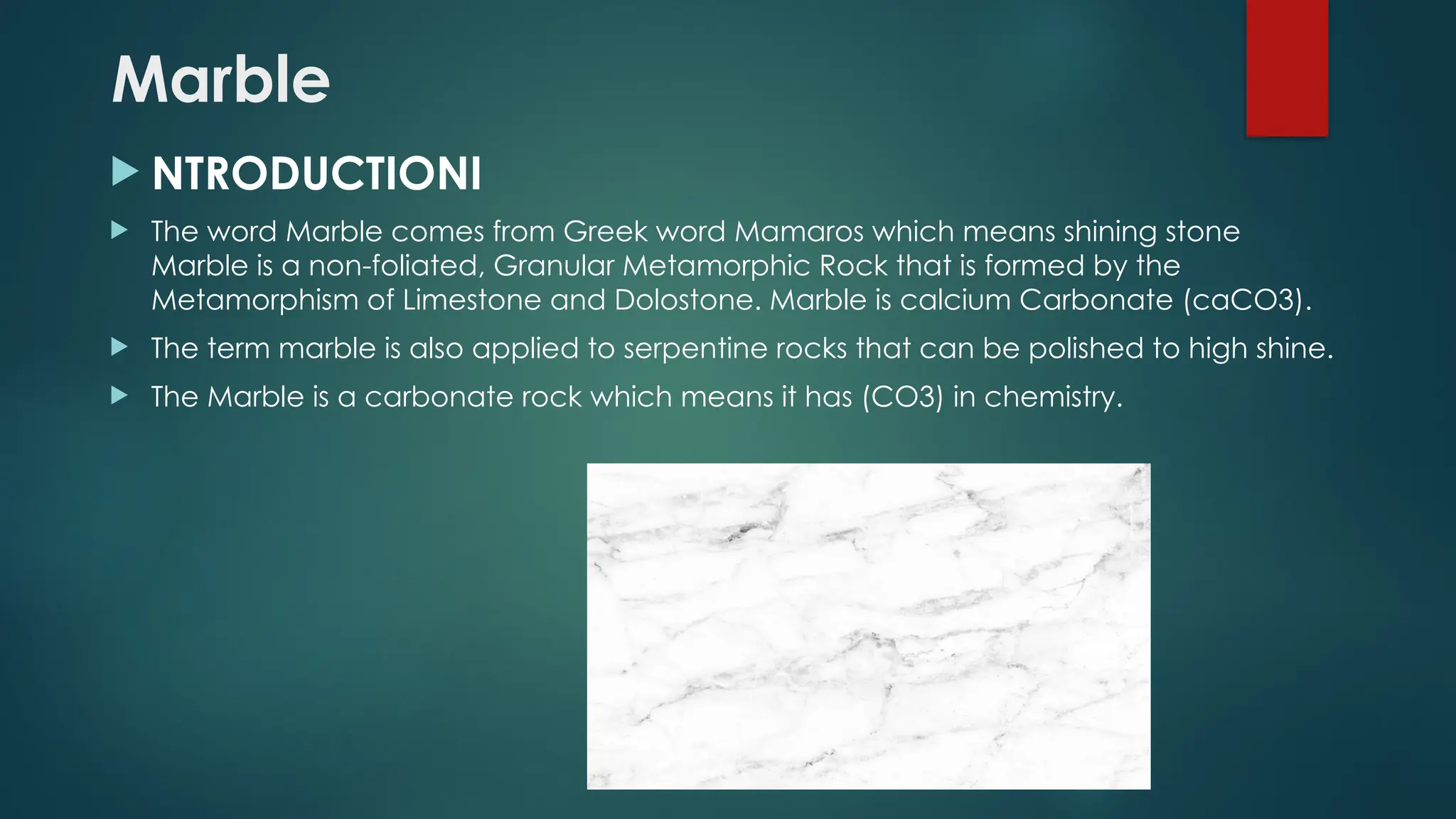
 The word Marble comes from Greek word Mamaros which means shining stone
Marble is a non-foliated, Granular Metamorphic Rock that is formed by the
Metamorphism of Limestone and Dolostone. Marble is calcium Carbonate (caCO3).
 The term marble is also applied to serpentine rocks that can be polished to high shine.
 The Marble is a carbonate rock which means it has (CO3) in chemistry.
 FORMATION OF MARBLE:
 Metamorphic Rock of Crystalline Aggregate of Calcite and/or Dolomite. CALC –
Silicate Rock with Calcium – Magnesium Silicate Mineral”(Calciphyre).
 Any Calcareous and / or Dolomite Rock Capable of Taking Polish & Suitable for
Decorative & Structural Purposes.
 Crystalline Calcite and / or Dolomite Rock – Marble Geologically
 Partially Crystallized Dense Compact Limestones – Marble
 Commercially Travertine (Calcium Carbonate Precipitates) – Onyx marble Verde
Antique – Serpentine Marble
 CHEMICAL COMPOSITION OF MARBLE
 Calcite & Dolomite Carbonate of calcium (Hardness 3-sp.grav.2.72)
 Carbonate of calcium & Magnesium (Hardness 3.5/4-Sp.Grave.2.9)
 Marble Formula (CaCO3), 1- Calcium, 1-Carbon, 3Oxygen
Uses
 Industrial use:
 Blocks of cut Marble: Colorless or light-colored marbles are a
very pure source of calcium carbonate,
 which is used in a wide variety of industries.
 Finely ground marble or calcium carbonate powder is a
component in paper, and in consumer products such as
toothpaste, plastics the ground calcium carbonate worldwide
is made from marble.
 Ground calcium carbonate is used as a coating pigment for
paper because of its high brightness and as a paper filler
because it strengthens the sheet and imparts high brightness.
 Consumer products:
 consumer products such as a food additive, in toothpaste, and as an inert filler
in pills.
 It is used in plastics because it imparts stiffness, impact strength, dimensional
stability, and thermal conductivity. I
 t is used in paints because it is a good filler and extender, has high brightness,
and is weather resistant.
 which has many applications including being a primary component of many
forms of cement
Production Sculpture:
 White marble has been prized for its use in sculptures since classical
times.
 This preference has to do with its softness, relative isotropy and
homogeneity, and a relative resistance to shattering. Also, the low
index of refraction of calcite allows light to penetrate several millimeters
into the stone before being scattered out, resulting in the characteristic
waxy look which gives "life" to marble sculptures of the human body
Construction marble:
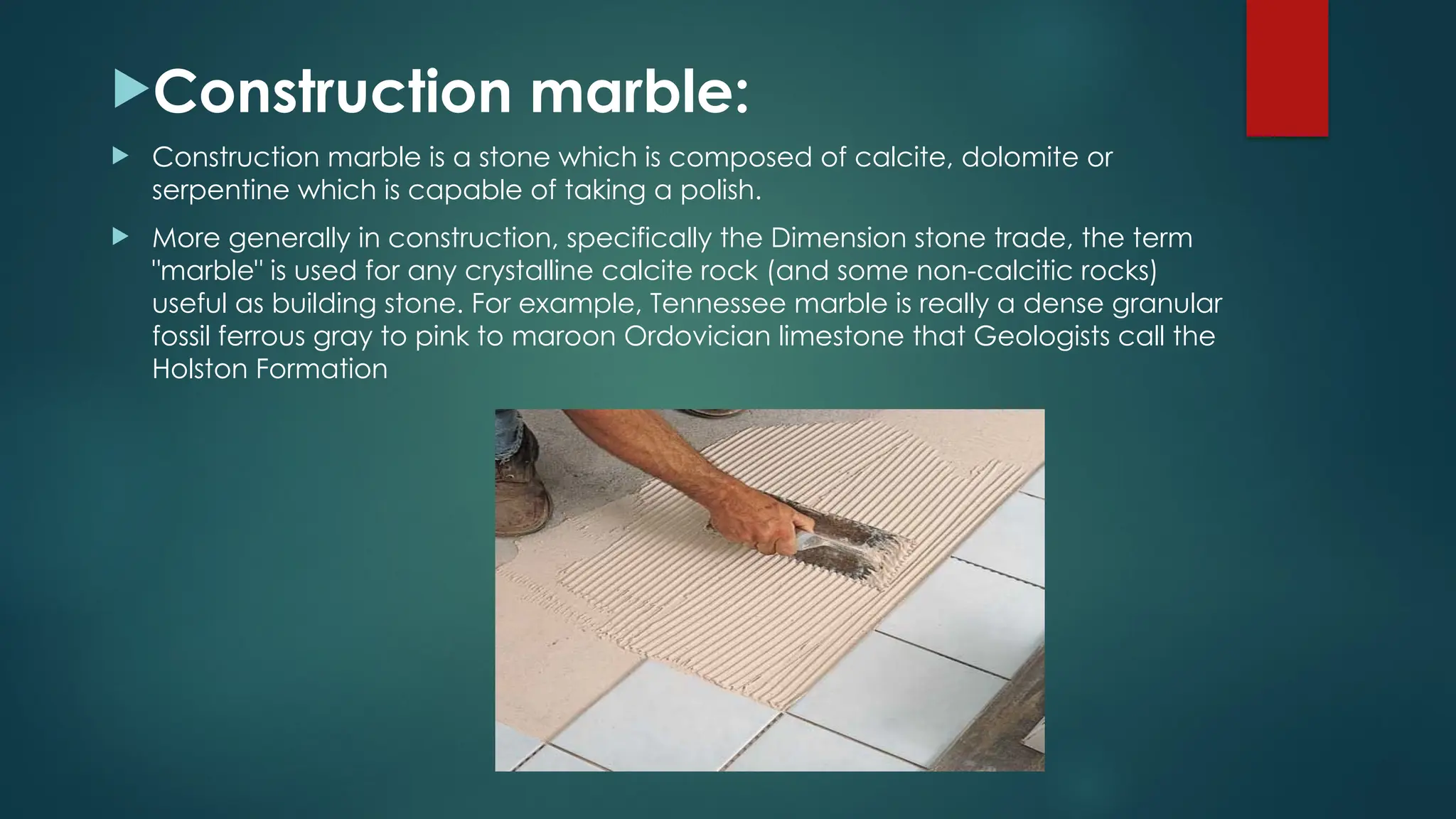
 Construction marble is a stone which is composed of calcite, dolomite or
serpentine which is capable of taking a polish.
 More generally in construction, specifically the Dimension stone trade, the term
"marble" is used for any crystalline calcite rock (and some non-calcitic rocks)
useful as building stone. For example, Tennessee marble is really a dense granular
fossil ferrous gray to pink to maroon Ordovician limestone that Geologists call the
Holston Formation
Characteristics Of Marbles
 Marble is a stone with a firm crystalline structure and slight porosity.
 Due to its structure, marble can be polished to improve its shine and is thus
a common and attractive stone for building applications.
 The restricted marble porosity, mainly when refined, makes it less
susceptible to water damage. However, calcium carbonate, the main
ingredient of marble, is exceedingly susceptible to acidic agents: it rapidly
dissolves in some acids.
 The actual influence of acidic contact will vary with the kind of the acid:
chlorides, sulfates, and other chemical compounds respond in different
ways with marble. Byproducts are created that possess a wide range of
solubility and influence on the durability of marble.
 Therefore, it is essential to ascertain the exact kind of pollutants that cause
marble deterioration.

marble mode of occurrence distribution.pptx

  • 1.
    Marble  NTRODUCTIONI  Theword Marble comes from Greek word Mamaros which means shining stone Marble is a non-foliated, Granular Metamorphic Rock that is formed by the Metamorphism of Limestone and Dolostone. Marble is calcium Carbonate (caCO3).  The term marble is also applied to serpentine rocks that can be polished to high shine.  The Marble is a carbonate rock which means it has (CO3) in chemistry.
  • 2.
     FORMATION OFMARBLE:  Metamorphic Rock of Crystalline Aggregate of Calcite and/or Dolomite. CALC – Silicate Rock with Calcium – Magnesium Silicate Mineral”(Calciphyre).  Any Calcareous and / or Dolomite Rock Capable of Taking Polish & Suitable for Decorative & Structural Purposes.  Crystalline Calcite and / or Dolomite Rock – Marble Geologically  Partially Crystallized Dense Compact Limestones – Marble  Commercially Travertine (Calcium Carbonate Precipitates) – Onyx marble Verde Antique – Serpentine Marble
  • 3.
     CHEMICAL COMPOSITIONOF MARBLE  Calcite & Dolomite Carbonate of calcium (Hardness 3-sp.grav.2.72)  Carbonate of calcium & Magnesium (Hardness 3.5/4-Sp.Grave.2.9)  Marble Formula (CaCO3), 1- Calcium, 1-Carbon, 3Oxygen
  • 4.
    Uses  Industrial use: Blocks of cut Marble: Colorless or light-colored marbles are a very pure source of calcium carbonate,  which is used in a wide variety of industries.  Finely ground marble or calcium carbonate powder is a component in paper, and in consumer products such as toothpaste, plastics the ground calcium carbonate worldwide is made from marble.  Ground calcium carbonate is used as a coating pigment for paper because of its high brightness and as a paper filler because it strengthens the sheet and imparts high brightness.
  • 5.
     Consumer products: consumer products such as a food additive, in toothpaste, and as an inert filler in pills.  It is used in plastics because it imparts stiffness, impact strength, dimensional stability, and thermal conductivity. I  t is used in paints because it is a good filler and extender, has high brightness, and is weather resistant.  which has many applications including being a primary component of many forms of cement
  • 6.
    Production Sculpture:  Whitemarble has been prized for its use in sculptures since classical times.  This preference has to do with its softness, relative isotropy and homogeneity, and a relative resistance to shattering. Also, the low index of refraction of calcite allows light to penetrate several millimeters into the stone before being scattered out, resulting in the characteristic waxy look which gives "life" to marble sculptures of the human body
  • 7.
    Construction marble:  Constructionmarble is a stone which is composed of calcite, dolomite or serpentine which is capable of taking a polish.  More generally in construction, specifically the Dimension stone trade, the term "marble" is used for any crystalline calcite rock (and some non-calcitic rocks) useful as building stone. For example, Tennessee marble is really a dense granular fossil ferrous gray to pink to maroon Ordovician limestone that Geologists call the Holston Formation
  • 8.
    Characteristics Of Marbles Marble is a stone with a firm crystalline structure and slight porosity.  Due to its structure, marble can be polished to improve its shine and is thus a common and attractive stone for building applications.  The restricted marble porosity, mainly when refined, makes it less susceptible to water damage. However, calcium carbonate, the main ingredient of marble, is exceedingly susceptible to acidic agents: it rapidly dissolves in some acids.  The actual influence of acidic contact will vary with the kind of the acid: chlorides, sulfates, and other chemical compounds respond in different ways with marble. Byproducts are created that possess a wide range of solubility and influence on the durability of marble.  Therefore, it is essential to ascertain the exact kind of pollutants that cause marble deterioration.