Hassan Z. Harraz
hharraz2006@yahoo.com
2017- 2018
DOI: 10.13140/RG.2.2.24716.62080
Outline
• WHAT IS VERMICULITE?
• TYPICAL vermiculite PROPERTIES;
• GRADES OF VERMICULITE;
• VERMICULITE EXPANSION;
• Processing Vermiculite;
• Vermiculite Expansion;
• Production and Reserves of Vermiculite
• Vermiculite occurrences in Gabal Hafafit area, Eastern
Desert, Egypt;
• Uses of Vermiculite
2
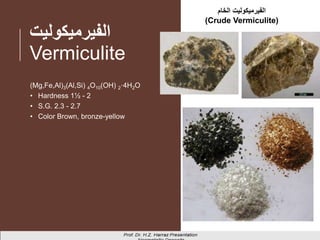
‫الفيرميكوليت‬
Vermiculite
43
(Mg,Fe,Al)3(Al,Si) 4O10(OH) 2·4H2O
• Hardness 1½ - 2
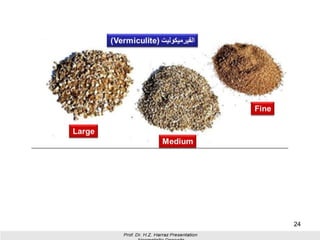
• S.G. 2.3 - 2.7
• Color Brown, bronze-yellow
‫الخام‬ ‫الفيرميكوليت‬
(Crude Vermiculite)
Vermiculite
4
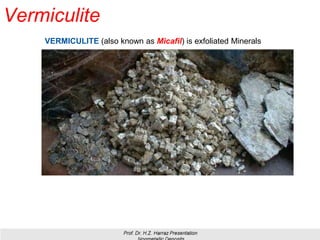
VERMICULITE (also known as Micafil) is exfoliated Minerals
VERMICULITE
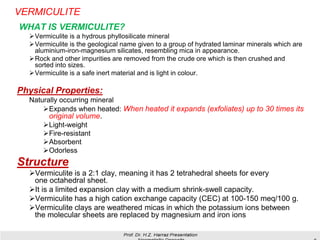
WHAT IS VERMICULITE?
➢Vermiculite is a hydrous phyllosilicate mineral
➢Vermiculite is the geological name given to a group of hydrated laminar minerals which are
aluminium-iron-magnesium silicates, resembling mica in appearance.
➢Rock and other impurities are removed from the crude ore which is then crushed and
sorted into sizes.
➢Vermiculite is a safe inert material and is light in colour.
Physical Properties:
Naturally occurring mineral
➢Expands when heated: When heated it expands (exfoliates) up to 30 times its
original volume.
➢Light-weight
➢Fire-resistant
➢Absorbent
➢Odorless
Structure
➢Vermiculite is a 2:1 clay, meaning it has 2 tetrahedral sheets for every
one octahedral sheet.
➢It is a limited expansion clay with a medium shrink-swell capacity.
➢Vermiculite has a high cation exchange capacity (CEC) at 100-150 meq/100 g.
➢Vermiculite clays are weathered micas in which the potassium ions between
the molecular sheets are replaced by magnesium and iron ions
‫الفيرميكوليت‬Vermiculite))
❖‫للحرارة‬ ‫تعرضه‬ ‫عند‬ ‫يتمدد‬ ،‫طبيعي‬ ‫معدن‬ ‫هو‬.
❖‫التجارية‬ ‫األفران‬ ‫في‬ ‫وتطبق‬ ‫التقشير‬ ‫تسمى‬ ‫التمدد‬ ‫عملية‬.
❖‫وعد‬ ‫المتحدة‬ ‫والواليات‬ ‫والبرازيل‬ ‫والصين‬ ‫أفريقيا‬ ‫جنوب‬ ‫في‬ ‫للفيرميكليت‬ ‫كبيرة‬ ‫تجارية‬ ‫مناجم‬ ‫توجد‬‫أخرى‬ ‫بلدان‬ ‫ة‬.
❖‫الكيميائي‬ ‫التركيب‬:(Mg,Fe,Al)3(Al,Si) 4O10(OH) 2·4H2O
‫الفيرميكوليت‬ ‫خصائص‬:
❖‫الفطريات‬ ‫نمو‬ ‫على‬ ‫يساعد‬ ‫فال‬ ‫ِه‬‫ت‬‫بطبيع‬ ‫معقم‬ ‫الفيرميكوليت‬.
❖‫الوزن‬ ‫خفيف‬.
❖‫عالية‬ ‫بدرجة‬ ‫بالماء‬ ‫يحتفظ‬.
❖‫عالية‬ ‫تبادلية‬ ‫سعة‬ ‫ذو‬.
❖‫واالستفاد‬ ‫امتصاصها‬ ‫يمكن‬ ‫للنباتات‬ ‫ميسرة‬ ‫صورة‬ ‫في‬ ‫والبوتاسيوم‬ ‫الماغنسيوم‬ ْ‫عنصري‬ ‫على‬ ‫يحتوى‬‫منها‬ ‫ة‬.
❖‫الوقت‬ ‫معظم‬ ‫بالماء‬ ً‫ا‬‫محتفظ‬ ‫يظل‬ ‫الماء‬ ‫امتصاص‬ ‫على‬ ‫العالية‬ ‫لقدرته‬ ‫ونظرا‬ ‫الفيرميكوليت‬ ‫أن‬ ‫إلى‬ ‫ونشير‬‫يفضل‬ ‫لذلك‬ ،
‫النباتات‬ ‫لنمو‬ ‫مناسبة‬ ‫البيئة‬ ‫رطوبة‬ ‫تظل‬ ‫وحتى‬ ،‫العالية‬ ‫الرطوبة‬ ‫من‬ ‫للتقليل‬ ‫أخرى‬ ‫بمواد‬ ‫خلطه‬.
‫االستخدامات‬:
❖‫العامل‬‫بوصفه‬‫المانع‬‫الحرارة‬
❖‫المياه‬‫غالية‬
❖‫صناعة‬‫ورق‬‫الجدران‬
❖‫التشحيم‬ ‫لزيوت‬ ‫ونتيجة‬
❖‫تمتلك‬‫التبادل‬‫الكاتيوني‬‫جيدة‬‫جدا‬
Production and Reserves of Vermiculite
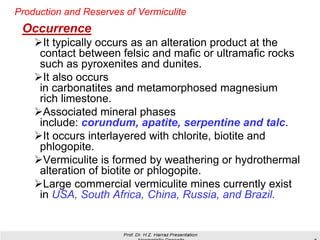
Occurrence
➢It typically occurs as an alteration product at the
contact between felsic and mafic or ultramafic rocks
such as pyroxenites and dunites.
➢It also occurs
in carbonatites and metamorphosed magnesium
rich limestone.
➢Associated mineral phases
include: corundum, apatite, serpentine and talc.
➢It occurs interlayered with chlorite, biotite and
phlogopite.
➢Vermiculite is formed by weathering or hydrothermal
alteration of biotite or phlogopite.
➢Large commercial vermiculite mines currently exist
in USA, South Africa, China, Russia, and Brazil.
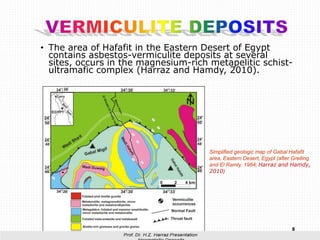
• The area of Hafafit in the Eastern Desert of Egypt
contains asbestos-vermiculite deposits at several
sites, occurs in the magnesium-rich metapelitic schist-
ultramafic complex (Harraz and Hamdy, 2010).
8
Simplified geologic map of Gabal Hafafit
area, Eastern Desert, Egypt (after Greiling
and El Ramly, 1984; Harraz and Hamdy,
2010)
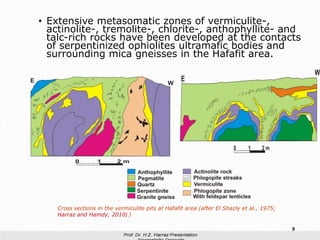
• Extensive metasomatic zones of vermiculite-,
actinolite-, tremolite-, chlorite-, anthophyllite- and
talc-rich rocks have been developed at the contacts
of serpentinized ophiolites ultramafic bodies and
surrounding mica gneisses in the Hafafit area.
9
Cross sections in the vermiculite pits at Hafafit area (after El Shazly et al., 1975;
Harraz and Hamdy, 2010) )
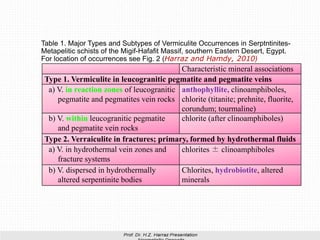
Table 1. Major Types and Subtypes of Vermiculite Occurrences in Serptntinites-
Metapelitic schists of the Migif-Hafafit Massif, southern Eastern Desert, Egypt.
For location of occurrences see Fig. 2 (Harraz and Hamdy, 2010)
10
Characteristic mineral associations
Type 1. Vermiculite in leucogranitic pegmatite and pegmatite veins
a) V. in reaction zones of leucogranitic
pegmatite and pegmatites vein rocks
anthophyllite, clinoamphiboles,
chlorite (titanite; prehnite, fluorite,
corundum; tourmaline)
b) V. within leucogranitic pegmatite
and pegmatite vein rocks
chlorite (after clinoamphiboles)
Type 2. Verraiculite in fractures; primary, formed by hydrothermal fluids
a) V. in hydrothermal vein zones and
fracture systems
chlorites ± clinoamphiboles
b) V. dispersed in hydrothermally
altered serpentinite bodies
Chlorites, hydrobiotite, altered
minerals
11
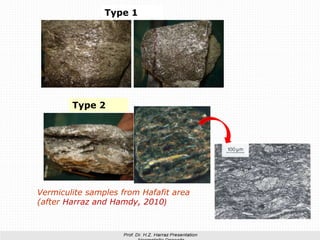
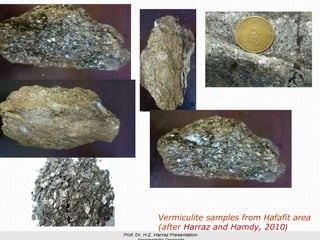
Type 1
Type 2
Vermiculite samples from Hafafit area
(after Harraz and Hamdy, 2010)
12
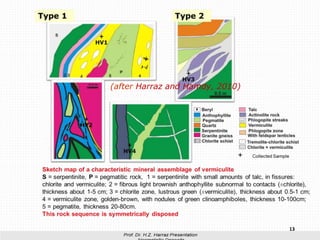
Vermiculite samples from Hafafit area
(after Harraz and Hamdy, 2010)
13
(after Harraz and Hamdy, 2010)
Geologic setting
❖The mineralized area is occupied by granite gneiss with irregular masses of
serpentinite as well as pegmatite veins and lenticels. The serpentinite bodies
are usually not more than 300 m length and 150 m width and are generally of
flattened lenticular shape with a roughly avoid cross section. They show
certain conformity between their contacts and the direction of foliation of the
gneiss.
❖Anthophyllite and vermiculate occur only where the serpentinite masses are
cut by leucogranite (pegmatitic leucogranites). The amount and concentration
of each of these two minerals vary from one site to another; some of them
are big enough to mine. The field study of a number of the mineralized sites
showed that they have the same mode of occurrence. They exhibit similar
rock types, structural relations and disposition within the same geological
framework. The main differences that could be observed between one site
and another are related to the total amount and the relative abundance of
the anthophyllite and vermiculate within the mineralized ultramafic mass.
❖The mineralized serpentinite mass ~200 x 100 m and lies in the northern
closure of the domal structure. The pegmatite cut across the serpentinite
mass in the form of dense stockwork of veinlets, the smaller veinlets net to
form bigger one following the contact between the serpentinite mass and the
enclosing gneiss. Generally, the pegmatites are composed essentially white
feldspar, glassy quartz, few red garnet crystals and black mica pockets, streaks
and sheaths, specially concentrated on the borders of the pegmatites. Within
the gneiss, these pegmatites are relatively rich in quartz and contain fair
amounts of garnets, where they cut across the serpentinite; they become
quartz-free plagioclasite pegmatites with rare garnet and with abundant black
mica.
❖Passing from the core of the serpentinite outwards towards the pegmatites, a
sort of zoning due to variable mineral composition is usually recognizable and
is roughly parallel to the pegmatite-serpentinite contact.
14
Origin
❖The formation of anthophyllite-vermiculite at Hafafit to
bimetasomatic reactions between pegmatitic material
and the ultramafic rocks, where alkalis and silica
supplied by the pegmatites infiltrated the ultramafic
mass, producing successive, almost monomineralic
zones of vermiculite, actinolite, anthophyllite and talc
away from the pegmatite intrusion (El-Shazly et al.,
1975).
❖The relative abundance of silica determines the degree
to which each of the anthophyllite or vermiculite zones
are developed. Moreover, a process of bimetasomatism
in situ, between the pegmatites and serpentinites,
resulted in the formation of asbestiform anthophyllite
on the expense of the ultramafic mass.
❖Pockets and streaks of black mica and vermiculite are
usually developed in the border zone of the emplacing
pegmatites and form an integral part of them.
15
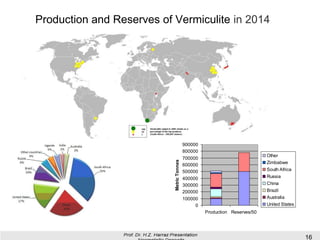
Production and Reserves of Vermiculite in 2014
Production and Reserves of
Vermiculite
0
100000
200000
300000
400000
500000
600000
700000
800000
900000
Production Reserves/50
MetricTonnes
Other
Zimbabwe
South Africa
Russia
China
Brazil
Australia
United States
16
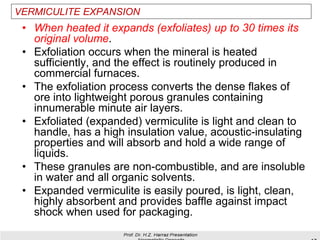
VERMICULITE EXPANSION
• When heated it expands (exfoliates) up to 30 times its
original volume.
• Exfoliation occurs when the mineral is heated
sufficiently, and the effect is routinely produced in
commercial furnaces.
• The exfoliation process converts the dense flakes of
ore into lightweight porous granules containing
innumerable minute air layers.
• Exfoliated (expanded) vermiculite is light and clean to
handle, has a high insulation value, acoustic-insulating
properties and will absorb and hold a wide range of
liquids.
• These granules are non-combustible, and are insoluble
in water and all organic solvents.
• Expanded vermiculite is easily poured, is light, clean,
highly absorbent and provides baffle against impact
shock when used for packaging.
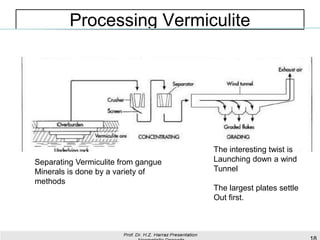
Processing Vermiculite
Separating Vermiculite from gangue
Minerals is done by a variety of
methods
The interesting twist is
Launching down a wind
Tunnel
The largest plates settle
Out first.
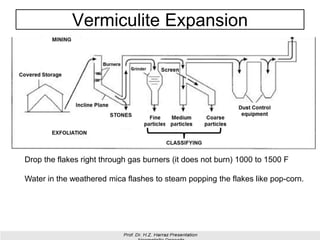
Vermiculite Expansion
Drop the flakes right through gas burners (it does not burn) 1000 to 1500 F
Water in the weathered mica flashes to steam popping the flakes like pop-corn.
19
TYPICAL PROPERTIES
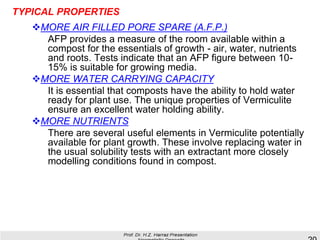
❖MORE AIR FILLED PORE SPARE (A.F.P.)
AFP provides a measure of the room available within a
compost for the essentials of growth - air, water, nutrients
and roots. Tests indicate that an AFP figure between 10-
15% is suitable for growing media.
❖MORE WATER CARRYING CAPACITY
It is essential that composts have the ability to hold water
ready for plant use. The unique properties of Vermiculite
ensure an excellent water holding ability.
❖MORE NUTRIENTS
There are several useful elements in Vermiculite potentially
available for plant growth. These involve replacing water in
the usual solubility tests with an extractant more closely
modelling conditions found in compost.
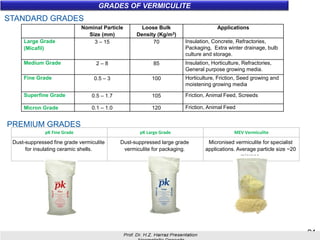
GRADES OF VERMICULITE
21
Nominal Particle
Size (mm)
Loose Bulk
Density (Kg/m3)
Applications
Large Grade
(Micafil)
3 – 15 70 Insulation, Concrete, Refractories,
Packaging, Extra winter drainage, bulb
culture and storage.
Medium Grade 2 – 8 85 Insulation, Horticulture, Refractories,
General purpose growing media.
Fine Grade 0.5 – 3 100 Horticulture, Friction, Seed growing and
moistening growing media
Superfine Grade 0.5 – 1.7 105 Friction, Animal Feed, Screeds
Micron Grade 0.1 – 1.0 120 Friction, Animal Feed
PREMIUM GRADES
pK Fine Grade pK Large Grade MEV Vermiculite
Dust-suppressed fine grade vermiculite
for insulating ceramic shells.
Dust-suppressed large grade
vermiculite for packaging.
Micronised vermiculite for specialist
applications. Average particle size ~20
microns.
STANDARD GRADES
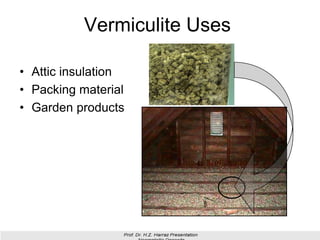
Vermiculite Uses
• Attic insulation
• Packing material
• Garden products
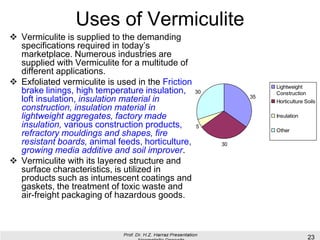
Uses of Vermiculite
23
Vermiculite Uses
35
30
5
30
Lightweight
Construction
Horticulture Soils
Insulation
Other
❖ Vermiculite is supplied to the demanding
specifications required in today’s
marketplace. Numerous industries are
supplied with Vermiculite for a multitude of
different applications.
❖ Exfoliated vermiculite is used in the Friction
brake linings, high temperature insulation,
loft insulation, insulation material in
construction, insulation material in
lightweight aggregates, factory made
insulation, various construction products,
refractory mouldings and shapes, fire
resistant boards, animal feeds, horticulture,
growing media additive and soil improver.
❖ Vermiculite with its layered structure and
surface characteristics, is utilized in
products such as intumescent coatings and
gaskets, the treatment of toxic waste and
air-freight packaging of hazardous goods.
24
25
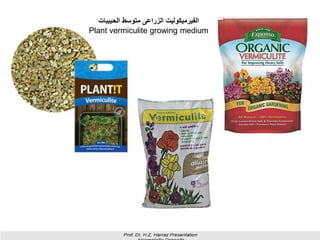
‫الحبيبات‬ ‫متوسط‬ ‫الزراعى‬ ‫الفيرميكوليت‬
Plant vermiculite growing medium
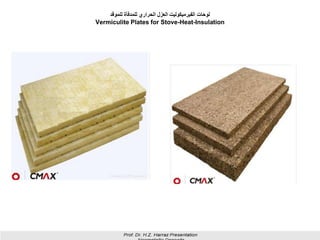
‫للموقد‬ ‫للمدفأة‬ ‫الحراري‬ ‫العزل‬ ‫الفيرميكوليت‬ ‫لوحات‬
Vermiculite Plates for Stove-Heat-Insulation
26
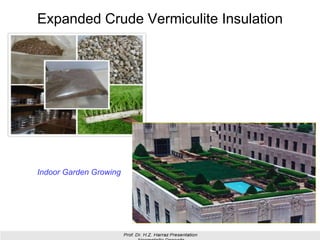
Expanded Crude Vermiculite Insulation
Indoor Garden Growing
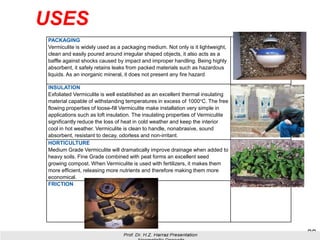
USES
28
PACKAGING
Vermiculite is widely used as a packaging medium. Not only is it lightweight,
clean and easily poured around irregular shaped objects, it also acts as a
baffle against shocks caused by impact and improper handling. Being highly
absorbent, it safely retains leaks from packed materials such as hazardous
liquids. As an inorganic mineral, it does not present any fire hazard
INSULATION
Exfoliated Vermiculite is well established as an excellent thermal insulating
material capable of withstanding temperatures in excess of 1000°C. The free
flowing properties of loose-fill Vermiculite make installation very simple in
applications such as loft insulation. The insulating properties of Vermiculite
significantly reduce the loss of heat in cold weather and keep the interior
cool in hot weather. Vermiculite is clean to handle, nonabrasive, sound
absorbent, resistant to decay, odorless and non-irritant.
HORTICULTURE
Medium Grade Vermiculite will dramatically improve drainage when added to
heavy soils. Fine Grade combined with peat forms an excellent seed
growing compost. When Vermiculite is used with fertilizers, it makes them
more efficient, releasing more nutrients and therefore making them more
economical.
FRICTION
Health Issues
• May be contaminated with amphibole
(tremolite) asbestos
• Health effects determined by degree of
amphibole exposure
References
• http://www.tdap.gov.pk/doc_reports/product_report_presentations.pdf
• http://www.nature.com/nature/journal/v207/n4994/abs/207283a0.html
• http://en.wikipedia.org/wiki/Talc
• http://www.mineralszone.com/minerals/talc.html
30

Vermiculite deposits

  • 1.
    Hassan Z. Harraz hharraz2006@yahoo.com 2017-2018 DOI: 10.13140/RG.2.2.24716.62080
  • 2.
    Outline • WHAT ISVERMICULITE? • TYPICAL vermiculite PROPERTIES; • GRADES OF VERMICULITE; • VERMICULITE EXPANSION; • Processing Vermiculite; • Vermiculite Expansion; • Production and Reserves of Vermiculite • Vermiculite occurrences in Gabal Hafafit area, Eastern Desert, Egypt; • Uses of Vermiculite 2
  • 3.
    ‫الفيرميكوليت‬ Vermiculite 43 (Mg,Fe,Al)3(Al,Si) 4O10(OH) 2·4H2O •Hardness 1½ - 2 • S.G. 2.3 - 2.7 • Color Brown, bronze-yellow ‫الخام‬ ‫الفيرميكوليت‬ (Crude Vermiculite)
  • 4.
    Vermiculite 4 VERMICULITE (also knownas Micafil) is exfoliated Minerals
  • 5.
    VERMICULITE WHAT IS VERMICULITE? ➢Vermiculiteis a hydrous phyllosilicate mineral ➢Vermiculite is the geological name given to a group of hydrated laminar minerals which are aluminium-iron-magnesium silicates, resembling mica in appearance. ➢Rock and other impurities are removed from the crude ore which is then crushed and sorted into sizes. ➢Vermiculite is a safe inert material and is light in colour. Physical Properties: Naturally occurring mineral ➢Expands when heated: When heated it expands (exfoliates) up to 30 times its original volume. ➢Light-weight ➢Fire-resistant ➢Absorbent ➢Odorless Structure ➢Vermiculite is a 2:1 clay, meaning it has 2 tetrahedral sheets for every one octahedral sheet. ➢It is a limited expansion clay with a medium shrink-swell capacity. ➢Vermiculite has a high cation exchange capacity (CEC) at 100-150 meq/100 g. ➢Vermiculite clays are weathered micas in which the potassium ions between the molecular sheets are replaced by magnesium and iron ions
  • 6.
    ‫الفيرميكوليت‬Vermiculite)) ❖‫للحرارة‬ ‫تعرضه‬ ‫عند‬‫يتمدد‬ ،‫طبيعي‬ ‫معدن‬ ‫هو‬. ❖‫التجارية‬ ‫األفران‬ ‫في‬ ‫وتطبق‬ ‫التقشير‬ ‫تسمى‬ ‫التمدد‬ ‫عملية‬. ❖‫وعد‬ ‫المتحدة‬ ‫والواليات‬ ‫والبرازيل‬ ‫والصين‬ ‫أفريقيا‬ ‫جنوب‬ ‫في‬ ‫للفيرميكليت‬ ‫كبيرة‬ ‫تجارية‬ ‫مناجم‬ ‫توجد‬‫أخرى‬ ‫بلدان‬ ‫ة‬. ❖‫الكيميائي‬ ‫التركيب‬:(Mg,Fe,Al)3(Al,Si) 4O10(OH) 2·4H2O ‫الفيرميكوليت‬ ‫خصائص‬: ❖‫الفطريات‬ ‫نمو‬ ‫على‬ ‫يساعد‬ ‫فال‬ ‫ِه‬‫ت‬‫بطبيع‬ ‫معقم‬ ‫الفيرميكوليت‬. ❖‫الوزن‬ ‫خفيف‬. ❖‫عالية‬ ‫بدرجة‬ ‫بالماء‬ ‫يحتفظ‬. ❖‫عالية‬ ‫تبادلية‬ ‫سعة‬ ‫ذو‬. ❖‫واالستفاد‬ ‫امتصاصها‬ ‫يمكن‬ ‫للنباتات‬ ‫ميسرة‬ ‫صورة‬ ‫في‬ ‫والبوتاسيوم‬ ‫الماغنسيوم‬ ْ‫عنصري‬ ‫على‬ ‫يحتوى‬‫منها‬ ‫ة‬. ❖‫الوقت‬ ‫معظم‬ ‫بالماء‬ ً‫ا‬‫محتفظ‬ ‫يظل‬ ‫الماء‬ ‫امتصاص‬ ‫على‬ ‫العالية‬ ‫لقدرته‬ ‫ونظرا‬ ‫الفيرميكوليت‬ ‫أن‬ ‫إلى‬ ‫ونشير‬‫يفضل‬ ‫لذلك‬ ، ‫النباتات‬ ‫لنمو‬ ‫مناسبة‬ ‫البيئة‬ ‫رطوبة‬ ‫تظل‬ ‫وحتى‬ ،‫العالية‬ ‫الرطوبة‬ ‫من‬ ‫للتقليل‬ ‫أخرى‬ ‫بمواد‬ ‫خلطه‬. ‫االستخدامات‬: ❖‫العامل‬‫بوصفه‬‫المانع‬‫الحرارة‬ ❖‫المياه‬‫غالية‬ ❖‫صناعة‬‫ورق‬‫الجدران‬ ❖‫التشحيم‬ ‫لزيوت‬ ‫ونتيجة‬ ❖‫تمتلك‬‫التبادل‬‫الكاتيوني‬‫جيدة‬‫جدا‬
  • 7.
    Production and Reservesof Vermiculite Occurrence ➢It typically occurs as an alteration product at the contact between felsic and mafic or ultramafic rocks such as pyroxenites and dunites. ➢It also occurs in carbonatites and metamorphosed magnesium rich limestone. ➢Associated mineral phases include: corundum, apatite, serpentine and talc. ➢It occurs interlayered with chlorite, biotite and phlogopite. ➢Vermiculite is formed by weathering or hydrothermal alteration of biotite or phlogopite. ➢Large commercial vermiculite mines currently exist in USA, South Africa, China, Russia, and Brazil.
  • 8.
    • The areaof Hafafit in the Eastern Desert of Egypt contains asbestos-vermiculite deposits at several sites, occurs in the magnesium-rich metapelitic schist- ultramafic complex (Harraz and Hamdy, 2010). 8 Simplified geologic map of Gabal Hafafit area, Eastern Desert, Egypt (after Greiling and El Ramly, 1984; Harraz and Hamdy, 2010)
  • 9.
    • Extensive metasomaticzones of vermiculite-, actinolite-, tremolite-, chlorite-, anthophyllite- and talc-rich rocks have been developed at the contacts of serpentinized ophiolites ultramafic bodies and surrounding mica gneisses in the Hafafit area. 9 Cross sections in the vermiculite pits at Hafafit area (after El Shazly et al., 1975; Harraz and Hamdy, 2010) )
  • 10.
    Table 1. MajorTypes and Subtypes of Vermiculite Occurrences in Serptntinites- Metapelitic schists of the Migif-Hafafit Massif, southern Eastern Desert, Egypt. For location of occurrences see Fig. 2 (Harraz and Hamdy, 2010) 10 Characteristic mineral associations Type 1. Vermiculite in leucogranitic pegmatite and pegmatite veins a) V. in reaction zones of leucogranitic pegmatite and pegmatites vein rocks anthophyllite, clinoamphiboles, chlorite (titanite; prehnite, fluorite, corundum; tourmaline) b) V. within leucogranitic pegmatite and pegmatite vein rocks chlorite (after clinoamphiboles) Type 2. Verraiculite in fractures; primary, formed by hydrothermal fluids a) V. in hydrothermal vein zones and fracture systems chlorites ± clinoamphiboles b) V. dispersed in hydrothermally altered serpentinite bodies Chlorites, hydrobiotite, altered minerals
  • 11.
    11 Type 1 Type 2 Vermiculitesamples from Hafafit area (after Harraz and Hamdy, 2010)
  • 12.
    12 Vermiculite samples fromHafafit area (after Harraz and Hamdy, 2010)
  • 13.
  • 14.
    Geologic setting ❖The mineralizedarea is occupied by granite gneiss with irregular masses of serpentinite as well as pegmatite veins and lenticels. The serpentinite bodies are usually not more than 300 m length and 150 m width and are generally of flattened lenticular shape with a roughly avoid cross section. They show certain conformity between their contacts and the direction of foliation of the gneiss. ❖Anthophyllite and vermiculate occur only where the serpentinite masses are cut by leucogranite (pegmatitic leucogranites). The amount and concentration of each of these two minerals vary from one site to another; some of them are big enough to mine. The field study of a number of the mineralized sites showed that they have the same mode of occurrence. They exhibit similar rock types, structural relations and disposition within the same geological framework. The main differences that could be observed between one site and another are related to the total amount and the relative abundance of the anthophyllite and vermiculate within the mineralized ultramafic mass. ❖The mineralized serpentinite mass ~200 x 100 m and lies in the northern closure of the domal structure. The pegmatite cut across the serpentinite mass in the form of dense stockwork of veinlets, the smaller veinlets net to form bigger one following the contact between the serpentinite mass and the enclosing gneiss. Generally, the pegmatites are composed essentially white feldspar, glassy quartz, few red garnet crystals and black mica pockets, streaks and sheaths, specially concentrated on the borders of the pegmatites. Within the gneiss, these pegmatites are relatively rich in quartz and contain fair amounts of garnets, where they cut across the serpentinite; they become quartz-free plagioclasite pegmatites with rare garnet and with abundant black mica. ❖Passing from the core of the serpentinite outwards towards the pegmatites, a sort of zoning due to variable mineral composition is usually recognizable and is roughly parallel to the pegmatite-serpentinite contact. 14
  • 15.
    Origin ❖The formation ofanthophyllite-vermiculite at Hafafit to bimetasomatic reactions between pegmatitic material and the ultramafic rocks, where alkalis and silica supplied by the pegmatites infiltrated the ultramafic mass, producing successive, almost monomineralic zones of vermiculite, actinolite, anthophyllite and talc away from the pegmatite intrusion (El-Shazly et al., 1975). ❖The relative abundance of silica determines the degree to which each of the anthophyllite or vermiculite zones are developed. Moreover, a process of bimetasomatism in situ, between the pegmatites and serpentinites, resulted in the formation of asbestiform anthophyllite on the expense of the ultramafic mass. ❖Pockets and streaks of black mica and vermiculite are usually developed in the border zone of the emplacing pegmatites and form an integral part of them. 15
  • 16.
    Production and Reservesof Vermiculite in 2014 Production and Reserves of Vermiculite 0 100000 200000 300000 400000 500000 600000 700000 800000 900000 Production Reserves/50 MetricTonnes Other Zimbabwe South Africa Russia China Brazil Australia United States 16
  • 17.
    VERMICULITE EXPANSION • Whenheated it expands (exfoliates) up to 30 times its original volume. • Exfoliation occurs when the mineral is heated sufficiently, and the effect is routinely produced in commercial furnaces. • The exfoliation process converts the dense flakes of ore into lightweight porous granules containing innumerable minute air layers. • Exfoliated (expanded) vermiculite is light and clean to handle, has a high insulation value, acoustic-insulating properties and will absorb and hold a wide range of liquids. • These granules are non-combustible, and are insoluble in water and all organic solvents. • Expanded vermiculite is easily poured, is light, clean, highly absorbent and provides baffle against impact shock when used for packaging.
  • 18.
    Processing Vermiculite Separating Vermiculitefrom gangue Minerals is done by a variety of methods The interesting twist is Launching down a wind Tunnel The largest plates settle Out first.
  • 19.
    Vermiculite Expansion Drop theflakes right through gas burners (it does not burn) 1000 to 1500 F Water in the weathered mica flashes to steam popping the flakes like pop-corn. 19
  • 20.
    TYPICAL PROPERTIES ❖MORE AIRFILLED PORE SPARE (A.F.P.) AFP provides a measure of the room available within a compost for the essentials of growth - air, water, nutrients and roots. Tests indicate that an AFP figure between 10- 15% is suitable for growing media. ❖MORE WATER CARRYING CAPACITY It is essential that composts have the ability to hold water ready for plant use. The unique properties of Vermiculite ensure an excellent water holding ability. ❖MORE NUTRIENTS There are several useful elements in Vermiculite potentially available for plant growth. These involve replacing water in the usual solubility tests with an extractant more closely modelling conditions found in compost.
  • 21.
    GRADES OF VERMICULITE 21 NominalParticle Size (mm) Loose Bulk Density (Kg/m3) Applications Large Grade (Micafil) 3 – 15 70 Insulation, Concrete, Refractories, Packaging, Extra winter drainage, bulb culture and storage. Medium Grade 2 – 8 85 Insulation, Horticulture, Refractories, General purpose growing media. Fine Grade 0.5 – 3 100 Horticulture, Friction, Seed growing and moistening growing media Superfine Grade 0.5 – 1.7 105 Friction, Animal Feed, Screeds Micron Grade 0.1 – 1.0 120 Friction, Animal Feed PREMIUM GRADES pK Fine Grade pK Large Grade MEV Vermiculite Dust-suppressed fine grade vermiculite for insulating ceramic shells. Dust-suppressed large grade vermiculite for packaging. Micronised vermiculite for specialist applications. Average particle size ~20 microns. STANDARD GRADES
  • 22.
    Vermiculite Uses • Atticinsulation • Packing material • Garden products
  • 23.
    Uses of Vermiculite 23 VermiculiteUses 35 30 5 30 Lightweight Construction Horticulture Soils Insulation Other ❖ Vermiculite is supplied to the demanding specifications required in today’s marketplace. Numerous industries are supplied with Vermiculite for a multitude of different applications. ❖ Exfoliated vermiculite is used in the Friction brake linings, high temperature insulation, loft insulation, insulation material in construction, insulation material in lightweight aggregates, factory made insulation, various construction products, refractory mouldings and shapes, fire resistant boards, animal feeds, horticulture, growing media additive and soil improver. ❖ Vermiculite with its layered structure and surface characteristics, is utilized in products such as intumescent coatings and gaskets, the treatment of toxic waste and air-freight packaging of hazardous goods.
  • 24.
  • 25.
    25 ‫الحبيبات‬ ‫متوسط‬ ‫الزراعى‬‫الفيرميكوليت‬ Plant vermiculite growing medium
  • 26.
    ‫للموقد‬ ‫للمدفأة‬ ‫الحراري‬‫العزل‬ ‫الفيرميكوليت‬ ‫لوحات‬ Vermiculite Plates for Stove-Heat-Insulation 26
  • 27.
    Expanded Crude VermiculiteInsulation Indoor Garden Growing
  • 28.
    USES 28 PACKAGING Vermiculite is widelyused as a packaging medium. Not only is it lightweight, clean and easily poured around irregular shaped objects, it also acts as a baffle against shocks caused by impact and improper handling. Being highly absorbent, it safely retains leaks from packed materials such as hazardous liquids. As an inorganic mineral, it does not present any fire hazard INSULATION Exfoliated Vermiculite is well established as an excellent thermal insulating material capable of withstanding temperatures in excess of 1000°C. The free flowing properties of loose-fill Vermiculite make installation very simple in applications such as loft insulation. The insulating properties of Vermiculite significantly reduce the loss of heat in cold weather and keep the interior cool in hot weather. Vermiculite is clean to handle, nonabrasive, sound absorbent, resistant to decay, odorless and non-irritant. HORTICULTURE Medium Grade Vermiculite will dramatically improve drainage when added to heavy soils. Fine Grade combined with peat forms an excellent seed growing compost. When Vermiculite is used with fertilizers, it makes them more efficient, releasing more nutrients and therefore making them more economical. FRICTION
  • 29.
    Health Issues • Maybe contaminated with amphibole (tremolite) asbestos • Health effects determined by degree of amphibole exposure
  • 30.