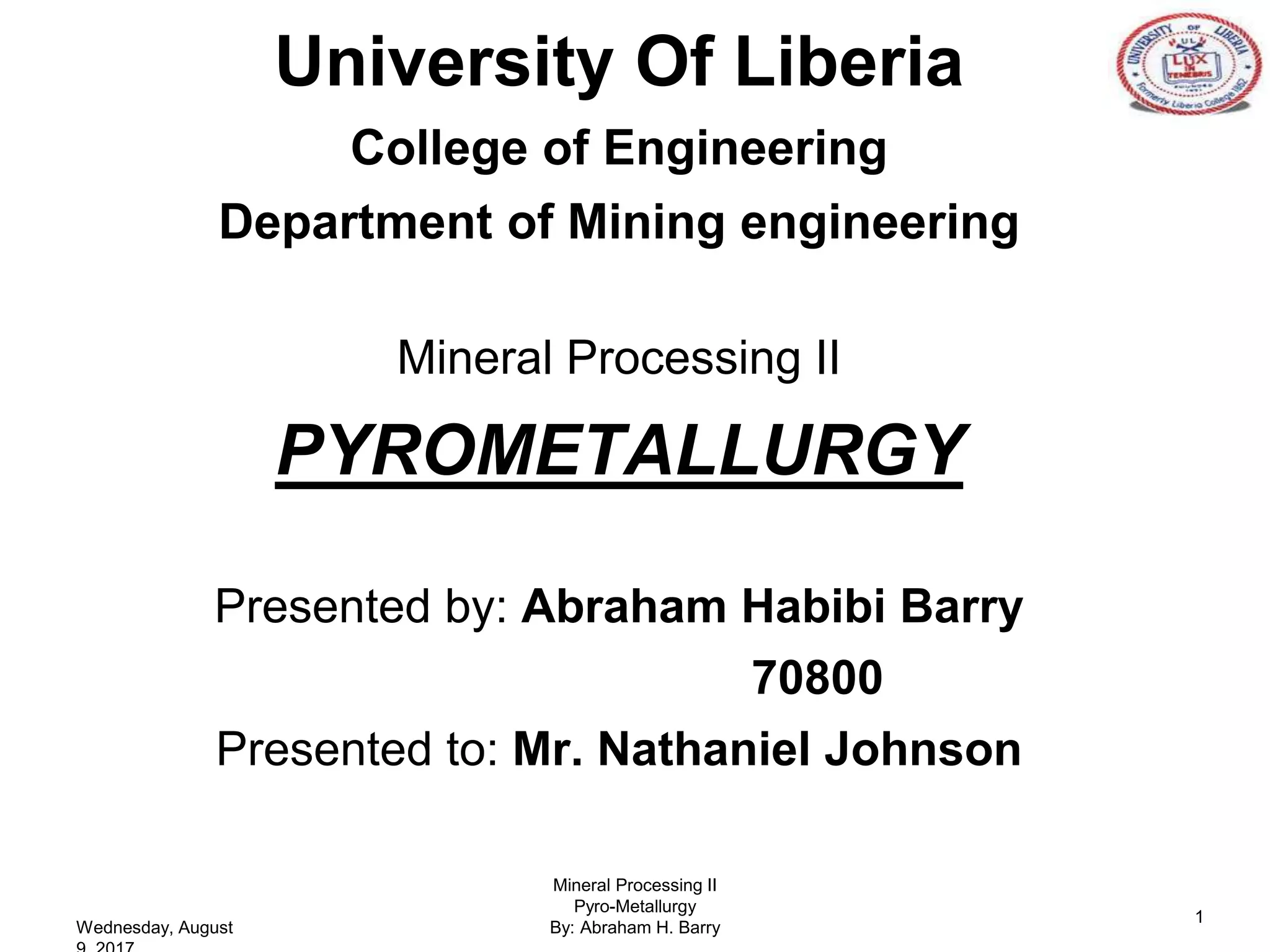
University Of Liberia
College of Engineering
Department of Mining engineering
Mineral Processing II
PYROMETALLURGY
Presented by: Abraham Habibi Barry
70800
Presented to: Mr. Nathaniel Johnson
Wednesday, August
Mineral Processing II
Pyro-Metallurgy
By: Abraham H. Barry
1
Pyrometallurgy
 Presentation Content:
 What Is Pyrometallurgy
 Processes Of Pyrometallurgy
 Calcination
 Roasting
 Smelting
 Refining
 Furnaces used in Pyrometallurgy
 Conclusion
 References
 Q & A
Wednesday, August
Mineral Processing II
Pyro-Metallurgy
By: Abraham H. Barry
2
Pyrometallurgy
 What Is Pyrometallurgy?
 It is a branch of Extractive Metallurgy
 It Uses Thermal Energy to achieve separation
 Its products may be:
 Pure Metal
 Intermediate Compound
 Alloys
Mineral Processing II
Pyro-Metallurgy
By: Abraham H. Barry
3
Wednesday, August
Pyrometallurgy
 Processes Of Pyrometallurgy:
Calcination
 A thermal treatment process done sometimes in the absence of
oxygen
 Calcining Causes:
 Thermal decomposition
 Phase transition
 Removal of a volatile fraction
 The calcination process normally takes place at temperatures below
the melting point of the product materials.
 Used mostly for Carbonate Ores.
Mineral Processing II
Pyro-Metallurgy
By: Abraham H. Barry
4
Wednesday, August
Pyrometallurgy
Processes Of Pyrometallurgy:
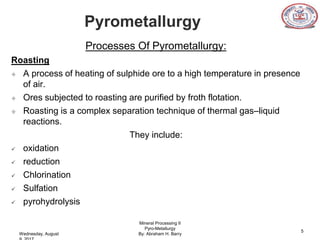
Roasting
 A process of heating of sulphide ore to a high temperature in presence
of air.
 Ores subjected to roasting are purified by froth flotation.
 Roasting is a complex separation technique of thermal gas–liquid
reactions.
They include:
 oxidation
 reduction
 Chlorination
 Sulfation
 pyrohydrolysis
Mineral Processing II
Pyro-Metallurgy
By: Abraham H. Barry
5
Wednesday, August
Pyrometallurgy
Types of Roasting:
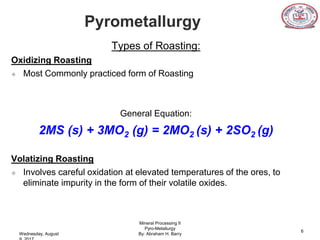
Oxidizing Roasting
 Most Commonly practiced form of Roasting
General Equation:
2MS (s) + 3MO2 (g) = 2MO2 (s) + 2SO2 (g)
Volatizing Roasting
 Involves careful oxidation at elevated temperatures of the ores, to
eliminate impurity in the form of their volatile oxides.
Mineral Processing II
Pyro-Metallurgy
By: Abraham H. Barry
6
Wednesday, August
Pyrometallurgy
Types of Roasting:
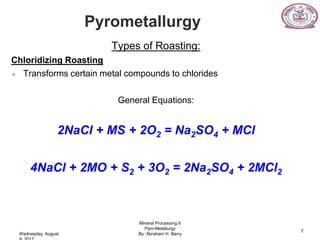
Chloridizing Roasting
 Transforms certain metal compounds to chlorides
General Equations:
2NaCl + MS + 2O2 = Na2SO4 + MCl
4NaCl + 2MO + S2 + 3O2 = 2Na2SO4 + 2MCl2
Mineral Processing II
Pyro-Metallurgy
By: Abraham H. Barry
7
Wednesday, August
Pyrometallurgy
Types of Roasting:
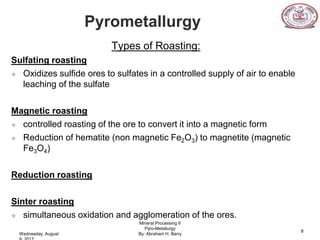
Sulfating roasting
 Oxidizes sulfide ores to sulfates in a controlled supply of air to enable
leaching of the sulfate
Magnetic roasting
 controlled roasting of the ore to convert it into a magnetic form
 Reduction of hematite (non magnetic Fe2O3) to magnetite (magnetic
Fe3O4)
Reduction roasting
Sinter roasting
 simultaneous oxidation and agglomeration of the ores.
Mineral Processing II
Pyro-Metallurgy
By: Abraham H. Barry
8
Wednesday, August
Pyrometallurgy
Processes Of Pyrometallurgy:
Smelting
 process by which a metal is obtained, either as the element or as a
simple compound by heating beyond the melting point.
 Smelting is done in the presence of:
 Oxidizing agents = Air
 Reducing agents = Coke
Mineral Processing II
Pyro-Metallurgy
By: Abraham H. Barry
9
Wednesday, August
Pyrometallurgy
 Processes Of Pyrometallurgy:
Refining
 Purification of an impure metal.
 Different from smelting and calcining in that:
 They involve a chemical change to the raw material, while in refining,
the final material is usually identical chemically to the original one,
only it is purer.
Mineral Processing II
Pyro-Metallurgy
By: Abraham H. Barry
10
Wednesday, August
Pyrometallurgy
 Types of Furnaces:
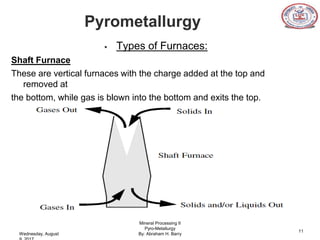
Shaft Furnace
These are vertical furnaces with the charge added at the top and
removed at
the bottom, while gas is blown into the bottom and exits the top.
Mineral Processing II
Pyro-Metallurgy
By: Abraham H. Barry
11
Wednesday, August
Pyrometallurgy
 Types of Furnaces:
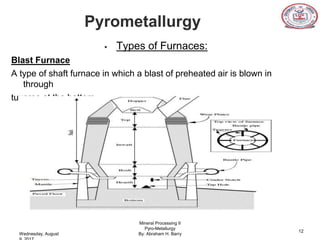
Blast Furnace
A type of shaft furnace in which a blast of preheated air is blown in
through
tuyeres at the bottom.
Mineral Processing II
Pyro-Metallurgy
By: Abraham H. Barry
12
Wednesday, August
Pyrometallurgy
Types of Furnaces:
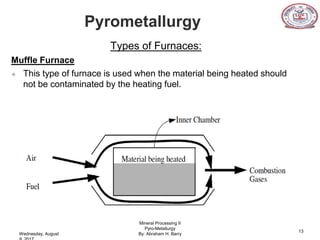
Muffle Furnace
 This type of furnace is used when the material being heated should
not be contaminated by the heating fuel.
Mineral Processing II
Pyro-Metallurgy
By: Abraham H. Barry
13
Wednesday, August
Pyrometallurgy
 Types of Furnaces
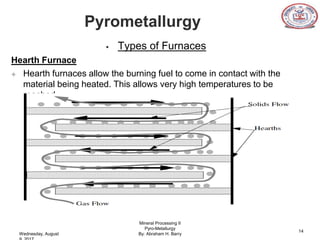
Hearth Furnace
 Hearth furnaces allow the burning fuel to come in contact with the
material being heated. This allows very high temperatures to be
reached
Mineral Processing II
Pyro-Metallurgy
By: Abraham H. Barry
14
Wednesday, August
Pyrometallurgy
 Conclusion:
 Pyrometallurgy was one of the primary method of separation
discovered.
 Uses the thermodynamic properties of ores to drive chemical and
physical reactions.
 It consumes tremendous amount of energy.
 Causes pollution if not managed extremely carefully.
 Pyrometallurgy is useful in metal separation and alloy production.
Mineral Processing II
Pyro-Metallurgy
By: Abraham H. Barry
15
Wednesday, August
Pyrometallurgy
References:
1. H S Ray, R Sridhar and K.P Abraham; extraction of non ferrous
metals.
2. Pyrometallurgy basics, assessed athttp://www.carbolite-
gero.com/applications/heating-applications calcination/ on July 23,
2017.
3. Primary Metal Production assessed at http://www.chem.mtu.edu/
chem_eng/faculty/kawatra/CM2200_Primary_Metals on July 23,
2017.
Mineral Processing II
Pyro-Metallurgy
By: Abraham H. Barry
16
Wednesday, August
Pyrometallurgy
Mineral Processing II
Pyro-Metallurgy
By: Abraham H. Barry
17
Wednesday, August
Pyrometallurgy
Mineral Processing II
Pyro-Metallurgy
By: Abraham H. Barry
18
Wednesday, August

Mineral Processing (Pyrometallurgy)

  • 1.
    University Of Liberia Collegeof Engineering Department of Mining engineering Mineral Processing II PYROMETALLURGY Presented by: Abraham Habibi Barry 70800 Presented to: Mr. Nathaniel Johnson Wednesday, August Mineral Processing II Pyro-Metallurgy By: Abraham H. Barry 1
  • 2.
    Pyrometallurgy  Presentation Content: What Is Pyrometallurgy  Processes Of Pyrometallurgy  Calcination  Roasting  Smelting  Refining  Furnaces used in Pyrometallurgy  Conclusion  References  Q & A Wednesday, August Mineral Processing II Pyro-Metallurgy By: Abraham H. Barry 2
  • 3.
    Pyrometallurgy  What IsPyrometallurgy?  It is a branch of Extractive Metallurgy  It Uses Thermal Energy to achieve separation  Its products may be:  Pure Metal  Intermediate Compound  Alloys Mineral Processing II Pyro-Metallurgy By: Abraham H. Barry 3 Wednesday, August
  • 4.
    Pyrometallurgy  Processes OfPyrometallurgy: Calcination  A thermal treatment process done sometimes in the absence of oxygen  Calcining Causes:  Thermal decomposition  Phase transition  Removal of a volatile fraction  The calcination process normally takes place at temperatures below the melting point of the product materials.  Used mostly for Carbonate Ores. Mineral Processing II Pyro-Metallurgy By: Abraham H. Barry 4 Wednesday, August
  • 5.
    Pyrometallurgy Processes Of Pyrometallurgy: Roasting A process of heating of sulphide ore to a high temperature in presence of air.  Ores subjected to roasting are purified by froth flotation.  Roasting is a complex separation technique of thermal gas–liquid reactions. They include:  oxidation  reduction  Chlorination  Sulfation  pyrohydrolysis Mineral Processing II Pyro-Metallurgy By: Abraham H. Barry 5 Wednesday, August
  • 6.
    Pyrometallurgy Types of Roasting: OxidizingRoasting  Most Commonly practiced form of Roasting General Equation: 2MS (s) + 3MO2 (g) = 2MO2 (s) + 2SO2 (g) Volatizing Roasting  Involves careful oxidation at elevated temperatures of the ores, to eliminate impurity in the form of their volatile oxides. Mineral Processing II Pyro-Metallurgy By: Abraham H. Barry 6 Wednesday, August
  • 7.
    Pyrometallurgy Types of Roasting: ChloridizingRoasting  Transforms certain metal compounds to chlorides General Equations: 2NaCl + MS + 2O2 = Na2SO4 + MCl 4NaCl + 2MO + S2 + 3O2 = 2Na2SO4 + 2MCl2 Mineral Processing II Pyro-Metallurgy By: Abraham H. Barry 7 Wednesday, August
  • 8.
    Pyrometallurgy Types of Roasting: Sulfatingroasting  Oxidizes sulfide ores to sulfates in a controlled supply of air to enable leaching of the sulfate Magnetic roasting  controlled roasting of the ore to convert it into a magnetic form  Reduction of hematite (non magnetic Fe2O3) to magnetite (magnetic Fe3O4) Reduction roasting Sinter roasting  simultaneous oxidation and agglomeration of the ores. Mineral Processing II Pyro-Metallurgy By: Abraham H. Barry 8 Wednesday, August
  • 9.
    Pyrometallurgy Processes Of Pyrometallurgy: Smelting process by which a metal is obtained, either as the element or as a simple compound by heating beyond the melting point.  Smelting is done in the presence of:  Oxidizing agents = Air  Reducing agents = Coke Mineral Processing II Pyro-Metallurgy By: Abraham H. Barry 9 Wednesday, August
  • 10.
    Pyrometallurgy  Processes OfPyrometallurgy: Refining  Purification of an impure metal.  Different from smelting and calcining in that:  They involve a chemical change to the raw material, while in refining, the final material is usually identical chemically to the original one, only it is purer. Mineral Processing II Pyro-Metallurgy By: Abraham H. Barry 10 Wednesday, August
  • 11.
    Pyrometallurgy  Types ofFurnaces: Shaft Furnace These are vertical furnaces with the charge added at the top and removed at the bottom, while gas is blown into the bottom and exits the top. Mineral Processing II Pyro-Metallurgy By: Abraham H. Barry 11 Wednesday, August
  • 12.
    Pyrometallurgy  Types ofFurnaces: Blast Furnace A type of shaft furnace in which a blast of preheated air is blown in through tuyeres at the bottom. Mineral Processing II Pyro-Metallurgy By: Abraham H. Barry 12 Wednesday, August
  • 13.
    Pyrometallurgy Types of Furnaces: MuffleFurnace  This type of furnace is used when the material being heated should not be contaminated by the heating fuel. Mineral Processing II Pyro-Metallurgy By: Abraham H. Barry 13 Wednesday, August
  • 14.
    Pyrometallurgy  Types ofFurnaces Hearth Furnace  Hearth furnaces allow the burning fuel to come in contact with the material being heated. This allows very high temperatures to be reached Mineral Processing II Pyro-Metallurgy By: Abraham H. Barry 14 Wednesday, August
  • 15.
    Pyrometallurgy  Conclusion:  Pyrometallurgywas one of the primary method of separation discovered.  Uses the thermodynamic properties of ores to drive chemical and physical reactions.  It consumes tremendous amount of energy.  Causes pollution if not managed extremely carefully.  Pyrometallurgy is useful in metal separation and alloy production. Mineral Processing II Pyro-Metallurgy By: Abraham H. Barry 15 Wednesday, August
  • 16.
    Pyrometallurgy References: 1. H SRay, R Sridhar and K.P Abraham; extraction of non ferrous metals. 2. Pyrometallurgy basics, assessed athttp://www.carbolite- gero.com/applications/heating-applications calcination/ on July 23, 2017. 3. Primary Metal Production assessed at http://www.chem.mtu.edu/ chem_eng/faculty/kawatra/CM2200_Primary_Metals on July 23, 2017. Mineral Processing II Pyro-Metallurgy By: Abraham H. Barry 16 Wednesday, August
  • 17.
    Pyrometallurgy Mineral Processing II Pyro-Metallurgy By:Abraham H. Barry 17 Wednesday, August
  • 18.
    Pyrometallurgy Mineral Processing II Pyro-Metallurgy By:Abraham H. Barry 18 Wednesday, August