Seismic waves
Seismic waves
• Seismic waves are the waves of energy caused
by the sudden breaking of rock within the
earth or an explosion.
• Response of material to the arrival of energy
fronts released by rupture.
• Energy that travels through the earth and is
recorded on seismographs.
Seismic waves defined by:
• Where they move –Earth’s interior vs. Surface
• How they move –vertically vs. Horizontally
• How fast they move –meters per second
Types of Seismic Waves
• There are several different kinds of seismic waves,
and they all move in different ways.
– Body waves
– Surface waves.
• Body waves can travel through the earth's inner
layers, but surface waves can only move along the
surfaces like ripples on water.
• Earthquakes radiate seismic energy as both body
and surface waves.
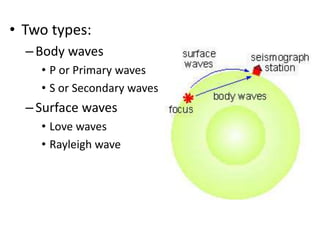
• Two types:
–Body waves
• P or Primary waves
• S or Secondary waves
–Surface waves
• Love waves
• Rayleigh wave
Body Waves
• Travelling through the interior of the
earth, body waves arrive before the surface
waves emitted by an earthquake.
• These waves are of a higher frequency than
surface waves.
P or Primary waves
• The first kind of body wave is P wave or primary
wave.
• This is the fastest kind of seismic wave, and,
consequently, the first to arrive at a seismic
station.
• P wave can move through solid rock and fluids,
like water or the liquid layers of the earth.
• It pushes and pulls the rock it moves through just
like sound waves push and pull the air.
• P waves are also known as compressional
waves, because of the pushing and pulling
they do.
• Subjected to a P wave, particles move in the
same direction that the wave is moving in,
which is the direction that the energy is
travelling in, and is called the direction of
wave propagation.
S or Secondary waves
• The second type of body wave is the S
wave or secondary wave, which is the second
wave you feel in an earthquake.
• S wave is slower than a P wave and can only
move through solid rock, not through any liquid
medium.
• It is this property of S waves that led
seismologists to conclude that the Earth's outer
core is a liquid.
• S waves move rock particles up and down,
perpendicular to the direction that the wave is
travelling in (the direction of wave propagation).
SURFACE WAVES
• Travelling through the crust, surface waves are of
a lower frequency than body waves, and are
easily distinguished on a seismogram as a result.
• Though they arrive after body waves, it is surface
waves that are almost enitrely responsible for the
damage and destruction associated with
earthquakes.
• This damage and the strength of the surface
waves are reduced in deeper earthquakes.
LOVE WAVES
• The first kind of surface wave is called a Love
wave, named after A.E.H. Love, a British
mathematician who worked out the
mathematical model for this kind of wave in
1911.
• It's the fastest surface wave and moves the
ground from side-to-side.
• Confined to the surface of the crust, Love
waves produce entirely horizontal motion.
RAYLEIGH WAVES
• The other kind of surface wave is the Rayleigh
wave, named for John William Strutt, Lord
Rayleigh, who mathematically predicted the
existence of this kind of wave in 1885.
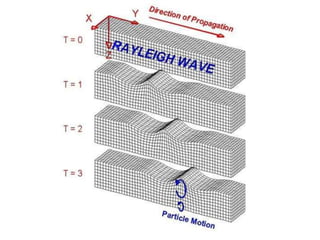
• A Rayleigh wave rolls along the ground just like a
wave rolls across a lake or an ocean. Because it
rolls, it moves the ground up and down, and side-
to-side in the same direction that the wave is
moving.
• Most of the shaking felt from an earthquake is
due to the Rayleigh wave, which can be much
larger than the other waves.
Seismic waves

Seismic waves

  • 1.
  • 2.
    Seismic waves • Seismicwaves are the waves of energy caused by the sudden breaking of rock within the earth or an explosion. • Response of material to the arrival of energy fronts released by rupture. • Energy that travels through the earth and is recorded on seismographs.
  • 3.
    Seismic waves definedby: • Where they move –Earth’s interior vs. Surface • How they move –vertically vs. Horizontally • How fast they move –meters per second
  • 4.
    Types of SeismicWaves • There are several different kinds of seismic waves, and they all move in different ways. – Body waves – Surface waves. • Body waves can travel through the earth's inner layers, but surface waves can only move along the surfaces like ripples on water. • Earthquakes radiate seismic energy as both body and surface waves.
  • 5.
    • Two types: –Bodywaves • P or Primary waves • S or Secondary waves –Surface waves • Love waves • Rayleigh wave
  • 6.
    Body Waves • Travellingthrough the interior of the earth, body waves arrive before the surface waves emitted by an earthquake. • These waves are of a higher frequency than surface waves.
  • 7.
    P or Primarywaves • The first kind of body wave is P wave or primary wave. • This is the fastest kind of seismic wave, and, consequently, the first to arrive at a seismic station. • P wave can move through solid rock and fluids, like water or the liquid layers of the earth. • It pushes and pulls the rock it moves through just like sound waves push and pull the air.
  • 8.
    • P wavesare also known as compressional waves, because of the pushing and pulling they do. • Subjected to a P wave, particles move in the same direction that the wave is moving in, which is the direction that the energy is travelling in, and is called the direction of wave propagation.
  • 10.
    S or Secondarywaves • The second type of body wave is the S wave or secondary wave, which is the second wave you feel in an earthquake. • S wave is slower than a P wave and can only move through solid rock, not through any liquid medium. • It is this property of S waves that led seismologists to conclude that the Earth's outer core is a liquid. • S waves move rock particles up and down, perpendicular to the direction that the wave is travelling in (the direction of wave propagation).
  • 12.
    SURFACE WAVES • Travellingthrough the crust, surface waves are of a lower frequency than body waves, and are easily distinguished on a seismogram as a result. • Though they arrive after body waves, it is surface waves that are almost enitrely responsible for the damage and destruction associated with earthquakes. • This damage and the strength of the surface waves are reduced in deeper earthquakes.
  • 13.
    LOVE WAVES • Thefirst kind of surface wave is called a Love wave, named after A.E.H. Love, a British mathematician who worked out the mathematical model for this kind of wave in 1911. • It's the fastest surface wave and moves the ground from side-to-side. • Confined to the surface of the crust, Love waves produce entirely horizontal motion.
  • 15.
    RAYLEIGH WAVES • Theother kind of surface wave is the Rayleigh wave, named for John William Strutt, Lord Rayleigh, who mathematically predicted the existence of this kind of wave in 1885. • A Rayleigh wave rolls along the ground just like a wave rolls across a lake or an ocean. Because it rolls, it moves the ground up and down, and side- to-side in the same direction that the wave is moving. • Most of the shaking felt from an earthquake is due to the Rayleigh wave, which can be much larger than the other waves.