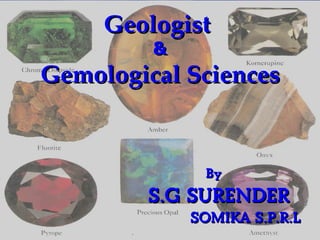
Geologist
                &
Gemological Sciences


                                 By
              S.G SURENDER
                             SOMIKA S.P.R.L
       sgs_sena@rediffmail.com
Resources are not; they become.
                                   --- E.S Zimmerman


 “A proper appreciation of mineral
resources may be the greatest service
 we as geologist can perform for our
        society and country”.
                                          ---E.L Chile.
             sgs_sena@rediffmail.com
Introduction
 Nearly 4000+ varieties of minerals are identified in
  nature; only a few are referred as gem minerals
  due to their exceptional qualities and properties.

 Gems have been a part of human history for more
  than 5000 years. Throughout the ages gemstones
  have been seen as representations of wealth, power
  and symbols of supremacy.

 Gem minerals are usually hard and relatively free
  from cleavage and occur as transparent crystals, with
  few exception such as opal, fluorite etc.,

 Thus gemstones are artificially polished fragments
  (faceted or with smooth curved finish) that are used
  for decorative purposes and personal adornment.
                      sgs_sena@rediffmail.com
 The study of gemstones is an accepted part of
 Mineralogy .

 A gem is a naturally occurring material
 desirable for its beauty, valuable in its
 rarity, and sufficiently durable to give
 lasting pleasure.

 Gemology- is the subject matter the
 scientific study of gemstones (from its
 genesis to valuation).

 Lapidary – is the science of cutting and
 polishing a gem mineral.
                 sgs_sena@rediffmail.com
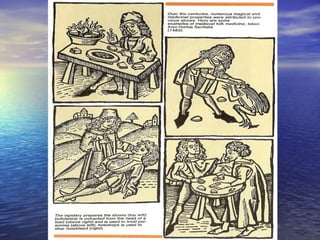
 Over the centuries numerous magical and
    medicinal properties were attributed to precious
    stones.

   In Ayurveda (Indian System of Medicine)
   Audbhida-Extract form Plants,
   Jangama-Extract from Animals
   Parthiva-Extract from Metals and Minerals

Different types of BHASMA such as Hirka Bhasma
    (Diamond), Manikya Bhasma (Ruby), Swarna
    Bhasma (Gold), Abhraka Bhasma (Mica) etc. were
    prepared from metals and minerals to cure variety
    of diseases.
                   sgs_sena@rediffmail.com
sgs_sena@rediffmail.com
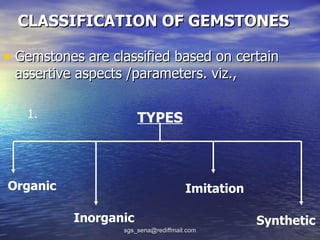
CLASSIFICATION OF GEMSTONES

• Gemstones are classified based on certain
 assertive aspects /parameters. viz.,

   1.                 TYPES


Organic                              Imitation

          Inorganic                              Synthetic
                  sgs_sena@rediffmail.com
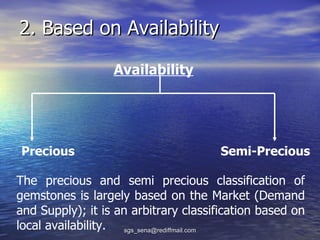
2. Based on Availability

                  Availability


Precious                              Semi-Precious

The precious and semi precious classification of
gemstones is largely based on the Market (Demand
and Supply); it is an arbitrary classification based on
local availability. sgs_sena@rediffmail.com
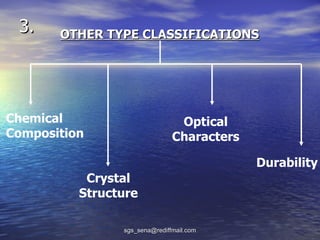
3.    OTHER TYPE CLASSIFICATIONS


Chemical                        Optical
Composition                    Characters

                                            Durability
           Crystal
          Structure

                sgs_sena@rediffmail.com
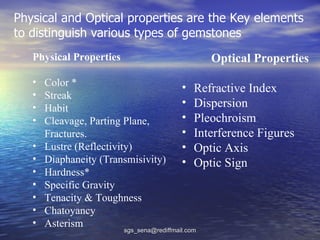
Physical and Optical properties are the Key elements
to distinguish various types of gemstones
   Physical Properties                             Optical Properties
   •   Color *                             •   Refractive Index
   •   Streak
   •   Habit
                                           •   Dispersion
   •   Cleavage, Parting Plane,            •   Pleochroism
       Fractures.                          •   Interference Figures
   •   Lustre (Reflectivity)               •   Optic Axis
   •   Diaphaneity (Transmisivity)         •   Optic Sign
   •   Hardness*
   •   Specific Gravity
   •   Tenacity & Toughness
   •   Chatoyancy
   •   Asterism
                         sgs_sena@rediffmail.com
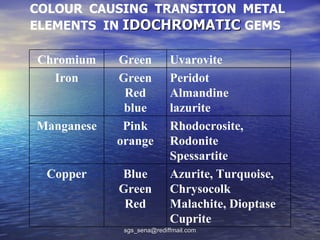
COLOUR CAUSING TRANSITION METAL
ELEMENTS IN IDOCHROMATIC GEMS

Chromium    Green          Uvarovite
  Iron      Green          Peridot
             Red           Almandine
             blue          lazurite
Manganese    Pink          Rhodocrosite,
            orange         Rodonite
                           Spessartite
  Copper    Blue           Azurite, Turquoise,
            Green          Chrysocolk
             Red           Malachite, Dioptase
                           Cuprite
             sgs_sena@rediffmail.com
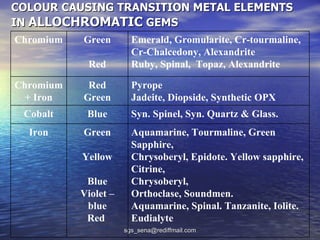
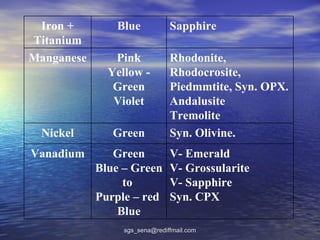
COLOUR CAUSING TRANSITION METAL ELEMENTS
IN ALLOCHROMATIC GEMS
Chromium   Green        Emerald, Gromularite, Cr-tourmaline,
                        Cr-Chalcedony, Alexandrite
            Red         Ruby, Spinal, Topaz, Alexandrite

Chromium    Red         Pyrope
  + Iron   Green        Jadeite, Diopside, Synthetic OPX

 Cobalt     Blue        Syn. Spinel, Syn. Quartz & Glass.
  Iron     Green        Aquamarine, Tourmaline, Green
                        Sapphire,
           Yellow       Chrysoberyl, Epidote. Yellow sapphire,
                        Citrine,
            Blue        Chrysoberyl,
           Violet –     Orthoclase, Soundmen.
            blue        Aquamarine, Spinal. Tanzanite, Iolite.
            Red         Eudialyte
                      sgs_sena@rediffmail.com
Iron +        Blue            Sapphire
Titanium
Manganese      Pink            Rhodonite,
              Yellow -         Rhodocrosite,
               Green           Piedmmtite, Syn. OPX.
               Violet          Andalusite
                               Tremolite
 Nickel        Green           Syn. Olivine.
Vanadium       Green           V- Emerald
            Blue – Green       V- Grossularite
                 to            V- Sapphire
            Purple – red       Syn. CPX
                Blue
                 sgs_sena@rediffmail.com
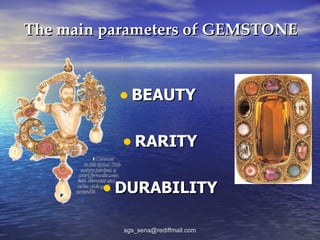
The main parameters of GEMSTONE


          • BEAUTY

           • RARITY

        • DURABILITY
           sgs_sena@rediffmail.com
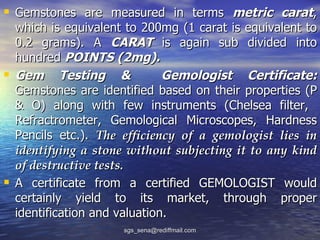
 Gemstones are measured in terms metric carat,
    which is equivalent to 200mg (1 carat is equivalent to
    0.2 grams). A CARAT is again sub divided into
    hundred POINTS (2mg).
   Gem Testing &               Gemologist Certificate:
    Gemstones are identified based on their properties (P
    & O) along with few instruments (Chelsea filter,
    Refractrometer, Gemological Microscopes, Hardness
    Pencils etc.). The efficiency of a gemologist lies in
    identifying a stone without subjecting it to any kind
    of destructive tests.
   A certificate from a certified GEMOLOGIST would
    certainly yield to its market, through proper
    identification and valuation.
                       sgs_sena@rediffmail.com
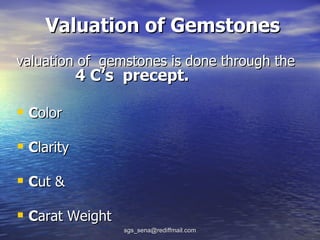
Valuation of Gemstones
valuation of gemstones is done through the
            4 C’s precept.

 Color

 Clarity

 Cut &

 Carat Weight
                 sgs_sena@rediffmail.com
EXPLORATION
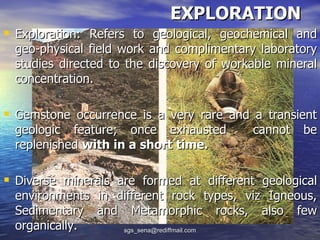
 Exploration: Refers to geological, geochemical and
  geo-physical field work and complimentary laboratory
  studies directed to the discovery of workable mineral
  concentration.

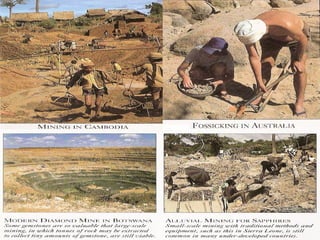
 Gemstone occurrence is a very rare and a transient
  geologic feature; once exhausted         cannot   be
  replenished with in a short time.

 Diverse minerals are formed at different geological
  environments in different rock types, viz Igneous,
  Sedimentary and Metamorphic rocks, also few
  organically.     sgs_sena@rediffmail.com
For Example:
 Diamonds in Kimberlites (Ultra-mafic HTHP)

 Beryl in Pegmatites

 Quartz in Felsic rocks

 Peridot in Ultra mafic rocks

 Garnets in Metamorphic Rocks
                   sgs_sena@rediffmail.com
sgs_sena@rediffmail.com
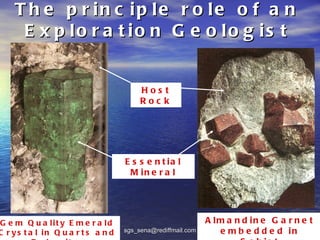
T h e p r in c ip le r o le o f a n
     E x p lo r a t io n G e o lo g is t


                                          Hos t
                                          Roc k


                                     E s s e n t ia l
                                      M in e r a l


G e m Q u a lit y E m e r a ld                                 A lm a n d in e G a r n e t
C r y s t a l in Q u a r t s a n d   sgs_sena@rediffmail.com      e m b e d d e d in
BERYL
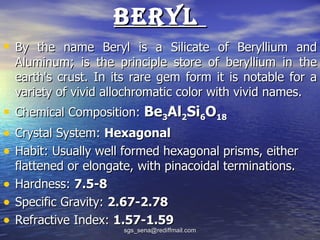
 By the name Beryl is a Silicate of Beryllium and
    Aluminum; is the principle store of beryllium in the
    earth's crust. In its rare gem form it is notable for a
    variety of vivid allochromatic color with vivid names.
 Chemical Composition: Be3Al2Si6O18
• Crystal System: Hexagonal
• Habit: Usually well formed hexagonal prisms, either
    flattened or elongate, with pinacoidal terminations.
•   Hardness: 7.5-8
•   Specific Gravity: 2.67-2.78
•   Refractive Index: 1.57-1.59
                        sgs_sena@rediffmail.com
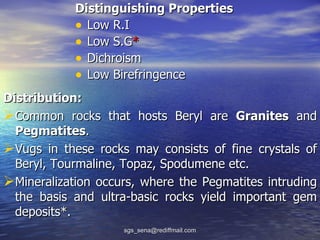
Distinguishing Properties
            • Low R.I
            • Low S.G*
            • Dichroism
            • Low Birefringence
Distribution:
Common rocks that hosts Beryl are Granites and
  Pegmatites.
Vugs in these rocks may consists of fine crystals of
  Beryl, Tourmaline, Topaz, Spodumene etc.
Mineralization occurs, where the Pegmatites intruding
  the basis and ultra-basic rocks yield important gem
  deposits*.
                    sgs_sena@rediffmail.com
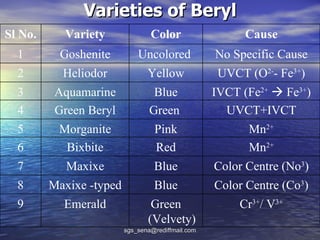
Varieties of Beryl
Sl No.     Variety               Color                   Cause
  1        Goshenite         Uncolored             No Specific Cause
  2        Heliodor             Yellow              UVCT (O2-- Fe3+)
  3       Aquamarine              Blue             IVCT (Fe2+  Fe3+)
  4       Green Beryl            Green               UVCT+IVCT
  5       Morganite               Pink                   Mn2+
  6        Bixbite                Red                    Mn2+
  7         Maxixe                Blue             Color Centre (No3)
  8      Maxixe -typed            Blue             Color Centre (Co3)
  9        Emerald               Green                  Cr3+/ V3+
                                (Velvety)
                         sgs_sena@rediffmail.com
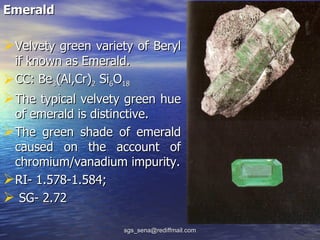
Emerald

Velvety green variety of Beryl
 if known as Emerald.
CC: Be3(Al,Cr)2 Si6O18
The typical velvety green hue
 of emerald is distinctive.
The green shade of emerald
 caused on the account of
 chromium/vanadium impurity.
RI- 1.578-1.584;
 SG- 2.72

                     sgs_sena@rediffmail.com
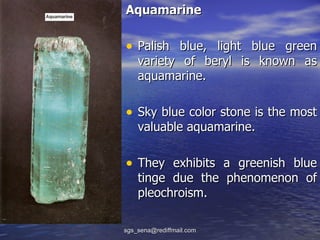
Aquamarine

• Palish blue, light blue green
    variety of beryl is known as
    aquamarine.

• Sky blue color stone is the most
    valuable aquamarine.

• They exhibits a greenish blue
    tinge due the phenomenon of
    pleochroism.

sgs_sena@rediffmail.com
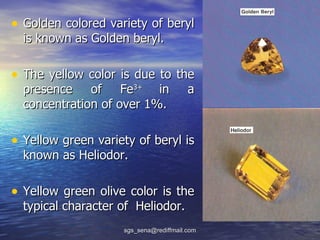
• Golden colored variety of beryl
  is known as Golden beryl.

• The yellow color is due to the
  presence of Fe3+ in                   a
  concentration of over 1%.

• Yellow green variety of beryl is
  known as Heliodor.

• Yellow green olive color is the
  typical character of Heliodor.
                    sgs_sena@rediffmail.com
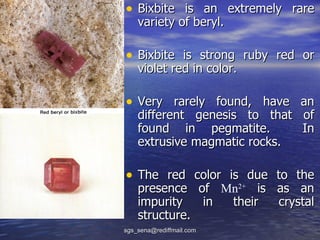
• Bixbite is an extremely rare
    variety of beryl.

• Bixbite is strong ruby red or
    violet red in color.

• Very rarely found, have an
    different genesis to that of
    found in pegmatite.       In
    extrusive magmatic rocks.

• The red color is due to the
    presence of Mn2+ is as an
    impurity   in their crystal
    structure.
sgs_sena@rediffmail.com
Case Study: Ndola Rural Emerald
               Fields, Zambia
• Nolda –Rural Emerald field of the Zambian Republic
    represents a good source of easily mined emeralds.
•   To this day, many areas are a preserve of artisinal
    miners. Lack of capital has lead to inefficient
    exploration and exploitation.

GEOLOGICAL SETUP:
• Zambia lies in between Zaire and the Zambian cratons
    characterized geologically as being ancient mobile
    belt; comprising of Igneous, Sedimentary and
    metamorphic formations of the Precambrian age.
                      sgs_sena@rediffmail.com
• Mineralization in the Ndola Rural Emerald Fields
  occurs where the quartz-tourmaline-pegmatite
  veins intrude the talc-chlorite-tremolite-magnetite
  schist and alter the contact zone as biotite-phaloghite
  rock, this alteration zone forms the chief ore body.

Three distinct varieties of pegmatite are known in the
  study area:
• 1st Generation: initial feeder phase rich in quartz
  and feldspar and contain minor fine grained
  tourmaline and not related to mineralization.
• 2nd Generation: veins composed largely of
  tourmaline commonly associated with emerald
  mineralization.
                     sgs_sena@rediffmail.com
• 3rd Generation:        composed of coarse quartz
    tourmaline (5-10 mm) always found in association
    with mineralization of emerald.
•   The distribution of emerald is very erratic; major
    emerald mineralization, rich in volume & grade are
    associated with flat lying undulating veins and
    number of vein intersects.

• Granitic emplacement characterized by intensive
    pulses of pegmatite activity rich in minerals B, Be, F
    etc intruding through the well developed shear
    system appears to be the cause.
•   Crystallization of beryl appears to have taken place
    during metasomatic reaction between the slow
    cooling pegmatite (3rd Generation)           and the
    surrounding schist.
                       sgs_sena@rediffmail.com
CONCLUSION


  sgs_sena@rediffmail.com
The role of a GEOLOGIST in the field of
                Gemological Science:
• Prospecting of a gem deposit.
• Establishing the properties of gem minerals.
• Identification of stone in cut and rough form.
• Enhancement of stone (synthesis).
• Minerals grow in a definite physico-chemical
  environment, thus a geologist is better able
  to understand and reason out the paragenesis
  of a mineral or gemstone. It is easy to
  distinguish a natural stone from its synthetic
  counterpart.       sgs_sena@rediffmail.com
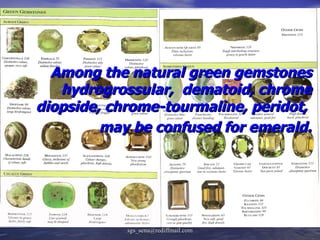
Among the natural green gemstones
   hydrogrossular, dematoid, chrome
diopside, chrome-tourmaline, peridot,
         may be confused for emerald.


            sgs_sena@rediffmail.com
sgs_sena@rediffmail.com
“Gems are the flowers of the
  mineral kingdom, exquisite products
  of Nature which have given a great
  deal of satisfaction, to those who
  behold them. They have fascinated
  mankind for thousands of years”.

                             -Dr. B.P Radhakrishna


GEOLOGY ILLUMINATES THE PAST , SUSTAINS
 THE PRESENT AND PROMOTES THE FUTURE.
              sgs_sena@rediffmail.com
Re f e r e n c e s :
•   Bateman A.M., Tensen M.L., (1982) Economic Mineral
    Deposits, Third Edition, John Willy & Sons pp/

•   Curizio Cipriani., Alessandro Borelli., (1992) Gems and
    Precious Stones, Simon & Schuster Inc, pp. 10-49,
    138-149.

•   Emerald Deposit of Nolda, Zambia (1997),
    www. members.tripod.com/emerald/html.

•   O. Von Knorring., (1970) Mineralogical and
    Geochemical Aspects of Pegmatites from Orogenic
    Belts of Equatorial and Southern Africa, African
    Magmatism and Tectonics, Oliver Boyd Publishers
                      sgs_sena@rediffmail.com
• Guilbert J.M., Park C.F., (1988) Ore Geology, W.H
  Freeman Company, New York, pp. 487-511.

• Hall Cally., (1995) Gemstones, Dorling Kindersley Publ.

• Joel. E Arem., (1987) Color Encyclopedia of Gemstones,
  Van Nostrand Reinhold Company, pp 1-20.

• Karanth R.V., (2000) Gems and Gemstone Industry in
  India, Geological Society of India, pp. 1-56, 233-242.

• Klein Cornelis., Hurlbut S Cornelis Jr., (1993) Manual of
  Mineralogy, John Wiley & Sons, pp. 593-605.

                      sgs_sena@rediffmail.com
?
QUESTIONS
sgs_sena@rediffmail.com

Gemstone Exploration & Mining

  • 1.
    Geologist & Gemological Sciences By S.G SURENDER SOMIKA S.P.R.L sgs_sena@rediffmail.com
  • 2.
    Resources are not;they become. --- E.S Zimmerman “A proper appreciation of mineral resources may be the greatest service we as geologist can perform for our society and country”. ---E.L Chile. sgs_sena@rediffmail.com
  • 3.
    Introduction  Nearly 4000+varieties of minerals are identified in nature; only a few are referred as gem minerals due to their exceptional qualities and properties.  Gems have been a part of human history for more than 5000 years. Throughout the ages gemstones have been seen as representations of wealth, power and symbols of supremacy.  Gem minerals are usually hard and relatively free from cleavage and occur as transparent crystals, with few exception such as opal, fluorite etc.,  Thus gemstones are artificially polished fragments (faceted or with smooth curved finish) that are used for decorative purposes and personal adornment. sgs_sena@rediffmail.com
  • 4.
     The studyof gemstones is an accepted part of Mineralogy .  A gem is a naturally occurring material desirable for its beauty, valuable in its rarity, and sufficiently durable to give lasting pleasure.  Gemology- is the subject matter the scientific study of gemstones (from its genesis to valuation).  Lapidary – is the science of cutting and polishing a gem mineral. sgs_sena@rediffmail.com
  • 5.
     Over thecenturies numerous magical and medicinal properties were attributed to precious stones.  In Ayurveda (Indian System of Medicine)  Audbhida-Extract form Plants,  Jangama-Extract from Animals  Parthiva-Extract from Metals and Minerals Different types of BHASMA such as Hirka Bhasma (Diamond), Manikya Bhasma (Ruby), Swarna Bhasma (Gold), Abhraka Bhasma (Mica) etc. were prepared from metals and minerals to cure variety of diseases. sgs_sena@rediffmail.com
  • 6.
  • 7.
    CLASSIFICATION OF GEMSTONES •Gemstones are classified based on certain assertive aspects /parameters. viz., 1. TYPES Organic Imitation Inorganic Synthetic sgs_sena@rediffmail.com
  • 8.
    2. Based onAvailability Availability Precious Semi-Precious The precious and semi precious classification of gemstones is largely based on the Market (Demand and Supply); it is an arbitrary classification based on local availability. sgs_sena@rediffmail.com
  • 9.
    3. OTHER TYPE CLASSIFICATIONS Chemical Optical Composition Characters Durability Crystal Structure sgs_sena@rediffmail.com
  • 10.
    Physical and Opticalproperties are the Key elements to distinguish various types of gemstones Physical Properties Optical Properties • Color * • Refractive Index • Streak • Habit • Dispersion • Cleavage, Parting Plane, • Pleochroism Fractures. • Interference Figures • Lustre (Reflectivity) • Optic Axis • Diaphaneity (Transmisivity) • Optic Sign • Hardness* • Specific Gravity • Tenacity & Toughness • Chatoyancy • Asterism sgs_sena@rediffmail.com
  • 11.
    COLOUR CAUSING TRANSITIONMETAL ELEMENTS IN IDOCHROMATIC GEMS Chromium Green Uvarovite Iron Green Peridot Red Almandine blue lazurite Manganese Pink Rhodocrosite, orange Rodonite Spessartite Copper Blue Azurite, Turquoise, Green Chrysocolk Red Malachite, Dioptase Cuprite sgs_sena@rediffmail.com
  • 12.
    COLOUR CAUSING TRANSITIONMETAL ELEMENTS IN ALLOCHROMATIC GEMS Chromium Green Emerald, Gromularite, Cr-tourmaline, Cr-Chalcedony, Alexandrite Red Ruby, Spinal, Topaz, Alexandrite Chromium Red Pyrope + Iron Green Jadeite, Diopside, Synthetic OPX Cobalt Blue Syn. Spinel, Syn. Quartz & Glass. Iron Green Aquamarine, Tourmaline, Green Sapphire, Yellow Chrysoberyl, Epidote. Yellow sapphire, Citrine, Blue Chrysoberyl, Violet – Orthoclase, Soundmen. blue Aquamarine, Spinal. Tanzanite, Iolite. Red Eudialyte sgs_sena@rediffmail.com
  • 13.
    Iron + Blue Sapphire Titanium Manganese Pink Rhodonite, Yellow - Rhodocrosite, Green Piedmmtite, Syn. OPX. Violet Andalusite Tremolite Nickel Green Syn. Olivine. Vanadium Green V- Emerald Blue – Green V- Grossularite to V- Sapphire Purple – red Syn. CPX Blue sgs_sena@rediffmail.com
  • 14.
    The main parametersof GEMSTONE • BEAUTY • RARITY • DURABILITY sgs_sena@rediffmail.com
  • 15.
     Gemstones aremeasured in terms metric carat, which is equivalent to 200mg (1 carat is equivalent to 0.2 grams). A CARAT is again sub divided into hundred POINTS (2mg).  Gem Testing & Gemologist Certificate: Gemstones are identified based on their properties (P & O) along with few instruments (Chelsea filter, Refractrometer, Gemological Microscopes, Hardness Pencils etc.). The efficiency of a gemologist lies in identifying a stone without subjecting it to any kind of destructive tests.  A certificate from a certified GEMOLOGIST would certainly yield to its market, through proper identification and valuation. sgs_sena@rediffmail.com
  • 16.
    Valuation of Gemstones valuationof gemstones is done through the 4 C’s precept.  Color  Clarity  Cut &  Carat Weight sgs_sena@rediffmail.com
  • 17.
    EXPLORATION  Exploration: Refersto geological, geochemical and geo-physical field work and complimentary laboratory studies directed to the discovery of workable mineral concentration.  Gemstone occurrence is a very rare and a transient geologic feature; once exhausted cannot be replenished with in a short time.  Diverse minerals are formed at different geological environments in different rock types, viz Igneous, Sedimentary and Metamorphic rocks, also few organically. sgs_sena@rediffmail.com
  • 18.
    For Example:  Diamondsin Kimberlites (Ultra-mafic HTHP)  Beryl in Pegmatites  Quartz in Felsic rocks  Peridot in Ultra mafic rocks  Garnets in Metamorphic Rocks sgs_sena@rediffmail.com
  • 19.
  • 20.
    T h ep r in c ip le r o le o f a n E x p lo r a t io n G e o lo g is t Hos t Roc k E s s e n t ia l M in e r a l G e m Q u a lit y E m e r a ld A lm a n d in e G a r n e t C r y s t a l in Q u a r t s a n d sgs_sena@rediffmail.com e m b e d d e d in
  • 21.
    BERYL  By thename Beryl is a Silicate of Beryllium and Aluminum; is the principle store of beryllium in the earth's crust. In its rare gem form it is notable for a variety of vivid allochromatic color with vivid names.  Chemical Composition: Be3Al2Si6O18 • Crystal System: Hexagonal • Habit: Usually well formed hexagonal prisms, either flattened or elongate, with pinacoidal terminations. • Hardness: 7.5-8 • Specific Gravity: 2.67-2.78 • Refractive Index: 1.57-1.59 sgs_sena@rediffmail.com
  • 22.
    Distinguishing Properties • Low R.I • Low S.G* • Dichroism • Low Birefringence Distribution: Common rocks that hosts Beryl are Granites and Pegmatites. Vugs in these rocks may consists of fine crystals of Beryl, Tourmaline, Topaz, Spodumene etc. Mineralization occurs, where the Pegmatites intruding the basis and ultra-basic rocks yield important gem deposits*. sgs_sena@rediffmail.com
  • 23.
    Varieties of Beryl SlNo. Variety Color Cause 1 Goshenite Uncolored No Specific Cause 2 Heliodor Yellow UVCT (O2-- Fe3+) 3 Aquamarine Blue IVCT (Fe2+  Fe3+) 4 Green Beryl Green UVCT+IVCT 5 Morganite Pink Mn2+ 6 Bixbite Red Mn2+ 7 Maxixe Blue Color Centre (No3) 8 Maxixe -typed Blue Color Centre (Co3) 9 Emerald Green Cr3+/ V3+ (Velvety) sgs_sena@rediffmail.com
  • 24.
    Emerald Velvety green varietyof Beryl if known as Emerald. CC: Be3(Al,Cr)2 Si6O18 The typical velvety green hue of emerald is distinctive. The green shade of emerald caused on the account of chromium/vanadium impurity. RI- 1.578-1.584;  SG- 2.72 sgs_sena@rediffmail.com
  • 25.
    Aquamarine • Palish blue,light blue green variety of beryl is known as aquamarine. • Sky blue color stone is the most valuable aquamarine. • They exhibits a greenish blue tinge due the phenomenon of pleochroism. sgs_sena@rediffmail.com
  • 26.
    • Golden coloredvariety of beryl is known as Golden beryl. • The yellow color is due to the presence of Fe3+ in a concentration of over 1%. • Yellow green variety of beryl is known as Heliodor. • Yellow green olive color is the typical character of Heliodor. sgs_sena@rediffmail.com
  • 27.
    • Bixbite isan extremely rare variety of beryl. • Bixbite is strong ruby red or violet red in color. • Very rarely found, have an different genesis to that of found in pegmatite. In extrusive magmatic rocks. • The red color is due to the presence of Mn2+ is as an impurity in their crystal structure. sgs_sena@rediffmail.com
  • 28.
    Case Study: NdolaRural Emerald Fields, Zambia • Nolda –Rural Emerald field of the Zambian Republic represents a good source of easily mined emeralds. • To this day, many areas are a preserve of artisinal miners. Lack of capital has lead to inefficient exploration and exploitation. GEOLOGICAL SETUP: • Zambia lies in between Zaire and the Zambian cratons characterized geologically as being ancient mobile belt; comprising of Igneous, Sedimentary and metamorphic formations of the Precambrian age. sgs_sena@rediffmail.com
  • 29.
    • Mineralization inthe Ndola Rural Emerald Fields occurs where the quartz-tourmaline-pegmatite veins intrude the talc-chlorite-tremolite-magnetite schist and alter the contact zone as biotite-phaloghite rock, this alteration zone forms the chief ore body. Three distinct varieties of pegmatite are known in the study area: • 1st Generation: initial feeder phase rich in quartz and feldspar and contain minor fine grained tourmaline and not related to mineralization. • 2nd Generation: veins composed largely of tourmaline commonly associated with emerald mineralization. sgs_sena@rediffmail.com
  • 30.
    • 3rd Generation: composed of coarse quartz tourmaline (5-10 mm) always found in association with mineralization of emerald. • The distribution of emerald is very erratic; major emerald mineralization, rich in volume & grade are associated with flat lying undulating veins and number of vein intersects. • Granitic emplacement characterized by intensive pulses of pegmatite activity rich in minerals B, Be, F etc intruding through the well developed shear system appears to be the cause. • Crystallization of beryl appears to have taken place during metasomatic reaction between the slow cooling pegmatite (3rd Generation) and the surrounding schist. sgs_sena@rediffmail.com
  • 31.
  • 32.
    The role ofa GEOLOGIST in the field of Gemological Science: • Prospecting of a gem deposit. • Establishing the properties of gem minerals. • Identification of stone in cut and rough form. • Enhancement of stone (synthesis). • Minerals grow in a definite physico-chemical environment, thus a geologist is better able to understand and reason out the paragenesis of a mineral or gemstone. It is easy to distinguish a natural stone from its synthetic counterpart. sgs_sena@rediffmail.com
  • 33.
    Among the naturalgreen gemstones hydrogrossular, dematoid, chrome diopside, chrome-tourmaline, peridot, may be confused for emerald. sgs_sena@rediffmail.com
  • 34.
  • 35.
  • 36.
    “Gems are theflowers of the mineral kingdom, exquisite products of Nature which have given a great deal of satisfaction, to those who behold them. They have fascinated mankind for thousands of years”. -Dr. B.P Radhakrishna GEOLOGY ILLUMINATES THE PAST , SUSTAINS THE PRESENT AND PROMOTES THE FUTURE. sgs_sena@rediffmail.com
  • 37.
    Re f er e n c e s : • Bateman A.M., Tensen M.L., (1982) Economic Mineral Deposits, Third Edition, John Willy & Sons pp/ • Curizio Cipriani., Alessandro Borelli., (1992) Gems and Precious Stones, Simon & Schuster Inc, pp. 10-49, 138-149. • Emerald Deposit of Nolda, Zambia (1997), www. members.tripod.com/emerald/html. • O. Von Knorring., (1970) Mineralogical and Geochemical Aspects of Pegmatites from Orogenic Belts of Equatorial and Southern Africa, African Magmatism and Tectonics, Oliver Boyd Publishers sgs_sena@rediffmail.com
  • 38.
    • Guilbert J.M.,Park C.F., (1988) Ore Geology, W.H Freeman Company, New York, pp. 487-511. • Hall Cally., (1995) Gemstones, Dorling Kindersley Publ. • Joel. E Arem., (1987) Color Encyclopedia of Gemstones, Van Nostrand Reinhold Company, pp 1-20. • Karanth R.V., (2000) Gems and Gemstone Industry in India, Geological Society of India, pp. 1-56, 233-242. • Klein Cornelis., Hurlbut S Cornelis Jr., (1993) Manual of Mineralogy, John Wiley & Sons, pp. 593-605. sgs_sena@rediffmail.com
  • 39.