1
BASICS OF MINERAL PROCESSING
(Ore dressing Operations)
by
Prof. A. Balasubramanian
Centre for Advanced Studies in Earth Science
University of Mysore
India
2
Treatment of ores to concentrate their valuable
constituents (minerals) into products
(concentrate) of smaller bulk, and
simultaneously to collect the worthless material
(gangue) into discardable waste (tailing).
The cleaning of ore by the removal of certain
valueless portions, as by jigging, cobbing, or
vanning.
3
The fundamental operations of ore-dressing
processes are:
a) the breaking apart of the associated
constituents of the ore by mechanical means
(severance) and
b) the separation of the severed components
(beneficiation) into concentrate and tailing,
using mechanical or physical methods which do
not effect substantial chemical changes.
4
Mining and quarry fronts
The mining and quarry fronts are the starting
points for recovery of rock and mineral values
from surface and underground deposits.
Operations are drilling (blasting), primary
crushing (optional) and materials handling, dry
and wet.
5
Drilling (and blasting) is the technology of
achieving primary fragmentation of “in situ”
minerals. This is the starting point for most
mineral processes with the exception of natural
minerals in the form of sand and gravel.
Comminution is a single- or multistage process
whereby ore is reduced from run-of-mine size
to that size needed by the beneficiation process.
The process is intended to produce individual
6
particles which are either wholly mineral or
wholly gangue, that is, to produce liberation.
Since the mechanical forces producing fracture
are not susceptible to detailed control, a class of
particles containing both mineral and gangue
(middling particles) are also produced.
The process of Comminution is divided into
two methods as
A) Size reduction
7
B) Separation (by screens and cyclones)
C) Enrichment
D) Upgrading.
A. SIZE REDUCTION is done through two
major methods as:
A1) crushing (down to 6- to 14-mesh) and
A2) grinding (down to micrometer sizes).
8
Size reduction of ores is normally done in order
to liberate the value minerals from the host
rock. it is done through
Crushing and grinding of ore and minerals. this
is also called as liberation the economically
important mineral from its host rock.
Crushing of rock and minerals is the major
operation in minerals processing.
9
A1. Crushing and screening is the first
controlled size reduction stage in the process.
This is the main process in aggregate
production and a preparation process for
further size reduction.
A2. Grinding is the stage of size reduction (wet
or dry) where the liberation size for individual
minerals can be reached. Size reduction by
crushing has a size limitation for the final
10
products. If we require further reduction, say
below 5-20 mm, we have to use the processes of
grinding.
The two main purposes for a grinding process
are:
• To liberate individual minerals trapped in rock
crystals (ores) and thereby open up for a
subsequent enrichment in the form of
separation.
11
• To produce fines (or filler) from mineral
fractions by increasing the specific surface.
B. SEPARATION is attempted through
Screening & cyclonic methods, Flotation,
Leaching, and other Mechanical separation
techniques.
Screening is a method of sizing whereby graded
products are produced, the individual particles
12
in each grade being of nearly the same size. In
beneficiation, screening is practiced for two
reasons: as an integral part of the separation
process, for example, in jigging; and to produce
a feed of such size and size range as is
compatible with the applicability of the
separation process. Performance of screens will
fall back on three main parameters: Motion –
Inclination – Screening media.
13
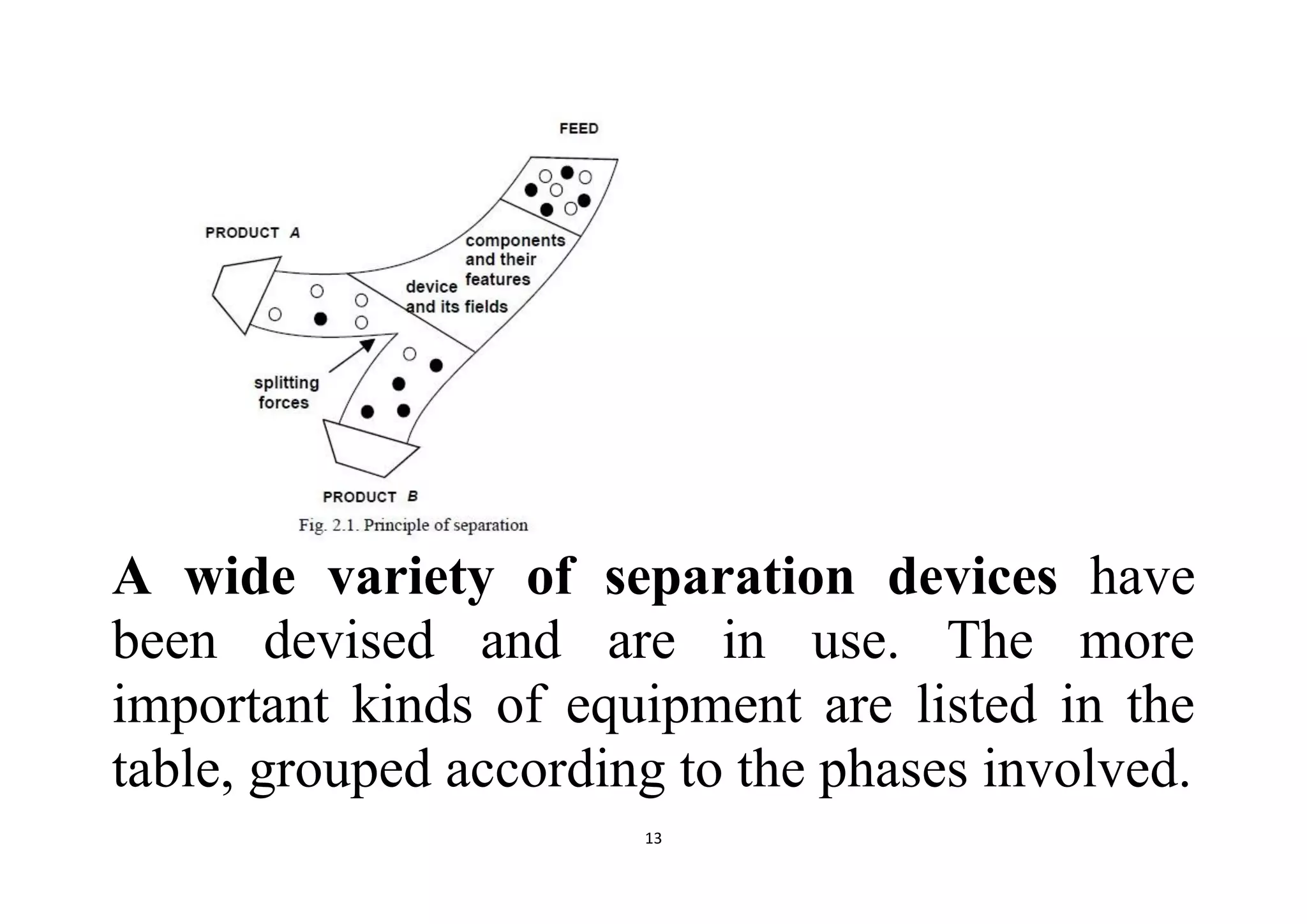
A wide variety of separation devices have
been devised and are in use. The more
important kinds of equipment are listed in the
table, grouped according to the phases involved.
14
1. Centrifugation, Clarification,
2. Dust and mist collection, Filtration,
3. Flotation, Magnetic separation methods,
4. Mechanical classification, Screening,
5. Sedimentation (industry).
The major processess involved are:
Flotation,
Leaching,
15
Mechanical separation techniques
Separation is achieved by subjecting each
particle of the mixture to a set of forces which is
usually the same irrespective of the nature of
the particles excepting for the force based upon
the discriminating property. This force may be
present for both mineral and gangue particles
but differing in magnitude, or it may be present
for one type of particle and absent for the other.
16
As a result of this difference, separation is
possible, and the particles are collected in the
form of concentrate or tailing.
Flotation:
A process used to separate particulate solids,
which have been suspended in a fluid, by
selectively attaching the particles to be removed
to a light fluid and allowing this mineralized
17
fluid aggregation to rise to where it can be
removed. The principal use of the process is to
separate valuable minerals from waste rock, or
gangue, in which case the ground ore is
suspended in water and, after chemical
treatment, subjected to bubbles of air. The
minerals which are to be floated attach to the air
bubbles, rise through the suspension, and are
removed with the froth which forms on top of
the pulp. Although most materials subjected to
18
flotation are minerals, applications to chemical
and biological materials have been reported.
Leaching :
Method of extraction in which a solvent is
passed through a mixture to remove some
desired substance from it. Leaching is also
used to remove metals from their ores. In one
procedure certain crushed ores of copper are
19
placed into a series of tanks. As a solvent, such
as sulfuric acid, is pumped into the first tank, it
dissolves the copper from the ore. Eventually
overflowing the first tank, the solution passes
into the second, where more copper is
dissolved. When this tank overflows, the
process is repeated in the third tank and so on.
The copper is ultimately removed from the
solution by chemical or other treatment.
20
Mechanical separation techniques
A group of laboratory and production
operations whereby the components of a
polyphase mixture are separated by mechanical
methods into two or more fractions of different
mechanical characteristics. The separated
fractions may be homogeneous or
heterogeneous, particulate or nonparticulate.
21
The techniques of mechanical separation are
based on differences in phase density, in phase
fluidity, and in such mechanical properties of
particles-as size, shape, and density; and on
such particle characteristics as wettability,
surface charge, and magnetic susceptibility.
C. ENRICHMENT
22
Enrichment involves washing , classified
separation, slurry processing, pyroprocessing
and compaction.
D. UPGRADATION is related to
Beneficiation of concentrated ores. It is related
to Concentration ( Final Product Collection).
Upgradation involves sedimentation,
mechanical dewatering, drying, calcining or
23
sintering and recovering the process water from
the tailings.
Enrichment – Washing
Washing is the simplest method of enrichment
used to improve the value of rock and mineral
fractions from sand size and upwards.
Removing of surface impurities like clay, dust,
organics or salts is often a must for a saleable
24
product. Different techniques are used
depending on how hard these impurities are
attached to the rock or mineral surface.
Enrichment – Separation
Most value minerals (both metallic and
industrial) are priced by their purity. After
liberation by size reduction and size control all
25
minerals are free to be separated from each
other.
Depending on the properties of the individual
minerals they can be recovered by different
methods of separation.
Slurry processing includes the technologies for
wet processing of mineral fractions.
26
Pyro processing includes the technologies for
upgrading of the mineral fractions by drying,
calcining or sintering.
Compaction of minerals includes the
technologies for moving and densifying
minerals by vibration, impaction and pressure,
mainly used in construction applications.
27
Materials handling includes the technologies
for moving the process flow (dry) forward by
loading, transportation, storage and feeding.
Upgrading:
After the enrichment operation we end up with
a value product (concentrate) and a non-value
product (tailings). These products are probably
not sellable nor disposable due to the content of
28
process water, particle size, or chemical
composition. By upgrading we mean the
methods of increasing the value of these
products by sedimentation, mechanical
dewatering, drying, calcining or sintering and
recovering the process water from the tailings,
making them disposable.
Beneficiation :
29
Beneficiation consists of two fundamental
operations: the determination that an individual
particle is either a mineral or a gangue particle
(selection); and the movement of selected
particles via different paths (separation) into the
concentrate and tailing products. When
middling particles occur, they will either be
selected according to their mineral content and
then caused to report as concentrate or tailing,
30
or be separated as a third product (middling),
which is reground to achieve further liberation.
Clarification :
The removal of small amounts of fine,
particulate solids from liquids. The purpose is
almost invariably to improve the quality of the
liquid, and the removed solids often are
discarded. The particles removed by a clarifier
31
may be as large as 100 micrometers or as small
as 2 micrometers.
Clarification is used in the manufacture of
pharmaceuticals, beverages, and fiber and film
polymers; in the reconditioning of
electroplating solutions; in the recovery of dry-
cleaning solvent; and for the purification of
drinking water and waste water. The filters in
32
the feed line and lubricating oil system of an
internal combustion engine are clarifiers.
The methods of clarification include gravity
sedimentation, centrifugal sedimentation,
filtration, and magnetic separation. Clarification
differs from other applications of these
mechanical separation techniques by the low
solid content of the suspension to be clarified
33
(usually less than 0.2%) and the substantial
completion of the particle removal.
Filtration, Magnetic separation methods,
Mechanical separation techniques,
Sedimentation (industry)
Filtration :
(science and technology)
34
A process of separating particulate matter from
a fluid, such as air or a liquid, by passing the
fluid carrier through a medium that will not pass
the particulates.
Magnetic separation:
Magnetic separation utilizes the force exerted
by a magnetic field upon magnetic materials to
counteract partially or wholly the effect of
gravity. Thus under the action of these two
35
forces, different paths are produced for the
magnetic and nonmagnetic particles.
Sedimentation:
The settling or surfacing of particles in the
dispersed phase, such as solid particles, liquid
droplets, or gas bubbles, in a liquid or gaseous
dispersion medium as a result of a gravitational
field or centrifugal force.
36
Sedimentation occurs if the directional motion
of the particles under the effect of gravity or
centrifugal force predominates over the random
thermal motion. The rate of sedimentation
depends on the mass, size, and shape of the
particles, the viscosity and density of the
medium, and the acceleration caused by the
force field.
37
Properties of mass play a major role in
Mineral processing
All deposits of minerals, rock or ores have
different hardness depending on the chemical
composition and the geological environment.
Size and hardness
38
All operations have different process
environments due to mineral hardness and size
range. It is important to know in which “range”
we are operating as this will affect many
process parameters, (wear rate, uptime,
operation costs etc.). Size and hardness
together give interesting information.
The stress forces of rock mechanics
39
Beside size and hardness, the classical stress
forces of rock mechanics are the fundamentals
in most of what we do in mineral processing.
They guide us in equipment design, in systems
layout, in wear protection etc. They are always
around and they always have to be considered.
Feed material
All operations in size reduction, both crushing
and grinding are of course determined by the
40
feed characteristics of the minerals (rock/ore)
moving into the circuit. The key parameters we
need are the “crushability or grindability”, also
called work index and the “wear profile”,
called abrasion index.
Reduction ratio
As seen above all size reduction operations are
performed in stages. All equipment involved,
crushers or grinding mills have different
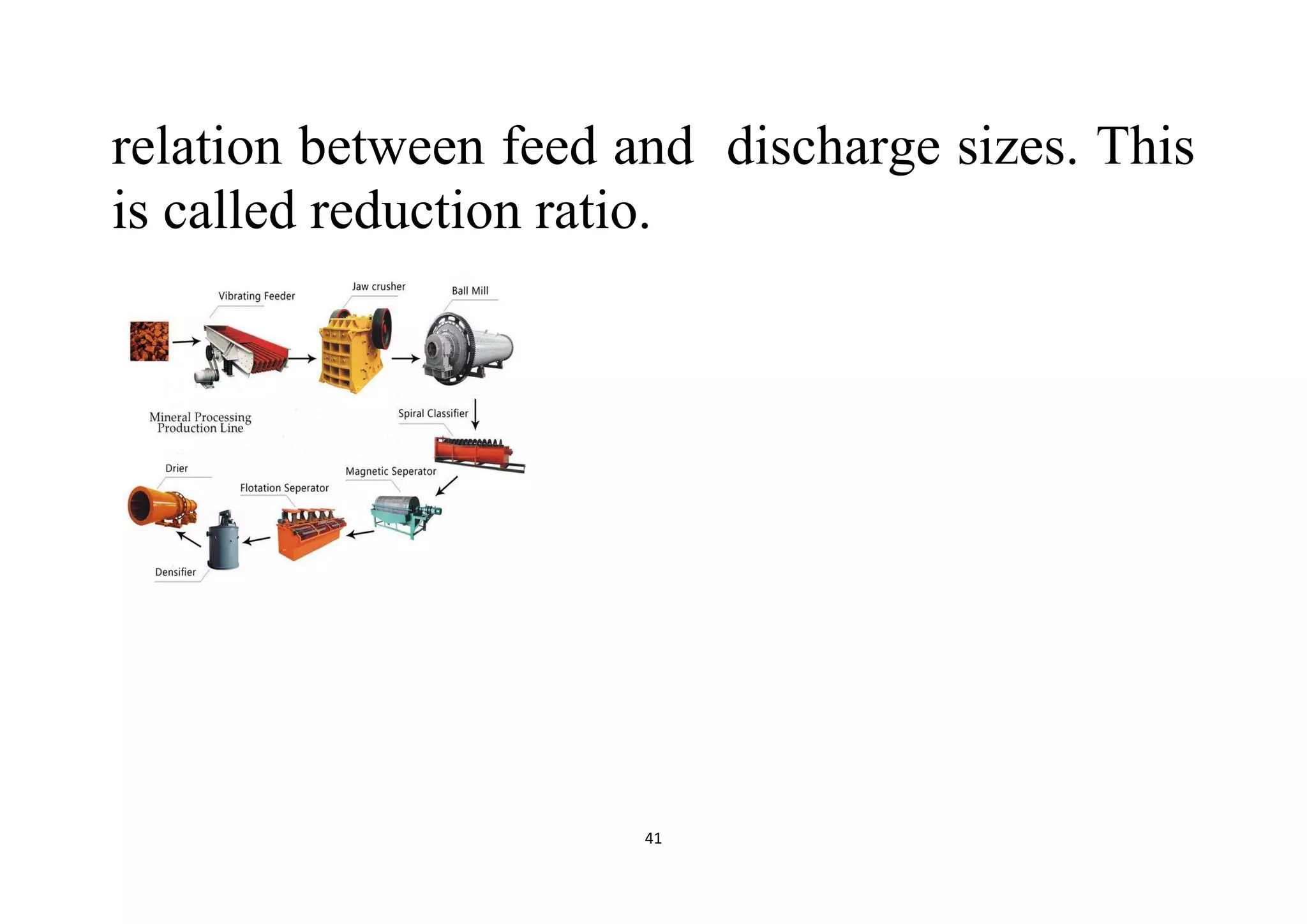
41
relation between feed and discharge sizes. This
is called reduction ratio.

Basics of mineral processing

  • 1.
    1 BASICS OF MINERALPROCESSING (Ore dressing Operations) by Prof. A. Balasubramanian Centre for Advanced Studies in Earth Science University of Mysore India
  • 2.
    2 Treatment of oresto concentrate their valuable constituents (minerals) into products (concentrate) of smaller bulk, and simultaneously to collect the worthless material (gangue) into discardable waste (tailing). The cleaning of ore by the removal of certain valueless portions, as by jigging, cobbing, or vanning.
  • 3.
    3 The fundamental operationsof ore-dressing processes are: a) the breaking apart of the associated constituents of the ore by mechanical means (severance) and b) the separation of the severed components (beneficiation) into concentrate and tailing, using mechanical or physical methods which do not effect substantial chemical changes.
  • 4.
    4 Mining and quarryfronts The mining and quarry fronts are the starting points for recovery of rock and mineral values from surface and underground deposits. Operations are drilling (blasting), primary crushing (optional) and materials handling, dry and wet.
  • 5.
    5 Drilling (and blasting)is the technology of achieving primary fragmentation of “in situ” minerals. This is the starting point for most mineral processes with the exception of natural minerals in the form of sand and gravel. Comminution is a single- or multistage process whereby ore is reduced from run-of-mine size to that size needed by the beneficiation process. The process is intended to produce individual
  • 6.
    6 particles which areeither wholly mineral or wholly gangue, that is, to produce liberation. Since the mechanical forces producing fracture are not susceptible to detailed control, a class of particles containing both mineral and gangue (middling particles) are also produced. The process of Comminution is divided into two methods as A) Size reduction
  • 7.
    7 B) Separation (byscreens and cyclones) C) Enrichment D) Upgrading. A. SIZE REDUCTION is done through two major methods as: A1) crushing (down to 6- to 14-mesh) and A2) grinding (down to micrometer sizes).
  • 8.
    8 Size reduction ofores is normally done in order to liberate the value minerals from the host rock. it is done through Crushing and grinding of ore and minerals. this is also called as liberation the economically important mineral from its host rock. Crushing of rock and minerals is the major operation in minerals processing.
  • 9.
    9 A1. Crushing andscreening is the first controlled size reduction stage in the process. This is the main process in aggregate production and a preparation process for further size reduction. A2. Grinding is the stage of size reduction (wet or dry) where the liberation size for individual minerals can be reached. Size reduction by crushing has a size limitation for the final
  • 10.
    10 products. If werequire further reduction, say below 5-20 mm, we have to use the processes of grinding. The two main purposes for a grinding process are: • To liberate individual minerals trapped in rock crystals (ores) and thereby open up for a subsequent enrichment in the form of separation.
  • 11.
    11 • To producefines (or filler) from mineral fractions by increasing the specific surface. B. SEPARATION is attempted through Screening & cyclonic methods, Flotation, Leaching, and other Mechanical separation techniques. Screening is a method of sizing whereby graded products are produced, the individual particles
  • 12.
    12 in each gradebeing of nearly the same size. In beneficiation, screening is practiced for two reasons: as an integral part of the separation process, for example, in jigging; and to produce a feed of such size and size range as is compatible with the applicability of the separation process. Performance of screens will fall back on three main parameters: Motion – Inclination – Screening media.
  • 13.
    13 A wide varietyof separation devices have been devised and are in use. The more important kinds of equipment are listed in the table, grouped according to the phases involved.
  • 14.
    14 1. Centrifugation, Clarification, 2.Dust and mist collection, Filtration, 3. Flotation, Magnetic separation methods, 4. Mechanical classification, Screening, 5. Sedimentation (industry). The major processess involved are: Flotation, Leaching,
  • 15.
    15 Mechanical separation techniques Separationis achieved by subjecting each particle of the mixture to a set of forces which is usually the same irrespective of the nature of the particles excepting for the force based upon the discriminating property. This force may be present for both mineral and gangue particles but differing in magnitude, or it may be present for one type of particle and absent for the other.
  • 16.
    16 As a resultof this difference, separation is possible, and the particles are collected in the form of concentrate or tailing. Flotation: A process used to separate particulate solids, which have been suspended in a fluid, by selectively attaching the particles to be removed to a light fluid and allowing this mineralized
  • 17.
    17 fluid aggregation torise to where it can be removed. The principal use of the process is to separate valuable minerals from waste rock, or gangue, in which case the ground ore is suspended in water and, after chemical treatment, subjected to bubbles of air. The minerals which are to be floated attach to the air bubbles, rise through the suspension, and are removed with the froth which forms on top of the pulp. Although most materials subjected to
  • 18.
    18 flotation are minerals,applications to chemical and biological materials have been reported. Leaching : Method of extraction in which a solvent is passed through a mixture to remove some desired substance from it. Leaching is also used to remove metals from their ores. In one procedure certain crushed ores of copper are
  • 19.
    19 placed into aseries of tanks. As a solvent, such as sulfuric acid, is pumped into the first tank, it dissolves the copper from the ore. Eventually overflowing the first tank, the solution passes into the second, where more copper is dissolved. When this tank overflows, the process is repeated in the third tank and so on. The copper is ultimately removed from the solution by chemical or other treatment.
  • 20.
    20 Mechanical separation techniques Agroup of laboratory and production operations whereby the components of a polyphase mixture are separated by mechanical methods into two or more fractions of different mechanical characteristics. The separated fractions may be homogeneous or heterogeneous, particulate or nonparticulate.
  • 21.
    21 The techniques ofmechanical separation are based on differences in phase density, in phase fluidity, and in such mechanical properties of particles-as size, shape, and density; and on such particle characteristics as wettability, surface charge, and magnetic susceptibility. C. ENRICHMENT
  • 22.
    22 Enrichment involves washing, classified separation, slurry processing, pyroprocessing and compaction. D. UPGRADATION is related to Beneficiation of concentrated ores. It is related to Concentration ( Final Product Collection). Upgradation involves sedimentation, mechanical dewatering, drying, calcining or
  • 23.
    23 sintering and recoveringthe process water from the tailings. Enrichment – Washing Washing is the simplest method of enrichment used to improve the value of rock and mineral fractions from sand size and upwards. Removing of surface impurities like clay, dust, organics or salts is often a must for a saleable
  • 24.
    24 product. Different techniquesare used depending on how hard these impurities are attached to the rock or mineral surface. Enrichment – Separation Most value minerals (both metallic and industrial) are priced by their purity. After liberation by size reduction and size control all
  • 25.
    25 minerals are freeto be separated from each other. Depending on the properties of the individual minerals they can be recovered by different methods of separation. Slurry processing includes the technologies for wet processing of mineral fractions.
  • 26.
    26 Pyro processing includesthe technologies for upgrading of the mineral fractions by drying, calcining or sintering. Compaction of minerals includes the technologies for moving and densifying minerals by vibration, impaction and pressure, mainly used in construction applications.
  • 27.
    27 Materials handling includesthe technologies for moving the process flow (dry) forward by loading, transportation, storage and feeding. Upgrading: After the enrichment operation we end up with a value product (concentrate) and a non-value product (tailings). These products are probably not sellable nor disposable due to the content of
  • 28.
    28 process water, particlesize, or chemical composition. By upgrading we mean the methods of increasing the value of these products by sedimentation, mechanical dewatering, drying, calcining or sintering and recovering the process water from the tailings, making them disposable. Beneficiation :
  • 29.
    29 Beneficiation consists oftwo fundamental operations: the determination that an individual particle is either a mineral or a gangue particle (selection); and the movement of selected particles via different paths (separation) into the concentrate and tailing products. When middling particles occur, they will either be selected according to their mineral content and then caused to report as concentrate or tailing,
  • 30.
    30 or be separatedas a third product (middling), which is reground to achieve further liberation. Clarification : The removal of small amounts of fine, particulate solids from liquids. The purpose is almost invariably to improve the quality of the liquid, and the removed solids often are discarded. The particles removed by a clarifier
  • 31.
    31 may be aslarge as 100 micrometers or as small as 2 micrometers. Clarification is used in the manufacture of pharmaceuticals, beverages, and fiber and film polymers; in the reconditioning of electroplating solutions; in the recovery of dry- cleaning solvent; and for the purification of drinking water and waste water. The filters in
  • 32.
    32 the feed lineand lubricating oil system of an internal combustion engine are clarifiers. The methods of clarification include gravity sedimentation, centrifugal sedimentation, filtration, and magnetic separation. Clarification differs from other applications of these mechanical separation techniques by the low solid content of the suspension to be clarified
  • 33.
    33 (usually less than0.2%) and the substantial completion of the particle removal. Filtration, Magnetic separation methods, Mechanical separation techniques, Sedimentation (industry) Filtration : (science and technology)
  • 34.
    34 A process ofseparating particulate matter from a fluid, such as air or a liquid, by passing the fluid carrier through a medium that will not pass the particulates. Magnetic separation: Magnetic separation utilizes the force exerted by a magnetic field upon magnetic materials to counteract partially or wholly the effect of gravity. Thus under the action of these two
  • 35.
    35 forces, different pathsare produced for the magnetic and nonmagnetic particles. Sedimentation: The settling or surfacing of particles in the dispersed phase, such as solid particles, liquid droplets, or gas bubbles, in a liquid or gaseous dispersion medium as a result of a gravitational field or centrifugal force.
  • 36.
    36 Sedimentation occurs ifthe directional motion of the particles under the effect of gravity or centrifugal force predominates over the random thermal motion. The rate of sedimentation depends on the mass, size, and shape of the particles, the viscosity and density of the medium, and the acceleration caused by the force field.
  • 37.
    37 Properties of massplay a major role in Mineral processing All deposits of minerals, rock or ores have different hardness depending on the chemical composition and the geological environment. Size and hardness
  • 38.
    38 All operations havedifferent process environments due to mineral hardness and size range. It is important to know in which “range” we are operating as this will affect many process parameters, (wear rate, uptime, operation costs etc.). Size and hardness together give interesting information. The stress forces of rock mechanics
  • 39.
    39 Beside size andhardness, the classical stress forces of rock mechanics are the fundamentals in most of what we do in mineral processing. They guide us in equipment design, in systems layout, in wear protection etc. They are always around and they always have to be considered. Feed material All operations in size reduction, both crushing and grinding are of course determined by the
  • 40.
    40 feed characteristics ofthe minerals (rock/ore) moving into the circuit. The key parameters we need are the “crushability or grindability”, also called work index and the “wear profile”, called abrasion index. Reduction ratio As seen above all size reduction operations are performed in stages. All equipment involved, crushers or grinding mills have different
  • 41.
    41 relation between feedand discharge sizes. This is called reduction ratio.