Discrete mathemaetics
GRAPH
SUBMITTED BY
UJJWAL MATOLIYA
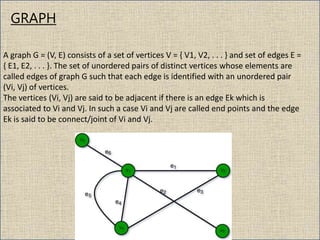
A graph G = (V, E) consists of a set of vertices V = { V1, V2, . . . } and set of edges E =
{ E1, E2, . . . }. The set of unordered pairs of distinct vertices whose elements are
called edges of graph G such that each edge is identified with an unordered pair
(Vi, Vj) of vertices.
The vertices (Vi, Vj) are said to be adjacent if there is an edge Ek which is
associated to Vi and Vj. In such a case Vi and Vj are called end points and the edge
Ek is said to be connect/joint of Vi and Vj.
GRAPH
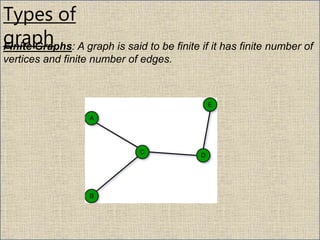
Finite Graphs: A graph is said to be finite if it has finite number of
vertices and finite number of edges.
Types of
graph
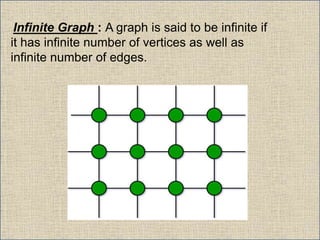
Infinite Graph : A graph is said to be infinite if
it has infinite number of vertices as well as
infinite number of edges.
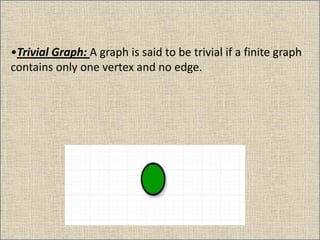
•Trivial Graph: A graph is said to be trivial if a finite graph
contains only one vertex and no edge.
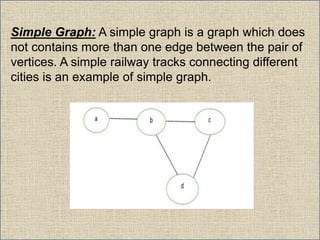
Simple Graph: A simple graph is a graph which does
not contains more than one edge between the pair of
vertices. A simple railway tracks connecting different
cities is an example of simple graph.
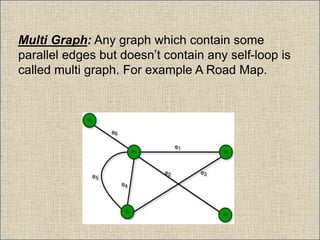
Multi Graph: Any graph which contain some
parallel edges but doesn’t contain any self-loop is
called multi graph. For example A Road Map.
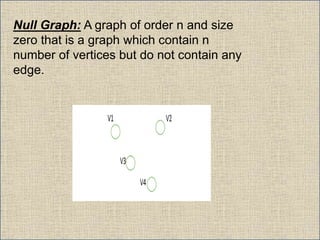
Null Graph: A graph of order n and size
zero that is a graph which contain n
number of vertices but do not contain any
edge.
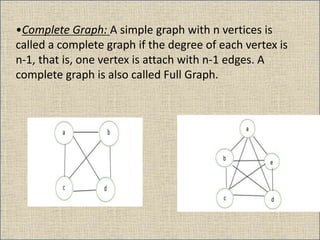
•Complete Graph: A simple graph with n vertices is
called a complete graph if the degree of each vertex is
n-1, that is, one vertex is attach with n-1 edges. A
complete graph is also called Full Graph.
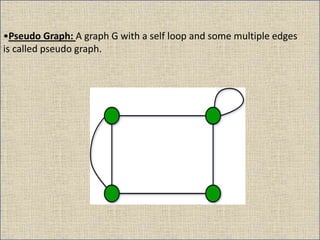
•Pseudo Graph: A graph G with a self loop and some multiple edges
is called pseudo graph.
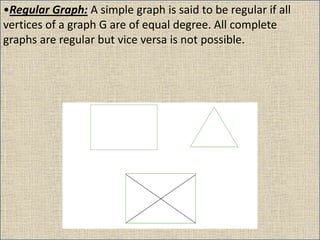
•Regular Graph: A simple graph is said to be regular if all
vertices of a graph G are of equal degree. All complete
graphs are regular but vice versa is not possible.
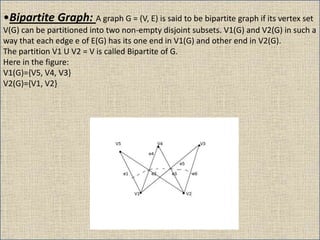
•Bipartite Graph: A graph G = (V, E) is said to be bipartite graph if its vertex set
V(G) can be partitioned into two non-empty disjoint subsets. V1(G) and V2(G) in such a
way that each edge e of E(G) has its one end in V1(G) and other end in V2(G).
The partition V1 U V2 = V is called Bipartite of G.
Here in the figure:
V1(G)={V5, V4, V3}
V2(G)={V1, V2}
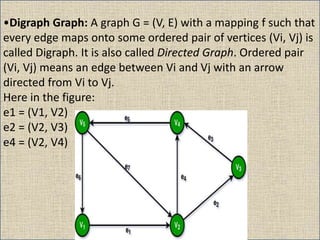
•Digraph Graph: A graph G = (V, E) with a mapping f such that
every edge maps onto some ordered pair of vertices (Vi, Vj) is
called Digraph. It is also called Directed Graph. Ordered pair
(Vi, Vj) means an edge between Vi and Vj with an arrow
directed from Vi to Vj.
Here in the figure:
e1 = (V1, V2)
e2 = (V2, V3)
e4 = (V2, V4)
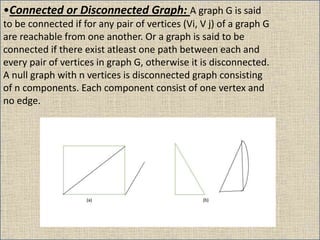
•Connected or Disconnected Graph: A graph G is said
to be connected if for any pair of vertices (Vi, V j) of a graph G
are reachable from one another. Or a graph is said to be
connected if there exist atleast one path between each and
every pair of vertices in graph G, otherwise it is disconnected.
A null graph with n vertices is disconnected graph consisting
of n components. Each component consist of one vertex and
no edge.
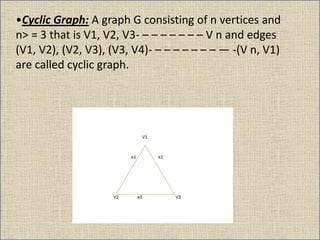
•Cyclic Graph: A graph G consisting of n vertices and
n> = 3 that is V1, V2, V3- – – – – – – – V n and edges
(V1, V2), (V2, V3), (V3, V4)- – – – – – – – — -(V n, V1)
are called cyclic graph.
Graph in Discrete mathemaetics.pptx

Graph in Discrete mathemaetics.pptx

  • 1.
  • 2.
    A graph G= (V, E) consists of a set of vertices V = { V1, V2, . . . } and set of edges E = { E1, E2, . . . }. The set of unordered pairs of distinct vertices whose elements are called edges of graph G such that each edge is identified with an unordered pair (Vi, Vj) of vertices. The vertices (Vi, Vj) are said to be adjacent if there is an edge Ek which is associated to Vi and Vj. In such a case Vi and Vj are called end points and the edge Ek is said to be connect/joint of Vi and Vj. GRAPH
  • 3.
    Finite Graphs: Agraph is said to be finite if it has finite number of vertices and finite number of edges. Types of graph
  • 4.
    Infinite Graph :A graph is said to be infinite if it has infinite number of vertices as well as infinite number of edges.
  • 5.
    •Trivial Graph: Agraph is said to be trivial if a finite graph contains only one vertex and no edge.
  • 6.
    Simple Graph: Asimple graph is a graph which does not contains more than one edge between the pair of vertices. A simple railway tracks connecting different cities is an example of simple graph.
  • 7.
    Multi Graph: Anygraph which contain some parallel edges but doesn’t contain any self-loop is called multi graph. For example A Road Map.
  • 8.
    Null Graph: Agraph of order n and size zero that is a graph which contain n number of vertices but do not contain any edge.
  • 9.
    •Complete Graph: Asimple graph with n vertices is called a complete graph if the degree of each vertex is n-1, that is, one vertex is attach with n-1 edges. A complete graph is also called Full Graph.
  • 10.
    •Pseudo Graph: Agraph G with a self loop and some multiple edges is called pseudo graph.
  • 11.
    •Regular Graph: Asimple graph is said to be regular if all vertices of a graph G are of equal degree. All complete graphs are regular but vice versa is not possible.
  • 12.
    •Bipartite Graph: Agraph G = (V, E) is said to be bipartite graph if its vertex set V(G) can be partitioned into two non-empty disjoint subsets. V1(G) and V2(G) in such a way that each edge e of E(G) has its one end in V1(G) and other end in V2(G). The partition V1 U V2 = V is called Bipartite of G. Here in the figure: V1(G)={V5, V4, V3} V2(G)={V1, V2}
  • 13.
    •Digraph Graph: Agraph G = (V, E) with a mapping f such that every edge maps onto some ordered pair of vertices (Vi, Vj) is called Digraph. It is also called Directed Graph. Ordered pair (Vi, Vj) means an edge between Vi and Vj with an arrow directed from Vi to Vj. Here in the figure: e1 = (V1, V2) e2 = (V2, V3) e4 = (V2, V4)
  • 14.
    •Connected or DisconnectedGraph: A graph G is said to be connected if for any pair of vertices (Vi, V j) of a graph G are reachable from one another. Or a graph is said to be connected if there exist atleast one path between each and every pair of vertices in graph G, otherwise it is disconnected. A null graph with n vertices is disconnected graph consisting of n components. Each component consist of one vertex and no edge.
  • 15.
    •Cyclic Graph: Agraph G consisting of n vertices and n> = 3 that is V1, V2, V3- – – – – – – – V n and edges (V1, V2), (V2, V3), (V3, V4)- – – – – – – – — -(V n, V1) are called cyclic graph.