
PLANAR GRAPH
ALGORITHMS & APPLICATIONS.
PREPARED BY
▪ SHAKIL AHMED
OUTLINE
▪ Definition of Planar Graph.
▪ Some Examples.
▪ Some Notations.
▪ SomeTheorems.
▪ Kuratowski /WagnerTheorem.
▪ EulerTheorem.
▪ Some Corollaries.
▪ Non Planarity.
▪ K3,3 and k5 is not Planar Graph.
▪ Drawing of a Planar Graph.
▪ PlanarityTesting.
▪ Algorithms.
▪ Applications.
▪ VLSICircuits.
▪ References.
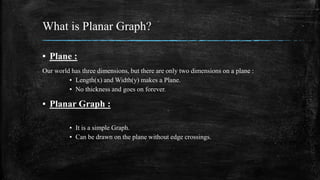
What is Planar Graph?
▪ Plane :
Our world has three dimensions, but there are only two dimensions on a plane :
▪ Length(x) and Width(y) makes a Plane.
▪ No thickness and goes on forever.
▪ Planar Graph :
▪ It is a simple Graph.
▪ Can be drawn on the plane without edge crossings.
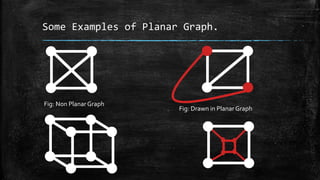
Some Examples of Planar Graph.
Fig: Drawn in Planar Graph
Fig: Non PlanarGraph
Some Notations.
▪ Faces
▪ Divide the Plane in many regions.
– Exterior face.
– Interior faces.
▪ Each edge is incident to 2 faces, except in special cases:
f1 f2
f3
f4
Exterior
Face
Some Theorems
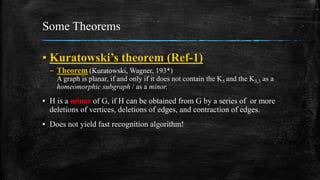
▪ Kuratowski’s theorem (Ref-1)
– Theorem (Kuratowski, Wagner, 193*)
A graph is planar, if and only if it does not contain the K5 and the K3,3 as a
homeomorphic subgraph / as a minor.
▪ H is a minor of G, if H can be obtained from G by a series of or more
deletions of vertices, deletions of edges, and contraction of edges.
▪ Does not yield fast recognition algorithm!
Euler’s Theorem.
▪ Theorem (Euler)
Let G be a connected plane graph with n vertices, m edges,
and f faces.Then n + f – m = 2.
▪ Proof. By induction.
– True if m=0.
– If G has a circuit, then delete an edge
– If G has a vertex v of degree 1, then delete v
Euler’s Theorem Corollaries.
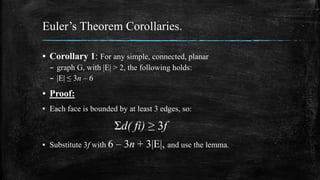
▪ Corollary 1: For any simple, connected, planar
– graph G, with |E| > 2, the following holds:
– |E| ≤ 3n – 6
▪ Proof:
▪ Each face is bounded by at least 3 edges, so:
Σd( fi) ≥ 3f
▪ Substitute 3f with 6 – 3n + 3|E|, and use the lemma.
Euler’s Theorem Corollaries. (Cont..)
▪ Corollary 2: For any simple
connected bipartite planar graph G,
with |E| > 2, the following holds:
▪ |E| ≤ 2n – 4
▪ Proof:
▪ Each face of G is bounded by at
least 4 edges.
▪ The result then follows as for the
previous corollary.
▪ Corollary 3: In a simple,
connected, planar graph there
exists at least one vertex of
degree at most 5.
▪ Proof:
▪ Without loss of generality we can
assume the graph to be connected,
and to have at least three vertices.
▪ If each vertex has degree at least
6, then we have 6n ≤ 2m, and so
3n ≤ m.
▪ It follows immediately from
previous Corollary that 3n ≤ 3n
— 6, which is a contradiction
Non Planarity.
▪ The House-and-Utilities Problem (Ref- 4)
The smallest graphs that are not planar.
▪ K5, K3,3
Ref - 1 & 4
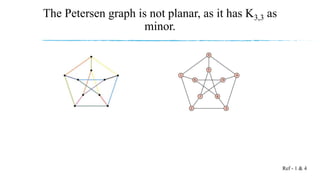
The Petersen graph is not planar, as it has K3,3 as
minor.
Ref - 1 & 4
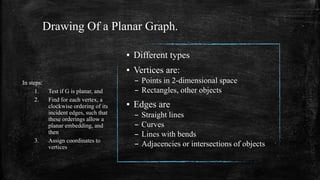
Drawing Of a Planar Graph.
In steps:
1. Test if G is planar, and
2. Find for each vertex, a
clockwise ordering of its
incident edges, such that
these orderings allow a
planar embedding, and
then
3. Assign coordinates to
vertices
▪ Different types
▪ Vertices are:
– Points in 2-dimensional space
– Rectangles, other objects
▪ Edges are
– Straight lines
– Curves
– Lines with bends
– Adjacencies or intersections of objects
Planarity Testing.
▪ Simple tests
▪ Following the simplifications, two elementary tests can be applied:
– If e < 9 or n < 5 then the graph must be planar.
– If e > 3n – 6 then the graph must be non-planar.
▪ If these tests fail to resolve the question of planarity, then we need to
use a more elaborate test.
Ref - 5
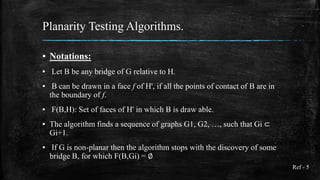
Planarity Testing Algorithms.
▪ Notations:
▪ Let B be any bridge of G relative to H.
▪ B can be drawn in a face f of H', if all the points of contact of B are in
the boundary of f.
▪ F(B,H): Set of faces of H' in which B is draw able.
▪ The algorithm finds a sequence of graphs G1, G2, …, such that Gi ⊂
Gi+1.
▪ If G is non-planar then the algorithm stops with the discovery of some
bridge B, for which F(B,Gi) = ∅
Ref - 5
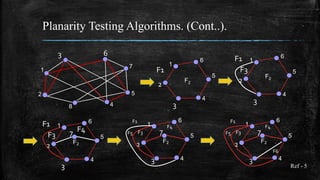
Planarity Testing Algorithms. (Cont..).
Ref - 5
Planarity Testing Algorithms. (Cont..).
1
2
8
7
5
4
3 6
6
1
5
4
F2
2
3
6
1
5
4
F2
2
3
F1
F1
F3
6
1
5
4
F2
2
3
F1
F3
F47
6
1
5
4
F2
2
3
F1
F3
F4
7F5
6
1
5
4
F2
2
3
F1
F3
F4
7F5
F6
Ref - 5
Planarity Testing Algorithms. (Cont..).
Ref - 5
6
1
5
4
F2
2
3
F1
F3
F4
7F5
F6
F7
6
1
5
4
F2
2
3
F1
F3
F4
7F5
F6
F7
F8
6
1
5
4
F2
2
3
F1
F3
F4
7F5
F6
F7
F8
F9
6
1
5
4
F2
2
3
F1
F3
F4
7F5
F6
F7
F8
F9
F10
Planarity Testing Algorithms. (Cont..)
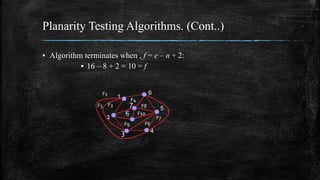
▪ Algorithm terminates when , f = e – n + 2:
▪ 16 – 8 + 2 = 10 = f
6
1
5
4
F2
2
3
F1
F3
F4
7F5
F6
F7
F8
F9
F10
Applications.
▪ Applications:
– Visually representing a network (e.g., social network, organization
structure, data bases (ER-diagrams), software (e.g., UML-diagrams),
flow charts, phylogenetic trees (biology, evolution), …
– Design of “chip” layout (VLSI)
Applications : (Electrical Circuits).
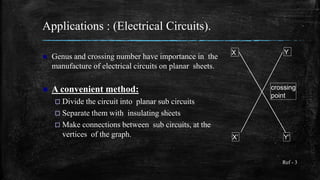
 Genus and crossing number have importance in the
manufacture of electrical circuits on planar sheets.
 A convenient method:
 Divide the circuit into planar sub circuits
 Separate them with insulating sheets
 Make connections between sub circuits, at the
vertices of the graph. X’ Y’
crossing
point
X Y
Ref - 3
Applications : (Computer Vision).
▪ In ComputerVision there is an abundance of problems that can be
addressed as finding a minimal cut through a planar graph.
▪ such as shape matching, image segmentation
▪ or cyclic time series.
Ref - 2
References.
1. Kuratowski, Kazimierz (1930), "Sur le problème des courbes gauches
en topologie" (PDF), Fund. Math. (in French), 15: 271–283.
2. Efficient Planar Graph Cuts with Applications in ComputerVision, IEEE
Computer Society Conference on ComputerVision and Pattern Recognition 2009,
Miami, Florida. c IEEE.
3. Design Of Integrated Circuits And Systems,Vol. 22, No. 5, May
2003, Pp 584-592.
4. Dudeney, Henry (1917), "Problem 251 –Water, Gas, and Electricity",
Amusements in mathematics,Thomas Nelson
5. K.S Booth ‘Testing graph planarity’ j-comp syst.sci (1976)
Planar graph

Planar graph

  • 1.
  • 2.
  • 3.
    OUTLINE ▪ Definition ofPlanar Graph. ▪ Some Examples. ▪ Some Notations. ▪ SomeTheorems. ▪ Kuratowski /WagnerTheorem. ▪ EulerTheorem. ▪ Some Corollaries. ▪ Non Planarity. ▪ K3,3 and k5 is not Planar Graph. ▪ Drawing of a Planar Graph. ▪ PlanarityTesting. ▪ Algorithms. ▪ Applications. ▪ VLSICircuits. ▪ References.
  • 4.
    What is PlanarGraph? ▪ Plane : Our world has three dimensions, but there are only two dimensions on a plane : ▪ Length(x) and Width(y) makes a Plane. ▪ No thickness and goes on forever. ▪ Planar Graph : ▪ It is a simple Graph. ▪ Can be drawn on the plane without edge crossings.
  • 5.
    Some Examples ofPlanar Graph. Fig: Drawn in Planar Graph Fig: Non PlanarGraph
  • 6.
    Some Notations. ▪ Faces ▪Divide the Plane in many regions. – Exterior face. – Interior faces. ▪ Each edge is incident to 2 faces, except in special cases: f1 f2 f3 f4 Exterior Face
  • 7.
    Some Theorems ▪ Kuratowski’stheorem (Ref-1) – Theorem (Kuratowski, Wagner, 193*) A graph is planar, if and only if it does not contain the K5 and the K3,3 as a homeomorphic subgraph / as a minor. ▪ H is a minor of G, if H can be obtained from G by a series of or more deletions of vertices, deletions of edges, and contraction of edges. ▪ Does not yield fast recognition algorithm!
  • 8.
    Euler’s Theorem. ▪ Theorem(Euler) Let G be a connected plane graph with n vertices, m edges, and f faces.Then n + f – m = 2. ▪ Proof. By induction. – True if m=0. – If G has a circuit, then delete an edge – If G has a vertex v of degree 1, then delete v
  • 9.
    Euler’s Theorem Corollaries. ▪Corollary 1: For any simple, connected, planar – graph G, with |E| > 2, the following holds: – |E| ≤ 3n – 6 ▪ Proof: ▪ Each face is bounded by at least 3 edges, so: Σd( fi) ≥ 3f ▪ Substitute 3f with 6 – 3n + 3|E|, and use the lemma.
  • 10.
    Euler’s Theorem Corollaries.(Cont..) ▪ Corollary 2: For any simple connected bipartite planar graph G, with |E| > 2, the following holds: ▪ |E| ≤ 2n – 4 ▪ Proof: ▪ Each face of G is bounded by at least 4 edges. ▪ The result then follows as for the previous corollary. ▪ Corollary 3: In a simple, connected, planar graph there exists at least one vertex of degree at most 5. ▪ Proof: ▪ Without loss of generality we can assume the graph to be connected, and to have at least three vertices. ▪ If each vertex has degree at least 6, then we have 6n ≤ 2m, and so 3n ≤ m. ▪ It follows immediately from previous Corollary that 3n ≤ 3n — 6, which is a contradiction
  • 11.
    Non Planarity. ▪ TheHouse-and-Utilities Problem (Ref- 4)
  • 12.
    The smallest graphsthat are not planar. ▪ K5, K3,3 Ref - 1 & 4
  • 13.
    The Petersen graphis not planar, as it has K3,3 as minor. Ref - 1 & 4
  • 14.
    Drawing Of aPlanar Graph. In steps: 1. Test if G is planar, and 2. Find for each vertex, a clockwise ordering of its incident edges, such that these orderings allow a planar embedding, and then 3. Assign coordinates to vertices ▪ Different types ▪ Vertices are: – Points in 2-dimensional space – Rectangles, other objects ▪ Edges are – Straight lines – Curves – Lines with bends – Adjacencies or intersections of objects
  • 15.
    Planarity Testing. ▪ Simpletests ▪ Following the simplifications, two elementary tests can be applied: – If e < 9 or n < 5 then the graph must be planar. – If e > 3n – 6 then the graph must be non-planar. ▪ If these tests fail to resolve the question of planarity, then we need to use a more elaborate test. Ref - 5
  • 16.
    Planarity Testing Algorithms. ▪Notations: ▪ Let B be any bridge of G relative to H. ▪ B can be drawn in a face f of H', if all the points of contact of B are in the boundary of f. ▪ F(B,H): Set of faces of H' in which B is draw able. ▪ The algorithm finds a sequence of graphs G1, G2, …, such that Gi ⊂ Gi+1. ▪ If G is non-planar then the algorithm stops with the discovery of some bridge B, for which F(B,Gi) = ∅ Ref - 5
  • 17.
  • 18.
    Planarity Testing Algorithms.(Cont..). 1 2 8 7 5 4 3 6 6 1 5 4 F2 2 3 6 1 5 4 F2 2 3 F1 F1 F3 6 1 5 4 F2 2 3 F1 F3 F47 6 1 5 4 F2 2 3 F1 F3 F4 7F5 6 1 5 4 F2 2 3 F1 F3 F4 7F5 F6 Ref - 5
  • 19.
    Planarity Testing Algorithms.(Cont..). Ref - 5 6 1 5 4 F2 2 3 F1 F3 F4 7F5 F6 F7 6 1 5 4 F2 2 3 F1 F3 F4 7F5 F6 F7 F8 6 1 5 4 F2 2 3 F1 F3 F4 7F5 F6 F7 F8 F9 6 1 5 4 F2 2 3 F1 F3 F4 7F5 F6 F7 F8 F9 F10
  • 20.
    Planarity Testing Algorithms.(Cont..) ▪ Algorithm terminates when , f = e – n + 2: ▪ 16 – 8 + 2 = 10 = f 6 1 5 4 F2 2 3 F1 F3 F4 7F5 F6 F7 F8 F9 F10
  • 21.
    Applications. ▪ Applications: – Visuallyrepresenting a network (e.g., social network, organization structure, data bases (ER-diagrams), software (e.g., UML-diagrams), flow charts, phylogenetic trees (biology, evolution), … – Design of “chip” layout (VLSI)
  • 22.
    Applications : (ElectricalCircuits).  Genus and crossing number have importance in the manufacture of electrical circuits on planar sheets.  A convenient method:  Divide the circuit into planar sub circuits  Separate them with insulating sheets  Make connections between sub circuits, at the vertices of the graph. X’ Y’ crossing point X Y Ref - 3
  • 23.
    Applications : (ComputerVision). ▪ In ComputerVision there is an abundance of problems that can be addressed as finding a minimal cut through a planar graph. ▪ such as shape matching, image segmentation ▪ or cyclic time series. Ref - 2
  • 24.
    References. 1. Kuratowski, Kazimierz(1930), "Sur le problème des courbes gauches en topologie" (PDF), Fund. Math. (in French), 15: 271–283. 2. Efficient Planar Graph Cuts with Applications in ComputerVision, IEEE Computer Society Conference on ComputerVision and Pattern Recognition 2009, Miami, Florida. c IEEE. 3. Design Of Integrated Circuits And Systems,Vol. 22, No. 5, May 2003, Pp 584-592. 4. Dudeney, Henry (1917), "Problem 251 –Water, Gas, and Electricity", Amusements in mathematics,Thomas Nelson 5. K.S Booth ‘Testing graph planarity’ j-comp syst.sci (1976)