1
Graphs
Ahmad Baryal
Saba Institute of Higher Education
Computer Science Faculty
March 21, 2023
2 Table of contents
 Introduction to Graphs
 Types of Graphs
 Representation of Graphs
 Applications of Graphs
 Real-world Example
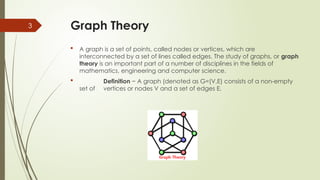
3 Graph Theory
 A graph is a set of points, called nodes or vertices, which are
interconnected by a set of lines called edges. The study of graphs, or graph
theory is an important part of a number of disciplines in the fields of
mathematics, engineering and computer science.
 Definition − A graph (denoted as G=(V,E) consists of a non-empty
set of vertices or nodes V and a set of edges E.
4 Graph
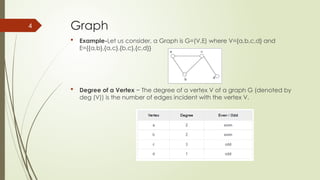
 Example-Let us consider, a Graph is G=(V,E) where V={a,b,c,d} and
E={{a,b},{a,c},{b,c},{c,d}}
 Degree of a Vertex − The degree of a vertex V of a graph G (denoted by
deg (V)) is the number of edges incident with the vertex V.
5 Graph
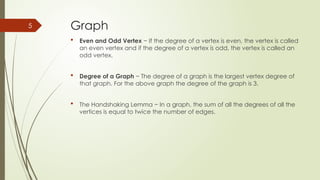
 Even and Odd Vertex − If the degree of a vertex is even, the vertex is called
an even vertex and if the degree of a vertex is odd, the vertex is called an
odd vertex.
 Degree of a Graph − The degree of a graph is the largest vertex degree of
that graph. For the above graph the degree of the graph is 3.
 The Handshaking Lemma − In a graph, the sum of all the degrees of all the
vertices is equal to twice the number of edges.
6 Types of Graphs
There are different types of graphs, which we will learn in the following section.
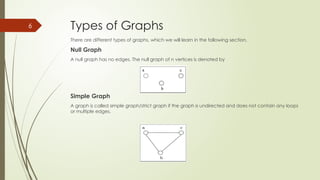
Null Graph
A null graph has no edges. The null graph of n vertices is denoted by
Simple Graph
A graph is called simple graph/strict graph if the graph is undirected and does not contain any loops
or multiple edges.
7 Types of Graphs
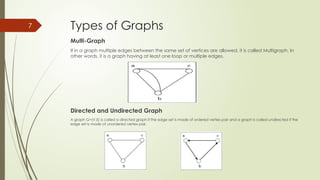
Multi-Graph
If in a graph multiple edges between the same set of vertices are allowed, it is called Multigraph. In
other words, it is a graph having at least one loop or multiple edges.
Directed and Undirected Graph
A graph G=(V,E) is called a directed graph if the edge set is made of ordered vertex pair and a graph is called undirected if the
edge set is made of unordered vertex pair.
8 Types of Graphs
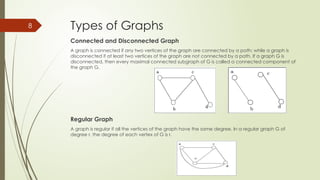
Connected and Disconnected Graph
A graph is connected if any two vertices of the graph are connected by a path; while a graph is
disconnected if at least two vertices of the graph are not connected by a path. If a graph G is
disconnected, then every maximal connected subgraph of G is called a connected component of
the graph G.
Regular Graph
A graph is regular if all the vertices of the graph have the same degree. In a regular graph G of
degree r, the degree of each vertex of G is r.
9 Types of Graphs
Complete Graph
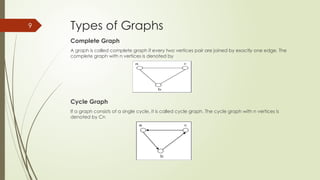
A graph is called complete graph if every two vertices pair are joined by exactly one edge. The
complete graph with n vertices is denoted by
Cycle Graph
If a graph consists of a single cycle, it is called cycle graph. The cycle graph with n vertices is
denoted by Cn
10 Types of Graphs
Bipartite Graph
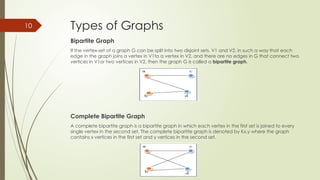
If the vertex-set of a graph G can be split into two disjoint sets, V1 and V2, in such a way that each
edge in the graph joins a vertex in V1to a vertex in V2, and there are no edges in G that connect two
vertices in V1or two vertices in V2, then the graph G is called a bipartite graph.
Complete Bipartite Graph
A complete bipartite graph is a bipartite graph in which each vertex in the first set is joined to every
single vertex in the second set. The complete bipartite graph is denoted by Kx,y where the graph
contains x vertices in the first set and y vertices in the second set.
11 Representation of Graphs
There are mainly two ways to represent a graph −
 Adjacency Matrix
 Adjacency List
Adjacency Matrix
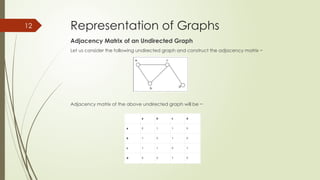
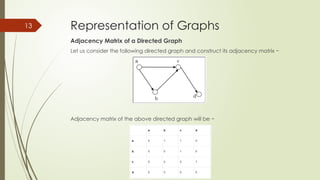
An Adjacency Matrix A[V][V] is a 2D array of size V×V where V is the number of vertices in a
undirected graph. If there is an edge between Vx to Vy then the value of A[Vx][Vy]=1and A[Vy]
[Vx]=1, otherwise the value will be zero. And for a directed graph, if there is an edge between Vx to
Vy, then the value of A[Vx][Vy]=1, otherwise the value will be zero.
Adjacency Matrix of an Undirected Graph
Let us consider the following undirected graph and construct the adjacency matrix −
12 Representation of Graphs
Adjacency Matrix of an Undirected Graph
Let us consider the following undirected graph and construct the adjacency matrix −
Adjacency matrix of the above undirected graph will be −
13 Representation of Graphs
Adjacency Matrix of a Directed Graph
Let us consider the following directed graph and construct its adjacency matrix −
Adjacency matrix of the above directed graph will be −
14 Representation of Graphs
Adjacency List
In adjacency list, an array (A[V]) of linked lists is used to represent the graph G with V number of vertices. An entry
A[Vx] represents the linked list of vertices adjacent to the Vx−th vertex. The adjacency list of the undirected graph is as
shown in the figure below −
Planar vs. Non-planar graph
Planar graph − A graph G is called a planar graph if it can be drawn in a plane without any edges crossed. If we draw
graph in the plane without edge crossing, it is called embedding the graph in the plane.
15 Planar vs. Non-planar graph
Non-planar graph − A graph is non-planar if it cannot be drawn in a plane without graph edges crossing.
Isomorphism
If two graphs G and H contain the same number of vertices connected in the same way, they are called isomorphic
graphs (denoted by G H).
≅
It is easier to check non-isomorphism than isomorphism. If any of these following conditions occurs, then two graphs
are non-isomorphic −
 The number of connected components are different
 Vertex-set cardinalities are different
 Edge-set cardinalities are different
 Degree sequences are different
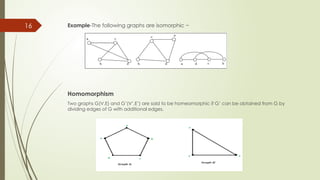
16 Example-The following graphs are isomorphic −
Homomorphism
Two graphs G(V,E) and G’(V’,E’) are said to be homeomorphic if G’ can be obtained from G by
dividing edges of G with additional edges.
17 Applications of Graphs in CS
• Network Routing: Graphs are used in designing communication networks.
• Social Networks: Graphs model connections between people.
• Scheduling Problems: Use of Directed Acyclic Graphs (DAGs).
• Web Page Ranking (PageRank): Google’s algorithm is based on graph
theory.
• Compilers: Dependency graphs for program execution order.
18 Real-world examples:
• Google Maps: Nodes represent locations, edges represent roads. Used to find
shortest routes with Dijkstra's algorithm.
• Social Networks: Nodes are users, edges are friendships or follows. Graphs analyze
social connections.
• PageRank (Google): Nodes are web pages, edges are hyperlinks. Used for ranking
websites.
• Network Routing: Nodes are routers, edges are network links. Algorithms optimize
data transfer.
• AI in Games: Nodes are game states, edges are moves. AI uses graphs for decision-
making.
19
Any Questions?

Graph Theory in Theoretical computer science

  • 1.
    1 Graphs Ahmad Baryal Saba Instituteof Higher Education Computer Science Faculty March 21, 2023
  • 2.
    2 Table ofcontents  Introduction to Graphs  Types of Graphs  Representation of Graphs  Applications of Graphs  Real-world Example
  • 3.
    3 Graph Theory A graph is a set of points, called nodes or vertices, which are interconnected by a set of lines called edges. The study of graphs, or graph theory is an important part of a number of disciplines in the fields of mathematics, engineering and computer science.  Definition − A graph (denoted as G=(V,E) consists of a non-empty set of vertices or nodes V and a set of edges E.
  • 4.
    4 Graph  Example-Letus consider, a Graph is G=(V,E) where V={a,b,c,d} and E={{a,b},{a,c},{b,c},{c,d}}  Degree of a Vertex − The degree of a vertex V of a graph G (denoted by deg (V)) is the number of edges incident with the vertex V.
  • 5.
    5 Graph  Evenand Odd Vertex − If the degree of a vertex is even, the vertex is called an even vertex and if the degree of a vertex is odd, the vertex is called an odd vertex.  Degree of a Graph − The degree of a graph is the largest vertex degree of that graph. For the above graph the degree of the graph is 3.  The Handshaking Lemma − In a graph, the sum of all the degrees of all the vertices is equal to twice the number of edges.
  • 6.
    6 Types ofGraphs There are different types of graphs, which we will learn in the following section. Null Graph A null graph has no edges. The null graph of n vertices is denoted by Simple Graph A graph is called simple graph/strict graph if the graph is undirected and does not contain any loops or multiple edges.
  • 7.
    7 Types ofGraphs Multi-Graph If in a graph multiple edges between the same set of vertices are allowed, it is called Multigraph. In other words, it is a graph having at least one loop or multiple edges. Directed and Undirected Graph A graph G=(V,E) is called a directed graph if the edge set is made of ordered vertex pair and a graph is called undirected if the edge set is made of unordered vertex pair.
  • 8.
    8 Types ofGraphs Connected and Disconnected Graph A graph is connected if any two vertices of the graph are connected by a path; while a graph is disconnected if at least two vertices of the graph are not connected by a path. If a graph G is disconnected, then every maximal connected subgraph of G is called a connected component of the graph G. Regular Graph A graph is regular if all the vertices of the graph have the same degree. In a regular graph G of degree r, the degree of each vertex of G is r.
  • 9.
    9 Types ofGraphs Complete Graph A graph is called complete graph if every two vertices pair are joined by exactly one edge. The complete graph with n vertices is denoted by Cycle Graph If a graph consists of a single cycle, it is called cycle graph. The cycle graph with n vertices is denoted by Cn
  • 10.
    10 Types ofGraphs Bipartite Graph If the vertex-set of a graph G can be split into two disjoint sets, V1 and V2, in such a way that each edge in the graph joins a vertex in V1to a vertex in V2, and there are no edges in G that connect two vertices in V1or two vertices in V2, then the graph G is called a bipartite graph. Complete Bipartite Graph A complete bipartite graph is a bipartite graph in which each vertex in the first set is joined to every single vertex in the second set. The complete bipartite graph is denoted by Kx,y where the graph contains x vertices in the first set and y vertices in the second set.
  • 11.
    11 Representation ofGraphs There are mainly two ways to represent a graph −  Adjacency Matrix  Adjacency List Adjacency Matrix An Adjacency Matrix A[V][V] is a 2D array of size V×V where V is the number of vertices in a undirected graph. If there is an edge between Vx to Vy then the value of A[Vx][Vy]=1and A[Vy] [Vx]=1, otherwise the value will be zero. And for a directed graph, if there is an edge between Vx to Vy, then the value of A[Vx][Vy]=1, otherwise the value will be zero. Adjacency Matrix of an Undirected Graph Let us consider the following undirected graph and construct the adjacency matrix −
  • 12.
    12 Representation ofGraphs Adjacency Matrix of an Undirected Graph Let us consider the following undirected graph and construct the adjacency matrix − Adjacency matrix of the above undirected graph will be −
  • 13.
    13 Representation ofGraphs Adjacency Matrix of a Directed Graph Let us consider the following directed graph and construct its adjacency matrix − Adjacency matrix of the above directed graph will be −
  • 14.
    14 Representation ofGraphs Adjacency List In adjacency list, an array (A[V]) of linked lists is used to represent the graph G with V number of vertices. An entry A[Vx] represents the linked list of vertices adjacent to the Vx−th vertex. The adjacency list of the undirected graph is as shown in the figure below − Planar vs. Non-planar graph Planar graph − A graph G is called a planar graph if it can be drawn in a plane without any edges crossed. If we draw graph in the plane without edge crossing, it is called embedding the graph in the plane.
  • 15.
    15 Planar vs.Non-planar graph Non-planar graph − A graph is non-planar if it cannot be drawn in a plane without graph edges crossing. Isomorphism If two graphs G and H contain the same number of vertices connected in the same way, they are called isomorphic graphs (denoted by G H). ≅ It is easier to check non-isomorphism than isomorphism. If any of these following conditions occurs, then two graphs are non-isomorphic −  The number of connected components are different  Vertex-set cardinalities are different  Edge-set cardinalities are different  Degree sequences are different
  • 16.
    16 Example-The followinggraphs are isomorphic − Homomorphism Two graphs G(V,E) and G’(V’,E’) are said to be homeomorphic if G’ can be obtained from G by dividing edges of G with additional edges.
  • 17.
    17 Applications ofGraphs in CS • Network Routing: Graphs are used in designing communication networks. • Social Networks: Graphs model connections between people. • Scheduling Problems: Use of Directed Acyclic Graphs (DAGs). • Web Page Ranking (PageRank): Google’s algorithm is based on graph theory. • Compilers: Dependency graphs for program execution order.
  • 18.
    18 Real-world examples: •Google Maps: Nodes represent locations, edges represent roads. Used to find shortest routes with Dijkstra's algorithm. • Social Networks: Nodes are users, edges are friendships or follows. Graphs analyze social connections. • PageRank (Google): Nodes are web pages, edges are hyperlinks. Used for ranking websites. • Network Routing: Nodes are routers, edges are network links. Algorithms optimize data transfer. • AI in Games: Nodes are game states, edges are moves. AI uses graphs for decision- making.
  • 19.