Submitted By
Ujjwal matoliya
Atal Bihari Vajpayee Vishwavidyalaya
Department of Computer Science and Information
It stand for multi-way search tree
m-WAY Search Trees
It stand for multi-way search tree
Multi-way search trees are a generalized version
of binary trees
m-WAY Search Trees
It stand for multi-way search tree
Multi-way search trees are a generalized version
of binary trees
That allow for efficient data searching and sorting
m-WAY Search Trees
It stand for multi-way search tree
Multi-way search trees are a generalized version
of binary trees
That allow for efficient data searching and sorting
In contrast to binary search trees, which can only
have two children per node
m-WAY Search Trees
It stand for multi-way search tree
Multi-way search trees are a generalized version
of binary trees
That allow for efficient data searching and sorting
In contrast to binary search trees, which can only
have two children per node
Multi-way search trees can have multiple children
per node
m-WAY Search Trees
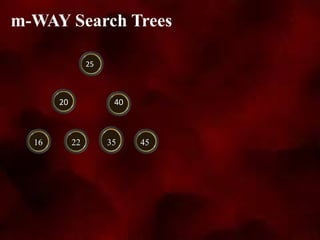
m-WAY Search Trees
25
20 40
16 22 35 45
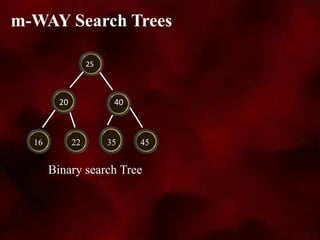
m-WAY Search Trees
25
20 40
16 22 35 45
Binary search Tree
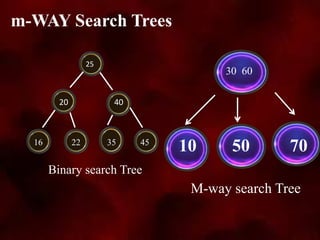
m-WAY Search Trees
25
20 40
16 22 35 45
Binary search Tree
10 50 70
30 60
M-way search Tree
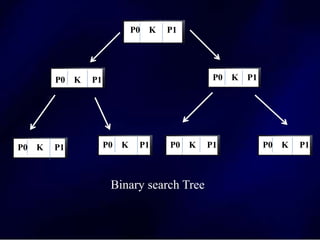
P0 K P1
P0 K P1 P0 K P1
P0 K P1 P0 K P1 P0 K P1 P0 K P1
Binary search Tree
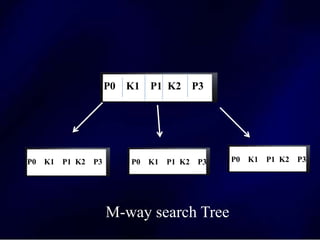
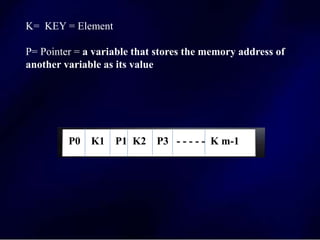
P0 K1 P1 K2 P3
P0 K1 P1 K2 P3 P0 K1 P1 K2 P3
P0 K1 P1 K2 P3
M-way search Tree
K=
K= KEY
K= KEY = Element
K= KEY = Element
P=
K= KEY = Element
P= Pointer
K= KEY = Element
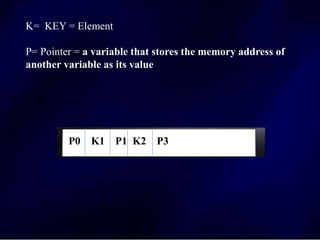
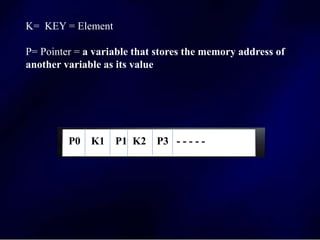
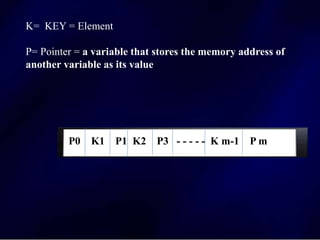
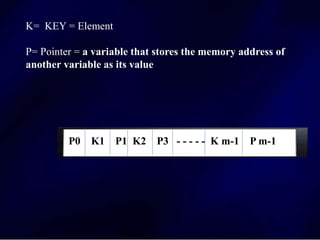
P= Pointer = a variable that stores the memory address of
another variable as its value
K= KEY = Element
P= Pointer = a variable that stores the memory address of
another variable as its value
P0 K1 P1 K2 P3
K= KEY = Element
P= Pointer = a variable that stores the memory address of
another variable as its value
P0 K1 P1 K2 P3 - - - - -
K= KEY = Element
P= Pointer = a variable that stores the memory address of
another variable as its value
P0 K1 P1 K2 P3 - - - - - K m-1
K= KEY = Element
P= Pointer = a variable that stores the memory address of
another variable as its value
P0 K1 P1 K2 P3 - - - - - K m-1 P m
K= KEY = Element
P= Pointer = a variable that stores the memory address of
another variable as its value
P0 K1 P1 K2 P3 - - - - - K m-1 P m-1
Types of Multi-way Search Trees
There are several types of multi-way search
trees, each with unique features and use
cases.
The two common types are
Types of Multi-way Search Trees
There are several types of multi-way search
trees, each with unique features and use
cases.

The two common types are
2-3 Tree and B-Tree.
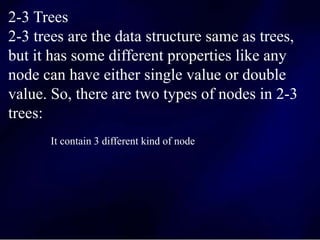
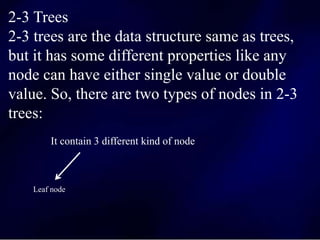
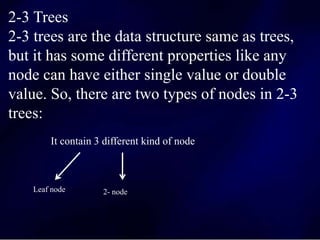
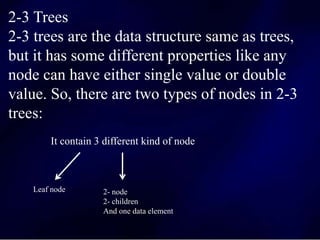
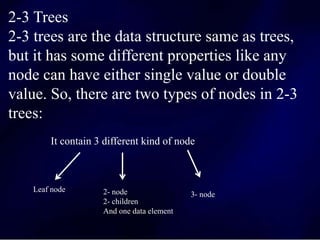
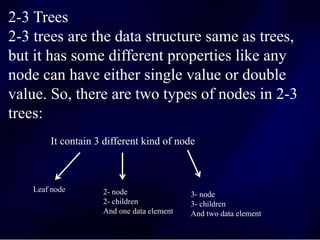
2-3 Trees
2-3 trees are the data structure same as trees,
but it has some different properties like any
node can have either single value or double
value. So, there are two types of nodes in 2-3
trees:
2-3 Trees
Properties of 2-3 tree
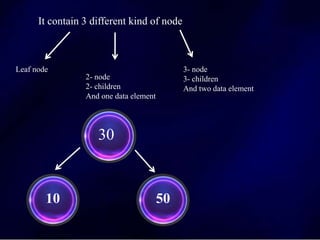
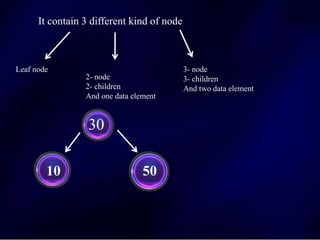
Nodes with two children are called 2-nodes. The 2-
nodes have one data value and two children
Nodes with three children are called 3-nodes. The 3-
nodes have two data values and three children.
Data is stored in sorted order.
It is a balanced tree.
All the leaf nodes are at same level.
Each node can either be leaf, 2 node, or 3 node.
Always insertion is done at leaf.
2-3 Trees
2-3 trees are the data structure same as trees,
but it has some different properties like any
node can have either single value or double
value. So, there are two types of nodes in 2-3
trees:
It contain 3 different kind of node
2-3 Trees
2-3 trees are the data structure same as trees,
but it has some different properties like any
node can have either single value or double
value. So, there are two types of nodes in 2-3
trees:
It contain 3 different kind of node
Leaf node
2-3 Trees
2-3 trees are the data structure same as trees,
but it has some different properties like any
node can have either single value or double
value. So, there are two types of nodes in 2-3
trees:
It contain 3 different kind of node
Leaf node 2- node
2-3 Trees
2-3 trees are the data structure same as trees,
but it has some different properties like any
node can have either single value or double
value. So, there are two types of nodes in 2-3
trees:
It contain 3 different kind of node
Leaf node 2- node
2- children
And one data element
2-3 Trees
2-3 trees are the data structure same as trees,
but it has some different properties like any
node can have either single value or double
value. So, there are two types of nodes in 2-3
trees:
It contain 3 different kind of node
Leaf node 2- node
2- children
And one data element
3- node
2-3 Trees
2-3 trees are the data structure same as trees,
but it has some different properties like any
node can have either single value or double
value. So, there are two types of nodes in 2-3
trees:
It contain 3 different kind of node
Leaf node 2- node
2- children
And one data element
3- node
3- children
And two data element
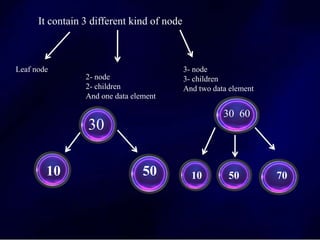
It contain 3 different kind of node
Leaf node
2- node
2- children
And one data element
3- node
3- children
And two data element
10 50
30
It contain 3 different kind of node
Leaf node
2- node
2- children
And one data element
3- node
3- children
And two data element
10 50
30
It contain 3 different kind of node
Leaf node
2- node
2- children
And one data element
3- node
3- children
And two data element
10 50
30
10 50 70
30 60
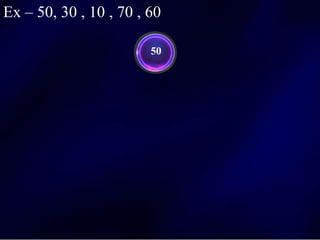
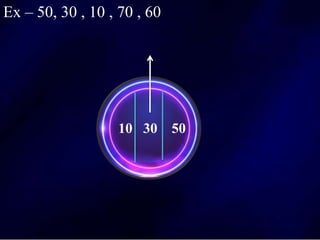
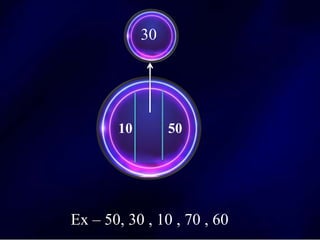
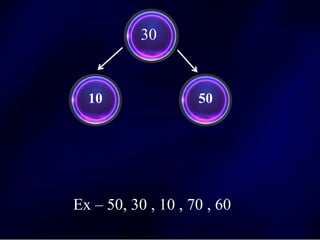
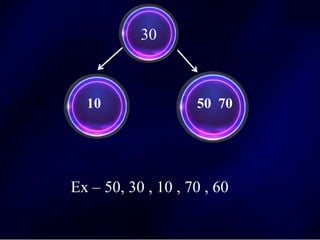
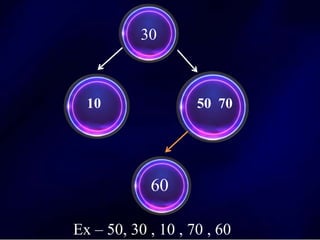
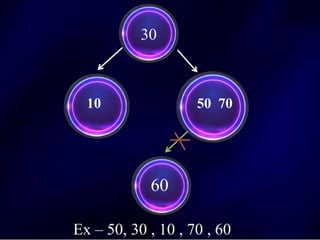
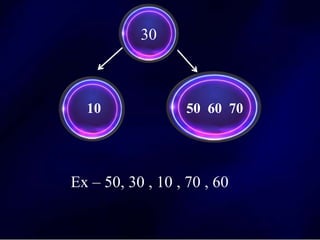
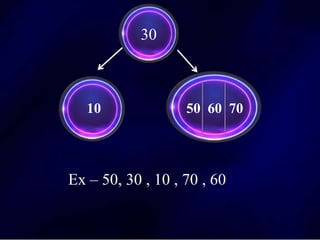
Ex – 50, 30 , 10 , 70 , 60
50
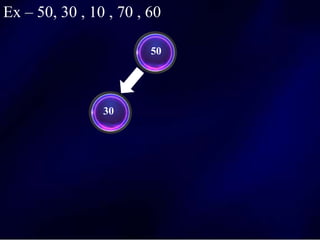
Ex – 50, 30 , 10 , 70 , 60
50
30
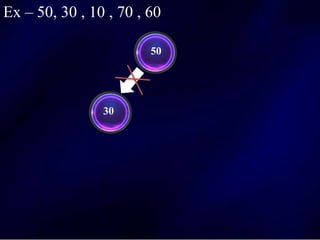
Ex – 50, 30 , 10 , 70 , 60
50
30
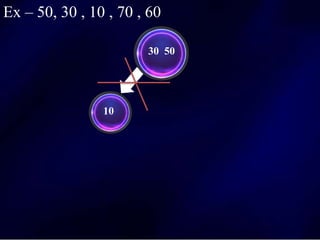
Ex – 50, 30 , 10 , 70 , 60
30 50
Ex – 50, 30 , 10 , 70 , 60
50
10
30 50
Ex – 50, 30 , 10 , 70 , 60
10 30 50
Ex – 50, 30 , 10 , 70 , 60
10 50
30
Ex – 50, 30 , 10 , 70 , 60
10 50
30
Ex – 50, 30 , 10 , 70 , 60
10 50 70
30
Ex – 50, 30 , 10 , 70 , 60
10 50 70
30
60
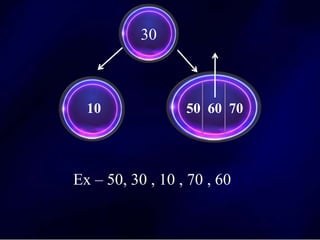
Ex – 50, 30 , 10 , 70 , 60
10 50 70
30
60
Ex – 50, 30 , 10 , 70 , 60
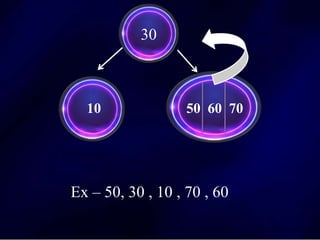
10 50 60 70
30
Ex – 50, 30 , 10 , 70 , 60
10 50 60 70
30
Ex – 50, 30 , 10 , 70 , 60
10 50 60 70
30
Ex – 50, 30 , 10 , 70 , 60
10 50 60 70
30
Ex – 50, 30 , 10 , 70 , 60
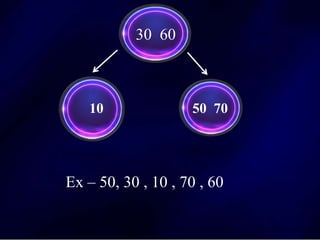
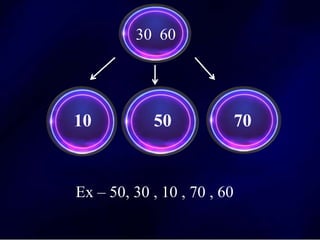
10 50 70
30 60
Ex – 50, 30 , 10 , 70 , 60
10 50 70
30 60
Ex – 50, 30 , 10 , 70 , 60
Search:
If T is empty, return False (key cannot be found in
the tree).
If current node contains data value which is equal
to K, return True.
If we reach the leaf-node and it doesn’t contain the
required key value K, return False.
Recursive Calls:
If K < currentNode.leftVal, we explore the left
subtree of the current node.
Else if currentNode.leftVal < K <
currentNode.rightVal, we explore the middle subtree
of the current node.
Else if K > currentNode.rightVal, we explore the
right subtree of the current node.
Insertion:
Insertion:
There are 3 possible cases in insertion which have
been discussed below:
Insertion:
There are 3 possible cases in insertion which have
been discussed below:
Case 1: Insert in a node with only one data
element
Insertion:
There are 3 possible cases in insertion which have
been discussed below:
Case 1: Insert in a node with only one data element
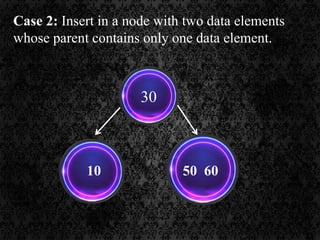
Case 2: Insert in a node with two data elements
whose parent contains only one data element.
Case 2: Insert in a node with two data elements
whose parent contains only one data element.
10 50 60
30
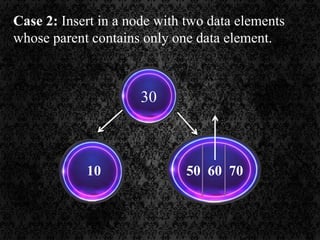
Case 2: Insert in a node with two data elements
whose parent contains only one data element.
10 50 60 70
30
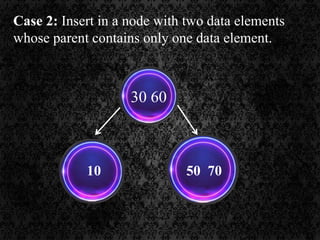
Case 2: Insert in a node with two data elements
whose parent contains only one data element.
10 50 70
30 60
Insertion:
There are 3 possible cases in insertion which have
been discussed below:
Case 1: Insert in a node with only one data element
Case 2: Insert in a node with two data elements
whose parent contains only one data element.
Case 3: Insert in a node with two data elements
whose parent also contains two data elements.
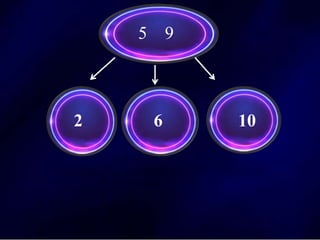
2 6 10
5 9
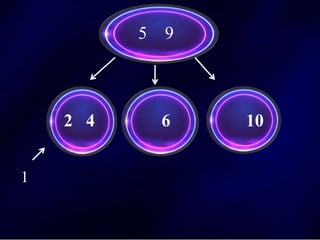
2 4 6 10
5 9
1
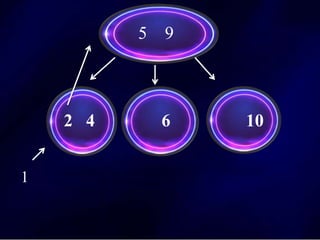
2 4 6 10
5 9
1
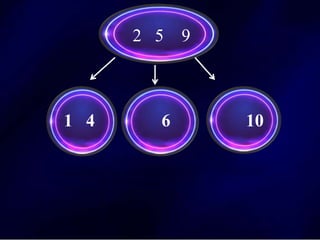
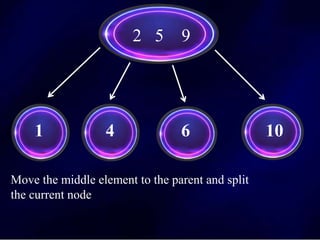
1 4 6 10
2 5 9
1 4 6 10
2 5 9
Move the middle element to the parent and split
the current node
Deletion
To delete a value, it is replaced by its in-order
successor and then removed.
If a node is left with less than one data value then
two nodes must be merged together.
If a node becomes empty after deleting a value, it is
then merged with another node.
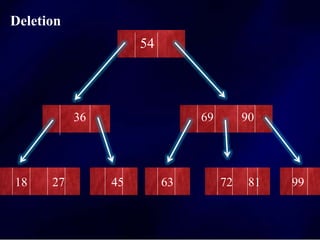
Deletion
54
36 69 90
18 27 45 63 72 81 99
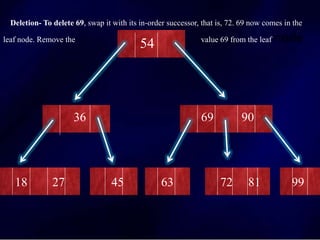
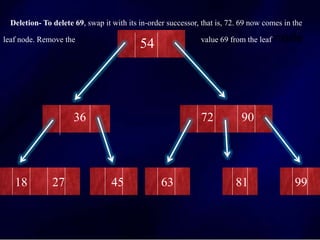
Deletion- To delete 69, swap it with its in-order successor, that is, 72. 69 now comes in the
leaf node. Remove the value 69 from the leaf node.
54
36 69 90
18 27 45 63 72 81 99
Deletion- To delete 69, swap it with its in-order successor, that is, 72. 69 now comes in the
leaf node. Remove the value 69 from the leaf node.
54
36 72 90
18 27 45 63 81 99
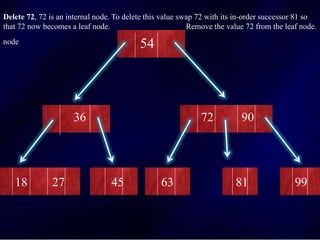
Delete 72, 72 is an internal node. To delete this value swap 72 with its in-order successor 81 so
that 72 now becomes a leaf node. Remove the value 72 from the leaf node.
node. 54
36 72 90
18 27 45 63 81 99
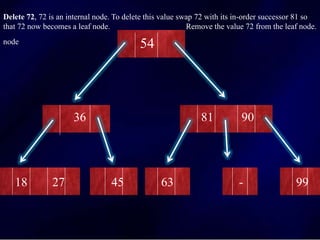
Delete 72, 72 is an internal node. To delete this value swap 72 with its in-order successor 81 so
that 72 now becomes a leaf node. Remove the value 72 from the leaf node.
node. 54
36 81 90
18 27 45 63 - 99
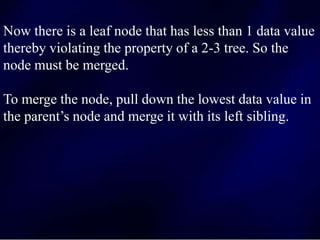
Now there is a leaf node that has less than 1 data value
thereby violating the property of a 2-3 tree. So the
node must be merged.
To merge the node, pull down the lowest data value in
the parent’s node and merge it with its left sibling.
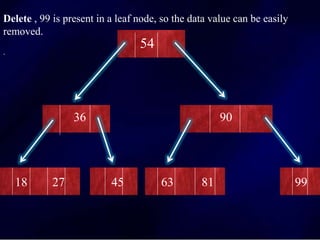
Delete , 99 is present in a leaf node, so the data value can be easily
removed.
.
54
36 90
18 27 45 63 81 99
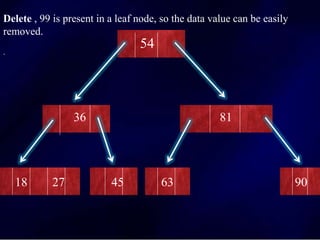
Delete , 99 is present in a leaf node, so the data value can be easily
removed.
.
54
36 81
18 27 45 63 90
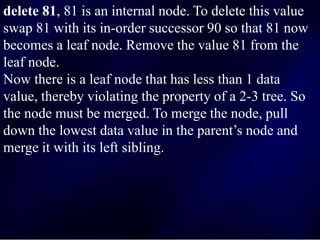
delete 81, 81 is an internal node. To delete this value
swap 81 with its in-order successor 90 so that 81 now
becomes a leaf node. Remove the value 81 from the
leaf node.
Now there is a leaf node that has less than 1 data
value, thereby violating the property of a 2-3 tree. So
the node must be merged. To merge the node, pull
down the lowest data value in the parent’s node and
merge it with its left sibling.
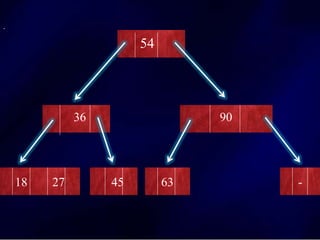
.
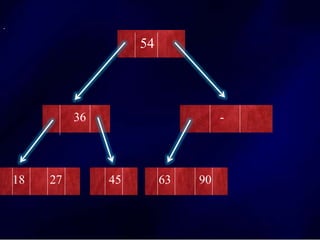
54
36 90
18 27 45 63 -
.
54
36 -
18 27 45 63 90
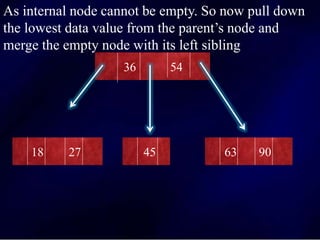
.
36 54
18 27 45 63 90
As internal node cannot be empty. So now pull down
the lowest data value from the parent’s node and
merge the empty node with its left sibling
2-3 tree ujjwal matoliya .pptx

2-3 tree ujjwal matoliya .pptx

  • 1.
    Submitted By Ujjwal matoliya AtalBihari Vajpayee Vishwavidyalaya Department of Computer Science and Information
  • 2.
    It stand formulti-way search tree m-WAY Search Trees
  • 3.
    It stand formulti-way search tree Multi-way search trees are a generalized version of binary trees m-WAY Search Trees
  • 4.
    It stand formulti-way search tree Multi-way search trees are a generalized version of binary trees That allow for efficient data searching and sorting m-WAY Search Trees
  • 5.
    It stand formulti-way search tree Multi-way search trees are a generalized version of binary trees That allow for efficient data searching and sorting In contrast to binary search trees, which can only have two children per node m-WAY Search Trees
  • 6.
    It stand formulti-way search tree Multi-way search trees are a generalized version of binary trees That allow for efficient data searching and sorting In contrast to binary search trees, which can only have two children per node Multi-way search trees can have multiple children per node m-WAY Search Trees
  • 7.
  • 8.
    m-WAY Search Trees 25 2040 16 22 35 45 Binary search Tree
  • 9.
    m-WAY Search Trees 25 2040 16 22 35 45 Binary search Tree 10 50 70 30 60 M-way search Tree
  • 10.
    P0 K P1 P0K P1 P0 K P1 P0 K P1 P0 K P1 P0 K P1 P0 K P1 Binary search Tree
  • 11.
    P0 K1 P1K2 P3 P0 K1 P1 K2 P3 P0 K1 P1 K2 P3 P0 K1 P1 K2 P3 M-way search Tree
  • 12.
  • 13.
  • 14.
    K= KEY =Element
  • 15.
    K= KEY =Element P=
  • 16.
    K= KEY =Element P= Pointer
  • 17.
    K= KEY =Element P= Pointer = a variable that stores the memory address of another variable as its value
  • 18.
    K= KEY =Element P= Pointer = a variable that stores the memory address of another variable as its value P0 K1 P1 K2 P3
  • 19.
    K= KEY =Element P= Pointer = a variable that stores the memory address of another variable as its value P0 K1 P1 K2 P3 - - - - -
  • 20.
    K= KEY =Element P= Pointer = a variable that stores the memory address of another variable as its value P0 K1 P1 K2 P3 - - - - - K m-1
  • 21.
    K= KEY =Element P= Pointer = a variable that stores the memory address of another variable as its value P0 K1 P1 K2 P3 - - - - - K m-1 P m
  • 22.
    K= KEY =Element P= Pointer = a variable that stores the memory address of another variable as its value P0 K1 P1 K2 P3 - - - - - K m-1 P m-1
  • 23.
    Types of Multi-waySearch Trees
  • 24.
    Types of Multi-waySearch Trees There are several types of multi-way search trees, each with unique features and use cases. The two common types are
  • 25.
    Types of Multi-waySearch Trees There are several types of multi-way search trees, each with unique features and use cases. The two common types are 2-3 Tree and B-Tree.
  • 26.
    2-3 Trees 2-3 treesare the data structure same as trees, but it has some different properties like any node can have either single value or double value. So, there are two types of nodes in 2-3 trees:
  • 27.
    2-3 Trees Properties of2-3 tree Nodes with two children are called 2-nodes. The 2- nodes have one data value and two children Nodes with three children are called 3-nodes. The 3- nodes have two data values and three children. Data is stored in sorted order. It is a balanced tree. All the leaf nodes are at same level. Each node can either be leaf, 2 node, or 3 node. Always insertion is done at leaf.
  • 28.
    2-3 Trees 2-3 treesare the data structure same as trees, but it has some different properties like any node can have either single value or double value. So, there are two types of nodes in 2-3 trees: It contain 3 different kind of node
  • 29.
    2-3 Trees 2-3 treesare the data structure same as trees, but it has some different properties like any node can have either single value or double value. So, there are two types of nodes in 2-3 trees: It contain 3 different kind of node Leaf node
  • 30.
    2-3 Trees 2-3 treesare the data structure same as trees, but it has some different properties like any node can have either single value or double value. So, there are two types of nodes in 2-3 trees: It contain 3 different kind of node Leaf node 2- node
  • 31.
    2-3 Trees 2-3 treesare the data structure same as trees, but it has some different properties like any node can have either single value or double value. So, there are two types of nodes in 2-3 trees: It contain 3 different kind of node Leaf node 2- node 2- children And one data element
  • 32.
    2-3 Trees 2-3 treesare the data structure same as trees, but it has some different properties like any node can have either single value or double value. So, there are two types of nodes in 2-3 trees: It contain 3 different kind of node Leaf node 2- node 2- children And one data element 3- node
  • 33.
    2-3 Trees 2-3 treesare the data structure same as trees, but it has some different properties like any node can have either single value or double value. So, there are two types of nodes in 2-3 trees: It contain 3 different kind of node Leaf node 2- node 2- children And one data element 3- node 3- children And two data element
  • 34.
    It contain 3different kind of node Leaf node 2- node 2- children And one data element 3- node 3- children And two data element 10 50 30
  • 35.
    It contain 3different kind of node Leaf node 2- node 2- children And one data element 3- node 3- children And two data element 10 50 30
  • 36.
    It contain 3different kind of node Leaf node 2- node 2- children And one data element 3- node 3- children And two data element 10 50 30 10 50 70 30 60
  • 38.
    Ex – 50,30 , 10 , 70 , 60
  • 39.
    50 Ex – 50,30 , 10 , 70 , 60
  • 40.
    50 30 Ex – 50,30 , 10 , 70 , 60
  • 41.
    50 30 Ex – 50,30 , 10 , 70 , 60
  • 42.
    30 50 Ex –50, 30 , 10 , 70 , 60
  • 43.
    50 10 30 50 Ex –50, 30 , 10 , 70 , 60
  • 44.
    10 30 50 Ex– 50, 30 , 10 , 70 , 60
  • 45.
    10 50 30 Ex –50, 30 , 10 , 70 , 60
  • 46.
    10 50 30 Ex –50, 30 , 10 , 70 , 60
  • 47.
    10 50 70 30 Ex– 50, 30 , 10 , 70 , 60
  • 48.
    10 50 70 30 60 Ex– 50, 30 , 10 , 70 , 60
  • 49.
    10 50 70 30 60 Ex– 50, 30 , 10 , 70 , 60
  • 50.
    10 50 6070 30 Ex – 50, 30 , 10 , 70 , 60
  • 51.
    10 50 6070 30 Ex – 50, 30 , 10 , 70 , 60
  • 52.
    10 50 6070 30 Ex – 50, 30 , 10 , 70 , 60
  • 53.
    10 50 6070 30 Ex – 50, 30 , 10 , 70 , 60
  • 54.
    10 50 70 3060 Ex – 50, 30 , 10 , 70 , 60
  • 55.
    10 50 70 3060 Ex – 50, 30 , 10 , 70 , 60
  • 56.
    Search: If T isempty, return False (key cannot be found in the tree). If current node contains data value which is equal to K, return True. If we reach the leaf-node and it doesn’t contain the required key value K, return False. Recursive Calls: If K < currentNode.leftVal, we explore the left subtree of the current node. Else if currentNode.leftVal < K < currentNode.rightVal, we explore the middle subtree of the current node. Else if K > currentNode.rightVal, we explore the right subtree of the current node.
  • 57.
  • 58.
    Insertion: There are 3possible cases in insertion which have been discussed below:
  • 59.
    Insertion: There are 3possible cases in insertion which have been discussed below: Case 1: Insert in a node with only one data element
  • 60.
    Insertion: There are 3possible cases in insertion which have been discussed below: Case 1: Insert in a node with only one data element Case 2: Insert in a node with two data elements whose parent contains only one data element.
  • 61.
    Case 2: Insertin a node with two data elements whose parent contains only one data element. 10 50 60 30
  • 62.
    Case 2: Insertin a node with two data elements whose parent contains only one data element. 10 50 60 70 30
  • 63.
    Case 2: Insertin a node with two data elements whose parent contains only one data element. 10 50 70 30 60
  • 64.
    Insertion: There are 3possible cases in insertion which have been discussed below: Case 1: Insert in a node with only one data element Case 2: Insert in a node with two data elements whose parent contains only one data element. Case 3: Insert in a node with two data elements whose parent also contains two data elements.
  • 65.
  • 66.
    2 4 610 5 9 1
  • 67.
    2 4 610 5 9 1
  • 68.
    1 4 610 2 5 9
  • 69.
    1 4 610 2 5 9 Move the middle element to the parent and split the current node
  • 70.
    Deletion To delete avalue, it is replaced by its in-order successor and then removed. If a node is left with less than one data value then two nodes must be merged together. If a node becomes empty after deleting a value, it is then merged with another node.
  • 71.
    Deletion 54 36 69 90 1827 45 63 72 81 99
  • 72.
    Deletion- To delete69, swap it with its in-order successor, that is, 72. 69 now comes in the leaf node. Remove the value 69 from the leaf node. 54 36 69 90 18 27 45 63 72 81 99
  • 73.
    Deletion- To delete69, swap it with its in-order successor, that is, 72. 69 now comes in the leaf node. Remove the value 69 from the leaf node. 54 36 72 90 18 27 45 63 81 99
  • 74.
    Delete 72, 72is an internal node. To delete this value swap 72 with its in-order successor 81 so that 72 now becomes a leaf node. Remove the value 72 from the leaf node. node. 54 36 72 90 18 27 45 63 81 99
  • 75.
    Delete 72, 72is an internal node. To delete this value swap 72 with its in-order successor 81 so that 72 now becomes a leaf node. Remove the value 72 from the leaf node. node. 54 36 81 90 18 27 45 63 - 99
  • 76.
    Now there isa leaf node that has less than 1 data value thereby violating the property of a 2-3 tree. So the node must be merged. To merge the node, pull down the lowest data value in the parent’s node and merge it with its left sibling.
  • 77.
    Delete , 99is present in a leaf node, so the data value can be easily removed. . 54 36 90 18 27 45 63 81 99
  • 78.
    Delete , 99is present in a leaf node, so the data value can be easily removed. . 54 36 81 18 27 45 63 90
  • 79.
    delete 81, 81is an internal node. To delete this value swap 81 with its in-order successor 90 so that 81 now becomes a leaf node. Remove the value 81 from the leaf node. Now there is a leaf node that has less than 1 data value, thereby violating the property of a 2-3 tree. So the node must be merged. To merge the node, pull down the lowest data value in the parent’s node and merge it with its left sibling.
  • 80.
  • 81.
  • 82.
    . 36 54 18 2745 63 90 As internal node cannot be empty. So now pull down the lowest data value from the parent’s node and merge the empty node with its left sibling