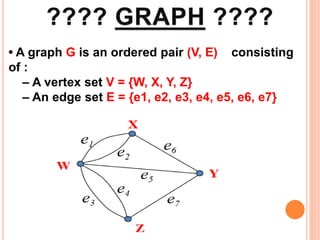
• A graph G is an ordered pair (V, E) consisting
of :
– A vertex set V = {W, X, Y, Z}
– An edge set E = {e1, e2, e3, e4, e5, e6, e7}
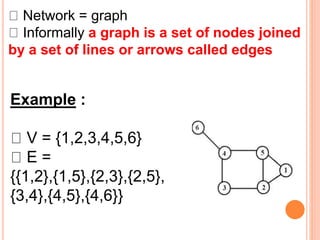
Network = graph
Informally a graph is a set of nodes joined
by a set of lines or arrows called edges
Example :
V = {1,2,3,4,5,6}
E =
{{1,2},{1,5},{2,3},{2,5},
{3,4},{4,5},{4,6}}
DIRECTED GRAPH :-
A directed graph (or digraph, or just graph) is a set
of vertices, V, together with a set of ordered pairs, E,
of edges. Thus we write that a graph,
G = (V,E)
Each edge consists of two vertices in V and is
represented diagrammatically by an arrow from
the first vertex to the second.
This definition permits self - loops, i.e., edges of
the form {v, v}, that begin and end at the same place
. Parallel edges, i.e., two identical edges in E, are
prohibited however.
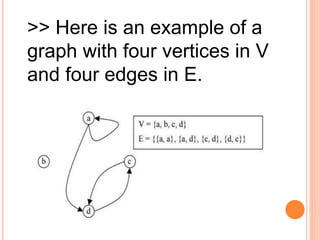
>> Here is an example of a
graph with four vertices in V
and four edges in E.
 Simple Digraphs :-
A digraph that has no self-loop or
parallel edges is called a simple digraph.
Asymmetric Digraphs :-
Digraphs that have at most one
directed edge between a pair of
vertices , but are allowed to have self –
loops , are called asymmetric or
antisymmetric.
Symmetric Digraphs :-
Digraphs in which for every edge (a,b) (
i.e., from vertex a to b ) there is also an edge
(b,a).
 NOTE :- A digraph that is both simple and
symmetric is called a simple symmetric
digraph.
NOTE :- A digraph that is both simple and
asymmetric is called a simple asymmetric
digraph.
Complete Digraphs :-
1) Complete symmetric digraph..
2) Complete asymmetric digraph
1. Complete Symmetric Digraph :-
complete symmetric digraph is a simple digraph in
which there is exactly one edge directed from every vertex to
every other vertex.
2. Complete Asymmetric Digraph :-
complete asymmetric digraph is an asymmetric
digraph in which there is exactly one edge between every pair
of vertices.
 Balanced Digraphs :-
A digraph is said to be balanced if for every vertex
v , the in-degree equals to out-degree.
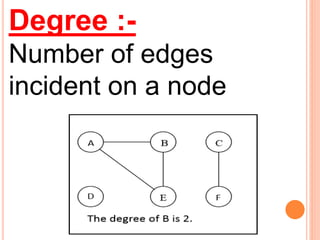
Degree :-
Number of edges
incident on a node
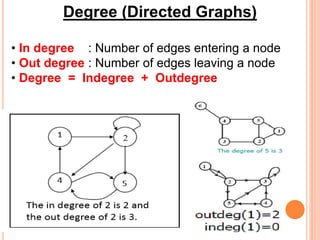
Degree (Directed Graphs)
• In degree : Number of edges entering a node
• Out degree : Number of edges leaving a node
• Degree = Indegree + Outdegree
Degree: Simple Facts
• If G is a graph with m edges, then
Σ deg(v) = 2m = 2 |E |
• If G is a digraph with m edges, then
Σ indeg(v) = Σ outdeg(v) = m = |E |
– Number of Odd degree Nodes is
even
graphtheory

graphtheory

  • 3.
    • A graphG is an ordered pair (V, E) consisting of : – A vertex set V = {W, X, Y, Z} – An edge set E = {e1, e2, e3, e4, e5, e6, e7}
  • 4.
    Network = graph Informallya graph is a set of nodes joined by a set of lines or arrows called edges Example : V = {1,2,3,4,5,6} E = {{1,2},{1,5},{2,3},{2,5}, {3,4},{4,5},{4,6}}
  • 5.
    DIRECTED GRAPH :- Adirected graph (or digraph, or just graph) is a set of vertices, V, together with a set of ordered pairs, E, of edges. Thus we write that a graph, G = (V,E) Each edge consists of two vertices in V and is represented diagrammatically by an arrow from the first vertex to the second. This definition permits self - loops, i.e., edges of the form {v, v}, that begin and end at the same place . Parallel edges, i.e., two identical edges in E, are prohibited however.
  • 6.
    >> Here isan example of a graph with four vertices in V and four edges in E.
  • 7.
     Simple Digraphs:- A digraph that has no self-loop or parallel edges is called a simple digraph. Asymmetric Digraphs :- Digraphs that have at most one directed edge between a pair of vertices , but are allowed to have self – loops , are called asymmetric or antisymmetric.
  • 8.
    Symmetric Digraphs :- Digraphsin which for every edge (a,b) ( i.e., from vertex a to b ) there is also an edge (b,a).  NOTE :- A digraph that is both simple and symmetric is called a simple symmetric digraph. NOTE :- A digraph that is both simple and asymmetric is called a simple asymmetric digraph.
  • 9.
    Complete Digraphs :- 1)Complete symmetric digraph.. 2) Complete asymmetric digraph 1. Complete Symmetric Digraph :- complete symmetric digraph is a simple digraph in which there is exactly one edge directed from every vertex to every other vertex. 2. Complete Asymmetric Digraph :- complete asymmetric digraph is an asymmetric digraph in which there is exactly one edge between every pair of vertices.  Balanced Digraphs :- A digraph is said to be balanced if for every vertex v , the in-degree equals to out-degree.
  • 10.
    Degree :- Number ofedges incident on a node
  • 11.
    Degree (Directed Graphs) •In degree : Number of edges entering a node • Out degree : Number of edges leaving a node • Degree = Indegree + Outdegree
  • 12.
    Degree: Simple Facts •If G is a graph with m edges, then Σ deg(v) = 2m = 2 |E | • If G is a digraph with m edges, then Σ indeg(v) = Σ outdeg(v) = m = |E | – Number of Odd degree Nodes is even