JSS MAHAVIDYAPEETHA MYSORE 04
JSS INSTITUTE OF EDUCATION, SAKALESHPUR
Topic- SETS
Submitted by
Rohith V
1st Year B Ed
2nd semester
SETS
SETS
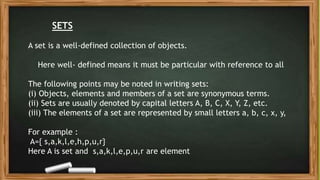
A set is a well-defined collection of objects.
Here well- defined means it must be particular with reference to all
The following points may be noted in writing sets:
(i) Objects, elements and members of a set are synonymous terms.
(ii) Sets are usually denoted by capital letters A, B, C, X, Y, Z, etc.
(iii) The elements of a set are represented by small letters a, b, c, x, y,
For example :
A={ s,a,k,l,e,h,p,u,r}
Here A is set and s,a,k,l,e,p,u,r are element
REPRESENTATION OF SET
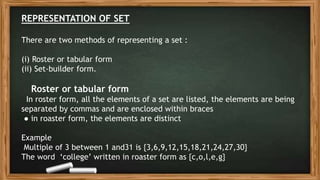
There are two methods of representing a set :
(i) Roster or tabular form
(ii) Set-builder form.
Roster or tabular form
In roster form, all the elements of a set are listed, the elements are being
separated by commas and are enclosed within braces
● in roaster form, the elements are distinct
Example
Multiple of 3 between 1 and31 is {3,6,9,12,15,18,21,24,27,30}
The word ‘college’ written in roaster form as {c,o,l,e,g}
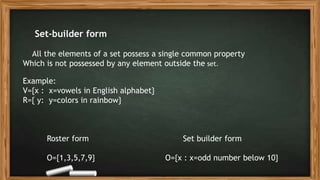
Set-builder form
All the elements of a set possess a single common property
Which is not possessed by any element outside the set.
Example:
V={x : x=vowels in English alphabet}
R={ y: y=colors in rainbow}
Roster form Set builder form
O={1,3,5,7,9} O={x : x=odd number below 10}
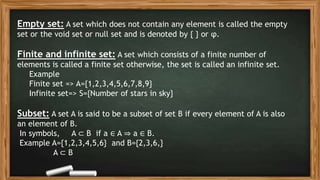
Empty set: A set which does not contain any element is called the empty
set or the void set or null set and is denoted by { } or φ.
Finite and infinite set: A set which consists of a finite number of
elements is called a finite set otherwise, the set is called an infinite set.
Example
Finite set => A={1,2,3,4,5,6,7,8,9}
Infinite set=> S={Number of stars in sky}
Subset: A set A is said to be a subset of set B if every element of A is also
an element of B.
In symbols, A ⊂ B if a ∈ A ⇒ a ∈ B.
Example A={1,2,3,4,5,6} and B={2,3,6,}
A ⊂ B
Equal set: Given two sets A and B, if every elements of A is also an
element of B and if every element of B is also an element of A, then
the sets A and B are said to be equal.
If A={2,4,6,8} and B={2,4,6,8}
Then set Aand set B are equal set
Intervals as subsets of R
Let a, b ∈ R and a < b. Then
(a) An open interval denoted by (a, b) is the set of real numbers {x : a
< x < b} this imples all elements between a & b expect a, b
(b) A closed interval denoted by [a, b] is the set of real numbers {x : a
≤ x ≤ b) Means all elements between a &b and a,b
(c) Intervals closed at one end and open at the other are given by
[a, b) = {x : a ≤ x < b} (a, b] = {x : a < x ≤ b}
Power set: The collection of all subsets of a set A is called the power set of A.
• it is denoted by P(A).
• If the number of elements in A = n , i.e., n(A) = n, then thenumber of
elements in P(A) = 2n
Universal set :
• This is a basic set.
• in a particular context whose elements and subsets are relevant to that
particular context.
• It is denoted by English aphabet letter U
Example ,
for the set of vowels in the English alphabet, the universal set can be the
set of all alphabets in English. Universal
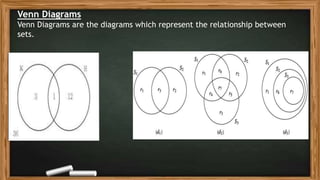
Venn Diagrams
Venn Diagrams are the diagrams which represent the relationship between
sets.
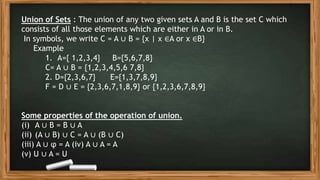
Union of Sets : The union of any two given sets A and B is the set C which
consists of all those elements which are either in A or in B.
In symbols, we write C = A ∪ B = {x | x ∈A or x ∈B}
Example
1. A={ 1,2,3,4} B={5,6,7,8}
C= A ∪ B = {1,2,3,4,5,6 7,8}
2. D={2,3,6,7} E={1,3,7,8,9}
F = D ∪ E = {2,3,6,7,1,8,9} or {1,2,3,6,7,8,9}
Some properties of the operation of union.
(i) A ∪ B = B ∪ A
(ii) (A ∪ B) ∪ C = A ∪ (B ∪ C)
(iii) A ∪ φ = A (iv) A ∪ A = A
(v) U ∪ A = U
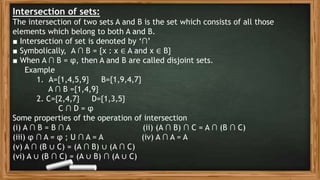
Intersection of sets:
The intersection of two sets A and B is the set which consists of all those
elements which belong to both A and B.
■ Intersection of set is denoted by ‘∩’
■ Symbolically, A ∩ B = {x : x ∈ A and x ∈ B}
■ When A ∩ B = φ, then A and B are called disjoint sets.
Example
1. A={1,4,5,9} B={1,9,4,7}
A ∩ B ={1,4,9}
2. C={2,4,7} D={1,3,5}
C ∩ D = φ
Some properties of the operation of intersection
(i) A ∩ B = B ∩ A (ii) (A ∩ B) ∩ C = A ∩ (B ∩ C)
(iii) φ ∩ A = φ ; U ∩ A = A (iv) A ∩ A = A
(v) A ∩ (B ∪ C) = (A ∩ B) ∪ (A ∩ C)
(vi) A ∪ (B ∩ C) = (A ∪ B) ∩ (A ∪ C)
SET AND ITS OPERATIONS

SET AND ITS OPERATIONS

  • 1.
    JSS MAHAVIDYAPEETHA MYSORE04 JSS INSTITUTE OF EDUCATION, SAKALESHPUR Topic- SETS Submitted by Rohith V 1st Year B Ed 2nd semester
  • 2.
  • 3.
    SETS A set isa well-defined collection of objects. Here well- defined means it must be particular with reference to all The following points may be noted in writing sets: (i) Objects, elements and members of a set are synonymous terms. (ii) Sets are usually denoted by capital letters A, B, C, X, Y, Z, etc. (iii) The elements of a set are represented by small letters a, b, c, x, y, For example : A={ s,a,k,l,e,h,p,u,r} Here A is set and s,a,k,l,e,p,u,r are element
  • 4.
    REPRESENTATION OF SET Thereare two methods of representing a set : (i) Roster or tabular form (ii) Set-builder form. Roster or tabular form In roster form, all the elements of a set are listed, the elements are being separated by commas and are enclosed within braces ● in roaster form, the elements are distinct Example Multiple of 3 between 1 and31 is {3,6,9,12,15,18,21,24,27,30} The word ‘college’ written in roaster form as {c,o,l,e,g}
  • 5.
    Set-builder form All theelements of a set possess a single common property Which is not possessed by any element outside the set. Example: V={x : x=vowels in English alphabet} R={ y: y=colors in rainbow} Roster form Set builder form O={1,3,5,7,9} O={x : x=odd number below 10}
  • 6.
    Empty set: Aset which does not contain any element is called the empty set or the void set or null set and is denoted by { } or φ. Finite and infinite set: A set which consists of a finite number of elements is called a finite set otherwise, the set is called an infinite set. Example Finite set => A={1,2,3,4,5,6,7,8,9} Infinite set=> S={Number of stars in sky} Subset: A set A is said to be a subset of set B if every element of A is also an element of B. In symbols, A ⊂ B if a ∈ A ⇒ a ∈ B. Example A={1,2,3,4,5,6} and B={2,3,6,} A ⊂ B
  • 7.
    Equal set: Giventwo sets A and B, if every elements of A is also an element of B and if every element of B is also an element of A, then the sets A and B are said to be equal. If A={2,4,6,8} and B={2,4,6,8} Then set Aand set B are equal set Intervals as subsets of R Let a, b ∈ R and a < b. Then (a) An open interval denoted by (a, b) is the set of real numbers {x : a < x < b} this imples all elements between a & b expect a, b (b) A closed interval denoted by [a, b] is the set of real numbers {x : a ≤ x ≤ b) Means all elements between a &b and a,b (c) Intervals closed at one end and open at the other are given by [a, b) = {x : a ≤ x < b} (a, b] = {x : a < x ≤ b}
  • 8.
    Power set: Thecollection of all subsets of a set A is called the power set of A. • it is denoted by P(A). • If the number of elements in A = n , i.e., n(A) = n, then thenumber of elements in P(A) = 2n Universal set : • This is a basic set. • in a particular context whose elements and subsets are relevant to that particular context. • It is denoted by English aphabet letter U Example , for the set of vowels in the English alphabet, the universal set can be the set of all alphabets in English. Universal
  • 9.
    Venn Diagrams Venn Diagramsare the diagrams which represent the relationship between sets.
  • 10.
    Union of Sets: The union of any two given sets A and B is the set C which consists of all those elements which are either in A or in B. In symbols, we write C = A ∪ B = {x | x ∈A or x ∈B} Example 1. A={ 1,2,3,4} B={5,6,7,8} C= A ∪ B = {1,2,3,4,5,6 7,8} 2. D={2,3,6,7} E={1,3,7,8,9} F = D ∪ E = {2,3,6,7,1,8,9} or {1,2,3,6,7,8,9} Some properties of the operation of union. (i) A ∪ B = B ∪ A (ii) (A ∪ B) ∪ C = A ∪ (B ∪ C) (iii) A ∪ φ = A (iv) A ∪ A = A (v) U ∪ A = U
  • 11.
    Intersection of sets: Theintersection of two sets A and B is the set which consists of all those elements which belong to both A and B. ■ Intersection of set is denoted by ‘∩’ ■ Symbolically, A ∩ B = {x : x ∈ A and x ∈ B} ■ When A ∩ B = φ, then A and B are called disjoint sets. Example 1. A={1,4,5,9} B={1,9,4,7} A ∩ B ={1,4,9} 2. C={2,4,7} D={1,3,5} C ∩ D = φ Some properties of the operation of intersection (i) A ∩ B = B ∩ A (ii) (A ∩ B) ∩ C = A ∩ (B ∩ C) (iii) φ ∩ A = φ ; U ∩ A = A (iv) A ∩ A = A (v) A ∩ (B ∪ C) = (A ∩ B) ∪ (A ∩ C) (vi) A ∪ (B ∩ C) = (A ∪ B) ∩ (A ∪ C)