Chapter 5
Counting
5.1 The Basics of Counting
5.3 Permutations and
Combinations
P. 335
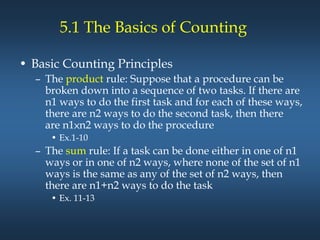
5.1 The Basics of Counting
• Basic Counting Principles
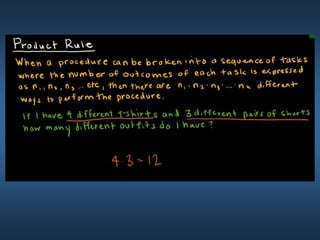
– The product rule: Suppose that a procedure can be
broken down into a sequence of two tasks. If there are
n1 ways to do the first task and for each of these ways,
there are n2 ways to do the second task, then there
are n1×n2 ways to do the procedure
• Ex.1-10
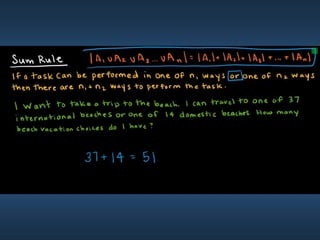
– The sum rule: If a task can be done either in one of n1
ways or in one of n2 ways, where none of the set of n1
ways is the same as any of the set of n2 ways, then
there are n1+n2 ways to do the task
• Ex. 11-13
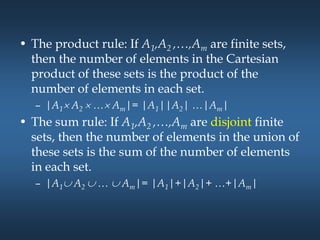
• The product rule: If A1,A2 ,…,Am are finite sets,
then the number of elements in the Cartesian
product of these sets is the product of the
number of elements in each set.
– |A1 A2  … Am|= |A1||A2| …|Am|
• The sum rule: If A1,A2 ,…,Am are disjoint finite
sets, then the number of elements in the union of
these sets is the sum of the number of elements
in each set.
– |A1 A2  …  Am|= |A1|+|A2|+ …+|Am|
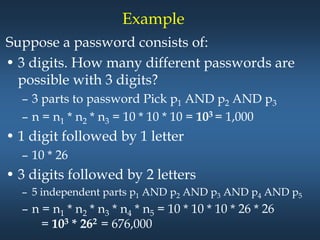
Example
Suppose a password consists of:
• 3 digits. How many different passwords are
possible with 3 digits?
– 3 parts to password Pick p1 AND p2 AND p3
– n = n1 * n2 * n3 = 10 * 10 * 10 = 103 = 1,000
• 1 digit followed by 1 letter
– 10 * 26
• 3 digits followed by 2 letters
– 5 independent parts p1 AND p2 AND p3 AND p4 AND p5
– n = n1 * n2 * n3 * n4 * n5 = 10 * 10 * 10 * 26 * 26
= 103 * 262 = 676,000
Examples
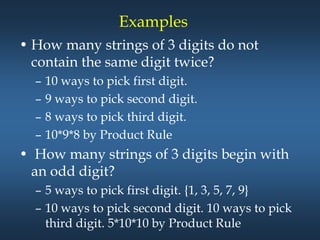
• How many strings of 3 digits do not
contain the same digit twice?
– 10 ways to pick first digit.
– 9 ways to pick second digit.
– 8 ways to pick third digit.
– 10*9*8 by Product Rule
• How many strings of 3 digits begin with
an odd digit?
– 5 ways to pick first digit. {1, 3, 5, 7, 9}
– 10 ways to pick second digit. 10 ways to pick
third digit. 5*10*10 by Product Rule
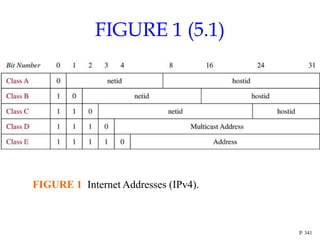
FIGURE 1 (5.1)
FIGURE 1 Internet Addresses (IPv4).
P. 341
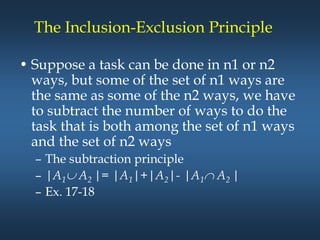
The Inclusion-Exclusion Principle
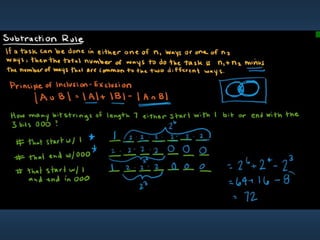
• Suppose a task can be done in n1 or n2
ways, but some of the set of n1 ways are
the same as some of the n2 ways, we have
to subtract the number of ways to do the
task that is both among the set of n1 ways
and the set of n2 ways
– The subtraction principle
– |A1 A2 |= |A1|+|A2|- |A1 A2 |
– Ex. 17-18
Example
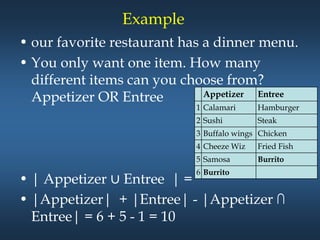
• our favorite restaurant has a dinner menu.
• You only want one item. How many
different items can you choose from?
Appetizer OR Entree
• | Appetizer ∪ Entree | =
• |Appetizer| + |Entree| - |Appetizer ∩
Entree| = 6 + 5 - 1 = 10
Appetizer Entree
1 Calamari Hamburger
2 Sushi Steak
3 Buffalo wings Chicken
4 Cheeze Wiz Fried Fish
5 Samosa Burrito
6 Burrito
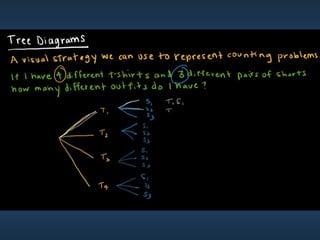
Tree Diagrams
• Counting problems can be solved using
tree diagrams
– Leaves: possible outcomes
– Ex. 19-21
5.3 Permutations and Combinations
• Permutations
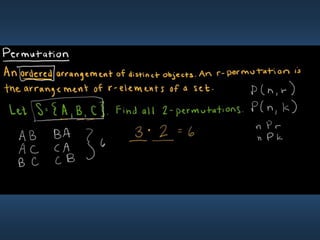
– A permutation of a set of distinct objects is an
ordered arrangement of these objects
– r-permutation: an ordered arrangement of r
elements of a set
– Ex.1
– Ex.2
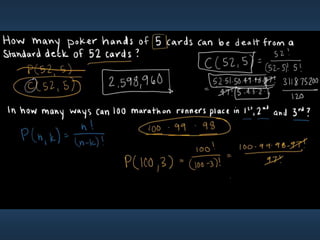
– P(n,r): the number of r-permutations of a set
with n elements
• Theorem 1: If n is a positive integer and r
is an integer with 1<=r<=n, then there are
P(n,r)=n(n-1)(n-2)…(n-r+1) r-permutations
of a set with n distinct elements.
– P(n,0)=1
– P(n,n)=n!
• Corollary 1: If n and r are integers with
0<=r<=n, then P(n,r)=n!/(n-r)!
– Ex. 4-7
Example
• You need to fly to 5 cities in any order,
how many possible air tickets do you need
to consider?
– Pick 1 of 5 cities to visit first. 5
– Pick 1 of 4 remaining to visit second. * 4
– Pick 1 of 3 remaining to visit third. * 3
– Pick 1 of 2 remaining to visit fourth. * 2
– Pick 1 of 1 remaining to visit last. * 1
– Total 5*4*3*2*1 = 5! = 120
Example
• S = {a, b, c}, (a, b) ≠ (b, a) it is a different 2-
permutation of S. How many different ways
are there to order {a, b, c} as a 2-tuple?
• Often stated as "What are all the possible ways
to take 3 things, 2 at a time?"
– 2 picks Ways to pick
– Pick 1 of 3 from {a, b, c}. 3
– Pick 1 from remaining 2. * 2
– 3*2 = 6
– {(a, b), (a, c), (b, a), (b, c), (c, a), (c, b)}
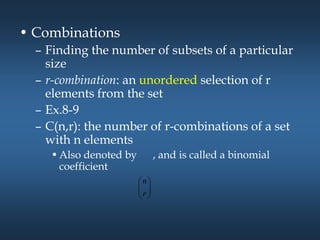
• Combinations
– Finding the number of subsets of a particular
size
– r-combination: an unordered selection of r
elements from the set
– Ex.8-9
– C(n,r): the number of r-combinations of a set
with n elements
•Also denoted by , and is called a binomial
coefficient








r
n
Example
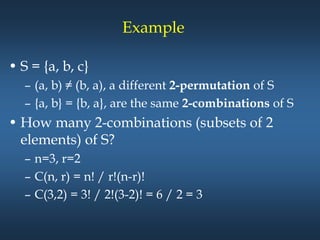
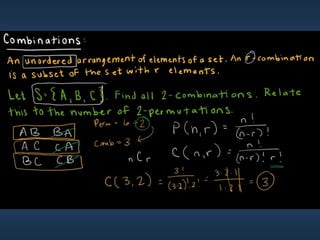
• S = {a, b, c}
– (a, b) ≠ (b, a), a different 2-permutation of S
– {a, b} = {b, a}, are the same 2-combinations of S
• How many 2-combinations (subsets of 2
elements) of S?
– n=3, r=2
– C(n, r) = n! / r!(n-r)!
– C(3,2) = 3! / 2!(3-2)! = 6 / 2 = 3
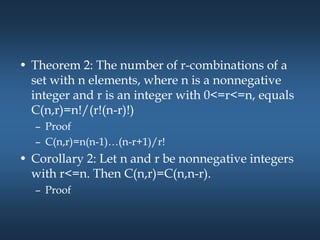
• Theorem 2: The number of r-combinations of a
set with n elements, where n is a nonnegative
integer and r is an integer with 0<=r<=n, equals
C(n,r)=n!/(r!(n-r)!)
– Proof
– C(n,r)=n(n-1)…(n-r+1)/r!
• Corollary 2: Let n and r be nonnegative integers
with r<=n. Then C(n,r)=C(n,n-r).
– Proof
Example
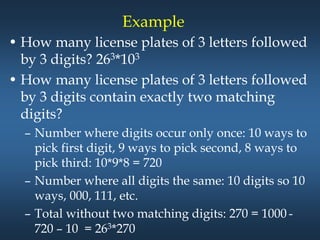
• How many license plates of 3 letters followed
by 3 digits? 263*103
• How many license plates of 3 letters followed
by 3 digits contain exactly two matching
digits?
– Number where digits occur only once: 10 ways to
pick first digit, 9 ways to pick second, 8 ways to
pick third: 10*9*8 = 720
– Number where all digits the same: 10 digits so 10
ways, 000, 111, etc.
– Total without two matching digits: 270 = 1000 -
720 – 10 = 263*270
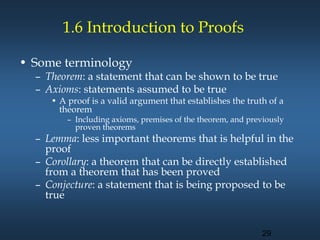
1.6 Introduction to Proofs
• Some terminology
– Theorem: a statement that can be shown to be true
– Axioms: statements assumed to be true
• A proof is a valid argument that establishes the truth of a
theorem
– Including axioms, premises of the theorem, and previously
proven theorems
– Lemma: less important theorems that is helpful in the
proof
– Corollary: a theorem that can be directly established
from a theorem that has been proved
– Conjecture: a statement that is being proposed to be
true
29
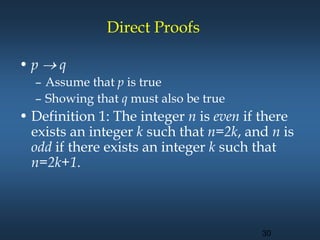
Direct Proofs
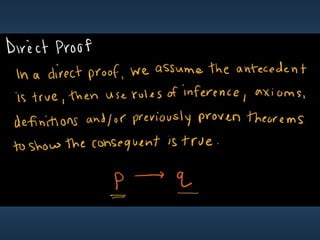
• p  q
– Assume that p is true
– Showing that q must also be true
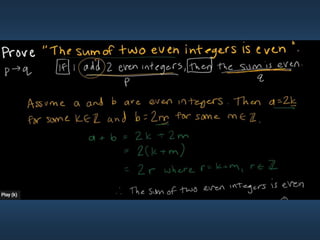
• Definition 1: The integer n is even if there
exists an integer k such that n=2k, and n is
odd if there exists an integer k such that
n=2k+1.
30
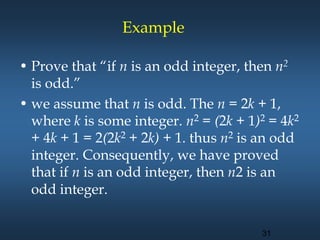
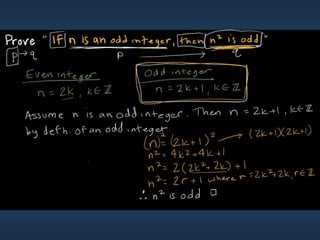
• Prove that “if n is an odd integer, then n2
is odd.”
• we assume that n is odd. The n = 2k + 1,
where k is some integer. n2 = (2k + 1)2 = 4k2
+ 4k + 1 = 2(2k2 + 2k) + 1. thus n2 is an odd
integer. Consequently, we have proved
that if n is an odd integer, then n2 is an
odd integer.
Example
31
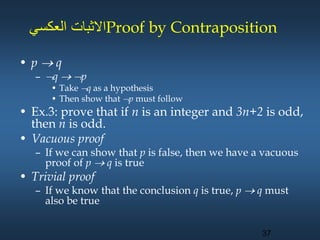
‫العكسي‬ ‫االثبات‬Proof by Contraposition
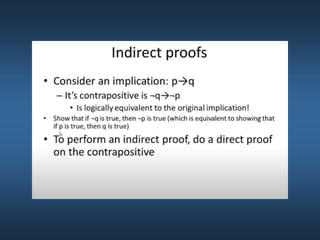
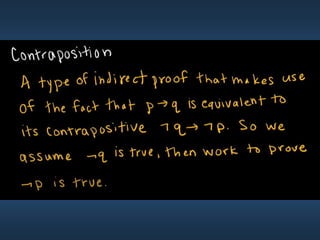
• p  q
– q  p
• Take q as a hypothesis
• Then show that p must follow
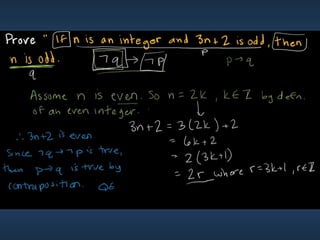
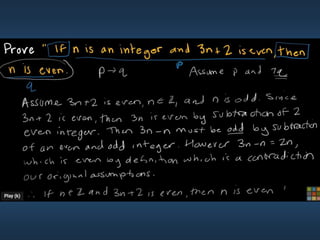
• Ex.3: prove that if n is an integer and 3n+2 is odd,
then n is odd.
• Vacuous proof
– If we can show that p is false, then we have a vacuous
proof of p  q is true
• Trivial proof
– If we know that the conclusion q is true, p  q must
also be true
37
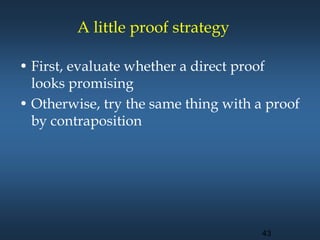
A little proof strategy
• First, evaluate whether a direct proof
looks promising
• Otherwise, try the same thing with a proof
by contraposition
43
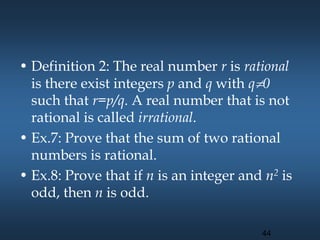
• Definition 2: The real number r is rational
is there exist integers p and q with q0
such that r=p/q. A real number that is not
rational is called irrational.
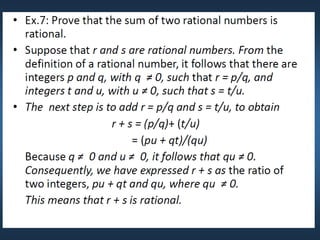
• Ex.7: Prove that the sum of two rational
numbers is rational.
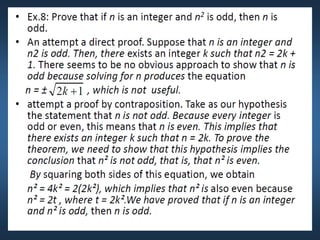
• Ex.8: Prove that if n is an integer and n2 is
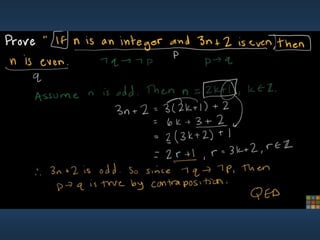
odd, then n is odd.
44
‫بالتعارض‬ ‫االثبات‬Proof by
Contradiction
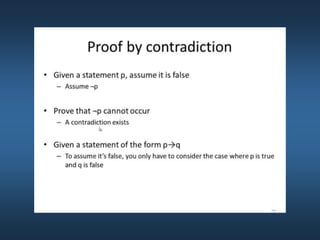
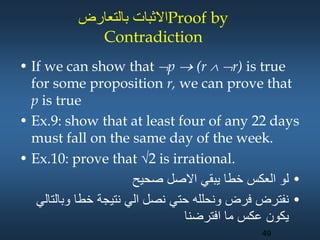
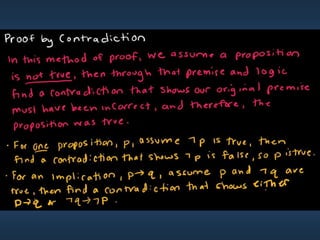
• If we can show that p  (r  r) is true
for some proposition r, we can prove that
p is true
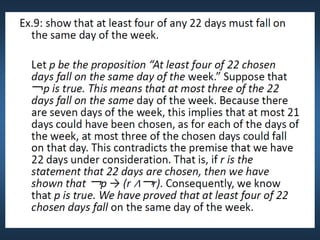
• Ex.9: show that at least four of any 22 days
must fall on the same day of the week.
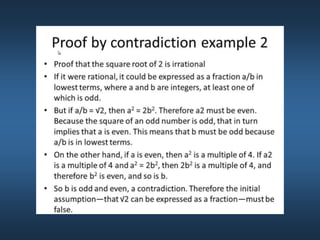
• Ex.10: prove that 2 is irrational.
•
‫صحيح‬ ‫االصل‬ ‫يبقي‬ ‫خطا‬ ‫العكس‬ ‫لو‬
•
‫وب‬ ‫خطا‬ ‫نتيجة‬ ‫الي‬ ‫نصل‬ ‫حتي‬ ‫ونحلله‬ ‫فرض‬ ‫نفترض‬
‫التالي‬
‫افترضنا‬ ‫ما‬ ‫عكس‬ ‫يكون‬
49
Discrete Math Ch5 counting + proofs

Discrete Math Ch5 counting + proofs

  • 1.
  • 2.
    5.1 The Basicsof Counting 5.3 Permutations and Combinations P. 335
  • 3.
    5.1 The Basicsof Counting • Basic Counting Principles – The product rule: Suppose that a procedure can be broken down into a sequence of two tasks. If there are n1 ways to do the first task and for each of these ways, there are n2 ways to do the second task, then there are n1×n2 ways to do the procedure • Ex.1-10 – The sum rule: If a task can be done either in one of n1 ways or in one of n2 ways, where none of the set of n1 ways is the same as any of the set of n2 ways, then there are n1+n2 ways to do the task • Ex. 11-13
  • 4.
    • The productrule: If A1,A2 ,…,Am are finite sets, then the number of elements in the Cartesian product of these sets is the product of the number of elements in each set. – |A1 A2  … Am|= |A1||A2| …|Am| • The sum rule: If A1,A2 ,…,Am are disjoint finite sets, then the number of elements in the union of these sets is the sum of the number of elements in each set. – |A1 A2  …  Am|= |A1|+|A2|+ …+|Am|
  • 8.
    Example Suppose a passwordconsists of: • 3 digits. How many different passwords are possible with 3 digits? – 3 parts to password Pick p1 AND p2 AND p3 – n = n1 * n2 * n3 = 10 * 10 * 10 = 103 = 1,000 • 1 digit followed by 1 letter – 10 * 26 • 3 digits followed by 2 letters – 5 independent parts p1 AND p2 AND p3 AND p4 AND p5 – n = n1 * n2 * n3 * n4 * n5 = 10 * 10 * 10 * 26 * 26 = 103 * 262 = 676,000
  • 9.
    Examples • How manystrings of 3 digits do not contain the same digit twice? – 10 ways to pick first digit. – 9 ways to pick second digit. – 8 ways to pick third digit. – 10*9*8 by Product Rule • How many strings of 3 digits begin with an odd digit? – 5 ways to pick first digit. {1, 3, 5, 7, 9} – 10 ways to pick second digit. 10 ways to pick third digit. 5*10*10 by Product Rule
  • 10.
    FIGURE 1 (5.1) FIGURE1 Internet Addresses (IPv4). P. 341
  • 12.
    The Inclusion-Exclusion Principle •Suppose a task can be done in n1 or n2 ways, but some of the set of n1 ways are the same as some of the n2 ways, we have to subtract the number of ways to do the task that is both among the set of n1 ways and the set of n2 ways – The subtraction principle – |A1 A2 |= |A1|+|A2|- |A1 A2 | – Ex. 17-18
  • 14.
    Example • our favoriterestaurant has a dinner menu. • You only want one item. How many different items can you choose from? Appetizer OR Entree • | Appetizer ∪ Entree | = • |Appetizer| + |Entree| - |Appetizer ∩ Entree| = 6 + 5 - 1 = 10 Appetizer Entree 1 Calamari Hamburger 2 Sushi Steak 3 Buffalo wings Chicken 4 Cheeze Wiz Fried Fish 5 Samosa Burrito 6 Burrito
  • 15.
    Tree Diagrams • Countingproblems can be solved using tree diagrams – Leaves: possible outcomes – Ex. 19-21
  • 17.
    5.3 Permutations andCombinations • Permutations – A permutation of a set of distinct objects is an ordered arrangement of these objects – r-permutation: an ordered arrangement of r elements of a set – Ex.1 – Ex.2 – P(n,r): the number of r-permutations of a set with n elements
  • 18.
    • Theorem 1:If n is a positive integer and r is an integer with 1<=r<=n, then there are P(n,r)=n(n-1)(n-2)…(n-r+1) r-permutations of a set with n distinct elements. – P(n,0)=1 – P(n,n)=n! • Corollary 1: If n and r are integers with 0<=r<=n, then P(n,r)=n!/(n-r)! – Ex. 4-7
  • 19.
    Example • You needto fly to 5 cities in any order, how many possible air tickets do you need to consider? – Pick 1 of 5 cities to visit first. 5 – Pick 1 of 4 remaining to visit second. * 4 – Pick 1 of 3 remaining to visit third. * 3 – Pick 1 of 2 remaining to visit fourth. * 2 – Pick 1 of 1 remaining to visit last. * 1 – Total 5*4*3*2*1 = 5! = 120
  • 20.
    Example • S ={a, b, c}, (a, b) ≠ (b, a) it is a different 2- permutation of S. How many different ways are there to order {a, b, c} as a 2-tuple? • Often stated as "What are all the possible ways to take 3 things, 2 at a time?" – 2 picks Ways to pick – Pick 1 of 3 from {a, b, c}. 3 – Pick 1 from remaining 2. * 2 – 3*2 = 6 – {(a, b), (a, c), (b, a), (b, c), (c, a), (c, b)}
  • 22.
    • Combinations – Findingthe number of subsets of a particular size – r-combination: an unordered selection of r elements from the set – Ex.8-9 – C(n,r): the number of r-combinations of a set with n elements •Also denoted by , and is called a binomial coefficient         r n
  • 23.
    Example • S ={a, b, c} – (a, b) ≠ (b, a), a different 2-permutation of S – {a, b} = {b, a}, are the same 2-combinations of S • How many 2-combinations (subsets of 2 elements) of S? – n=3, r=2 – C(n, r) = n! / r!(n-r)! – C(3,2) = 3! / 2!(3-2)! = 6 / 2 = 3
  • 24.
    • Theorem 2:The number of r-combinations of a set with n elements, where n is a nonnegative integer and r is an integer with 0<=r<=n, equals C(n,r)=n!/(r!(n-r)!) – Proof – C(n,r)=n(n-1)…(n-r+1)/r! • Corollary 2: Let n and r be nonnegative integers with r<=n. Then C(n,r)=C(n,n-r). – Proof
  • 27.
    Example • How manylicense plates of 3 letters followed by 3 digits? 263*103 • How many license plates of 3 letters followed by 3 digits contain exactly two matching digits? – Number where digits occur only once: 10 ways to pick first digit, 9 ways to pick second, 8 ways to pick third: 10*9*8 = 720 – Number where all digits the same: 10 digits so 10 ways, 000, 111, etc. – Total without two matching digits: 270 = 1000 - 720 – 10 = 263*270
  • 29.
    1.6 Introduction toProofs • Some terminology – Theorem: a statement that can be shown to be true – Axioms: statements assumed to be true • A proof is a valid argument that establishes the truth of a theorem – Including axioms, premises of the theorem, and previously proven theorems – Lemma: less important theorems that is helpful in the proof – Corollary: a theorem that can be directly established from a theorem that has been proved – Conjecture: a statement that is being proposed to be true 29
  • 30.
    Direct Proofs • p q – Assume that p is true – Showing that q must also be true • Definition 1: The integer n is even if there exists an integer k such that n=2k, and n is odd if there exists an integer k such that n=2k+1. 30
  • 31.
    • Prove that“if n is an odd integer, then n2 is odd.” • we assume that n is odd. The n = 2k + 1, where k is some integer. n2 = (2k + 1)2 = 4k2 + 4k + 1 = 2(2k2 + 2k) + 1. thus n2 is an odd integer. Consequently, we have proved that if n is an odd integer, then n2 is an odd integer. Example 31
  • 37.
    ‫العكسي‬ ‫االثبات‬Proof byContraposition • p  q – q  p • Take q as a hypothesis • Then show that p must follow • Ex.3: prove that if n is an integer and 3n+2 is odd, then n is odd. • Vacuous proof – If we can show that p is false, then we have a vacuous proof of p  q is true • Trivial proof – If we know that the conclusion q is true, p  q must also be true 37
  • 43.
    A little proofstrategy • First, evaluate whether a direct proof looks promising • Otherwise, try the same thing with a proof by contraposition 43
  • 44.
    • Definition 2:The real number r is rational is there exist integers p and q with q0 such that r=p/q. A real number that is not rational is called irrational. • Ex.7: Prove that the sum of two rational numbers is rational. • Ex.8: Prove that if n is an integer and n2 is odd, then n is odd. 44
  • 49.
    ‫بالتعارض‬ ‫االثبات‬Proof by Contradiction •If we can show that p  (r  r) is true for some proposition r, we can prove that p is true • Ex.9: show that at least four of any 22 days must fall on the same day of the week. • Ex.10: prove that 2 is irrational. • ‫صحيح‬ ‫االصل‬ ‫يبقي‬ ‫خطا‬ ‫العكس‬ ‫لو‬ • ‫وب‬ ‫خطا‬ ‫نتيجة‬ ‫الي‬ ‫نصل‬ ‫حتي‬ ‫ونحلله‬ ‫فرض‬ ‫نفترض‬ ‫التالي‬ ‫افترضنا‬ ‫ما‬ ‫عكس‬ ‫يكون‬ 49