BASIC GRAPH THEORY
P.JAYALAKSHMI
ASSISTANT PROFESSOR IN MATHEMATICS
SRI GVG VISALAKSHI COLLEGE FOR WOMEN(Autonomous)
Affiliated to Bharathiar University
An ISO 9001 - 2015 Certified Institution
Re-Accredited at 'A+' Grade by NAAC (Fourth Cycle)
UDUMALPET
GRAPHS, SUBGRAPHS AND
COMPONENTS
• Graphs
• Subgraphs and Some Special Graphs
• Graph Properties
• Paths ,Cycles and Components
Graphs
• The algebraic definition of a graph is given
as follows:
A graph G is a finite non-empty set V together
with a symmetric irreflexive binary relation A
on V. The elements of the set V are called the
vertices of the graph .The relation A is called
the adjacency relation.
Graphs
• The set-theoretic definition of a graph is
defined as follows:
A graph G is a pair (V,E) where V is a non-
empty set whose elements are called the
vertices of G and E is a subset of V whose
elements are called the edges of G.
Graphs
• The geometric flavour of a graph is given as
follows:
A graph G is a pair of disjoint sets V (where V
is non-empty) and E & a 1 -1 incidence
function f : E→ V.Elements of V are called
vertices of G and elements of E are called
edges of G.
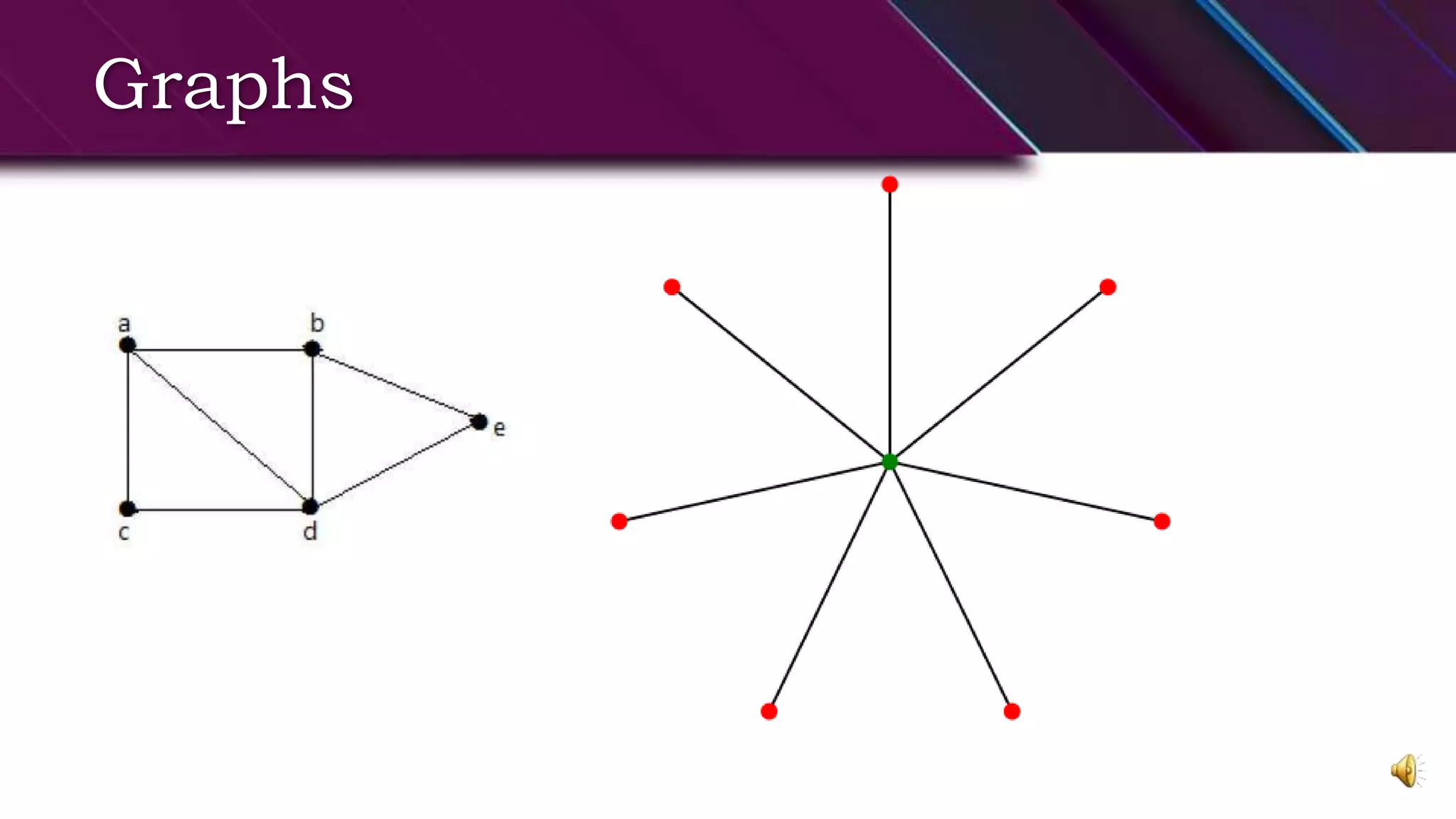
Graphs
Graphs
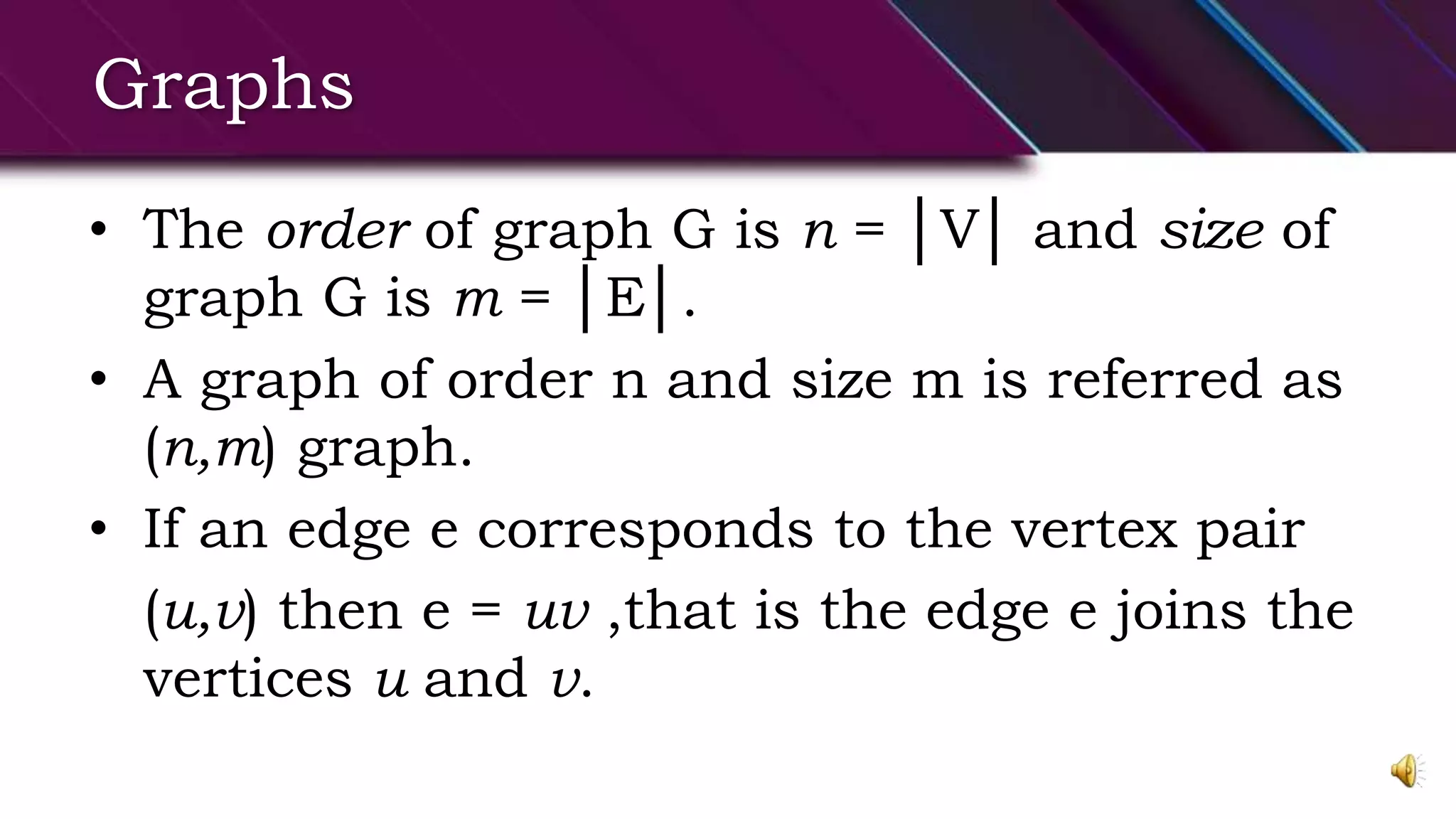
• The order of graph G is n = │V│ and size of
graph G is m = │E│.
• A graph of order n and size m is referred as
(n,m) graph.
• If an edge e corresponds to the vertex pair
(u,v) then e = uv ,that is the edge e joins the
vertices u and v.
Graphs
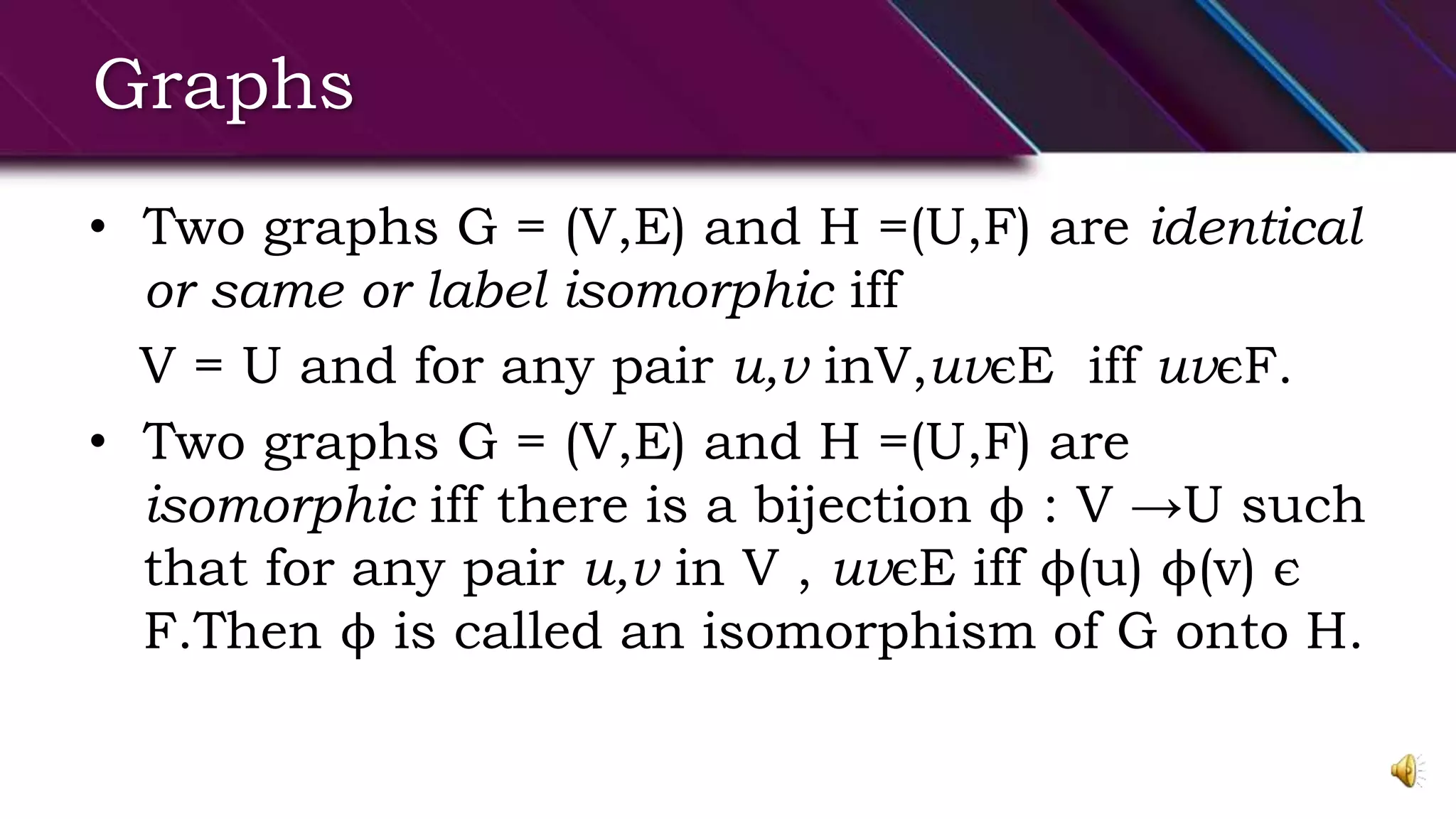
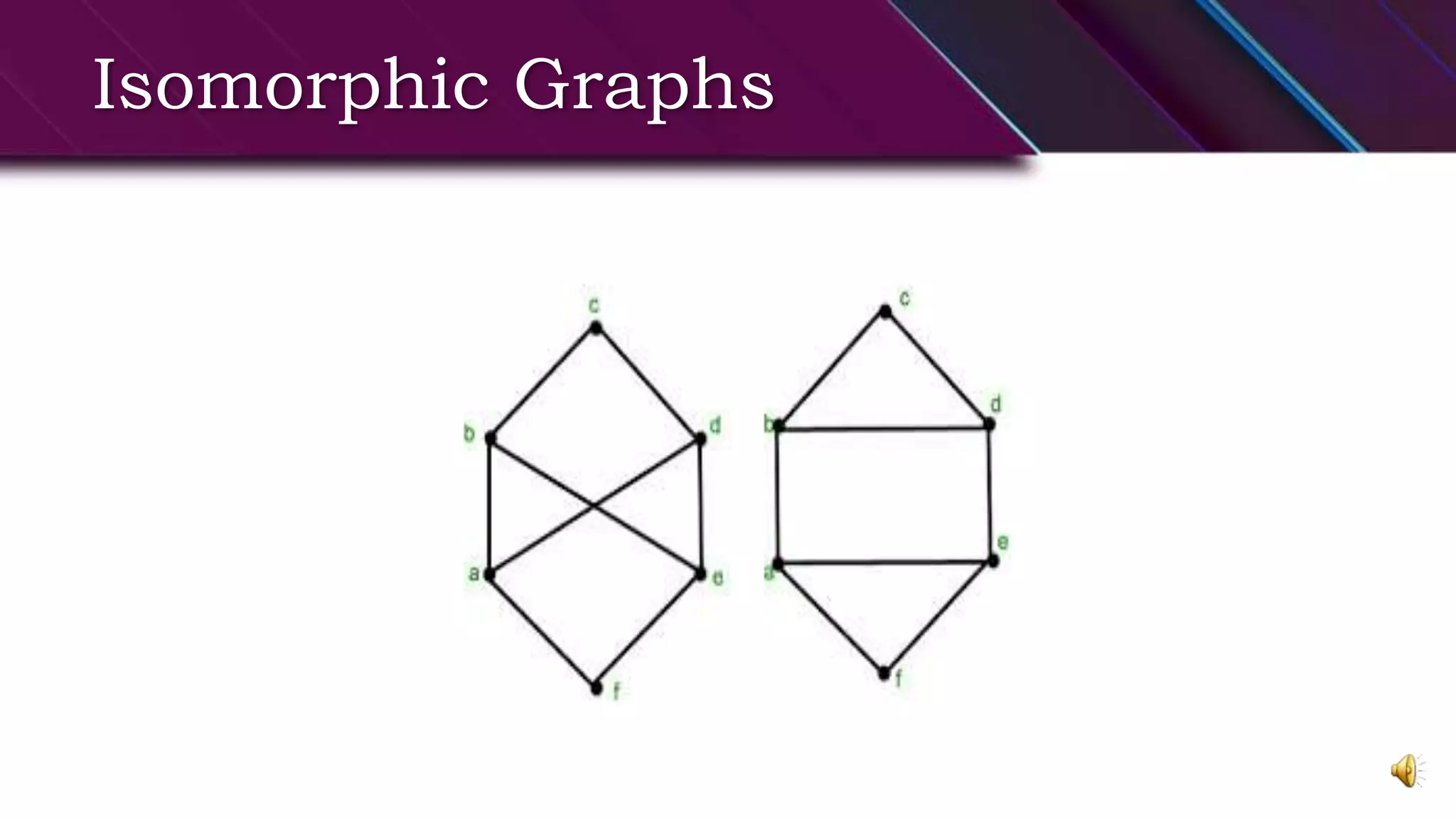
• Two graphs G = (V,E) and H =(U,F) are identical
or same or label isomorphic iff
V = U and for any pair u,v inV,uvєE iff uvєF.
• Two graphs G = (V,E) and H =(U,F) are
isomorphic iff there is a bijection ϕ : V →U such
that for any pair u,v in V , uvєE iff ϕ(u) ϕ(v) є
F.Then ϕ is called an isomorphism of G onto H.
Isomorphic Graphs
Isomorphic Graphs
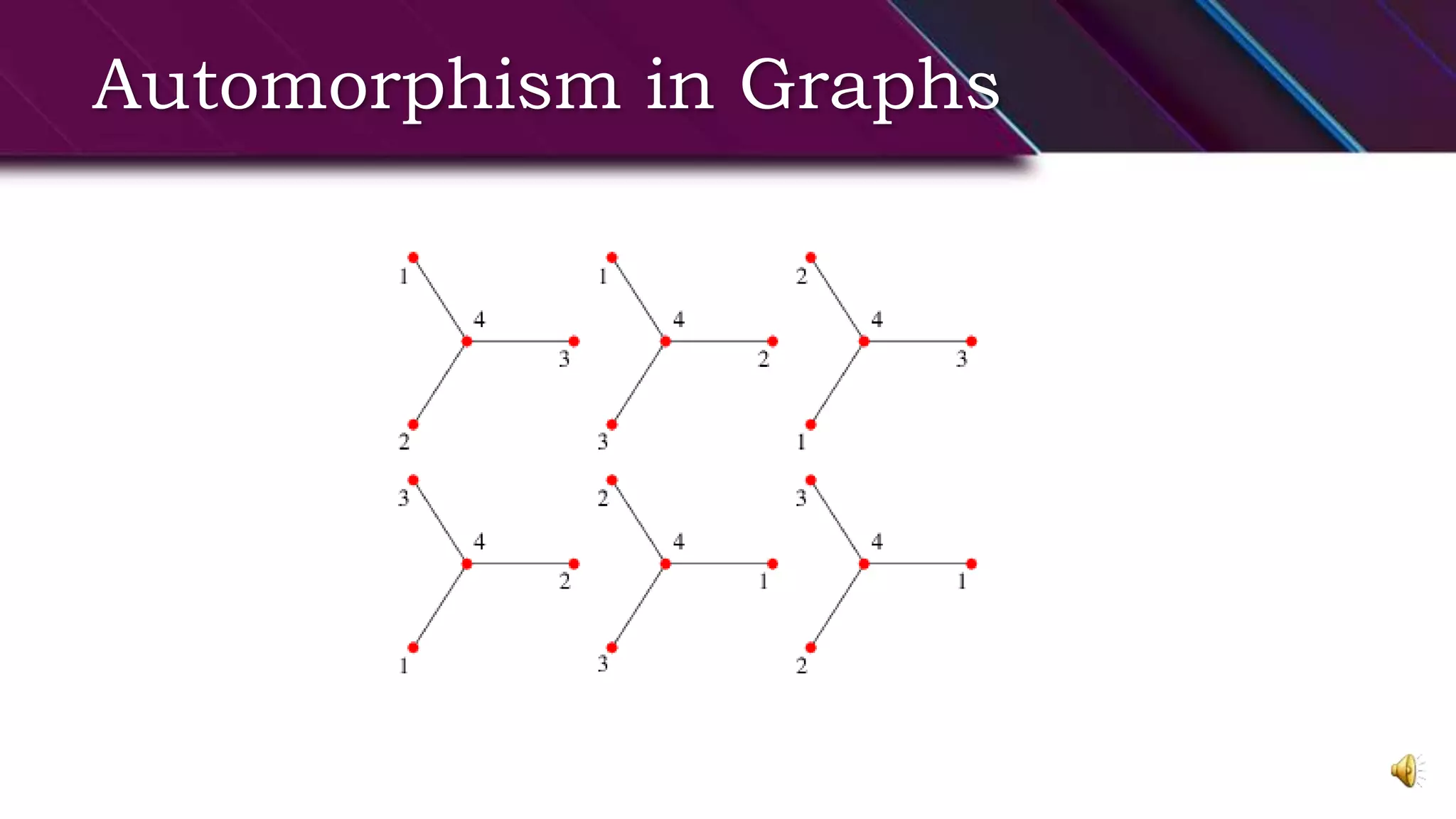
• An isomorphism of G onto itself is called
automorphism.
(i.e)It is a mapping from the vertices of the
given graph G back to vertices of such that
the resulting graph is isomorphic with G.
Automorphism in Graphs
Graph Invariant
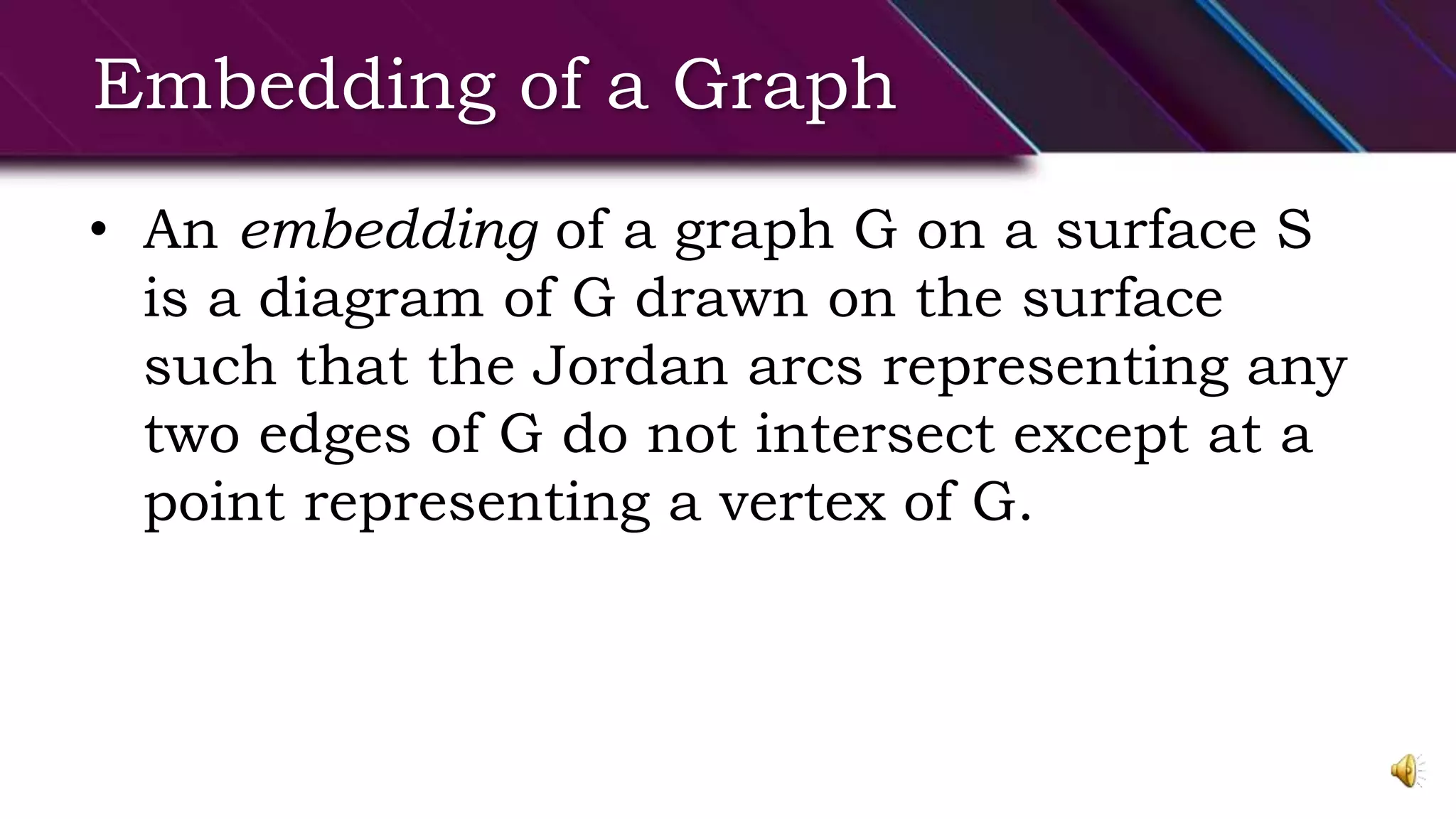
• A graph invariant is a function f from the set
of all graphs to any range of
values(numerical, vectorial or any other)
such that f takes the same value on
isomorphic graphs.When the range of
values is numerical(real,rational or integral)
the invariant is called a parameter.
Graph Invariant
• It is well known that we associate numbers to
mathematical objects in many ways.
For instance Determinant is associated to a
matrix,degree is associated to a
polynomial,dimension is associated to a
space,length is associated to a vector etc.,
There are several numbers associated with
graph.Such a number is called graph invariant.
Graph Invariant
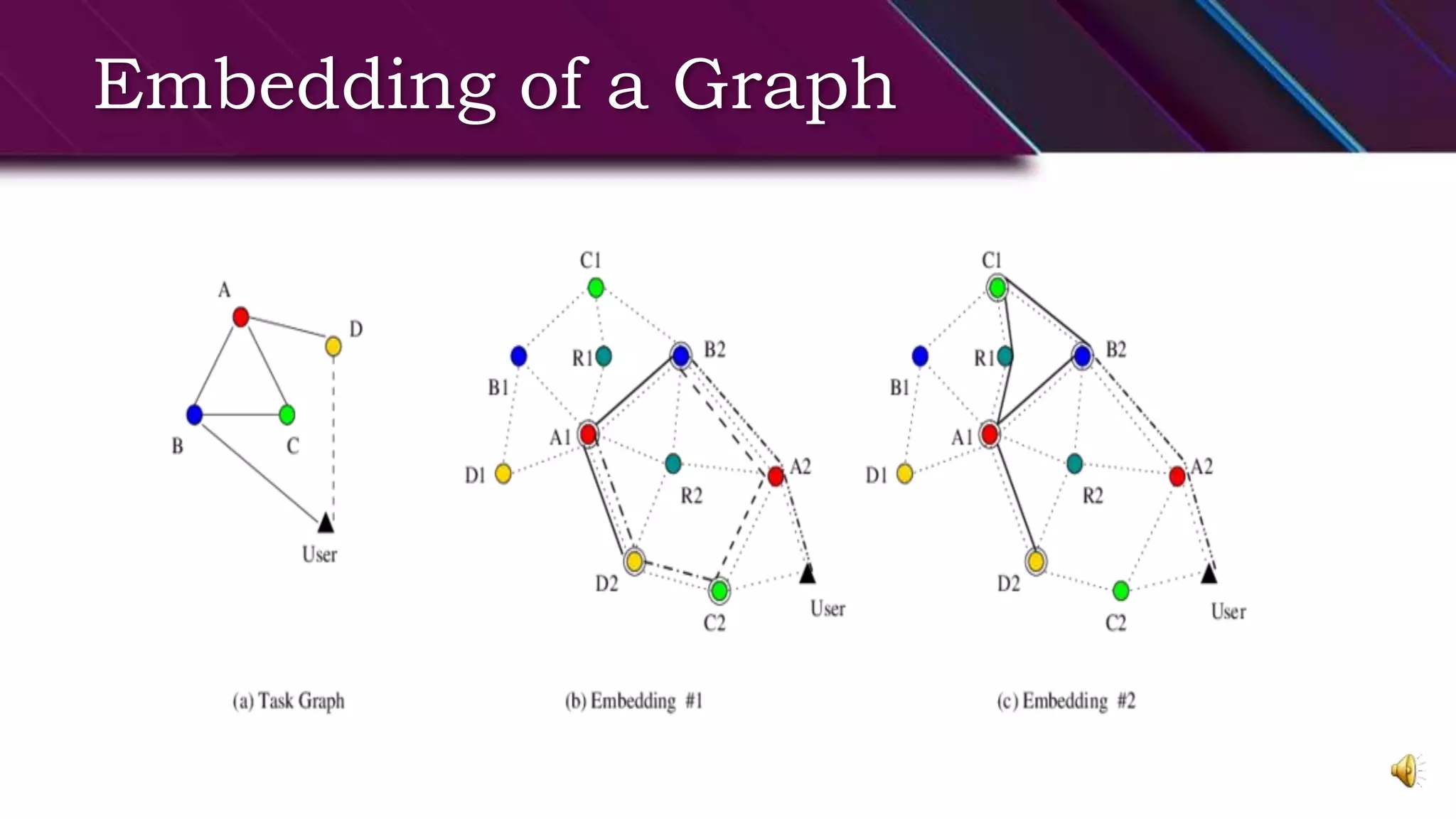
Embedding of a Graph
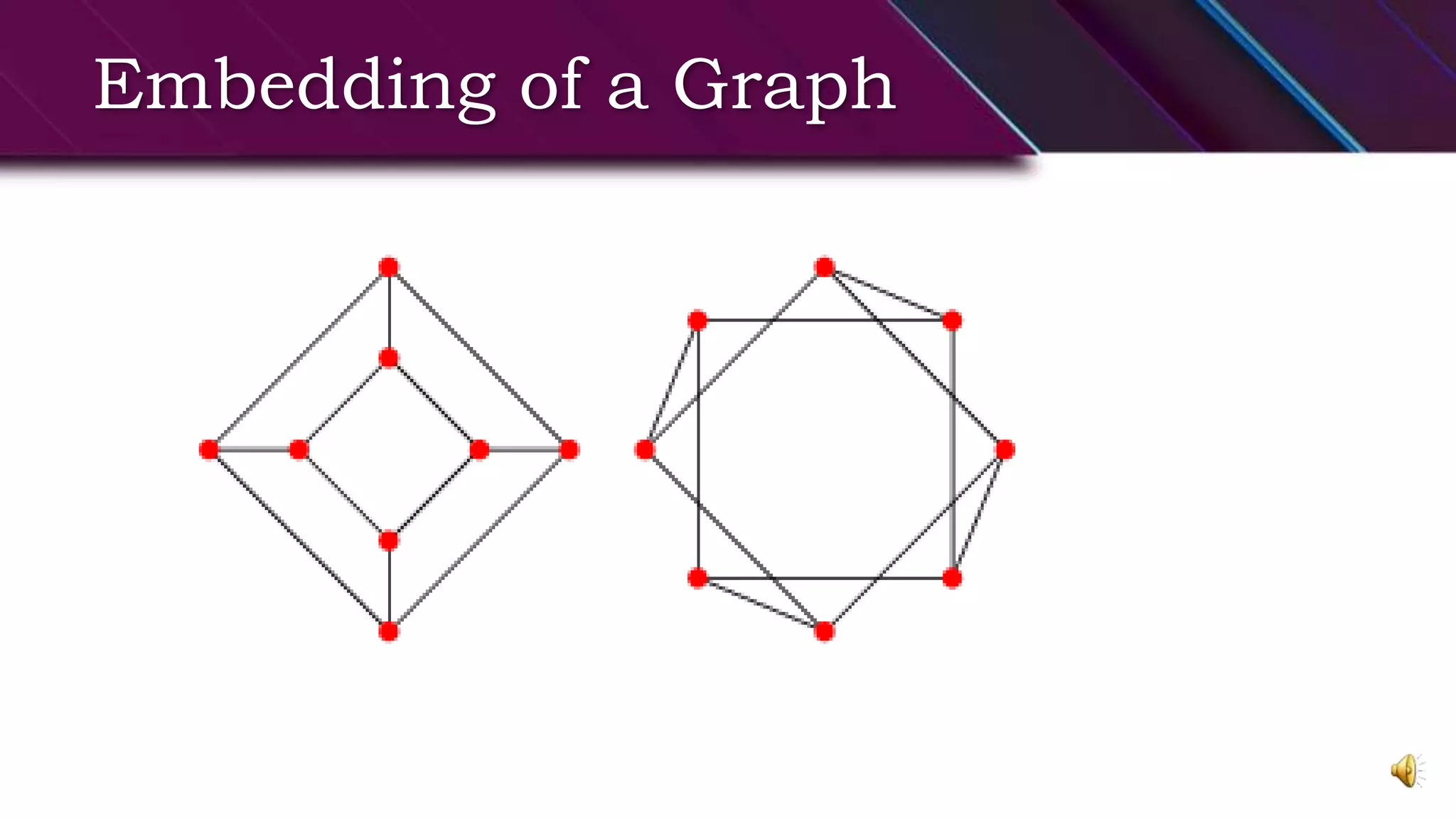
• An embedding of a graph G on a surface S
is a diagram of G drawn on the surface
such that the Jordan arcs representing any
two edges of G do not intersect except at a
point representing a vertex of G.
Embedding of a Graph
Planar and non-planar Graph
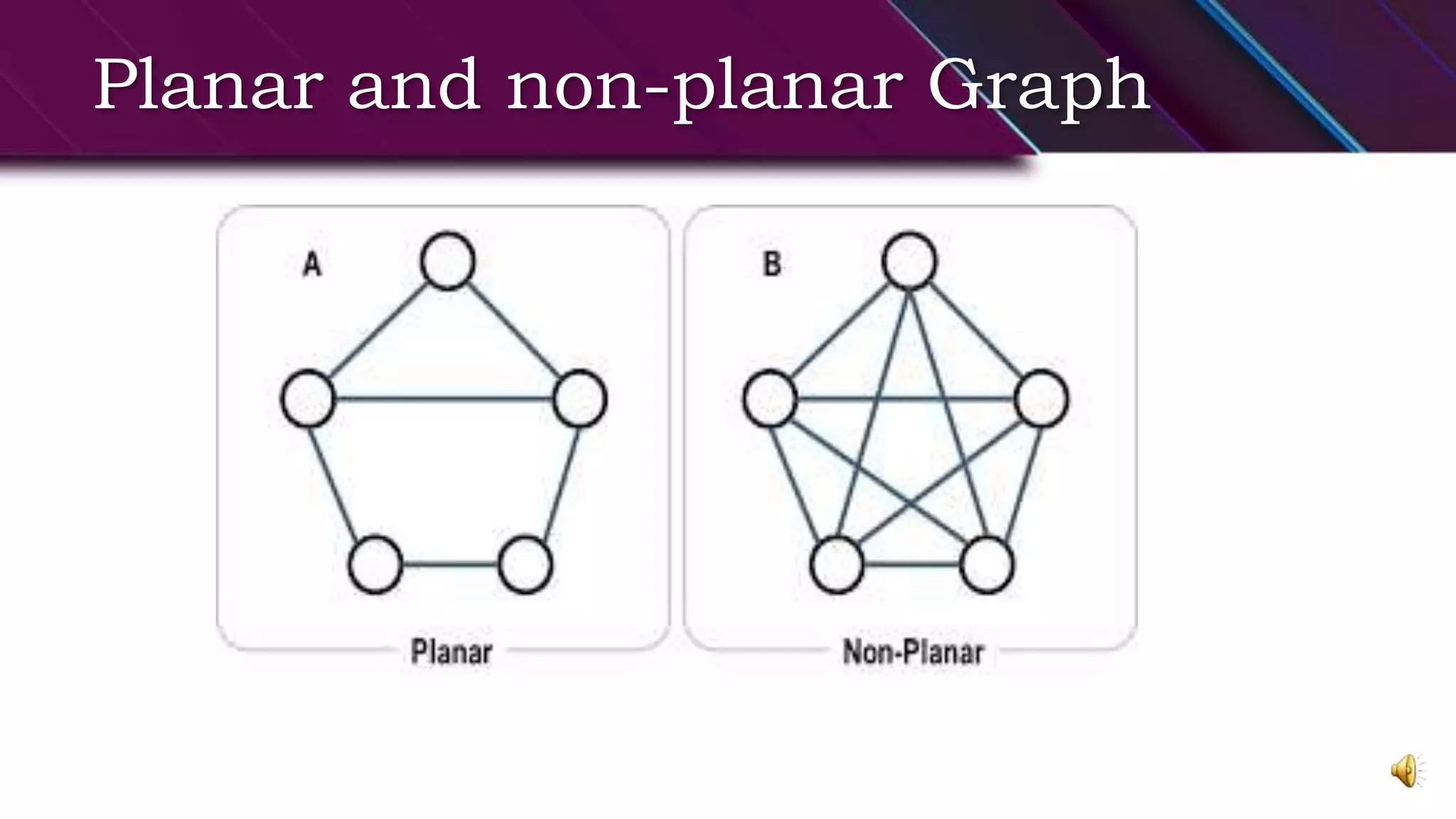
• A graph is planar if it has an embedding on
the plane.
• A graph which has no embedding on the
plane is non-planar.
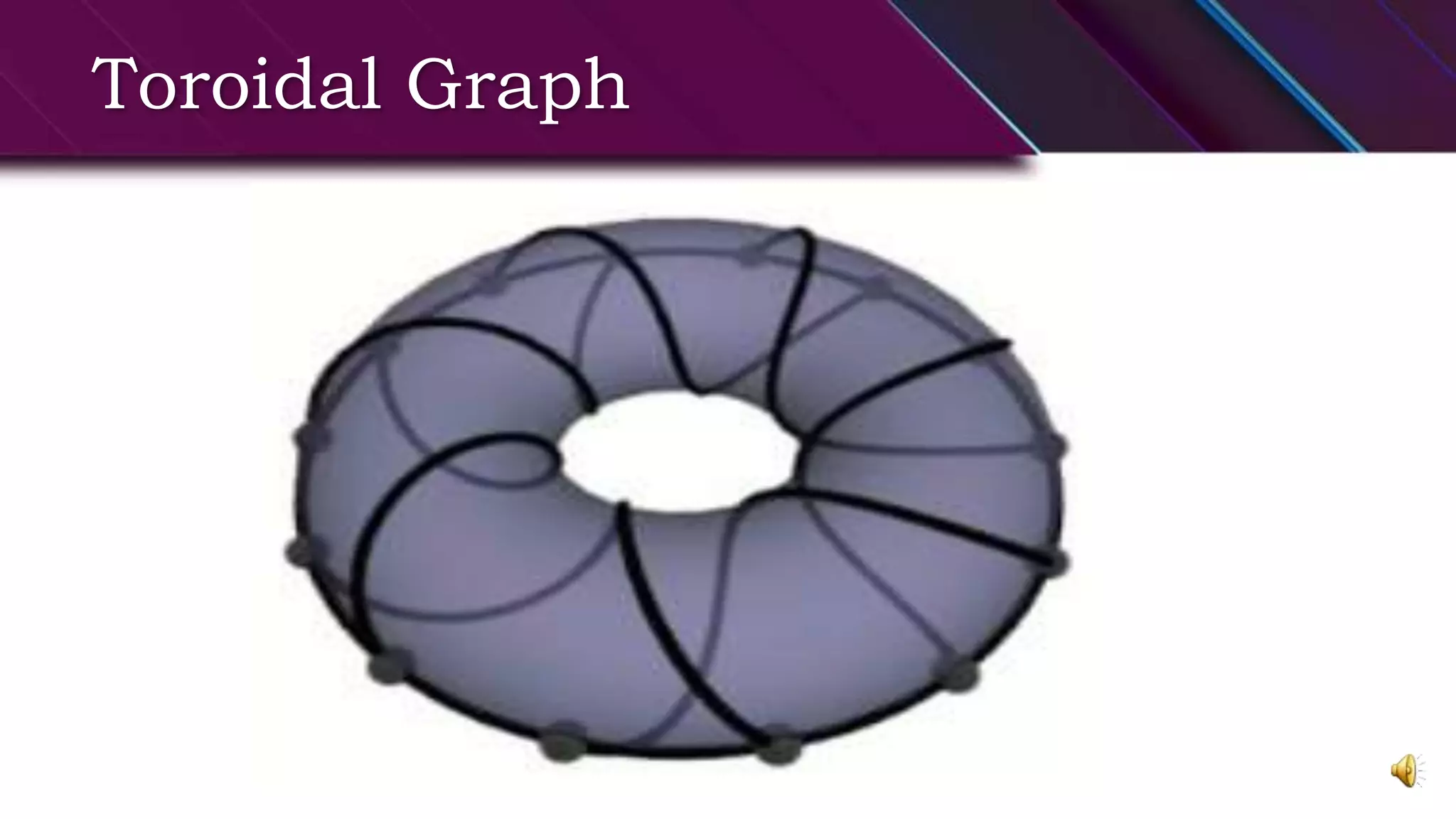
• A graph that can be embedded on a torus is
called a toroidal graph.
Planar and non-planar Graph
Toroidal Graph
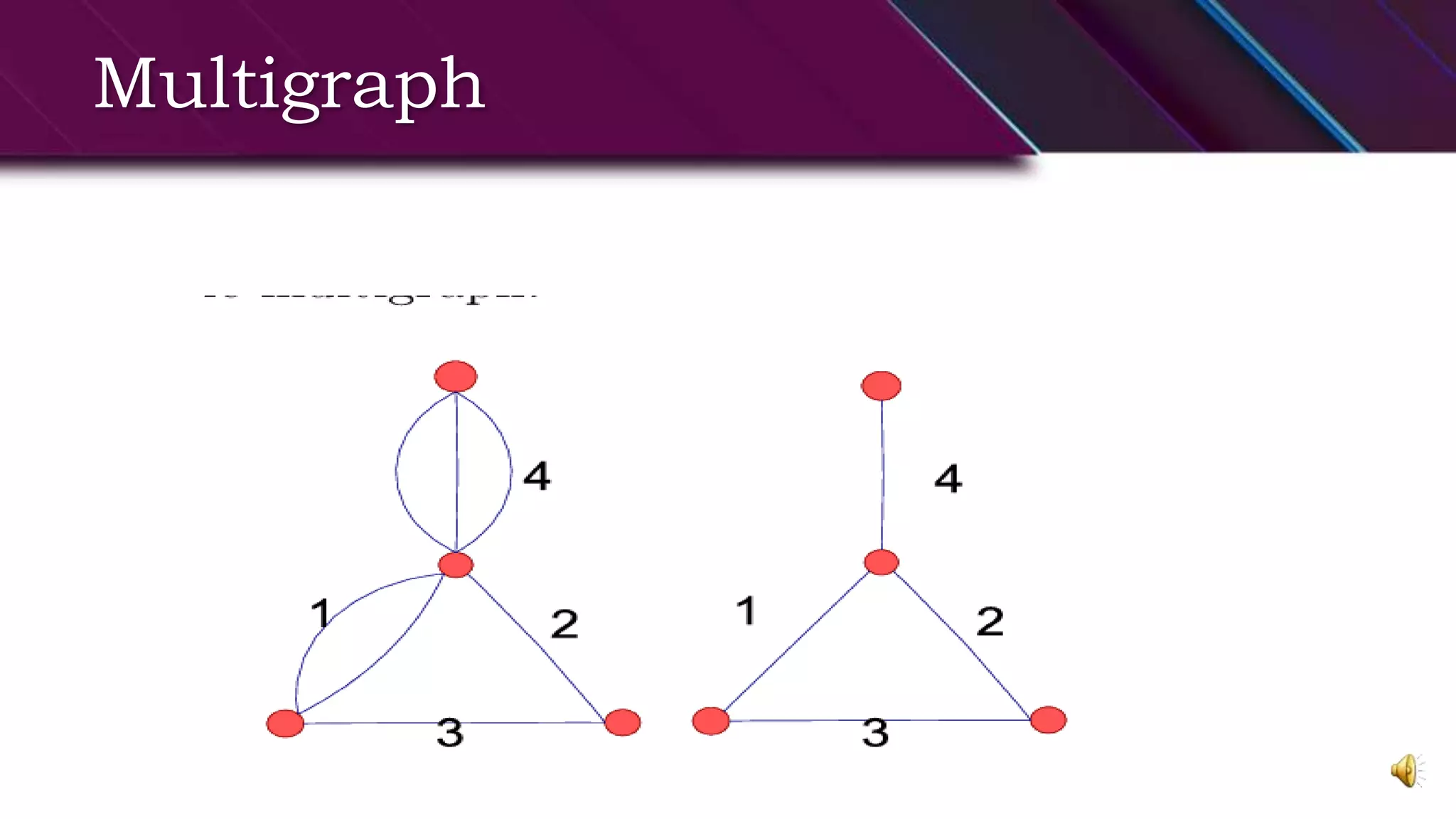
Multigraph
• A multigraph is a pair (V,E) where V is a
non-empty set of vertices and E is a
multiset of edges ,being a multisubset of V.
The number of times an edge e = uv occurs
in E is called the multiplicity of e and edges
with multiplicity greater than one are called
multiple edges.
Multigraph
Graph
• A general graph is a pair (V,E) where V is a
non-empty set of vertices and E is a multiset of
edges, being a multisubset of V ,the set of
unordered pairs of elements of V,not
necessarily distinct.
• An edge of the form e = uu(uєV) is called a
loop.
• An edge which is not a loop is called a proper
edge or link.
Graph
• The number of times edge e occurs is called
its multiplicity and proper edges with
multiplicity greater than one are called
multiple edges.
• Loops with multiplicity greater than one are
called multiple loops.
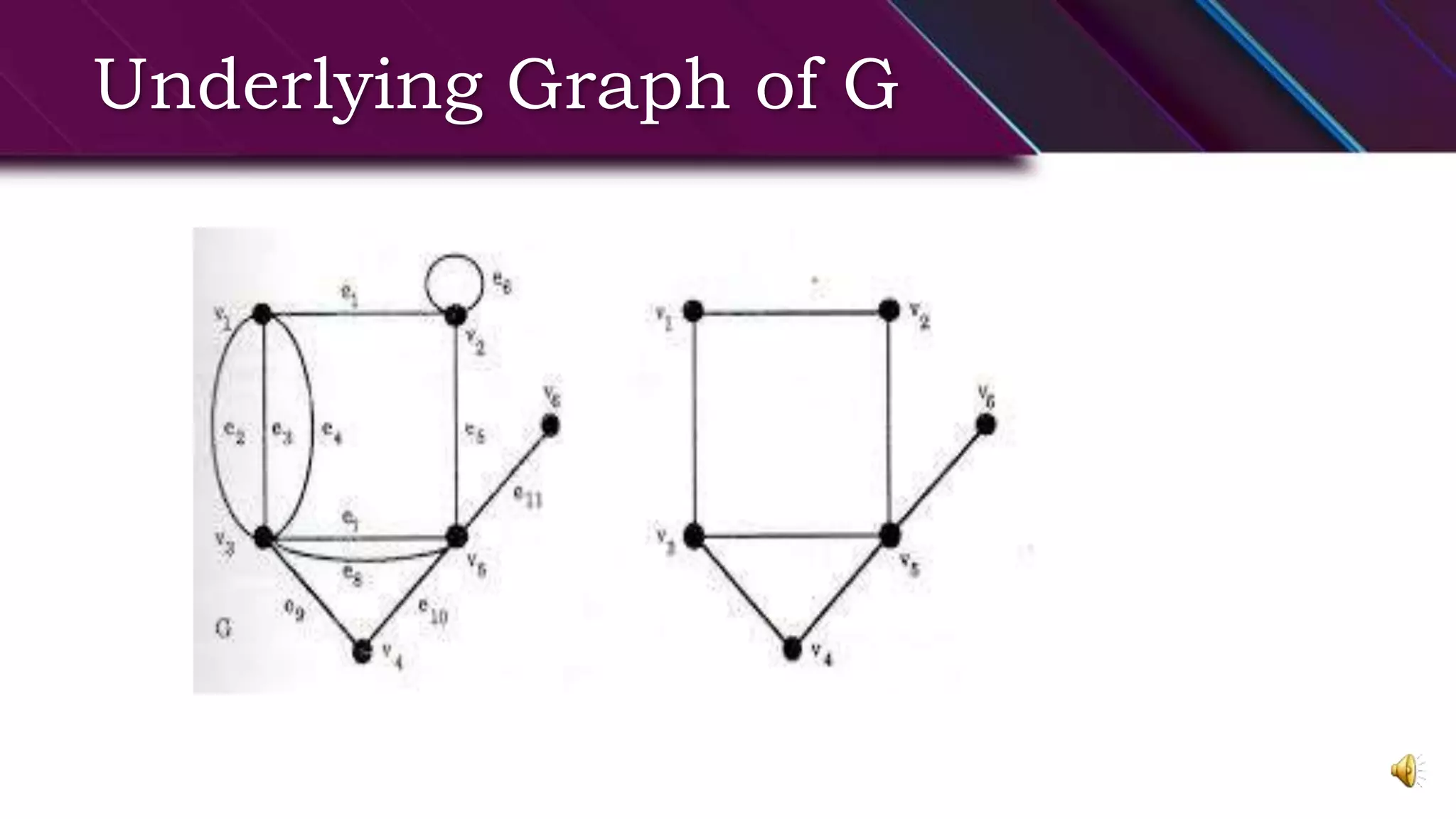
Underlying Graph of G
• The graph obtained by replacing all multiple
edges by single edge in a multigraph G, is
called underlying graph of G.
• Similarly if G is a general graph , the graph
H obtained by removing all its loops and by
replacing all multiple edges by single edges
is called the underlying graph of G.
Underlying Graph of G
Digraph
• A digraph D is a pair (V,A) where V is a non-
empty set whose elements are called
vertices and A is a subset of the set of
ordered pairs of the distinct elements of V
whose elements are called the arcs of D.
Multidigraph
• A multidigraph D is a pair (V,A) where V is a
non-empty set of vertices and A is a
multiset of arcs,being a multisubset of the
set of ordered pairs of distinct elements of
V. The number of times an arc occurs in D
is called its multiplicity and arcs with
multiplicity greater than one are called
multiple arcs of D.
General digraph
• A generaldigraph D is a pair (V,A) where V
is a non-empty set of vertices and A is a
multiset of arcs,being a multisubset of the
cartesian product of V with itself.An arc of
the form uu is called a loop of D and arcs
which are not loops are called proper arcs of
D
General digraph
• The number of times an arcs occurs is
called its multiplicity.
• A loop with multiplicity greater than one is
called a multiple loop.
• An arc (u,v)є A of a digraph will also be
denoted by uv,implying that it is directed
from u to v,u being the initial vertex and v
the terminal vertex.
General digraph
• If D = (V,A) is a digraph, then the graph
G = (V,E) where uvє E iff uv or vu or both
are in A, is called the underlying graph of D.
• If D = (V,A) is a general digraph, the digraph
obtained from D by removing all loops and
by replacing all multiple arcs by single arcs
is called the digraph underlying D.
Mixed graph
• A mixed graph G = (V, A ᴜ E) consists of a
non-empty set V of vertices, a set A of arcs
and a set E of edges such that if uv є E then
neither uv nor vu is in A.
SUBGRAPHS AND SOME SPECIAL
GRAPHS
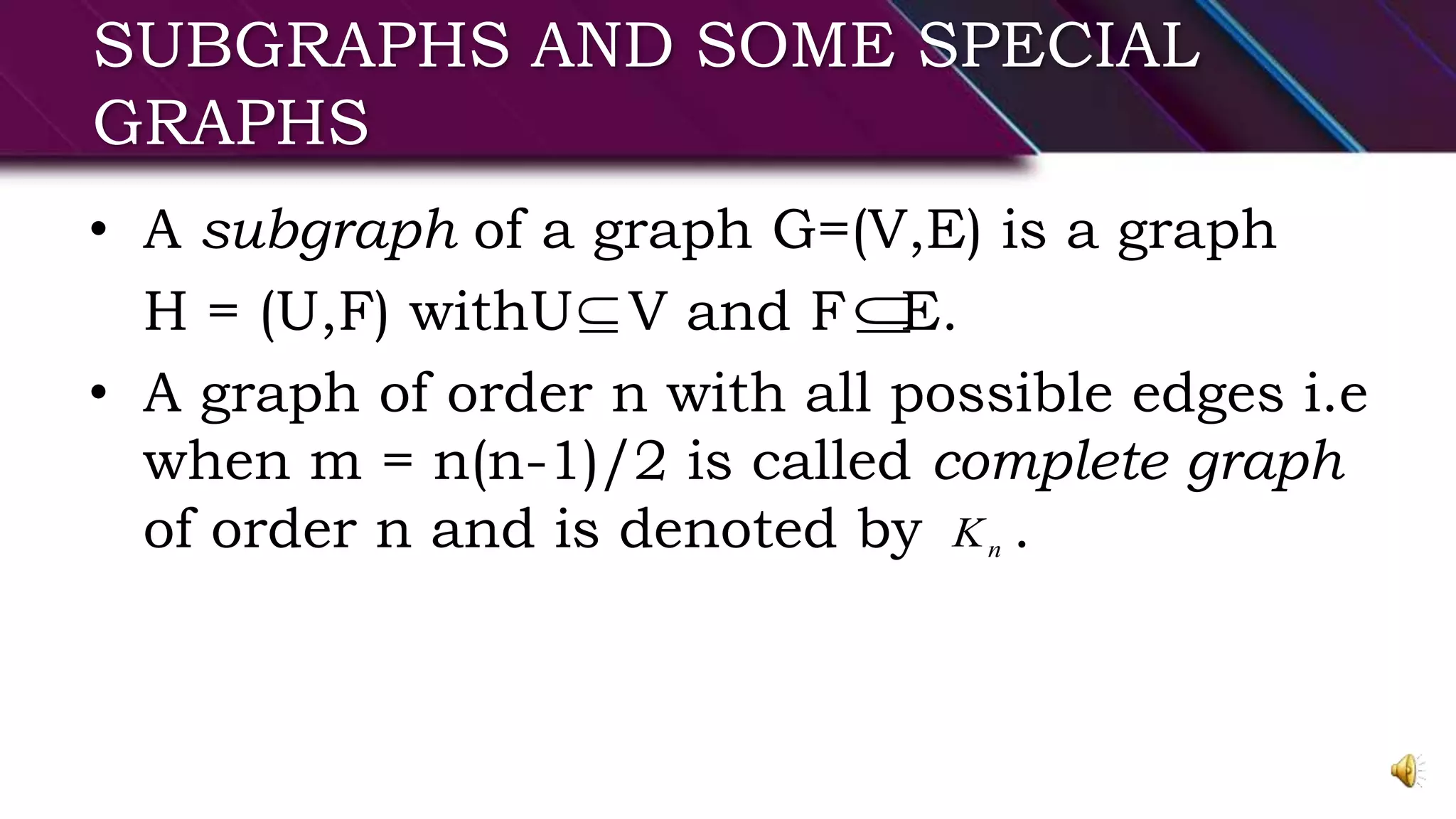
• A subgraph of a graph G=(V,E) is a graph
H = (U,F) withU V and F E.
• A graph of order n with all possible edges i.e
when m = n(n-1)/2 is called complete graph
of order n and is denoted by .
 
nK
SUBGRAPHS AND SOME SPECIAL
GRAPHS
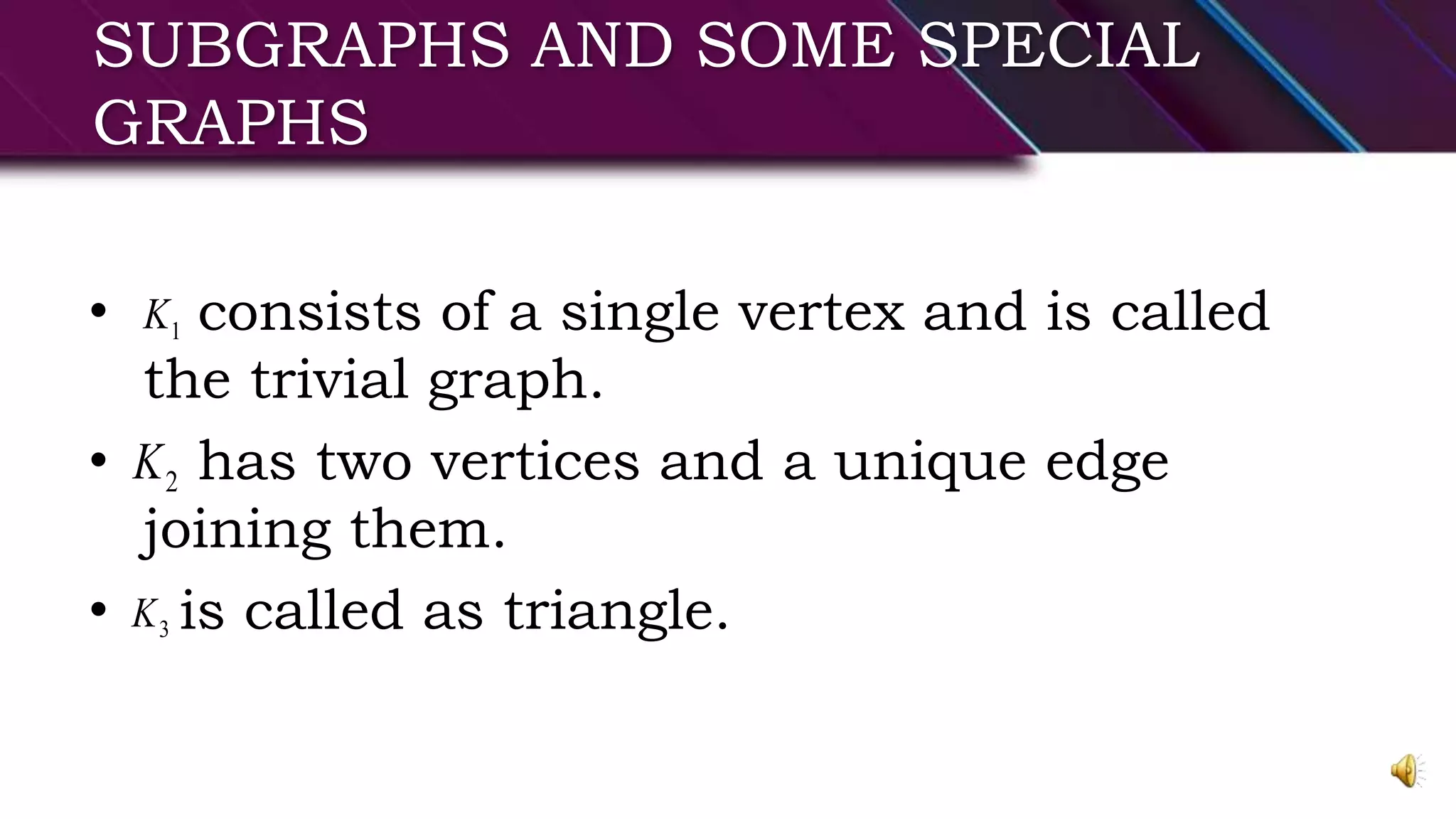
• consists of a single vertex and is called
the trivial graph.
• has two vertices and a unique edge
joining them.
• is called as triangle.
1K
2K
3K
SUBGRAPHS AND SOME SPECIAL
GRAPHS
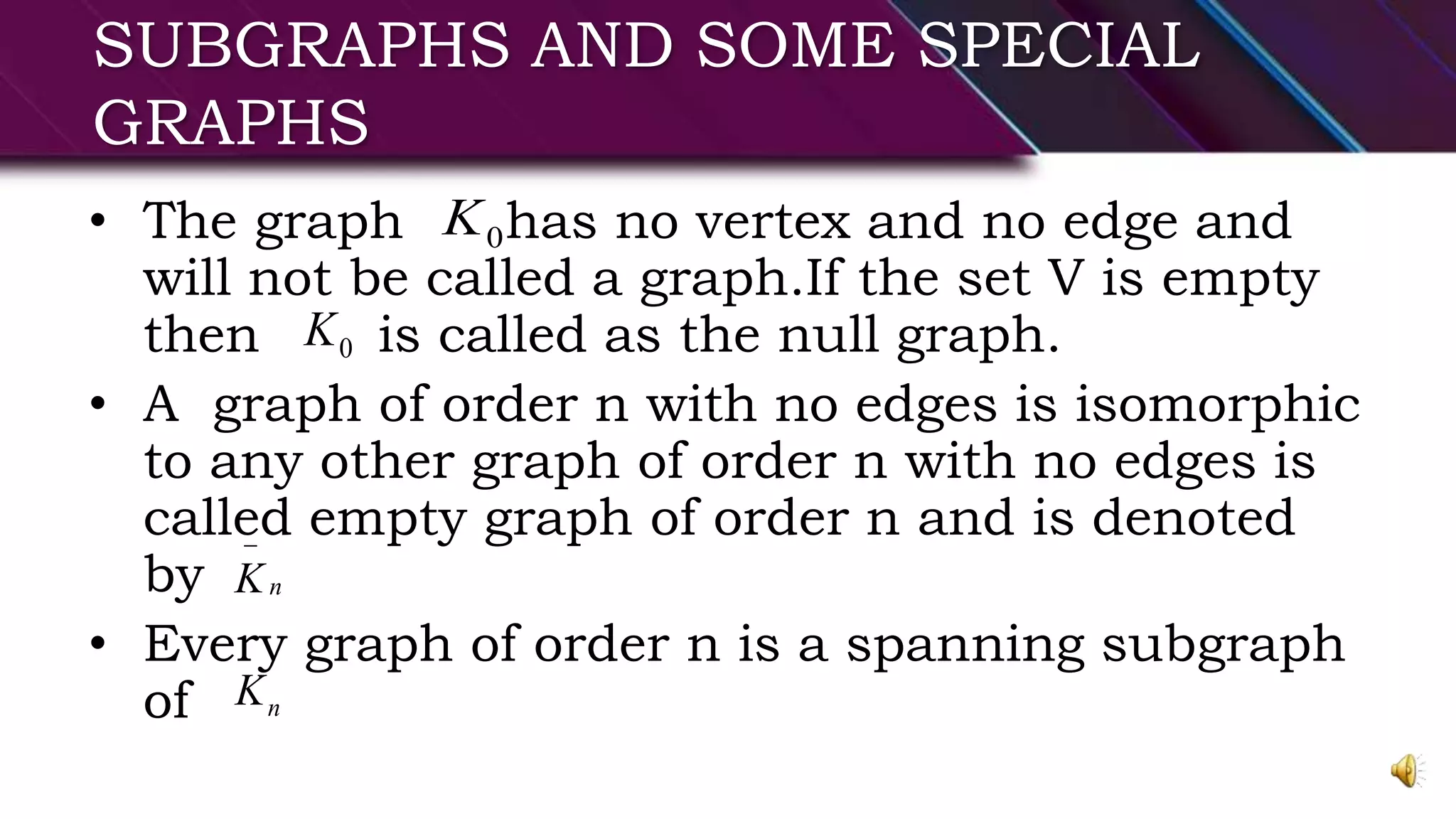
• The graph has no vertex and no edge and
will not be called a graph.If the set V is empty
then is called as the null graph.
• A graph of order n with no edges is isomorphic
to any other graph of order n with no edges is
called empty graph of order n and is denoted
by
• Every graph of order n is a spanning subgraph
of
0K
0K
nK

nK
SUBGRAPHS AND SOME SPECIAL
GRAPHS
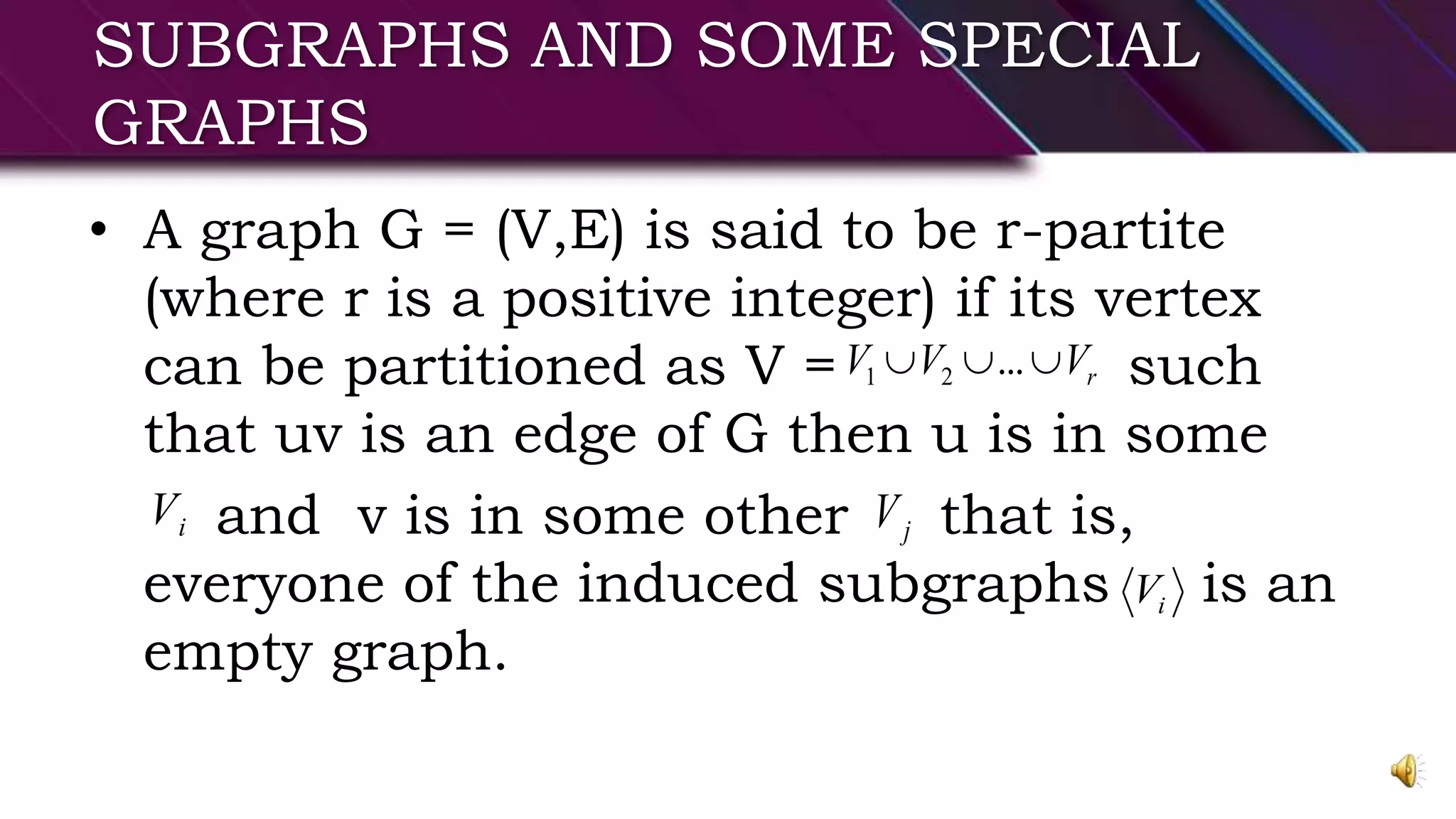
• A graph G = (V,E) is said to be r-partite
(where r is a positive integer) if its vertex
can be partitioned as V = such
that uv is an edge of G then u is in some
and v is in some other that is,
everyone of the induced subgraphs is an
empty graph.
rVVV  ...21
iV jV
iV
SUBGRAPHS AND SOME SPECIAL
GRAPHS
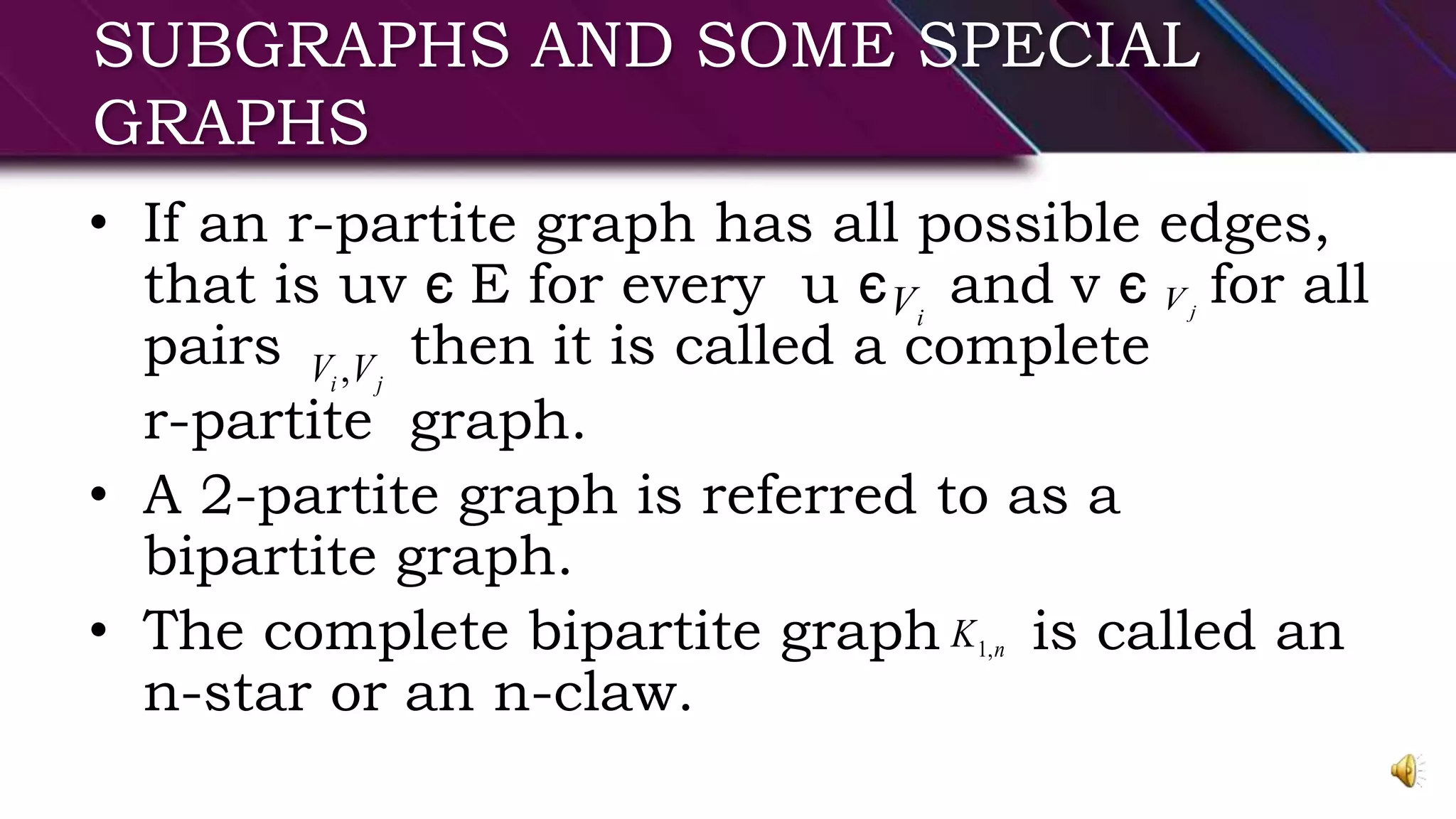
• If an r-partite graph has all possible edges,
that is uv є E for every u є and v є for all
pairs then it is called a complete
r-partite graph.
• A 2-partite graph is referred to as a
bipartite graph.
• The complete bipartite graph is called an
n-star or an n-claw.
jViV
ji VV ,
nK ,1
SUBGRAPHS AND SOME SPECIAL
GRAPHS
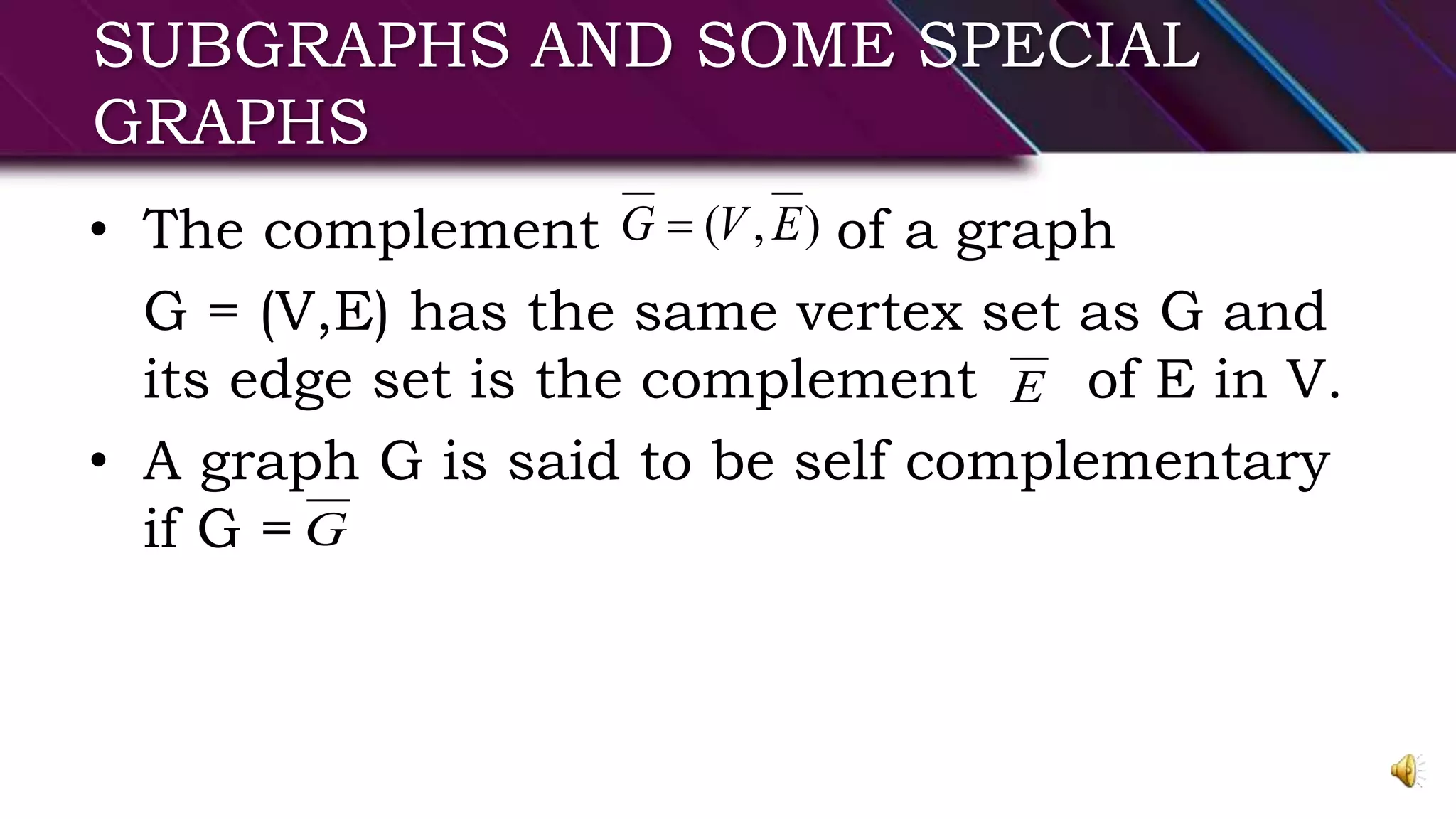
• The complement of a graph
G = (V,E) has the same vertex set as G and
its edge set is the complement of E in V.
• A graph G is said to be self complementary
if G =
),( EVG 
E
G
SUBGRAPHS AND SOME SPECIAL
GRAPHS
• Let G = (V,E) be a graph and F a subset of
the edge set E. Then the graph H = (V,E-F)
with the same vertex set as G and the edge
set E-F is said to be obtained from G by
removing the edges in the set F .It is
denoted by G – F. If F consists of a single
edge e of G,the graph obtained by removing
e is denoted by G – e.
SUBGRAPHS AND SOME SPECIAL
GRAPHS
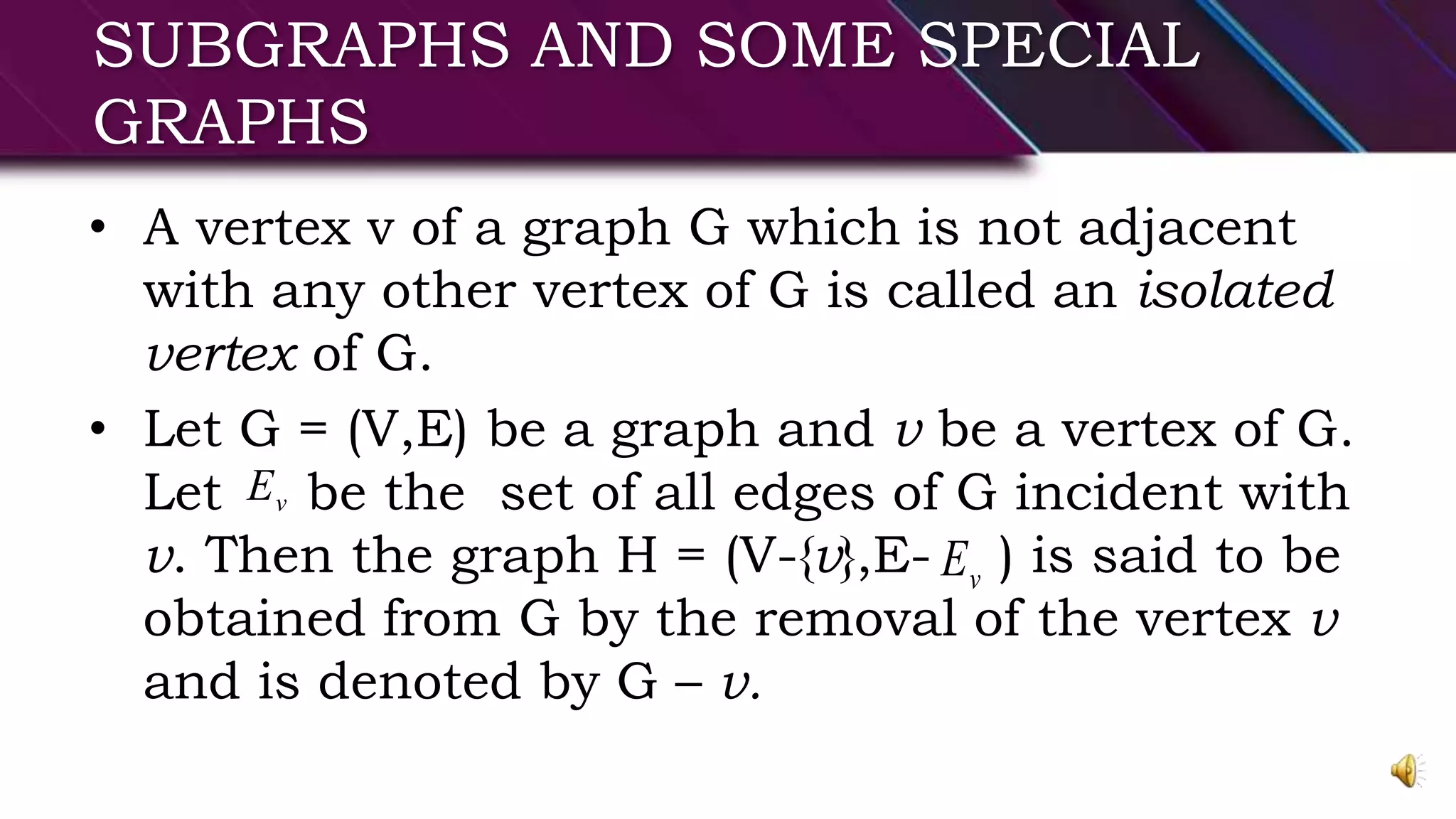
• A vertex v of a graph G which is not adjacent
with any other vertex of G is called an isolated
vertex of G.
• Let G = (V,E) be a graph and v be a vertex of G.
Let be the set of all edges of G incident with
v. Then the graph H = (V-{v},E- ) is said to be
obtained from G by the removal of the vertex v
and is denoted by G – v.
vE
vE
THANK YOU

Basic graph theory

  • 1.
    BASIC GRAPH THEORY P.JAYALAKSHMI ASSISTANTPROFESSOR IN MATHEMATICS SRI GVG VISALAKSHI COLLEGE FOR WOMEN(Autonomous) Affiliated to Bharathiar University An ISO 9001 - 2015 Certified Institution Re-Accredited at 'A+' Grade by NAAC (Fourth Cycle) UDUMALPET
  • 2.
    GRAPHS, SUBGRAPHS AND COMPONENTS •Graphs • Subgraphs and Some Special Graphs • Graph Properties • Paths ,Cycles and Components
  • 3.
    Graphs • The algebraicdefinition of a graph is given as follows: A graph G is a finite non-empty set V together with a symmetric irreflexive binary relation A on V. The elements of the set V are called the vertices of the graph .The relation A is called the adjacency relation.
  • 4.
    Graphs • The set-theoreticdefinition of a graph is defined as follows: A graph G is a pair (V,E) where V is a non- empty set whose elements are called the vertices of G and E is a subset of V whose elements are called the edges of G.
  • 5.
    Graphs • The geometricflavour of a graph is given as follows: A graph G is a pair of disjoint sets V (where V is non-empty) and E & a 1 -1 incidence function f : E→ V.Elements of V are called vertices of G and elements of E are called edges of G.
  • 6.
  • 7.
    Graphs • The orderof graph G is n = │V│ and size of graph G is m = │E│. • A graph of order n and size m is referred as (n,m) graph. • If an edge e corresponds to the vertex pair (u,v) then e = uv ,that is the edge e joins the vertices u and v.
  • 8.
    Graphs • Two graphsG = (V,E) and H =(U,F) are identical or same or label isomorphic iff V = U and for any pair u,v inV,uvєE iff uvєF. • Two graphs G = (V,E) and H =(U,F) are isomorphic iff there is a bijection ϕ : V →U such that for any pair u,v in V , uvєE iff ϕ(u) ϕ(v) є F.Then ϕ is called an isomorphism of G onto H.
  • 9.
  • 10.
    Isomorphic Graphs • Anisomorphism of G onto itself is called automorphism. (i.e)It is a mapping from the vertices of the given graph G back to vertices of such that the resulting graph is isomorphic with G.
  • 11.
  • 12.
    Graph Invariant • Agraph invariant is a function f from the set of all graphs to any range of values(numerical, vectorial or any other) such that f takes the same value on isomorphic graphs.When the range of values is numerical(real,rational or integral) the invariant is called a parameter.
  • 13.
    Graph Invariant • Itis well known that we associate numbers to mathematical objects in many ways. For instance Determinant is associated to a matrix,degree is associated to a polynomial,dimension is associated to a space,length is associated to a vector etc., There are several numbers associated with graph.Such a number is called graph invariant.
  • 14.
  • 15.
    Embedding of aGraph • An embedding of a graph G on a surface S is a diagram of G drawn on the surface such that the Jordan arcs representing any two edges of G do not intersect except at a point representing a vertex of G.
  • 16.
  • 17.
  • 18.
    Planar and non-planarGraph • A graph is planar if it has an embedding on the plane. • A graph which has no embedding on the plane is non-planar. • A graph that can be embedded on a torus is called a toroidal graph.
  • 19.
  • 20.
  • 21.
    Multigraph • A multigraphis a pair (V,E) where V is a non-empty set of vertices and E is a multiset of edges ,being a multisubset of V. The number of times an edge e = uv occurs in E is called the multiplicity of e and edges with multiplicity greater than one are called multiple edges.
  • 22.
  • 23.
    Graph • A generalgraph is a pair (V,E) where V is a non-empty set of vertices and E is a multiset of edges, being a multisubset of V ,the set of unordered pairs of elements of V,not necessarily distinct. • An edge of the form e = uu(uєV) is called a loop. • An edge which is not a loop is called a proper edge or link.
  • 24.
    Graph • The numberof times edge e occurs is called its multiplicity and proper edges with multiplicity greater than one are called multiple edges. • Loops with multiplicity greater than one are called multiple loops.
  • 25.
    Underlying Graph ofG • The graph obtained by replacing all multiple edges by single edge in a multigraph G, is called underlying graph of G. • Similarly if G is a general graph , the graph H obtained by removing all its loops and by replacing all multiple edges by single edges is called the underlying graph of G.
  • 26.
  • 27.
    Digraph • A digraphD is a pair (V,A) where V is a non- empty set whose elements are called vertices and A is a subset of the set of ordered pairs of the distinct elements of V whose elements are called the arcs of D.
  • 28.
    Multidigraph • A multidigraphD is a pair (V,A) where V is a non-empty set of vertices and A is a multiset of arcs,being a multisubset of the set of ordered pairs of distinct elements of V. The number of times an arc occurs in D is called its multiplicity and arcs with multiplicity greater than one are called multiple arcs of D.
  • 29.
    General digraph • Ageneraldigraph D is a pair (V,A) where V is a non-empty set of vertices and A is a multiset of arcs,being a multisubset of the cartesian product of V with itself.An arc of the form uu is called a loop of D and arcs which are not loops are called proper arcs of D
  • 30.
    General digraph • Thenumber of times an arcs occurs is called its multiplicity. • A loop with multiplicity greater than one is called a multiple loop. • An arc (u,v)є A of a digraph will also be denoted by uv,implying that it is directed from u to v,u being the initial vertex and v the terminal vertex.
  • 31.
    General digraph • IfD = (V,A) is a digraph, then the graph G = (V,E) where uvє E iff uv or vu or both are in A, is called the underlying graph of D. • If D = (V,A) is a general digraph, the digraph obtained from D by removing all loops and by replacing all multiple arcs by single arcs is called the digraph underlying D.
  • 32.
    Mixed graph • Amixed graph G = (V, A ᴜ E) consists of a non-empty set V of vertices, a set A of arcs and a set E of edges such that if uv є E then neither uv nor vu is in A.
  • 33.
    SUBGRAPHS AND SOMESPECIAL GRAPHS • A subgraph of a graph G=(V,E) is a graph H = (U,F) withU V and F E. • A graph of order n with all possible edges i.e when m = n(n-1)/2 is called complete graph of order n and is denoted by .   nK
  • 34.
    SUBGRAPHS AND SOMESPECIAL GRAPHS • consists of a single vertex and is called the trivial graph. • has two vertices and a unique edge joining them. • is called as triangle. 1K 2K 3K
  • 35.
    SUBGRAPHS AND SOMESPECIAL GRAPHS • The graph has no vertex and no edge and will not be called a graph.If the set V is empty then is called as the null graph. • A graph of order n with no edges is isomorphic to any other graph of order n with no edges is called empty graph of order n and is denoted by • Every graph of order n is a spanning subgraph of 0K 0K nK  nK
  • 36.
    SUBGRAPHS AND SOMESPECIAL GRAPHS • A graph G = (V,E) is said to be r-partite (where r is a positive integer) if its vertex can be partitioned as V = such that uv is an edge of G then u is in some and v is in some other that is, everyone of the induced subgraphs is an empty graph. rVVV  ...21 iV jV iV
  • 37.
    SUBGRAPHS AND SOMESPECIAL GRAPHS • If an r-partite graph has all possible edges, that is uv є E for every u є and v є for all pairs then it is called a complete r-partite graph. • A 2-partite graph is referred to as a bipartite graph. • The complete bipartite graph is called an n-star or an n-claw. jViV ji VV , nK ,1
  • 38.
    SUBGRAPHS AND SOMESPECIAL GRAPHS • The complement of a graph G = (V,E) has the same vertex set as G and its edge set is the complement of E in V. • A graph G is said to be self complementary if G = ),( EVG  E G
  • 39.
    SUBGRAPHS AND SOMESPECIAL GRAPHS • Let G = (V,E) be a graph and F a subset of the edge set E. Then the graph H = (V,E-F) with the same vertex set as G and the edge set E-F is said to be obtained from G by removing the edges in the set F .It is denoted by G – F. If F consists of a single edge e of G,the graph obtained by removing e is denoted by G – e.
  • 40.
    SUBGRAPHS AND SOMESPECIAL GRAPHS • A vertex v of a graph G which is not adjacent with any other vertex of G is called an isolated vertex of G. • Let G = (V,E) be a graph and v be a vertex of G. Let be the set of all edges of G incident with v. Then the graph H = (V-{v},E- ) is said to be obtained from G by the removal of the vertex v and is denoted by G – v. vE vE
  • 41.