Grammar
Verbs, Helping
Verbs, & Adverbs
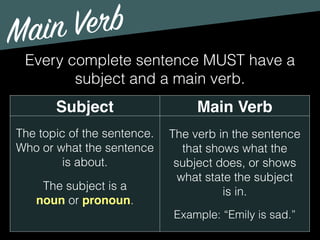
Main Verb
Every complete sentence MUST have a
subject and a main verb.
Subject Main Verb
The topic of the sentence.
Who or what the sentence
is about.
The subject is a
noun or pronoun.
The verb in the sentence
that shows what the
subject does, or shows
what state the subject
is in.
Example: “Emily is sad.”
Subject/Predicate
Sam loves poetry.
Subject Main Verb
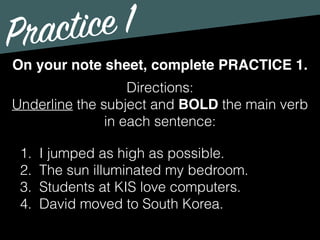
Practice 1
Directions:
Underline the subject and BOLD the main verb
in each sentence:
On your note sheet, complete PRACTICE 1.
1. I jumped as high as possible.
2. The sun illuminated my bedroom.
3. Students at KIS love computers.
4. David moved to South Korea.
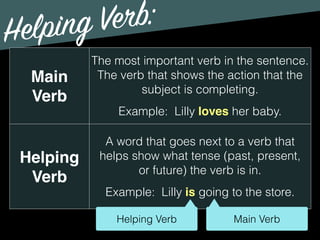
Helping Verb:
Main
Verb
The most important verb in the sentence.
The verb that shows the action that the
subject is completing.
Example: Lilly loves her baby.
Helping
Verb
A word that goes next to a verb that
helps show what tense (past, present,
or future) the verb is in.
Example: Lilly is going to the store.
Main VerbHelping Verb
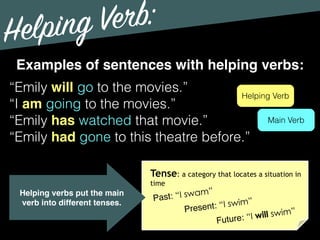
Helping Verb:
Examples of sentences with helping verbs:
“Emily will go to the movies.”
“I am going to the movies.”
“Emily has watched that movie.”
“Emily had gone to this theatre before.”
Tense: a category that locates a situation in
time
Past: “I swam”
Present: “I swim”
Future: “I will swim”
Helping verbs put the main
verb into different tenses.
Helping Verb
Main Verb
Helping Verb:
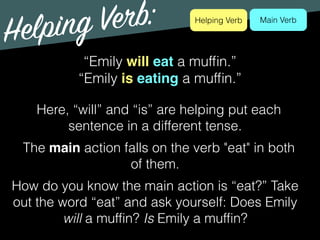
“Emily will eat a muffin.”
“Emily is eating a muffin.”
Helping Verb Main Verb
Here, “will” and “is” are helping put each
sentence in a different tense.
The main action falls on the verb "eat" in both
of them.
How do you know the main action is “eat?” Take
out the word “eat” and ask yourself: Does Emily
will a muffin? Is Emily a muffin?
Helping Verb:
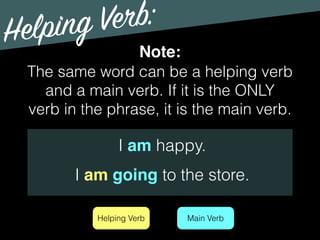
Note:
I am happy.
I am going to the store.
The same word can be a helping verb
and a main verb. If it is the ONLY
verb in the phrase, it is the main verb.
Helping Verb Main Verb
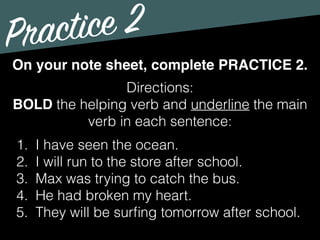
Practice 2
Directions:
BOLD the helping verb and underline the main
verb in each sentence:
On your note sheet, complete PRACTICE 2.
1. I have seen the ocean.
2. I will run to the store after school.
3. Max was trying to catch the bus.
4. He had broken my heart.
5. They will be surfing tomorrow after school.
Adverb:
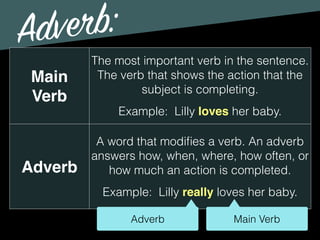
Main
Verb
The most important verb in the sentence.
The verb that shows the action that the
subject is completing.
Example: Lilly loves her baby.
Adverb
A word that modifies a verb. An adverb
answers how, when, where, how often, or
how much an action is completed.
Example: Lilly really loves her baby.
Main VerbAdverb
Adverb:
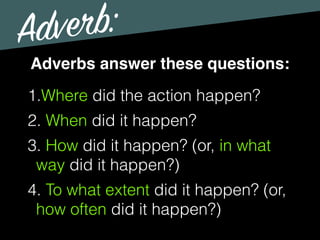
Adverbs answer these questions:
1.Where did the action happen?
2. When did it happen?
3. How did it happen? (or, in what
way did it happen?)
4. To what extent did it happen? (or,
how often did it happen?)
Adverb:
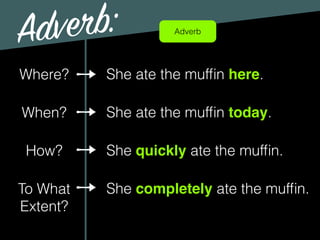
Where?
When?
How?
To What
Extent?
She ate the muffin here.
She ate the muffin today.
She quickly ate the muffin.
She completely ate the muffin.
Adverb
Adverb:
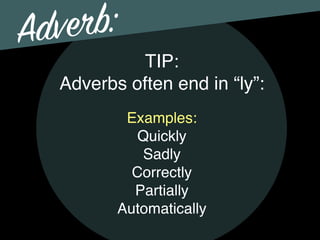
TIP:
Adverbs often end in “ly”:
Examples:
Quickly
Sadly
Correctly
Partially
Automatically
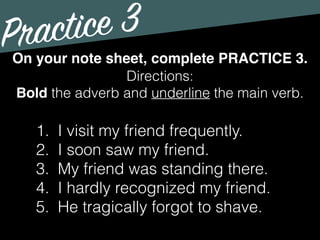
Practice 3
Directions:
Bold the adverb and underline the main verb.
On your note sheet, complete PRACTICE 3.
1. I visit my friend frequently.
2. I soon saw my friend.
3. My friend was standing there.
4. I hardly recognized my friend.
5. He tragically forgot to shave.

Grammar: Verb Types

  • 1.
  • 2.
    Main Verb Every completesentence MUST have a subject and a main verb. Subject Main Verb The topic of the sentence. Who or what the sentence is about. The subject is a noun or pronoun. The verb in the sentence that shows what the subject does, or shows what state the subject is in. Example: “Emily is sad.”
  • 3.
  • 4.
    Practice 1 Directions: Underline thesubject and BOLD the main verb in each sentence: On your note sheet, complete PRACTICE 1. 1. I jumped as high as possible. 2. The sun illuminated my bedroom. 3. Students at KIS love computers. 4. David moved to South Korea.
  • 5.
    Helping Verb: Main Verb The mostimportant verb in the sentence. The verb that shows the action that the subject is completing. Example: Lilly loves her baby. Helping Verb A word that goes next to a verb that helps show what tense (past, present, or future) the verb is in. Example: Lilly is going to the store. Main VerbHelping Verb
  • 6.
    Helping Verb: Examples ofsentences with helping verbs: “Emily will go to the movies.” “I am going to the movies.” “Emily has watched that movie.” “Emily had gone to this theatre before.” Tense: a category that locates a situation in time Past: “I swam” Present: “I swim” Future: “I will swim” Helping verbs put the main verb into different tenses. Helping Verb Main Verb
  • 7.
    Helping Verb: “Emily willeat a muffin.” “Emily is eating a muffin.” Helping Verb Main Verb Here, “will” and “is” are helping put each sentence in a different tense. The main action falls on the verb "eat" in both of them. How do you know the main action is “eat?” Take out the word “eat” and ask yourself: Does Emily will a muffin? Is Emily a muffin?
  • 8.
    Helping Verb: Note: I amhappy. I am going to the store. The same word can be a helping verb and a main verb. If it is the ONLY verb in the phrase, it is the main verb. Helping Verb Main Verb
  • 9.
    Practice 2 Directions: BOLD thehelping verb and underline the main verb in each sentence: On your note sheet, complete PRACTICE 2. 1. I have seen the ocean. 2. I will run to the store after school. 3. Max was trying to catch the bus. 4. He had broken my heart. 5. They will be surfing tomorrow after school.
  • 10.
    Adverb: Main Verb The most importantverb in the sentence. The verb that shows the action that the subject is completing. Example: Lilly loves her baby. Adverb A word that modifies a verb. An adverb answers how, when, where, how often, or how much an action is completed. Example: Lilly really loves her baby. Main VerbAdverb
  • 11.
    Adverb: Adverbs answer thesequestions: 1.Where did the action happen? 2. When did it happen? 3. How did it happen? (or, in what way did it happen?) 4. To what extent did it happen? (or, how often did it happen?)
  • 12.
    Adverb: Where? When? How? To What Extent? She atethe muffin here. She ate the muffin today. She quickly ate the muffin. She completely ate the muffin. Adverb
  • 13.
    Adverb: TIP: Adverbs often endin “ly”: Examples: Quickly Sadly Correctly Partially Automatically
  • 14.
    Practice 3 Directions: Bold theadverb and underline the main verb. On your note sheet, complete PRACTICE 3. 1. I visit my friend frequently. 2. I soon saw my friend. 3. My friend was standing there. 4. I hardly recognized my friend. 5. He tragically forgot to shave.