Verb
RAJA MAZHAR IQBAL
Verbs are words that tell us what a person (or thing or animal) does, what is
done to a person (or thing or animal), or what a person (or thing or animal) is.
Definition of Verb.
Verb is an action word that describes what the subject is doing.
It shows an action, state or an event
it is the main part of a subject which tells the story of what is taking place in the sentence.
Example. Study, celebrate, sleep, run, eat, swim, eat, cook, write
A word used to describe an action, state or occurrence and forming the main part of the predicate of a sentence
be, do, run, read…..
A Verb is an action word that describes what the subject is doing. It show an action, state or an event. It is the main par of subject which tells the
story of what is taking in the sentence.
Example.
We are studying grammar. (Action)
He organizes summer camp every year. (Event)
MAZ walks in the morning. (state)
Verb is only part of speech in English language that show action, abilities, occurrence, time period, so verb is very important.
“We all activity and explain with verb”
Type of verb
State (Situated)
Main (Action)
Action (Dynamic)
Auxiliary (Helping)
Type of verb
• Main Verb
• Auxiliary Verb
• Transitive Verb
• Intransitive Verb
• Regular Verb
• Irregular Verb
• Finite Verb
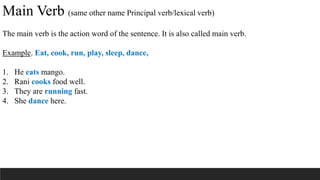
Main Verb (same other name Principal verb/lexical verb)
The main verb is the action word of the sentence. It is also called main verb.
Example. Eat, cook, run, play, sleep, dance,
1. He eats mango.
2. Rani cooks food well.
3. They are running fast.
4. She dance here.
Auxiliary Verb (same other name Helping verb)
The auxiliary verb is used with a main verb to express the main verb Mood, Tense or Voice.
To be - am, is, are, was, were
To have - has, have, had
To do - do, does, did
Example.
1. He is going.
2. She was eating.
3. He has passed the examination.
4. We have bought a book.
5. They had cut the cake.
6. Do you like mango?
7. Does he go to school daily?
Transiting Verb (To Pass Over)
A verb that Denote an action which passes over form the doer or subject to an object is called
transitive verb.
Kick, Eat, like, Cut, Decide
Example.
1. The students KICK the football.
2. I decide to go to Market today.
3. She eats a mango.
4. They like my red pen.
Intransitive Verb
A verb that Does not need any object to complete itself is called intransitive verb.
It does not pass its action form subject to the object.
Cry, Shout, Sleep, Die, Smile
Example.
1. The man cries.
2. Reena Sleeps.
3. He died in an accident.
4. They Shouted.
Regular Verb
A verb that’s past (2nd form) or past participle (3rd form) is made by adding “d” or “ed” is called
Regular verb.
Killed, called, informed, Joined, loved
Example.
1. He called me.
2. They informed the Police of theft.
3. She added me in her Whatup group.
4. Awais joined the new batch of class.
Irregular Verb
A verb which past or past participle is other than the regular verb comes under irregular verb.
They do not have any fix pattern.
Their 2nd and 3rd forms cannot be made by adding ‘d’ or ‘ed’
Example.
1. He drank a full glass of water.
2. Rani broke my heart.
3. We knew all the facts
Finite Verb
This verb is called the actual verb which has a subject and shows tense.
This verb changes its form according to the number or person of the subject.
if the tense of the sentence changes, the form of verb also changes.
Example.
1. I write a letter
2. He writes a letter.
3. I have written a letter.
4. She wrote a letter.
5. I am writing a letter.
Adverbs
Ab adverb is a word use to modify a verb, an adjective, or another adverb.
Quickly, Extremely, Yesterday, Here, Daily
Example.
1. He ran quickly. (adverb modifies verb ran)
2. Musa Come here early. (adverb modifies verb early)
3. It is extremely hot. (adverb modifies verb hot)
Type of Adverbs
1.Adverb of Time
2.Adverb of Place
3.Adverb of Manner
4.Adverb of Frequency
5.Adverb of Degree or Quantity
Adverb of Time
It tells when the action takes place, took place or will take place
Today, Tomorrow, Monday, Last week, ago
Example.
1. They came to my home yesterday.
2. Inzar went to Japan last weeks.
3. She is arriving here today.
4. I shall meet you tomorrow.
Adverb of Place
It tells us where an action takes place/took place or will take place
There, Here, Nowhere, Somewhere
Example.
1. He Left his bad here.
2. She goes for tuition here.
3. I found him nowhere.
4. Ateeq kept the box somewhere in the room.
Adverb of Manner
It tells us how or in what manner an action takes place.
Happily, badly, suddenly, gently
Example.
1. He joined the party happily.
2. We celebrated our friend’s birthday gracefully.
3. Shoaib talked to abid gently.
Adverb of Frequency
It tells us how often an action takes place.
Always, never, often, sometimes
Example.
1. He never comes to my house.
2. My mother always helps me.
3. We play chess sometime
4. They go to school everyday.
Adverb of Degree or Quantity
It tells us how much or in what degree or to what extent an action takes place.
enough, Completely, absolutely, nearly
Example.
1. He completely forgot about assignment.
2. You are absolutely right.
3. There is enough space in rack.
Adverb.pptx

Adverb.pptx

  • 1.
  • 2.
    Verbs are wordsthat tell us what a person (or thing or animal) does, what is done to a person (or thing or animal), or what a person (or thing or animal) is.
  • 3.
    Definition of Verb. Verbis an action word that describes what the subject is doing. It shows an action, state or an event it is the main part of a subject which tells the story of what is taking place in the sentence. Example. Study, celebrate, sleep, run, eat, swim, eat, cook, write A word used to describe an action, state or occurrence and forming the main part of the predicate of a sentence be, do, run, read….. A Verb is an action word that describes what the subject is doing. It show an action, state or an event. It is the main par of subject which tells the story of what is taking in the sentence. Example. We are studying grammar. (Action) He organizes summer camp every year. (Event) MAZ walks in the morning. (state) Verb is only part of speech in English language that show action, abilities, occurrence, time period, so verb is very important. “We all activity and explain with verb” Type of verb State (Situated) Main (Action) Action (Dynamic) Auxiliary (Helping)
  • 4.
    Type of verb •Main Verb • Auxiliary Verb • Transitive Verb • Intransitive Verb • Regular Verb • Irregular Verb • Finite Verb
  • 5.
    Main Verb (sameother name Principal verb/lexical verb) The main verb is the action word of the sentence. It is also called main verb. Example. Eat, cook, run, play, sleep, dance, 1. He eats mango. 2. Rani cooks food well. 3. They are running fast. 4. She dance here.
  • 6.
    Auxiliary Verb (sameother name Helping verb) The auxiliary verb is used with a main verb to express the main verb Mood, Tense or Voice. To be - am, is, are, was, were To have - has, have, had To do - do, does, did Example. 1. He is going. 2. She was eating. 3. He has passed the examination. 4. We have bought a book. 5. They had cut the cake. 6. Do you like mango? 7. Does he go to school daily?
  • 7.
    Transiting Verb (ToPass Over) A verb that Denote an action which passes over form the doer or subject to an object is called transitive verb. Kick, Eat, like, Cut, Decide Example. 1. The students KICK the football. 2. I decide to go to Market today. 3. She eats a mango. 4. They like my red pen.
  • 8.
    Intransitive Verb A verbthat Does not need any object to complete itself is called intransitive verb. It does not pass its action form subject to the object. Cry, Shout, Sleep, Die, Smile Example. 1. The man cries. 2. Reena Sleeps. 3. He died in an accident. 4. They Shouted.
  • 9.
    Regular Verb A verbthat’s past (2nd form) or past participle (3rd form) is made by adding “d” or “ed” is called Regular verb. Killed, called, informed, Joined, loved Example. 1. He called me. 2. They informed the Police of theft. 3. She added me in her Whatup group. 4. Awais joined the new batch of class.
  • 10.
    Irregular Verb A verbwhich past or past participle is other than the regular verb comes under irregular verb. They do not have any fix pattern. Their 2nd and 3rd forms cannot be made by adding ‘d’ or ‘ed’ Example. 1. He drank a full glass of water. 2. Rani broke my heart. 3. We knew all the facts
  • 11.
    Finite Verb This verbis called the actual verb which has a subject and shows tense. This verb changes its form according to the number or person of the subject. if the tense of the sentence changes, the form of verb also changes. Example. 1. I write a letter 2. He writes a letter. 3. I have written a letter. 4. She wrote a letter. 5. I am writing a letter.
  • 12.
    Adverbs Ab adverb isa word use to modify a verb, an adjective, or another adverb. Quickly, Extremely, Yesterday, Here, Daily Example. 1. He ran quickly. (adverb modifies verb ran) 2. Musa Come here early. (adverb modifies verb early) 3. It is extremely hot. (adverb modifies verb hot)
  • 13.
    Type of Adverbs 1.Adverbof Time 2.Adverb of Place 3.Adverb of Manner 4.Adverb of Frequency 5.Adverb of Degree or Quantity
  • 14.
    Adverb of Time Ittells when the action takes place, took place or will take place Today, Tomorrow, Monday, Last week, ago Example. 1. They came to my home yesterday. 2. Inzar went to Japan last weeks. 3. She is arriving here today. 4. I shall meet you tomorrow.
  • 15.
    Adverb of Place Ittells us where an action takes place/took place or will take place There, Here, Nowhere, Somewhere Example. 1. He Left his bad here. 2. She goes for tuition here. 3. I found him nowhere. 4. Ateeq kept the box somewhere in the room.
  • 16.
    Adverb of Manner Ittells us how or in what manner an action takes place. Happily, badly, suddenly, gently Example. 1. He joined the party happily. 2. We celebrated our friend’s birthday gracefully. 3. Shoaib talked to abid gently.
  • 17.
    Adverb of Frequency Ittells us how often an action takes place. Always, never, often, sometimes Example. 1. He never comes to my house. 2. My mother always helps me. 3. We play chess sometime 4. They go to school everyday.
  • 18.
    Adverb of Degreeor Quantity It tells us how much or in what degree or to what extent an action takes place. enough, Completely, absolutely, nearly Example. 1. He completely forgot about assignment. 2. You are absolutely right. 3. There is enough space in rack.