The document discusses different types of verbs including action verbs, present tense verbs, past tense verbs, future tense verbs, and helping verbs. It provides examples of each type of verb and notes how their forms may change depending on tense. It also lists some online games and activities related to verbs.
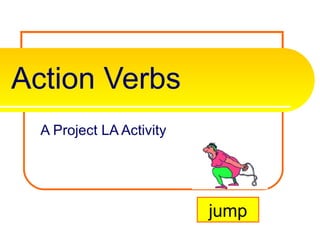
What is anaction verb? A verb is one of the most important parts of the sentence. It tells the subjects actions, events, or state of being. It is always found in the predicate of a sentence. A verb that shows action is called an action verb.
3.
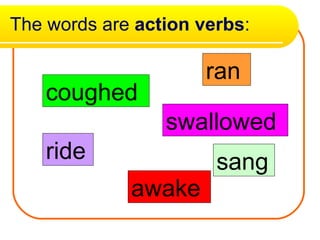
The words are action verbs : coughed swallowed awake ran ride sang
4.
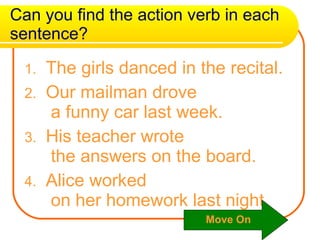
Can you findthe action verb in each sentence? The girls danced in the recital. Our mailman drove a funny car last week. His teacher wrote the answers on the board. Alice worked on her homework last night. Move On
Yes, that wordis an action verb! Try another sentence Move On
7.
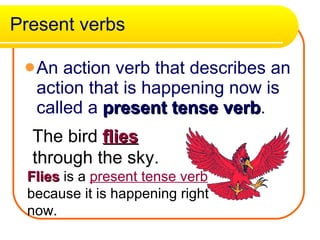
Present verbs Anaction verb that describes an action that is happening now is called a present tense verb . The bird flies through the sky. Flies is a present tense verb because it is happening right now.
8.
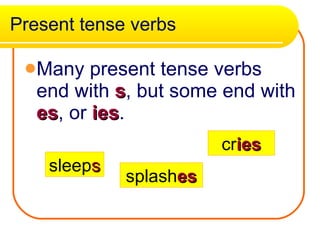
Present tense verbsMany present tense verbs end with s , but some end with es , or ies . sleep s splash es cr ies
9.
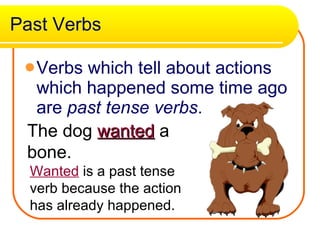
Past Verbs Verbswhich tell about actions which happened some time ago are past tense verbs . The dog wanted a bone. Wanted is a past tense verb because the action has already happened.
10.
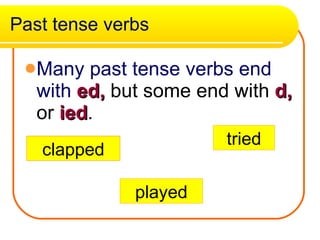
Past tense verbsMany past tense verbs end with ed, but some end with d, or ied . clapped played tried
11.
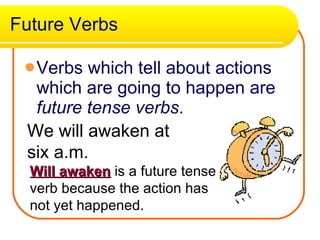
Future Verbs Verbswhich tell about actions which are going to happen are future tense verbs . We will awaken at six a.m. Will awaken is a future tense verb because the action has not yet happened.
12.
Future tense verbsFuture tense verbs use special words to talk about things that will happen: will, going to, shall, aim to, etc. going to start shall email will enjoy
13.
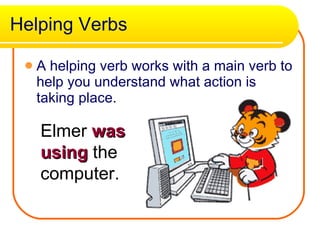
Helping Verbs Ahelping verb works with a main verb to help you understand what action is taking place. Elmer was using the computer.
14.
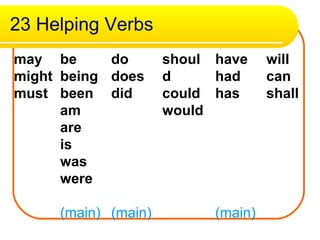
23 Helping Verbswill can shall have had has (main) should could would do does did (main) be being been am are is was were (main) may might must
15.
Helping Verbs Otherthings to keep in mind: Not every sentence will have a helping verb with the main verb. When you see an "ing" verb such as "running", be on the lookout for a helping verb also.
16.
Helping Verbs Sometimesthere is another word which separates the helping verb from the main verb. One common example is "not", as in: The boy couldn't find his socks. The helping verb is could and the main verb is find.
17.
Helping Verbs Asentence may contain up to three helping verbs to the main verb. An example would be: The dog must have been chasing the cat. The helping verbs are: must, have, and been; the main verb is chasing.
18.
Online Verb GamesHit the Back Arrow on your browser to return. Take Dave’s Quiz Helping Verb Quiz Print and complete the Action Verb Worksheet Find the Verb Game Jeopardy Challenge Board Present and Past Tense Matching Game Verb Machine
19.
More Verb ActivitiesIrregular Verb Worksheet Verb Concentration Game ANTS PICNIC (Irregular Verb Game) Verb Worksheet MAIN