Verb
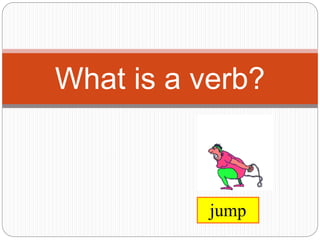
What is a verb?
jump
Verbs
A verb is one of the most
important parts of the sentence.
It tells the subjects actions,
events, or state of being.
It is always found in the
predicate of a sentence.
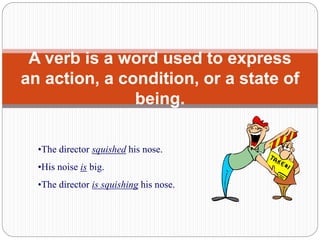
A verb is a word used to express
an action, a condition, or a state of
being.
•The director squished his nose.
•His noise is big.
•The director is squishing his nose.
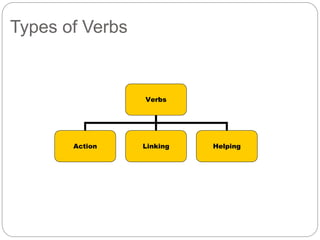
Types of Verbs
Verbs
Action Linking Helping
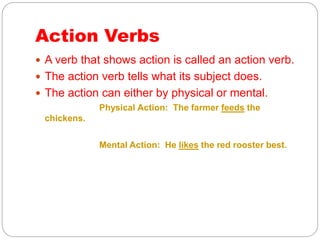
Action Verbs
 A verb that shows action is called an action verb.
 The action verb tells what its subject does.
 The action can either by physical or mental.
Physical Action: The farmer feeds the
chickens.
Mental Action: He likes the red rooster best.
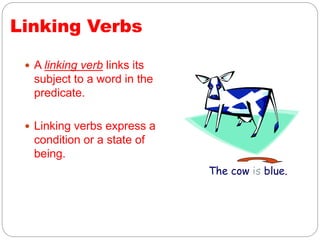
Linking Verbs
 A linking verb links its
subject to a word in the
predicate.
 Linking verbs express a
condition or a state of
being.
The cow is blue.
Linking Verbs
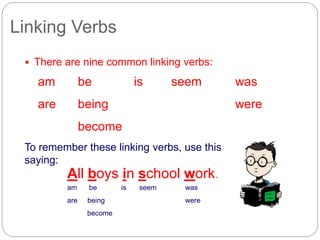
 There are nine common linking verbs:
am
are
be
being
become
is seem was
were
To remember these linking verbs, use this
saying:
All boys in school work.
am be is seem was
are being were
become
Helping Verbs
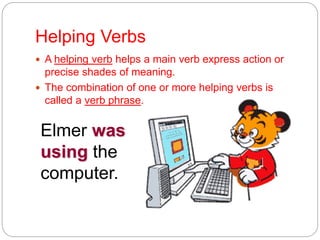
 A helping verb helps a main verb express action or
precise shades of meaning.
 The combination of one or more helping verbs is
called a verb phrase.
Elmer was
using the
computer.
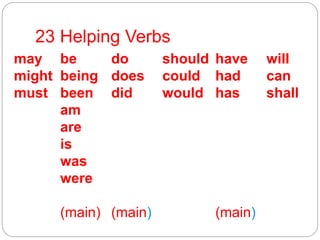
23 Helping Verbs
may
might
must
be
being
been
am
are
is
was
were
(main)
do
does
did
(main)
should
could
would
have
had
has
(main)
will
can
shall
Helping Verbs
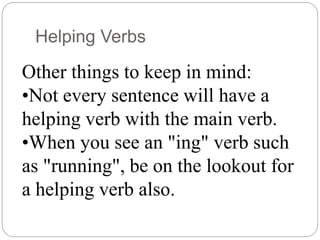
Other things to keep in mind:
•Not every sentence will have a
helping verb with the main verb.
•When you see an "ing" verb such
as "running", be on the lookout for
a helping verb also.
Helping Verbs
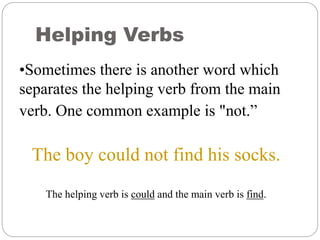
•Sometimes there is another word which
separates the helping verb from the main
verb. One common example is "not.”
The boy could not find his socks.
The helping verb is could and the main verb is find.
Helping Verbs
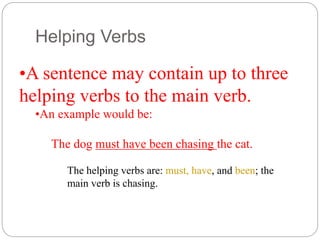
•A sentence may contain up to three
helping verbs to the main verb.
•An example would be:
The dog must have been chasing the cat.
The helping verbs are: must, have, and been; the
main verb is chasing.
Types of verbs
according to form
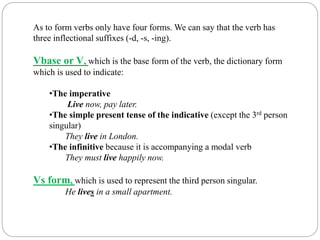
As to form verbs only have four forms. We can say that the verb has
three inflectional suffixes (-d, -s, -ing).
Vbase or V, which is the base form of the verb, the dictionary form
which is used to indicate:
•The imperative
Live now, pay later.
•The simple present tense of the indicative (except the 3rd person
singular)
They live in London.
•The infinitive because it is accompanying a modal verb
They must live happily now.
Vs form, which is used to represent the third person singular.
He lives in a small apartment.
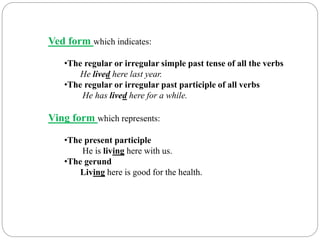
Ved form which indicates:
•The regular or irregular simple past tense of all the verbs
He lived here last year.
•The regular or irregular past participle of all verbs
He has lived here for a while.
Ving form which represents:
•The present participle
He is living here with us.
•The gerund
Living here is good for the health.
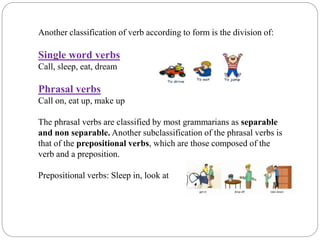
Another classification of verb according to form is the division of:
Single word verbs
Call, sleep, eat, dream
Phrasal verbs
Call on, eat up, make up
The phrasal verbs are classified by most grammarians as separable
and non separable. Another subclassification of the phrasal verbs is
that of the prepositional verbs, which are those composed of the
verb and a preposition.
Prepositional verbs: Sleep in, look at
Regular and irregular verbs
The regular verbs are those that form their past participle
(Ved) by adding the morpheme d.
Jump – jumped
Look - looked
Have – had
The irregular verbs are those that do not form their past or
past participle with the d morpheme.
Sing- sang
Be –was/were
Write - wrote
Dynamic and stative verbs
Dynamic verbs are those that readily accept, because of their meaning, the
use of Ving.
•These verbs denote an actual action or expression or process done by
the subject. They mean an action which can be seen or physically felt.
Be, drink, smoke, jump
Stative verbs are those that cannot be normally used in the continuous
form. They are called non-continuous verbs.
•These verbs refer to the state of the subject or the situation of the
subject. They tell us about the state of mind of the subject, or the
relation between the subject and the object.
Love, look like, remember, seem
Mixed verbs. These verbs have more than one meaning. Some
meanings behave like non-continuous verbs (stative verbs), while
other meanings behave like continuous verbs (dynamic verbs).
To have, to appear, to see, to feel, to look…
Examples:
I have a dollar now. (I possess a dollar.) non-continuous verb
I am having fun now. (I am experiencing fun now.)  continuous
verb
Dynamic and stative verbs (cont.)
Subject – Verb Agreement
The subject and verb in a clause should always
agree in number.
 Joey walks. (singular subject/singular verb)
 Joey and Maggie walk. (plural subject/plural verb)
 She runs. (singular subject/singular verb)
 They run. (plural subject/plural verb)

power point verb, macam-macam verb type verb

  • 1.
  • 2.
    What is averb? jump
  • 3.
    Verbs A verb isone of the most important parts of the sentence. It tells the subjects actions, events, or state of being. It is always found in the predicate of a sentence.
  • 4.
    A verb isa word used to express an action, a condition, or a state of being. •The director squished his nose. •His noise is big. •The director is squishing his nose.
  • 5.
  • 6.
    Action Verbs  Averb that shows action is called an action verb.  The action verb tells what its subject does.  The action can either by physical or mental. Physical Action: The farmer feeds the chickens. Mental Action: He likes the red rooster best.
  • 7.
    Linking Verbs  Alinking verb links its subject to a word in the predicate.  Linking verbs express a condition or a state of being. The cow is blue.
  • 8.
    Linking Verbs  Thereare nine common linking verbs: am are be being become is seem was were To remember these linking verbs, use this saying: All boys in school work. am be is seem was are being were become
  • 9.
    Helping Verbs  Ahelping verb helps a main verb express action or precise shades of meaning.  The combination of one or more helping verbs is called a verb phrase. Elmer was using the computer.
  • 10.
  • 11.
    Helping Verbs Other thingsto keep in mind: •Not every sentence will have a helping verb with the main verb. •When you see an "ing" verb such as "running", be on the lookout for a helping verb also.
  • 12.
    Helping Verbs •Sometimes thereis another word which separates the helping verb from the main verb. One common example is "not.” The boy could not find his socks. The helping verb is could and the main verb is find.
  • 13.
    Helping Verbs •A sentencemay contain up to three helping verbs to the main verb. •An example would be: The dog must have been chasing the cat. The helping verbs are: must, have, and been; the main verb is chasing.
  • 14.
  • 15.
    As to formverbs only have four forms. We can say that the verb has three inflectional suffixes (-d, -s, -ing). Vbase or V, which is the base form of the verb, the dictionary form which is used to indicate: •The imperative Live now, pay later. •The simple present tense of the indicative (except the 3rd person singular) They live in London. •The infinitive because it is accompanying a modal verb They must live happily now. Vs form, which is used to represent the third person singular. He lives in a small apartment.
  • 16.
    Ved form whichindicates: •The regular or irregular simple past tense of all the verbs He lived here last year. •The regular or irregular past participle of all verbs He has lived here for a while. Ving form which represents: •The present participle He is living here with us. •The gerund Living here is good for the health.
  • 17.
    Another classification ofverb according to form is the division of: Single word verbs Call, sleep, eat, dream Phrasal verbs Call on, eat up, make up The phrasal verbs are classified by most grammarians as separable and non separable. Another subclassification of the phrasal verbs is that of the prepositional verbs, which are those composed of the verb and a preposition. Prepositional verbs: Sleep in, look at
  • 18.
    Regular and irregularverbs The regular verbs are those that form their past participle (Ved) by adding the morpheme d. Jump – jumped Look - looked Have – had The irregular verbs are those that do not form their past or past participle with the d morpheme. Sing- sang Be –was/were Write - wrote
  • 19.
    Dynamic and stativeverbs Dynamic verbs are those that readily accept, because of their meaning, the use of Ving. •These verbs denote an actual action or expression or process done by the subject. They mean an action which can be seen or physically felt. Be, drink, smoke, jump Stative verbs are those that cannot be normally used in the continuous form. They are called non-continuous verbs. •These verbs refer to the state of the subject or the situation of the subject. They tell us about the state of mind of the subject, or the relation between the subject and the object. Love, look like, remember, seem
  • 20.
    Mixed verbs. Theseverbs have more than one meaning. Some meanings behave like non-continuous verbs (stative verbs), while other meanings behave like continuous verbs (dynamic verbs). To have, to appear, to see, to feel, to look… Examples: I have a dollar now. (I possess a dollar.) non-continuous verb I am having fun now. (I am experiencing fun now.)  continuous verb Dynamic and stative verbs (cont.)
  • 21.
    Subject – VerbAgreement The subject and verb in a clause should always agree in number.  Joey walks. (singular subject/singular verb)  Joey and Maggie walk. (plural subject/plural verb)  She runs. (singular subject/singular verb)  They run. (plural subject/plural verb)