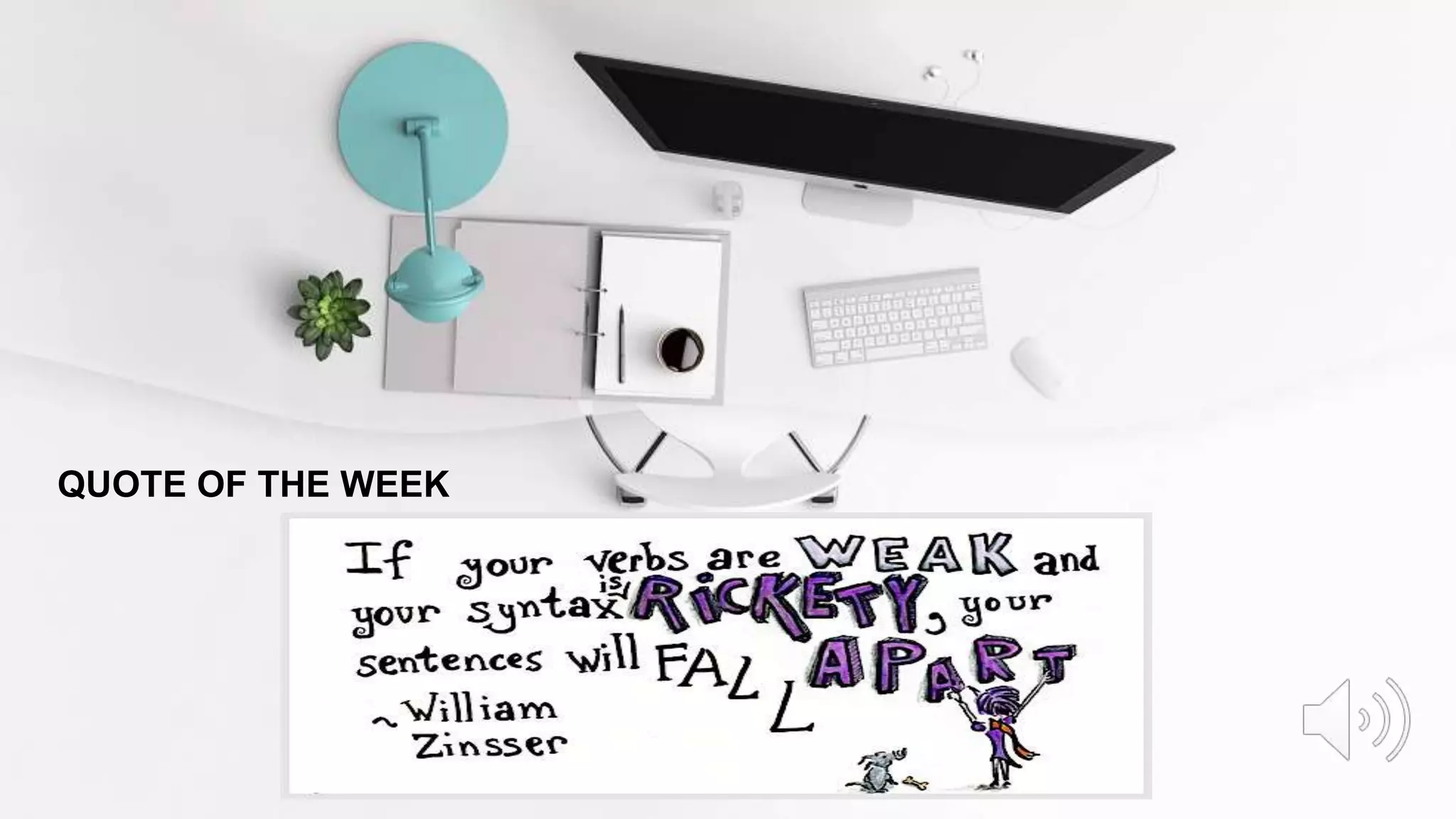
QUOTE OF THE WEEK
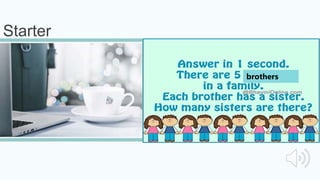
Starter
brothers
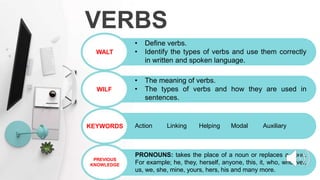
VERBS
WALT
• Define verbs.
• Identify the types of verbs and use them correctly
in written and spoken language.
WILF
• The meaning of verbs.
• The types of verbs and how they are used in
sentences.
KEYWORDS Action Linking Helping Modal Auxiliary
PREVIOUS
KNOWLEDGE
PRONOUNS: takes the place of a noun or replaces a noun.
For example; he, they, herself, anyone, this, it, who, whoever,
us, we, she, mine, yours, hers, his and many more.
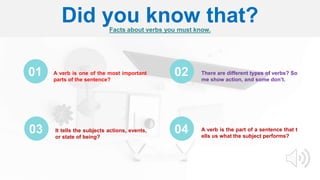
Did you know that?
Facts about verbs you must know.
01
03
02
04
A verb is one of the most important
parts of the sentence?
It tells the subjects actions, events,
or state of being?
There are different types of verbs? So
me show action, and some don’t.
A verb is the part of a sentence that t
ells us what the subject performs?
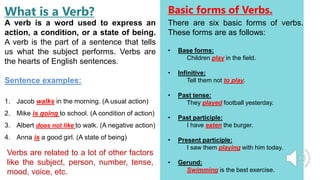
What is a Verb?
A verb is a word used to express an
action, a condition, or a state of being.
A verb is the part of a sentence that tells
us what the subject performs. Verbs are
the hearts of English sentences.
Sentence examples:
1. Jacob walks in the morning. (A usual action)
2. Mike is going to school. (A condition of action)
3. Albert does not like to walk. (A negative action)
4. Anna is a good girl. (A state of being)
Basic forms of Verbs.
Verbs are related to a lot of other factors
like the subject, person, number, tense,
mood, voice, etc.
There are six basic forms of verbs.
These forms are as follows:
• Base forms:
Children play in the field.
• Infinitive:
Tell them not to play.
• Past tense:
They played football yesterday.
• Past participle:
I have eaten the burger.
• Present participle:
I saw them playing with him today.
• Gerund:
Swimming is the best exercise.
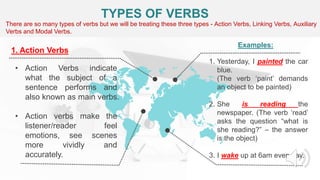
• Action Verbs indicate
what the subject of a
sentence performs and
also known as main verbs.
• Action verbs make the
listener/reader feel
emotions, see scenes
more vividly and
accurately.
1. Action Verbs
1. Yesterday, I painted the car
blue.
(The verb ‘paint’ demands
an object to be painted)
2. She is reading the
newspaper. (The verb ‘read’
asks the question “what is
she reading?” – the answer
is the object)
3. I wake up at 6am everyday.
Examples:
There are so many types of verbs but we will be treating these three types - Action Verbs, Linking Verbs, Auxiliary
Verbs and Modal Verbs.
TYPES OF VERBS
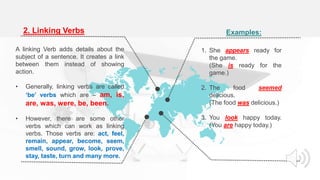
A linking Verb adds details about the
subject of a sentence. It creates a link
between them instead of showing
action.
• Generally, linking verbs are called
‘be’ verbs which are – am, is,
are, was, were, be, been.
• However, there are some other
verbs which can work as linking
verbs. Those verbs are: act, feel,
remain, appear, become, seem,
smell, sound, grow, look, prove,
stay, taste, turn and many more.
2. Linking Verbs
1. She appears ready for
the game.
(She is ready for the
game.)
2. The food seemed
delicious.
(The food was delicious.)
3. You look happy today.
(You are happy today.)
Examples:
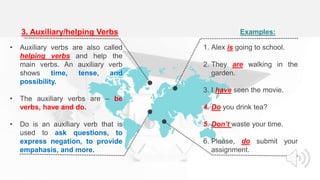
• Auxiliary verbs are also called
helping verbs and help the
main verbs. An auxiliary verb
shows time, tense, and
possibility.
• The auxiliary verbs are – be
verbs, have and do.
• Do is an auxiliary verb that is
used to ask questions, to
express negation, to provide
empahasis, and more.
3. Auxiliary/helping Verbs
1. Alex is going to school.
2. They are walking in the
garden.
3. I have seen the movie.
4. Do you drink tea?
5. Don’t waste your time.
6. Please, do submit your
assignment.
Examples:
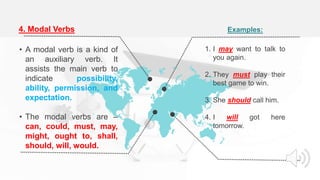
• A modal verb is a kind of
an auxiliary verb. It
assists the main verb to
indicate possibility,
ability, permission, and
expectation.
• The modal verbs are –
can, could, must, may,
might, ought to, shall,
should, will, would.
4. Modal Verbs
1. I may want to talk to
you again.
2. They must play their
best game to win.
3. She should call him.
4. I will got here
tomorrow.
Examples:
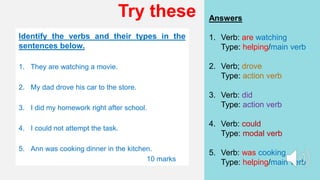
Try these
Identify the verbs and their types in the
sentences below.
1. They are watching a movie.
2. My dad drove his car to the store.
3. I did my homework right after school.
4. I could not attempt the task.
5. Ann was cooking dinner in the kitchen.
10 marks
Answers
1. Verb: are watching
Type: helping/main verb
2. Verb; drove
Type: action verb
3. Verb: did
Type: action verb
4. Verb: could
Type: modal verb
5. Verb: was cooking
Type: helping/main verb
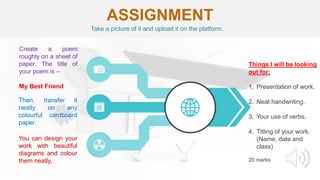
ASSIGNMENT
Create a poem
roughly on a sheet of
paper. The title of
your poem is –
My Best Friend
Then, transfer it
neatly on any
colourful cardboard
paper.
You can design your
work with beautiful
diagrams and colour
them neatly.
Things I will be looking
out for:
1. Presentation of work.
2. Neat handwriting.
3. Your use of verbs.
4. Titling of your work.
(Name, date and
class)
20 marks
Take a picture of it and upload it on the platform.
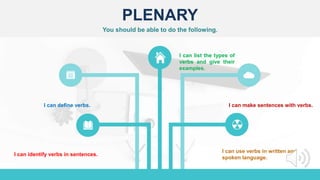
PLENARY
You should be able to do the following.
I can define verbs.
I can identify verbs in sentences.
I can use verbs in written and
spoken language.
I can make sentences with verbs.
I can list the types of
verbs and give their
examples.
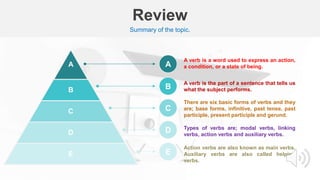
Review
Summary of the topic.
A
B
C
D
E
A
B
C
D
E
A verb is a word used to express an action,
a condition, or a state of being.
A verb is the part of a sentence that tells us
what the subject performs.
There are six basic forms of verbs and they
are; base forms, infinitive, past tense, past
participle, present participle and gerund.
Types of verbs are; modal verbs, linking
verbs, action verbs and auxiliary verbs.
Action verbs are also known as main verbs.
Auxiliary verbs are also called helping
verbs.
Thank You!
Ms. Precious
Resources:
Tes
Grammar made easy
E-reading
Slideshare
English grammar

Verbs.pptx

  • 1.
  • 2.
  • 3.
    VERBS WALT • Define verbs. •Identify the types of verbs and use them correctly in written and spoken language. WILF • The meaning of verbs. • The types of verbs and how they are used in sentences. KEYWORDS Action Linking Helping Modal Auxiliary PREVIOUS KNOWLEDGE PRONOUNS: takes the place of a noun or replaces a noun. For example; he, they, herself, anyone, this, it, who, whoever, us, we, she, mine, yours, hers, his and many more.
  • 4.
    Did you knowthat? Facts about verbs you must know. 01 03 02 04 A verb is one of the most important parts of the sentence? It tells the subjects actions, events, or state of being? There are different types of verbs? So me show action, and some don’t. A verb is the part of a sentence that t ells us what the subject performs?
  • 5.
    What is aVerb? A verb is a word used to express an action, a condition, or a state of being. A verb is the part of a sentence that tells us what the subject performs. Verbs are the hearts of English sentences. Sentence examples: 1. Jacob walks in the morning. (A usual action) 2. Mike is going to school. (A condition of action) 3. Albert does not like to walk. (A negative action) 4. Anna is a good girl. (A state of being) Basic forms of Verbs. Verbs are related to a lot of other factors like the subject, person, number, tense, mood, voice, etc. There are six basic forms of verbs. These forms are as follows: • Base forms: Children play in the field. • Infinitive: Tell them not to play. • Past tense: They played football yesterday. • Past participle: I have eaten the burger. • Present participle: I saw them playing with him today. • Gerund: Swimming is the best exercise.
  • 6.
    • Action Verbsindicate what the subject of a sentence performs and also known as main verbs. • Action verbs make the listener/reader feel emotions, see scenes more vividly and accurately. 1. Action Verbs 1. Yesterday, I painted the car blue. (The verb ‘paint’ demands an object to be painted) 2. She is reading the newspaper. (The verb ‘read’ asks the question “what is she reading?” – the answer is the object) 3. I wake up at 6am everyday. Examples: There are so many types of verbs but we will be treating these three types - Action Verbs, Linking Verbs, Auxiliary Verbs and Modal Verbs. TYPES OF VERBS
  • 7.
    A linking Verbadds details about the subject of a sentence. It creates a link between them instead of showing action. • Generally, linking verbs are called ‘be’ verbs which are – am, is, are, was, were, be, been. • However, there are some other verbs which can work as linking verbs. Those verbs are: act, feel, remain, appear, become, seem, smell, sound, grow, look, prove, stay, taste, turn and many more. 2. Linking Verbs 1. She appears ready for the game. (She is ready for the game.) 2. The food seemed delicious. (The food was delicious.) 3. You look happy today. (You are happy today.) Examples:
  • 8.
    • Auxiliary verbsare also called helping verbs and help the main verbs. An auxiliary verb shows time, tense, and possibility. • The auxiliary verbs are – be verbs, have and do. • Do is an auxiliary verb that is used to ask questions, to express negation, to provide empahasis, and more. 3. Auxiliary/helping Verbs 1. Alex is going to school. 2. They are walking in the garden. 3. I have seen the movie. 4. Do you drink tea? 5. Don’t waste your time. 6. Please, do submit your assignment. Examples:
  • 9.
    • A modalverb is a kind of an auxiliary verb. It assists the main verb to indicate possibility, ability, permission, and expectation. • The modal verbs are – can, could, must, may, might, ought to, shall, should, will, would. 4. Modal Verbs 1. I may want to talk to you again. 2. They must play their best game to win. 3. She should call him. 4. I will got here tomorrow. Examples:
  • 10.
    Try these Identify theverbs and their types in the sentences below. 1. They are watching a movie. 2. My dad drove his car to the store. 3. I did my homework right after school. 4. I could not attempt the task. 5. Ann was cooking dinner in the kitchen. 10 marks Answers 1. Verb: are watching Type: helping/main verb 2. Verb; drove Type: action verb 3. Verb: did Type: action verb 4. Verb: could Type: modal verb 5. Verb: was cooking Type: helping/main verb
  • 11.
    ASSIGNMENT Create a poem roughlyon a sheet of paper. The title of your poem is – My Best Friend Then, transfer it neatly on any colourful cardboard paper. You can design your work with beautiful diagrams and colour them neatly. Things I will be looking out for: 1. Presentation of work. 2. Neat handwriting. 3. Your use of verbs. 4. Titling of your work. (Name, date and class) 20 marks Take a picture of it and upload it on the platform.
  • 12.
    PLENARY You should beable to do the following. I can define verbs. I can identify verbs in sentences. I can use verbs in written and spoken language. I can make sentences with verbs. I can list the types of verbs and give their examples.
  • 13.
    Review Summary of thetopic. A B C D E A B C D E A verb is a word used to express an action, a condition, or a state of being. A verb is the part of a sentence that tells us what the subject performs. There are six basic forms of verbs and they are; base forms, infinitive, past tense, past participle, present participle and gerund. Types of verbs are; modal verbs, linking verbs, action verbs and auxiliary verbs. Action verbs are also known as main verbs. Auxiliary verbs are also called helping verbs.
  • 14.
    Thank You! Ms. Precious Resources: Tes Grammarmade easy E-reading Slideshare English grammar