Grammar
Subject &
Predicate
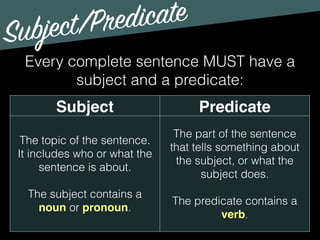
Subject/Predicate
Every complete sentence MUST have a
subject and a predicate:
Subject Predicate
The topic of the sentence.
It includes who or what the
sentence is about.
The subject contains a
noun or pronoun.
The part of the sentence
that tells something about
the subject, or what the
subject does.
The predicate contains a
verb.
Subject/Predicate
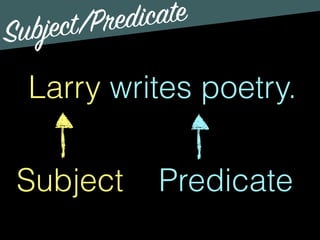
Larry writes poetry.
Subject Predicate
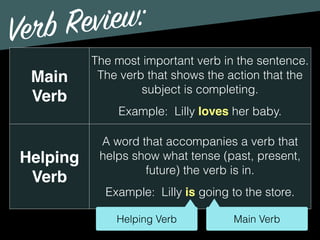
Verb Review:
Main
Verb
The most important verb in the sentence.
The verb that shows the action that the
subject is completing.
Example: Lilly loves her baby.
Helping
Verb
A word that accompanies a verb that
helps show what tense (past, present,
future) the verb is in.
Example: Lilly is going to the store.
Main VerbHelping Verb
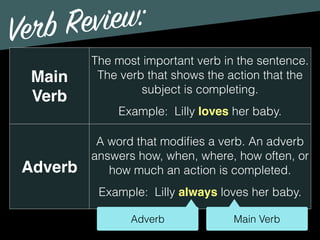
Verb Review:
Main
Verb
The most important verb in the sentence.
The verb that shows the action that the
subject is completing.
Example: Lilly loves her baby.
Adverb
A word that modifies a verb. An adverb
answers how, when, where, how often, or
how much an action is completed.
Example: Lilly always loves her baby.
Main VerbAdverb
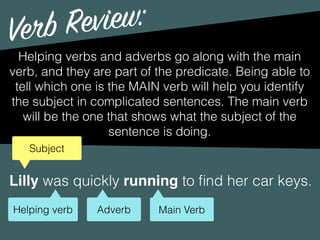
Verb Review:
Helping verbs and adverbs go along with the main
verb, and they are part of the predicate. Being able to
tell which one is the MAIN verb will help you identify
the subject in complicated sentences. The main verb
will be the one that shows what the subject of the
sentence is doing.
Lilly was quickly running to find her car keys.
Main VerbAdverbHelping verb
Subject
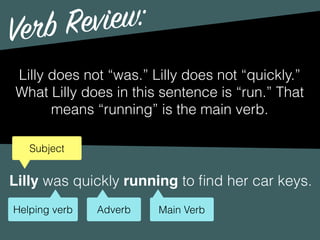
Verb Review:
Lilly does not “was.” Lilly does not “quickly.”
What Lilly does in this sentence is “run.” That
means “running” is the main verb.
Lilly was quickly running to find her car keys.
Main VerbAdverbHelping verb
Subject
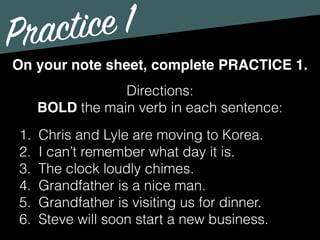
Practice 1
Directions:
BOLD the main verb in each sentence:
On your note sheet, complete PRACTICE 1.
1. Chris and Lyle are moving to Korea.
2. I can’t remember what day it is.
3. The clock loudly chimes.
4. Grandfather is a nice man.
5. Grandfather is visiting us for dinner.
6. Steve will soon start a new business.
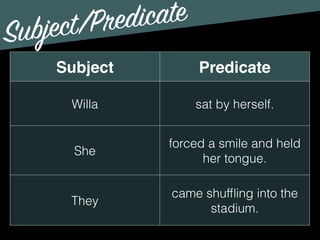
Subject/Predicate
Subject Predicate
Willa sat by herself.
She
forced a smile and held
her tongue.
They
came shuffling into the
stadium.
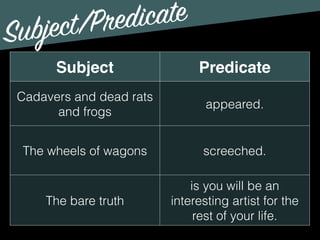
Subject/Predicate
Subject Predicate
Cadavers and dead rats
and frogs
appeared.
The wheels of wagons screeched.
The bare truth
is you will be an
interesting artist for the
rest of your life.
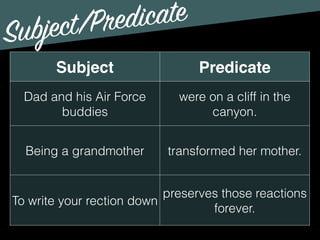
Subject/Predicate
Subject Predicate
Dad and his Air Force
buddies
were on a cliff in the
canyon.
Being a grandmother transformed her mother.
To write your rection down
preserves those reactions
forever.
Subject
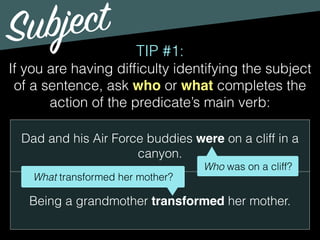
TIP #1:
If you are having difficulty identifying the subject
of a sentence, ask who or what completes the
action of the predicate’s main verb:
Dad and his Air Force buddies were on a cliff in a
canyon.
Being a grandmother transformed her mother.
Who was on a cliff?
What transformed her mother?
Subject
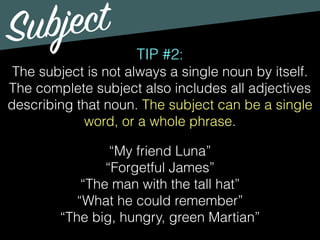
TIP #2:
The subject is not always a single noun by itself.
The complete subject also includes all adjectives
describing that noun. The subject can be a single
word, or a whole phrase.
“My friend Luna”
“Forgetful James”
“The man with the tall hat”
“What he could remember”
“The big, hungry, green Martian”
Subject
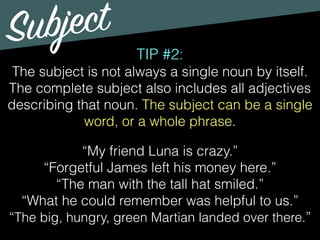
TIP #2:
The subject is not always a single noun by itself.
The complete subject also includes all adjectives
describing that noun. The subject can be a single
word, or a whole phrase.
“My friend Luna is crazy.”
“Forgetful James left his money here.”
“The man with the tall hat smiled.”
“What he could remember was helpful to us.”
“The big, hungry, green Martian landed over there.”
Subject
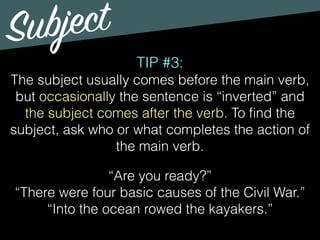
TIP #3:
The subject usually comes before the main verb,
but occasionally the sentence is “inverted” and
the subject comes after the verb. To find the
subject, ask who or what completes the action of
the main verb.
“Are you ready?”
“There were four basic causes of the Civil War.”
“Into the ocean rowed the kayakers.”
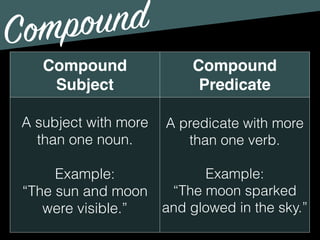
Compound
Subject
Compound
Predicate
A subject with more
than one noun.
Example:
“The sun and moon
were visible.”
A predicate with more
than one verb.
Example:
“The moon sparked
and glowed in the sky.”
Compound
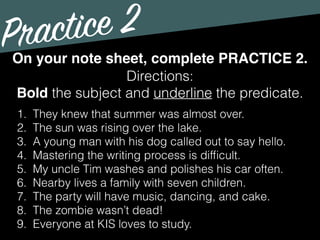
Practice 2
Directions:
Bold the subject and underline the predicate.
On your note sheet, complete PRACTICE 2.
1. They knew that summer was almost over.
2. The sun was rising over the lake.
3. A young man with his dog called out to say hello.
4. Mastering the writing process is difficult.
5. My uncle Tim washes and polishes his car often.
6. Nearby lives a family with seven children.
7. The party will have music, dancing, and cake.
8. The zombie wasn’t dead!
9. Everyone at KIS loves to study.
Grammar
Modifiers
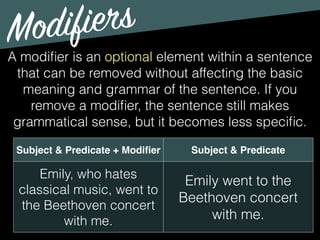
Modifiers
A modifier is an optional element within a sentence
that can be removed without affecting the basic
meaning and grammar of the sentence. If you
remove a modifier, the sentence still makes
grammatical sense, but it becomes less specific.
Subject & Predicate + Modifier Subject & Predicate
Emily, who hates
classical music, went to
the Beethoven concert
with me.
Emily went to the
Beethoven concert
with me.
Modifiers
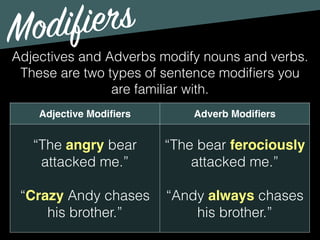
Adjectives and Adverbs modify nouns and verbs.
These are two types of sentence modifiers you
are familiar with.
Adjective Modifiers Adverb Modifiers
“The angry bear
attacked me.”
“Crazy Andy chases
his brother.”
“The bear ferociously
attacked me.”
“Andy always chases
his brother.”
Modifiers
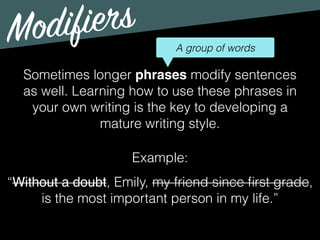
Sometimes longer phrases modify sentences
as well. Learning how to use these phrases in
your own writing is the key to developing a
mature writing style.
A group of words
Example:
“Without a doubt, Emily, my friend since first grade,
is the most important person in my life.”
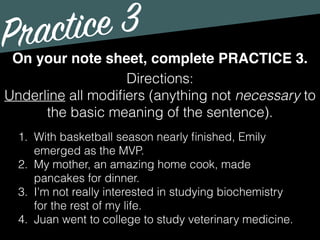
Practice 3
Directions:
Underline all modifiers (anything not necessary to
the basic meaning of the sentence).
On your note sheet, complete PRACTICE 3.
1. With basketball season nearly finished, Emily
emerged as the MVP.
2. My mother, an amazing home cook, made
pancakes for dinner.
3. I'm not really interested in studying biochemistry
for the rest of my life.
4. Juan went to college to study veterinary medicine.
Worksheet
Complete the worksheet:
“Subjects, Predicates, and Modifiers”!
Good Luck!

Grammar: Subject, Predicate, Modifiers

  • 1.
  • 2.
    Subject/Predicate Every complete sentenceMUST have a subject and a predicate: Subject Predicate The topic of the sentence. It includes who or what the sentence is about. The subject contains a noun or pronoun. The part of the sentence that tells something about the subject, or what the subject does. The predicate contains a verb.
  • 3.
  • 4.
    Verb Review: Main Verb The mostimportant verb in the sentence. The verb that shows the action that the subject is completing. Example: Lilly loves her baby. Helping Verb A word that accompanies a verb that helps show what tense (past, present, future) the verb is in. Example: Lilly is going to the store. Main VerbHelping Verb
  • 5.
    Verb Review: Main Verb The mostimportant verb in the sentence. The verb that shows the action that the subject is completing. Example: Lilly loves her baby. Adverb A word that modifies a verb. An adverb answers how, when, where, how often, or how much an action is completed. Example: Lilly always loves her baby. Main VerbAdverb
  • 6.
    Verb Review: Helping verbsand adverbs go along with the main verb, and they are part of the predicate. Being able to tell which one is the MAIN verb will help you identify the subject in complicated sentences. The main verb will be the one that shows what the subject of the sentence is doing. Lilly was quickly running to find her car keys. Main VerbAdverbHelping verb Subject
  • 7.
    Verb Review: Lilly doesnot “was.” Lilly does not “quickly.” What Lilly does in this sentence is “run.” That means “running” is the main verb. Lilly was quickly running to find her car keys. Main VerbAdverbHelping verb Subject
  • 8.
    Practice 1 Directions: BOLD themain verb in each sentence: On your note sheet, complete PRACTICE 1. 1. Chris and Lyle are moving to Korea. 2. I can’t remember what day it is. 3. The clock loudly chimes. 4. Grandfather is a nice man. 5. Grandfather is visiting us for dinner. 6. Steve will soon start a new business.
  • 9.
    Subject/Predicate Subject Predicate Willa satby herself. She forced a smile and held her tongue. They came shuffling into the stadium.
  • 10.
    Subject/Predicate Subject Predicate Cadavers anddead rats and frogs appeared. The wheels of wagons screeched. The bare truth is you will be an interesting artist for the rest of your life.
  • 11.
    Subject/Predicate Subject Predicate Dad andhis Air Force buddies were on a cliff in the canyon. Being a grandmother transformed her mother. To write your rection down preserves those reactions forever.
  • 12.
    Subject TIP #1: If youare having difficulty identifying the subject of a sentence, ask who or what completes the action of the predicate’s main verb: Dad and his Air Force buddies were on a cliff in a canyon. Being a grandmother transformed her mother. Who was on a cliff? What transformed her mother?
  • 13.
    Subject TIP #2: The subjectis not always a single noun by itself. The complete subject also includes all adjectives describing that noun. The subject can be a single word, or a whole phrase. “My friend Luna” “Forgetful James” “The man with the tall hat” “What he could remember” “The big, hungry, green Martian”
  • 14.
    Subject TIP #2: The subjectis not always a single noun by itself. The complete subject also includes all adjectives describing that noun. The subject can be a single word, or a whole phrase. “My friend Luna is crazy.” “Forgetful James left his money here.” “The man with the tall hat smiled.” “What he could remember was helpful to us.” “The big, hungry, green Martian landed over there.”
  • 15.
    Subject TIP #3: The subjectusually comes before the main verb, but occasionally the sentence is “inverted” and the subject comes after the verb. To find the subject, ask who or what completes the action of the main verb. “Are you ready?” “There were four basic causes of the Civil War.” “Into the ocean rowed the kayakers.”
  • 16.
    Compound Subject Compound Predicate A subject withmore than one noun. Example: “The sun and moon were visible.” A predicate with more than one verb. Example: “The moon sparked and glowed in the sky.” Compound
  • 17.
    Practice 2 Directions: Bold thesubject and underline the predicate. On your note sheet, complete PRACTICE 2. 1. They knew that summer was almost over. 2. The sun was rising over the lake. 3. A young man with his dog called out to say hello. 4. Mastering the writing process is difficult. 5. My uncle Tim washes and polishes his car often. 6. Nearby lives a family with seven children. 7. The party will have music, dancing, and cake. 8. The zombie wasn’t dead! 9. Everyone at KIS loves to study.
  • 18.
  • 19.
    Modifiers A modifier isan optional element within a sentence that can be removed without affecting the basic meaning and grammar of the sentence. If you remove a modifier, the sentence still makes grammatical sense, but it becomes less specific. Subject & Predicate + Modifier Subject & Predicate Emily, who hates classical music, went to the Beethoven concert with me. Emily went to the Beethoven concert with me.
  • 20.
    Modifiers Adjectives and Adverbsmodify nouns and verbs. These are two types of sentence modifiers you are familiar with. Adjective Modifiers Adverb Modifiers “The angry bear attacked me.” “Crazy Andy chases his brother.” “The bear ferociously attacked me.” “Andy always chases his brother.”
  • 21.
    Modifiers Sometimes longer phrasesmodify sentences as well. Learning how to use these phrases in your own writing is the key to developing a mature writing style. A group of words Example: “Without a doubt, Emily, my friend since first grade, is the most important person in my life.”
  • 22.
    Practice 3 Directions: Underline allmodifiers (anything not necessary to the basic meaning of the sentence). On your note sheet, complete PRACTICE 3. 1. With basketball season nearly finished, Emily emerged as the MVP. 2. My mother, an amazing home cook, made pancakes for dinner. 3. I'm not really interested in studying biochemistry for the rest of my life. 4. Juan went to college to study veterinary medicine.
  • 23.
    Worksheet Complete the worksheet: “Subjects,Predicates, and Modifiers”! Good Luck!