
ENGLISH
SMK 3 Perguruan Cikini
Past Perfect
Tense
Introduction
The past perfect tense is often used in
English when we are relating two events
which happened in the past. It helps to
show which event happened first. This
page will explain the rules for forming
and using the tense.
Forming The Past Perfect Tense
This tense is formed using two components: the
verb HAVE (in the past tense), and the past
participle form of a verb. With a regular verb
the past participle ends with -ED (just like the
simple past). Irregular verbs have a special past
participle form that you have to learn.
To be continued…..
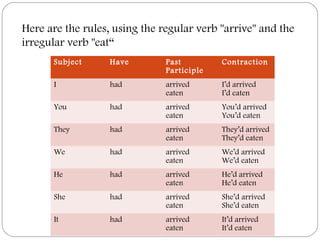
Here are the rules, using the regular verb "arrive" and the
irregular verb "eat“
Subject Have Past
Participle
Contraction
I had arrived
eaten
I’d arrived
I’d eaten
You had arrived
eaten
You’d arrived
You’d eaten
They had arrived
eaten
They’d arrived
They’d eaten
We had arrived
eaten
We’d arrived
We’d eaten
He had arrived
eaten
He’d arrived
He’d eaten
She had arrived
eaten
She’d arrived
She’d eaten
It had arrived
eaten
It’d arrived
It’d eaten
Using Past Perfect
The past perfect is used to show you which of two
events happened first. Imagine that two things
happened in the past:
I went to see the movie.
We discussed the movie in class.
Here, we don't know which order the events happened
in. That may be important -- perhaps I went to see
the movie after the discussion, or maybe I saw the
movie before the discussion. There are many ways to
make this sequence clear, and the past perfect is one
of them.
 This is how we do it:
“I went to see the movie. We had discussed the movie in
class”
Here, we know that the discussion took place first —
even though the sentence describing it comes
afterwards. We discussed the movie, and then I went to
see it. This can be very useful when you are telling a
story or relating a sequence of events.
At any point in your story, you can jump back to a
previous event, and your reader will not be confused
because the past perfect will make it clear that the event
happened previously.
Forms of Past Perfect Tense
USE 1 Completed Action Before Something in the
Past
The Past Perfect expresses the idea that something
occurred before another action in the past. It can also
show that something happened before a specific time in
the past.
Examples:
I had never seen such a beautiful beach before I went
to Kauai.
I did not have any money because I had lost my wallet.
To be continued…..
USE 2 Duration Before Something in the Past
(Non-Continuous Verbs)
With Non-Continuous Verbs and some non-continuous uses
of Mixed Verbs, we use the Past Perfect to show that
something started in the past and continued up until
another action in the past.
Examples:
We had had that car for ten years before it broke down.
By the time Alex finished his studies, he had been in
London for over eight years.
Although the above use of Past Perfect is normally limited to
Non-Continuous Verbs and non-continuous uses of Mixed
Verbs, the words "live," "work," "teach," and "study" are
sometimes used in this way even though they are NOT
Non-Continuous Verbs.
Important Spesific Times with Past
Perfect
Unlike with the Present Perfect, it is possible to use
specific time words or phrases with the Past
Perfect. Although this is possible, it is usually not
necessary.
Example:
She had visited her Japanese relatives once in
1993 before she moved in with them in 1996.
To be continued….
MOREOVER
If the Past Perfect action did occur at a specific time, the
Simple Past can be used instead of the Past Perfect
when "before" or "after" is used in the sentence. The
words "before" and "after" actually tell you what
happens first, so the Past Perfect is optional. For this
reason, both sentences below are correct.
Examples:
She had visited her Japanese relatives once in 1993
before she moved in with them in 1996.
She visited her Japanese relatives once in 1993 before
she moved in with them in 1996.
To be continued….
HOWEVER
If the Past Perfect is not referring to an action at a
specific time, Past Perfect is not optional. Compare the
examples below. Here Past Perfect is referring to a lack
of experience rather than an action at a specific time.
For this reason, Simple Past cannot be used.
Examples:
She never saw a bear before she moved to Alaska. Not
Correct
She had never seen a bear before she moved to
Alaska. Correct
Adverb Replacement
The examples below show the placement for grammar
adverbs such as: always, only, never, ever, still, just,
etc.
Examples:
You had previously studied English before you moved to
New York.
Had you previously studied English before you moved to
New York?
ACTIVE / PASSIVE
Examples:
George had repaired many cars before he received his
mechanic's license. ACTIVE
Many cars had been repaired by George before he
received his mechanic's license. PASSIVE

Past perfect tense

  • 1.
    ENGLISH SMK 3 PerguruanCikini Past Perfect Tense
  • 2.
    Introduction The past perfecttense is often used in English when we are relating two events which happened in the past. It helps to show which event happened first. This page will explain the rules for forming and using the tense.
  • 3.
    Forming The PastPerfect Tense This tense is formed using two components: the verb HAVE (in the past tense), and the past participle form of a verb. With a regular verb the past participle ends with -ED (just like the simple past). Irregular verbs have a special past participle form that you have to learn. To be continued…..
  • 4.
    Here are therules, using the regular verb "arrive" and the irregular verb "eat“ Subject Have Past Participle Contraction I had arrived eaten I’d arrived I’d eaten You had arrived eaten You’d arrived You’d eaten They had arrived eaten They’d arrived They’d eaten We had arrived eaten We’d arrived We’d eaten He had arrived eaten He’d arrived He’d eaten She had arrived eaten She’d arrived She’d eaten It had arrived eaten It’d arrived It’d eaten
  • 5.
    Using Past Perfect Thepast perfect is used to show you which of two events happened first. Imagine that two things happened in the past: I went to see the movie. We discussed the movie in class. Here, we don't know which order the events happened in. That may be important -- perhaps I went to see the movie after the discussion, or maybe I saw the movie before the discussion. There are many ways to make this sequence clear, and the past perfect is one of them.
  • 6.
     This is howwe do it: “I went to see the movie. We had discussed the movie in class” Here, we know that the discussion took place first — even though the sentence describing it comes afterwards. We discussed the movie, and then I went to see it. This can be very useful when you are telling a story or relating a sequence of events. At any point in your story, you can jump back to a previous event, and your reader will not be confused because the past perfect will make it clear that the event happened previously.
  • 7.
    Forms of PastPerfect Tense USE 1 Completed Action Before Something in the Past The Past Perfect expresses the idea that something occurred before another action in the past. It can also show that something happened before a specific time in the past. Examples: I had never seen such a beautiful beach before I went to Kauai. I did not have any money because I had lost my wallet. To be continued…..
  • 8.
    USE 2 DurationBefore Something in the Past (Non-Continuous Verbs) With Non-Continuous Verbs and some non-continuous uses of Mixed Verbs, we use the Past Perfect to show that something started in the past and continued up until another action in the past. Examples: We had had that car for ten years before it broke down. By the time Alex finished his studies, he had been in London for over eight years. Although the above use of Past Perfect is normally limited to Non-Continuous Verbs and non-continuous uses of Mixed Verbs, the words "live," "work," "teach," and "study" are sometimes used in this way even though they are NOT Non-Continuous Verbs.
  • 9.
    Important Spesific Timeswith Past Perfect Unlike with the Present Perfect, it is possible to use specific time words or phrases with the Past Perfect. Although this is possible, it is usually not necessary. Example: She had visited her Japanese relatives once in 1993 before she moved in with them in 1996. To be continued….
  • 10.
    MOREOVER If the PastPerfect action did occur at a specific time, the Simple Past can be used instead of the Past Perfect when "before" or "after" is used in the sentence. The words "before" and "after" actually tell you what happens first, so the Past Perfect is optional. For this reason, both sentences below are correct. Examples: She had visited her Japanese relatives once in 1993 before she moved in with them in 1996. She visited her Japanese relatives once in 1993 before she moved in with them in 1996. To be continued….
  • 11.
    HOWEVER If the PastPerfect is not referring to an action at a specific time, Past Perfect is not optional. Compare the examples below. Here Past Perfect is referring to a lack of experience rather than an action at a specific time. For this reason, Simple Past cannot be used. Examples: She never saw a bear before she moved to Alaska. Not Correct She had never seen a bear before she moved to Alaska. Correct
  • 12.
    Adverb Replacement The examplesbelow show the placement for grammar adverbs such as: always, only, never, ever, still, just, etc. Examples: You had previously studied English before you moved to New York. Had you previously studied English before you moved to New York? ACTIVE / PASSIVE Examples: George had repaired many cars before he received his mechanic's license. ACTIVE Many cars had been repaired by George before he received his mechanic's license. PASSIVE