VERBS
The verb is the king in English ! Why? The shortest sentence contains a verb.  You can make a one-word sentence with a verb. For example: Stop!   You  cannot  make a one-word sentence with any other type of word.
Verbs are sometimes described as “ action words” This is partly true. Why? Many verbs  give the idea of action  of “doing” something. For example: run ,  fight ,  do , and  work   They convey the idea of action.
BUT ! Some verbs do not give the idea of action; they give the idea of  existence ,  of  state , of  “being”. For example: be ,  exist ,  seem ,and  belong. They all convey the idea of state.
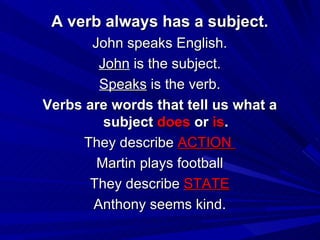
A verb always has a subject. John speaks English. John  is the subject. Speaks  is the verb. Verbs are words that tell us what a subject  does  or  is . They describe  ACTION  Martin plays football They describe  STATE Anthony seems kind.
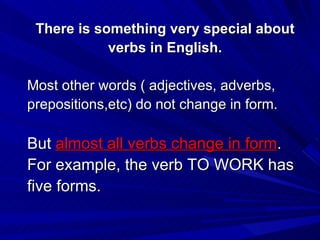
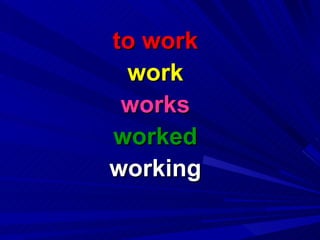
There is something very special about verbs in English. Most other words ( adjectives, adverbs,  prepositions,etc) do not change in form. But  almost all verbs change in form . For example, the verb TO WORK has five forms.
to work work works worked working
VERB CLASSIFICATION. 1.Helping Verbs. 2. Main Verbs.
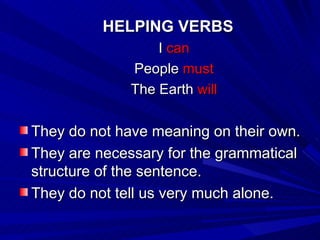
HELPING VERBS I  can People  must The Earth  will They do not have meaning on their own. They are necessary for the grammatical structure of the sentence. They do not tell us very much alone.
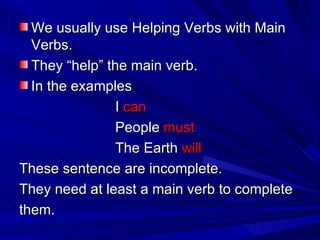
We usually use Helping Verbs with Main Verbs. They “help” the main verb. In the examples  I  can People  must The Earth  will These sentence are incomplete. They need at least a main verb to complete them.
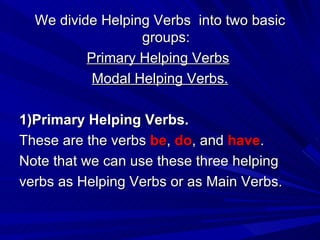
We divide Helping Verbs  into two basic groups: Primary Helping Verbs   Modal Helping Verbs. 1)Primary Helping Verbs. These are the verbs  be ,  do , and  have . Note that we can use these three helping verbs as Helping Verbs or as Main Verbs.
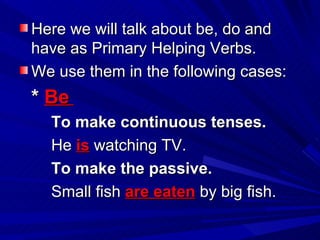
Here we will talk about be, do and have as Primary Helping Verbs. We use them in the following cases: *  Be   To make continuous tenses. He  is  watching TV. To make the passive. Small fish  are eaten  by big fish.
** HAVE to make perfect tenses. I  have  finished my homework. ** DO to make negatives. I  do  not like you. to ask questions. Do  you want some coffee? to show emphasis. I  do  want you to pass your exam. to stand for a main verb in some  constructions . He speaks faster than she  does .
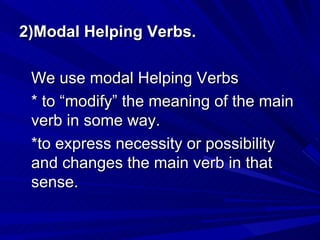
2)Modal Helping Verbs. We use modal Helping Verbs  * to “modify” the meaning of the main verb in some way.  *to express necessity or possibility and changes the main verb in that sense.
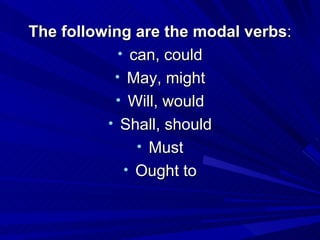
The following are the modal verbs : can, could May, might Will, would Shall, should Must Ought to
I  can’t  speak Chinese. John  may  arrive late. Would  you like a cup of coffee? You  should  see a doctor. I really  must  go now.
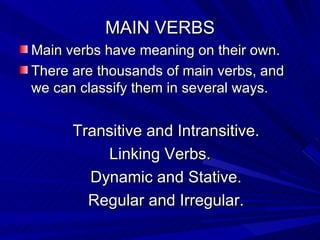
MAIN VERBS Main verbs have meaning on their own. There are thousands of main verbs, and we can classify them in several ways. Transitive and Intransitive. Linking Verbs. Dynamic and Stative. Regular and Irregular.
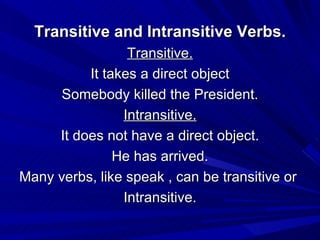
Transitive and Intransitive Verbs. Transitive. It takes a direct object Somebody killed the President. Intransitive. It does not have a direct object. He has arrived. Many verbs, like speak , can be transitive or  Intransitive.
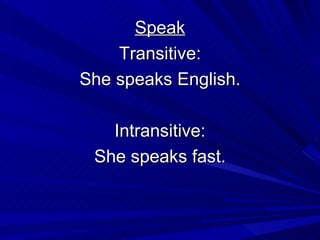
Speak Transitive: She speaks English. Intransitive: She speaks fast.
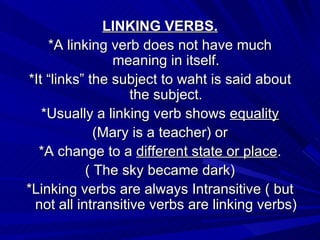
LINKING VERBS. *A linking verb does not have much meaning in itself. *It “links” the subject to waht is said about the subject. *Usually a linking verb shows  equality (Mary is a teacher) or *A change to a  different state or place . ( The sky became dark) *Linking verbs are always Intransitive ( but not all intransitive verbs are linking verbs)
Linking verbs are always Intransitive  but not all intransitive verbs are linking verbs.
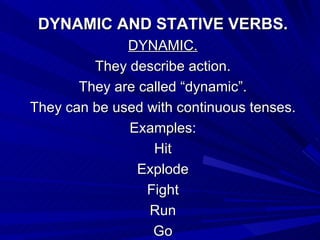
DYNAMIC AND STATIVE VERBS. DYNAMIC. They describe action. They are called “dynamic”. They can be used with continuous tenses. Examples: Hit Explode Fight Run Go
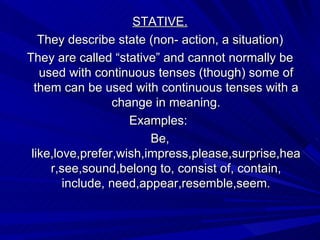
STATIVE. They describe state (non- action, a situation) They are called “stative” and cannot normally be used with continuous tenses (though) some of them can be used with continuous tenses with a change in meaning. Examples:  Be, like,love,prefer,wish,impress,please,surprise,hear,see,sound,belong to, consist of, contain, include, need,appear,resemble,seem.
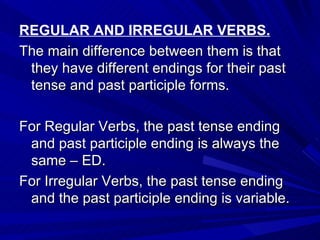
REGULAR AND IRREGULAR VERBS. The main difference between them is that they have different endings for their past tense and past participle forms. For Regular Verbs, the past tense ending and past participle ending is always the same – ED. For Irregular Verbs, the past tense ending and the past participle ending is variable.
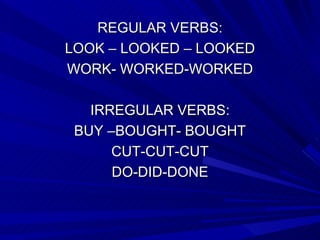
REGULAR VERBS: LOOK – LOOKED – LOOKED WORK- WORKED-WORKED IRREGULAR VERBS: BUY –BOUGHT- BOUGHT CUT-CUT-CUT DO-DID-DONE

Verbs

  • 1.
  • 2.
    The verb isthe king in English ! Why? The shortest sentence contains a verb. You can make a one-word sentence with a verb. For example: Stop! You cannot make a one-word sentence with any other type of word.
  • 3.
    Verbs are sometimesdescribed as “ action words” This is partly true. Why? Many verbs give the idea of action of “doing” something. For example: run , fight , do , and work They convey the idea of action.
  • 4.
    BUT ! Someverbs do not give the idea of action; they give the idea of existence , of state , of “being”. For example: be , exist , seem ,and belong. They all convey the idea of state.
  • 5.
    A verb alwayshas a subject. John speaks English. John is the subject. Speaks is the verb. Verbs are words that tell us what a subject does or is . They describe ACTION Martin plays football They describe STATE Anthony seems kind.
  • 6.
    There is somethingvery special about verbs in English. Most other words ( adjectives, adverbs, prepositions,etc) do not change in form. But almost all verbs change in form . For example, the verb TO WORK has five forms.
  • 7.
    to work workworks worked working
  • 8.
    VERB CLASSIFICATION. 1.HelpingVerbs. 2. Main Verbs.
  • 9.
    HELPING VERBS I can People must The Earth will They do not have meaning on their own. They are necessary for the grammatical structure of the sentence. They do not tell us very much alone.
  • 10.
    We usually useHelping Verbs with Main Verbs. They “help” the main verb. In the examples I can People must The Earth will These sentence are incomplete. They need at least a main verb to complete them.
  • 11.
    We divide HelpingVerbs into two basic groups: Primary Helping Verbs Modal Helping Verbs. 1)Primary Helping Verbs. These are the verbs be , do , and have . Note that we can use these three helping verbs as Helping Verbs or as Main Verbs.
  • 12.
    Here we willtalk about be, do and have as Primary Helping Verbs. We use them in the following cases: * Be To make continuous tenses. He is watching TV. To make the passive. Small fish are eaten by big fish.
  • 13.
    ** HAVE tomake perfect tenses. I have finished my homework. ** DO to make negatives. I do not like you. to ask questions. Do you want some coffee? to show emphasis. I do want you to pass your exam. to stand for a main verb in some constructions . He speaks faster than she does .
  • 14.
    2)Modal Helping Verbs.We use modal Helping Verbs * to “modify” the meaning of the main verb in some way. *to express necessity or possibility and changes the main verb in that sense.
  • 15.
    The following arethe modal verbs : can, could May, might Will, would Shall, should Must Ought to
  • 16.
    I can’t speak Chinese. John may arrive late. Would you like a cup of coffee? You should see a doctor. I really must go now.
  • 17.
    MAIN VERBS Mainverbs have meaning on their own. There are thousands of main verbs, and we can classify them in several ways. Transitive and Intransitive. Linking Verbs. Dynamic and Stative. Regular and Irregular.
  • 18.
    Transitive and IntransitiveVerbs. Transitive. It takes a direct object Somebody killed the President. Intransitive. It does not have a direct object. He has arrived. Many verbs, like speak , can be transitive or Intransitive.
  • 19.
    Speak Transitive: Shespeaks English. Intransitive: She speaks fast.
  • 20.
    LINKING VERBS. *Alinking verb does not have much meaning in itself. *It “links” the subject to waht is said about the subject. *Usually a linking verb shows equality (Mary is a teacher) or *A change to a different state or place . ( The sky became dark) *Linking verbs are always Intransitive ( but not all intransitive verbs are linking verbs)
  • 21.
    Linking verbs arealways Intransitive but not all intransitive verbs are linking verbs.
  • 22.
    DYNAMIC AND STATIVEVERBS. DYNAMIC. They describe action. They are called “dynamic”. They can be used with continuous tenses. Examples: Hit Explode Fight Run Go
  • 23.
    STATIVE. They describestate (non- action, a situation) They are called “stative” and cannot normally be used with continuous tenses (though) some of them can be used with continuous tenses with a change in meaning. Examples: Be, like,love,prefer,wish,impress,please,surprise,hear,see,sound,belong to, consist of, contain, include, need,appear,resemble,seem.
  • 24.
    REGULAR AND IRREGULARVERBS. The main difference between them is that they have different endings for their past tense and past participle forms. For Regular Verbs, the past tense ending and past participle ending is always the same – ED. For Irregular Verbs, the past tense ending and the past participle ending is variable.
  • 25.
    REGULAR VERBS: LOOK– LOOKED – LOOKED WORK- WORKED-WORKED IRREGULAR VERBS: BUY –BOUGHT- BOUGHT CUT-CUT-CUT DO-DID-DONE