Reading Strategies
               for Nonfiction
               Cause and Effect
                 Created & Developed by Jill M. Leone
                             Reading Specialist   Copyright © 2007

RPDP Secondary
Literacy
Today's Objectives


        We will discuss -
        • difference between causes
           and effects in nonfiction text.
        • strategies to distinguish
          between causes and effects.
RPDP Secondary
Literacy
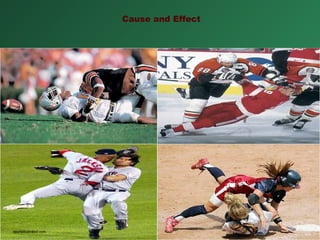
Cause and Effect


RPDP Secondary
Literacy
  sportsillustrated.com
Cause and Effect
 • Nothing happens without
   a reason or without some
   kind of consequence.
 • When you explain why
   things happen and what
   occurs when they do, the
   technique you use is
   called cause and effect.
RPDP Secondary
Literacy
Cause and Effect
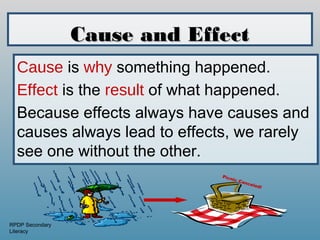
  Cause is why something happened.
  Effect is the result of what happened.
  Because effects always have causes and
  causes always lead to effects, we rarely
  see one without the other.
                              Picn
                                  ic C
                                       anc
                                          eled
                                              !


RPDP Secondary
Literacy
Cause and Effect
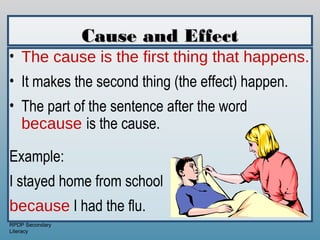
• The cause is the first thing that happens.
• It makes the second thing (the effect) happen.
• The part of the sentence after the word
  because is the cause.

Example:
I stayed home from school
because I had the flu.
RPDP Secondary
Literacy
Remember -


             The cause
              answers
                 the
              question
               why?
RPDP Secondary
Literacy
Cause and Effect
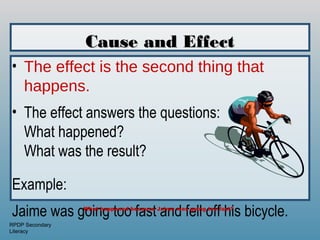
• The effect is the second thing that
  happens.
• The effect answers the questions:
  What happened?
  What was the result?

Example:
Jaime was going too fast and fell off his bicycle.
                 What happened because Jaime was going too fast?


RPDP Secondary
Literacy
Understanding Cause and Effect
                         Relationships
   • In some paragraphs, the cause-and-effect
     relationship is not directly stated.
   • In these cases, you have to -
     "read between the lines."
   • Use clues from the paragraph
      to identify cause-and-effect
     relationships.
                         Use your prior knowledge.

RPDP Secondary
Literacy
Look for effects that are also causes.
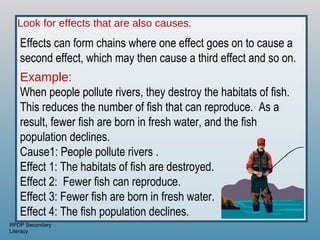
   Effects can form chains where one effect goes on to cause a
   second effect, which may then cause a third effect and so on.
   Example:
   When people pollute rivers, they destroy the habitats of fish.
   This reduces the number of fish that can reproduce. As a
   result, fewer fish are born in fresh water, and the fish
   population declines.
   Cause1: People pollute rivers .
   Effect 1: The habitats of fish are destroyed.
   Effect 2: Fewer fish can reproduce.
   Effect 3: Fewer fish are born in fresh water.
   Effect 4: The fish population declines.
RPDP Secondary
Literacy
Understanding Cause and Effect
                         Relationships
   • You use cause and effect every day when you
     solve problems and make decisions.
   • As a result, understanding causes and effects is
     extremely important in day-to-day living.
   • Learning to identify cause and effect
      relationships helps you understand what
           is happening in the world around you.

RPDP Secondary
Literacy
Clue Words for Cause
     These expressions indicate cause -
        Because…
        Since…
        Cause..
        Reason..
        So that
        Unless..
        The main reason…
RPDP Secondary
Literacy
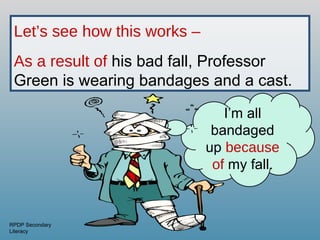
Let’s see how this works –
 As a result of his bad fall, Professor
 Green is wearing bandages and a cast.

                                 I’m all
                               bandaged
                              up because
                               of my fall.


RPDP Secondary
Literacy
Good advice!


                     Helpful Tip
    Try this idea when you are not sure.
    When you answer a question that
    begins with why, try putting the word
    because in front of your answer
    choices. Then read the choices this
    way to help figure out the correct
    answer.
RPDP Secondary
Literacy
Example

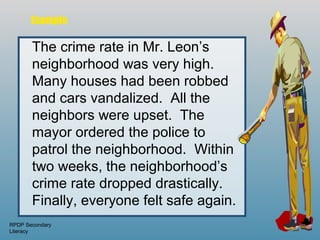
       The crime rate in Mr. Leon’s
       neighborhood was very high.
       Many houses had been robbed
       and cars vandalized. All the
       neighbors were upset. The
       mayor ordered the police to
       patrol the neighborhood. Within
       two weeks, the neighborhood’s
       crime rate dropped drastically.
       Finally, everyone felt safe again.
RPDP Secondary
Literacy
Why did the crime rate drop?
      A. All the neighbors were upset.
      B. Houses and cars were robbed
         and vandalized.
      C. The mayor called for added
         police protection.
     D. Everyone in the neighborhood
          felt safe again.

RPDP Secondary
Literacy
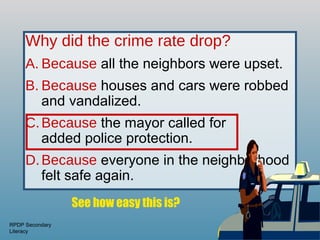
Why did the crime rate drop?
     A. Because all the neighbors were upset.
     B. Because houses and cars were robbed
        and vandalized.
     C. Because the mayor called for
        added police protection.
     D. Because everyone in the neighborhood
        felt safe again.
                 See how easy this is?
RPDP Secondary
Literacy
Clue Words for Effect
    These expressions indicate effect -
       As a result of
       If
       Consequently
       Effect
       Therefore
       Thus                 Test Grade = F

RPDP Secondary
Literacy
Read this Paragraph.


       About 75 million people died from the
  bubonic plague during the 14th century. Half
  of the population of Italy fell victim to the
  disease. The plague caused high fever,
  swollen glands, dark bruises or sores on the
  face, and spitting of blood. Most people who
  got the disease died within five days. The
  disease was spread by fleas from rats. Lack
  of sanitation and poor medical knowledge
  account for the continuous plague epidemics
  throughout the 14th century.
RPDP Secondary
Literacy
Practice Question
   What caused so many people to die from
   the bubonic plague?
• Lack of sanitation and poor medical
   knowledge account for the continuous
   plague epidemics.
• The dead were buried without the usual
   prayers.
• Italy was constantly at war.
A. The victims got large bruises or
   sores on the face.
RPDP Secondary
Literacy
Practice Question
    What caused so many people to die from
    the bubonic plague?
 • Lack of sanitation and poor medical
    knowledge account for the continuous
    plague epidemics.
 • The dead were buried without the usual
    prayers.
 • Italy was constantly at war.
 A. The victims got large bruises or
    sores on the face.
             The phrase account for was your clue.
RPDP Secondary
Literacy
Practice Question
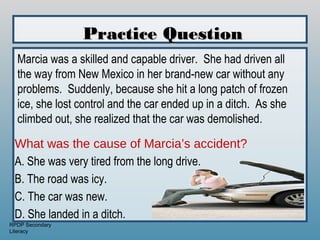
  Marcia was a skilled and capable driver. She had driven all
  the way from New Mexico in her brand-new car without any
  problems. Suddenly, because she hit a long patch of frozen
  ice, she lost control and the car ended up in a ditch. As she
  climbed out, she realized that the car was demolished.

 What was the cause of Marcia’s accident?
 A. She was very tired from the long drive.
 B. The road was icy.
 C. The car was new.
 D. She landed in a ditch.
RPDP Secondary
Literacy
Practice Question
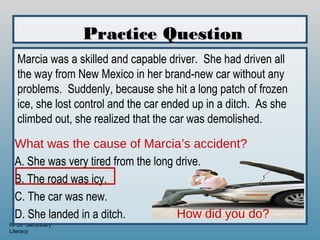
  Marcia was a skilled and capable driver. She had driven all
  the way from New Mexico in her brand-new car without any
  problems. Suddenly, because she hit a long patch of frozen
  ice, she lost control and the car ended up in a ditch. As she
  climbed out, she realized that the car was demolished.

 What was the cause of Marcia’s accident?
 A. She was very tired from the long drive.
 B. The road was icy.
 C. The car was new.
 D. She landed in a ditch.           How did you do?
RPDP Secondary
Literacy
Practice Question
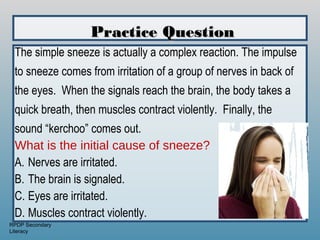
 The simple sneeze is actually a complex reaction. The impulse
 to sneeze comes from irritation of a group of nerves in back of
 the eyes. When the signals reach the brain, the body takes a
 quick breath, then muscles contract violently. Finally, the
 sound “kerchoo” comes out.
 What is the initial cause of sneeze?
 A. Nerves are irritated.
 B. The brain is signaled.
 C. Eyes are irritated.
 D. Muscles contract violently.
RPDP Secondary
Literacy
Practice Question
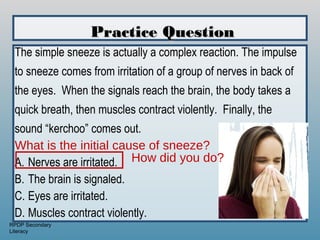
 The simple sneeze is actually a complex reaction. The impulse
 to sneeze comes from irritation of a group of nerves in back of
 the eyes. When the signals reach the brain, the body takes a
 quick breath, then muscles contract violently. Finally, the
 sound “kerchoo” comes out.
 What is the initial cause of sneeze?
 A. Nerves are irritated. How did you do?
 B. The brain is signaled.
 C. Eyes are irritated.
 D. Muscles contract violently.
RPDP Secondary
Literacy
Practice Question
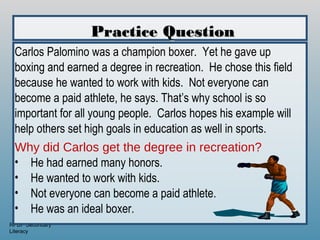
 Carlos Palomino was a champion boxer. Yet he gave up
 boxing and earned a degree in recreation. He chose this field
 because he wanted to work with kids. Not everyone can
 become a paid athlete, he says. That’s why school is so
 important for all young people. Carlos hopes his example will
 help others set high goals in education as well in sports.
 Why did Carlos get the degree in recreation?
 • He had earned many honors.
 • He wanted to work with kids.
 • Not everyone can become a paid athlete.
 • He was an ideal boxer.
RPDP Secondary
Literacy
Practice Question
 Carlos Palomino was a champion boxer. Yet he gave up
 boxing and earned a degree in recreation. He chose this field
 because he wanted to work with kids. Not everyone can
 become a paid athlete, he says. That’s why school is so
 important for all young people. Carlos hopes his example will
 help others set high goals in education as well in sports.
 Why did Carlos get the degree in recreation?
 • He had earned many honors.
 • He wanted to work with kids.
                                       How did you
 • Not everyone can become a paid athlete.
                                            do?
 • He was an ideal boxer.
RPDP Secondary
Literacy
It's important to know-


                 A good reader is also a good detective.

RPDP Secondary
Literacy
Key Stategies and Terms


       Today we discussed -
       • Causes
       • Effects
       • Clue Words
       • Cause and Effect Relationships

RPDP Secondary
Literacy
It doesn’t matter whether
                     you read fiction or
                        nonfiction -
                                    Remember!


     As long as
     you take

     the time to
        read!
RPDP Secondary
Literacy
Copyright Notice
         Permission is granted to copy (unmodified) all or
         part of this PowerPoint for educational, personal,
         non-commercial use off-line as long as the copyright
         message (Copyright © 2007 by Jill Leone) is
         maintained on the title page. This material may not
         be sold, duplicated on other websites, incorporated in
         commercial documents or products, or used for
         promotional purposes.

                 Copyright © 2007 by Jill M. Leone
RPDP Secondary
Literacy

Cause and-effect-powerpoint

  • 1.
    Reading Strategies for Nonfiction Cause and Effect Created & Developed by Jill M. Leone Reading Specialist Copyright © 2007 RPDP Secondary Literacy
  • 2.
    Today's Objectives We will discuss - • difference between causes and effects in nonfiction text. • strategies to distinguish between causes and effects. RPDP Secondary Literacy
  • 3.
    Cause and Effect RPDPSecondary Literacy sportsillustrated.com
  • 4.
    Cause and Effect • Nothing happens without a reason or without some kind of consequence. • When you explain why things happen and what occurs when they do, the technique you use is called cause and effect. RPDP Secondary Literacy
  • 5.
    Cause and Effect Cause is why something happened. Effect is the result of what happened. Because effects always have causes and causes always lead to effects, we rarely see one without the other. Picn ic C anc eled ! RPDP Secondary Literacy
  • 6.
    Cause and Effect •The cause is the first thing that happens. • It makes the second thing (the effect) happen. • The part of the sentence after the word because is the cause. Example: I stayed home from school because I had the flu. RPDP Secondary Literacy
  • 7.
    Remember - The cause answers the question why? RPDP Secondary Literacy
  • 8.
    Cause and Effect •The effect is the second thing that happens. • The effect answers the questions: What happened? What was the result? Example: Jaime was going too fast and fell off his bicycle. What happened because Jaime was going too fast? RPDP Secondary Literacy
  • 9.
    Understanding Cause andEffect Relationships • In some paragraphs, the cause-and-effect relationship is not directly stated. • In these cases, you have to - "read between the lines." • Use clues from the paragraph to identify cause-and-effect relationships. Use your prior knowledge. RPDP Secondary Literacy
  • 10.
    Look for effectsthat are also causes. Effects can form chains where one effect goes on to cause a second effect, which may then cause a third effect and so on. Example: When people pollute rivers, they destroy the habitats of fish. This reduces the number of fish that can reproduce. As a result, fewer fish are born in fresh water, and the fish population declines. Cause1: People pollute rivers . Effect 1: The habitats of fish are destroyed. Effect 2: Fewer fish can reproduce. Effect 3: Fewer fish are born in fresh water. Effect 4: The fish population declines. RPDP Secondary Literacy
  • 11.
    Understanding Cause andEffect Relationships • You use cause and effect every day when you solve problems and make decisions. • As a result, understanding causes and effects is extremely important in day-to-day living. • Learning to identify cause and effect relationships helps you understand what is happening in the world around you. RPDP Secondary Literacy
  • 12.
    Clue Words forCause These expressions indicate cause -  Because…  Since…  Cause..  Reason..  So that  Unless..  The main reason… RPDP Secondary Literacy
  • 13.
    Let’s see howthis works – As a result of his bad fall, Professor Green is wearing bandages and a cast. I’m all bandaged up because of my fall. RPDP Secondary Literacy
  • 14.
    Good advice! Helpful Tip Try this idea when you are not sure. When you answer a question that begins with why, try putting the word because in front of your answer choices. Then read the choices this way to help figure out the correct answer. RPDP Secondary Literacy
  • 15.
    Example The crime rate in Mr. Leon’s neighborhood was very high. Many houses had been robbed and cars vandalized. All the neighbors were upset. The mayor ordered the police to patrol the neighborhood. Within two weeks, the neighborhood’s crime rate dropped drastically. Finally, everyone felt safe again. RPDP Secondary Literacy
  • 16.
    Why did thecrime rate drop? A. All the neighbors were upset. B. Houses and cars were robbed and vandalized. C. The mayor called for added police protection. D. Everyone in the neighborhood felt safe again. RPDP Secondary Literacy
  • 17.
    Why did thecrime rate drop? A. Because all the neighbors were upset. B. Because houses and cars were robbed and vandalized. C. Because the mayor called for added police protection. D. Because everyone in the neighborhood felt safe again. See how easy this is? RPDP Secondary Literacy
  • 18.
    Clue Words forEffect These expressions indicate effect -  As a result of  If  Consequently  Effect  Therefore  Thus Test Grade = F RPDP Secondary Literacy
  • 19.
    Read this Paragraph. About 75 million people died from the bubonic plague during the 14th century. Half of the population of Italy fell victim to the disease. The plague caused high fever, swollen glands, dark bruises or sores on the face, and spitting of blood. Most people who got the disease died within five days. The disease was spread by fleas from rats. Lack of sanitation and poor medical knowledge account for the continuous plague epidemics throughout the 14th century. RPDP Secondary Literacy
  • 20.
    Practice Question What caused so many people to die from the bubonic plague? • Lack of sanitation and poor medical knowledge account for the continuous plague epidemics. • The dead were buried without the usual prayers. • Italy was constantly at war. A. The victims got large bruises or sores on the face. RPDP Secondary Literacy
  • 21.
    Practice Question What caused so many people to die from the bubonic plague? • Lack of sanitation and poor medical knowledge account for the continuous plague epidemics. • The dead were buried without the usual prayers. • Italy was constantly at war. A. The victims got large bruises or sores on the face. The phrase account for was your clue. RPDP Secondary Literacy
  • 22.
    Practice Question Marcia was a skilled and capable driver. She had driven all the way from New Mexico in her brand-new car without any problems. Suddenly, because she hit a long patch of frozen ice, she lost control and the car ended up in a ditch. As she climbed out, she realized that the car was demolished. What was the cause of Marcia’s accident? A. She was very tired from the long drive. B. The road was icy. C. The car was new. D. She landed in a ditch. RPDP Secondary Literacy
  • 23.
    Practice Question Marcia was a skilled and capable driver. She had driven all the way from New Mexico in her brand-new car without any problems. Suddenly, because she hit a long patch of frozen ice, she lost control and the car ended up in a ditch. As she climbed out, she realized that the car was demolished. What was the cause of Marcia’s accident? A. She was very tired from the long drive. B. The road was icy. C. The car was new. D. She landed in a ditch. How did you do? RPDP Secondary Literacy
  • 24.
    Practice Question Thesimple sneeze is actually a complex reaction. The impulse to sneeze comes from irritation of a group of nerves in back of the eyes. When the signals reach the brain, the body takes a quick breath, then muscles contract violently. Finally, the sound “kerchoo” comes out. What is the initial cause of sneeze? A. Nerves are irritated. B. The brain is signaled. C. Eyes are irritated. D. Muscles contract violently. RPDP Secondary Literacy
  • 25.
    Practice Question Thesimple sneeze is actually a complex reaction. The impulse to sneeze comes from irritation of a group of nerves in back of the eyes. When the signals reach the brain, the body takes a quick breath, then muscles contract violently. Finally, the sound “kerchoo” comes out. What is the initial cause of sneeze? A. Nerves are irritated. How did you do? B. The brain is signaled. C. Eyes are irritated. D. Muscles contract violently. RPDP Secondary Literacy
  • 26.
    Practice Question CarlosPalomino was a champion boxer. Yet he gave up boxing and earned a degree in recreation. He chose this field because he wanted to work with kids. Not everyone can become a paid athlete, he says. That’s why school is so important for all young people. Carlos hopes his example will help others set high goals in education as well in sports. Why did Carlos get the degree in recreation? • He had earned many honors. • He wanted to work with kids. • Not everyone can become a paid athlete. • He was an ideal boxer. RPDP Secondary Literacy
  • 27.
    Practice Question CarlosPalomino was a champion boxer. Yet he gave up boxing and earned a degree in recreation. He chose this field because he wanted to work with kids. Not everyone can become a paid athlete, he says. That’s why school is so important for all young people. Carlos hopes his example will help others set high goals in education as well in sports. Why did Carlos get the degree in recreation? • He had earned many honors. • He wanted to work with kids. How did you • Not everyone can become a paid athlete. do? • He was an ideal boxer. RPDP Secondary Literacy
  • 28.
    It's important toknow- A good reader is also a good detective. RPDP Secondary Literacy
  • 29.
    Key Stategies andTerms Today we discussed - • Causes • Effects • Clue Words • Cause and Effect Relationships RPDP Secondary Literacy
  • 30.
    It doesn’t matterwhether you read fiction or nonfiction - Remember! As long as you take the time to read! RPDP Secondary Literacy
  • 31.
    Copyright Notice Permission is granted to copy (unmodified) all or part of this PowerPoint for educational, personal, non-commercial use off-line as long as the copyright message (Copyright © 2007 by Jill Leone) is maintained on the title page. This material may not be sold, duplicated on other websites, incorporated in commercial documents or products, or used for promotional purposes. Copyright © 2007 by Jill M. Leone RPDP Secondary Literacy

Editor's Notes

  • #5 When something happens, we often try to understand why. We try to figure out the cause of the event or the reason for it.
  • #13 Other key words and phrases used to show the cause are: Since the student forgot her homework, … As a result of her fantastic report card, … The main reason is not enough money. An important factor was his participation in class. The chief cause was too many absences. The best explanation is too little interest. Due to his constant tardies …
  • #15 Effect = the result The effect answers the question “ What happened? ” Remember that the effect is the second thing that happens (as a result of the cause, which was the first thing). Sometimes no key words are used. The cause and effect relationship is then suggested or implied by the writer. When this happens, the reader must add up (think about all) the details. WHY = THE CAUSE WHAT HAPPENDED = THE EFFECT
  • #22 Answer = A
  • #24 Answer = B
  • #26 Answer = A