TUTORIAL 1
English 1 Online Language Development Course
Developed by Nora-LeeWales
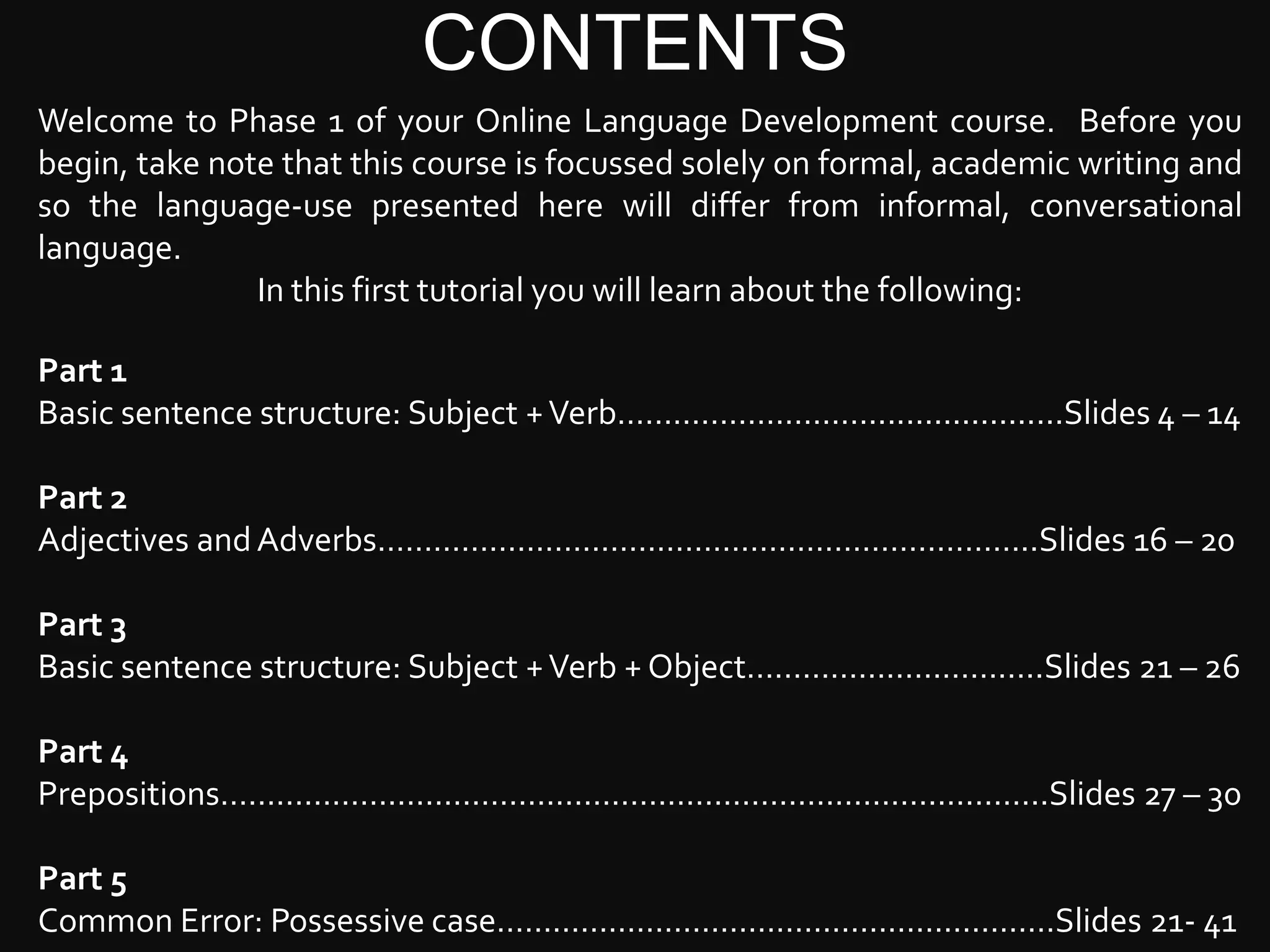
CONTENTS
Welcome to Phase 1 of your Online Language Development course. Before you
begin, take note that this course is focussed solely on formal, academic writing and
so the language-use presented here will differ from informal, conversational
language.
In this first tutorial you will learn about the following:
Part 1
Basic sentence structure: Subject +Verb……………………….....................Slides 4 – 14
Part 2
Adjectives andAdverbs……………………………………………………………..Slides 16 – 20
Part 3
Basic sentence structure: Subject +Verb + Object…………………………..Slides 21 – 26
Part 4
Prepositions……………………………………………………………………………..Slides 27 – 30
Part 5
Common Error: Possessive case……………………………………………………Slides 21- 41
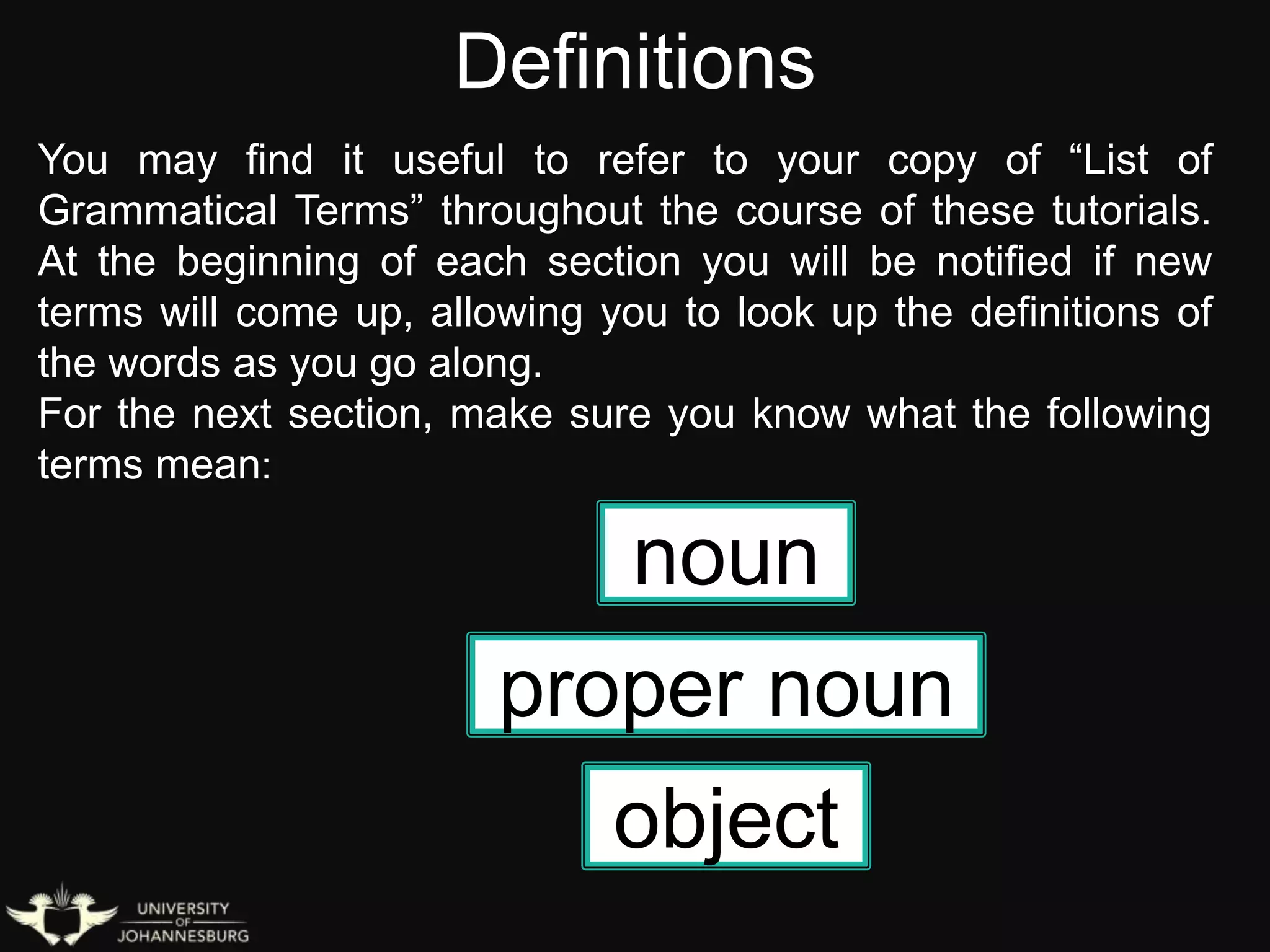
Definitions
object
You may find it useful to refer to your copy of “List of
Grammatical Terms” throughout the course of these tutorials.
At the beginning of each section you will be notified if new
terms will come up, allowing you to look up the definitions of
the words as you go along.
For the next section, make sure you know what the following
terms mean:
noun
proper noun
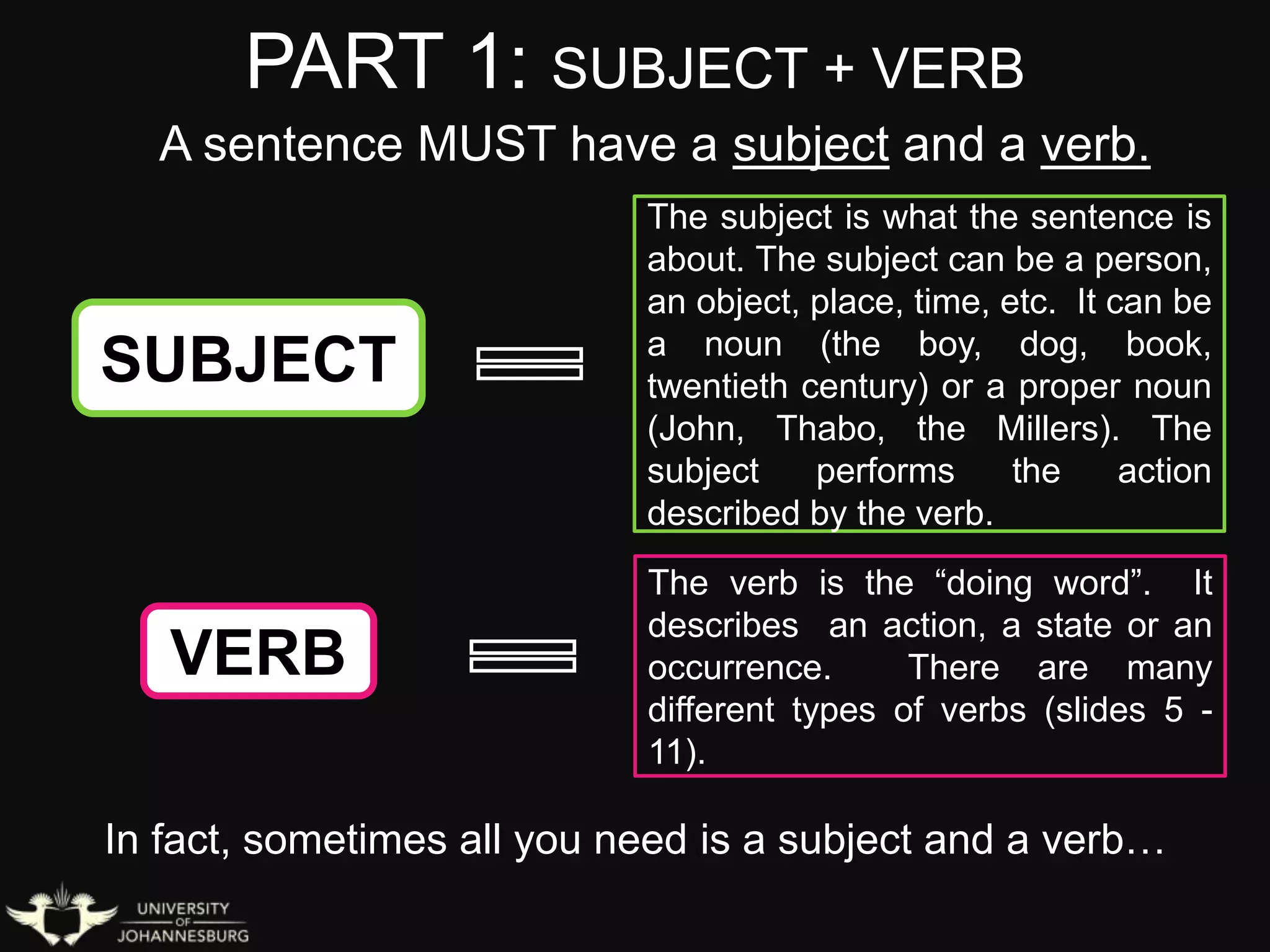
PART 1: SUBJECT + VERB
A sentence MUST have a subject and a verb.
SUBJECT
VERB
The subject is what the sentence is
about. The subject can be a person,
an object, place, time, etc. It can be
a noun (the boy, dog, book,
twentieth century) or a proper noun
(John, Thabo, the Millers). The
subject performs the action
described by the verb.
The verb is the “doing word”. It
describes an action, a state or an
occurrence. There are many
different types of verbs (slides 5 -
11).
In fact, sometimes all you need is a subject and a verb…
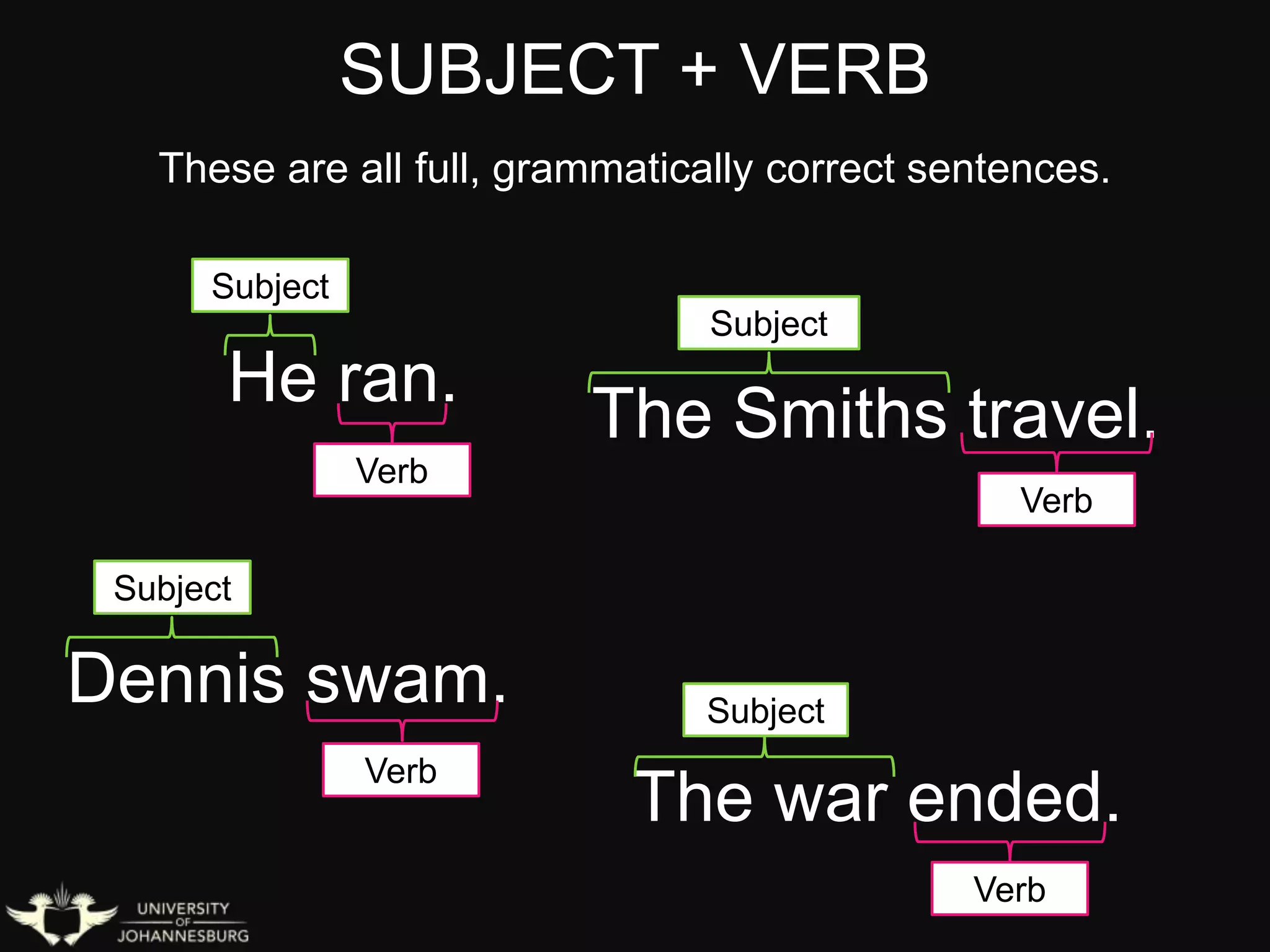
SUBJECT + VERB
He ran.
The Smiths travel.
Subject
Verb
Dennis swam.
Subject
Verb
Subject
Verb
The war ended.
Subject
Verb
These are all full, grammatically correct sentences.
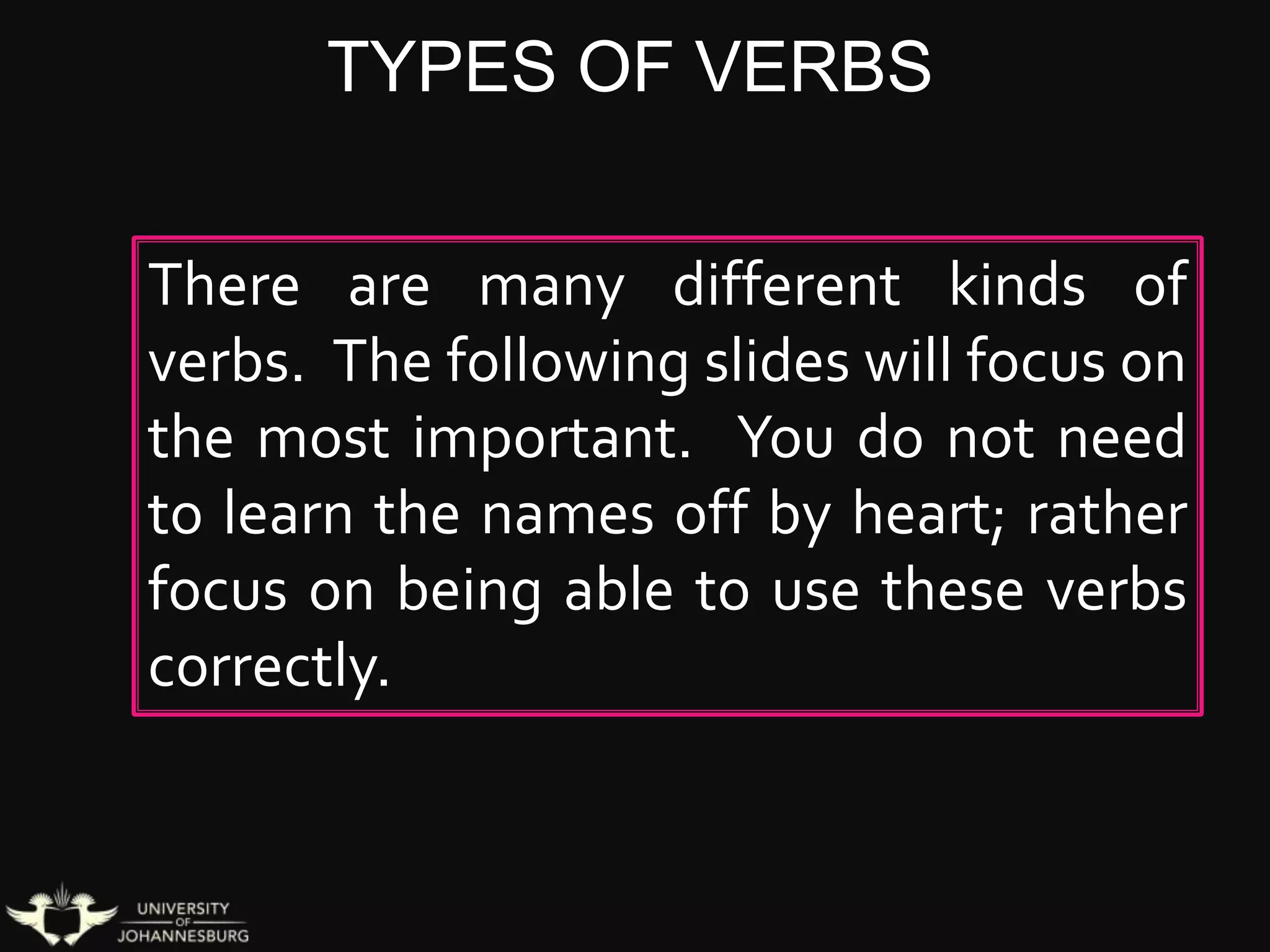
TYPES OF VERBS
There are many different kinds of
verbs. The following slides will focus on
the most important. You do not need
to learn the names off by heart; rather
focus on being able to use these verbs
correctly.
TYPES OF VERBS
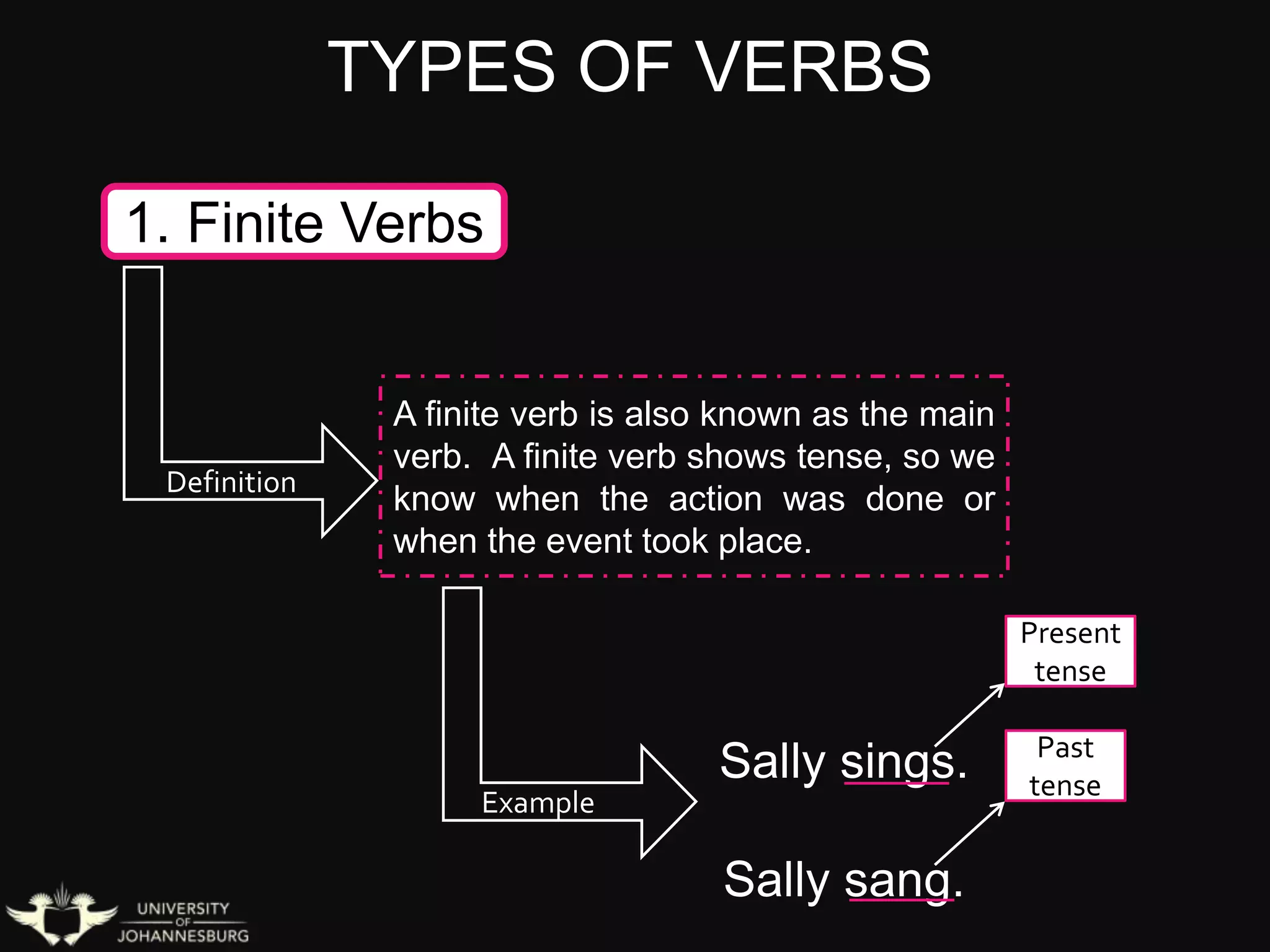
1. Finite Verbs
A finite verb is also known as the main
verb. A finite verb shows tense, so we
know when the action was done or
when the event took place.
Sally sings.
Sally sang.
Present
tense
Past
tense
Definition
Example
TYPES OF VERBS
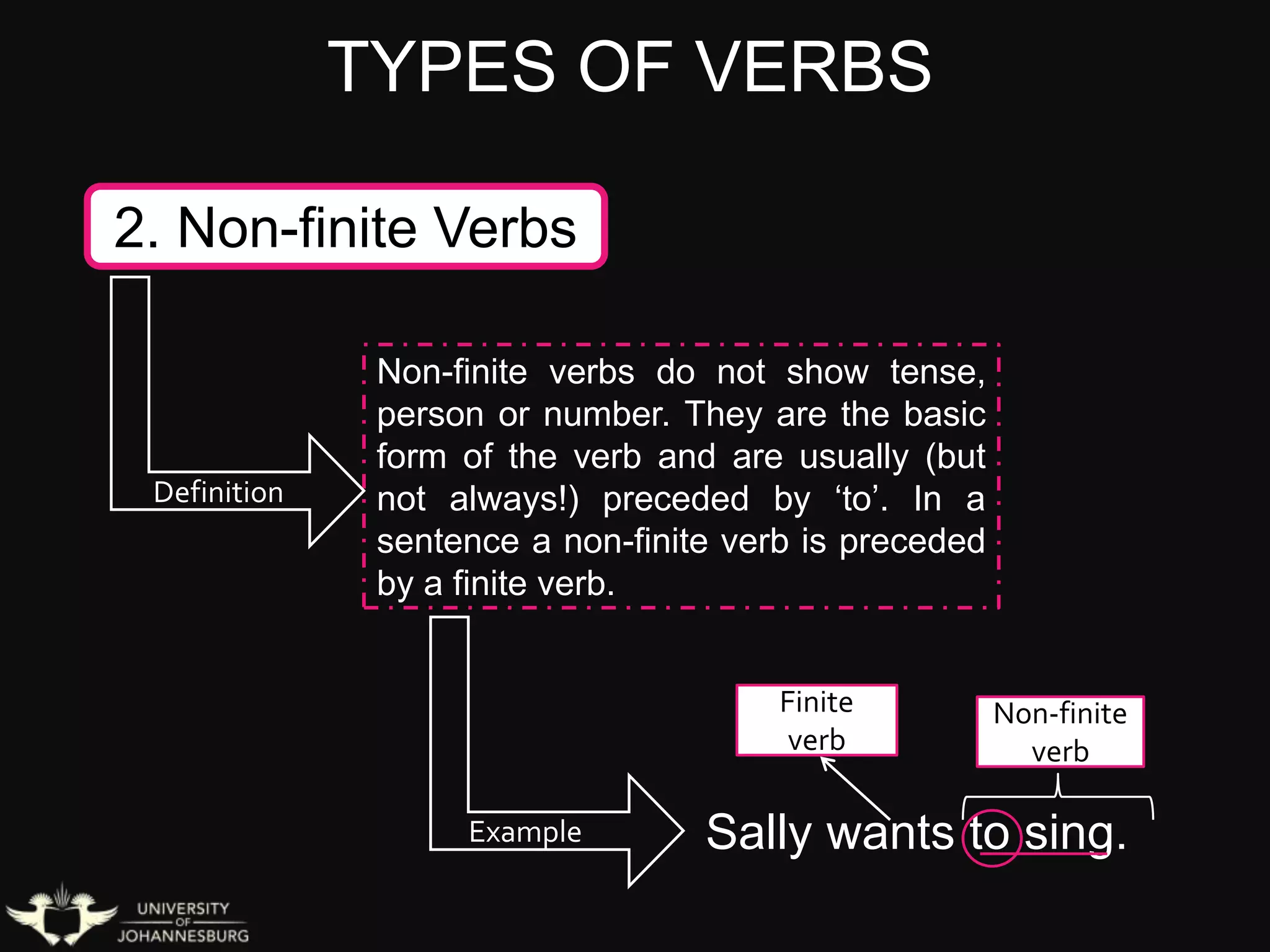
2. Non-finite Verbs
Sally wants to sing.
Finite
verb
Non-finite
verb
Non-finite verbs do not show tense,
person or number. They are the basic
form of the verb and are usually (but
not always!) preceded by ‘to’. In a
sentence a non-finite verb is preceded
by a finite verb.
Definition
Example
TYPES OF VERBS
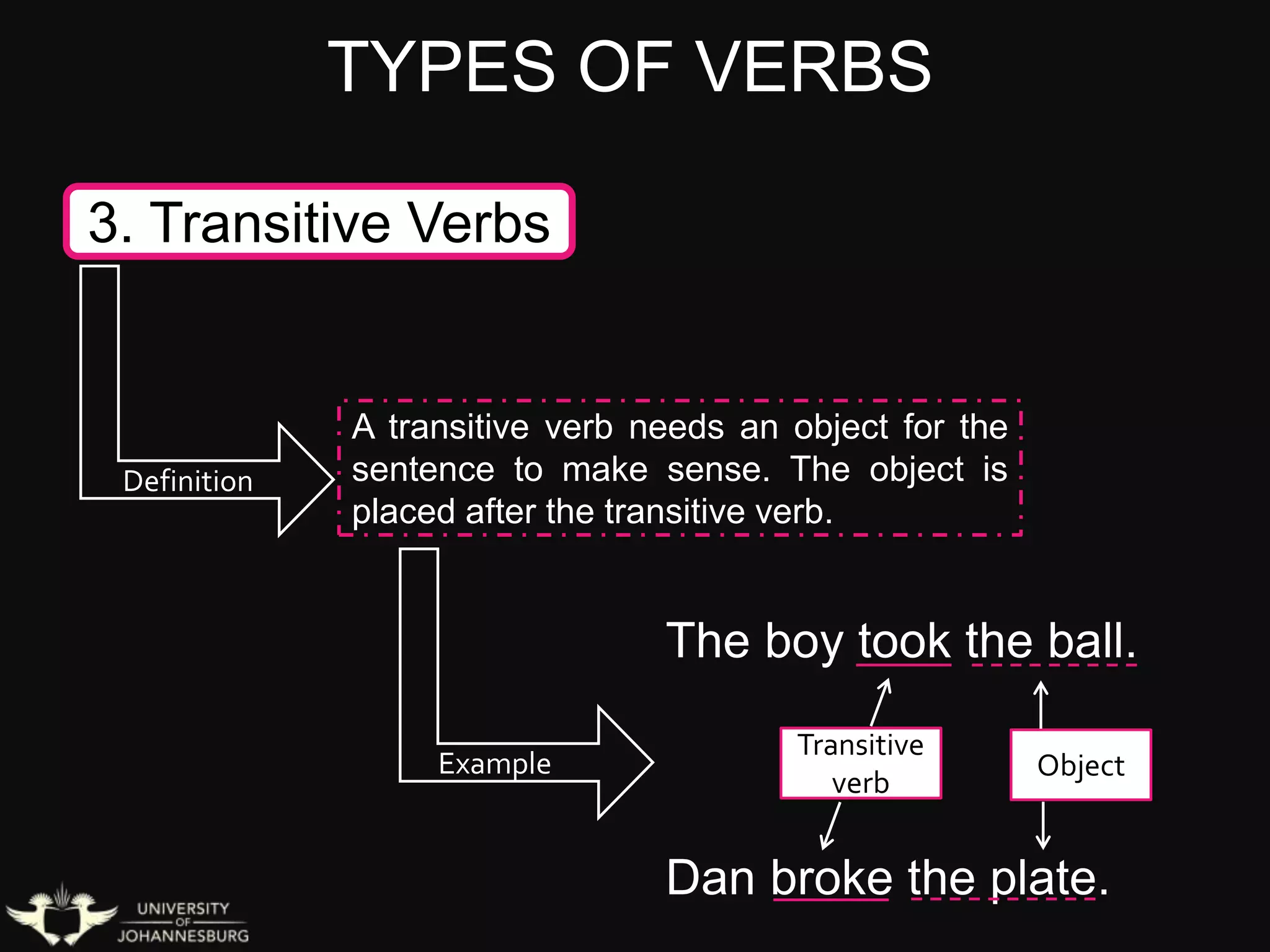
3. Transitive Verbs
Definition
Example
A transitive verb needs an object for the
sentence to make sense. The object is
placed after the transitive verb.
The boy took the ball.
Dan broke the plate.
Transitive
verb
Object
TYPES OF VERBS
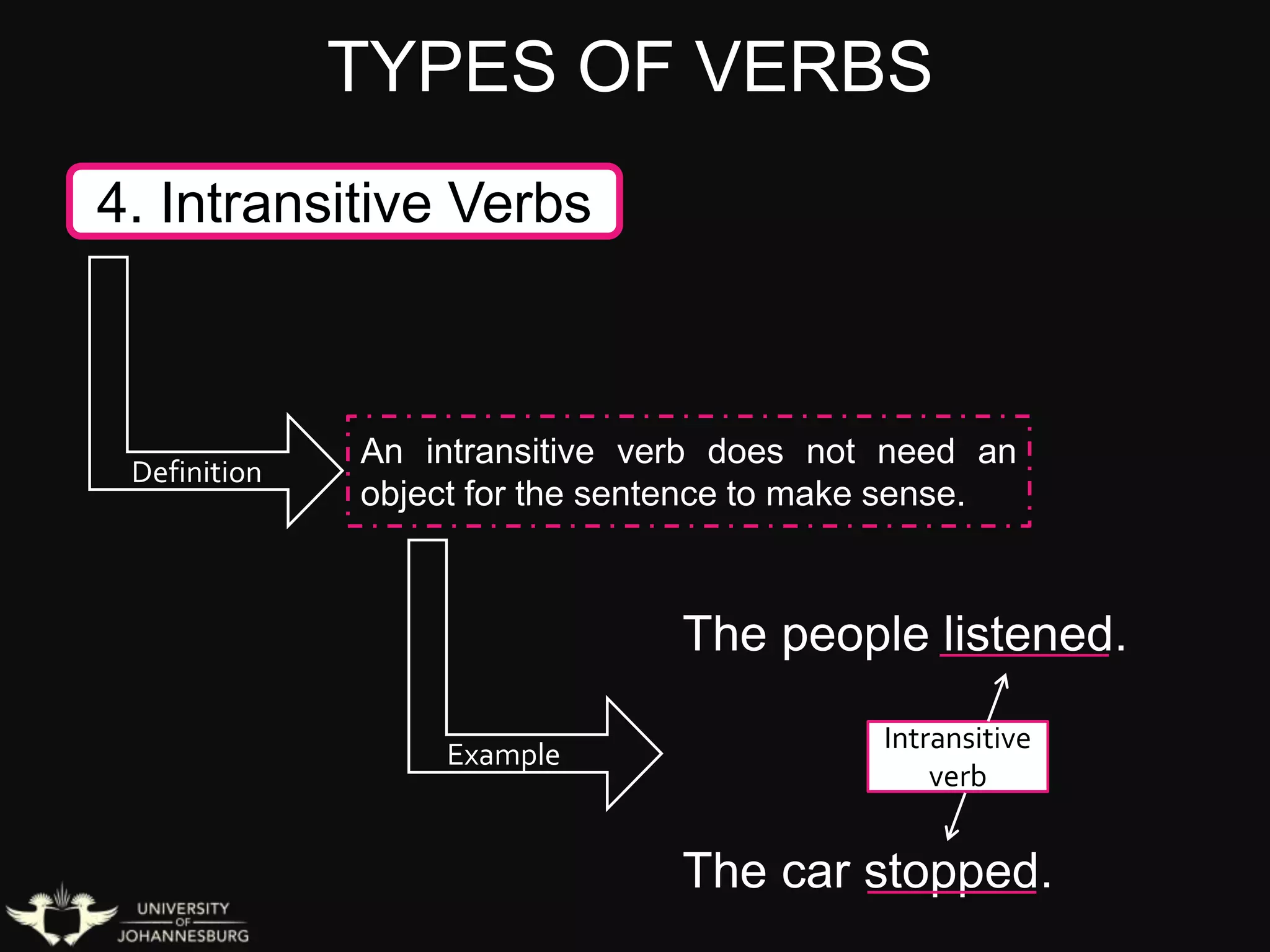
4. Intransitive Verbs
Definition
Example
An intransitive verb does not need an
object for the sentence to make sense.
The people listened.
The car stopped.
Intransitive
verb
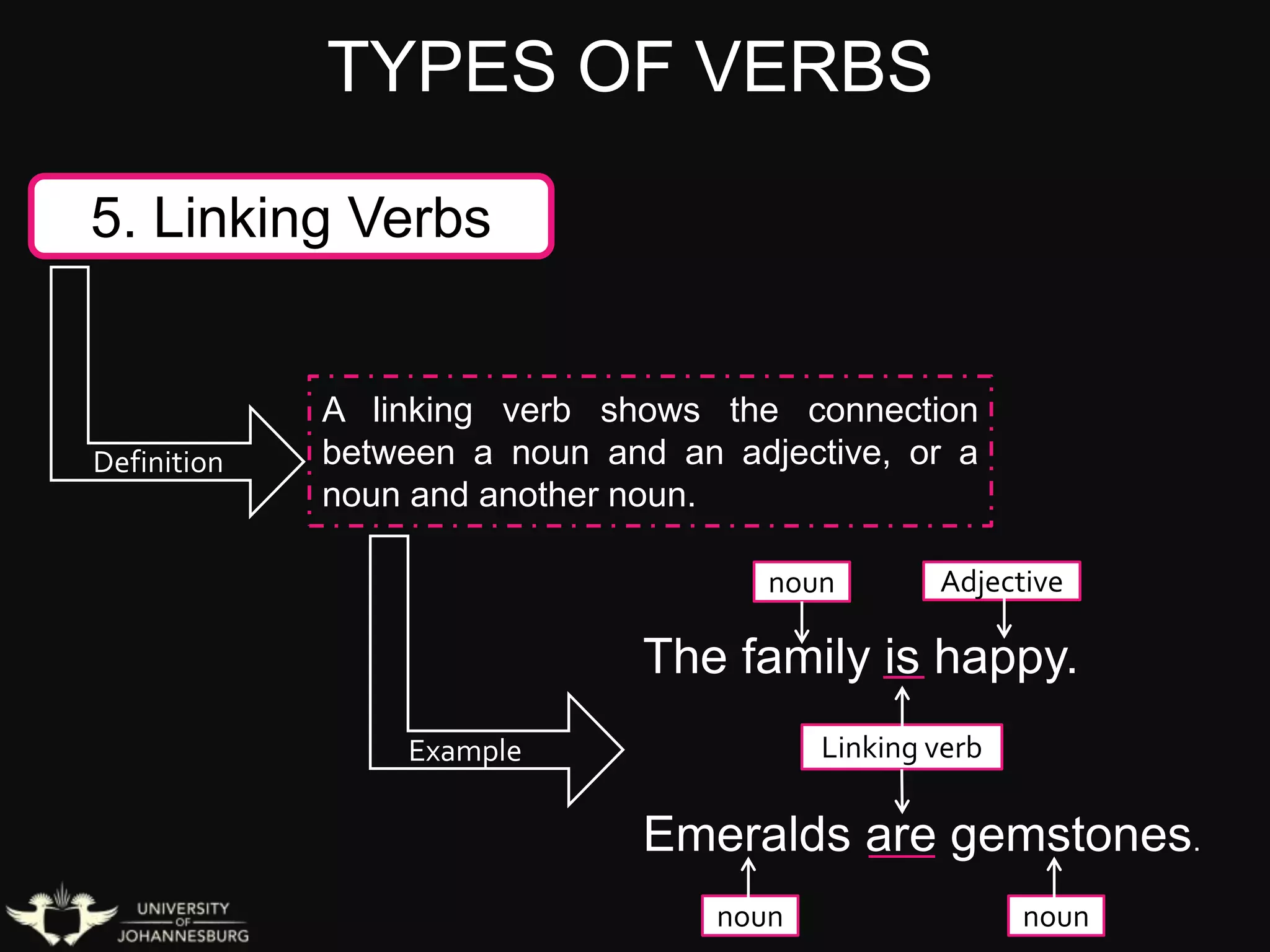
The family is happy.
Emeralds are gemstones.
TYPES OF VERBS
5. Linking Verbs
A linking verb shows the connection
between a noun and an adjective, or a
noun and another noun.
Definition
Example Linking verb
noun Adjective
noun noun
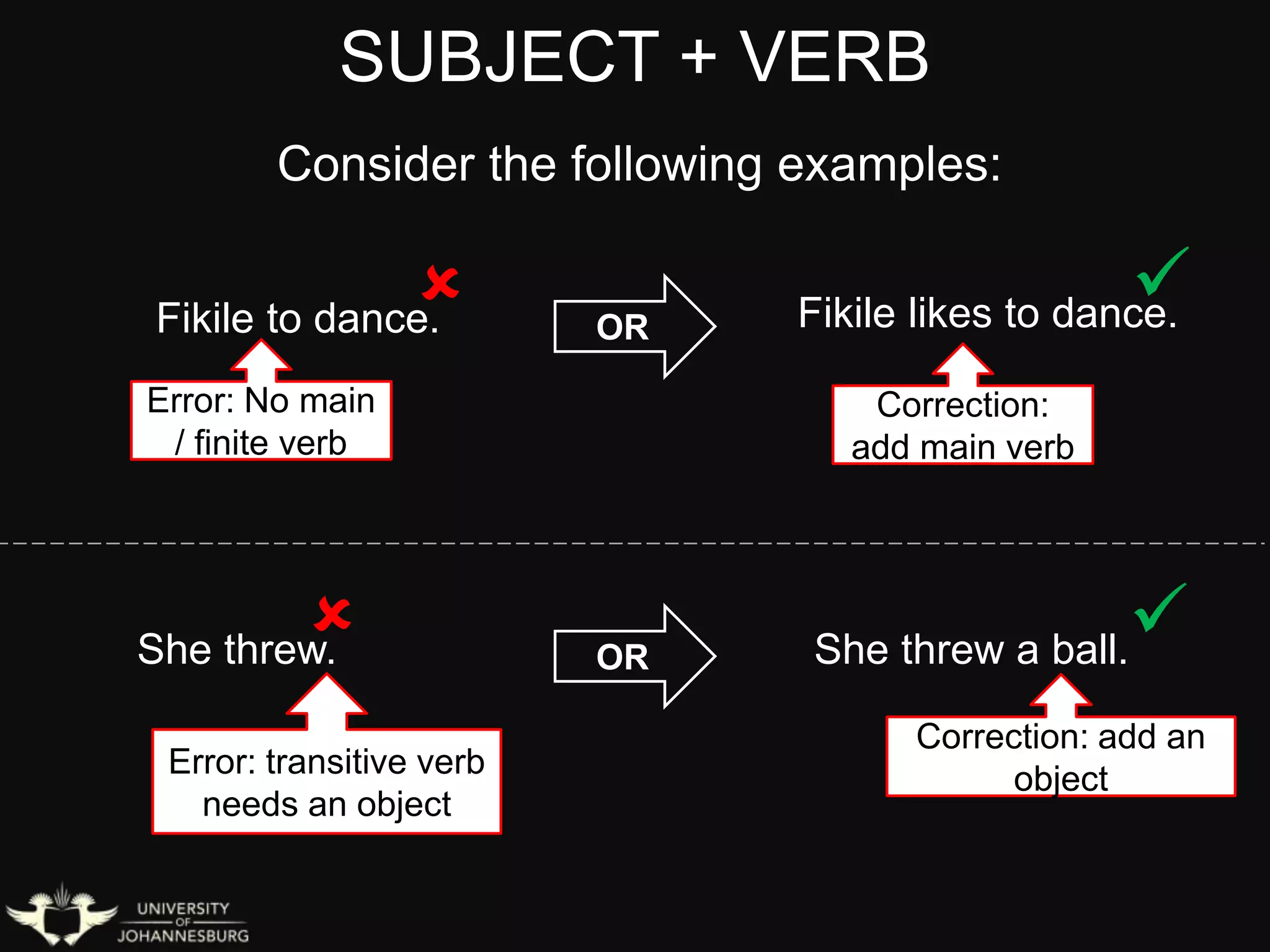
SUBJECT + VERB
Consider the following examples:
Fikile to dance.

Error: No main
/ finite verb
Fikile likes to dance.

Correction:
add main verb
She threw.

Error: transitive verb
needs an object
She threw a ball.

Correction: add an
object
OR
OR
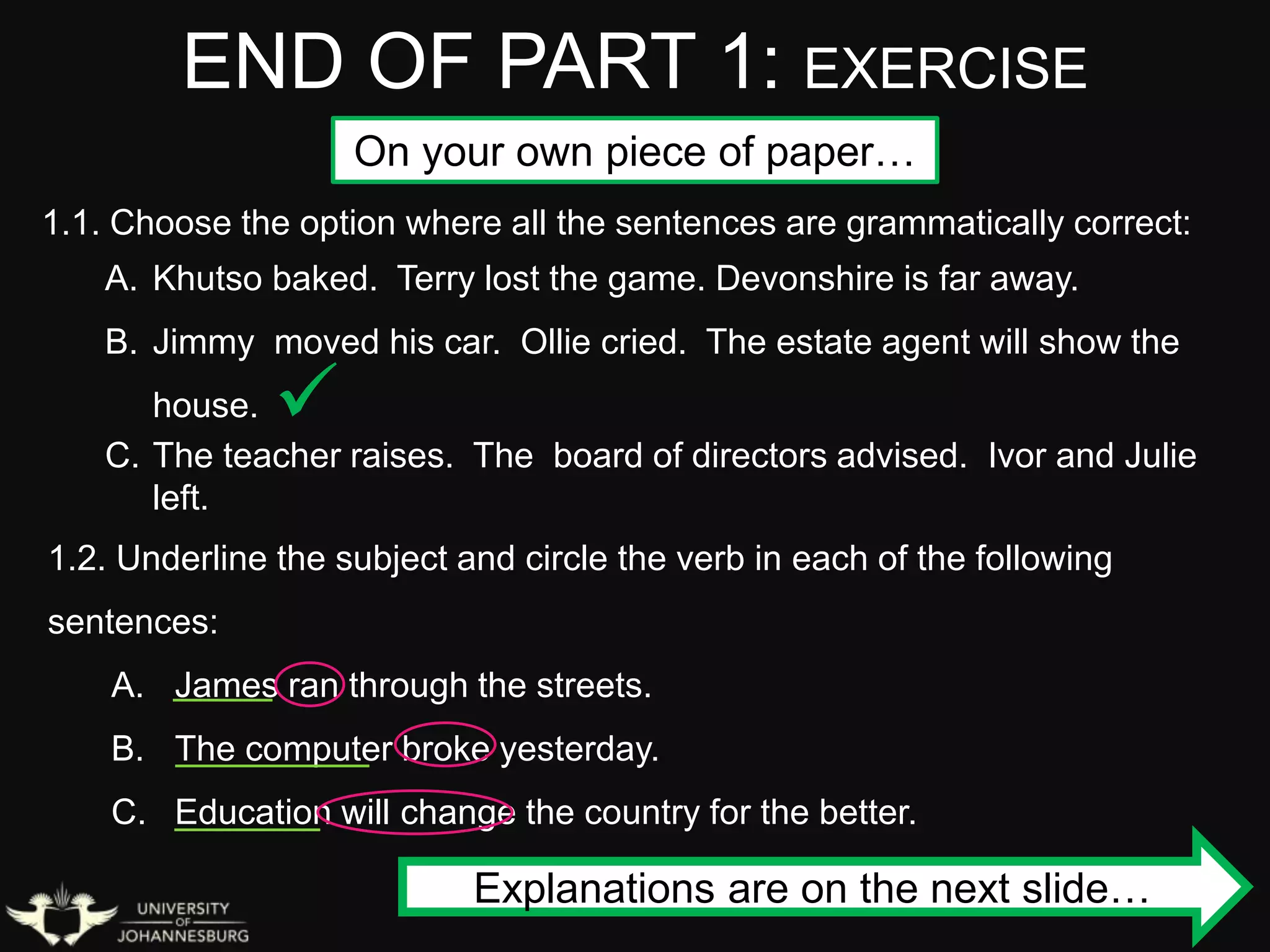
END OF PART 1: EXERCISE
1.1. Choose the option where all the sentences are grammatically correct:
A. Khutso baked. Terry lost the game. Devonshire is far away.
B. Jimmy moved his car. Ollie cried. The estate agent will show the
house.
C. The teacher raises. The board of directors advised. Ivor and Julie
left.
1.2. Underline the subject and circle the verb in each of the following
sentences:
A. James ran through the streets.
B. The computer broke yesterday.
C. Education will change the country for the better.

Explanations are on the next slide…
On your own piece of paper…
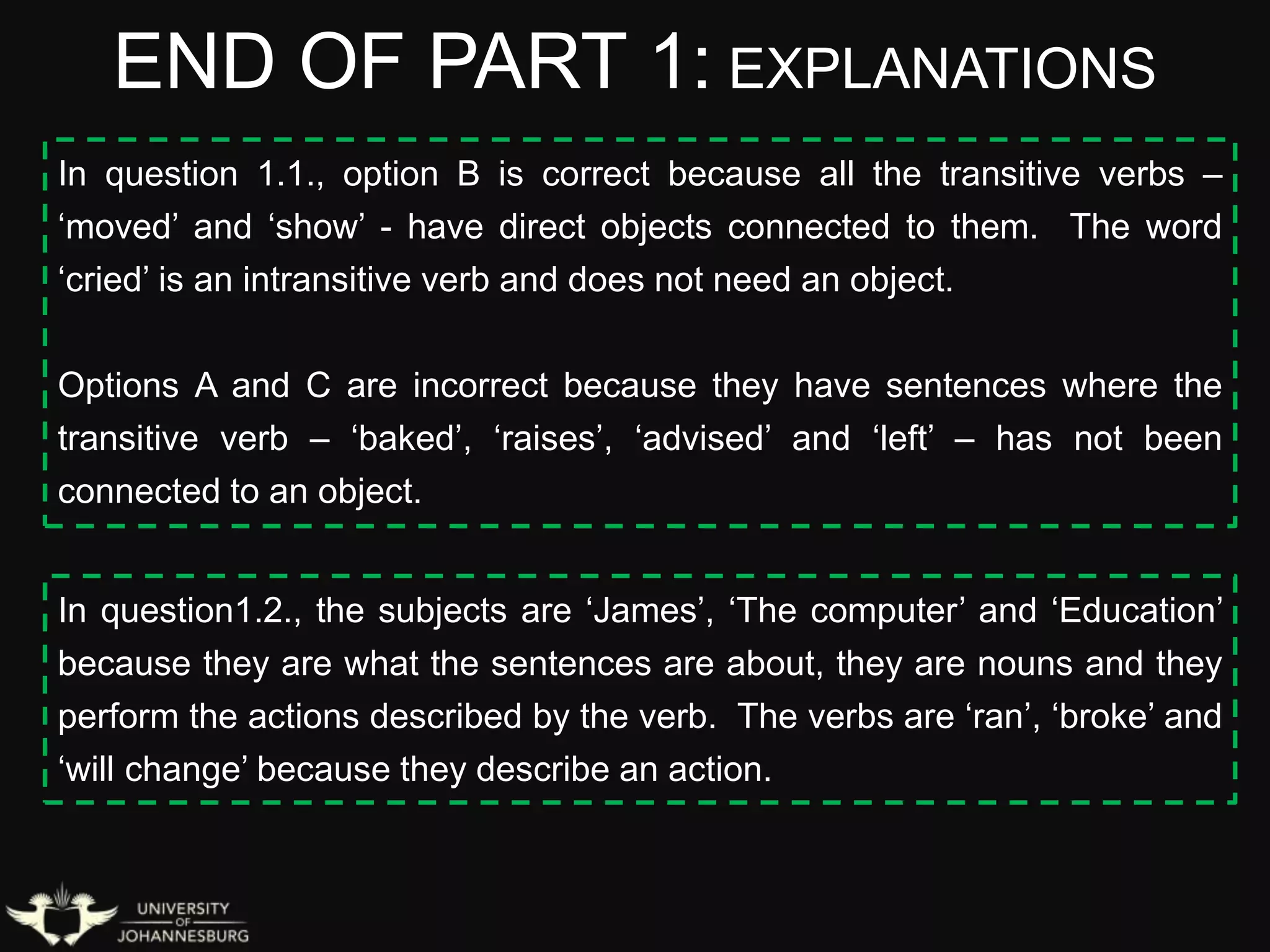
END OF PART 1: EXPLANATIONS
In question 1.1., option B is correct because all the transitive verbs –
‘moved’ and ‘show’ - have direct objects connected to them. The word
‘cried’ is an intransitive verb and does not need an object.
Options A and C are incorrect because they have sentences where the
transitive verb – ‘baked’, ‘raises’, ‘advised’ and ‘left’ – has not been
connected to an object.
In question1.2., the subjects are ‘James’, ‘The computer’ and ‘Education’
because they are what the sentences are about, they are nouns and they
perform the actions described by the verb. The verbs are ‘ran’, ‘broke’ and
‘will change’ because they describe an action.
pronoun
For the next section, make sure you know
what the following term means:
Definitions
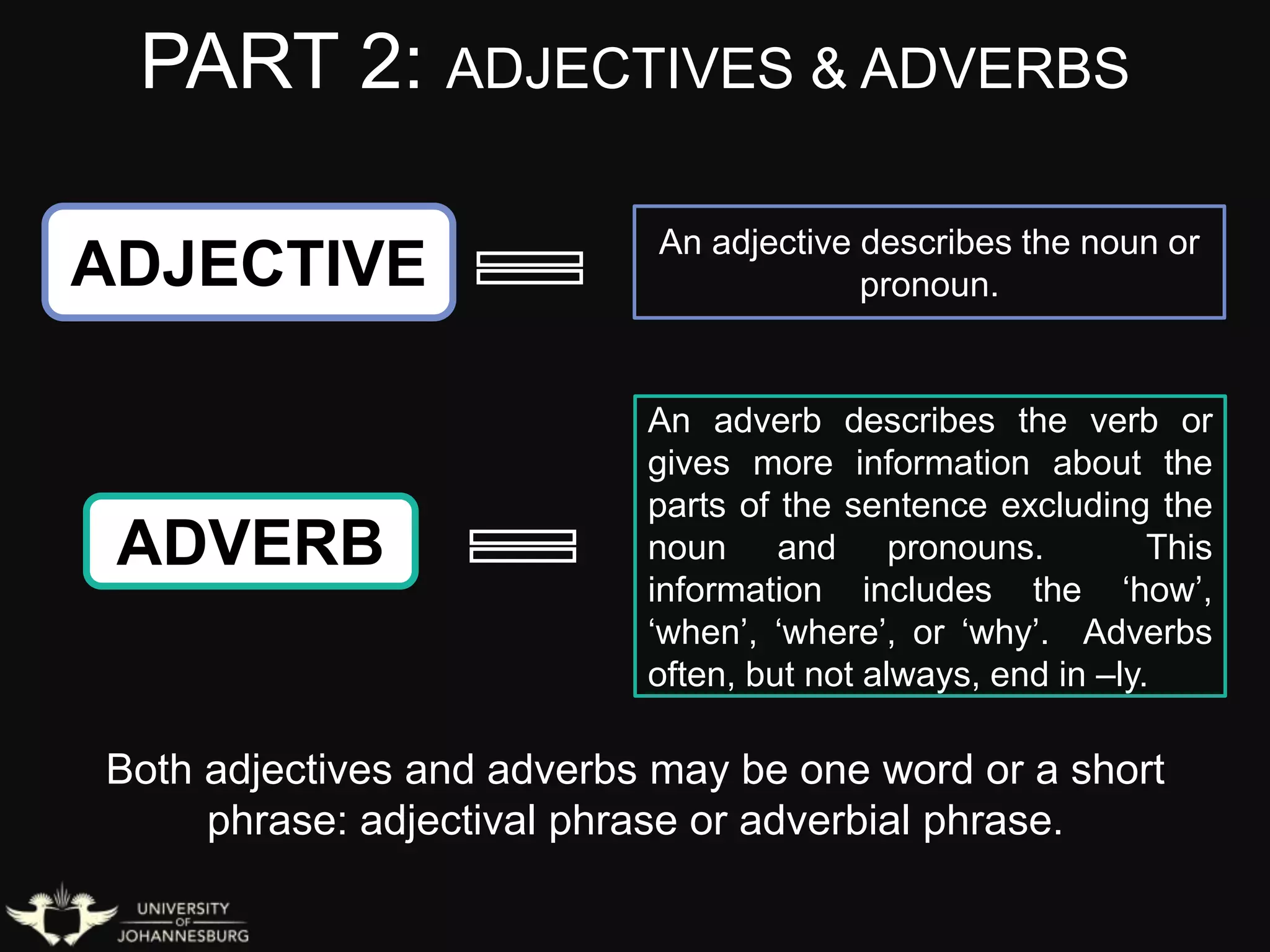
PART 2: ADJECTIVES & ADVERBS
ADJECTIVE
ADVERB
An adjective describes the noun or
pronoun.
An adverb describes the verb or
gives more information about the
parts of the sentence excluding the
noun and pronouns. This
information includes the ‘how’,
‘when’, ‘where’, or ‘why’. Adverbs
often, but not always, end in –ly.
Both adjectives and adverbs may be one word or a short
phrase: adjectival phrase or adverbial phrase.
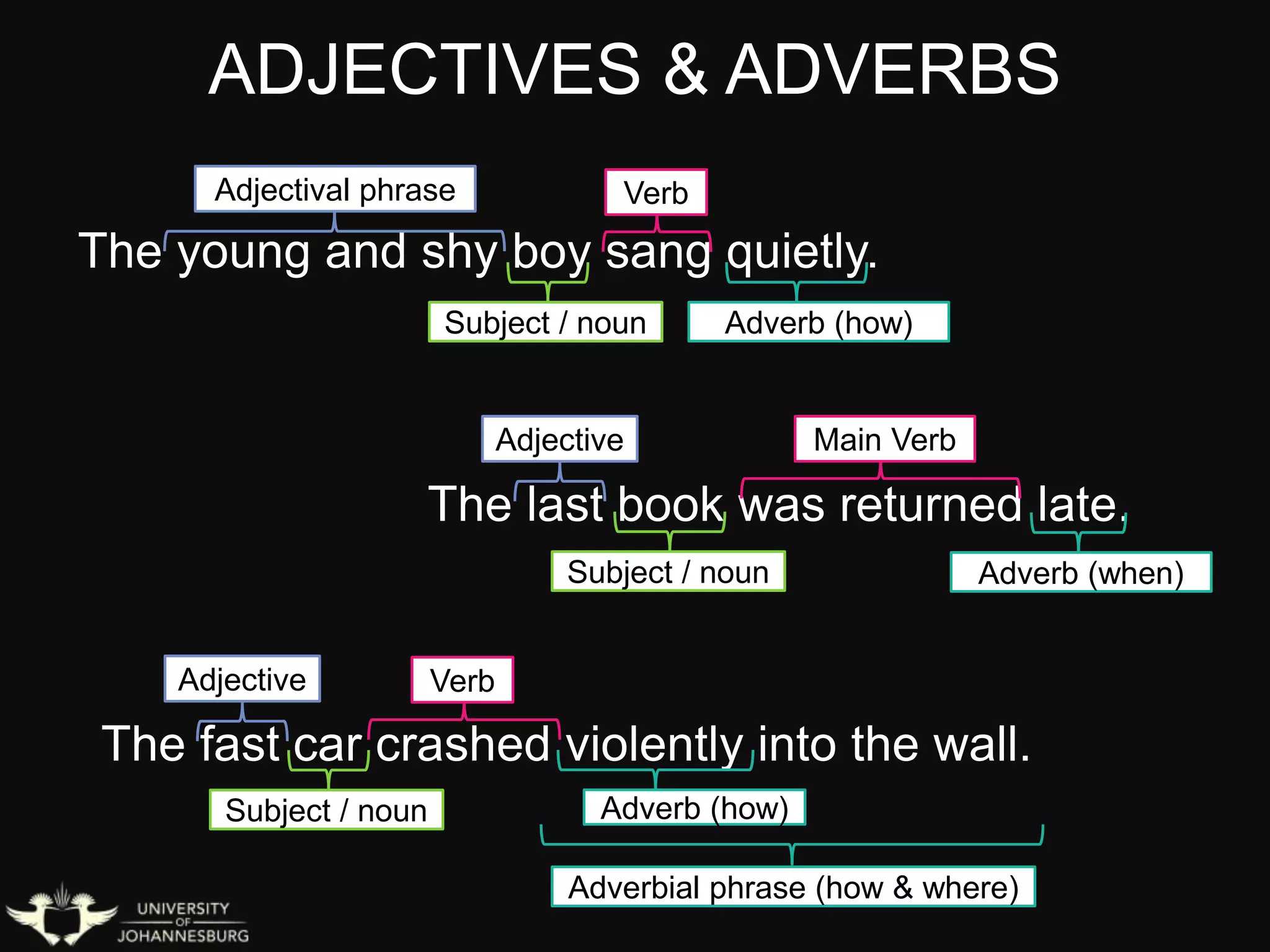
ADJECTIVES & ADVERBS
Subject / noun
The young and shy boy sang quietly.
Adjectival phrase Verb
Adverb (how)
The last book was returned late.
Adjective
Subject / noun
Main Verb
Adverb (when)
The fast car crashed violently into the wall.
Adjective
Subject / noun
Verb
Adverbial phrase (how & where)
Adverb (how)
ADJECTIVES & ADVERBS
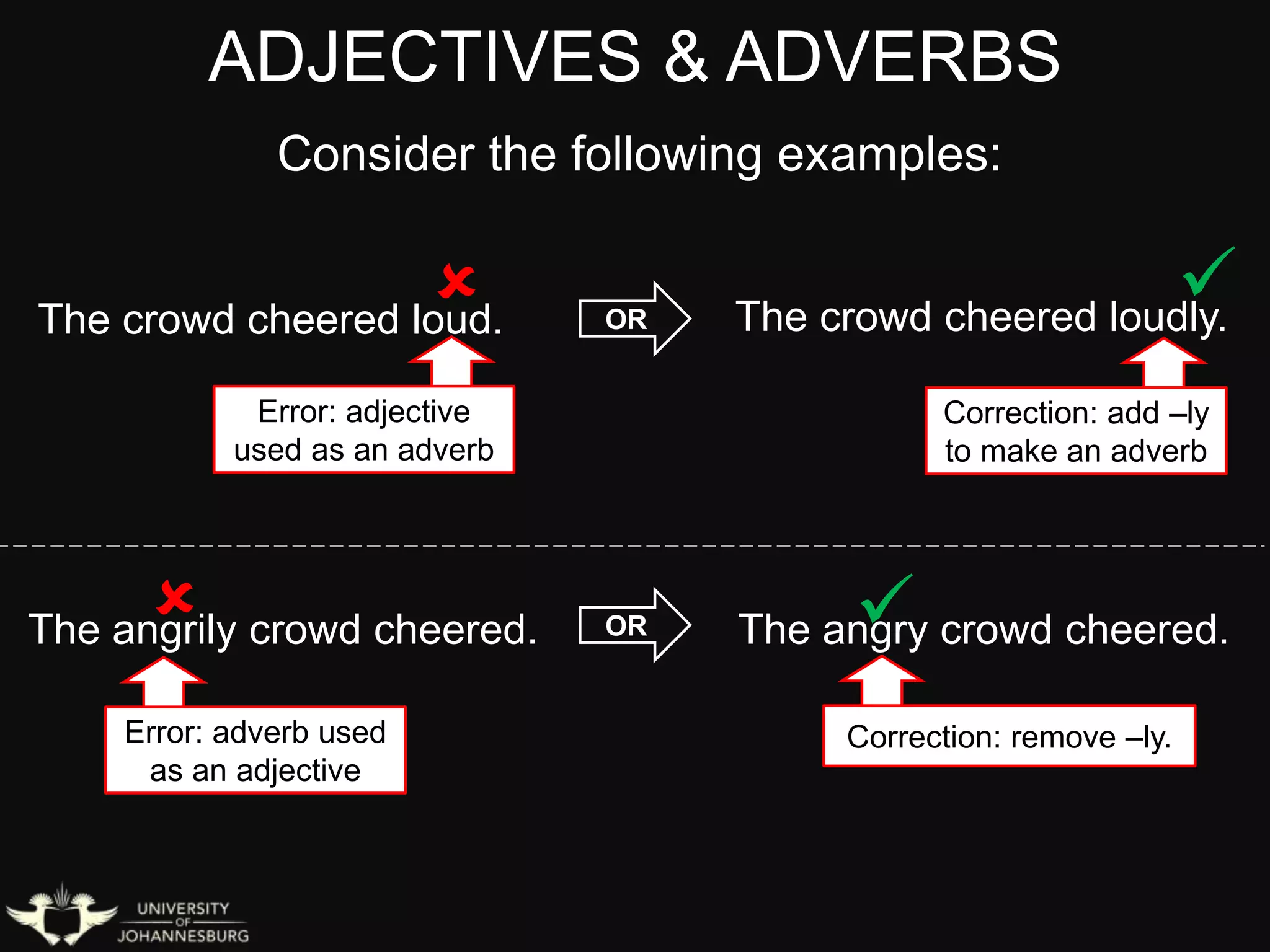
Consider the following examples:
ORThe crowd cheered loud.
 The crowd cheered loudly.

The angrily crowd cheered. OR The angry crowd cheered.
Correction: add –ly
to make an adverb
Error: adjective
used as an adverb
Error: adverb used
as an adjective
Correction: remove –ly.
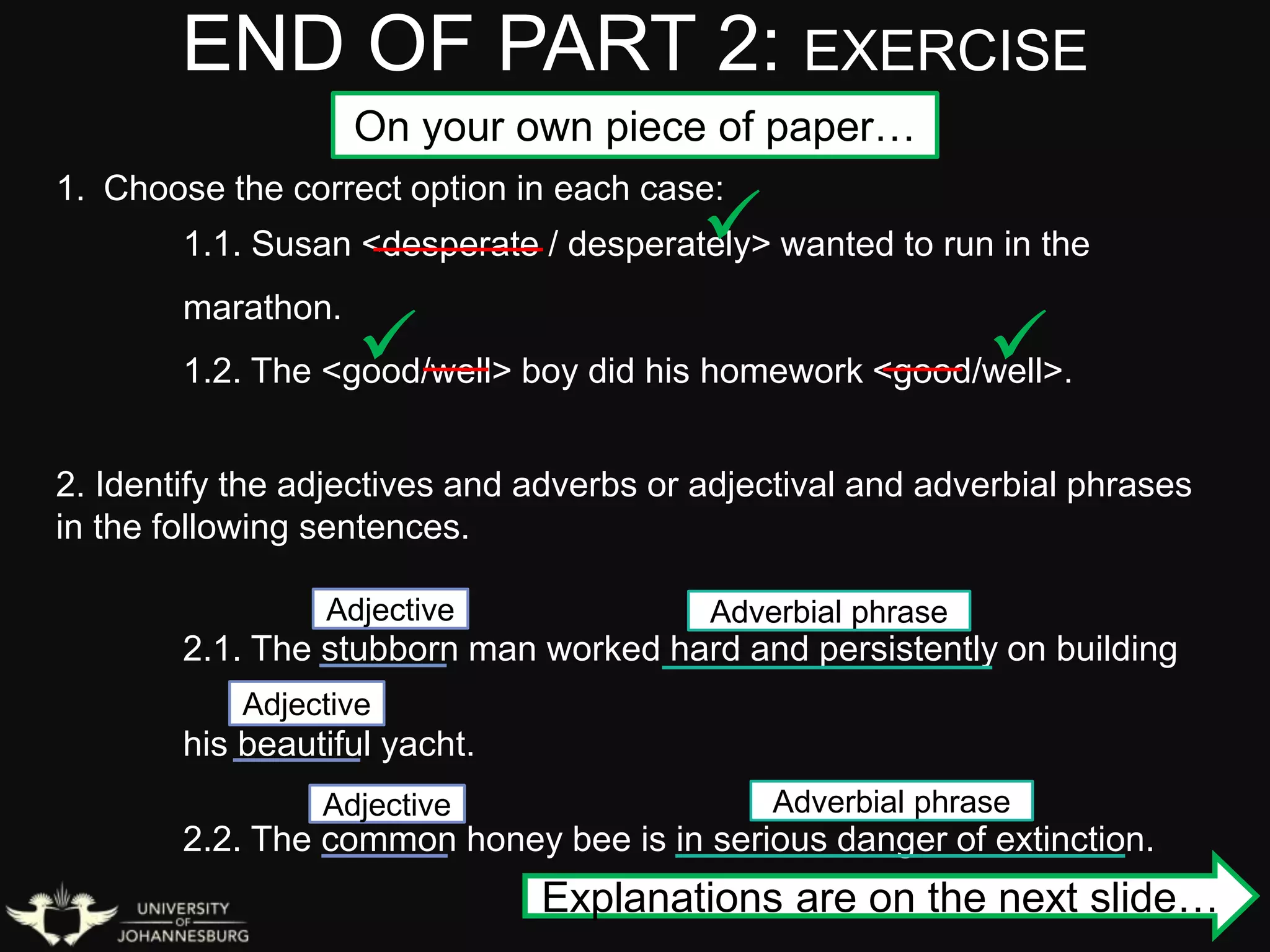
END OF PART 2: EXERCISE
1. Choose the correct option in each case:
1.1. Susan <desperate / desperately> wanted to run in the
marathon.
1.2. The <good/well> boy did his homework <good/well>.
2. Identify the adjectives and adverbs or adjectival and adverbial phrases
in the following sentences.
2.1. The stubborn man worked hard and persistently on building
his beautiful yacht.
2.2. The common honey bee is in serious danger of extinction.

 
Adjective
Adjective
Adjective Adverbial phrase
Adverbial phrase
Explanations are on the next slide…
On your own piece of paper…
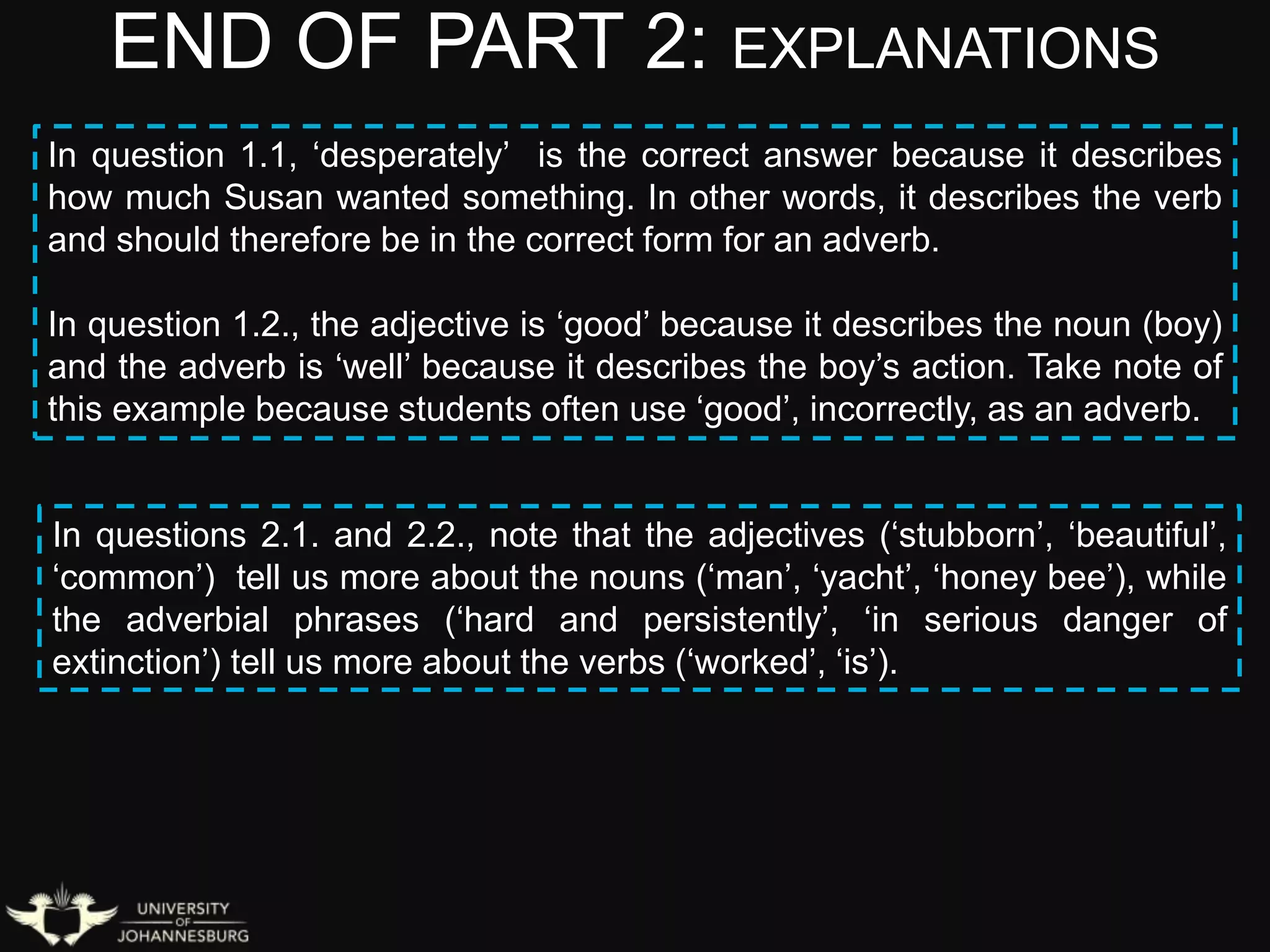
END OF PART 2: EXPLANATIONS
In question 1.1, ‘desperately’ is the correct answer because it describes
how much Susan wanted something. In other words, it describes the verb
and should therefore be in the correct form for an adverb.
In question 1.2., the adjective is ‘good’ because it describes the noun (boy)
and the adverb is ‘well’ because it describes the boy’s action. Take note of
this example because students often use ‘good’, incorrectly, as an adverb.
In questions 2.1. and 2.2., note that the adjectives (‘stubborn’, ‘beautiful’,
‘common’) tell us more about the nouns (‘man’, ‘yacht’, ‘honey bee’), while
the adverbial phrases (‘hard and persistently’, ‘in serious danger of
extinction’) tell us more about the verbs (‘worked’, ‘is’).
active voice
For the next section, make sure you know
what the following term means:
Definitions
passive voice
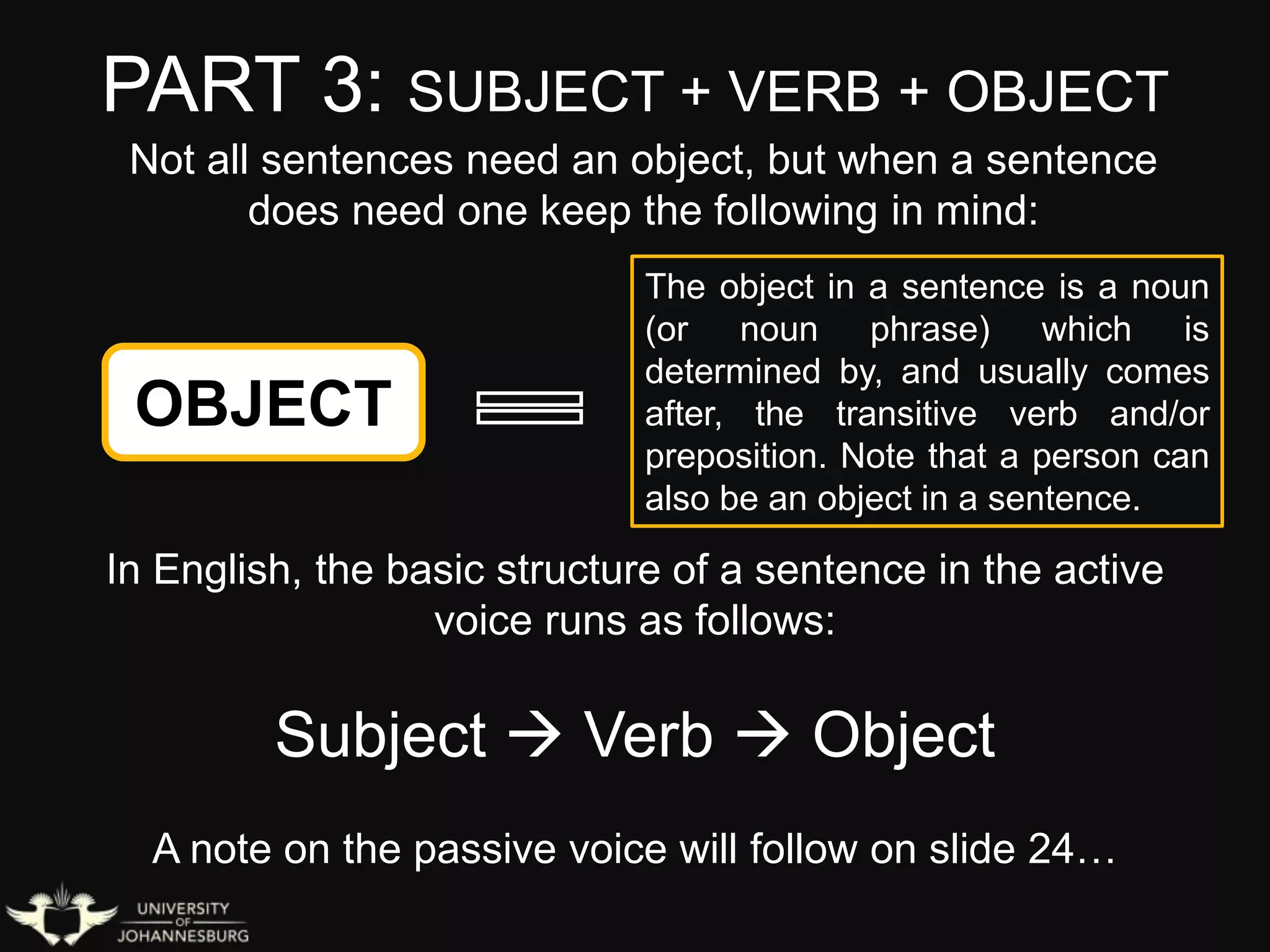
PART 3: SUBJECT + VERB + OBJECT
OBJECT
The object in a sentence is a noun
(or noun phrase) which is
determined by, and usually comes
after, the transitive verb and/or
preposition. Note that a person can
also be an object in a sentence.
In English, the basic structure of a sentence in the active
voice runs as follows:
Subject  Verb  Object
A note on the passive voice will follow on slide 24…
Not all sentences need an object, but when a sentence
does need one keep the following in mind:
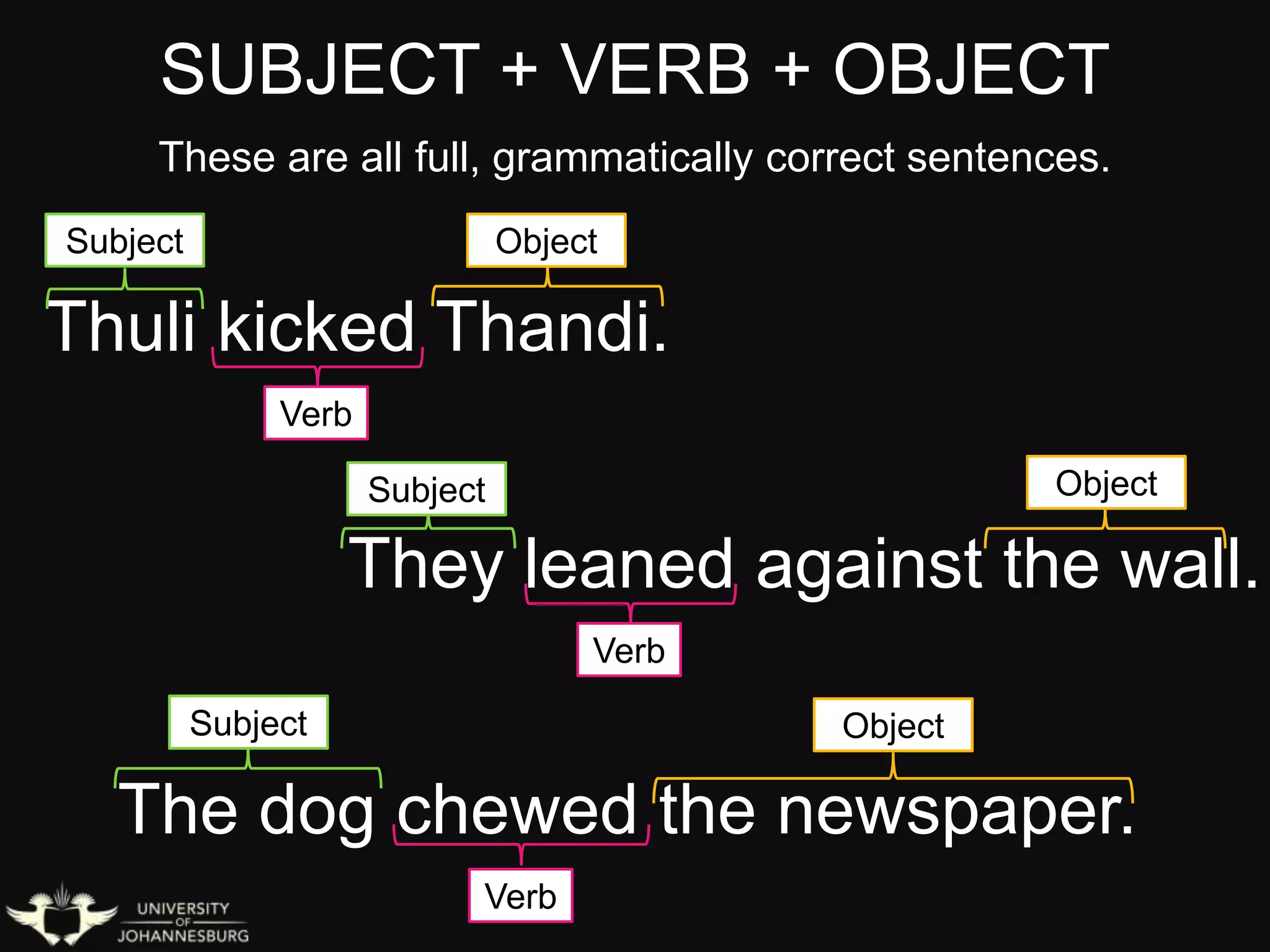
SUBJECT + VERB + OBJECT
These are all full, grammatically correct sentences.
Thuli kicked Thandi.
They leaned against the wall.
The dog chewed the newspaper.
Subject
Verb
Object
Subject
Verb
Object
Subject
Verb
Object
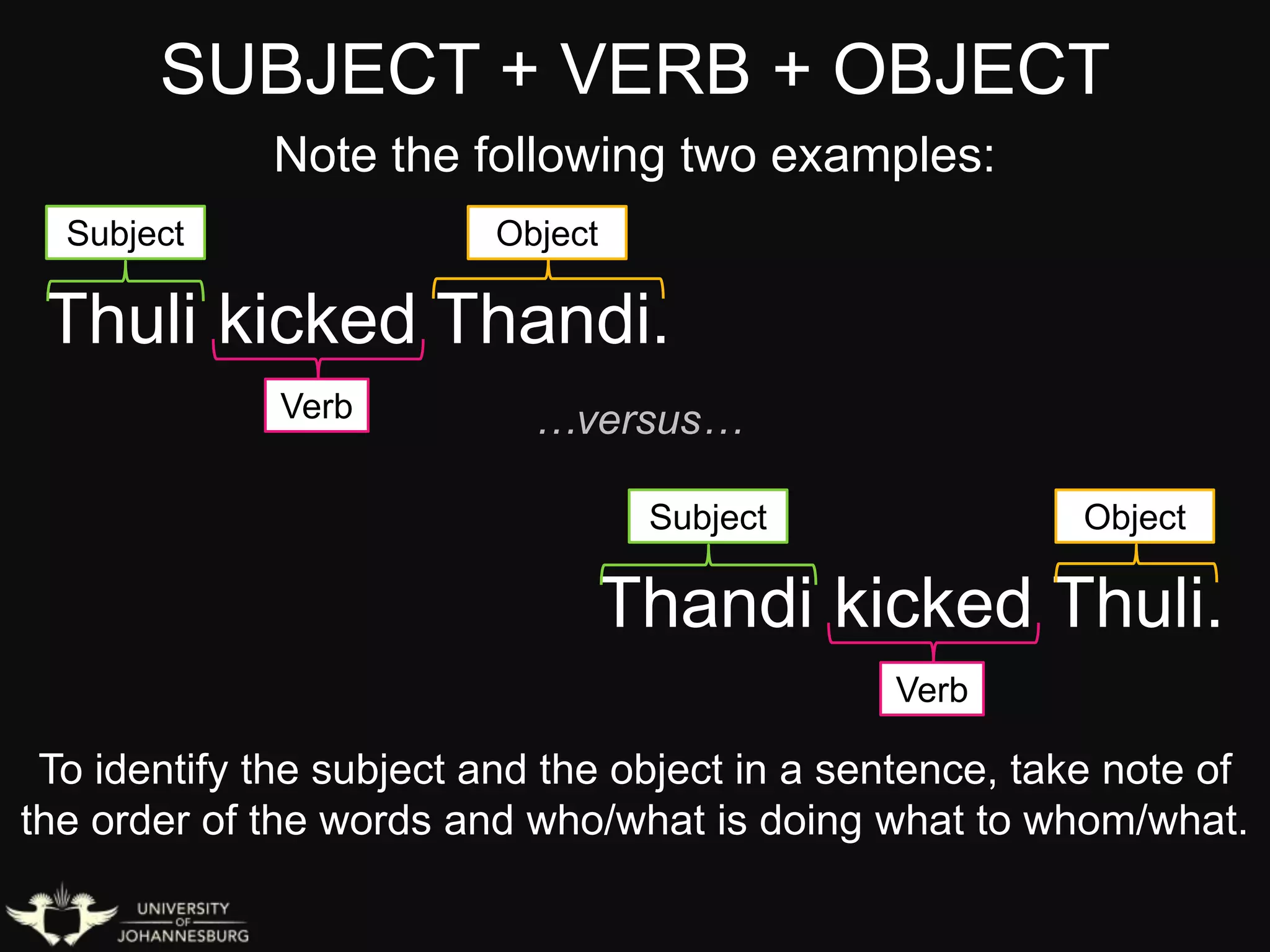
SUBJECT + VERB + OBJECT
Note the following two examples:
Thuli kicked Thandi.
Subject
Verb
Object
Thandi kicked Thuli.
Subject
Verb
Object
…versus…
To identify the subject and the object in a sentence, take note of
the order of the words and who/what is doing what to whom/what.
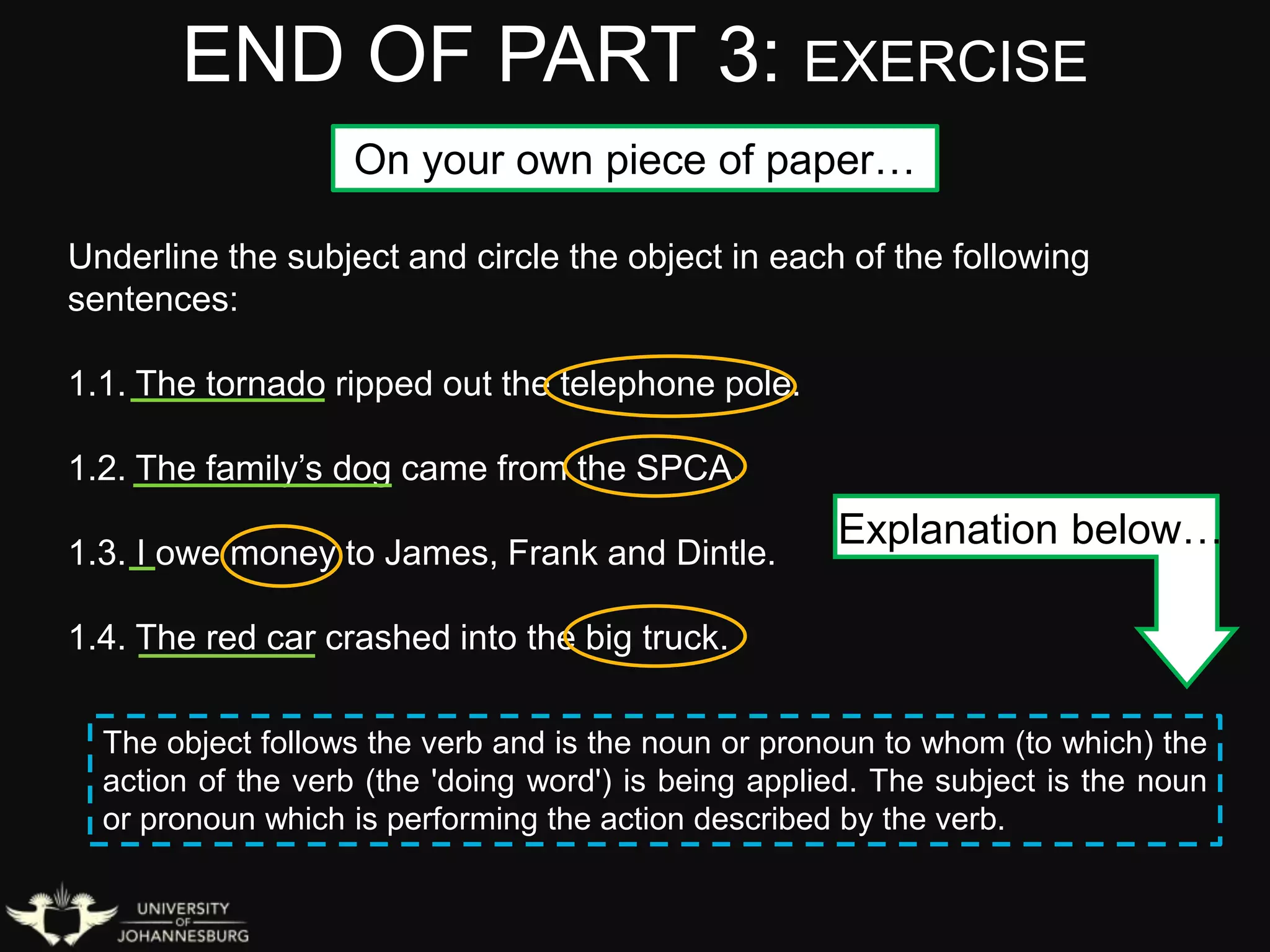
END OF PART 3: EXERCISE
Underline the subject and circle the object in each of the following
sentences:
1.1. The tornado ripped out the telephone pole.
1.2. The family’s dog came from the SPCA.
1.3. I owe money to James, Frank and Dintle.
1.4. The red car crashed into the big truck.
The object follows the verb and is the noun or pronoun to whom (to which) the
action of the verb (the 'doing word') is being applied. The subject is the noun
or pronoun which is performing the action described by the verb.
Explanation below…
On your own piece of paper…
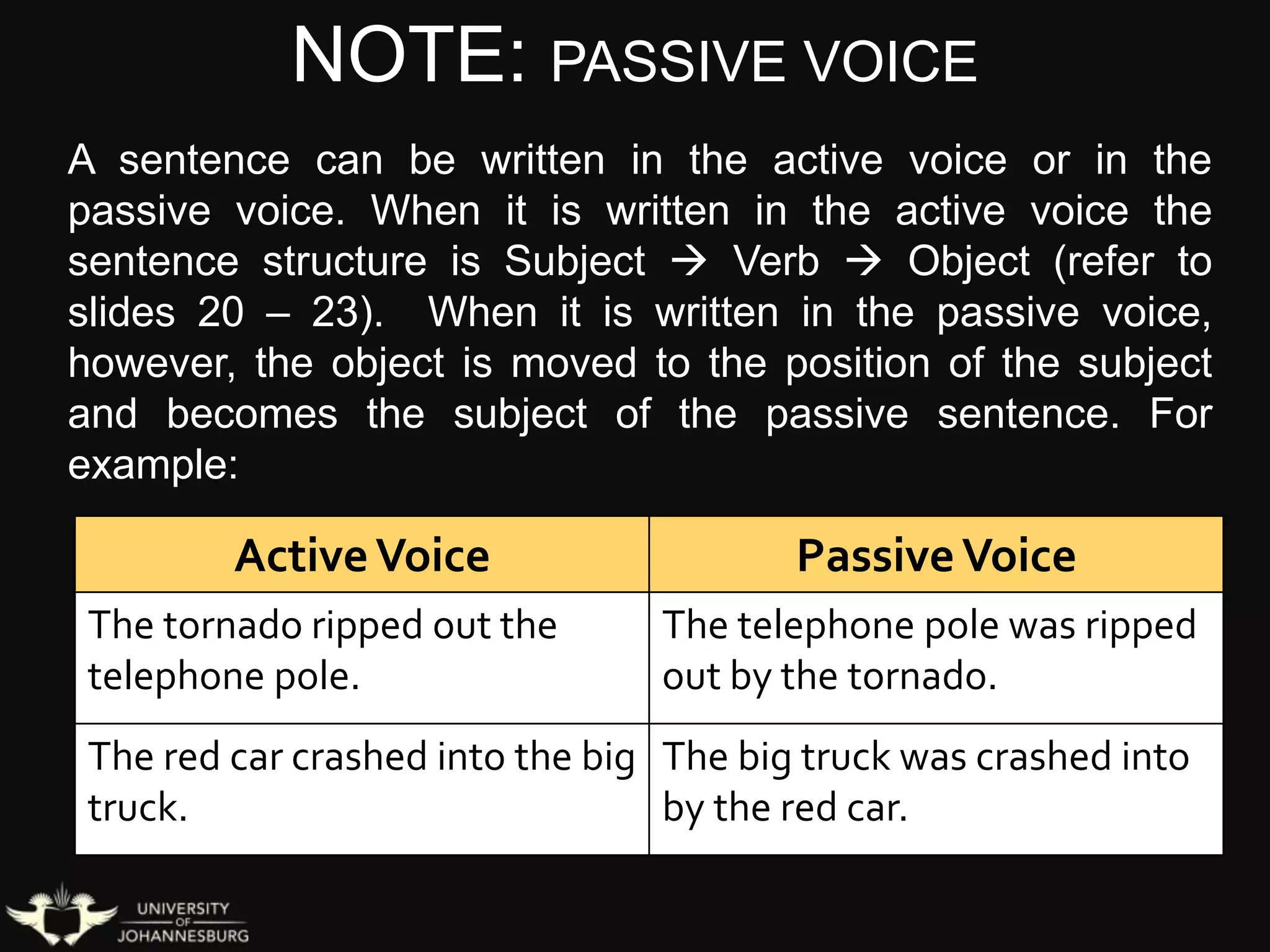
NOTE: PASSIVE VOICE
A sentence can be written in the active voice or in the
passive voice. When it is written in the active voice the
sentence structure is Subject  Verb  Object (refer to
slides 20 – 23). When it is written in the passive voice,
however, the object is moved to the position of the subject
and becomes the subject of the passive sentence. For
example:
ActiveVoice PassiveVoice
The tornado ripped out the
telephone pole.
The telephone pole was ripped
out by the tornado.
The red car crashed into the big
truck.
The big truck was crashed into
by the red car.
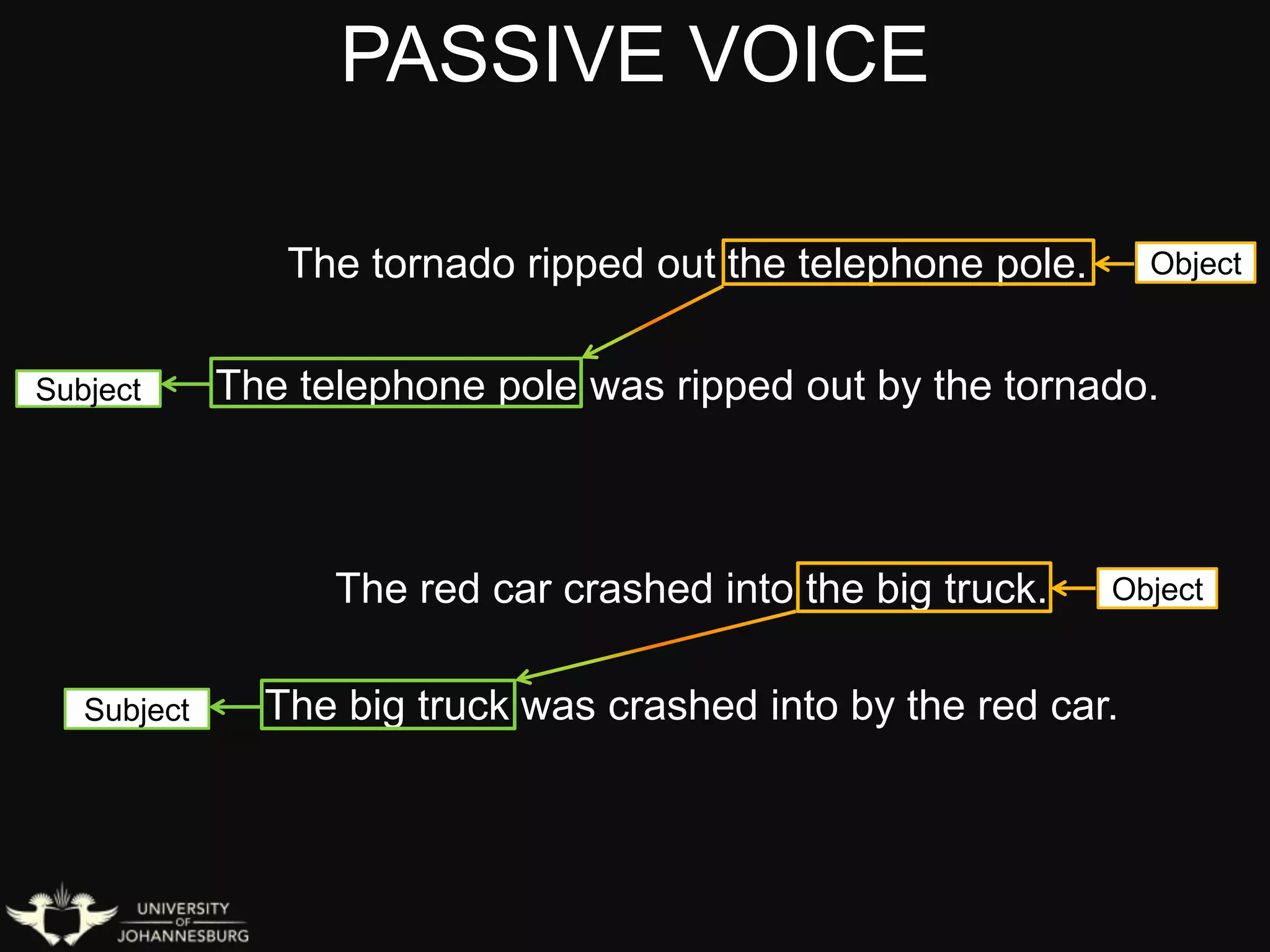
PASSIVE VOICE
The tornado ripped out the telephone pole.
The telephone pole was ripped out by the tornado.
Object
Subject
The red car crashed into the big truck.
The big truck was crashed into by the red car.
Object
Subject
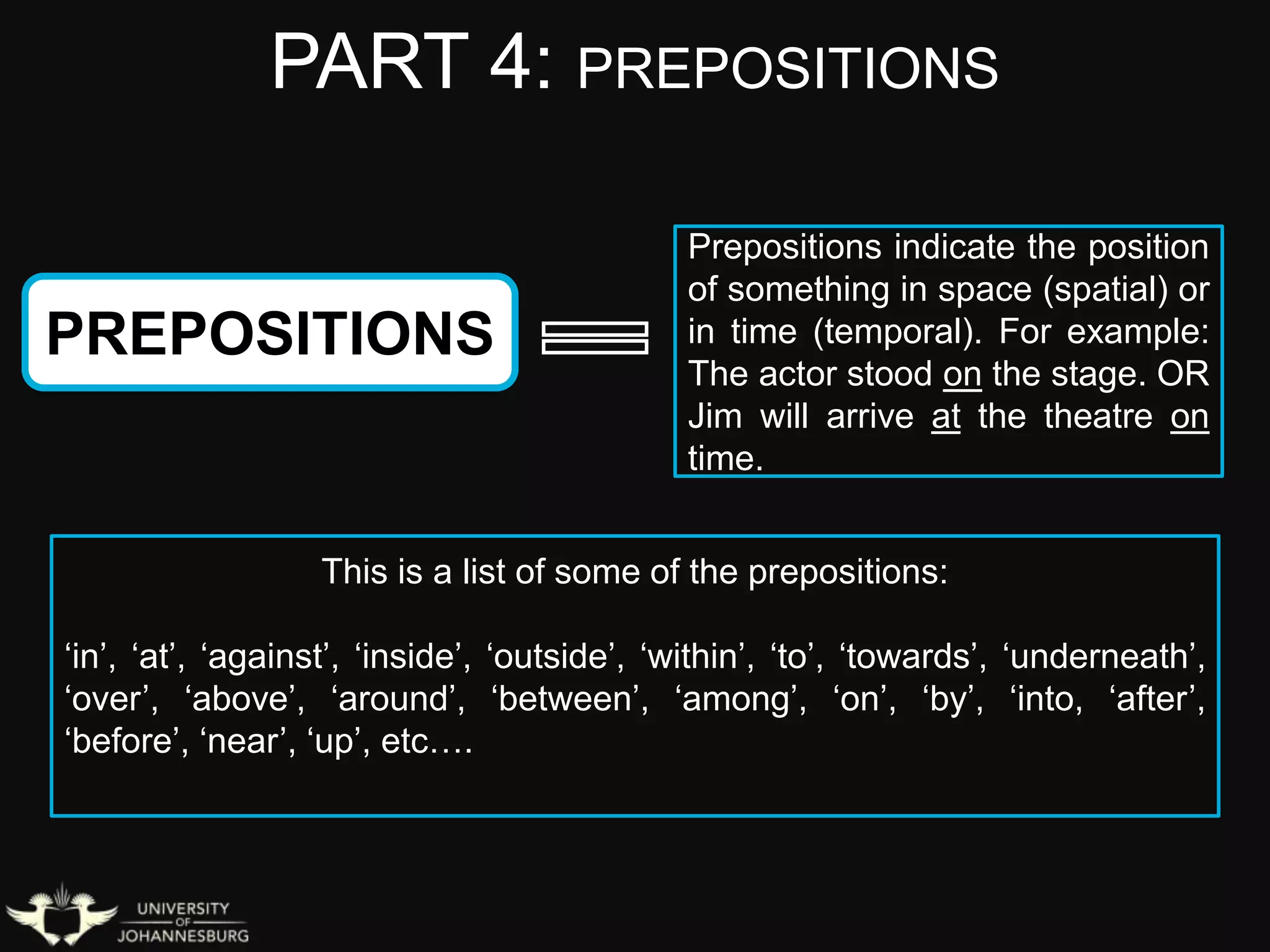
PART 4: PREPOSITIONS
PREPOSITIONS
Prepositions indicate the position
of something in space (spatial) or
in time (temporal). For example:
The actor stood on the stage. OR
Jim will arrive at the theatre on
time.
This is a list of some of the prepositions:
‘in’, ‘at’, ‘against’, ‘inside’, ‘outside’, ‘within’, ‘to’, ‘towards’, ‘underneath’,
‘over’, ‘above’, ‘around’, ‘between’, ‘among’, ‘on’, ‘by’, ‘into, ‘after’,
‘before’, ‘near’, ‘up’, etc….
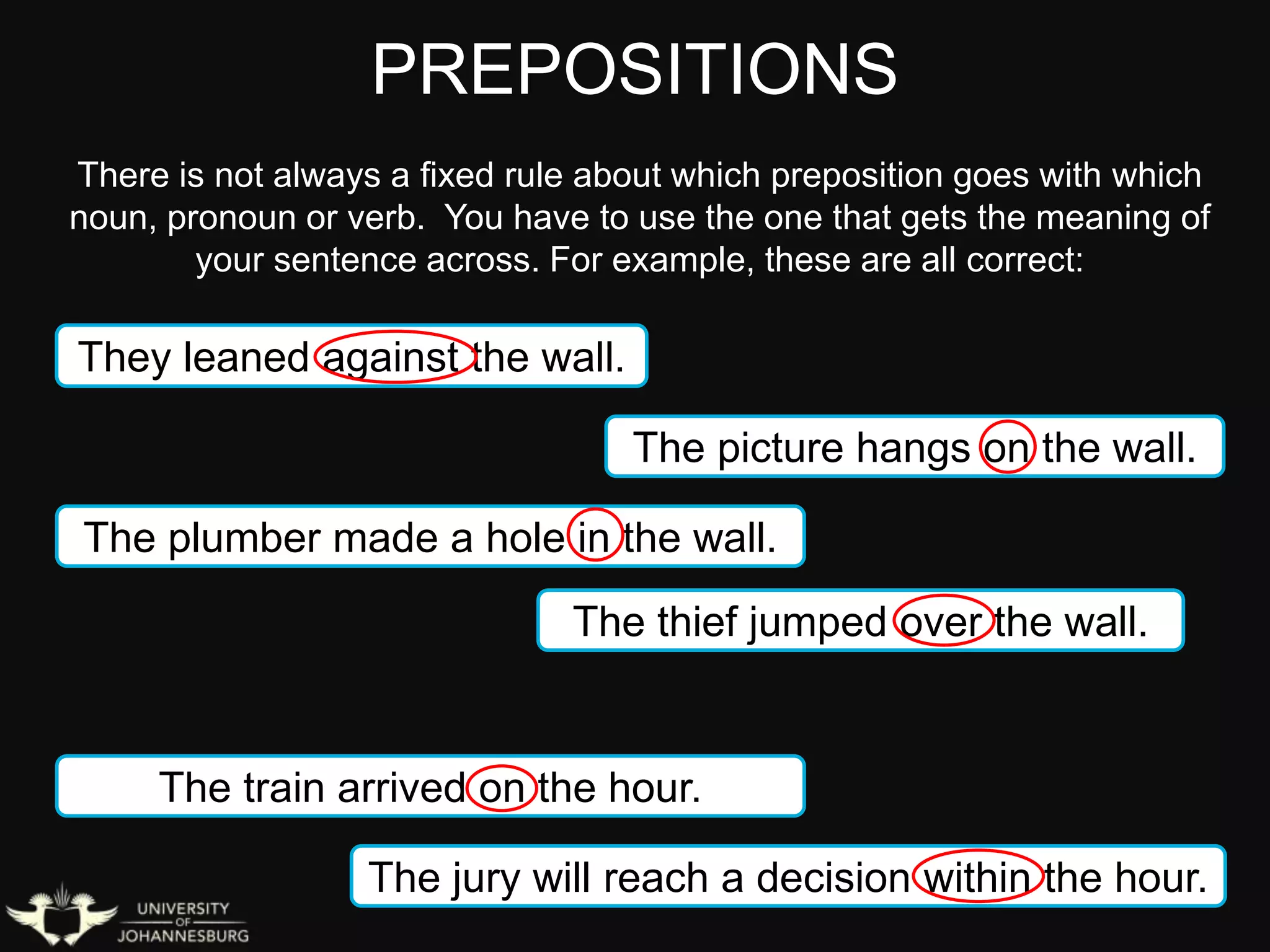
PREPOSITIONS
There is not always a fixed rule about which preposition goes with which
noun, pronoun or verb. You have to use the one that gets the meaning of
your sentence across. For example, these are all correct:
They leaned against the wall.
The picture hangs on the wall.
The jury will reach a decision within the hour.
The plumber made a hole in the wall.
The train arrived on the hour.
The thief jumped over the wall.
PREPOSITIONS
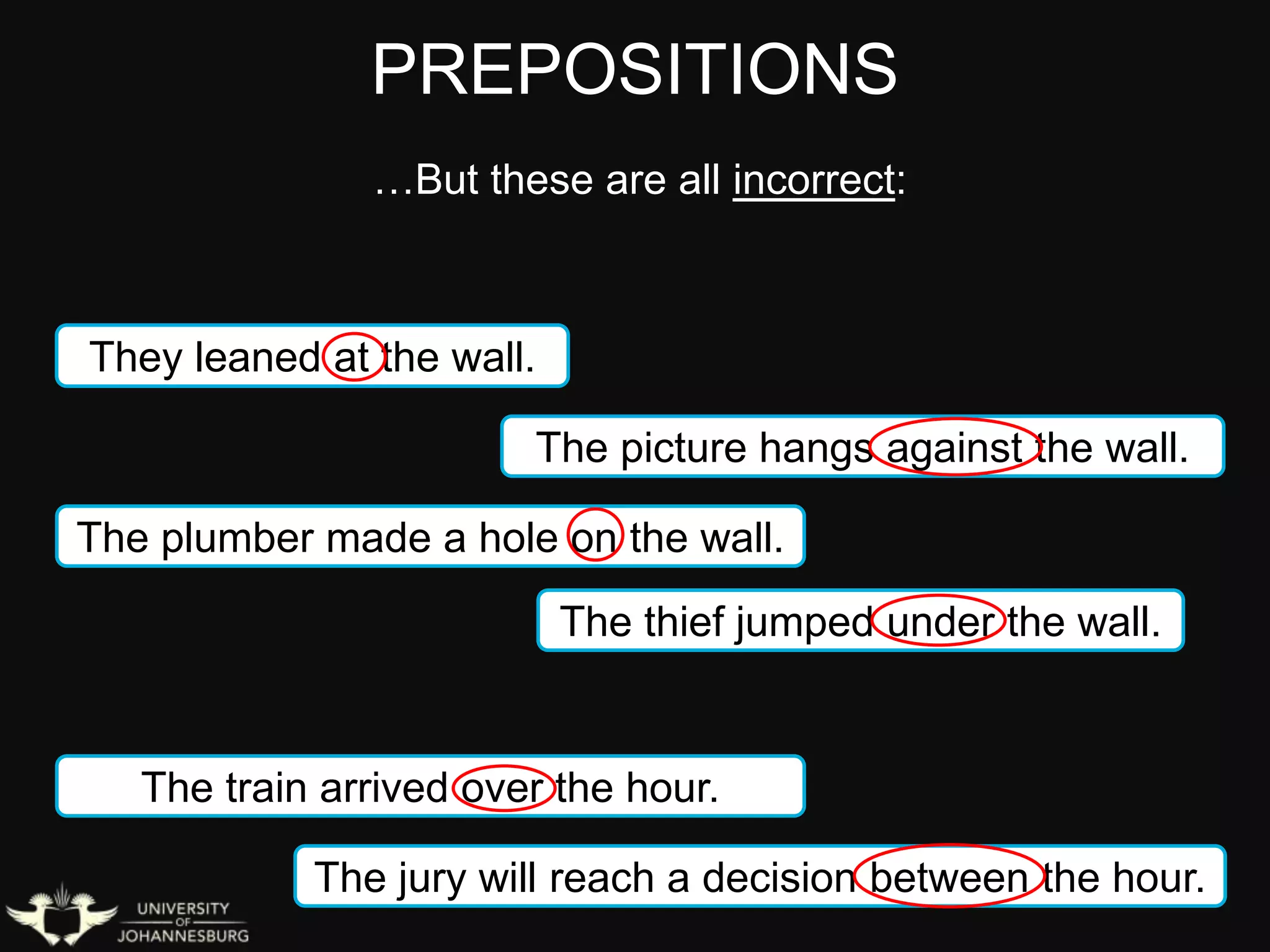
…But these are all incorrect:
They leaned at the wall.
The picture hangs against the wall.
The jury will reach a decision between the hour.
The plumber made a hole on the wall.
The train arrived over the hour.
The thief jumped under the wall.
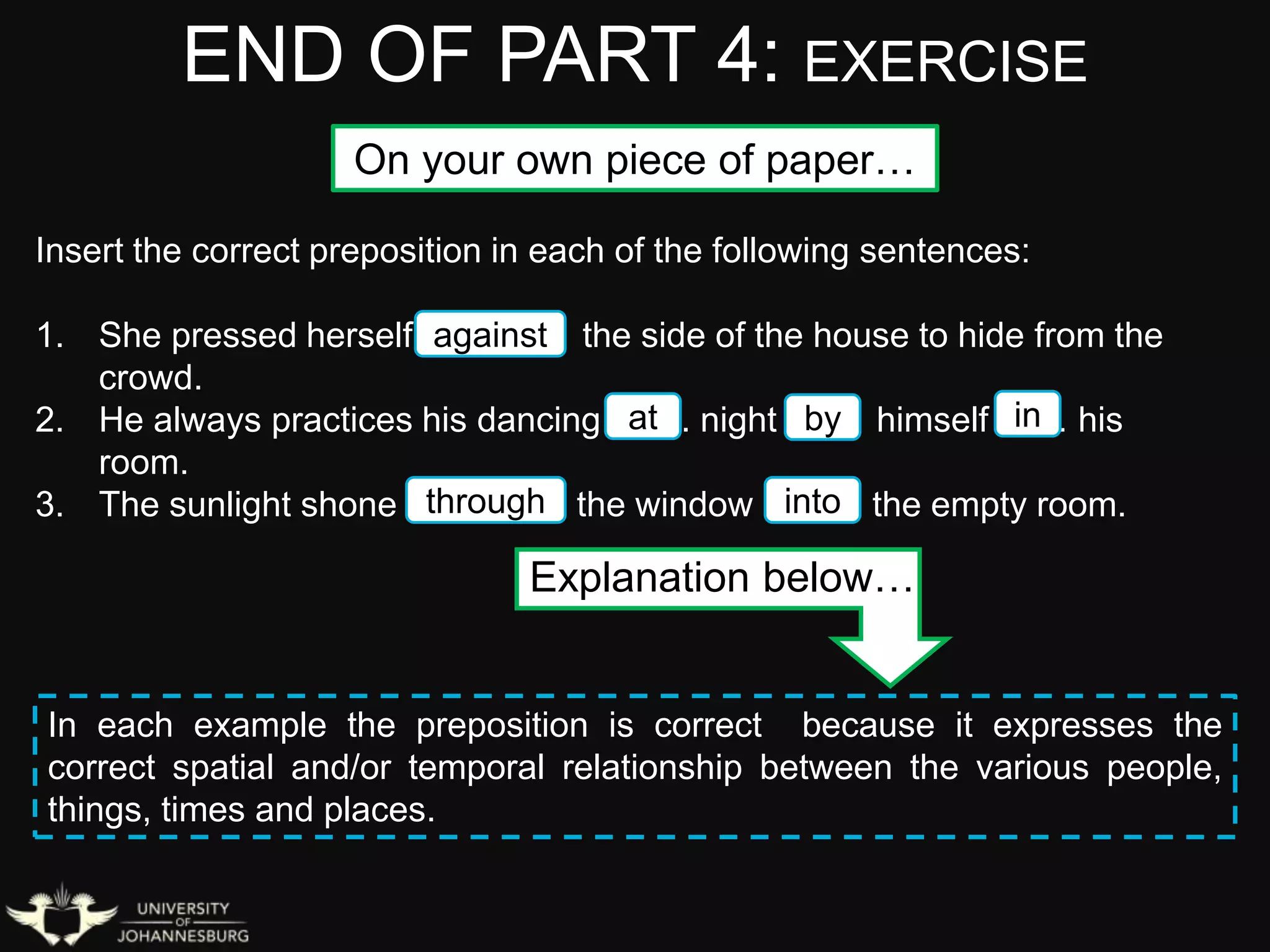
END OF PART 4: EXERCISE
Insert the correct preposition in each of the following sentences:
1. She pressed herself ………… the side of the house to hide from the
crowd.
2. He always practices his dancing ……. night …… himself …… his
room.
3. The sunlight shone ………….. the window ……. the empty room.
On your own piece of paper…
against
at by in
through into
Explanation below…
In each example the preposition is correct because it expresses the
correct spatial and/or temporal relationship between the various people,
things, times and places.
PART 5: POSSESSIVE CASE
POSSESSIVE
CASE
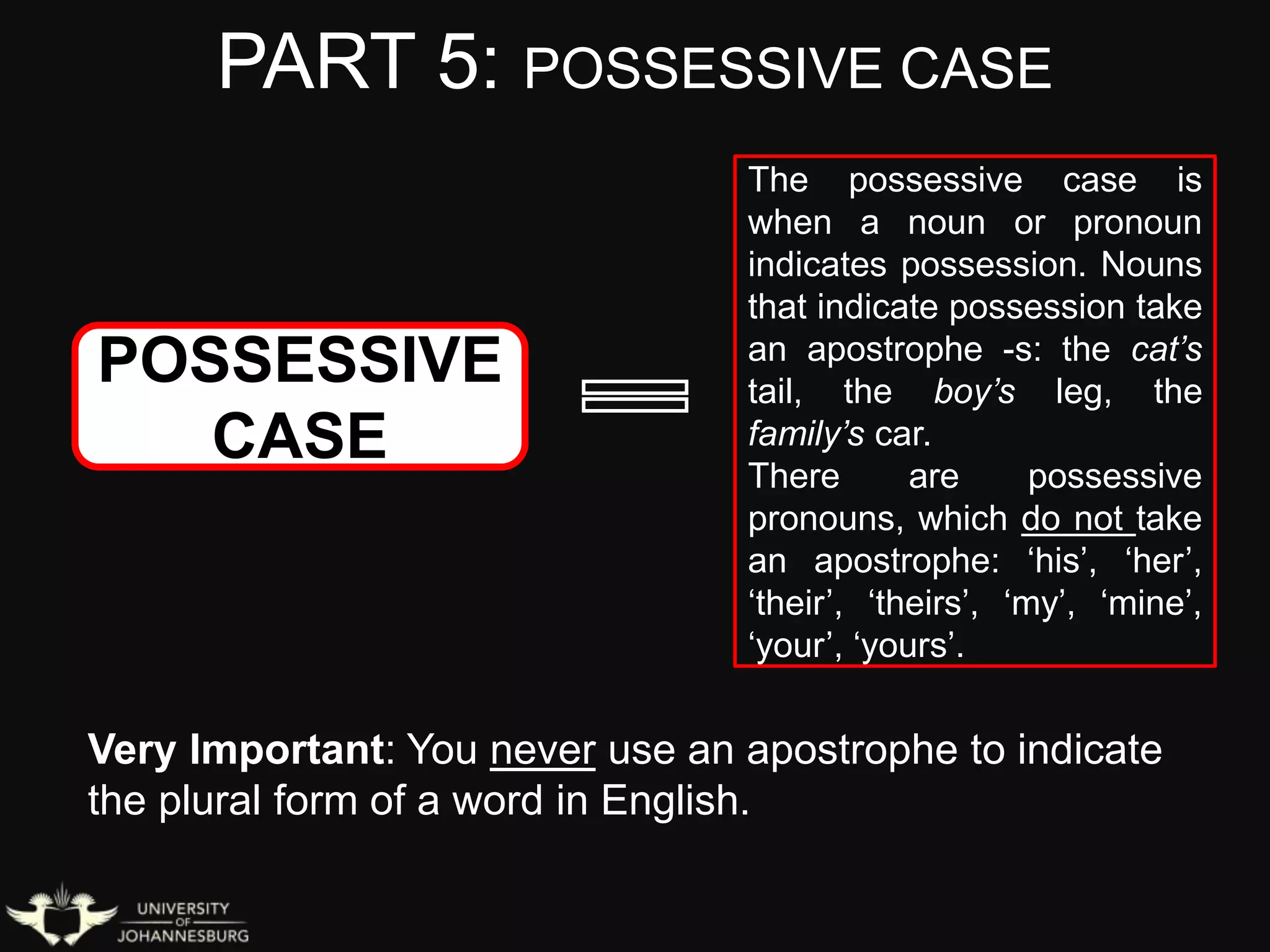
The possessive case is
when a noun or pronoun
indicates possession. Nouns
that indicate possession take
an apostrophe -s: the cat’s
tail, the boy’s leg, the
family’s car.
There are possessive
pronouns, which do not take
an apostrophe: ‘his’, ‘her’,
‘their’, ‘theirs’, ‘my’, ‘mine’,
‘your’, ‘yours’.
Very Important: You never use an apostrophe to indicate
the plural form of a word in English.
POSSESSIVE CASE
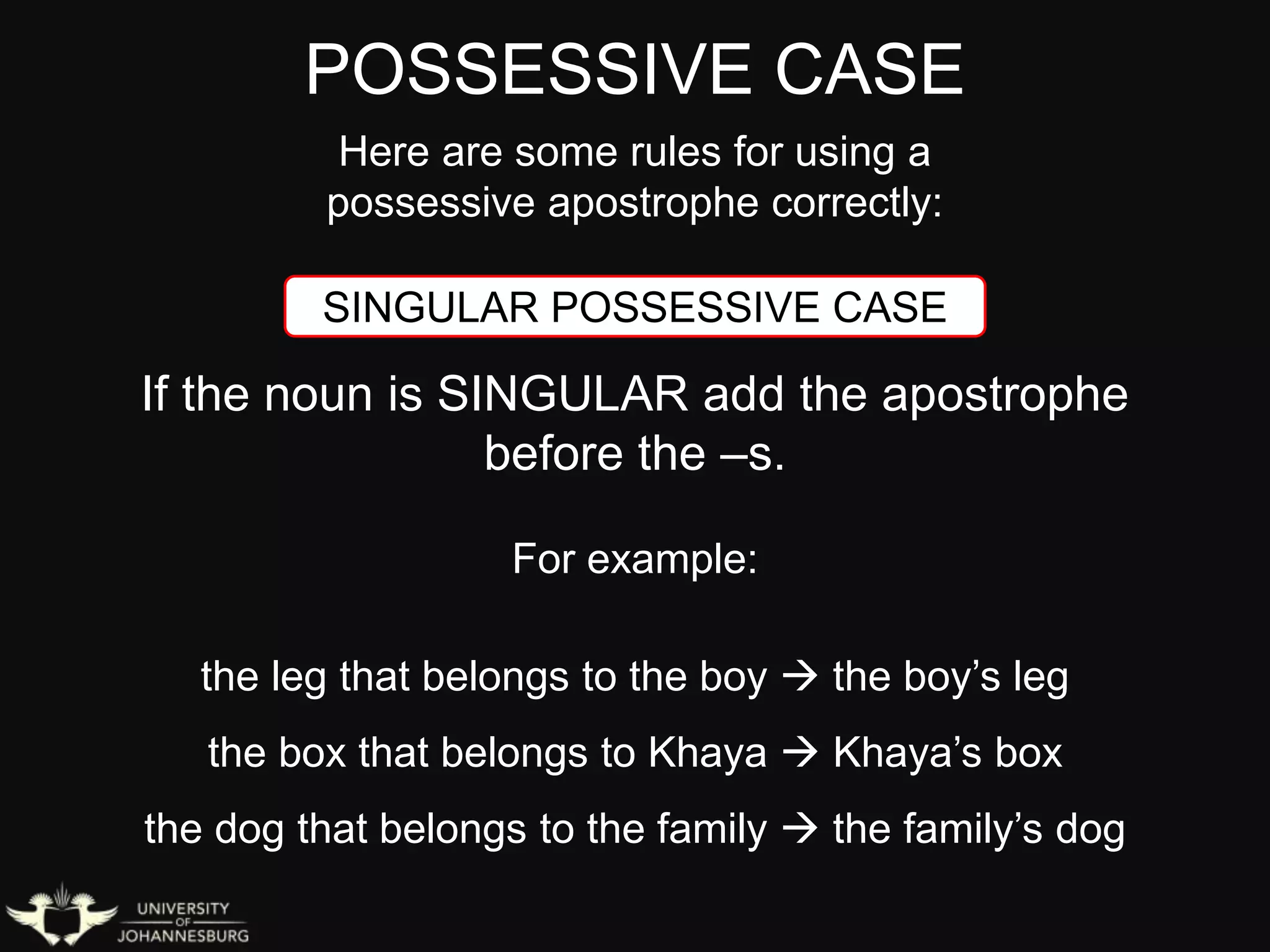
Here are some rules for using a
possessive apostrophe correctly:
SINGULAR POSSESSIVE CASE
If the noun is SINGULAR add the apostrophe
before the –s.
For example:
the leg that belongs to the boy  the boy’s leg
the box that belongs to Khaya  Khaya’s box
the dog that belongs to the family  the family’s dog
POSSESSIVE CASE
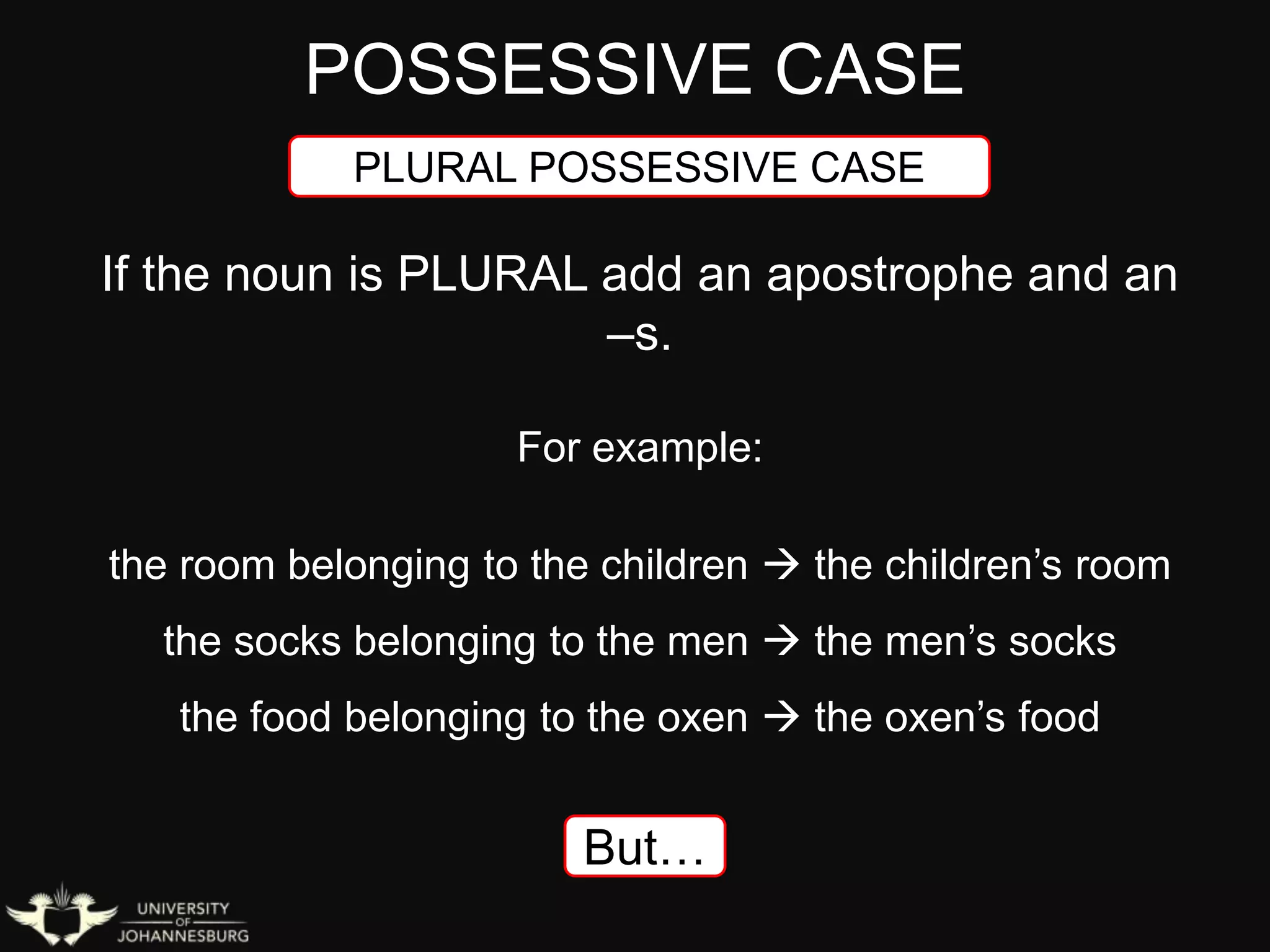
PLURAL POSSESSIVE CASE
If the noun is PLURAL add an apostrophe and an
–s.
For example:
the room belonging to the children  the children’s room
the socks belonging to the men  the men’s socks
the food belonging to the oxen  the oxen’s food
But…
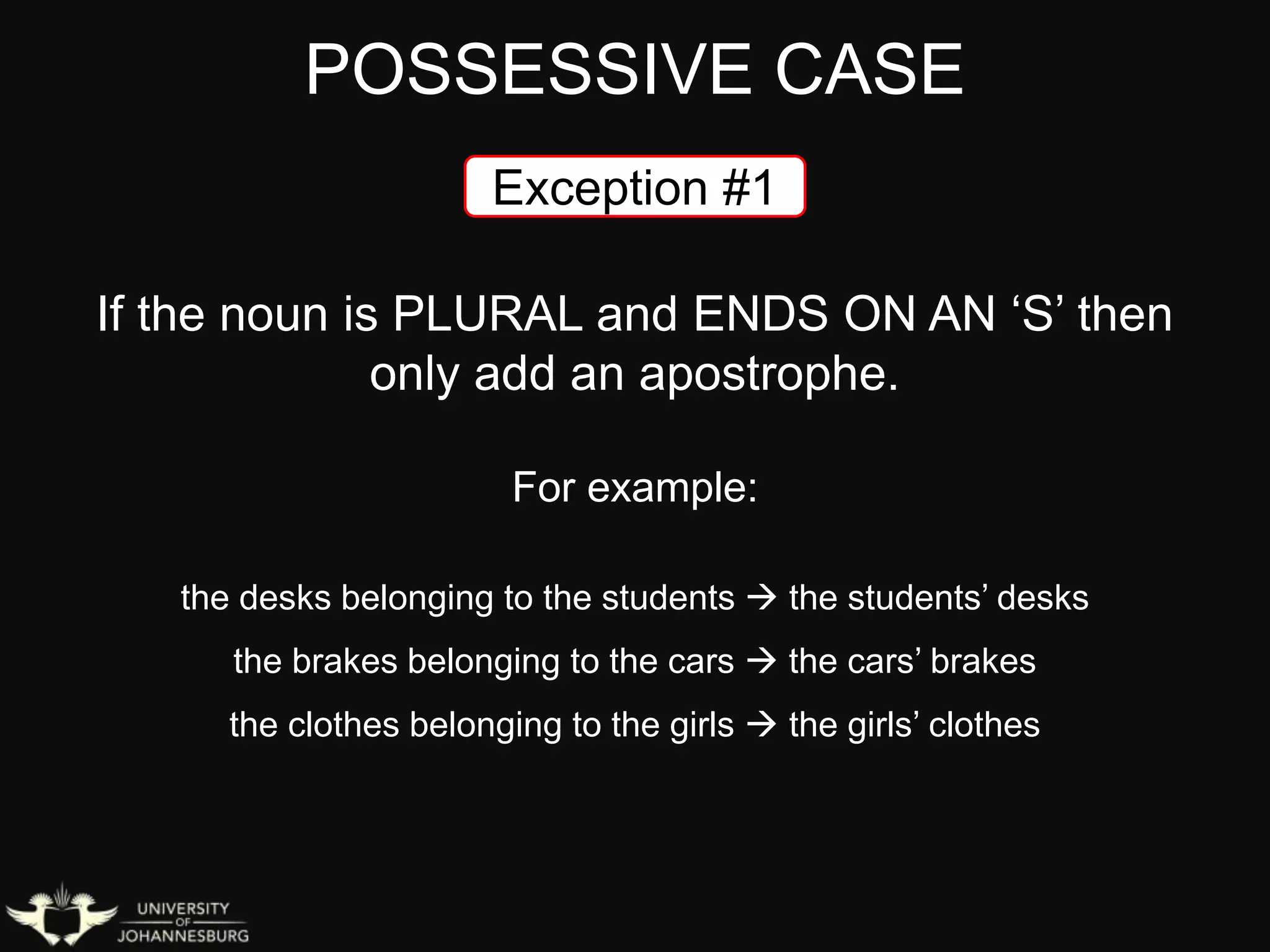
POSSESSIVE CASE
If the noun is PLURAL and ENDS ON AN ‘S’ then
only add an apostrophe.
For example:
the desks belonging to the students  the students’ desks
the brakes belonging to the cars  the cars’ brakes
the clothes belonging to the girls  the girls’ clothes
Exception #1
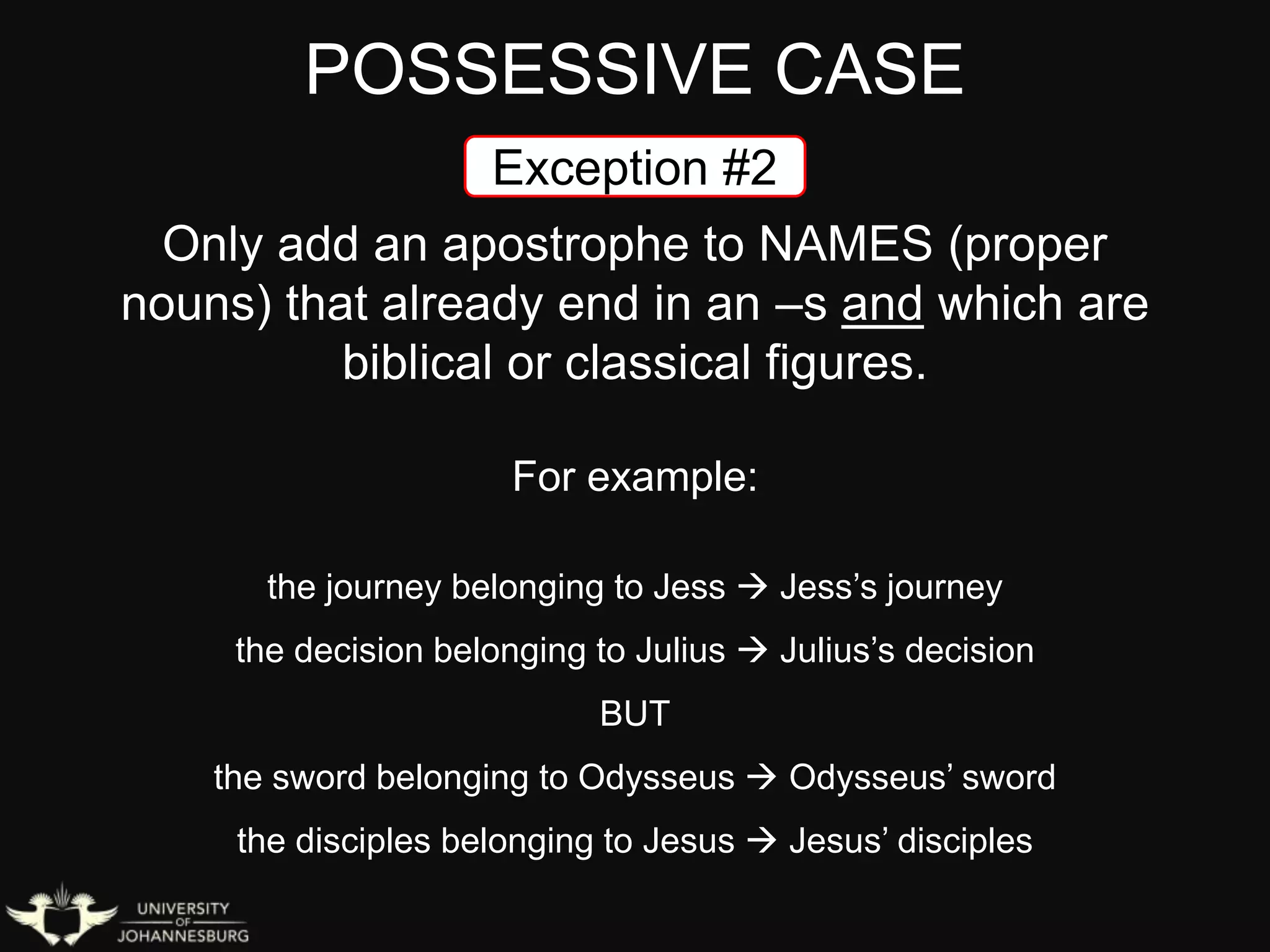
POSSESSIVE CASE
Exception #2
Only add an apostrophe to NAMES (proper
nouns) that already end in an –s and which are
biblical or classical figures.
For example:
the journey belonging to Jess  Jess’s journey
the decision belonging to Julius  Julius’s decision
BUT
the sword belonging to Odysseus  Odysseus’ sword
the disciples belonging to Jesus  Jesus’ disciples
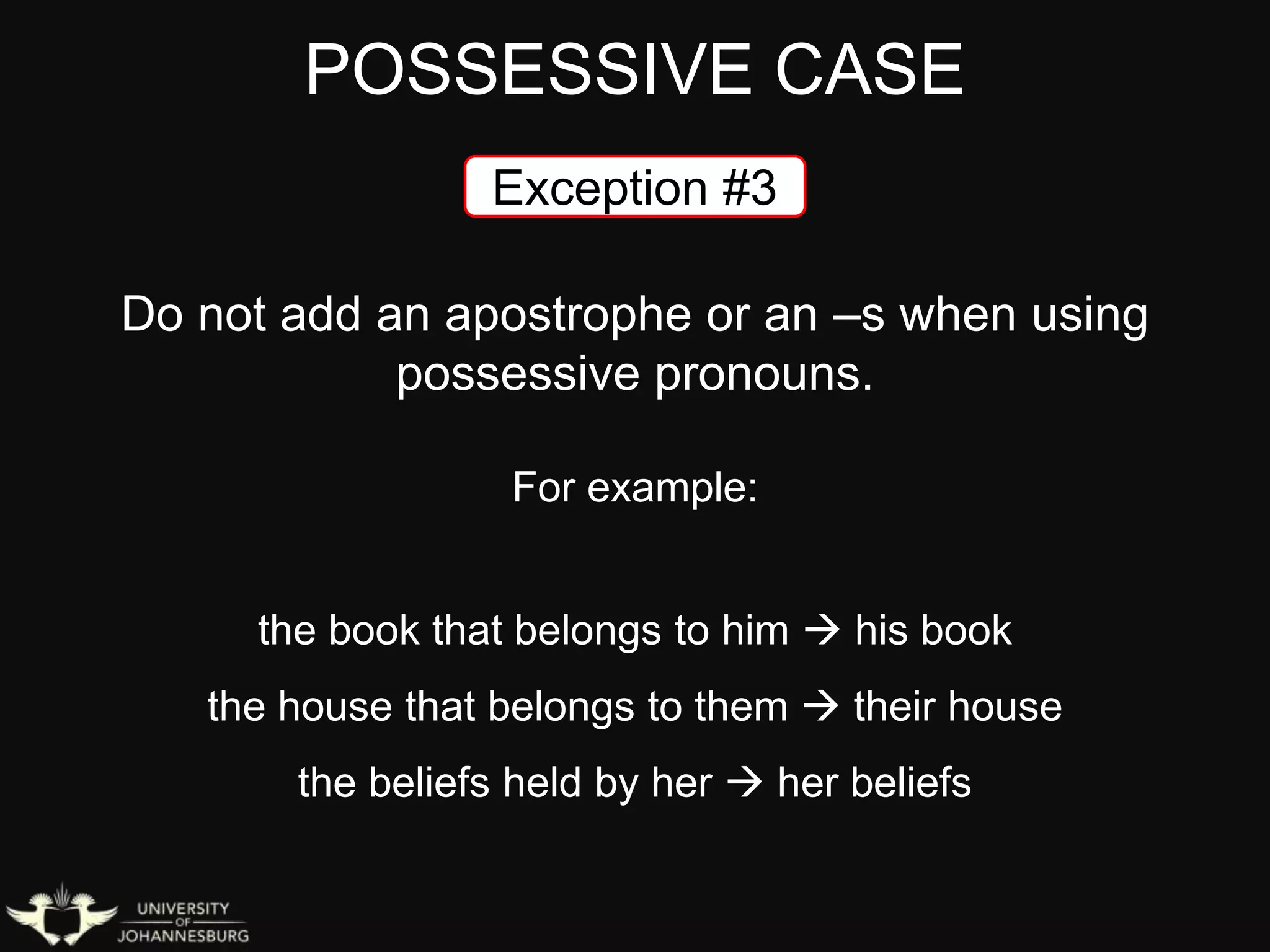
POSSESSIVE CASE
Exception #3
Do not add an apostrophe or an –s when using
possessive pronouns.
For example:
the book that belongs to him  his book
the house that belongs to them  their house
the beliefs held by her  her beliefs
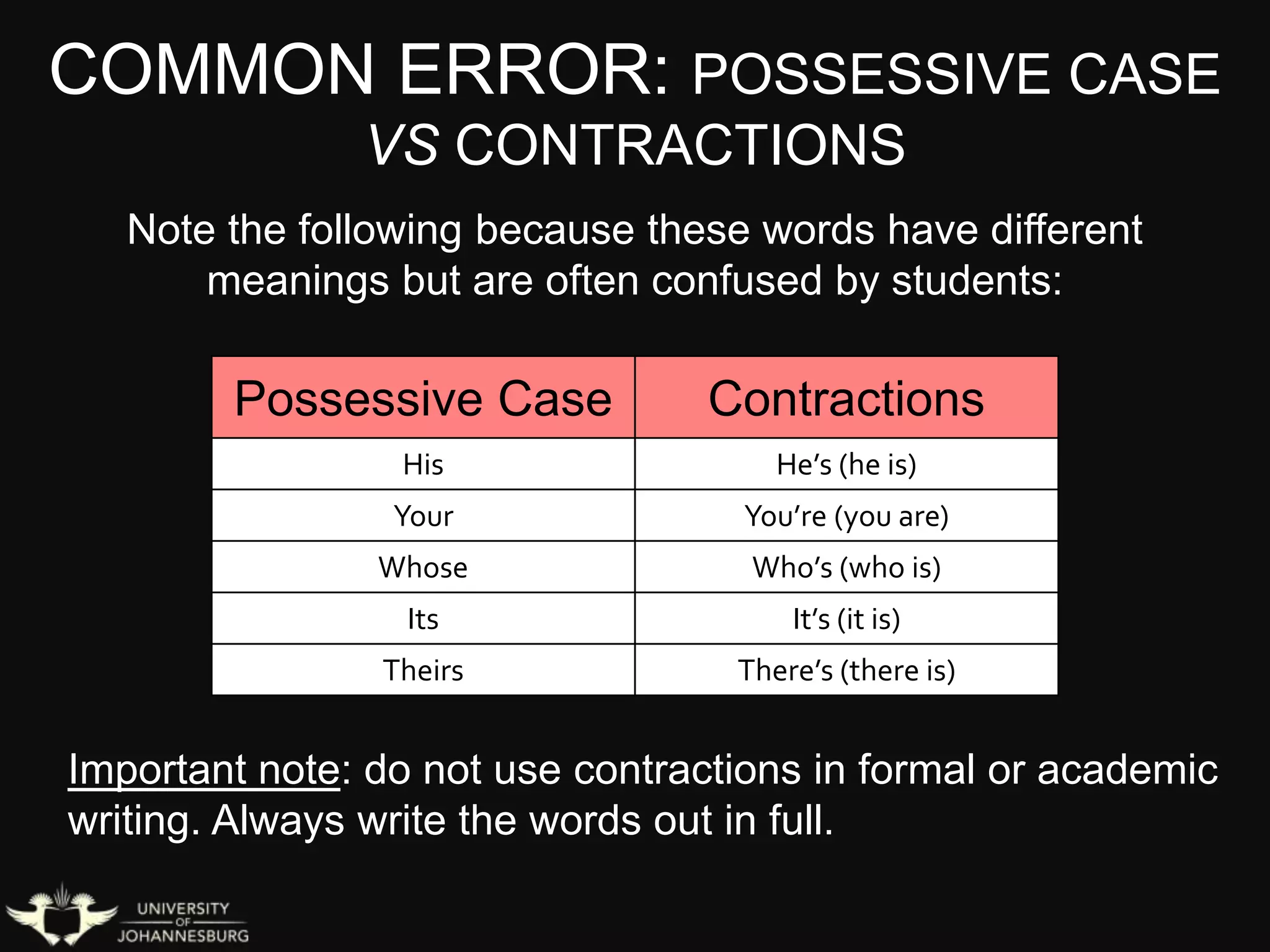
COMMON ERROR: POSSESSIVE CASE
VS CONTRACTIONS
Important note: do not use contractions in formal or academic
writing. Always write the words out in full.
Note the following because these words have different
meanings but are often confused by students:
Possessive Case Contractions
His He’s (he is)
Your You’re (you are)
Whose Who’s (who is)
Its It’s (it is)
Theirs There’s (there is)
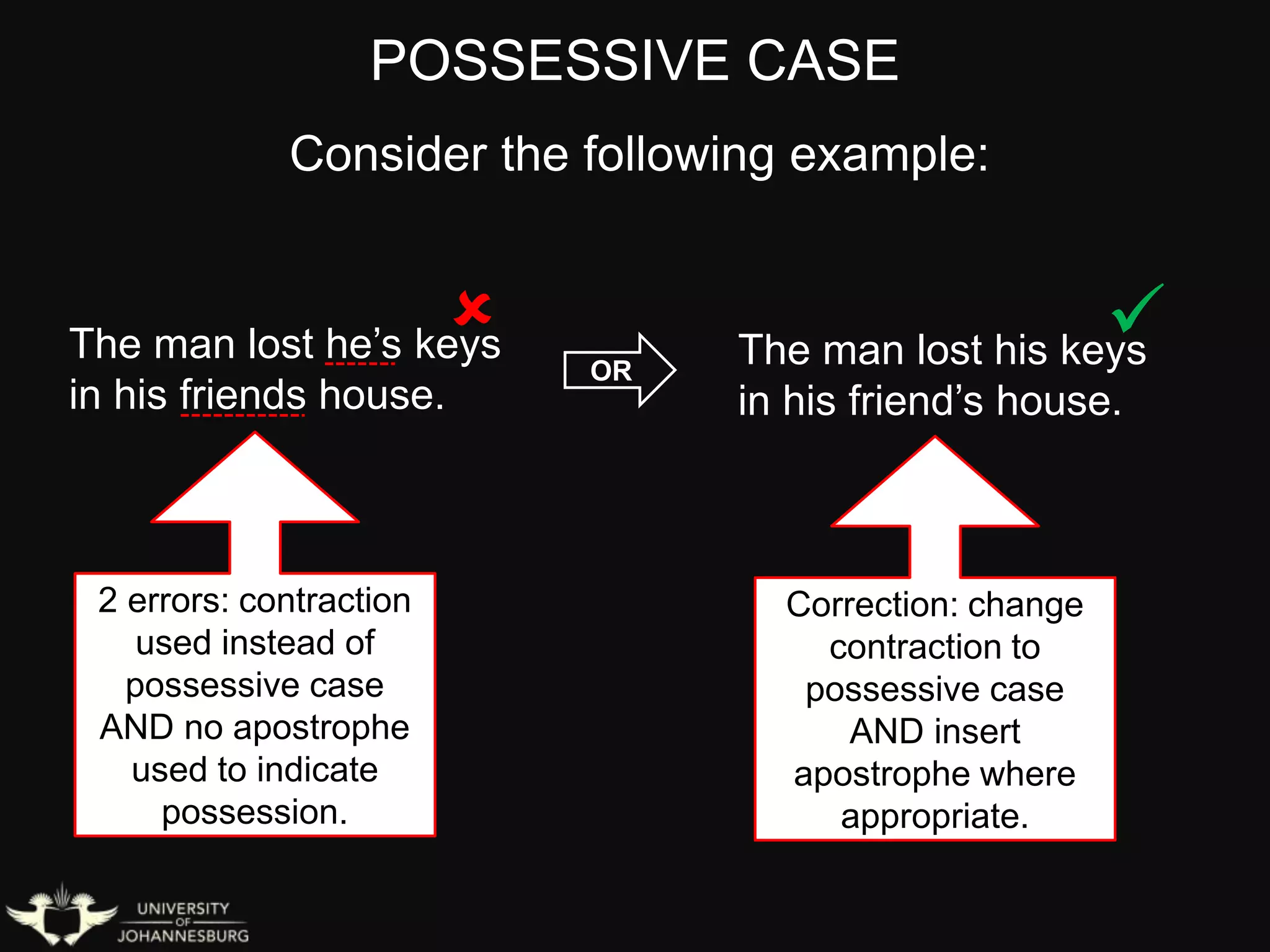
POSSESSIVE CASE
Consider the following example:
The man lost he’s keys
in his friends house.
The man lost his keys
in his friend’s house.
 
2 errors: contraction
used instead of
possessive case
AND no apostrophe
used to indicate
possession.
OR
Correction: change
contraction to
possessive case
AND insert
apostrophe where
appropriate.
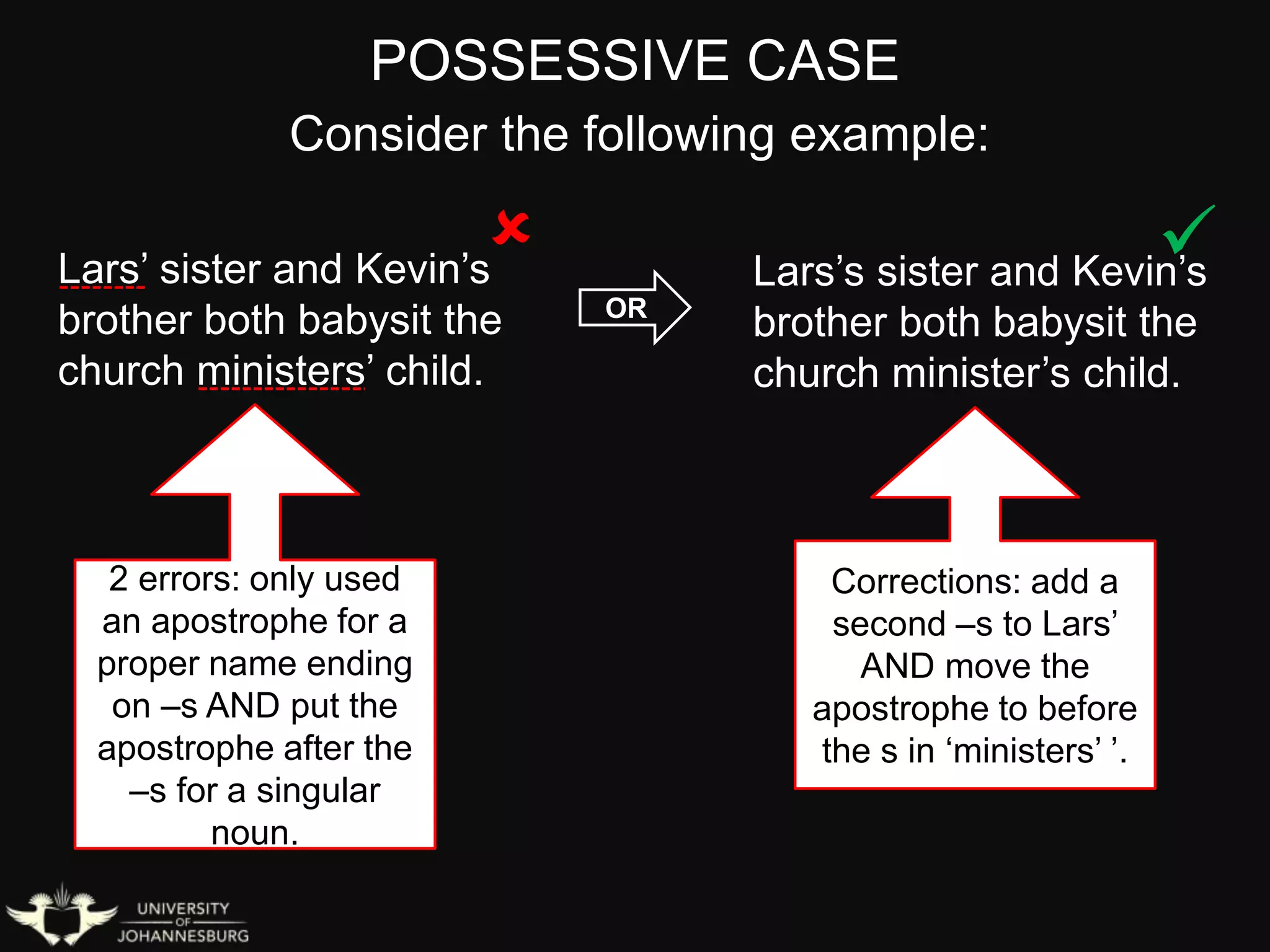
POSSESSIVE CASE
Consider the following example:
Lars’ sister and Kevin’s
brother both babysit the
church ministers’ child.
Lars’s sister and Kevin’s
brother both babysit the
church minister’s child.
 
2 errors: only used
an apostrophe for a
proper name ending
on –s AND put the
apostrophe after the
–s for a singular
noun.
OR
Corrections: add a
second –s to Lars’
AND move the
apostrophe to before
the s in ‘ministers’ ’.
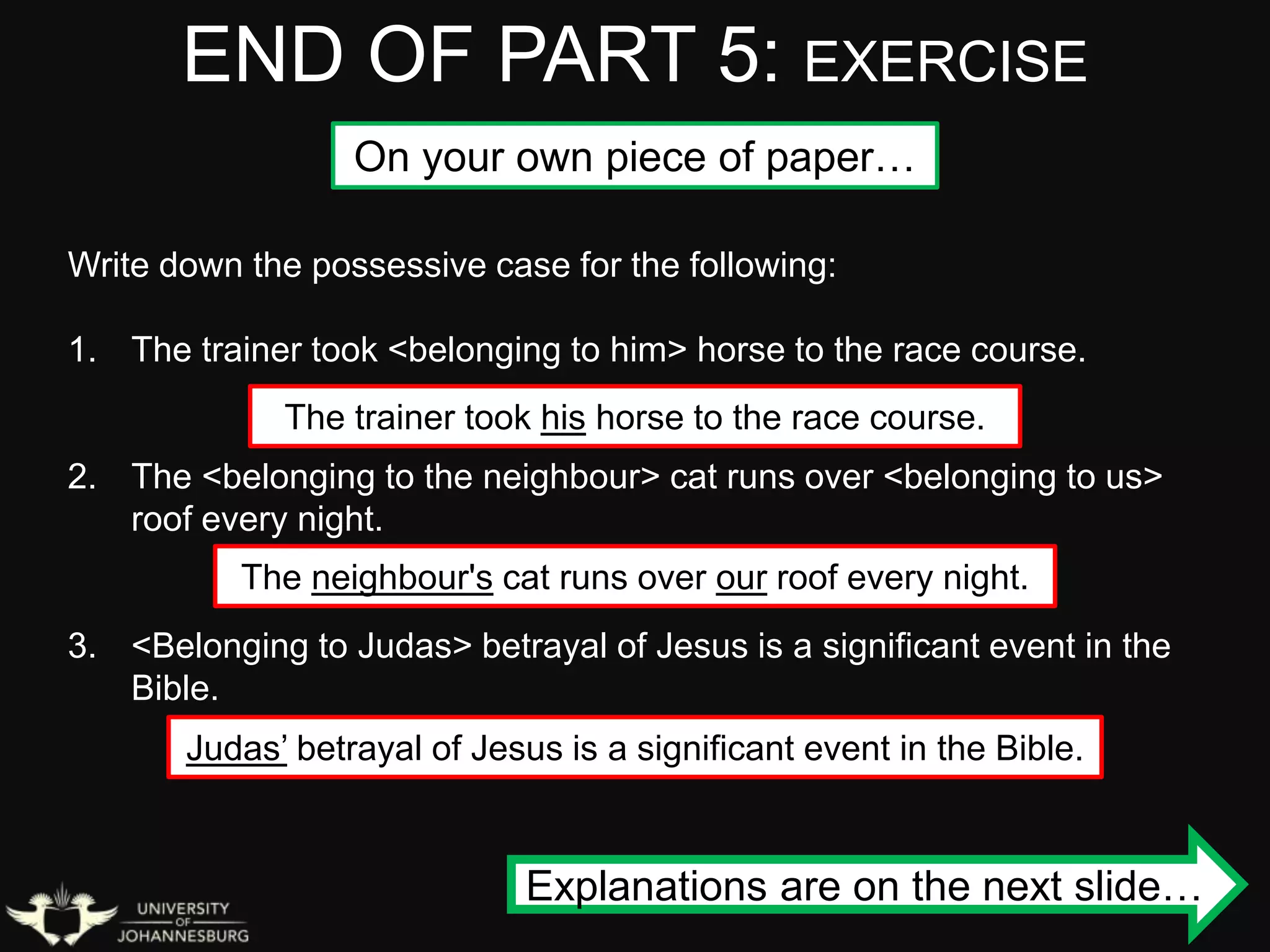
END OF PART 5: EXERCISE
On your own piece of paper…
Write down the possessive case for the following:
1. The trainer took <belonging to him> horse to the race course.
2. The <belonging to the neighbour> cat runs over <belonging to us>
roof every night.
3. <Belonging to Judas> betrayal of Jesus is a significant event in the
Bible.
The trainer took his horse to the race course.
The neighbour's cat runs over our roof every night.
Judas’ betrayal of Jesus is a significant event in the Bible.
Explanations are on the next slide…
END OF PART 6: EXPLANATIONS
In question 1, the possessive pronoun was needed and because the
trainer is singular and male, as was indicated, the correct possessive
pronoun is ‘his’.
In question 2, there were two instances of possession. The first was
singular and so required an –’s- (neighbour’s). The second was a plural
pronoun (us) and so required the plural possessive pronoun “our”.
In question 3, the possessive case related to a biblical figure whose
name ends on an –s. Therefore, the possessive case in the final
sentence was Judas’ and not Judas’s.
END OF TUTORIAL 1!
Make sure you understand the content of this tutorial before
attempting Quiz 1, which is on Blackboard.
The quiz is an open-book test. Download and print the PDF
version of this tutorial, which is also available on Blackboard.
You have to achieve a minimum mark of 26 out of 40 ( 65%) for
Quiz 1 before you will be given access toTutorial 2. While you
have an unlimited number of attempts to achieve this mark, you
must achieve the minimum before or on 21 August. The quiz
will not be available after that date.

Tutorial 1

  • 1.
    TUTORIAL 1 English 1Online Language Development Course Developed by Nora-LeeWales
  • 2.
    CONTENTS Welcome to Phase1 of your Online Language Development course. Before you begin, take note that this course is focussed solely on formal, academic writing and so the language-use presented here will differ from informal, conversational language. In this first tutorial you will learn about the following: Part 1 Basic sentence structure: Subject +Verb……………………….....................Slides 4 – 14 Part 2 Adjectives andAdverbs……………………………………………………………..Slides 16 – 20 Part 3 Basic sentence structure: Subject +Verb + Object…………………………..Slides 21 – 26 Part 4 Prepositions……………………………………………………………………………..Slides 27 – 30 Part 5 Common Error: Possessive case……………………………………………………Slides 21- 41
  • 3.
    Definitions object You may findit useful to refer to your copy of “List of Grammatical Terms” throughout the course of these tutorials. At the beginning of each section you will be notified if new terms will come up, allowing you to look up the definitions of the words as you go along. For the next section, make sure you know what the following terms mean: noun proper noun
  • 4.
    PART 1: SUBJECT+ VERB A sentence MUST have a subject and a verb. SUBJECT VERB The subject is what the sentence is about. The subject can be a person, an object, place, time, etc. It can be a noun (the boy, dog, book, twentieth century) or a proper noun (John, Thabo, the Millers). The subject performs the action described by the verb. The verb is the “doing word”. It describes an action, a state or an occurrence. There are many different types of verbs (slides 5 - 11). In fact, sometimes all you need is a subject and a verb…
  • 5.
    SUBJECT + VERB Heran. The Smiths travel. Subject Verb Dennis swam. Subject Verb Subject Verb The war ended. Subject Verb These are all full, grammatically correct sentences.
  • 6.
    TYPES OF VERBS Thereare many different kinds of verbs. The following slides will focus on the most important. You do not need to learn the names off by heart; rather focus on being able to use these verbs correctly.
  • 7.
    TYPES OF VERBS 1.Finite Verbs A finite verb is also known as the main verb. A finite verb shows tense, so we know when the action was done or when the event took place. Sally sings. Sally sang. Present tense Past tense Definition Example
  • 8.
    TYPES OF VERBS 2.Non-finite Verbs Sally wants to sing. Finite verb Non-finite verb Non-finite verbs do not show tense, person or number. They are the basic form of the verb and are usually (but not always!) preceded by ‘to’. In a sentence a non-finite verb is preceded by a finite verb. Definition Example
  • 9.
    TYPES OF VERBS 3.Transitive Verbs Definition Example A transitive verb needs an object for the sentence to make sense. The object is placed after the transitive verb. The boy took the ball. Dan broke the plate. Transitive verb Object
  • 10.
    TYPES OF VERBS 4.Intransitive Verbs Definition Example An intransitive verb does not need an object for the sentence to make sense. The people listened. The car stopped. Intransitive verb
  • 11.
    The family ishappy. Emeralds are gemstones. TYPES OF VERBS 5. Linking Verbs A linking verb shows the connection between a noun and an adjective, or a noun and another noun. Definition Example Linking verb noun Adjective noun noun
  • 12.
    SUBJECT + VERB Considerthe following examples: Fikile to dance.  Error: No main / finite verb Fikile likes to dance.  Correction: add main verb She threw.  Error: transitive verb needs an object She threw a ball.  Correction: add an object OR OR
  • 13.
    END OF PART1: EXERCISE 1.1. Choose the option where all the sentences are grammatically correct: A. Khutso baked. Terry lost the game. Devonshire is far away. B. Jimmy moved his car. Ollie cried. The estate agent will show the house. C. The teacher raises. The board of directors advised. Ivor and Julie left. 1.2. Underline the subject and circle the verb in each of the following sentences: A. James ran through the streets. B. The computer broke yesterday. C. Education will change the country for the better.  Explanations are on the next slide… On your own piece of paper…
  • 14.
    END OF PART1: EXPLANATIONS In question 1.1., option B is correct because all the transitive verbs – ‘moved’ and ‘show’ - have direct objects connected to them. The word ‘cried’ is an intransitive verb and does not need an object. Options A and C are incorrect because they have sentences where the transitive verb – ‘baked’, ‘raises’, ‘advised’ and ‘left’ – has not been connected to an object. In question1.2., the subjects are ‘James’, ‘The computer’ and ‘Education’ because they are what the sentences are about, they are nouns and they perform the actions described by the verb. The verbs are ‘ran’, ‘broke’ and ‘will change’ because they describe an action.
  • 15.
    pronoun For the nextsection, make sure you know what the following term means: Definitions
  • 16.
    PART 2: ADJECTIVES& ADVERBS ADJECTIVE ADVERB An adjective describes the noun or pronoun. An adverb describes the verb or gives more information about the parts of the sentence excluding the noun and pronouns. This information includes the ‘how’, ‘when’, ‘where’, or ‘why’. Adverbs often, but not always, end in –ly. Both adjectives and adverbs may be one word or a short phrase: adjectival phrase or adverbial phrase.
  • 17.
    ADJECTIVES & ADVERBS Subject/ noun The young and shy boy sang quietly. Adjectival phrase Verb Adverb (how) The last book was returned late. Adjective Subject / noun Main Verb Adverb (when) The fast car crashed violently into the wall. Adjective Subject / noun Verb Adverbial phrase (how & where) Adverb (how)
  • 18.
    ADJECTIVES & ADVERBS Considerthe following examples: ORThe crowd cheered loud.  The crowd cheered loudly.  The angrily crowd cheered. OR The angry crowd cheered. Correction: add –ly to make an adverb Error: adjective used as an adverb Error: adverb used as an adjective Correction: remove –ly.
  • 19.
    END OF PART2: EXERCISE 1. Choose the correct option in each case: 1.1. Susan <desperate / desperately> wanted to run in the marathon. 1.2. The <good/well> boy did his homework <good/well>. 2. Identify the adjectives and adverbs or adjectival and adverbial phrases in the following sentences. 2.1. The stubborn man worked hard and persistently on building his beautiful yacht. 2.2. The common honey bee is in serious danger of extinction.    Adjective Adjective Adjective Adverbial phrase Adverbial phrase Explanations are on the next slide… On your own piece of paper…
  • 20.
    END OF PART2: EXPLANATIONS In question 1.1, ‘desperately’ is the correct answer because it describes how much Susan wanted something. In other words, it describes the verb and should therefore be in the correct form for an adverb. In question 1.2., the adjective is ‘good’ because it describes the noun (boy) and the adverb is ‘well’ because it describes the boy’s action. Take note of this example because students often use ‘good’, incorrectly, as an adverb. In questions 2.1. and 2.2., note that the adjectives (‘stubborn’, ‘beautiful’, ‘common’) tell us more about the nouns (‘man’, ‘yacht’, ‘honey bee’), while the adverbial phrases (‘hard and persistently’, ‘in serious danger of extinction’) tell us more about the verbs (‘worked’, ‘is’).
  • 21.
    active voice For thenext section, make sure you know what the following term means: Definitions passive voice
  • 22.
    PART 3: SUBJECT+ VERB + OBJECT OBJECT The object in a sentence is a noun (or noun phrase) which is determined by, and usually comes after, the transitive verb and/or preposition. Note that a person can also be an object in a sentence. In English, the basic structure of a sentence in the active voice runs as follows: Subject  Verb  Object A note on the passive voice will follow on slide 24… Not all sentences need an object, but when a sentence does need one keep the following in mind:
  • 23.
    SUBJECT + VERB+ OBJECT These are all full, grammatically correct sentences. Thuli kicked Thandi. They leaned against the wall. The dog chewed the newspaper. Subject Verb Object Subject Verb Object Subject Verb Object
  • 24.
    SUBJECT + VERB+ OBJECT Note the following two examples: Thuli kicked Thandi. Subject Verb Object Thandi kicked Thuli. Subject Verb Object …versus… To identify the subject and the object in a sentence, take note of the order of the words and who/what is doing what to whom/what.
  • 25.
    END OF PART3: EXERCISE Underline the subject and circle the object in each of the following sentences: 1.1. The tornado ripped out the telephone pole. 1.2. The family’s dog came from the SPCA. 1.3. I owe money to James, Frank and Dintle. 1.4. The red car crashed into the big truck. The object follows the verb and is the noun or pronoun to whom (to which) the action of the verb (the 'doing word') is being applied. The subject is the noun or pronoun which is performing the action described by the verb. Explanation below… On your own piece of paper…
  • 26.
    NOTE: PASSIVE VOICE Asentence can be written in the active voice or in the passive voice. When it is written in the active voice the sentence structure is Subject  Verb  Object (refer to slides 20 – 23). When it is written in the passive voice, however, the object is moved to the position of the subject and becomes the subject of the passive sentence. For example: ActiveVoice PassiveVoice The tornado ripped out the telephone pole. The telephone pole was ripped out by the tornado. The red car crashed into the big truck. The big truck was crashed into by the red car.
  • 27.
    PASSIVE VOICE The tornadoripped out the telephone pole. The telephone pole was ripped out by the tornado. Object Subject The red car crashed into the big truck. The big truck was crashed into by the red car. Object Subject
  • 28.
    PART 4: PREPOSITIONS PREPOSITIONS Prepositionsindicate the position of something in space (spatial) or in time (temporal). For example: The actor stood on the stage. OR Jim will arrive at the theatre on time. This is a list of some of the prepositions: ‘in’, ‘at’, ‘against’, ‘inside’, ‘outside’, ‘within’, ‘to’, ‘towards’, ‘underneath’, ‘over’, ‘above’, ‘around’, ‘between’, ‘among’, ‘on’, ‘by’, ‘into, ‘after’, ‘before’, ‘near’, ‘up’, etc….
  • 29.
    PREPOSITIONS There is notalways a fixed rule about which preposition goes with which noun, pronoun or verb. You have to use the one that gets the meaning of your sentence across. For example, these are all correct: They leaned against the wall. The picture hangs on the wall. The jury will reach a decision within the hour. The plumber made a hole in the wall. The train arrived on the hour. The thief jumped over the wall.
  • 30.
    PREPOSITIONS …But these areall incorrect: They leaned at the wall. The picture hangs against the wall. The jury will reach a decision between the hour. The plumber made a hole on the wall. The train arrived over the hour. The thief jumped under the wall.
  • 31.
    END OF PART4: EXERCISE Insert the correct preposition in each of the following sentences: 1. She pressed herself ………… the side of the house to hide from the crowd. 2. He always practices his dancing ……. night …… himself …… his room. 3. The sunlight shone ………….. the window ……. the empty room. On your own piece of paper… against at by in through into Explanation below… In each example the preposition is correct because it expresses the correct spatial and/or temporal relationship between the various people, things, times and places.
  • 32.
    PART 5: POSSESSIVECASE POSSESSIVE CASE The possessive case is when a noun or pronoun indicates possession. Nouns that indicate possession take an apostrophe -s: the cat’s tail, the boy’s leg, the family’s car. There are possessive pronouns, which do not take an apostrophe: ‘his’, ‘her’, ‘their’, ‘theirs’, ‘my’, ‘mine’, ‘your’, ‘yours’. Very Important: You never use an apostrophe to indicate the plural form of a word in English.
  • 33.
    POSSESSIVE CASE Here aresome rules for using a possessive apostrophe correctly: SINGULAR POSSESSIVE CASE If the noun is SINGULAR add the apostrophe before the –s. For example: the leg that belongs to the boy  the boy’s leg the box that belongs to Khaya  Khaya’s box the dog that belongs to the family  the family’s dog
  • 34.
    POSSESSIVE CASE PLURAL POSSESSIVECASE If the noun is PLURAL add an apostrophe and an –s. For example: the room belonging to the children  the children’s room the socks belonging to the men  the men’s socks the food belonging to the oxen  the oxen’s food But…
  • 35.
    POSSESSIVE CASE If thenoun is PLURAL and ENDS ON AN ‘S’ then only add an apostrophe. For example: the desks belonging to the students  the students’ desks the brakes belonging to the cars  the cars’ brakes the clothes belonging to the girls  the girls’ clothes Exception #1
  • 36.
    POSSESSIVE CASE Exception #2 Onlyadd an apostrophe to NAMES (proper nouns) that already end in an –s and which are biblical or classical figures. For example: the journey belonging to Jess  Jess’s journey the decision belonging to Julius  Julius’s decision BUT the sword belonging to Odysseus  Odysseus’ sword the disciples belonging to Jesus  Jesus’ disciples
  • 37.
    POSSESSIVE CASE Exception #3 Donot add an apostrophe or an –s when using possessive pronouns. For example: the book that belongs to him  his book the house that belongs to them  their house the beliefs held by her  her beliefs
  • 38.
    COMMON ERROR: POSSESSIVECASE VS CONTRACTIONS Important note: do not use contractions in formal or academic writing. Always write the words out in full. Note the following because these words have different meanings but are often confused by students: Possessive Case Contractions His He’s (he is) Your You’re (you are) Whose Who’s (who is) Its It’s (it is) Theirs There’s (there is)
  • 39.
    POSSESSIVE CASE Consider thefollowing example: The man lost he’s keys in his friends house. The man lost his keys in his friend’s house.   2 errors: contraction used instead of possessive case AND no apostrophe used to indicate possession. OR Correction: change contraction to possessive case AND insert apostrophe where appropriate.
  • 40.
    POSSESSIVE CASE Consider thefollowing example: Lars’ sister and Kevin’s brother both babysit the church ministers’ child. Lars’s sister and Kevin’s brother both babysit the church minister’s child.   2 errors: only used an apostrophe for a proper name ending on –s AND put the apostrophe after the –s for a singular noun. OR Corrections: add a second –s to Lars’ AND move the apostrophe to before the s in ‘ministers’ ’.
  • 41.
    END OF PART5: EXERCISE On your own piece of paper… Write down the possessive case for the following: 1. The trainer took <belonging to him> horse to the race course. 2. The <belonging to the neighbour> cat runs over <belonging to us> roof every night. 3. <Belonging to Judas> betrayal of Jesus is a significant event in the Bible. The trainer took his horse to the race course. The neighbour's cat runs over our roof every night. Judas’ betrayal of Jesus is a significant event in the Bible. Explanations are on the next slide…
  • 42.
    END OF PART6: EXPLANATIONS In question 1, the possessive pronoun was needed and because the trainer is singular and male, as was indicated, the correct possessive pronoun is ‘his’. In question 2, there were two instances of possession. The first was singular and so required an –’s- (neighbour’s). The second was a plural pronoun (us) and so required the plural possessive pronoun “our”. In question 3, the possessive case related to a biblical figure whose name ends on an –s. Therefore, the possessive case in the final sentence was Judas’ and not Judas’s.
  • 43.
    END OF TUTORIAL1! Make sure you understand the content of this tutorial before attempting Quiz 1, which is on Blackboard. The quiz is an open-book test. Download and print the PDF version of this tutorial, which is also available on Blackboard. You have to achieve a minimum mark of 26 out of 40 ( 65%) for Quiz 1 before you will be given access toTutorial 2. While you have an unlimited number of attempts to achieve this mark, you must achieve the minimum before or on 21 August. The quiz will not be available after that date.