Phrase & Clause PPT
Mrs. Lee- 7th Grade Language Arts
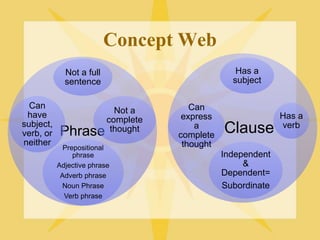
Concept Web
Phrase
Not a full
sentence
Not a
complete
thought
Prepositional
phrase
Adjective phrase
Adverb phrase
Noun Phrase
Verb phrase
Can
have
subject,
verb, or
neither
Clause
Has a
subject
Has a
verb
Independent
&
Dependent=
Subordinate
Can
express
a
complete
thought
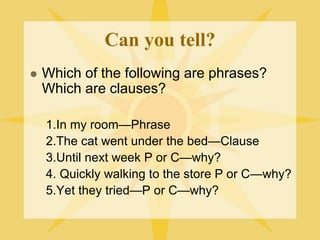
Can you tell?
 Which of the following are phrases?
Which are clauses?
1.In my room—Phrase
2.The cat went under the bed—Clause
3.Until next week P or C—why?
4. Quickly walking to the store P or C—why?
5.Yet they tried—P or C—why?
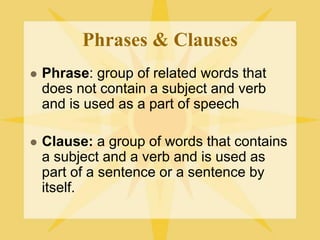
Phrases & Clauses
 Phrase: group of related words that
does not contain a subject and verb
and is used as a part of speech
 Clause: a group of words that contains
a subject and a verb and is used as
part of a sentence or a sentence by
itself.
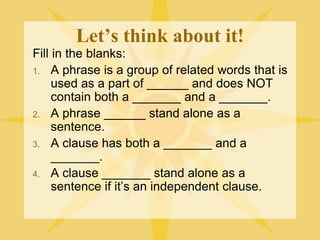
Let’s think about it!
Fill in the blanks:
1. A phrase is a group of related words that is
used as a part of ______ and does NOT
contain both a _______ and a _______.
2. A phrase ______ stand alone as a
sentence.
3. A clause has both a _______ and a
_______.
4. A clause _______ stand alone as a
sentence if it’s an independent clause.
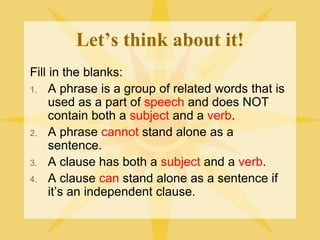
Let’s think about it!
Fill in the blanks:
1. A phrase is a group of related words that is
used as a part of speech and does NOT
contain both a subject and a verb.
2. A phrase cannot stand alone as a
sentence.
3. A clause has both a subject and a verb.
4. A clause can stand alone as a sentence if
it’s an independent clause.
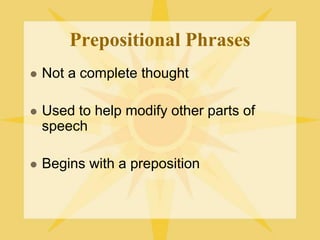
Prepositional Phrases
 Not a complete thought
 Used to help modify other parts of
speech
 Begins with a preposition
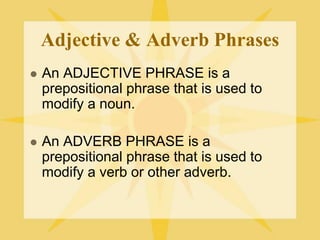
Adjective & Adverb Phrases
 An ADJECTIVE PHRASE is a
prepositional phrase that is used to
modify a noun.
 An ADVERB PHRASE is a
prepositional phrase that is used to
modify a verb or other adverb.
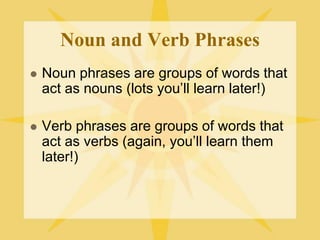
Noun and Verb Phrases
 Noun phrases are groups of words that
act as nouns (lots you’ll learn later!)
 Verb phrases are groups of words that
act as verbs (again, you’ll learn them
later!)
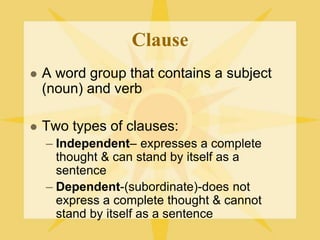
Clause
 A word group that contains a subject
(noun) and verb
 Two types of clauses:
– Independent– expresses a complete
thought & can stand by itself as a
sentence
– Dependent-(subordinate)-does not
express a complete thought & cannot
stand by itself as a sentence
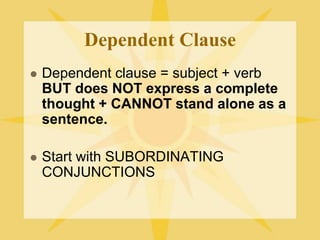
Dependent Clause
 Dependent clause = subject + verb
BUT does NOT express a complete
thought + CANNOT stand alone as a
sentence.
 Start with SUBORDINATING
CONJUNCTIONS
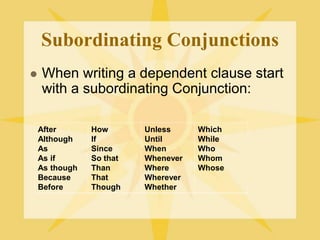
Subordinating Conjunctions
 When writing a dependent clause start
with a subordinating Conjunction:
After
Although
As
As if
As though
Because
Before
How
If
Since
So that
Than
That
Though
Unless
Until
When
Whenever
Where
Wherever
Whether
Which
While
Who
Whom
Whose
Wrap Up!
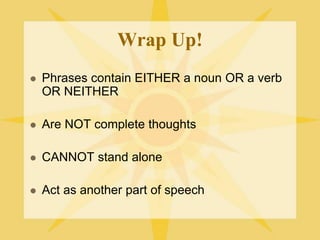
 Phrases contain EITHER a noun OR a verb
OR NEITHER
 Are NOT complete thoughts
 CANNOT stand alone
 Act as another part of speech
Wrap Up!
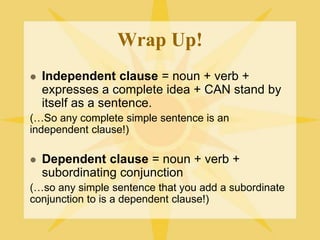
 Independent clause = noun + verb +
expresses a complete idea + CAN stand by
itself as a sentence.
(…So any complete simple sentence is an
independent clause!)
 Dependent clause = noun + verb +
subordinating conjunction
(…so any simple sentence that you add a subordinate
conjunction to is a dependent clause!)
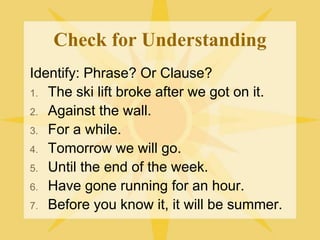
Check for Understanding
Identify: Phrase? Or Clause?
1. The ski lift broke after we got on it.
2. Against the wall.
3. For a while.
4. Tomorrow we will go.
5. Until the end of the week.
6. Have gone running for an hour.
7. Before you know it, it will be summer.
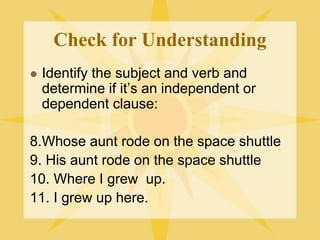
Check for Understanding
 Identify the subject and verb and
determine if it’s an independent or
dependent clause:
8.Whose aunt rode on the space shuttle
9. His aunt rode on the space shuttle
10. Where I grew up.
11. I grew up here.

Phrases and Clauses.pdf

  • 1.
    Phrase & ClausePPT Mrs. Lee- 7th Grade Language Arts
  • 2.
    Concept Web Phrase Not afull sentence Not a complete thought Prepositional phrase Adjective phrase Adverb phrase Noun Phrase Verb phrase Can have subject, verb, or neither Clause Has a subject Has a verb Independent & Dependent= Subordinate Can express a complete thought
  • 3.
    Can you tell? Which of the following are phrases? Which are clauses? 1.In my room—Phrase 2.The cat went under the bed—Clause 3.Until next week P or C—why? 4. Quickly walking to the store P or C—why? 5.Yet they tried—P or C—why?
  • 4.
    Phrases & Clauses Phrase: group of related words that does not contain a subject and verb and is used as a part of speech  Clause: a group of words that contains a subject and a verb and is used as part of a sentence or a sentence by itself.
  • 5.
    Let’s think aboutit! Fill in the blanks: 1. A phrase is a group of related words that is used as a part of ______ and does NOT contain both a _______ and a _______. 2. A phrase ______ stand alone as a sentence. 3. A clause has both a _______ and a _______. 4. A clause _______ stand alone as a sentence if it’s an independent clause.
  • 6.
    Let’s think aboutit! Fill in the blanks: 1. A phrase is a group of related words that is used as a part of speech and does NOT contain both a subject and a verb. 2. A phrase cannot stand alone as a sentence. 3. A clause has both a subject and a verb. 4. A clause can stand alone as a sentence if it’s an independent clause.
  • 7.
    Prepositional Phrases  Nota complete thought  Used to help modify other parts of speech  Begins with a preposition
  • 8.
    Adjective & AdverbPhrases  An ADJECTIVE PHRASE is a prepositional phrase that is used to modify a noun.  An ADVERB PHRASE is a prepositional phrase that is used to modify a verb or other adverb.
  • 9.
    Noun and VerbPhrases  Noun phrases are groups of words that act as nouns (lots you’ll learn later!)  Verb phrases are groups of words that act as verbs (again, you’ll learn them later!)
  • 10.
    Clause  A wordgroup that contains a subject (noun) and verb  Two types of clauses: – Independent– expresses a complete thought & can stand by itself as a sentence – Dependent-(subordinate)-does not express a complete thought & cannot stand by itself as a sentence
  • 11.
    Dependent Clause  Dependentclause = subject + verb BUT does NOT express a complete thought + CANNOT stand alone as a sentence.  Start with SUBORDINATING CONJUNCTIONS
  • 12.
    Subordinating Conjunctions  Whenwriting a dependent clause start with a subordinating Conjunction: After Although As As if As though Because Before How If Since So that Than That Though Unless Until When Whenever Where Wherever Whether Which While Who Whom Whose
  • 13.
    Wrap Up!  Phrasescontain EITHER a noun OR a verb OR NEITHER  Are NOT complete thoughts  CANNOT stand alone  Act as another part of speech
  • 14.
    Wrap Up!  Independentclause = noun + verb + expresses a complete idea + CAN stand by itself as a sentence. (…So any complete simple sentence is an independent clause!)  Dependent clause = noun + verb + subordinating conjunction (…so any simple sentence that you add a subordinate conjunction to is a dependent clause!)
  • 15.
    Check for Understanding Identify:Phrase? Or Clause? 1. The ski lift broke after we got on it. 2. Against the wall. 3. For a while. 4. Tomorrow we will go. 5. Until the end of the week. 6. Have gone running for an hour. 7. Before you know it, it will be summer.
  • 16.
    Check for Understanding Identify the subject and verb and determine if it’s an independent or dependent clause: 8.Whose aunt rode on the space shuttle 9. His aunt rode on the space shuttle 10. Where I grew up. 11. I grew up here.