Prepared by:
Rigor R. Suguitao
CLAUSES
a

group of words with a
subject and a verb.
INDEPEDEPENDENT

DEPENDENT

CLAUSES

CLAUSES
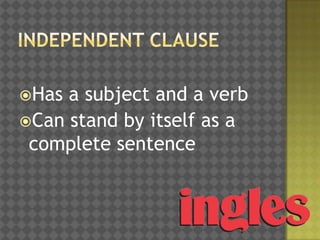
Has

a subject and a verb
Can stand by itself as a
complete sentence


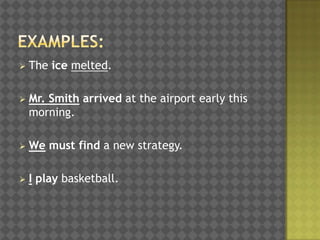
The ice melted.



Mr. Smith arrived at the airport early this
morning.



We must find a new strategy.



I play basketball.
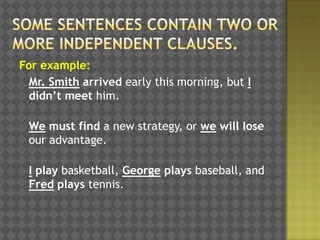
For example:
Mr. Smith arrived early this morning, but I
didn’t meet him.
We must find a new strategy, or we will lose
our advantage.
I play basketball, George plays baseball, and
Fred plays tennis.
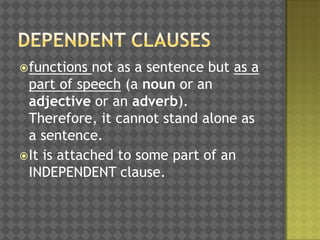
 functions

not as a sentence but as a
part of speech (a noun or an
adjective or an adverb).
Therefore, it cannot stand alone as
a sentence.
 It is attached to some part of an
INDEPENDENT clause.
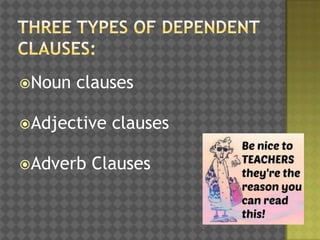
Noun

clauses

Adjective
Adverb

clauses

Clauses
Definitions of Noun
 The English word “noun” comes from the
Latin „nomen‟ meaning „name‟. The function
of noun is to name someone or something.
 According to Oxford Dictionary (Pearsall,
1999:945), noun is a word used to identify
any of a class of people, places or things, or
to name a particular one of these.
 It can be concluded that noun is a word that
functions to identify someone or something.
Definition of Clause
 A clause is a group of related words. It
contains a subject and a verb (Betty,
1993:346).
 Clause is a group of words that contains a
subject and a verb. it can take the place of
different parts of speech
(http://esl.lbcc.cc.ca.us/eesllessons/nouncl
auses/nounclause.htm).
Definition of Noun Clause
 A noun clause is a dependent clause and cannot
stand alone as a sentence (Betty Schrampfer
Azar, 1993:346).
 In a noun clause, the full subject and predicate
are retained. The noun clause fills the same
position and serves the same function as noun
 act as simple nouns and identify persons,
places, things, etc.
 So, it can be concluded that noun clause is a
dependent clause that has function as a
subject, object, or complement.
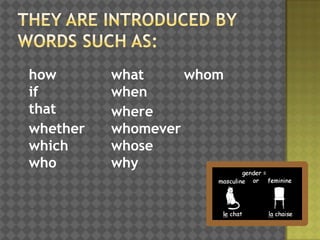
how
if
that
whether
which
who

what
whom
when
where
whomever
whose
why
 Subject
 Subject

complement
 Direct object
 Object complement
 Object of the preposition
 Adjective phrase complement
 Appositive
The first grammatical function that noun clauses
perform is the subject. A subject is a word, phrase,
or clause that performs the action of or acts upon
the verb
 Example:
 Whoever ate my lunch is in big trouble.
 How you will finish all your homework on time is
beyond me.
 That the museum cancelled the lecture disappoints
me.
 For you to not graduate from college now is such
as shame.

A subject complement is a word, phrase, or clause
that follows a copular, or linking, verb and
describes the subject of a clause. The
terms predicate nominative and predicate
noun are also used for noun clauses that function
as subject complements.
 Examples:
 The truth was that the moving company lost all
your furniture.
 My question is whether you will sue the company
for losses.

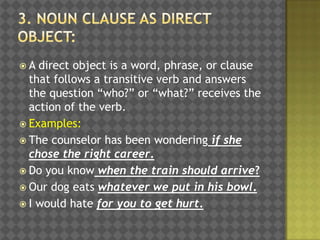
A

direct object is a word, phrase, or clause
that follows a transitive verb and answers
the question “who?” or “what?” receives the
action of the verb.
 Examples:
 The counselor has been wondering if she
chose the right career.
 Do you know when the train should arrive?
 Our dog eats whatever we put in his bowl.
 I would hate for you to get hurt.
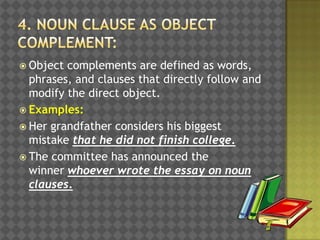
 Object

complements are defined as words,
phrases, and clauses that directly follow and
modify the direct object.
 Examples:
 Her grandfather considers his biggest
mistake that he did not finish college.
 The committee has announced the
winner whoever wrote the essay on noun
clauses.
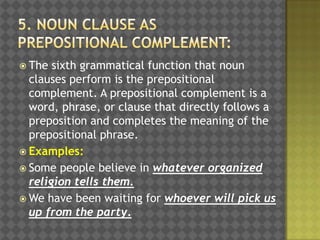
 The

sixth grammatical function that noun
clauses perform is the prepositional
complement. A prepositional complement is a
word, phrase, or clause that directly follows a
preposition and completes the meaning of the
prepositional phrase.
 Examples:
 Some people believe in whatever organized
religion tells them.
 We have been waiting for whoever will pick us
up from the party.
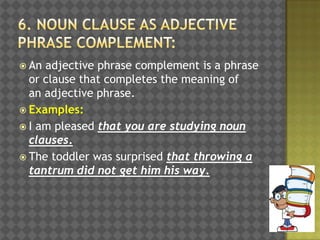
 An

adjective phrase complement is a phrase
or clause that completes the meaning of
an adjective phrase.
 Examples:
 I am pleased that you are studying noun
clauses.
 The toddler was surprised that throwing a
tantrum did not get him his way.
 An

appositive is a word, phrase, or clause
that modifies or explains another noun
phrase.
 Examples:
 That man, whoever is he, tried to steal
some library books.
 The problem, that the storm knocked out
power, is affecting the entire town.
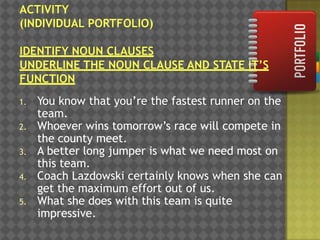
1.
2.
3.
4.
5.

You know that you‟re the fastest runner on the
team.
Whoever wins tomorrow‟s race will compete in
the county meet.
A better long jumper is what we need most on
this team.
Coach Lazdowski certainly knows when she can
get the maximum effort out of us.
What she does with this team is quite
impressive.
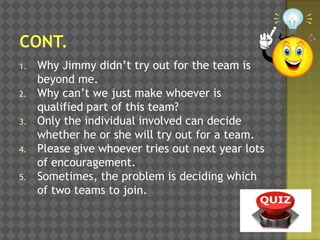
1.
2.
3.
4.
5.

Why Jimmy didn‟t try out for the team is
beyond me.
Why can‟t we just make whoever is
qualified part of this team?
Only the individual involved can decide
whether he or she will try out for a team.
Please give whoever tries out next year lots
of encouragement.
Sometimes, the problem is deciding which
of two teams to join.
Noun clause functions

Noun clause functions

  • 1.
  • 2.
  • 3.
    a group of wordswith a subject and a verb.
  • 4.
  • 5.
    Has a subject anda verb Can stand by itself as a complete sentence
  • 6.
     The ice melted.  Mr.Smith arrived at the airport early this morning.  We must find a new strategy.  I play basketball.
  • 7.
    For example: Mr. Smitharrived early this morning, but I didn’t meet him. We must find a new strategy, or we will lose our advantage. I play basketball, George plays baseball, and Fred plays tennis.
  • 8.
     functions not asa sentence but as a part of speech (a noun or an adjective or an adverb). Therefore, it cannot stand alone as a sentence.  It is attached to some part of an INDEPENDENT clause.
  • 9.
  • 11.
    Definitions of Noun The English word “noun” comes from the Latin „nomen‟ meaning „name‟. The function of noun is to name someone or something.  According to Oxford Dictionary (Pearsall, 1999:945), noun is a word used to identify any of a class of people, places or things, or to name a particular one of these.  It can be concluded that noun is a word that functions to identify someone or something.
  • 12.
    Definition of Clause A clause is a group of related words. It contains a subject and a verb (Betty, 1993:346).  Clause is a group of words that contains a subject and a verb. it can take the place of different parts of speech (http://esl.lbcc.cc.ca.us/eesllessons/nouncl auses/nounclause.htm).
  • 13.
    Definition of NounClause  A noun clause is a dependent clause and cannot stand alone as a sentence (Betty Schrampfer Azar, 1993:346).  In a noun clause, the full subject and predicate are retained. The noun clause fills the same position and serves the same function as noun  act as simple nouns and identify persons, places, things, etc.  So, it can be concluded that noun clause is a dependent clause that has function as a subject, object, or complement.
  • 14.
  • 15.
     Subject  Subject complement Direct object  Object complement  Object of the preposition  Adjective phrase complement  Appositive
  • 16.
    The first grammaticalfunction that noun clauses perform is the subject. A subject is a word, phrase, or clause that performs the action of or acts upon the verb  Example:  Whoever ate my lunch is in big trouble.  How you will finish all your homework on time is beyond me.  That the museum cancelled the lecture disappoints me.  For you to not graduate from college now is such as shame. 
  • 17.
    A subject complementis a word, phrase, or clause that follows a copular, or linking, verb and describes the subject of a clause. The terms predicate nominative and predicate noun are also used for noun clauses that function as subject complements.  Examples:  The truth was that the moving company lost all your furniture.  My question is whether you will sue the company for losses. 
  • 18.
    A direct object isa word, phrase, or clause that follows a transitive verb and answers the question “who?” or “what?” receives the action of the verb.  Examples:  The counselor has been wondering if she chose the right career.  Do you know when the train should arrive?  Our dog eats whatever we put in his bowl.  I would hate for you to get hurt.
  • 19.
     Object complements aredefined as words, phrases, and clauses that directly follow and modify the direct object.  Examples:  Her grandfather considers his biggest mistake that he did not finish college.  The committee has announced the winner whoever wrote the essay on noun clauses.
  • 20.
     The sixth grammaticalfunction that noun clauses perform is the prepositional complement. A prepositional complement is a word, phrase, or clause that directly follows a preposition and completes the meaning of the prepositional phrase.  Examples:  Some people believe in whatever organized religion tells them.  We have been waiting for whoever will pick us up from the party.
  • 21.
     An adjective phrasecomplement is a phrase or clause that completes the meaning of an adjective phrase.  Examples:  I am pleased that you are studying noun clauses.  The toddler was surprised that throwing a tantrum did not get him his way.
  • 22.
     An appositive isa word, phrase, or clause that modifies or explains another noun phrase.  Examples:  That man, whoever is he, tried to steal some library books.  The problem, that the storm knocked out power, is affecting the entire town.
  • 23.
    1. 2. 3. 4. 5. You know thatyou‟re the fastest runner on the team. Whoever wins tomorrow‟s race will compete in the county meet. A better long jumper is what we need most on this team. Coach Lazdowski certainly knows when she can get the maximum effort out of us. What she does with this team is quite impressive.
  • 24.
    1. 2. 3. 4. 5. Why Jimmy didn‟ttry out for the team is beyond me. Why can‟t we just make whoever is qualified part of this team? Only the individual involved can decide whether he or she will try out for a team. Please give whoever tries out next year lots of encouragement. Sometimes, the problem is deciding which of two teams to join.