Participial Phrases
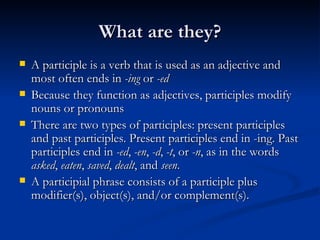
What are they? A participle is a verb that is used as an adjective and most often ends in  -ing  or  -ed   Because they function as adjectives, participles modify nouns or pronouns There are two types of participles: present participles and past participles. Present participles end in -ing. Past participles end in  -ed ,  -en ,  -d ,  -t , or  -n , as in the words  asked ,  eaten ,  saved ,  dealt , and  seen .  A participial phrase consists of a participle plus modifier(s), object(s), and/or complement(s).
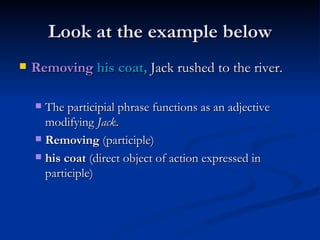
Look at the example below Removing  his coat,  Jack rushed to the river.  The participial phrase functions as an adjective modifying  Jack . Removing  (participle) his coat  (direct object of action expressed in participle)
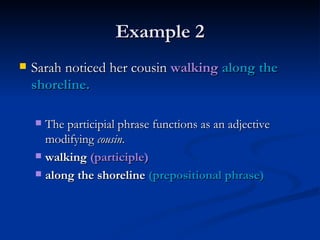
Example 2 Sarah noticed her cousin  walking   along the shoreline.  The participial phrase functions as an adjective modifying  cousin . walking   (participle) along the shoreline   (prepositional phrase)
Example 3 Having been  a gymnast,  James knew the importance of exercise. The participial phrase functions as an adjective modifying  James. Having been   (participle) a gymnast   (subject complement for Lynn)
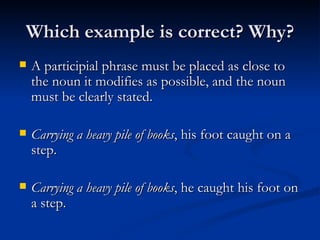
Which example is correct? Why? A participial phrase must be placed as close to the noun it modifies as possible, and the noun must be clearly stated.  Carrying a heavy pile of books , his foot caught on a step.  Carrying a heavy pile of books , he caught his foot on a step.
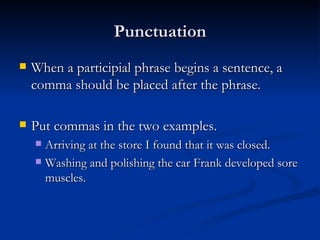
Punctuation When a participial phrase begins a sentence, a comma should be placed after the phrase.  Put commas in the two examples.  Arriving at the store I found that it was closed.  Washing and polishing the car Frank developed sore muscles.
Punctuation cont., If the participial phrase comes in the middle of a sentence, it should be separated with commas  only  if the information is not essential to the meaning of the sentence.  Sid,  watching an old movie , drifted in and out of sleep.  The church,  destroyed by a fire , was never rebuilt.
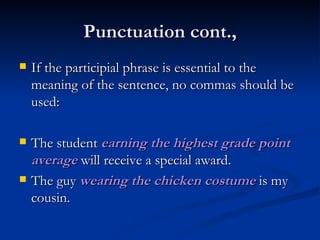
Punctuation cont., If the participial phrase is essential to the meaning of the sentence, no commas should be used: The student  earning the highest grade point average  will receive a special award.  The guy  wearing the chicken costume  is my cousin.
Summary A participle is a verbal ending in  -ing  (present) or  -ed ,  -en ,  -d ,  -t , or  -n  (past) that functions as an adjective, modifying a noun or pronoun.  A participial phrase consists of a participle plus modifier(s), object(s), and/or complement(s).  Participles and participial phrases must be placed as close to the nouns or pronouns they modify as possible, and those nouns or pronouns must be clearly stated.  A participial phrase is set off with commas when it:  a) comes at the beginning of a sentence  b) not essential information  c) comes at the end of a sentence and is separated from the word it modifies.
Why do we want to use participial phrases? To make our writing more academic and to use a variety of ways to structure sentences Participial phrases, reduce relative clauses and adverbial clauses
Re-write the examples we have looked at as relative/adverbial clauses. Removing  his coat,  Jack rushed to the river. Sarah noticed her cousin  walking   along the shoreline.  Having been  a gymnast,  James knew the importance of exercise. Carrying   a heavy pile of books,  he caught his foot on a step. Arriving   at the store  I found that it was closed. Washing and polishing   the car  Frank developed sore muscles.  Sid,  watching   an old movie,  drifted in and out of sleep.  The church,  destroyed   by a fire,  was never rebuilt. The student  earning  the highest grade point average  will receive a special award.  The guy  wearing  the chicken costume  is my cousin.
Extra Tips Delete ‘because’ and ‘as’ from the participial phrase. Because/as Jason is very friendly, he was shocked that the other students didn’t like him. Being very friendly, Jason was shocked that the other students didn’t like him.
Extra Tips cont., ‘ After, while & when’ are optional. You can include or delete them. E.g. After he had passed the IELTS exam, he went to study English abroad. E.g. (After) passing the IELTS exam, he went to study English abroad. E.g. While he was preparing for the IELTS exam, he lived with a host family. E.g. (While) preparing for the IELTS exam, he lived with a host family. E.g. When he was asked about studying in England, he was saddened by memories. E.g. (When) asked about studying in England, he was saddened by memories.
Online Practice Click here  to do some exercises online, write down you score before returning to class.
Practice Click here  for a list of participles (‘ing’ and ‘ed’)  Remember, you only need to focus on the past/present participle for this exercise Read the next slide which contains tips to help you do the worksheet Complete the worksheet you were given yesterday Bring the completed worksheet back to class
Worksheet Tips If the relative/adverbial clause contains a passive structure, the participial phrase structure is:  Having + past participle (ed) Past/Future tenses use the ‘ed’ participle Present tense uses the ‘ing’ participle Have/had + finished action Verb to be + finished action  Having + been + past participle (ed)

Participial phrases

  • 1.
  • 2.
    What are they?A participle is a verb that is used as an adjective and most often ends in -ing or -ed Because they function as adjectives, participles modify nouns or pronouns There are two types of participles: present participles and past participles. Present participles end in -ing. Past participles end in -ed , -en , -d , -t , or -n , as in the words asked , eaten , saved , dealt , and seen . A participial phrase consists of a participle plus modifier(s), object(s), and/or complement(s).
  • 3.
    Look at theexample below Removing his coat, Jack rushed to the river. The participial phrase functions as an adjective modifying Jack . Removing (participle) his coat (direct object of action expressed in participle)
  • 4.
    Example 2 Sarahnoticed her cousin walking along the shoreline. The participial phrase functions as an adjective modifying cousin . walking (participle) along the shoreline (prepositional phrase)
  • 5.
    Example 3 Havingbeen a gymnast, James knew the importance of exercise. The participial phrase functions as an adjective modifying James. Having been (participle) a gymnast (subject complement for Lynn)
  • 6.
    Which example iscorrect? Why? A participial phrase must be placed as close to the noun it modifies as possible, and the noun must be clearly stated. Carrying a heavy pile of books , his foot caught on a step. Carrying a heavy pile of books , he caught his foot on a step.
  • 7.
    Punctuation When aparticipial phrase begins a sentence, a comma should be placed after the phrase. Put commas in the two examples. Arriving at the store I found that it was closed. Washing and polishing the car Frank developed sore muscles.
  • 8.
    Punctuation cont., Ifthe participial phrase comes in the middle of a sentence, it should be separated with commas only if the information is not essential to the meaning of the sentence. Sid, watching an old movie , drifted in and out of sleep. The church, destroyed by a fire , was never rebuilt.
  • 9.
    Punctuation cont., Ifthe participial phrase is essential to the meaning of the sentence, no commas should be used: The student earning the highest grade point average will receive a special award. The guy wearing the chicken costume is my cousin.
  • 10.
    Summary A participleis a verbal ending in -ing (present) or -ed , -en , -d , -t , or -n (past) that functions as an adjective, modifying a noun or pronoun. A participial phrase consists of a participle plus modifier(s), object(s), and/or complement(s). Participles and participial phrases must be placed as close to the nouns or pronouns they modify as possible, and those nouns or pronouns must be clearly stated. A participial phrase is set off with commas when it: a) comes at the beginning of a sentence b) not essential information c) comes at the end of a sentence and is separated from the word it modifies.
  • 11.
    Why do wewant to use participial phrases? To make our writing more academic and to use a variety of ways to structure sentences Participial phrases, reduce relative clauses and adverbial clauses
  • 12.
    Re-write the exampleswe have looked at as relative/adverbial clauses. Removing his coat, Jack rushed to the river. Sarah noticed her cousin walking along the shoreline. Having been a gymnast, James knew the importance of exercise. Carrying a heavy pile of books, he caught his foot on a step. Arriving at the store I found that it was closed. Washing and polishing the car Frank developed sore muscles. Sid, watching an old movie, drifted in and out of sleep. The church, destroyed by a fire, was never rebuilt. The student earning the highest grade point average will receive a special award. The guy wearing the chicken costume is my cousin.
  • 13.
    Extra Tips Delete‘because’ and ‘as’ from the participial phrase. Because/as Jason is very friendly, he was shocked that the other students didn’t like him. Being very friendly, Jason was shocked that the other students didn’t like him.
  • 14.
    Extra Tips cont.,‘ After, while & when’ are optional. You can include or delete them. E.g. After he had passed the IELTS exam, he went to study English abroad. E.g. (After) passing the IELTS exam, he went to study English abroad. E.g. While he was preparing for the IELTS exam, he lived with a host family. E.g. (While) preparing for the IELTS exam, he lived with a host family. E.g. When he was asked about studying in England, he was saddened by memories. E.g. (When) asked about studying in England, he was saddened by memories.
  • 15.
    Online Practice Clickhere to do some exercises online, write down you score before returning to class.
  • 16.
    Practice Click here for a list of participles (‘ing’ and ‘ed’) Remember, you only need to focus on the past/present participle for this exercise Read the next slide which contains tips to help you do the worksheet Complete the worksheet you were given yesterday Bring the completed worksheet back to class
  • 17.
    Worksheet Tips Ifthe relative/adverbial clause contains a passive structure, the participial phrase structure is: Having + past participle (ed) Past/Future tenses use the ‘ed’ participle Present tense uses the ‘ing’ participle Have/had + finished action Verb to be + finished action Having + been + past participle (ed)