Grammar Book 
By: Alejandra Green 
2nd Honors Spanish
Table of Contents 
 Page 1- Nationalities 
 Page 2- Stem Changing Verbs 
 Page 3- Para 
 Page 4- Adjectives 
 Page 5- Object Pronoun Placement 
 Page 6- DOP (direct object pronoun) 
 Page 7- IOP (indirect object pronoun) 
 Page 8- ser vs. estar 
 Page 9- isimo(a) and g/c/z 
 Page 10- Verbs like gustar 
 Page 11- Affirmative and Negative Words 
 Page 12- pero vs. sino 
 Page 13- DOP/IOP/SE 
 Page 14- Reflexive Verbs 
 Page 15- Tu commands affirmative/negative/irregulars 
 Page 16- los adverbios-mente 
 Page 17- deber+ other modal verbs 
 Page 18- past participles as adjectives 
 Page 19- Preterite 
 Page 20- Present Progressive
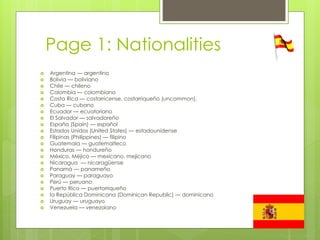
Page 1: Nationalities 
 Argentina — argentino 
 Bolivia — boliviano 
 Chile — chileno 
 Colombia — colombiano 
 Costa Rica — costarricense, costarriqueño (uncommon), 
 Cuba — cubano 
 Ecuador — ecuatoriano 
 El Salvador — salvadoreño 
 España (Spain) — español 
 Estados Unidos (United States) — estadounidense 
 Filipinas (Philippines) — filipino 
 Guatemala — guatemalteco 
 Honduras — hondureño 
 México, Méjico — mexicano, mejicano 
 Nicaragua — nicaragüense 
 Panamá — panameño 
 Paraguay — paraguayo 
 Perú — peruano 
 Puerto Rico — puertorriqueño 
 la República Dominicana (Dominican Republic) — dominicano 
 Uruguay — uruguayo 
 Venezuela — venezolano
Page 2: Stem Changing verbs 
The stem doesn’t change for the nosotros or vosotros form 
 Pensar 
 Encontrar 
 Almorzar 
 Contar 
cuento contamos example 
cuentas Contáis Las ollas 
cuenta Cuentan Cuestan 70 
May change from e to ie 
Or from o to ue 
pesos
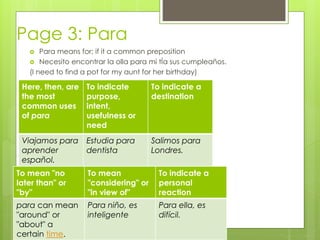
Page 3: Para 
 Para means for; if it a common preposition 
 Necesito encontrar la olla para mi tÍa sus cumpleaños. 
(I need to find a pot for my aunt for her birthday) 
Here, then, are 
the most 
common uses 
of para 
To indicate 
purpose, 
intent, 
usefulness or 
need 
To indicate a 
destination 
Viajamos para 
aprender 
español. 
Estudia para 
dentista 
Salimos para 
Londres. 
To mean "no 
later than" or 
"by" 
To mean 
"considering" or 
"in view of" 
To indicate a 
personal 
reaction 
para can mean 
"around" or 
"about" a 
certain time. 
Para niño, es 
inteligente 
Para ella, es 
difícil.
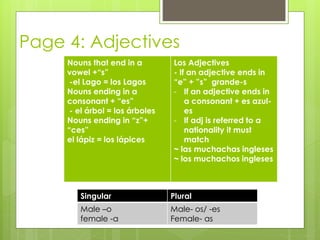
Page 4: Adjectives 
Nouns that end in a 
vowel +“s” 
-el Lago = los Lagos 
Nouns ending in a 
consonant + “es” 
- el árbol = los árboles 
Nouns ending in “z”+ 
“ces” 
el lápiz = los lápices 
Los Adjectives 
- If an adjective ends in 
“e” + ”s” grande-s 
- If an adjective ends in 
a consonant + es azul-es 
- If adj is referred to a 
nationality it must 
match 
~ las muchachas ingleses 
~ los muchachos ingleses 
Singular Plural 
Male –o 
female -a 
Male- os/ -es 
Female- as
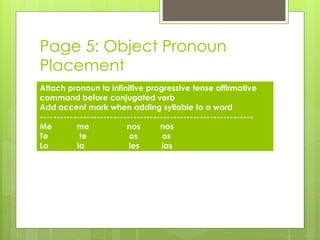
Page 5: Object Pronoun 
Placement 
Attach pronoun to infinitive progressive tense affirmative 
command before conjugated verb 
Add accent mark when adding syllable to a word 
---------------------------------------------------------------- 
Me me nos nos 
Te te os os 
Lo la les las
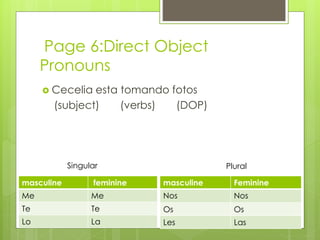
Page 6:Direct Object 
Pronouns 
 Cecelia esta tomando fotos 
(subject) (verbs) (DOP) 
Singular Plural 
masculine feminine 
Me Me 
Te Te 
Lo La 
masculine Feminine 
Nos Nos 
Os Os 
Les Las
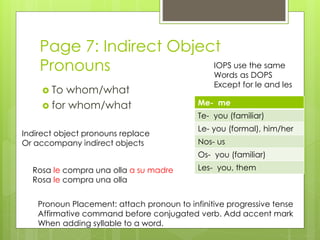
Page 7: Indirect Object 
Pronouns 
 To whom/what 
IOPS use the same 
Words as DOPS 
Except for le and les 
 for whom/what Me- me 
Te- you (familiar) 
Le- you (formal), him/her 
Nos- us 
Os- you (familiar) 
Les- you, them 
Indirect object pronouns replace 
Or accompany indirect objects 
Rosa le compra una olla a su madre 
Rosa le compra una olla 
Pronoun Placement: attach pronoun to infinitive progressive tense 
Affirmative command before conjugated verb. Add accent mark 
When adding syllable to a word.
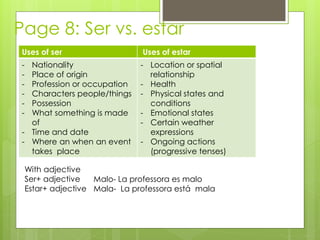
Page 8: Ser vs. estar 
Uses of ser Uses of estar 
- Nationality 
- Place of origin 
- Profession or occupation 
- Characters people/things 
- Possession 
- What something is made 
of 
- Time and date 
- Where an when an event 
takes place 
- Location or spatial 
relationship 
- Health 
- Physical states and 
conditions 
- Emotional states 
- Certain weather 
expressions 
- Ongoing actions 
(progressive tenses) 
With adjective 
Ser+ adjective 
Estar+ adjective 
Malo- La professora es malo 
Mala- La professora está mala
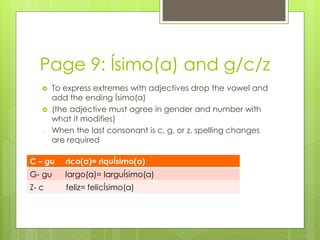
Page 9: Ísimo(a) and g/c/z 
 To express extremes with adjectives drop the vowel and 
add the ending Ísimo(a) 
 (the adjective must agree in gender and number with 
what it modifies) 
- When the last consonant is c, g, or z, spelling changes 
are required 
C – gu rico(a)= riquÍsimo(a) 
G- gu largo(a)= larguÍsimo(a) 
Z- c feliz= felicÍsimo(a)
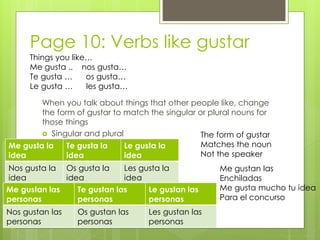
Page 10: Verbs like gustar 
Things you like… 
Me gusta .. nos gusta… 
Te gusta … os gusta… 
Le gusta … les gusta… 
When you talk about things that other people like, change 
the form of gustar to match the singular or plural nouns for 
those things 
 Singular and plural 
Me gusta la 
idea 
Te gusta la 
idea 
Le gusta la 
idea 
Nos gusta la 
idea 
Os gusta la 
idea 
Les gusta la 
idea 
Me gustan las 
personas 
Te gustan las 
personas 
Le gustan las 
personas 
Nos gustan las 
personas 
Os gustan las 
personas 
The form of gustar 
Matches the noun 
Not the speaker 
Les gustan las 
personas 
Me gustan las 
Enchiladas 
Me gusta mucho tu idea 
Para el concurso
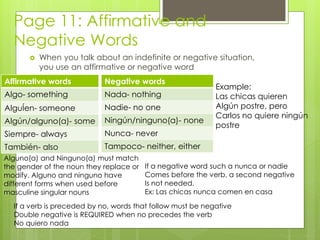
Page 11: Affirmative and 
Negative Words 
 When you talk about an indefinite or negative situation, 
you use an affirmative or negative word 
Affirmative words 
Algo- something 
AlguÍen- someone 
Algún/alguno(a)- some 
Siempre- always 
También- also 
Negative words 
Nada- nothing 
Nadie- no one 
Ningún/ninguno(a)- none 
Nunca- never 
Tampoco- neither, either 
Example: 
Las chicas quieren 
Algún postre, pero 
Carlos no quiere ningún 
postre 
Alguno(a) and Ninguno(a) must match 
the gender of the noun they replace or 
modify. Alguno and ninguno have 
different forms when used before 
masculine singular nouns 
If a negative word such a nunca or nadie 
Comes before the verb, a second negative 
Is not needed. 
Ex: Las chicas nunca comen en casa 
If a verb is preceded by no, words that follow must be negative 
Double negative is REQUIRED when no precedes the verb 
No quiero nada
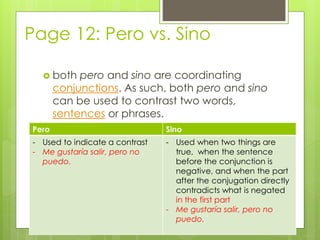
Page 12: Pero vs. Sino 
 both pero and sino are coordinating 
conjunctions. As such, both pero and sino 
can be used to contrast two words, 
sentences or phrases. 
Pero Sino 
- Used to indicate a contrast 
- Me gustaría salir, pero no 
puedo. 
- Used when two things are 
true, when the sentence 
before the conjunction is 
negative, and when the part 
after the conjugation directly 
contradicts what is negated 
in the first part 
- Me gustaría salir, pero no 
puedo.
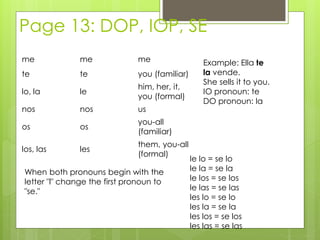
Page 13: DOP, IOP, SE 
me me me 
te te you (familiar) 
lo, la le 
him, her, it, 
you (formal) 
nos nos us 
os os 
you-all 
(familiar) 
los, las les 
them, you-all 
(formal) 
When both pronouns begin with the 
letter "l" change the first pronoun to 
"se." 
Example: Ella te 
la vende. 
She sells it to you. 
IO pronoun: te 
DO pronoun: la 
le lo = se lo 
le la = se la 
le los = se los 
le las = se las 
les lo = se lo 
les la = se la 
les los = se los 
les las = se las
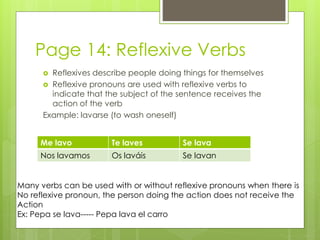
Page 14: Reflexive Verbs 
 Reflexives describe people doing things for themselves 
 Reflexive pronouns are used with reflexive verbs to 
indicate that the subject of the sentence receives the 
action of the verb 
Example: lavarse (to wash oneself) 
Me lavo Te laves Se lava 
Nos lavamos Os laváis Se lavan 
Many verbs can be used with or without reflexive pronouns when there is 
No reflexive pronoun, the person doing the action does not receive the 
Action 
Ex: Pepa se lava----- Pepa lava el carro
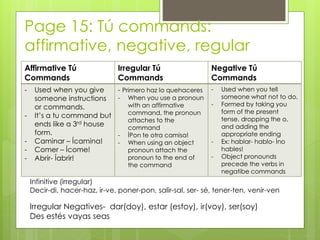
Page 15: Tú commands: 
affirmative, negative, regular 
Affirmative Tú 
Commands 
Irregular Tú 
Commands 
Negative Tú 
Commands 
- Used when you give 
someone instructions 
or commands. 
- It’s a tu command but 
ends like a 3rd house 
form. 
- Caminar – Ícamina! 
- Comer – Ícome! 
- Abrir- Íabrir! 
- Primero haz lo quehaceres 
- When you use a pronoun 
with an affirmative 
command, the pronoun 
attaches to the 
command 
- İPon te otra camisa! 
- When using an object 
pronoun attach the 
pronoun to the end of 
the command 
- Used when you tell 
someone what not to do. 
- Formed by taking you 
form of the present 
tense, dropping the o, 
and adding the 
appropriate ending 
- Ex: hablar- hablo- İno 
hables! 
- Object pronounds 
precede the verbs in 
negatibe commands 
Infinitive (irregular) 
Decir-di, hacer-haz, ir-ve, poner-pon, salir-sal, ser- sé, tener-ten, venir-ven 
Irregular Negatives- dar(doy), estar (estoy), ir(voy), ser(soy) 
Des estés vayas seas
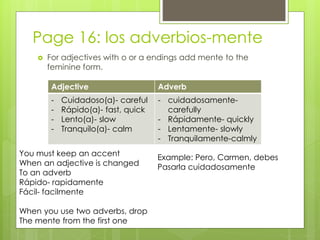
Page 16: los adverbios-mente 
 For adjectives with o or a endings add mente to the 
feminine form. 
Adjective Adverb 
- Cuidadoso(a)- careful 
- Rápido(a)- fast, quick 
- Lento(a)- slow 
- Tranquilo(a)- calm 
- cuidadosamente-carefully 
- Rápidamente- quickly 
- Lentamente- slowly 
- Tranquilamente-calmly 
You must keep an accent 
When an adjective is changed 
To an adverb 
Rápido- rapidamente 
Fácil- facilmente 
When you use two adverbs, drop 
The mente from the first one 
Example: Pero, Carmen, debes 
Pasarla cuidadosamente
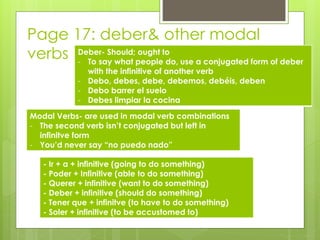
Page 17: deber& other modal 
verbs Deber- Should; ought to 
- To say what people do, use a conjugated form of deber 
with the infinitive of another verb 
- Debo, debes, debe, debemos, debéis, deben 
- Debo barrer el suelo 
- Debes limpiar la cocina 
Modal Verbs- are used in modal verb combinations 
- The second verb isn’t conjugated but left in 
infinitve form 
- You’d never say “no puedo nado” 
- Ir + a + infinitive (going to do something) 
- Poder + Infinitive (able to do something) 
- Querer + infinitive (want to do something) 
- Deber + infinitive (should do something) 
- Tener que + infinitve (to have to do something) 
- Soler + infinitive (to be accustomed to)
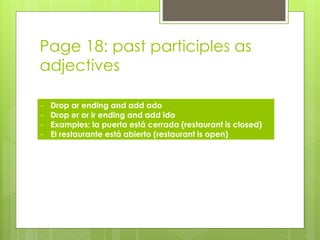
Page 18: past participles as 
adjectives 
- Drop ar ending and add ado 
- Drop er or ir ending and add ido 
- Examples: la puerta está cerrada (restaurant is closed) 
- El restaurante está abierto (restaurant is open)
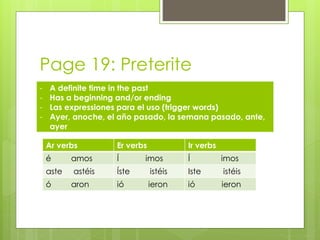
Page 19: Preterite 
- A definite time in the past 
- Has a beginning and/or ending 
- Las expressiones para el uso (trigger words) 
- Ayer, anoche, el año pasado, la semana pasado, ante, 
ayer 
Ar verbs Er verbs Ir verbs 
é amos Í imos Í imos 
aste astéis Íste istéis Iste istéis 
ó aron ió ieron ió ieron
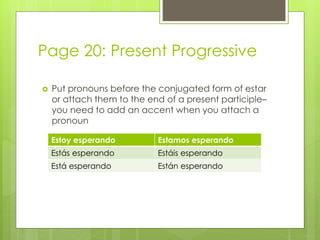
Page 20: Present Progressive 
 Put pronouns before the conjugated form of estar 
or attach them to the end of a present participle– 
you need to add an accent when you attach a 
pronoun 
Estoy esperando Estamos esperando 
Estás esperando Estáis esperando 
Está esperando Están esperando
Bibliography 
"7 Reasons for Using the Spanish 
Preposition "Para"" About. N.p., n.d. 
Web. 10 Dec. 2014. 
"2 Ways To Say "But" in Spanish." About. 
N.p., n.d. Web. 10 Dec. 2014. 
"Direct and Indirect Object Pronouns 
Used Together." Direct and Indirect 
Object Pronouns Used Together. N.p., 
n.d. Web. 10 Dec. 2014.

Grammar book by Alejandra Green

  • 1.
    Grammar Book By:Alejandra Green 2nd Honors Spanish
  • 2.
    Table of Contents  Page 1- Nationalities  Page 2- Stem Changing Verbs  Page 3- Para  Page 4- Adjectives  Page 5- Object Pronoun Placement  Page 6- DOP (direct object pronoun)  Page 7- IOP (indirect object pronoun)  Page 8- ser vs. estar  Page 9- isimo(a) and g/c/z  Page 10- Verbs like gustar  Page 11- Affirmative and Negative Words  Page 12- pero vs. sino  Page 13- DOP/IOP/SE  Page 14- Reflexive Verbs  Page 15- Tu commands affirmative/negative/irregulars  Page 16- los adverbios-mente  Page 17- deber+ other modal verbs  Page 18- past participles as adjectives  Page 19- Preterite  Page 20- Present Progressive
  • 3.
    Page 1: Nationalities  Argentina — argentino  Bolivia — boliviano  Chile — chileno  Colombia — colombiano  Costa Rica — costarricense, costarriqueño (uncommon),  Cuba — cubano  Ecuador — ecuatoriano  El Salvador — salvadoreño  España (Spain) — español  Estados Unidos (United States) — estadounidense  Filipinas (Philippines) — filipino  Guatemala — guatemalteco  Honduras — hondureño  México, Méjico — mexicano, mejicano  Nicaragua — nicaragüense  Panamá — panameño  Paraguay — paraguayo  Perú — peruano  Puerto Rico — puertorriqueño  la República Dominicana (Dominican Republic) — dominicano  Uruguay — uruguayo  Venezuela — venezolano
  • 4.
    Page 2: StemChanging verbs The stem doesn’t change for the nosotros or vosotros form  Pensar  Encontrar  Almorzar  Contar cuento contamos example cuentas Contáis Las ollas cuenta Cuentan Cuestan 70 May change from e to ie Or from o to ue pesos
  • 5.
    Page 3: Para  Para means for; if it a common preposition  Necesito encontrar la olla para mi tÍa sus cumpleaños. (I need to find a pot for my aunt for her birthday) Here, then, are the most common uses of para To indicate purpose, intent, usefulness or need To indicate a destination Viajamos para aprender español. Estudia para dentista Salimos para Londres. To mean "no later than" or "by" To mean "considering" or "in view of" To indicate a personal reaction para can mean "around" or "about" a certain time. Para niño, es inteligente Para ella, es difícil.
  • 6.
    Page 4: Adjectives Nouns that end in a vowel +“s” -el Lago = los Lagos Nouns ending in a consonant + “es” - el árbol = los árboles Nouns ending in “z”+ “ces” el lápiz = los lápices Los Adjectives - If an adjective ends in “e” + ”s” grande-s - If an adjective ends in a consonant + es azul-es - If adj is referred to a nationality it must match ~ las muchachas ingleses ~ los muchachos ingleses Singular Plural Male –o female -a Male- os/ -es Female- as
  • 7.
    Page 5: ObjectPronoun Placement Attach pronoun to infinitive progressive tense affirmative command before conjugated verb Add accent mark when adding syllable to a word ---------------------------------------------------------------- Me me nos nos Te te os os Lo la les las
  • 8.
    Page 6:Direct Object Pronouns  Cecelia esta tomando fotos (subject) (verbs) (DOP) Singular Plural masculine feminine Me Me Te Te Lo La masculine Feminine Nos Nos Os Os Les Las
  • 9.
    Page 7: IndirectObject Pronouns  To whom/what IOPS use the same Words as DOPS Except for le and les  for whom/what Me- me Te- you (familiar) Le- you (formal), him/her Nos- us Os- you (familiar) Les- you, them Indirect object pronouns replace Or accompany indirect objects Rosa le compra una olla a su madre Rosa le compra una olla Pronoun Placement: attach pronoun to infinitive progressive tense Affirmative command before conjugated verb. Add accent mark When adding syllable to a word.
  • 10.
    Page 8: Servs. estar Uses of ser Uses of estar - Nationality - Place of origin - Profession or occupation - Characters people/things - Possession - What something is made of - Time and date - Where an when an event takes place - Location or spatial relationship - Health - Physical states and conditions - Emotional states - Certain weather expressions - Ongoing actions (progressive tenses) With adjective Ser+ adjective Estar+ adjective Malo- La professora es malo Mala- La professora está mala
  • 11.
    Page 9: Ísimo(a)and g/c/z  To express extremes with adjectives drop the vowel and add the ending Ísimo(a)  (the adjective must agree in gender and number with what it modifies) - When the last consonant is c, g, or z, spelling changes are required C – gu rico(a)= riquÍsimo(a) G- gu largo(a)= larguÍsimo(a) Z- c feliz= felicÍsimo(a)
  • 12.
    Page 10: Verbslike gustar Things you like… Me gusta .. nos gusta… Te gusta … os gusta… Le gusta … les gusta… When you talk about things that other people like, change the form of gustar to match the singular or plural nouns for those things  Singular and plural Me gusta la idea Te gusta la idea Le gusta la idea Nos gusta la idea Os gusta la idea Les gusta la idea Me gustan las personas Te gustan las personas Le gustan las personas Nos gustan las personas Os gustan las personas The form of gustar Matches the noun Not the speaker Les gustan las personas Me gustan las Enchiladas Me gusta mucho tu idea Para el concurso
  • 13.
    Page 11: Affirmativeand Negative Words  When you talk about an indefinite or negative situation, you use an affirmative or negative word Affirmative words Algo- something AlguÍen- someone Algún/alguno(a)- some Siempre- always También- also Negative words Nada- nothing Nadie- no one Ningún/ninguno(a)- none Nunca- never Tampoco- neither, either Example: Las chicas quieren Algún postre, pero Carlos no quiere ningún postre Alguno(a) and Ninguno(a) must match the gender of the noun they replace or modify. Alguno and ninguno have different forms when used before masculine singular nouns If a negative word such a nunca or nadie Comes before the verb, a second negative Is not needed. Ex: Las chicas nunca comen en casa If a verb is preceded by no, words that follow must be negative Double negative is REQUIRED when no precedes the verb No quiero nada
  • 14.
    Page 12: Perovs. Sino  both pero and sino are coordinating conjunctions. As such, both pero and sino can be used to contrast two words, sentences or phrases. Pero Sino - Used to indicate a contrast - Me gustaría salir, pero no puedo. - Used when two things are true, when the sentence before the conjunction is negative, and when the part after the conjugation directly contradicts what is negated in the first part - Me gustaría salir, pero no puedo.
  • 15.
    Page 13: DOP,IOP, SE me me me te te you (familiar) lo, la le him, her, it, you (formal) nos nos us os os you-all (familiar) los, las les them, you-all (formal) When both pronouns begin with the letter "l" change the first pronoun to "se." Example: Ella te la vende. She sells it to you. IO pronoun: te DO pronoun: la le lo = se lo le la = se la le los = se los le las = se las les lo = se lo les la = se la les los = se los les las = se las
  • 16.
    Page 14: ReflexiveVerbs  Reflexives describe people doing things for themselves  Reflexive pronouns are used with reflexive verbs to indicate that the subject of the sentence receives the action of the verb Example: lavarse (to wash oneself) Me lavo Te laves Se lava Nos lavamos Os laváis Se lavan Many verbs can be used with or without reflexive pronouns when there is No reflexive pronoun, the person doing the action does not receive the Action Ex: Pepa se lava----- Pepa lava el carro
  • 17.
    Page 15: Túcommands: affirmative, negative, regular Affirmative Tú Commands Irregular Tú Commands Negative Tú Commands - Used when you give someone instructions or commands. - It’s a tu command but ends like a 3rd house form. - Caminar – Ícamina! - Comer – Ícome! - Abrir- Íabrir! - Primero haz lo quehaceres - When you use a pronoun with an affirmative command, the pronoun attaches to the command - İPon te otra camisa! - When using an object pronoun attach the pronoun to the end of the command - Used when you tell someone what not to do. - Formed by taking you form of the present tense, dropping the o, and adding the appropriate ending - Ex: hablar- hablo- İno hables! - Object pronounds precede the verbs in negatibe commands Infinitive (irregular) Decir-di, hacer-haz, ir-ve, poner-pon, salir-sal, ser- sé, tener-ten, venir-ven Irregular Negatives- dar(doy), estar (estoy), ir(voy), ser(soy) Des estés vayas seas
  • 18.
    Page 16: losadverbios-mente  For adjectives with o or a endings add mente to the feminine form. Adjective Adverb - Cuidadoso(a)- careful - Rápido(a)- fast, quick - Lento(a)- slow - Tranquilo(a)- calm - cuidadosamente-carefully - Rápidamente- quickly - Lentamente- slowly - Tranquilamente-calmly You must keep an accent When an adjective is changed To an adverb Rápido- rapidamente Fácil- facilmente When you use two adverbs, drop The mente from the first one Example: Pero, Carmen, debes Pasarla cuidadosamente
  • 19.
    Page 17: deber&other modal verbs Deber- Should; ought to - To say what people do, use a conjugated form of deber with the infinitive of another verb - Debo, debes, debe, debemos, debéis, deben - Debo barrer el suelo - Debes limpiar la cocina Modal Verbs- are used in modal verb combinations - The second verb isn’t conjugated but left in infinitve form - You’d never say “no puedo nado” - Ir + a + infinitive (going to do something) - Poder + Infinitive (able to do something) - Querer + infinitive (want to do something) - Deber + infinitive (should do something) - Tener que + infinitve (to have to do something) - Soler + infinitive (to be accustomed to)
  • 20.
    Page 18: pastparticiples as adjectives - Drop ar ending and add ado - Drop er or ir ending and add ido - Examples: la puerta está cerrada (restaurant is closed) - El restaurante está abierto (restaurant is open)
  • 21.
    Page 19: Preterite - A definite time in the past - Has a beginning and/or ending - Las expressiones para el uso (trigger words) - Ayer, anoche, el año pasado, la semana pasado, ante, ayer Ar verbs Er verbs Ir verbs é amos Í imos Í imos aste astéis Íste istéis Iste istéis ó aron ió ieron ió ieron
  • 22.
    Page 20: PresentProgressive  Put pronouns before the conjugated form of estar or attach them to the end of a present participle– you need to add an accent when you attach a pronoun Estoy esperando Estamos esperando Estás esperando Estáis esperando Está esperando Están esperando
  • 23.
    Bibliography "7 Reasonsfor Using the Spanish Preposition "Para"" About. N.p., n.d. Web. 10 Dec. 2014. "2 Ways To Say "But" in Spanish." About. N.p., n.d. Web. 10 Dec. 2014. "Direct and Indirect Object Pronouns Used Together." Direct and Indirect Object Pronouns Used Together. N.p., n.d. Web. 10 Dec. 2014.