Latin 1 / Intro to Latin

 Infinitives and Imperatives
Infinitives – The Official
        Mumbo Jumbo
A verb form
• Not limited by a subject
• Not fully inflected for tense, mood,
  number, gender, person
• Can function somewhat as another
  part of speech
Infinitives – What You Need
           to Know
“to” + definition of the verb
Infinitives in English
• Nounish
  –To err is human, to forgive divine.
  –I love to swim.
  –She was asked to speak.
  –He wants to learn to cook.
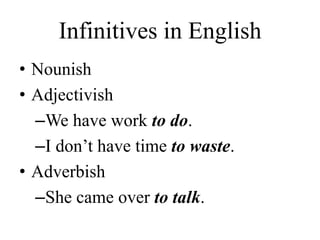
Infinitives in English
• Nounish
• Adjectivish
  –We have work to do.
  –I don’t have time to waste.
• Adverbish
  –She came over to talk.
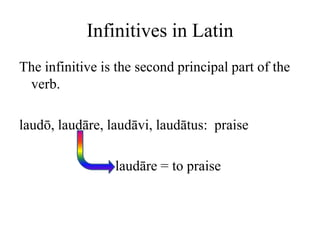
Infinitives in Latin
The infinitive is the second principal part of the
 verb.

laudō, laudāre, laudāvi, laudātus: praise

                 laudāre = to praise
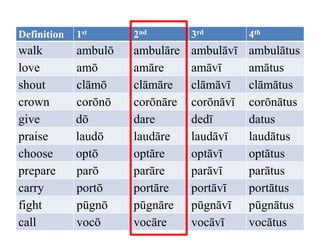
Definition   1st      2nd        3rd        4th
walk         ambulō   ambulāre   ambulāvī   ambulātus
love         amō      amāre      amāvī      amātus
shout        clāmō    clāmāre    clāmāvī    clāmātus
crown        corōnō   corōnāre   corōnāvī   corōnātus
give         dō       dare       dedī       datus
praise       laudō    laudāre    laudāvī    laudātus
choose       optō     optāre     optāvī     optātus
prepare      parō     parāre     parāvī     parātus
carry        portō    portāre    portāvī    portātus
fight        pūgnō    pūgnāre    pūgnāvī    pūgnātus
call         vocō     vocāre     vocāvī     vocātus
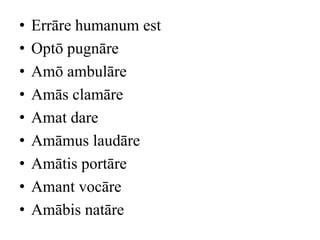
•   Errāre humanum est
•   Optō pugnāre
•   Amō ambulāre
•   Amās clamāre
•   Amat dare
•   Amāmus laudāre
•   Amātis portāre
•   Amant vocāre
•   Amābis natāre
Imperatives – The Official
       Mumbo Jumbo
One of three moods in Latin
• Indicative
  – Reality: statement of facts
• Subjunctive
  – Irreality: wish, possibility, opinion, etc
• Imperative
  – Command or Order
Imperatives – What You
    Need to Know

Command or Order
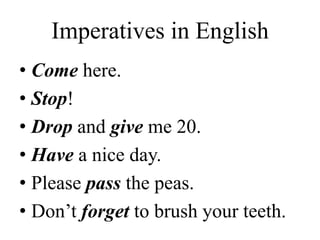
Imperatives in English
• Come here.
• Stop!
• Drop and give me 20.
• Have a nice day.
• Please pass the peas.
• Don’t forget to brush your teeth.
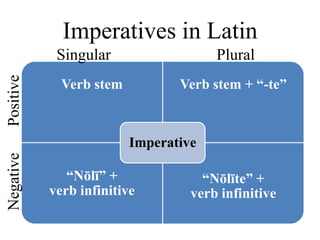
Imperatives in Latin
            Singular                  Plural
Positive


             Verb stem          Verb stem + “-te”


                         Imperative
Negative


              “Nōlī” +              “Nōlīte” +
           verb infinitive        verb infinitive
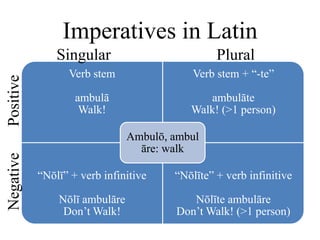
Imperatives in Latin
               Singular                         Plural
                 Verb stem                Verb stem + “-te”
Positive


                   ambulā                    ambulāte
                    Walk!                 Walk! (>1 person)

                               Ambulō, ambul
                                 āre: walk
Negative


           “Nōlī” + verb infinitive    “Nōlīte” + verb infinitive

               Nōlī ambulāre              Nōlīte ambulāre
                Don’t Walk!            Don’t Walk! (>1 person)
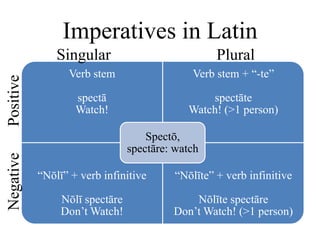
Imperatives in Latin
               Singular                            Plural
                 Verb stem                   Verb stem + “-te”
Positive


                   spectā                        spectāte
                   Watch!                    Watch! (>1 person)

                                    Spectō,
                                spectāre: watch
Negative


           “Nōlī” + verb infinitive       “Nōlīte” + verb infinitive

                Nōlī spectāre                Nōlīte spectāre
                Don’t Watch!             Don’t Watch! (>1 person)

Latin I lesson 11

  • 1.
    Latin 1 /Intro to Latin Infinitives and Imperatives
  • 2.
    Infinitives – TheOfficial Mumbo Jumbo A verb form • Not limited by a subject • Not fully inflected for tense, mood, number, gender, person • Can function somewhat as another part of speech
  • 3.
    Infinitives – WhatYou Need to Know “to” + definition of the verb
  • 4.
    Infinitives in English •Nounish –To err is human, to forgive divine. –I love to swim. –She was asked to speak. –He wants to learn to cook.
  • 5.
    Infinitives in English •Nounish • Adjectivish –We have work to do. –I don’t have time to waste. • Adverbish –She came over to talk.
  • 6.
    Infinitives in Latin Theinfinitive is the second principal part of the verb. laudō, laudāre, laudāvi, laudātus: praise laudāre = to praise
  • 7.
    Definition 1st 2nd 3rd 4th walk ambulō ambulāre ambulāvī ambulātus love amō amāre amāvī amātus shout clāmō clāmāre clāmāvī clāmātus crown corōnō corōnāre corōnāvī corōnātus give dō dare dedī datus praise laudō laudāre laudāvī laudātus choose optō optāre optāvī optātus prepare parō parāre parāvī parātus carry portō portāre portāvī portātus fight pūgnō pūgnāre pūgnāvī pūgnātus call vocō vocāre vocāvī vocātus
  • 8.
    Errāre humanum est • Optō pugnāre • Amō ambulāre • Amās clamāre • Amat dare • Amāmus laudāre • Amātis portāre • Amant vocāre • Amābis natāre
  • 9.
    Imperatives – TheOfficial Mumbo Jumbo One of three moods in Latin • Indicative – Reality: statement of facts • Subjunctive – Irreality: wish, possibility, opinion, etc • Imperative – Command or Order
  • 10.
    Imperatives – WhatYou Need to Know Command or Order
  • 11.
    Imperatives in English •Come here. • Stop! • Drop and give me 20. • Have a nice day. • Please pass the peas. • Don’t forget to brush your teeth.
  • 12.
    Imperatives in Latin Singular Plural Positive Verb stem Verb stem + “-te” Imperative Negative “Nōlī” + “Nōlīte” + verb infinitive verb infinitive
  • 13.
    Imperatives in Latin Singular Plural Verb stem Verb stem + “-te” Positive ambulā ambulāte Walk! Walk! (>1 person) Ambulō, ambul āre: walk Negative “Nōlī” + verb infinitive “Nōlīte” + verb infinitive Nōlī ambulāre Nōlīte ambulāre Don’t Walk! Don’t Walk! (>1 person)
  • 14.
    Imperatives in Latin Singular Plural Verb stem Verb stem + “-te” Positive spectā spectāte Watch! Watch! (>1 person) Spectō, spectāre: watch Negative “Nōlī” + verb infinitive “Nōlīte” + verb infinitive Nōlī spectāre Nōlīte spectāre Don’t Watch! Don’t Watch! (>1 person)