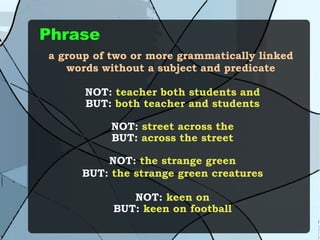
Phrase a group of two or more grammatically linked words without a subject and predicate NOT:  teacher both students and BUT:  both teacher and students NOT:  street across the BUT:  across the street NOT:  the strange green BUT:  the strange green creatures NOT:  keen on BUT:  keen on football
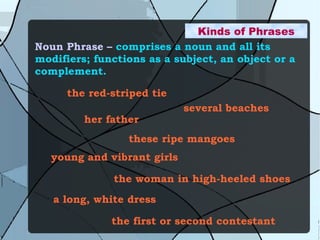
Kinds of Phrases Noun Phrase –   comprises a noun and all its modifiers; functions as a subject, an object or a complement. the red-striped tie several beaches these ripe mangoes young and vibrant girls the woman in high-heeled shoes a long, white dress her father the first or second contestant
Kinds of Phrases Verb Phrase –   comprises a main verb plus one or more helping verbs. has been broken was approved will have been joined  am learning can be returned have known could use might say
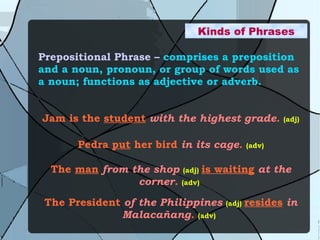
Kinds of Phrases Prepositional Phrase –   comprises a preposition and a noun, pronoun, or group of words used as a noun; functions as adjective or adverb. Jam is the  student   with the highest grade .  (adj) Pedra  put  her bird  in its cage .  (adv) The  man   from the shop   (adj)  is waiting   at the corner .  (adv) The President  of the Philippines  (adj)  resides   in Malacañang .  (adv)
Kinds of Phrases Adjective Phrase –   a phrase with an adjective as its head; expands noun phrases or completes the verbs (acts as the complement).  The fans  are   really enthusiastic .  (subjective complement; really-adv + enthusiastic-adj=adjectival phrase) The kids  are   keen on football .  (subjective complement; keen-adj + on football-prep phrase=adjectival phrase) The  unusually tall  (unusually-adv + tall-adj=adjectival phrase)  boy  could hardly bend.   The long and winding  (adjectival phrase)  road leads me to your door.
Kinds of Phrases Adverb Phrase –   a phrase with an adverb as its head; modifies a verb, an adjective or an adverb.  John  opened  the box  extremely easily .  (modifies the verb  opened ) The boys  will  do  the project  quite soon .  (modifies the verb  do ) Mr. Lee was  quite unexpectedly  kind .  (modifies the adjective  kind ) Ram came  very surprisingly  quickly .  (modifies the adverb  quickly )
Kinds of Phrases Appositive Phrase –   a phrase re-naming or amplifying a word that immediately precedes it.  My favorite uncle,  a fine chess player in his own right,  has won several national tournaments.  (noun phrase as appositive defining  uncle ) The best exercise,  walking briskly,  is also the cheapest.   (gerund phrase as appositive defining  exercise ) Jom's goal in life,  to become an astronaut,  is within his grasp this year, at last.   (infinitive phrase as appositive defining  goal )
Kinds of Phrases Absolute Phrase –   comprises a noun or a pronoun and a participle as well as any related modifiers modifying the whole sentence; is set off from the rest of the sentence with a comma or a pair of commas (sometimes by a dash or a pair of dashes). Their reputation as winners secured by victory,  the L.A. Lakers charged into the semifinals. [Having been] Stars all their adult lives,  Venus and Serena seemed used to the attention.   (When the participle of an absolute phrase is a form of  to be , such as  being  or  having been , the participle is often left out but understood.) Coach Cris Tiu strolled onto the court,  his arms akimbo and a large silver whistle clenched between his teeth  .   (descriptive prose describing the independent clause)
Kinds of Phrases Infinitive Phrase –   comprises of an infinitive—the root of the verb preceded by  to —and any modifiers or complements associated with it; acts as an adjective, an adverb, or a noun. Mrs. Smith's plan  to subsidize child care  won wide acceptance among urban politicians.   (adjective; modifies  plan ) Congress wanted  to raise taxes . (noun; object of the sentence) To watch the woman tell her  story   is an eye-opening experience.   (noun; subject of the sentence) To know her is  to love her .   (noun; predicate nominative) Jose went to college  to study veterinary medicine .   (adverb; tells why he  went  to college)
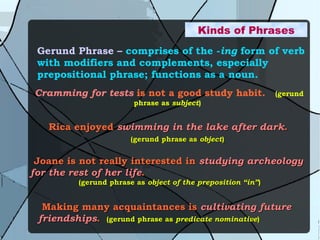
Kinds of Phrases Gerund Phrase –   comprises of the - ing  form of verb with modifiers and complements, especially prepositional phrase; functions as a noun. Cramming for tests  is not a good study habit.   (gerund phrase as  subject ) Rica enjoyed  swimming in the lake after dark .   (gerund phrase as  object ) Joane is not really interested in  studying archeology for the rest of her life .
(gerund phrase as  object of the preposition “in” ) Making many acquaintances is  cultivating future friendships .   (gerund phrase as  predicate nominative )

09 Phrases

  • 1.
    Phrase a groupof two or more grammatically linked words without a subject and predicate NOT: teacher both students and BUT: both teacher and students NOT: street across the BUT: across the street NOT: the strange green BUT: the strange green creatures NOT: keen on BUT: keen on football
  • 2.
    Kinds of PhrasesNoun Phrase – comprises a noun and all its modifiers; functions as a subject, an object or a complement. the red-striped tie several beaches these ripe mangoes young and vibrant girls the woman in high-heeled shoes a long, white dress her father the first or second contestant
  • 3.
    Kinds of PhrasesVerb Phrase – comprises a main verb plus one or more helping verbs. has been broken was approved will have been joined am learning can be returned have known could use might say
  • 4.
    Kinds of PhrasesPrepositional Phrase – comprises a preposition and a noun, pronoun, or group of words used as a noun; functions as adjective or adverb. Jam is the student with the highest grade . (adj) Pedra put her bird in its cage . (adv) The man from the shop (adj) is waiting at the corner . (adv) The President of the Philippines (adj) resides in Malacañang . (adv)
  • 5.
    Kinds of PhrasesAdjective Phrase – a phrase with an adjective as its head; expands noun phrases or completes the verbs (acts as the complement). The fans are really enthusiastic . (subjective complement; really-adv + enthusiastic-adj=adjectival phrase) The kids are keen on football . (subjective complement; keen-adj + on football-prep phrase=adjectival phrase) The unusually tall (unusually-adv + tall-adj=adjectival phrase) boy could hardly bend. The long and winding (adjectival phrase) road leads me to your door.
  • 6.
    Kinds of PhrasesAdverb Phrase – a phrase with an adverb as its head; modifies a verb, an adjective or an adverb. John opened the box extremely easily . (modifies the verb opened ) The boys will do the project quite soon . (modifies the verb do ) Mr. Lee was quite unexpectedly kind . (modifies the adjective kind ) Ram came very surprisingly quickly . (modifies the adverb quickly )
  • 7.
    Kinds of PhrasesAppositive Phrase – a phrase re-naming or amplifying a word that immediately precedes it. My favorite uncle, a fine chess player in his own right, has won several national tournaments. (noun phrase as appositive defining uncle ) The best exercise, walking briskly, is also the cheapest. (gerund phrase as appositive defining exercise ) Jom's goal in life, to become an astronaut, is within his grasp this year, at last. (infinitive phrase as appositive defining goal )
  • 8.
    Kinds of PhrasesAbsolute Phrase – comprises a noun or a pronoun and a participle as well as any related modifiers modifying the whole sentence; is set off from the rest of the sentence with a comma or a pair of commas (sometimes by a dash or a pair of dashes). Their reputation as winners secured by victory, the L.A. Lakers charged into the semifinals. [Having been] Stars all their adult lives, Venus and Serena seemed used to the attention. (When the participle of an absolute phrase is a form of to be , such as being or having been , the participle is often left out but understood.) Coach Cris Tiu strolled onto the court, his arms akimbo and a large silver whistle clenched between his teeth . (descriptive prose describing the independent clause)
  • 9.
    Kinds of PhrasesInfinitive Phrase – comprises of an infinitive—the root of the verb preceded by to —and any modifiers or complements associated with it; acts as an adjective, an adverb, or a noun. Mrs. Smith's plan to subsidize child care won wide acceptance among urban politicians. (adjective; modifies plan ) Congress wanted to raise taxes . (noun; object of the sentence) To watch the woman tell her story is an eye-opening experience. (noun; subject of the sentence) To know her is to love her . (noun; predicate nominative) Jose went to college to study veterinary medicine . (adverb; tells why he went to college)
  • 10.
    Kinds of PhrasesGerund Phrase – comprises of the - ing form of verb with modifiers and complements, especially prepositional phrase; functions as a noun. Cramming for tests is not a good study habit. (gerund phrase as subject ) Rica enjoyed swimming in the lake after dark . (gerund phrase as object ) Joane is not really interested in studying archeology for the rest of her life .
  • 11.
    (gerund phrase as object of the preposition “in” ) Making many acquaintances is cultivating future friendships . (gerund phrase as predicate nominative )