LIBRO DE
GRAMMAR
NICO PARBHOO
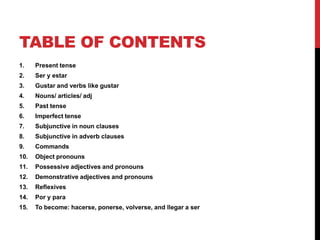
TABLE OF CONTENTS
1.    Present tense
2.    Ser y estar
3.    Gustar and verbs like gustar
4.    Nouns/ articles/ adj
5.    Past tense
6.    Imperfect tense
7.    Subjunctive in noun clauses
8.    Subjunctive in adverb clauses
9.    Commands
10.   Object pronouns
11.   Possessive adjectives and pronouns
12.   Demonstrative adjectives and pronouns
13.   Reflexives
14.   Por y para
15.   To become: hacerse, ponerse, volverse, and llegar a ser
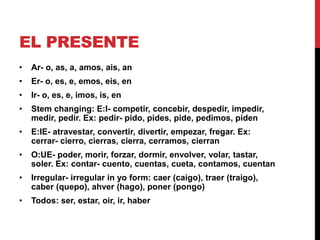
EL PRESENTE
•   Ar- o, as, a, amos, ais, an
•   Er- o, es, e, emos, eis, en
•   Ir- o, es, e, imos, is, en
•   Stem changing: E:I- competir, concebir, despedir, impedir,
    medir, pedir. Ex: pedir- pido, pides, pide, pedimos, piden
•   E:IE- atravestar, convertir, divertir, empezar, fregar. Ex:
    cerrar- cierro, cierras, cierra, cerramos, cierran
•   O:UE- poder, morir, forzar, dormir, envolver, volar, tastar,
    soler. Ex: contar- cuento, cuentas, cueta, contamos, cuentan
•   Irregular- irregular in yo form: caer (caigo), traer (traigo),
    caber (quepo), ahver (hago), poner (pongo)
•   Todos: ser, estar, oir, ir, haber
SER Y ESTAR
Both mean to be
Ser- permanent/ unchanging qualities, with adjectives to
describe expected qualities. Nationality/ place of origin,
profession, characteristics, generalizations, material of
composition, time, date, season, were or when an event takes
place
Ser- soy, eres, es, somos, sois, son
Estar- temporary or variable qualities, change in appearance
or condition, location or relationship, health, physical states,
emotional states, weather, ongoing actions, results of actions
Estar- estoy, estas, esta, estamos, estais, estana
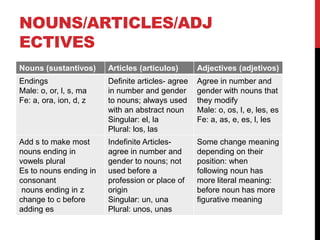
NOUNS/ARTICLES/ADJ
ECTIVES
Nouns (sustantivos)     Articles (articulos)       Adjectives (adjetivos)
Endings                 Definite articles- agree   Agree in number and
Male: o, or, l, s, ma   in number and gender       gender with nouns that
Fe: a, ora, ion, d, z   to nouns; always used      they modify
                        with an abstract noun      Male: o, os, l, e, les, es
                        Singular: el, la           Fe: a, as, e, es, l, les
                        Plural: los, las
Add s to make most      Indefinite Articles-       Some change meaning
nouns ending in         agree in number and        depending on their
vowels plural           gender to nouns; not       position: when
Es to nouns ending in   used before a              following noun has
consonant               profession or place of     more literal meaning:
 nouns ending in z      origin                     before noun has more
change to c before      Singular: un, una          figurative meaning
adding es               Plural: unos, unas
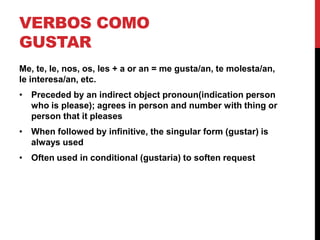
VERBOS COMO
GUSTAR
Me, te, le, nos, os, les + a or an = me gusta/an, te molesta/an,
le interesa/an, etc.
• Preceded by an indirect object pronoun(indication person
  who is please); agrees in person and number with thing or
  person that it pleases
• When followed by infinitive, the singular form (gustar) is
  always used
• Often used in conditional (gustaria) to soften request
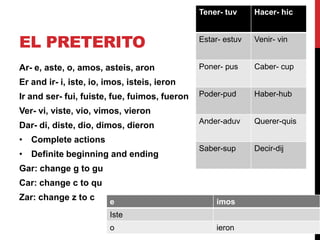
Tener- tuv     Hacer- hic


EL PRETERITO                                   Estar- estuv   Venir- vin


Ar- e, aste, o, amos, asteis, aron             Poner- pus     Caber- cup
Er and ir- i, iste, io, imos, isteis, ieron
Ir and ser- fui, fuiste, fue, fuimos, fueron   Poder-pud      Haber-hub

Ver- vi, viste, vio, vimos, vieron
                                               Ander-aduv     Querer-quis
Dar- di, diste, dio, dimos, dieron
• Complete actions
                                               Saber-sup      Decir-dij
• Definite beginning and ending
Gar: change g to gu
Car: change c to qu
Zar: change z to c      e                          imos
                        Iste
                        o                          ieron
EL IMPERFECTO
Ar- aba, abas, aba, abamos, abais, aban
Er/ir- ia, ias, ia, iamos, iais, ian
Ser- era, eras, era, eramos, erais, eran
Ver- veia, veias, veia, veiamos, veiais, veian
Ir- iba, ibas, iba, ibamos, ibais, iban
• Actions that are not yet completed
• No definite beginning or end
• Background information/ setting up a scene
• Time or appearance
• Doing and action before inerruption
SUBJUNCTIVE IN                             T            Tenga

NOUN CLAUSES                               V            venga


Formed by dropping o from yo form of present indicatives
and affing subjunctive endings. Main clause + connector +
subordinate clause
Ar: e,es,e,emos,en      Er/Ir- a,as,a,amos,an
Irregulars: dar (de), estar (este), ir (vaya), saber (sepa), haber
(haya), ser (sea)

D    De/diga                    W     Wishing/wanting

I    Vaya                       E     Emotions

S    Sea                        D     Doubt

H    Haga/haya                  D     Disbelief

E    Este                       I     Impersonal expressions

S    sepa                       N     Negation
                                G     God/greif
SUBJUNCTIVE IN
ADJECTIVE CLAUSES
• When subordinate clause refers to antecedent that is
  known to exist, the indicative is used. When the
  antecedent is uncertain or indefinite, the subjunctive is
  used
• The subjunctive is used in questions with adjective
  clauses when the speaker is trying to find information
  about which they are uncertain
• When the antecedent of an adjective clause is a negative
  pronouns, the subjunctive is used
• The personal a is maintained before nadie and alguien,
  even when their existence is uncertain
• The personal a is not used with direct objects tha
  represent hypothetical persons
COMMANDS
(MANDATOS)
Formal (ud. And uds.)-
•   Affirmative: put in yo form and change to opposite vowel
•   Negative: put in yo form and change to opposite vowel
•   Los irregulares: TVDISHES
Familiar (tu)-
•   Affirmative: put in tu form and drop the s. los irregulares: di, ahz, ve,
    pon, sal, se, ten, ven
•   Negative: put in yo form and change to opposite vowel, add an s
•   Los irregulares: TVDISHES
Nosotros-
•   Affirmative and negative: add emos(ar), amos(er)
•   Mono verbs
•   Ex:sentemosnos-> sentemonos
OBJECT PRONOUNS
Indirect object pronouns-
•   To whom or for whom
•   Precedes the verb (if verb is infinitive, may go attatched to the
    infinitive)
•   Me, te, le, nos, os, les
Direct Object Pronouns
•   Precedes the verb (if verb is infinitive, may go attached to the
    infintive)
•   Me, te, lo/la, nos, os, los/las
Double object pronoun
•   Indirect object pronoun precedes the direct object pronoun when
    they are used together in a sentence
•   Le and les change to se when they are used with lo, la, los, las
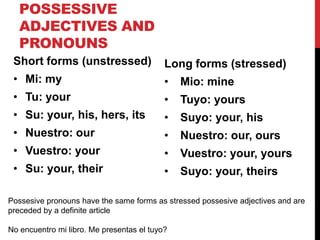
POSSESSIVE
   ADJECTIVES AND
   PRONOUNS
 Short forms (unstressed)                  Long forms (stressed)
 • Mi: my                                  •   Mio: mine
 • Tu: your                                •   Tuyo: yours
 • Su: your, his, hers, its                •   Suyo: your, his
 • Nuestro: our                            •   Nuestro: our, ours
 • Vuestro: your                           •   Vuestro: your, yours
 • Su: your, their                         •   Suyo: your, theirs

Possesive pronouns have the same forms as stressed possesive adjectives and are
preceded by a definite article

No encuentro mi libro. Me presentas el tuyo?
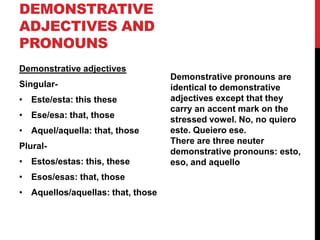
DEMONSTRATIVE
ADJECTIVES AND
PRONOUNS
Demonstrative adjectives
                                   Demonstrative pronouns are
Singular-                          identical to demonstrative
• Este/esta: this these            adjectives except that they
                                   carry an accent mark on the
• Ese/esa: that, those             stressed vowel. No, no quiero
• Aquel/aquella: that, those       este. Queiero ese.
                                   There are three neuter
Plural-
                                   demonstrative pronouns: esto,
• Estos/estas: this, these         eso, and aquello
• Esos/esas: that, those
• Aquellos/aquellas: that, those
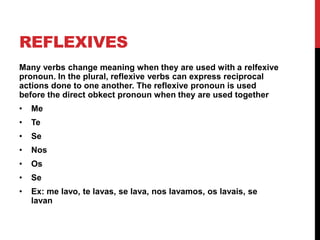
REFLEXIVES
Many verbs change meaning when they are used with a relfexive
pronoun. In the plural, reflexive verbs can express reciprocal
actions done to one another. The reflexive pronoun is used
before the direct obkect pronoun when they are used together
•   Me
•   Te
•   Se
•   Nos
•   Os
•   Se
•   Ex: me lavo, te lavas, se lava, nos lavamos, os lavais, se
    lavan
POR AND PARA
Por                       Para
• Motion or a general     • Destination
  location                • Deadline or specific
• Duration of an action     time in the future
• Reason or motive for    • Purpose or goal
  an action               • Recipient
• Objective of a search   • Comparision with others
• Means by which            or opinions
• Exchange or             • employment
  substitution
• Unit of measure
• Agent (passive)
TO BECOME
• Ponerser: ponerse+ (adj) expresses a change in mental,
  emotional, or physical state that is generally not long
  lasting
• Hacerse: hacerse can be followed by a noun or an
  adjective. It often implies a change that results from the
  subjects own efforts, such as changes in profession
• Volverse: volverse + (adj) expresses a radical, mental, or
  psychological change. It often conveys a gradual or
  irreversible change in character
• Llegar a ser: llegar a ser mau also be followed by a noun
  or an adjective. It indicates a change over time and does
  not imply the subject’s voluntary effort

Grammar book2

  • 1.
  • 2.
    TABLE OF CONTENTS 1. Present tense 2. Ser y estar 3. Gustar and verbs like gustar 4. Nouns/ articles/ adj 5. Past tense 6. Imperfect tense 7. Subjunctive in noun clauses 8. Subjunctive in adverb clauses 9. Commands 10. Object pronouns 11. Possessive adjectives and pronouns 12. Demonstrative adjectives and pronouns 13. Reflexives 14. Por y para 15. To become: hacerse, ponerse, volverse, and llegar a ser
  • 3.
    EL PRESENTE • Ar- o, as, a, amos, ais, an • Er- o, es, e, emos, eis, en • Ir- o, es, e, imos, is, en • Stem changing: E:I- competir, concebir, despedir, impedir, medir, pedir. Ex: pedir- pido, pides, pide, pedimos, piden • E:IE- atravestar, convertir, divertir, empezar, fregar. Ex: cerrar- cierro, cierras, cierra, cerramos, cierran • O:UE- poder, morir, forzar, dormir, envolver, volar, tastar, soler. Ex: contar- cuento, cuentas, cueta, contamos, cuentan • Irregular- irregular in yo form: caer (caigo), traer (traigo), caber (quepo), ahver (hago), poner (pongo) • Todos: ser, estar, oir, ir, haber
  • 4.
    SER Y ESTAR Bothmean to be Ser- permanent/ unchanging qualities, with adjectives to describe expected qualities. Nationality/ place of origin, profession, characteristics, generalizations, material of composition, time, date, season, were or when an event takes place Ser- soy, eres, es, somos, sois, son Estar- temporary or variable qualities, change in appearance or condition, location or relationship, health, physical states, emotional states, weather, ongoing actions, results of actions Estar- estoy, estas, esta, estamos, estais, estana
  • 5.
    NOUNS/ARTICLES/ADJ ECTIVES Nouns (sustantivos) Articles (articulos) Adjectives (adjetivos) Endings Definite articles- agree Agree in number and Male: o, or, l, s, ma in number and gender gender with nouns that Fe: a, ora, ion, d, z to nouns; always used they modify with an abstract noun Male: o, os, l, e, les, es Singular: el, la Fe: a, as, e, es, l, les Plural: los, las Add s to make most Indefinite Articles- Some change meaning nouns ending in agree in number and depending on their vowels plural gender to nouns; not position: when Es to nouns ending in used before a following noun has consonant profession or place of more literal meaning: nouns ending in z origin before noun has more change to c before Singular: un, una figurative meaning adding es Plural: unos, unas
  • 6.
    VERBOS COMO GUSTAR Me, te,le, nos, os, les + a or an = me gusta/an, te molesta/an, le interesa/an, etc. • Preceded by an indirect object pronoun(indication person who is please); agrees in person and number with thing or person that it pleases • When followed by infinitive, the singular form (gustar) is always used • Often used in conditional (gustaria) to soften request
  • 7.
    Tener- tuv Hacer- hic EL PRETERITO Estar- estuv Venir- vin Ar- e, aste, o, amos, asteis, aron Poner- pus Caber- cup Er and ir- i, iste, io, imos, isteis, ieron Ir and ser- fui, fuiste, fue, fuimos, fueron Poder-pud Haber-hub Ver- vi, viste, vio, vimos, vieron Ander-aduv Querer-quis Dar- di, diste, dio, dimos, dieron • Complete actions Saber-sup Decir-dij • Definite beginning and ending Gar: change g to gu Car: change c to qu Zar: change z to c e imos Iste o ieron
  • 8.
    EL IMPERFECTO Ar- aba,abas, aba, abamos, abais, aban Er/ir- ia, ias, ia, iamos, iais, ian Ser- era, eras, era, eramos, erais, eran Ver- veia, veias, veia, veiamos, veiais, veian Ir- iba, ibas, iba, ibamos, ibais, iban • Actions that are not yet completed • No definite beginning or end • Background information/ setting up a scene • Time or appearance • Doing and action before inerruption
  • 9.
    SUBJUNCTIVE IN T Tenga NOUN CLAUSES V venga Formed by dropping o from yo form of present indicatives and affing subjunctive endings. Main clause + connector + subordinate clause Ar: e,es,e,emos,en Er/Ir- a,as,a,amos,an Irregulars: dar (de), estar (este), ir (vaya), saber (sepa), haber (haya), ser (sea) D De/diga W Wishing/wanting I Vaya E Emotions S Sea D Doubt H Haga/haya D Disbelief E Este I Impersonal expressions S sepa N Negation G God/greif
  • 10.
    SUBJUNCTIVE IN ADJECTIVE CLAUSES •When subordinate clause refers to antecedent that is known to exist, the indicative is used. When the antecedent is uncertain or indefinite, the subjunctive is used • The subjunctive is used in questions with adjective clauses when the speaker is trying to find information about which they are uncertain • When the antecedent of an adjective clause is a negative pronouns, the subjunctive is used • The personal a is maintained before nadie and alguien, even when their existence is uncertain • The personal a is not used with direct objects tha represent hypothetical persons
  • 11.
    COMMANDS (MANDATOS) Formal (ud. Anduds.)- • Affirmative: put in yo form and change to opposite vowel • Negative: put in yo form and change to opposite vowel • Los irregulares: TVDISHES Familiar (tu)- • Affirmative: put in tu form and drop the s. los irregulares: di, ahz, ve, pon, sal, se, ten, ven • Negative: put in yo form and change to opposite vowel, add an s • Los irregulares: TVDISHES Nosotros- • Affirmative and negative: add emos(ar), amos(er) • Mono verbs • Ex:sentemosnos-> sentemonos
  • 12.
    OBJECT PRONOUNS Indirect objectpronouns- • To whom or for whom • Precedes the verb (if verb is infinitive, may go attatched to the infinitive) • Me, te, le, nos, os, les Direct Object Pronouns • Precedes the verb (if verb is infinitive, may go attached to the infintive) • Me, te, lo/la, nos, os, los/las Double object pronoun • Indirect object pronoun precedes the direct object pronoun when they are used together in a sentence • Le and les change to se when they are used with lo, la, los, las
  • 13.
    POSSESSIVE ADJECTIVES AND PRONOUNS Short forms (unstressed) Long forms (stressed) • Mi: my • Mio: mine • Tu: your • Tuyo: yours • Su: your, his, hers, its • Suyo: your, his • Nuestro: our • Nuestro: our, ours • Vuestro: your • Vuestro: your, yours • Su: your, their • Suyo: your, theirs Possesive pronouns have the same forms as stressed possesive adjectives and are preceded by a definite article No encuentro mi libro. Me presentas el tuyo?
  • 14.
    DEMONSTRATIVE ADJECTIVES AND PRONOUNS Demonstrative adjectives Demonstrative pronouns are Singular- identical to demonstrative • Este/esta: this these adjectives except that they carry an accent mark on the • Ese/esa: that, those stressed vowel. No, no quiero • Aquel/aquella: that, those este. Queiero ese. There are three neuter Plural- demonstrative pronouns: esto, • Estos/estas: this, these eso, and aquello • Esos/esas: that, those • Aquellos/aquellas: that, those
  • 15.
    REFLEXIVES Many verbs changemeaning when they are used with a relfexive pronoun. In the plural, reflexive verbs can express reciprocal actions done to one another. The reflexive pronoun is used before the direct obkect pronoun when they are used together • Me • Te • Se • Nos • Os • Se • Ex: me lavo, te lavas, se lava, nos lavamos, os lavais, se lavan
  • 16.
    POR AND PARA Por Para • Motion or a general • Destination location • Deadline or specific • Duration of an action time in the future • Reason or motive for • Purpose or goal an action • Recipient • Objective of a search • Comparision with others • Means by which or opinions • Exchange or • employment substitution • Unit of measure • Agent (passive)
  • 17.
    TO BECOME • Ponerser:ponerse+ (adj) expresses a change in mental, emotional, or physical state that is generally not long lasting • Hacerse: hacerse can be followed by a noun or an adjective. It often implies a change that results from the subjects own efforts, such as changes in profession • Volverse: volverse + (adj) expresses a radical, mental, or psychological change. It often conveys a gradual or irreversible change in character • Llegar a ser: llegar a ser mau also be followed by a noun or an adjective. It indicates a change over time and does not imply the subject’s voluntary effort