Page 110
Realidades 1


          Nouns
NOUNS
   Nouns refer to people,
    animals, places, and
    things.
NOUNS
   In Spanish, nouns have
    gender. They are either
    masculine or feminine.
Masculine / Feminine
   Most nouns that end in
    -o are masculine.
Masculine / Feminine
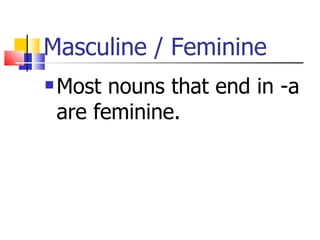
   Most nouns that end in -a
    are feminine.
Masculine / Feminine
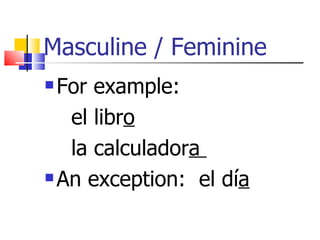
 For example:
   el libro
   la calculadora
 An exception: el día
Other Spanish Nouns
   Other Spanish nouns end
    in -e or a consonant.
Other Spanish Nouns
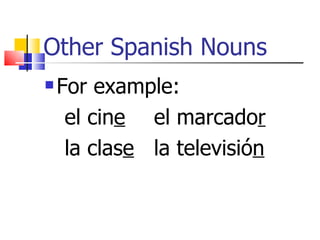
   For example:
     el cine el marcador
     la clase la televisión
Other Spanish Nouns
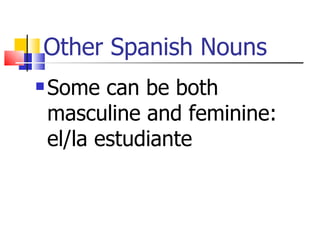
   Some can be both
    masculine and feminine:
    el/la estudiante
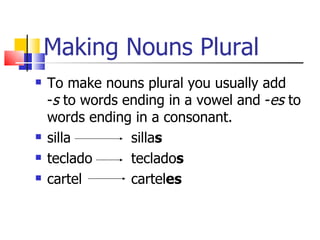
Making Nouns Plural
   To make nouns plural you usually add
    -s to words ending in a vowel and -es to
    words ending in a consonant.
   silla        sillas
   teclado      teclados
   cartel       carteles
Making Nouns Plural
   Singular nouns that end in z change the
    z to c in the plural.
   El lápiz       los lápices
Definite Articles
 El , La , Los and Las are
  called definite articles.
 In English they mean

  “the”
Definite Articles
   We use El and Los with
    masculine nouns and La
    and Las with feminine
    nouns.
Indefinite Articles
   Un, Una, Unos, and Unas
    are indefinite articles.
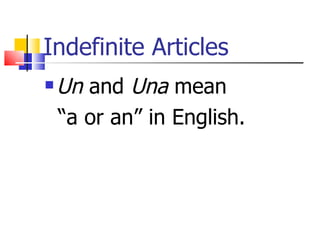
Indefinite Articles
   Un and Una mean
    “a or an” in English.
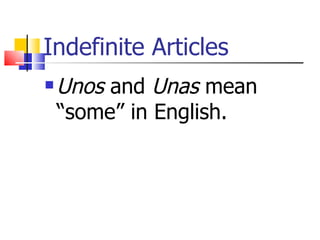
Indefinite Articles
   Unos and Unas mean
    “some” in English.
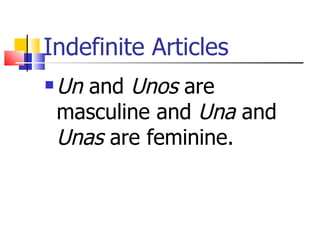
Indefinite Articles
   Un and Unos are
    masculine and Una and
    Unas are feminine.
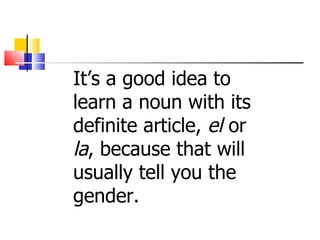
It’s a good idea to
learn a noun with its
definite article, el or
la, because that will
usually tell you the
gender.

TEMA 2B GRAMMAR NOUNS